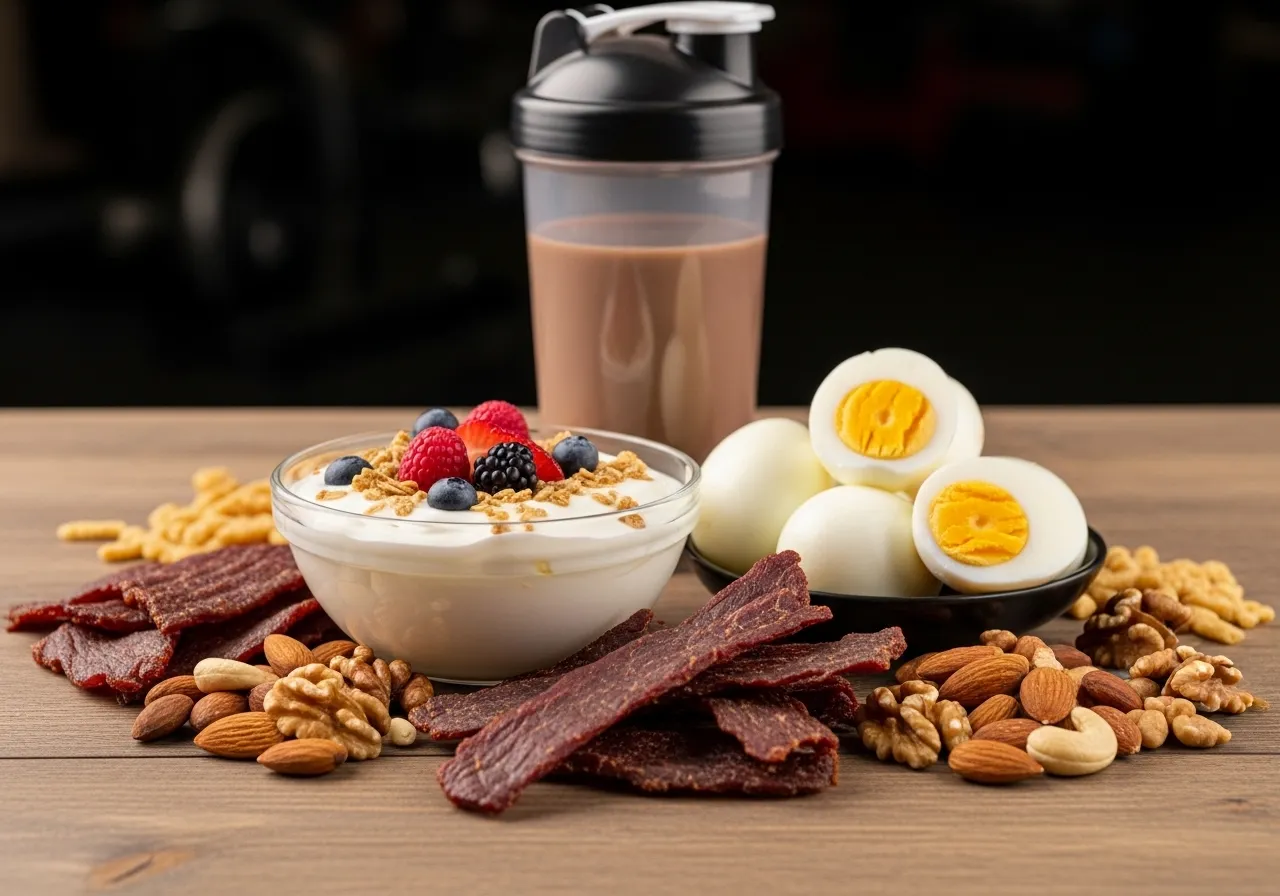
1. Why Smart Snacking Supports Muscle Growth
The relationship between snacking behavior and muscle building outcomes operates through several interconnected mechanisms that go beyond the simple arithmetic of adding protein grams to a daily total. Understanding these mechanisms clarifies why the specific timing, composition, and frequency of protein snacks matters for muscle building outcomes rather than simply whether a daily protein target is nominally achieved.
1-1. Protein Distribution and Muscle Protein Synthesis Frequency
Muscle protein synthesis (MPS) is not a continuous process — it is a discrete, stimulus-dependent response that is activated by adequate leucine availability in the bloodstream and persists for 2 to 4 hours before returning to baseline through a negative feedback mechanism called the muscle full effect. Each activation event represents a window of elevated protein synthesis that accumulates structural and contractile proteins within muscle fibers; the more activation events per day, the greater the total cumulative MPS across a 24-hour period, and the greater the net protein accretion that accumulates as muscle mass over weeks and months of consistent training and nutrition. Research by Areta and colleagues comparing protein distribution strategies found that consuming protein in four equal doses across the day produced significantly greater MPS stimulation than consuming the same total protein in two large doses or in eight very small doses — confirming that distribution frequency, not just total intake, meaningfully affects muscle building outcomes.
Strategic protein snacking is the practical mechanism that makes four to five daily MPS-stimulating protein doses achievable for people whose meal schedules do not naturally support this frequency. Most people eat two to three main meals per day — breakfast, lunch, and dinner — leaving gaps of 4 to 6 hours between meals during which circulating amino acid levels decline, MPS rates drop to basal levels, and the muscle full refractory period from the previous meal ends without a subsequent leucine stimulus to initiate a new synthesis cycle. A protein snack consumed in the mid-morning and the mid-afternoon — timed to coincide with the end of the refractory period from the preceding meal — initiates two additional MPS activation events per day beyond those generated by the three main meals, potentially doubling the number of anabolic stimulation windows from three to five across the waking day.
1-2. Appetite Regulation and Dietary Adherence
Protein is the most satiating macronutrient per calorie — it produces the greatest and most sustained suppression of the hunger hormone ghrelin and the greatest elevation of satiety hormones including peptide YY, GLP-1, and cholecystokinin of any macronutrient at equivalent caloric doses. High-protein snacks consumed at strategic intervals throughout the day maintain satiety more effectively than carbohydrate-dominant snacks of equivalent caloric content, reducing the likelihood of overeating at subsequent main meals, preventing the intense hunger that drives impulsive high-calorie food choices when meals are spaced too far apart, and making caloric targets easier to maintain consistently.
For trainees in a caloric surplus attempting to build muscle, the appetite-suppressing effect of protein snacks prevents the excessive overeating that produces unwanted fat gain alongside muscle development — keeping the surplus moderate and body composition trajectory favorable even in a gaining phase. For trainees in a caloric deficit attempting to lose fat while preserving muscle, high-protein snacks are even more important: they provide the muscle-preserving amino acid availability that prevents catabolism during the caloric restriction, while their superior satiety per calorie makes the deficit more psychologically manageable without the persistent hunger that lower-protein deficit diets notoriously generate. In both contexts, smart protein snacking is a dietary adherence tool as much as a nutritional optimization strategy.
1-3. Blood Glucose Stability and Energy Levels
The carbohydrate-dominant snacking pattern that most people default to — crackers, fruit juice, candy, chips, granola bars — produces a characteristic blood glucose roller coaster: a rapid spike from the simple carbohydrates, a proportionally large insulin response, and a subsequent blood glucose decline that leaves energy lower 60 to 90 minutes after the snack than it was before eating. This energy trough drives the next snacking episode, creating a cycle of reactive eating that is driven by blood glucose fluctuations rather than genuine caloric need or nutritional strategy. High-protein snacks break this cycle: the protein component moderates carbohydrate absorption rate (when paired with carbohydrate), blunts the insulin response, and extends the duration of stable blood glucose, producing a steady energy state that lasts 2 to 3 hours rather than the 60 to 90-minute cycle of the pure carbohydrate snack.
The practical consequence for training is that strategic protein snacking between meals produces more stable energy throughout the day — including in the hours leading up to training — and reduces the mid-afternoon energy slump that many people experience on carbohydrate-dominant diets. Replacing the 3 PM vending machine run for a high-carbohydrate snack with a high-protein option produces a measurable difference in energy and alertness for the remainder of the afternoon and into the early evening training session, translating directly into more productive and better-focused training performance without any caloric increase and often with a caloric reduction relative to the replaced carbohydrate-dominant snack.
1-4. Muscle Preservation During Caloric Restriction
During a caloric deficit, the body is at elevated risk of catabolizing muscle protein as an energy source in addition to the fat oxidation that the deficit is intended to produce. The rate of muscle protein catabolism during a deficit is determined partly by the overall protein intake and partly by how evenly that protein is distributed across the day — with even distribution producing less muscle catabolism than the same total protein concentrated in fewer, larger meals. High-protein snacks serve a muscle preservation function during dieting phases by maintaining circulating amino acid levels between main meals, providing the metabolic signal that adequate protein is available and reducing the need for the body to draw on muscle protein stores to meet amino acid demands between meals.
Research specifically examining protein distribution strategies during caloric restriction finds that individuals who distribute protein across five to six eating occasions per day, including two to three protein-containing snacks, preserve significantly more lean body mass during an equivalent caloric deficit and equivalent total protein intake than individuals who concentrate the same protein in three main meals. This lean mass preservation advantage compounds over weeks and months of dieting, producing a body composition outcome — more fat lost, more muscle preserved — that is meaningfully superior to less distributed protein intake strategies delivering the same daily protein total. For anyone using a caloric deficit to improve body composition while maintaining or building the muscle developed through resistance training, strategic protein snacking is not optional optimization but a core lean mass preservation mechanism.
1-5. The Cost of Mindless Snacking
Understanding why strategic protein snacking benefits muscle building also requires understanding the cost of its alternative: the mindless, reactive, carbohydrate-dominant snacking that most people engage in without deliberate nutritional consideration. The average commercial snack food — crackers, chips, cookies, granola bars, candy — provides 100 to 250 calories per serving with 1 to 5 grams of protein and 15 to 35 grams of carbohydrate or fat, contributing meaningfully to total daily caloric intake without providing any of the protein distribution, MPS activation, or satiety benefits that high-protein snacking delivers. A person who replaces two daily mindless snacks with two high-protein alternatives of equivalent caloric content increases their daily protein by 20 to 40 grams, adds two additional MPS stimulation events, improves mid-day satiety, and stabilizes energy without any net change in daily caloric intake — a straightforward caloric-neutral trade with substantial body composition and performance benefits that requires only the intention and information to make different snack choices.
| Benefit | Mechanism | Practical Impact |
|---|---|---|
| Increased MPS frequency | Leucine stimulus between meals | More synthesis events per day |
| Better satiety and adherence | Protein hormone response | Less overeating at main meals |
| Stable blood glucose/energy | Moderated carbohydrate absorption | Better training-time energy |
| Muscle preservation in deficit | Amino acid availability between meals | More fat lost, less muscle catabolized |
1-6. The Compound Effect of Consistent Protein Snacking Over Time
The benefits of strategic protein snacking are not dramatic in any single day — adding two protein snacks per day increases MPS frequency by two events, adds perhaps 40 grams of protein to the daily total, and modestly improves afternoon energy and satiety. The significance of these daily marginal improvements lies entirely in their compounding effect over weeks and months of consistent practice. Two additional MPS activation events per day represent 14 additional synthesis cycles per week, approximately 60 per month, and over 700 per year — each representing a period during which muscle protein accretion exceeds breakdown, contributing incrementally to the cumulative lean mass gains that distinguish consistent athletes from those whose results plateau despite continued training effort. The protein distribution advantages of regular snacking — maintaining amino acid availability throughout the day rather than in peaks around main meals — similarly compound over time, producing meaningfully better body composition trajectories over six to twelve months than identical total protein intake concentrated in fewer daily eating occasions.
Building the protein snacking habit — establishing the routine, identifying the specific foods and preparation approaches that work reliably in your specific daily environments, and making the habit automatic rather than effortfully deliberate — is therefore one of the highest-leverage nutrition investments available to any resistance-trained person seeking to maximize the muscle-building return on their training effort. The habit itself costs relatively little in time, money, or cognitive effort once established, and it delivers measurable improvements in protein distribution quality, MPS frequency, and dietary adherence that accumulate into substantial results over the training timescales — months to years — that meaningful physique development requires.
2. The Protein-Per-Calorie Ratio: What to Look For
Choosing high-protein snacks requires a clear evaluation framework that goes beyond simply reading the protein grams on a nutrition label. The protein-per-calorie ratio — how much protein a snack delivers relative to its total caloric contribution — is the most practically useful single metric for assessing snack quality from a muscle-building perspective, but it must be considered alongside protein quality, digestibility, palatability, and practical accessibility to produce a genuinely useful decision-making framework.
2-1. Understanding Protein-Per-Calorie Efficiency
The protein-per-calorie ratio is calculated by dividing grams of protein by total calories and expressing the result as a percentage. A food that provides 25 grams of protein and 150 calories has a protein-per-calorie ratio of approximately 67 percent of calories from protein — an exceptionally high ratio that represents one of the most protein-efficient foods available. By comparison, a granola bar providing 5 grams of protein and 200 calories delivers only 10 percent of calories from protein — adequate by general dietary standards but nutritionally inefficient for the specific purpose of hitting protein targets within caloric constraints. The practical utility of thinking in protein-per-calorie terms is that it makes caloric trade-offs visible: choosing the higher-ratio option allows a person to add more protein to their day within a fixed caloric budget, which is particularly valuable during a caloric deficit where every calorie needs to be maximally productive.
Foods with the highest protein-per-calorie ratios are almost exclusively lean animal proteins and their minimally processed derivatives: canned tuna (approximately 90 percent of calories from protein), cooked egg whites (85 percent), non-fat Greek yogurt (65 to 70 percent), low-fat cottage cheese (55 to 65 percent), cooked chicken breast (80 percent), and whey protein isolate (approximately 90 percent of calories from protein). The highest-ratio plant proteins — edamame at roughly 35 to 40 percent of calories from protein, and pea protein powder at 80 to 85 percent — are considerably lower-ratio than their animal protein counterparts because most whole plant protein sources contain significant carbohydrate and sometimes fat alongside their protein content. For omnivores, building protein snacks around lean animal protein sources provides the most protein-per-calorie-efficient foundation, supplemented by plant proteins for dietary variety and micronutrient breadth.
2-2. Protein Quality Beyond the Label
Not all protein grams on a nutrition label contribute equally to muscle protein synthesis. Protein quality — determined by amino acid profile completeness and digestibility — determines what fraction of consumed protein grams are effectively utilized for MPS versus oxidized for energy or used in other metabolic pathways. The most commonly used protein quality metric is the Digestible Indispensable Amino Acid Score (DIAAS), which accounts for both the essential amino acid composition and the digestibility coefficient of a protein source. Animal proteins consistently achieve DIAAS scores of 1.0 or above, indicating complete essential amino acid profiles with high digestibility. Most plant proteins score below 1.0, with the notable exception of soy protein.
For practical snack selection, protein quality primarily matters in two contexts: when total protein intake is near the minimum threshold (where maximizing the utilizable fraction of each gram matters most), and when plant-based protein sources constitute the majority of daily intake (where amino acid completeness requires deliberate attention to source combination). For most omnivores eating a varied diet with multiple animal protein sources, protein quality differences between common snack foods are less practically significant than the total protein quantity, and choosing snacks primarily based on total protein content and caloric efficiency is a reasonable simplification. For plant-based eaters, specifically choosing soy-based snack options (edamame, tofu-based products, soy yogurt) or combining complementary plant protein sources ensures adequate leucine and essential amino acid delivery from snacks.
2-3. Reading Nutrition Labels Effectively
Evaluating commercial protein snacks from their nutrition labels requires looking beyond the prominent front-of-package protein claim — which is often presented misleadingly to suggest higher protein density than the product actually provides — to the actual nutrition facts panel. The key figures to check are: total calories per serving, grams of protein per serving, serving size relative to the realistic consumption amount, and the ingredient list for the primary protein sources. A snack boasting “10 grams of protein” prominently on the front may deliver that protein in a 300-calorie serving of a product whose primary caloric contributions come from sugar and fat — perfectly acceptable for general dietary purposes but not representative of the efficient protein delivery that genuine muscle-building snacking requires.
The target profile for a high-protein muscle-building snack on a nutrition label: at minimum 15 grams of protein per reasonable serving, a protein-to-calorie ratio of at least 30 percent of calories from protein, minimal added sugars (under 5 grams per serving ideally), and a first or second ingredient that is a named protein source rather than a sugar, oil, or flour. Products meeting these criteria are genuinely high-protein options; products that fall below these thresholds are merely protein-containing options — a meaningful distinction for someone trying to build muscle through targeted nutritional strategy rather than simply adding modest protein amounts to a otherwise unchanged dietary pattern.
2-4. The Role of Satiety and Total Caloric Impact
Protein-per-calorie efficiency is the primary snack quality metric, but it must be balanced against the practical reality that snacks also need to satisfy genuine hunger — eating a technically protein-efficient snack that leaves you hungrier than before eating it undermines the dietary adherence goals that strategic snacking is supposed to support. The most protein-efficient foods are not always the most satiating: plain cooked egg whites have an exceptional protein-to-calorie ratio but minimal fat and no fiber, making them less filling per calorie than cottage cheese or Greek yogurt which have slightly lower protein ratios but produce greater satiety through their casein protein content and dairy fat. The ideal high-protein snack for muscle building therefore balances three criteria simultaneously: high protein-per-calorie ratio, adequate absolute protein content to stimulate MPS (minimum 20 to 25 grams for most adults), and sufficient satiety effect to prevent excess hunger driving overeating at the next meal.
2-5. Cost Per Gram of Protein: The Budget Dimension
For people who snack strategically across multiple daily occasions, the cost per gram of protein delivered becomes a practically significant factor — particularly when comparing commercial protein-enhanced products (bars, shakes, pouches) to basic whole food alternatives. The cost per gram of protein varies enormously across categories: canned tuna typically delivers protein at approximately $0.02 to $0.04 per gram, making it one of the most cost-efficient complete protein sources available in any form; cottage cheese and Greek yogurt deliver protein at approximately $0.03 to $0.06 per gram when purchased in large containers; hard-boiled eggs provide protein at $0.03 to $0.05 per gram. Commercial protein bars and ready-to-drink protein shakes, by contrast, typically deliver protein at $0.10 to $0.30 per gram — three to ten times the cost of whole food equivalents for identical or lower protein quality.
The cost differential does not make commercial protein products illegitimate — their convenience value in contexts where whole food preparation is impossible justifies the premium for many people. But the assumption that commercial products are necessary for high-protein snacking — an assumption that protein supplement marketing successfully creates in many consumers — is simply not supported by the economics. Two cans of tuna, a large tub of Greek yogurt, and a dozen eggs provide several days of high-protein snacking at a fraction of the cost of an equivalent number of commercial protein bars, with equivalent or superior protein quality and significantly better overall nutritional profiles from the whole food micronutrient content that processed snack products cannot match.
| Food | Protein per serving | Calories | % Calories from Protein | Cost/g Protein |
|---|---|---|---|---|
| Canned tuna (100g drained) | ~25g | ~110 | ~91% | Very low |
| Non-fat Greek yogurt (200g) | ~20g | ~120 | ~67% | Low |
| Cottage cheese (200g low-fat) | ~24g | ~160 | ~60% | Low |
| Hard-boiled eggs (2 large) | ~13g | ~140 | ~37% | Very low |
| Edamame (150g shelled) | ~18g | ~180 | ~40% | Low-moderate |
| Commercial protein bar (avg) | ~20g | ~220 | ~36% | High |
2-6. Building Your Personal Protein Snack Framework
The protein-per-calorie framework, protein quality considerations, label-reading skills, satiety assessment, and cost analysis described above combine into a practical personal decision-making system for evaluating any high-protein snack option you encounter. The most practically valuable output of this framework is not a ranked list of specific snacks — which will change as new products enter the market, as your dietary preferences evolve, and as your daily schedule and food access change — but the analytical capability to evaluate any snack option quickly and accurately against your specific muscle-building protein requirements. A person who has internalized the protein-per-calorie framework can assess a new protein product in under 60 seconds by checking total protein, total calories, ingredient quality, and cost per gram of protein — producing a rapid yes/no decision that is grounded in the same principles that distinguish genuinely beneficial protein snacks from marketing-driven products that merely appear protein-forward while delivering mediocre actual nutritional value.
The goal is not finding the single perfect protein snack and consuming it exclusively — which produces variety fatigue that undermines long-term habit consistency — but building a personal portfolio of three to six high-quality protein snack options that rotate across the week, providing the variety needed for sustainable daily practice while all meeting the minimum quality standards the framework identifies. This portfolio approach — choosing variety within quality standards rather than optimizing for a single best option — is the nutritional habit design principle that produces durable daily practice rather than short-term compliance followed by abandonment when any single option becomes monotonous or unavailable.
3. Top 10 High Protein Snacks Ranked and Reviewed
The following ten snacks are ranked based on a composite assessment of protein content per serving, protein quality (amino acid completeness and digestibility), protein-per-calorie efficiency, practical convenience, digestive tolerance, cost, and palatability across repeated consumption. Each snack is reviewed across these dimensions to help you determine which options best fit your specific muscle-building goals, dietary preferences, and daily logistics.
3-1. Rank 1–3: The Elite Protein Snacks
1. Greek Yogurt (Non-Fat or Low-Fat, Plain) earns the top ranking based on its exceptional combination of protein quantity, quality, convenience, versatility, and cost. A 200-gram serving of non-fat Greek yogurt provides 18 to 22 grams of high-quality complete protein — a mixture of approximately 80 percent casein and 20 percent whey, providing both the rapid MPS-stimulating effect of whey and the sustained amino acid release of casein. The casein-dominant profile makes Greek yogurt particularly valuable as an afternoon or pre-sleep snack, providing amino acids that are released gradually over 2 to 4 hours rather than the rapid peak and quick clearance of pure whey protein. Greek yogurt is available in virtually every supermarket, convenience store, and many coffee shops; requires no preparation; pairs well with fruit, nuts, granola, or honey for flavor variety; and costs approximately $0.03 to $0.05 per gram of protein from large format containers — making it among the most economical high-protein snack options available as a daily staple.
2. Cottage Cheese (Low-Fat) ranks second based on its outstanding protein content — 24 to 28 grams per 200-gram serving — predominantly casein protein, exceptional protein-per-calorie ratio of 55 to 65 percent, and very low cost. Cottage cheese is the gold-standard pre-sleep protein snack due to its near-exclusively casein protein profile, which produces the most sustained overnight amino acid release of any commonly available food protein. Its mild flavor makes it adaptable to both sweet preparations (with fruit and honey) and savory ones (with cucumber, tomatoes, herbs, and cracked pepper), reducing the variety fatigue risk that plagues less versatile protein foods when consumed repeatedly. The primary limitation of cottage cheese relative to Greek yogurt is its less universally appealing texture — the curdy consistency that some people find unpalatable, which is easily addressed by blending it smooth for use in sauces, dips, or smoothie applications where the texture is not perceptible.
3. Hard-Boiled Eggs rank third based on their exceptional protein quality (eggs have the highest biological value of any common food protein), complete essential amino acid profile, unique micronutrient density (B vitamins, fat-soluble vitamins A, D, E, and K, choline, selenium, lutein), minimal preparation requirement (batch-boiling 12 eggs takes 12 minutes of unattended stovetop time; they keep for 7 days unpeeled in the refrigerator), and universal portability. Two hard-boiled eggs provide approximately 13 grams of complete protein and 140 calories, giving a moderate protein-per-calorie ratio of 37 percent — lower than the top two snacks but accompanied by a micronutrient profile that makes eggs one of the most nutritionally comprehensive single-food snacks available. The practical limitation is the sulfurous odor of peeled hard-boiled eggs, which can be socially inconvenient in office or commuting environments — a minor logistical consideration that pre-peeling and storing in a sealed container partially mitigates.
3-2. Rank 4–7: Excellent Everyday Options
4. Canned Tuna or Salmon ranks fourth based on its virtually unmatched protein-per-calorie ratio and protein content: 25 grams of complete protein per 100-gram serving at approximately 110 to 120 calories — over 90 percent of calories from protein, making it the most calorie-efficient whole-food protein source available in any snack category. Canned fish also provides excellent omega-3 fatty acid content (particularly salmon), vitamin D, B12, and iodine that are difficult to obtain from other snack foods. The practical limitations of canned fish as a snack are real: the smell creates social awkwardness in shared spaces, the preparation requires a can opener and a bowl or plate, and eating cold tuna from a can is less appealing than most other snack options listed here. These limitations relegate it to contexts where private eating space is available rather than truly universal daily snacking use, but within those contexts it is arguably the highest-quality protein snack available per dollar spent.
5. Edamame (Steamed or Microwaved) ranks fifth as the best plant-based whole food snack on this list, providing 18 grams of complete soy protein per 150-gram shelled serving alongside 8 grams of fiber, iron, folate, and a distinctive umami flavor that makes it genuinely satisfying as a standalone snack. Edamame is available frozen in most supermarkets and microwaves from frozen to ready-to-eat in 3 to 4 minutes, making it among the fastest hot protein snacks available. The convenience of individual-serving frozen bags has expanded edamame’s practical accessibility as a daily snack option, and its complete amino acid profile — unique among plant foods as a single-source complete protein — makes it the most functionally equivalent plant-based alternative to animal protein snacks for muscle-building purposes.
6. Beef or Turkey Jerky ranks sixth as the most portable and shelf-stable high-protein snack in the category, providing approximately 10 to 14 grams of protein per 30-gram serving in a format that requires no refrigeration, no preparation, and no utensils. Quality jerky from lean beef or turkey with minimal added sugar provides complete animal protein with excellent digestibility; the primary nutritional concern with commercial jerky is its high sodium content (typically 500 to 800 mg per serving), which is relevant for those managing sodium intake but is not a meaningful concern for most active athletes whose sweat losses during training create an ongoing sodium demand that often exceeds normal dietary intake. Look for jerky with minimal added sugar (under 2 grams per serving) and lean meat as the primary ingredient to maximize protein-per-calorie efficiency and minimize the refined carbohydrate content that some commercial jerkies include as flavoring agents.
7. Protein Bars (High-Quality) rank seventh — lower than most people would expect given the protein bar industry’s marketing — because commercial protein bars are genuinely useful convenience tools but rarely match the protein efficiency, nutritional quality, or cost-effectiveness of the whole food options ranked above them. A quality protein bar providing 20 to 25 grams of protein with minimal added sugars (under 5 grams), high-quality protein sources (whey, casein, or soy as primary ingredients), and moderate total calories (200 to 250) is a legitimate and practical high-protein snack for contexts where whole foods are not accessible. The extensive variation in quality between commercial protein bar products makes the category highly heterogeneous — the best options are genuinely protein-efficient, but many products marketed as protein bars provide protein at the same ratio as a granola bar while charging a significant premium for the protein-food branding.
3-3. Rank 8–10: Solid Supporting Options
8. Ricotta Cheese (Low-Fat) ranks eighth as an underutilized high-protein dairy snack that provides approximately 14 grams of protein per 100-gram serving with a mild, creamy flavor that pairs naturally with both sweet and savory applications. Low-fat ricotta can be used as a high-protein toast spread, mixed with fruit for a sweet snack, or used as a dip base for vegetables — a versatility that makes it a valuable rotation option for people experiencing variety fatigue with Greek yogurt and cottage cheese. Its protein is primarily whey-dominant, providing a different absorption profile from the casein-heavy cottage cheese and Greek yogurt that anchor most high-protein snack routines.
9. Roasted Chickpeas rank ninth as the best plant-based crunchy snack option, providing approximately 7 grams of protein per 30-gram serving alongside 5 grams of fiber and a satisfying crunch that addresses the textural variety need that soft, creamy protein foods cannot meet. Roasted chickpeas are increasingly available commercially in well-seasoned varieties, or can be prepared at home by roasting canned chickpeas at 200°C for 25 to 30 minutes after drying and seasoning. Their protein content per serving is moderate rather than high, making them best used as a protein-boosting addition to an otherwise protein-centered snack rather than as a standalone protein source — mixing roasted chickpeas into a Greek yogurt snack, for example, adds both crunch and protein while improving the satiety and micronutrient profile of the combined snack.
10. String Cheese or Individual Cheese Portions rank tenth as the most universally convenient packaged protein snack available in virtually every retail environment. A single stick of string cheese provides approximately 7 to 8 grams of protein from complete dairy protein alongside calcium and fat-soluble vitamins, in a form that requires no preparation, no refrigeration for short periods, and no utensils. While the protein content per piece is lower than the top-ranked options and the fat content is relatively high for its protein contribution (a ratio closer to 40 to 45 percent of calories from fat), string cheese’s absolute convenience and universal availability make it the most reliable emergency protein snack for situations where no other options are available — a vending machine, an airport shop, or a convenience store where nutritional options are otherwise limited.
| Rank | Snack | Protein/Serving | Best Use Case | Key Advantage |
|---|---|---|---|---|
| 1 | Greek yogurt (200g non-fat) | 18–22g | Daily staple, pre-sleep | Best all-round option |
| 2 | Cottage cheese (200g low-fat) | 24–28g | Pre-sleep, high protein need | Highest protein per serving |
| 3 | Hard-boiled eggs (2) | ~13g | Portable, meal prep | Best protein quality/micronutrients |
| 4 | Canned tuna (100g) | ~25g | Private eating space | Best protein-per-calorie ratio |
| 5 | Edamame (150g shelled) | ~18g | Plant-based primary option | Only complete plant protein snack |
| 6 | Beef/turkey jerky (30g) | 10–14g | Travel, no refrigeration | Most portable, shelf-stable |
| 7 | Quality protein bar | 20–25g | Convenience on the go | No prep, widely available |
| 8 | Ricotta (100g low-fat) | ~14g | Variety rotation | Versatile, mild flavor |
| 9 | Roasted chickpeas (30g) | ~7g | Crunchy addition to snack | Best plant-based crunchy option |
| 10 | String cheese (1 stick) | 7–8g | Emergency portable option | Universal availability |
4. Store-Bought vs. Homemade: Which Is Better
The choice between commercial store-bought protein snacks and homemade preparations is not a binary good-versus-bad determination — it is a context-dependent trade-off that involves convenience, cost, nutritional quality, ingredient control, and practical sustainability as a daily habit. Understanding the genuine strengths and limitations of each approach allows for intelligent category-specific decisions rather than a blanket preference that may be suboptimal across the diverse snacking contexts that a typical day presents.
4-1. The Case for Store-Bought Protein Snacks
Commercial protein snacks offer a convenience value that is genuinely irreplaceable in the specific contexts where they excel. The ability to purchase a protein bar, a Greek yogurt pouch, or a container of cottage cheese at a petrol station, airport shop, or supermarket without any preparation or equipment is the defining advantage that whole-food homemade preparations cannot match. For working professionals, frequent travelers, parents with unpredictable schedules, or anyone whose day consistently includes periods where kitchen access is impossible for hours at a time, commercial protein snacks are the difference between hitting protein targets on those days and missing them entirely. The convenience justification for commercial snacks is strongest in three specific scenarios: when traveling away from home for more than one day, when working in environments with no food preparation facilities and limited healthy food options, and when schedule compression on specific days eliminates the time that homemade snack preparation requires.
The best commercial protein options — plain Greek yogurt, cottage cheese, canned fish, jerky with minimal additives, and genuinely high-protein bars with quality protein sources and minimal added sugars — are not nutritionally inferior to homemade equivalents and sometimes exceed what most people would practically prepare at home. Commercial Greek yogurt and cottage cheese are the same product as their homemade equivalents (they cannot meaningfully be homemade in any practical sense); commercial jerky of quality brands uses the same lean protein sources as homemade jerky with less preparation time investment; and quality protein bars, while more expensive than homemade alternatives, provide equivalent protein delivery with comparable digestibility from similar protein sources. For these options, the store-bought versus homemade distinction is essentially a convenience and cost comparison rather than a quality comparison.
4-2. The Limitations of Commercial Protein Snacks
Commercial protein snacks have several consistent limitations that homemade alternatives address more effectively. Cost is the most significant: commercial protein bars typically cost $2 to $4 per bar delivering 20 to 25 grams of protein, representing $0.10 to $0.20 per gram of protein — three to eight times the cost of equivalent protein from whole food sources. For someone consuming two protein snacks per day, seven days per week, this cost differential represents $20 to $50 per week spent on commercial products versus $5 to $12 for equivalent homemade preparations — a difference of $800 to $2,000 per year that accumulates to meaningful financial significance over months and years of consistent snacking.
Ingredient quality and additives represent the second significant limitation of commercial protein snacks. Many commercial protein bars and snack products contain substantial amounts of added sugars, sugar alcohols (which cause gastrointestinal distress in some people in the quantities found in commercial bars), artificial flavors, artificial sweeteners, cheap protein sources (collagen protein, which provides negligible MPS benefit despite contributing to total protein on the label), and fillers that inflate product volume without nutritional contribution. Reading ingredient lists carefully — rather than only the prominent front-panel protein claim — reveals that many products marketed as high-protein snacks are nutritionally mediocre despite their protein-forward branding, with ingredient lists that a homemade equivalent would never require.
4-3. The Case for Homemade Protein Snacks
Homemade protein snacks offer superior control over ingredient quality, macronutrient ratios, flavor customization, and cost — advantages that compound meaningfully over months of consistent snacking. A homemade protein snack batch prepared on Sunday — a dozen hard-boiled eggs, a batch of protein energy balls, a container of mixed Greek yogurt parfaits, or a week’s supply of seasoned cottage cheese with vegetables — provides 5 to 7 days of ready-to-eat high-protein snacks at a fraction of the commercial equivalent cost, with ingredient lists consisting entirely of recognizable whole food components rather than the processing aids, stabilizers, and artificial ingredients that commercial products contain.
The time investment for homemade snack preparation is frequently overstated as an objection to this approach. Hard-boiling 12 eggs takes 12 minutes of essentially unattended time; preparing a batch of 12 protein energy balls takes 15 to 20 minutes of active preparation. These time investments produce five to seven days of ready-to-eat snacks from a single preparation session — amortized across the week, the per-serving preparation time is 2 to 3 minutes, comparable to opening a commercial package and far less time than the commute to a shop to purchase one. Batch-preparing protein snacks alongside weekly meal prep eliminates the marginal time cost entirely, since the kitchen is already active and the incremental preparation time adds only 15 to 20 minutes to an already-scheduled cooking session.
4-4. Optimal Strategy: Hybrid Approach by Context
The most practical and sustainable approach for most people is a hybrid strategy that leverages the genuine advantages of each category for its appropriate context. Homemade preparations — hard-boiled eggs, Greek yogurt parfaits, protein energy balls, cottage cheese preparations — serve as the primary snacks for the majority of days spent in environments with refrigerator access and predictable schedules. Commercial products — protein bars, individually packaged yogurt pouches, single-serving cottage cheese cups, quality jerky — serve as the backup and travel-day options when homemade snacks are not accessible. This hybrid approach maximizes cost efficiency and nutritional quality on the days when preparation is feasible while preserving the convenience safety net of commercial products for the unpredictable days when the prepared snacks are unavailable or have been consumed.
4-5. Evaluating Commercial Protein Products: A Practical Checklist
When purchasing commercial protein snacks, the following checklist separates genuinely high-protein options from products that use protein-forward marketing to sell nutritionally mediocre products at premium prices. Criterion one: at least 15 grams of protein per serving, with a protein-per-calorie ratio of 30 percent or higher. Criterion two: the first or second ingredient is a named high-quality protein source — whey protein isolate, whey protein concentrate, casein, milk protein, chicken, tuna, soy protein isolate, or pea protein isolate — not a flour, sugar, oil, or collagen peptide. Criterion three: added sugar under 5 grams per serving, as higher added sugar content reduces the protein-per-calorie ratio and creates glycemic responses incompatible with stable energy management. Criterion four: no significant sugar alcohol content (over 5 grams of erythritol, maltitol, or xylitol per serving), which can cause gastrointestinal distress at the quantities present in many commercial protein bars and significantly impairs digestive comfort during training if snacks are consumed within 2 to 3 hours of exercise.
| Category | Best For | Key Advantage | Main Limitation |
|---|---|---|---|
| Store-bought (whole food) | Daily use, home/office | Convenience, consistent quality | Cost (commercial bars) |
| Store-bought (bars/shakes) | Travel, no food access | Portability, no prep | Cost, additives, lower quality |
| Homemade batch prep | Routine weekly snacking | Cost, ingredient control, quality | Requires prep time + refrigeration |
| Hybrid approach | Most practical scenario | Best of both categories | Requires planning for transitions |
4-5. Making the Decision: A Week-by-Week Implementation Plan
Deciding between store-bought and homemade protein snacks is most productively approached as a weekly planning exercise rather than a permanent categorical commitment. Each Sunday — or on whatever day weekly meal prep occurs — review the coming week’s schedule: which days involve travel, which have reliable home access and meal prep time, which are unpredictable, and which have specific high-protein requirements such as multiple training days where recovery nutrition is elevated. Based on this review, prepare the homemade protein snacks that serve the predictable, refrigerator-accessible days, and purchase or pre-stock the commercial snacks that serve the travel or schedule-disrupted days. This weekly contextual planning approach avoids both the over-reliance on expensive commercial products during days when homemade options would be perfectly accessible, and the over-commitment to homemade prep that fails when schedule disruptions make preparation impossible and no backup commercial option has been purchased.
Implementing this planning approach for three to four consecutive weeks produces a realistic picture of which days in your typical weekly cycle reliably support homemade snack preparation and which consistently require commercial backup — information that can be used to set a stable, accurate weekly shopping and preparation routine that reliably provides the right type of snack for each day without requiring fresh planning judgment each week. After this initial assessment period, the store-bought versus homemade decision becomes largely automatic — a built-in routine component rather than a deliberate weekly decision, which is the hallmark of a genuinely sustainable nutritional habit rather than a practiced dietary discipline that requires ongoing conscious effort to maintain. The store-bought versus homemade question, approached as a weekly contextual judgment rather than a fixed categorical policy, becomes one of the most consistently well-executed nutrition decisions in your weekly routine — matching the practical reality of each day’s food access conditions with the snack category that best serves that reality, producing a reliable protein snacking system that performs consistently across the full spectrum of daily circumstances rather than only under ideal conditions where every variable is favorable and controlled, making it a genuinely resilient nutrition system rather than a fragile protocol that works only when life cooperates perfectly.
5. When to Eat Protein Snacks for Maximum Benefit
Protein snack timing is not about rigid schedules or minute-precision optimization — it is about identifying the specific daily moments when a protein snack delivers maximum physiological and practical benefit and structuring snack habits around those moments consistently. The five key timing windows for protein snacks each address a specific nutritional challenge or opportunity that occurs at predictable points in the day for most people with regular training schedules.
5-1. Mid-Morning (Between Breakfast and Lunch)
The mid-morning period — approximately 2 to 3 hours after breakfast — represents the first MPS refractory period endpoint of the day for most people. After the MPS stimulation event generated by breakfast (assuming breakfast contains adequate protein to reach the leucine threshold), the muscle full negative feedback mechanism returns MPS to baseline within 2 to 3 hours. At this point, a protein snack containing 20 to 25 grams of complete protein initiates a new MPS activation cycle, adding a synthesis event that would not otherwise occur during the 4 to 6 hour gap between breakfast and lunch in a typical three-meal-per-day eating pattern. This mid-morning protein snack also stabilizes blood glucose across the late morning — the period when many people experience the attention and energy decline associated with falling blood glucose — improving focus and productivity in the hours before lunch and preventing the excessive hunger that drives overeating at the subsequent meal.
The ideal mid-morning protein snack is portable, requires no heating or preparation at the point of consumption, is suitable for consumption in an office or workplace environment, and provides 20 to 25 grams of protein without excessive total calories that would impair appetite for the upcoming lunch. Greek yogurt meets all these criteria and is the default recommendation for the mid-morning window; cottage cheese, hard-boiled eggs (in an odor-tolerant setting), or a quality protein bar serve as alternatives for variety rotation or when refrigerator access is unavailable. Scheduling this snack as a deliberate calendar item — treating it as an appointment like any other midday commitment — increases the consistency of consumption compared to relying on hunger as the trigger, because midmorning hunger is often suppressed in working environments where focus demands occupy cognitive attention that might otherwise notice a mild hunger signal.
5-2. Pre-Workout (1–2 Hours Before Training)
The pre-workout window is addressed in detail in the pre-workout nutrition guide, but from a snack-specific perspective, a protein-containing snack consumed 60 to 90 minutes before training serves the dual purpose of elevating circulating amino acid levels to reduce training-induced muscle protein catabolism and providing a small carbohydrate component for blood glucose and glycogen support during the session. The pre-workout protein snack is most important for trainees who cannot schedule a complete pre-workout meal — those who train in the early morning before full breakfast capacity is achieved, those whose lunch-to-training gap is shorter than ideal, or those who train immediately after work when afternoon hunger has been managed by snacking rather than a substantial meal. For these trainees, a Greek yogurt with fruit, a cottage cheese with a banana, or a protein shake with a piece of fruit serves as both the pre-workout protein source and the pre-workout carbohydrate source in a single, convenient preparation.
5-3. Post-Workout (Within 60–90 Minutes)
Post-workout is the most widely recognized protein timing window, and it remains important — not because the post-workout window is as narrow as originally believed (research has revised the urgency from 30 to 60 minutes to a more relaxed 2 to 3 hour window), but because the post-workout period represents the highest MPS rate of the day and the greatest responsiveness to protein feeding. Consuming a protein snack within 60 to 90 minutes of training provides amino acids during the period when the mTORC1 signaling pathway is most sensitized to leucine stimulation, producing a larger MPS response per gram of protein than the same amount consumed at other times. A post-workout protein snack of 25 to 35 grams — a serving of Greek yogurt with fruit, a protein shake, cottage cheese with carbohydrate, or hard-boiled eggs alongside rice cakes — initiates the protein synthesis phase of the recovery process more promptly than waiting for the next main meal, particularly when that meal is more than 2 hours after training.
5-4. Mid-Afternoon (Between Lunch and Dinner)
The mid-afternoon protein snack mirrors the function of the mid-morning snack: bridging the 4 to 6 hour gap between lunch and dinner with a protein-containing eating occasion that adds another MPS activation event, stabilizes blood glucose across the afternoon energy trough (the 2 to 4 PM period when circadian rhythm and post-lunch glucose dynamics combine to produce the characteristic afternoon slump), and prevents the extreme pre-dinner hunger that drives overeating when dinner is the first significant eating occasion after a 5 to 6 hour gap from lunch. For trainees who work through the afternoon and eat dinner after 6 to 7 PM, the mid-afternoon protein snack is particularly important for maintaining both protein distribution targets and the blood glucose stability that supports productive work performance through the late afternoon hours.
The mid-afternoon snack should be smaller in total calories than the mid-morning version — approximately 150 to 200 calories and 15 to 20 grams of protein — to preserve appetite for the upcoming dinner rather than suppressing it to the point where a nutritionally adequate dinner becomes difficult to consume. A small serving of cottage cheese with vegetables, a single hard-boiled egg with a piece of fruit, or 100 grams of Greek yogurt with a handful of nuts meets these criteria without the caloric load that would undermine dinner appetite and total daily caloric management.
5-5. Pre-Sleep (30–60 Minutes Before Bed)
The pre-sleep protein snack is the most physiologically specific timing window of the five, targeting the unique opportunity that the overnight recovery period represents for cumulative MPS support. Research by van Loon’s group at Maastricht University demonstrated that consuming 40 grams of casein protein before sleep significantly increased overnight MPS rates and produced greater muscle mass and strength gains over 12 weeks of resistance training compared to a placebo — a finding replicated across multiple subsequent studies. The mechanism is casein’s slow-digesting property: it forms a gel in the stomach’s acidic environment and releases amino acids gradually over 5 to 7 hours, providing amino acid availability throughout the sleep cycle rather than the rapid peak and quick clearance of fast-digesting proteins.
The ideal pre-sleep protein snack is casein-dominant, moderate in total calories (200 to 300 calories), and low in simple carbohydrates that could raise insulin at bedtime and potentially interfere with growth hormone release during deep sleep. The most practical whole-food casein sources for a pre-sleep snack are cottage cheese (24 to 28 grams of nearly pure casein protein per 200-gram serving) and Greek yogurt (18 to 22 grams, predominantly casein). A 200-gram serving of cottage cheese with a small amount of berries or a drizzle of honey, or an equivalent serving of plain Greek yogurt with similar accompaniments, provides the casein dose that research associates with enhanced overnight recovery while fitting naturally into the end-of-day eating routine without creating excessive caloric intake or disrupting sleep quality through digestive discomfort.
| Timing Window | Primary Benefit | Protein Target | Best Snack Option |
|---|---|---|---|
| Mid-morning (2–3h after breakfast) | Additional MPS event; blood glucose stability | 20–25g | Greek yogurt, cottage cheese |
| Pre-workout (60–90 min before) | Reduce catabolism; pre-session amino acids | 20–30g | Yogurt + fruit, protein shake + fruit |
| Post-workout (within 60–90 min) | Peak MPS response window | 25–35g | Greek yogurt, shake, cottage cheese |
| Mid-afternoon (2–3h after lunch) | Additional MPS event; afternoon energy | 15–20g | Cottage cheese, hard-boiled egg + fruit |
| Pre-sleep (30–60 min before bed) | Overnight MPS support via casein | 30–40g | Cottage cheese, Greek yogurt |
5-6. Integrating Timing Into Your Overall Daily Nutrition Plan
Protein snack timing works most effectively when integrated into an overall daily nutrition architecture that maps every eating occasion — main meals and snacks — to specific time slots and protein targets, creating a complete daily protein delivery schedule rather than a set of isolated individual decisions. The process of building this architecture takes approximately 15 minutes of planning at the beginning of a consistent snacking routine: identify the five to six daily eating occasions that are realistic given your schedule, assign a protein target to each based on the total daily target divided appropriately across the eating frequency, and identify the specific foods that will provide each target. Once this architecture is established, the snack timing question reduces to execution rather than decision-making — each snack occasion has a pre-assigned time, protein target, and food option, requiring only the habit of consuming the pre-designated snack at the pre-designated time rather than making a fresh food choice at each occasion.
The architecture should accommodate the reality that not every day is identical — travel days, social days, and high-training-volume days all create different nutritional contexts that modify the optimal protein timing and quantity for each eating occasion. Building simple adjustment rules into the architecture for these non-standard days — if traveling, substitute commercial options for homemade; if social lunch replaces the main meal, ensure the mid-afternoon snack compensates with a higher protein target; if two-a-day training creates elevated protein need, increase both the post-first-workout and post-second-workout snack protein targets — creates a robust daily framework that functions reliably across the full spectrum of daily circumstances rather than only on the ideal structured training days where following a predetermined schedule is straightforward.
6. Quick High-Protein Snack Recipes You Can Make in 5 Minutes
The most common barrier to consistent high-protein snacking is the perception that preparing quality protein snacks requires significant cooking time and culinary skill. The five recipes below require under 5 minutes of active preparation time, use ingredients available in any supermarket, require no cooking skill beyond basic assembly, and each provide at least 20 grams of protein per serving. All are suitable for batch preparation — making multiple servings simultaneously — which reduces the per-serving time investment further when incorporated into a weekly meal prep routine.
6-1. Cottage Cheese Power Bowl (2 minutes)
Combine 200 grams of low-fat cottage cheese with half a cup of mixed berries (fresh or thawed frozen), a drizzle of honey, and a tablespoon of ground flaxseed or chia seeds. Stir gently to combine and eat immediately, or store covered in the refrigerator for up to 24 hours. Protein content: approximately 26 grams from the cottage cheese, with additional trace protein from the seeds. Total calories: approximately 220 to 250. This combination provides fast-releasing protein alongside antioxidant-dense berries for micronutrient breadth, omega-3 fatty acids from the flaxseed for inflammation modulation, and a natural sweetness from the honey and berries that makes it feel genuinely satisfying rather than medicinally functional. The simplicity of the preparation — literally stirring four ingredients together in a bowl — makes it repeatable with zero skill requirement, and the flavor can be varied infinitely by rotating fruit type (diced mango, sliced peach, banana, apple), seed type (hemp seeds, sunflower seeds), and sweetener (maple syrup, agave, cinnamon) to prevent the variety fatigue that undermines snack habit consistency over weeks and months of daily consumption.
6-2. Tuna and Avocado Rice Cakes (3 minutes)
Drain a 100-gram can of tuna. Mash a quarter of a ripe avocado with a squeeze of lemon juice and a pinch of salt. Spread the avocado mash across two to three rice cakes, top with the tuna, and finish with a crack of black pepper and optional hot sauce. Protein content: approximately 27 to 28 grams (25 grams from tuna, 2 to 3 grams from rice cakes and avocado). Total calories: approximately 250 to 280. This preparation delivers an exceptional protein-to-calorie ratio alongside the healthy monounsaturated fats of avocado for sustained satiety, the digestively gentle carbohydrate base of rice cakes for pre- or post-workout energy support, and the practical advantage of using pantry and refrigerator staples that most people already have on hand. The total active preparation time including opening the can, mashing the avocado, and assembling the rice cakes is under 3 minutes with no cooking equipment required beyond a fork, making it one of the fastest genuinely satisfying protein snacks achievable from whole food components.
6-3. Greek Yogurt Protein Parfait (3 minutes)
Layer 200 grams of plain non-fat Greek yogurt with half a cup of granola (choose a variety with under 8 grams of added sugar per serving), half a sliced banana, and a tablespoon of natural nut butter drizzled on top. No mixing required beyond spooning the components into layers in a bowl or jar. Protein content: approximately 20 to 22 grams from the yogurt, plus 3 to 5 grams from the granola and nut butter, totaling 23 to 27 grams per serving. Total calories: approximately 380 to 420 — higher than the previous two recipes due to the granola and nut butter, making this the most calorie-substantial of the five recipes and best suited as a post-workout or morning snack when a higher caloric contribution is appropriate and desired. The layered format and flavor variety of this preparation make it one of the most enjoyable daily protein snacks — the combination of creamy yogurt, crunchy granola, sweet banana, and rich nut butter creates the textural and flavor complexity that prevents the monotony that simpler preparations produce when consumed daily without variation.
6-4. Spiced Edamame with Chili and Lime (4 minutes)
Microwave 150 grams of frozen shelled edamame for 3 to 4 minutes until heated through. Drain any water, then toss immediately with a squeeze of fresh lime juice, a pinch of sea salt, a pinch of chili flakes or cayenne, and optional garlic powder. Eat warm directly from the bowl. Protein content: approximately 18 grams complete soy protein. Total calories: approximately 180 to 200. This preparation addresses the specific need for a hot, savory, genuinely satisfying protein snack that requires no refrigeration at the point of consumption and provides a snack experience that feels substantive and meal-adjacent rather than merely functional — the warm temperature, the spice, and the chew of edamame creating a sensory experience that cold dairy-based snacks cannot replicate. The seasoning combination — lime, salt, chili — can be varied to create entirely different flavor profiles from the same base ingredient: a sesame-soy preparation using soy sauce and sesame oil, a simple garlic and herb preparation, or a smoky preparation using smoked paprika and cumin, providing effectively limitless flavor rotation from a single whole food protein base.
6-5. Savory Cottage Cheese Dip with Vegetables (4 minutes)
Blend 200 grams of low-fat cottage cheese in a small blender or food processor for 30 seconds until completely smooth. Season with garlic powder, onion powder, dried herbs (dill, chives, or Italian seasoning), a pinch of salt, and black pepper. Transfer to a bowl and serve alongside sliced cucumber, celery, bell pepper strips, and cherry tomatoes for dipping. Protein content: approximately 26 grams from the cottage cheese, plus trace protein from the vegetables, totaling approximately 27 to 28 grams per serving. Total calories: approximately 190 to 210 including the vegetables — an exceptionally efficient caloric profile for the protein and micronutrient content delivered. The blending step transforms cottage cheese’s polarizing curdy texture into a completely smooth, cream-cheese-like consistency that is universally palatable and versatile enough to serve as a dip, spread, or sauce base — dramatically expanding the practical usage occasions for cottage cheese beyond those accessible with its unblended texture. This recipe is particularly effective as a batch preparation item: a blended batch of seasoned cottage cheese stored in a sealed container in the refrigerator keeps for 5 to 6 days and provides a ready-to-use high-protein dip for the entire week with zero additional preparation time required at any subsequent serving.
| Recipe | Active Prep Time | Protein | Calories | Best Timing |
|---|---|---|---|---|
| Cottage Cheese Power Bowl | 2 min | ~26g | 220–250 | Pre-sleep, mid-afternoon |
| Tuna & Avocado Rice Cakes | 3 min | ~27g | 250–280 | Post-workout, mid-morning |
| Greek Yogurt Parfait | 3 min | ~25g | 380–420 | Post-workout, morning |
| Spiced Edamame | 4 min | ~18g | 180–200 | Mid-afternoon, pre-workout |
| Cottage Cheese Dip + Veg | 4 min | ~28g | 190–210 | Any window, batch-prep |
6-6. Scaling Recipes and Batch Preparation for the Full Week
Every recipe in this section becomes dramatically more time-efficient when scaled to batch quantities prepared once for the full week. The cottage cheese power bowl can be prepared in five individual jars simultaneously in under 10 minutes — a 2-minute recipe prepared as five portions in 10 minutes, amortizing the preparation time to 2 minutes per serving. The savory cottage cheese dip, once blended, stores in a sealed container for the full week with no quality degradation, providing ready-to-use dip for every workday from a single 4-minute preparation. Greek yogurt parfaits can be pre-assembled in sealed containers with the granola stored separately to prevent soggling, providing five mornings of snacks from a single 10-minute preparation session. The batch preparation approach is the single most impactful upgrade to any protein snacking system — it converts five separate 3 to 4-minute daily preparation sessions into one 10 to 15-minute weekly preparation, eliminates the daily decision-making friction that causes snack skipping on busy days, and ensures that the highest-quality whole food protein snacks are available every day of the week regardless of how compressed and unpredictable the daily schedule becomes.
Integrating protein snack batch preparation into the existing weekly meal prep session — which most consistent meal-preppers already schedule — adds only 15 to 20 minutes of incremental kitchen time to a session that is already active and organized, making the marginal time cost essentially negligible relative to the week-long benefit of having ready-to-eat high-protein snacks available for every eating occasion. The recommended sequence is to prepare protein snacks at the end of the main meal prep session, using the lingering kitchen organization and the residual motivation of a productive preparation session to complete the snack preparation as the natural conclusion of the weekly nutrition preparation investment. This sequencing approach — snack prep as the final item in an already-scheduled meal prep session rather than as a separate standalone activity — is the practical habit design principle that makes consistent weekly batch protein snack preparation achievable without requiring additional scheduled time or supplementary motivational effort. The five recipes above are starting points, not a fixed menu — replacing ingredients with nutritionally equivalent alternatives, adjusting seasonings, and exploring new flavor combinations while maintaining the core protein-dense food base produces an ever-evolving personal recipe rotation that sustains genuine enjoyment of high-protein snacking indefinitely, which is the ultimate prerequisite for the long-term consistency that makes any nutritional habit actually produce the body composition results it is theoretically capable of delivering when practiced with genuine consistency across the full duration of a meaningful training program.
7. How to Snack Smart While Traveling or Commuting
Maintaining high-protein snacking habits during travel and commuting is the most practically challenging scenario for consistent protein nutrition — and simultaneously one of the highest-leverage scenarios for improving total daily protein intake, because travel and commuting days are precisely when people most commonly fall back on carbohydrate-dominant convenience foods and fail to hit protein targets. Developing a robust travel and commute snacking strategy that works reliably in variable environments with limited food access is a meaningful investment in nutritional consistency.
7-1. Planning Ahead: The Foundation of Travel Snacking
The single most effective strategy for maintaining high-protein snacking during travel is preparing or purchasing protein snacks before departing rather than attempting to find adequate options at airports, motorway services, railway station cafés, or hotel convenience shops once the journey has begun. These environments are systematically optimized for the sale of high-margin, shelf-stable, predominantly carbohydrate-based snack foods — crisps, chocolate bars, pastries, biscuits — and the high-protein whole food options that would otherwise constitute the preferred snacking choice are either unavailable or available only in protein-light versions (yogurt snacks with 5 grams of protein, “protein bars” that deliver 10 grams at 250 calories) at substantial price premiums.
A travel snack preparation checklist for any journey longer than four hours: pack two to three primary protein snack options from the list in section three that are suitable for the specific journey conditions — non-refrigerated options for air or road travel where refrigeration is unavailable, refrigerated options in an insulated bag with ice pack for shorter journeys or car travel. Likely reliable pack options include: quality beef or turkey jerky (shelf-stable, excellent protein density, variety of flavors available), individual bags of mixed nuts and seeds (provides protein alongside healthy fats; 30g mixed nuts provides approximately 5 to 7 grams of protein), protein bars from a verified quality brand (as emergency backup when whole food options are exhausted), roasted chickpeas (portable, shelf-stable, provides fiber alongside protein), and hard-boiled eggs in a sealed container (acceptable in car travel; socially problematic on public transport due to odor).
7-2. Airport and Air Travel Strategy
Airports contain more high-protein food options than most travelers exploit, primarily because the effort of finding them requires navigating past the prominent, highly visible processed food outlets that occupy the most trafficked airport zones. Most mid-to-large airports contain at least one or two food retailers that offer Greek yogurt parfaits, hard-boiled egg snack packs, protein boxes (deli meat, cheese, and crackers combinations), sushi rolls with fish, or similar genuinely protein-substantial options alongside the ubiquitous pastry and coffee retailers that constitute the most visible airport food landscape. The strategy for maximizing protein snacking in airports is to identify and walk past the first several visible food outlets — which are disproportionately pastry and coffee shops — to find the supermarket-style food outlet, the deli counter, or the full-service café that offers the protein-dense options. Most airports have at least one such option; finding it requires only the intention to look past the first food outlet encountered.
On the flight itself, the primary protein strategy is relying on pre-packed snacks rather than aircraft catering, which is almost uniformly low in protein and high in refined carbohydrates across all airline seat classes. A protein bar or two packed in carry-on luggage, alongside a small bag of jerky or nuts, ensures protein availability during the flight without depending on the airline to provide nutritionally appropriate options. For long-haul flights of 8 hours or more, a more substantial carry-on protein supply — three to four protein-containing items totaling 60 to 80 grams of protein for the journey — ensures that the most protein-nutritionally challenging travel scenario does not produce a multi-hour protein desert that impacts recovery from training both before and after the journey.
7-3. Car and Road Trip Protein Strategy
Road travel offers more protein snacking flexibility than air travel because temperature control (car air conditioning), insulated bags and coolers, and the ability to stop at supermarkets rather than motorway service stations make refrigerated whole food options continuously viable throughout the journey. A small insulated bag with a frozen gel pack maintains refrigerated temperatures for 8 to 12 hours in most conditions — sufficient for all but the longest road journeys — enabling Greek yogurt, cottage cheese, hard-boiled eggs, and other refrigerated protein staples to be transported and consumed throughout the journey without food safety concerns.
The optimal road trip protein kit combines both shelf-stable and refrigerated options: shelf-stable items (jerky, roasted chickpeas, nuts, protein bars) for consumption in the hours after refrigeration expires or as backup when the cooler runs low, and refrigerated whole food options (Greek yogurt, hard-boiled eggs, cottage cheese portions, string cheese) for the hours when the cooler is at full effectiveness. Planning stops at supermarkets rather than motorway service stations for resupply enables restocking with whole food protein options at dramatically lower cost and higher nutritional quality than the limited options available at motorway food retail. A 20-minute stop at a supermarket to pick up Greek yogurt, cottage cheese, and fresh fruit provides several days of travel protein snacking at grocery prices — typically 50 to 70 percent less expensive than equivalent nutritional value purchased from motorway service station retail.
7-4. Office and Commuting Day Snacking
Regular commuting days — the majority of working days for most people — present a more manageable snacking challenge than longer-distance travel because the commute endpoint (typically an office or workplace) usually has at least a communal refrigerator where snacks prepared at home can be stored until needed. The commuting snack strategy therefore centers on preparation the night before or the morning of: packing two to three protein snacks in a small insulated bag or lunchbox for the working day, ensuring that both the mid-morning and mid-afternoon windows are covered by a pre-packed option that does not require any workplace food preparation beyond opening a container. This preparation-the-evening-before approach adds approximately 3 to 5 minutes to the pre-workday routine and eliminates reliance on whatever food options happen to be available near the workplace at snack time — a reliance that consistently produces protein-light choices from the range of vending machine, coffee shop, and corner shop options that constitute most workplaces’ snack food environment.
7-5. Building a Resilient Protein Snacking Habit Across Variable Environments
The ultimate goal of travel and commute snacking strategy is not a separate set of travel-specific habits but the extension of a consistent core protein snacking approach that functions reliably across the full spectrum of daily environments — from the fully equipped home kitchen to the airport terminal to the motorway service station. Building this environmental resilience requires identifying in advance the protein snack options that work in each environment type you regularly encounter, and pre-committing to specific snack choices for those environments rather than making ad-hoc decisions in the moment. The pre-commitment strategy — deciding in advance that in airports I will eat a protein box plus a Greek yogurt, that in motorway service stations I will eat my pre-packed jerky plus a purchased hard-boiled egg pack — eliminates the decision-making burden from the travel moment and replaces it with execution of a pre-decided plan that is immune to the influence of prominent unhealthy food displays, hunger-driven impulsivity, and the cognitive fatigue of travel that makes spontaneous nutritional decision-making unreliable.
Reviewing and refining this environment-specific snack plan based on actual travel experience — noting which options were genuinely available in the environments encountered, which were reliably satisfying, and which caused unexpected problems — produces an increasingly personalized and practical travel snacking system over months of iteration. The first iteration is never perfect; the tenth iteration, refined by actual experience across diverse environments, becomes genuinely robust and essentially automatic in execution. This habit development process is the investment that converts theoretical protein snacking knowledge into reliable daily practice that maintains muscle-building nutrition quality not just on the ideal home-kitchen days but on every day of the week regardless of what the schedule and environment present.
| Travel Context | Best Strategy | Reliable Options |
|---|---|---|
| Air travel (short-haul) | Pack carry-on protein snacks before departing | Jerky, protein bar, nuts |
| Air travel (long-haul 8h+) | Pack 60–80g protein supply for the journey | Bars, jerky, roasted chickpeas |
| Road trip | Insulated cooler + shelf-stable backup | Greek yogurt, cottage cheese, eggs, jerky |
| Daily commute | Prep 2–3 snacks the night before | Greek yogurt, hard-boiled eggs, cottage cheese |
| Airport layover | Walk past first outlets; find deli/supermarket | Egg packs, protein box, yogurt parfait |
Frequently Asked Questions
How many protein snacks should I eat per day?
For most people training for muscle building, two protein snacks per day — one mid-morning and one mid-afternoon — are sufficient to bridge the protein distribution gaps between main meals and add two additional MPS activation events to the day. If daily protein targets are consistently met from main meals alone, additional snacks are not necessary. If reaching the daily protein target requires supplementation from snacks, targeting 20 to 25 grams of protein from each snack makes the contribution meaningful for both protein targets and MPS frequency.
What is the best bedtime protein snack?
Cottage cheese is the evidence-supported optimal bedtime protein snack due to its predominantly casein protein profile, which releases amino acids gradually over 5 to 7 hours — matching the duration of the overnight fast. A 200-gram serving provides 24 to 28 grams of casein protein for approximately 160 calories. Greek yogurt is a close second with a similar casein-dominant profile and equivalent convenience. Both options are supported by research showing improved overnight MPS and greater long-term muscle and strength gains compared to no bedtime protein.
Are protein bars as good as whole food snacks?
Quality protein bars from reputable brands with genuine high-protein, low-sugar formulations are comparable to whole food snacks in their acute protein delivery and MPS stimulation per gram of protein. They are not superior to whole food snacks, and they cost substantially more per gram of protein. Their value is specifically in convenience — providing adequate protein in situations where whole food preparation is impossible. Use them as the backup and travel option rather than as the primary daily snack when whole food alternatives are available.
Can I build muscle on plant-based protein snacks only?
Yes, with deliberate attention to protein quantity and quality. Plant-based protein snacks require somewhat higher total protein quantities per snack (25 to 30 grams rather than 20 to 25 grams for animal proteins) to achieve equivalent MPS stimulation due to lower leucine content and digestibility of most plant proteins. Edamame is the most MPS-efficient single plant protein snack available; pea protein powder is the most practical plant-based supplement for boosting per-snack protein to the leucine threshold; combining multiple plant protein sources (legumes with grains) within the same snack improves amino acid completeness. It is more planning-intensive than omnivore protein snacking but entirely achievable.
What is a good high-protein snack under 200 calories?
Several excellent options: 150 grams of plain non-fat Greek yogurt provides 14 to 16 grams of protein at approximately 80 to 90 calories; a single hard-boiled egg with a small apple provides 7 grams of protein and approximately 130 calories; 100 grams of low-fat cottage cheese with a small handful of cherry tomatoes provides 12 to 14 grams of protein at approximately 100 to 120 calories; and 30 grams of beef jerky provides 10 to 14 grams of protein at approximately 90 to 120 calories depending on brand. All four options are genuinely filling for their caloric content due to the high protein satiety effect, making them effective within a calorie-conscious eating pattern.
Leave a Reply