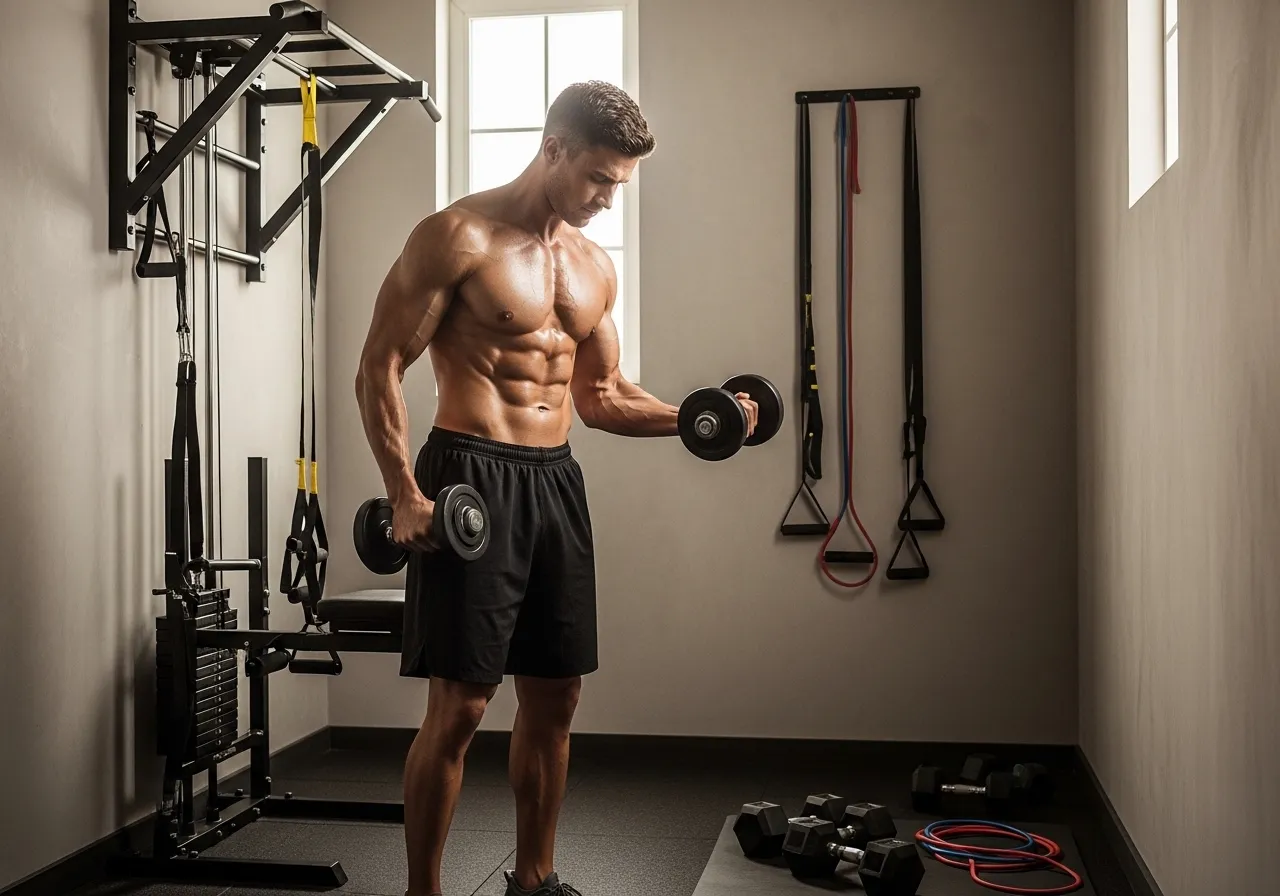
1. Why Home Workouts Work (The Science)
Skepticism about home workout effectiveness is understandable given the fitness industry’s heavy emphasis on gym equipment as the necessary vehicle for meaningful training. The research, however, does not support the equipment-dependency narrative.
1-1. Bodyweight Training and Muscle Hypertrophy
The fundamental stimulus for muscle hypertrophy (growth) is mechanical tension — the force placed on muscle fibers during exercise that triggers the molecular signaling cascade leading to muscle protein synthesis and progressive muscle development. For decades, the dominant narrative in sports science held that heavy external loading was necessary to produce the mechanical tension required for meaningful muscle growth, implicitly relegating bodyweight training to a conditioning tool with limited hypertrophy potential. More recent research has significantly revised this view. A landmark 2017 meta-analysis by Schoenfeld and colleagues found that training to momentary muscular failure with loads as low as 30 percent of one-repetition maximum produced muscle hypertrophy equivalent to training with loads of 70 to 80 percent of maximum — with the critical variable being proximity to failure rather than absolute load. This finding has profound implications for bodyweight training: a push-up performed to failure with full range of motion produces the same muscle-stimulating mechanical tension as a bench press performed to failure at a comparable relative intensity, despite the dramatically lower absolute load involved.
Research specifically on bodyweight training programs — comparing structured calisthenics protocols to gym-based resistance training programs over equivalent training periods — consistently finds comparable hypertrophy outcomes when the bodyweight training is programmed with sufficient volume, appropriate exercise selection, and genuine progressive overload. A 2019 study comparing an 8-week bodyweight training program to an equivalent gym-based program in untrained individuals found no significant difference in upper body muscle cross-sectional area increases between groups, despite the substantially different training modalities. For beginners and intermediate trainees, whose neuromuscular systems respond to a wide range of training stimuli with similar adaptation, bodyweight training represents a fully legitimate muscle-building tool that requires no equipment sacrifice for hypertrophy outcomes.
1-2. Progressive Overload Without External Load
Progressive overload — the gradual increase in training stimulus over time that drives continuing adaptation — is the fundamental principle of effective resistance training, and it is entirely achievable in bodyweight training through multiple variables that do not require adding external weight. Mechanical loading in bodyweight exercise can be progressively increased through: lever manipulation (extending the body further from the fulcrum increases mechanical disadvantage and loading on the working muscles — the progression from knee push-ups to full push-ups to pike push-ups to pseudo planche push-ups systematically increases mechanical loading without adding a single gram of external resistance); range of motion expansion (deficit push-ups, deep squat variations, full range of motion pull-up progressions); unilateral progressions (transitioning from bilateral movements to unilateral versions dramatically increases the load on each individual limb — from two-leg squats to Bulgarian split squats to pistol squats represents a progression from approximately 50 percent to 80 to 100 percent of bodyweight per leg); tempo manipulation (slower eccentric phases increase time under tension and mechanical stress without changing the absolute load); and volume and density progression (more sets, more reps, or the same work in less time).
1-3. Cardiovascular Fitness at Home
Home cardiovascular training — without a treadmill, stationary bike, or elliptical — is fully achievable through high-intensity bodyweight conditioning formats that elevate heart rate and cardiovascular demand as effectively as machine-based cardio. Jump rope (inexpensive, highly effective, minimal space), HIIT circuits combining burpees, jumping jacks, mountain climbers, and high knees, Tabata-format bodyweight intervals, and stair-based cardio all produce measurable cardiovascular adaptations comparable to equipment-based cardio at matched intensity levels. Research on high-intensity interval training specifically shows that HIIT protocols requiring no equipment (bodyweight-only HIIT) produce VO2max improvements comparable to or exceeding those from moderate-intensity continuous training on exercise equipment, in substantially less total time — a finding that makes equipment-free HIIT not just an alternative to gym cardio but potentially a more time-efficient cardiovascular training modality than many equipment-dependent options.
1-4. Flexibility and Mobility: No Equipment Needed
Flexibility and mobility training — arguably the most important fitness dimension for long-term health, injury prevention, and quality of movement — requires no equipment at all. Static stretching, dynamic mobility work, yoga-style flows, and movement quality drills all fall entirely within the equipment-free training domain and are directly accessible at home without any investment in gear or facilities. The research on flexibility training consistently shows that 5 to 10 minutes of daily mobility work produces meaningful and progressive improvements in range of motion over weeks of consistent practice — improvements that compound into dramatically better movement quality and injury resilience over months and years of training. Integrating flexibility and mobility work into home workouts as a standard component — rather than treating it as an optional add-on reserved for gym visits — actually provides more flexibility training benefit than gym-based exercise programs typically do, because the home training environment removes the social and logistical barriers that cause most gym-goers to skip flexibility work.
1-5. The Psychological Advantages of Home Training
Beyond the physiological evidence, home training offers psychological advantages that translate into real-world training outcomes for many people. The elimination of commute removes the most commonly cited barrier to exercise initiation — gym distance — making home training the lowest-friction exercise option available. The elimination of social self-consciousness (no concern about judgment, comparison, or gym etiquette) removes psychological barriers that genuinely prevent some people from training at all or from attempting challenging exercises that feel embarrassing to fail at in public. The scheduling flexibility of home training — the ability to train at any time, for any duration, without travel time — enables more consistent training frequency for people with unpredictable or constrained schedules. And the personal, familiar environment of home training reduces the activation energy required to begin a workout, supporting the habit formation process that is the ultimate determinant of long-term fitness outcomes.
The evidence-based case for home training effectiveness is strongest for the populations that constitute the majority of people seeking fitness improvements: beginners and intermediate trainees who have not yet reached the advanced adaptations that might require specialized equipment, people whose primary goal is general health and fitness rather than competitive athletic performance, and people whose schedule, budget, or lifestyle constraints make commercial gym training impractical for consistent execution. For these populations — which represent the vast majority of adults who want to exercise regularly — the research supports home training as a fully adequate, potentially superior alternative to gym-based training when the convenience, adherence, and cost advantages are weighted alongside the modest performance disadvantages that high-level competitive athletes might face. The decision to train at home is not a compromise born of necessity but a legitimate strategic choice that, for many people, produces better long-term fitness outcomes than gym-based training would — because the superior consistency that home training enables ultimately outweighs any per-session training quality advantage that gym facilities provide.
| Fitness Dimension | Equipment-Free Achievable? | Key Method |
|---|---|---|
| Muscle hypertrophy | Yes — equivalent to gym for beginners/intermediate | Bodyweight progressions to failure |
| Strength | Yes — up to advanced bodyweight levels | Lever + unilateral progressions |
| Cardiovascular fitness | Yes — full range | HIIT, jump rope, stair work |
| Flexibility/mobility | Yes — ideal environment | Daily stretching + mobility flows |
| Body composition | Yes — fully achievable | Training + nutrition (no equipment needed) |
1-6. The Financial Case for Home Training
Beyond the physiological and psychological arguments, the financial case for home training is compelling in its own right and deserves explicit articulation for anyone weighing home training against commercial gym membership. The average commercial gym membership in the United States costs $40 to $80 per month — $480 to $960 per year — with many premium facilities charging $100 to $200 per month or more. Over five years, the typical gym member spends $2,400 to $4,800 on memberships, often at facilities they use inconsistently due to the adherence challenges that commute and schedule create. The complete minimal home gym described in this article — pull-up bar, resistance bands, jump rope, adjustable dumbbells, and yoga mat — costs $200 to $400 in total and lasts indefinitely with basic maintenance. A dedicated room home gym with barbell, plates, and flooring costs $500 to $1,500 — the equivalent of 12 to 36 months of a premium gym membership — and then costs nothing in ongoing fees for the decades of training it subsequently enables.
The financial calculus becomes even more favorable when gym travel costs are included — commuting to the gym adds fuel costs or transit fares that, for people commuting 15 to 30 minutes each way, can add $50 to $150 per month to the effective membership cost. The home gym investment pays for itself within 6 to 24 months of use depending on the comparison gym membership cost, and then generates positive financial return with every subsequent year of use. For families where multiple members would train — each of whom would otherwise pay individual gym memberships — the financial advantage of the home gym compounds dramatically: a $600 home gym that replaces three $50-per-month memberships saves $1,200 per year after the first year of use, generating tens of thousands of dollars in saved membership costs over a decade of family training.
The most financially and practically optimal home training investment strategy for most people is a three-stage approach: begin with the zero-cost bodyweight program described in this guide to confirm genuine training commitment before spending anything; then invest in the minimal equipment package (pull-up bar, bands, jump rope, mat) for $80 to $130 when the training habit is established; and add adjustable dumbbells ($150 to $200) only when bodyweight progressions are genuinely limiting continued development — typically 6 to 18 months into consistent training depending on the individual’s starting fitness level. This staged investment approach matches equipment spending to demonstrated training need rather than aspirational equipment acquisition, ensuring that every equipment purchase reflects a genuine training requirement rather than motivational enthusiasm that may not persist through the habit formation period.
2. The Complete Bodyweight Exercise Library
Building an effective home workout program requires familiarity with the full library of bodyweight exercises organized by movement pattern and difficulty level — so that appropriate exercise selection and progression are possible across the full range of fitness levels from complete beginner to advanced calisthenics practitioner.
2-1. Push Movements: Chest, Shoulders, Triceps
Push movement progressions develop the anterior chain pushing muscles — primarily the pectorals, anterior deltoids, and triceps — through a spectrum from beginner-accessible to advanced-challenging variations. Beginner tier: wall push-ups (upright angle, minimal load), incline push-ups (hands elevated on a surface at various heights — the higher the hands, the lower the load), and knee push-ups (modified full range). Intermediate tier: standard push-ups (full range, bodyweight), wide-grip push-ups (increased pectoral emphasis), narrow-grip/tricep push-ups (increased tricep emphasis), and decline push-ups (feet elevated, increasing anterior deltoid and upper pectoral involvement). Advanced tier: pike push-ups (inverted V position, high deltoid emphasis), diamond push-ups, archer push-ups (unilateral loading progression toward one-arm push-up), pseudo planche push-ups (forward lean shifts mechanical load dramatically), and eventually the one-arm push-up and various planche progressions that represent the upper bound of pushing difficulty in calisthenics.
The key to effective push progression is matching the selected variation to the individual’s current strength level such that the working sets fall in the 6 to 20 repetition range to failure — the rep range research identifies as optimal for hypertrophy regardless of absolute load. If standard push-ups can be performed for 25 or more repetitions, the exercise has become insufficiently challenging for muscle development and a harder progression (decline, archer, or pike push-ups) should be selected. If standard push-ups can only be performed for 3 to 5 repetitions, an easier progression (incline push-ups) should be selected to ensure sufficient volume is achievable within the target rep range. Progressive overload in push training at home involves systematically moving toward more mechanically demanding push variations as each current variation becomes manageable for sets of 15 to 20 repetitions — a progression pathway that extends from complete beginner to elite calisthenics practitioner without requiring a single piece of equipment.
2-2. Pull Movements: Back, Biceps
Pull movements are the most commonly identified limitation of equipment-free bodyweight training, because horizontal and vertical pulling movements require something to pull against — a fixed bar, rings, or any other stable anchor above head height. In a true zero-equipment scenario, inverted rows using a sturdy table or desk (body horizontal, pulling chest to edge of table), doorframe rows (gripping the doorframe and pulling body toward it), and towel rows (looping a towel around a door handle and performing modified rows) provide some pulling stimulus. However, for genuine upper back and bicep development comparable to push development, access to a pull-up bar — the most valuable single piece of minimal equipment for home training — provides the full range of vertical pulling progressions from beginner-accessible Australian pull-ups (body at 45-degree angle) through standard pull-ups and chin-ups to one-arm pull-up variations.
A doorframe pull-up bar ($20 to $40) is arguably the highest-impact, lowest-cost equipment purchase available for home training — it installs in seconds, requires no drilling or permanent modification, stores flat against the wall when not in use, and provides access to the complete vertical pulling progression that is the most challenging major movement pattern to train without equipment. For anyone serious about balanced home training development, the pull-up bar is the essential first equipment purchase that transforms a genuinely limited equipment-free upper body routine into a complete pushing-and-pulling upper body program.
2-3. Squat and Lower Body Movements
Lower body training at home is one of the areas where bodyweight training genuinely excels — the lower body moves large amounts of bodyweight even in basic bilateral squat movements, and the progression to unilateral loading (single-leg variations) provides training stimulus comparable to moderate external loading at the gym for most people’s leg strength levels. Beginner tier: bodyweight squat (full range, heels flat), box squat (sitting to and standing from a chair develops the movement pattern before requiring full depth), and wall sit (isometric quad endurance). Intermediate tier: Bulgarian split squat (rear foot elevated on a chair, creating significant unilateral loading), lateral squat (significant hip and adductor mobility demand), and jump squat (explosive power development). Advanced tier: pistol squat (single-leg squat to full depth — one of the most demanding lower body bodyweight exercises available), shrimp squat (quad-dominant single-leg movement), and various plyometric progressions.
Glute and hamstring development — the posterior chain that is often underdeveloped relative to quadriceps in general populations — can be effectively addressed through equipment-free exercises including glute bridges (progressing to single-leg bridges and then to hip thrusts using a chair or couch as a bench), Nordic hamstring curls (performed by anchoring feet under a heavy piece of furniture and lowering the torso toward the floor — one of the most effective hamstring exercises available regardless of equipment availability), and good mornings (hip hinge movement with hands behind head). The Nordic hamstring curl in particular has one of the strongest evidence bases of any hamstring exercise for injury prevention and performance, and requires only a fixed foot anchor — a heavy piece of furniture — for full execution.
2-4. Core Movements
Core training is perhaps the area of bodyweight exercise with the broadest exercise library and the most continuous progression pathway — from the most basic stability exercises through the most advanced calisthenics skills. Anti-extension core training (the most important functional category): plank and its progressions (standard plank, push-up position plank, plank with alternating arm and leg extension, RKC plank with maximal tension), ab wheel rollout progressions (from kneeling to standing), and hollow body hold progressions. Anti-rotation core training: Pallof press variations using a resistance band or door anchor, single-arm farmer’s carry (substituting a heavy household item for a dumbbell). Flexion-based training: crunch variations, leg raises (from bent-knee to straight-leg to L-sit progressions), and bicycle crunches. The L-sit — a static hold with body elevated off the ground with straight legs extended horizontally — represents the convergence of core, tricep, and hip flexor strength into a single demanding skill that requires no equipment except a flat surface for hands.
2-5. Full-Body and Conditioning Movements
Full-body conditioning movements that simultaneously train multiple muscle groups and elevate cardiovascular demand are among the most time-efficient components of home workouts. Burpees (squat thrust with push-up and jump — full body, high metabolic demand), mountain climbers (core and cardiovascular combination), bear crawls (developmental movement pattern with high total body demand), inchworm walk-outs (hamstring flexibility combined with push-up movement), and various jump and plyometric exercises (broad jump, vertical jump, lateral jump, single-leg hop progressions) collectively provide high-intensity, equipment-free full-body conditioning that develops athleticism, coordination, and cardiovascular fitness simultaneously with the strength training that the isolated push, pull, and leg movements provide.
| Movement Pattern | Beginner | Intermediate | Advanced |
|---|---|---|---|
| Push (horizontal) | Incline push-up | Standard push-up | Archer / one-arm push-up |
| Push (vertical) | Pike push-up (modified) | Pike push-up | Handstand push-up |
| Pull (vertical) | Australian pull-up | Pull-up / chin-up | Weighted / one-arm pull-up |
| Squat (bilateral) | Goblet squat / bodyweight squat | Jump squat | Pistol squat |
| Hinge | Glute bridge | Single-leg bridge | Nordic hamstring curl |
| Core | Plank | Hollow body hold | L-sit / ab wheel rollout |
2-6. Integrating Flexibility and Mobility into the Exercise Library
Flexibility and mobility work is the most commonly neglected component of home workout exercise libraries — underrepresented in most bodyweight programs relative to its importance for both immediate performance and long-term training sustainability. The research on flexibility and injury prevention is clear: adequate joint range of motion, muscle extensibility, and movement quality significantly reduce injury risk during resistance training, and the flexibility deficits accumulated through sedentary modern lifestyles — tight hip flexors, restricted thoracic mobility, limited ankle dorsiflexion — directly impair performance in the major bodyweight movement patterns (squat depth limited by ankle mobility, push-up range limited by shoulder flexibility, hinge mechanics impaired by hamstring tightness). Integrating a targeted flexibility and mobility routine into each home workout session — either as part of the warm-up, as a cool-down, or as a dedicated daily practice — produces both immediate performance improvements and long-term movement quality development that sustains training capacity across decades.
A comprehensive home mobility routine addresses the five major flexibility targets for most modern sedentary adults: hip flexor length (affecting squat depth, posterior pelvic tilt, and lower back health), thoracic spine mobility (affecting overhead pressing mechanics and postural alignment), shoulder external rotation range (affecting shoulder health in all pressing and overhead movements), ankle dorsiflexion range (affecting squat mechanics and calf strain), and hamstring length (affecting hip hinge mechanics and lower back stress). Each target can be addressed through 2 to 3 specific exercises performed for 30 to 60 seconds daily — a total daily flexibility practice of 10 to 15 minutes that produces meaningful range of motion improvements within 4 to 6 weeks of consistent daily practice. The home training environment is particularly well-suited to daily flexibility practice because the zero-commute, always-available character of home training makes a 10-minute pre-sleep mobility routine as accessible as any other 10-minute daily activity — no planning, no commute, no equipment required beyond floor space and a mat.
For home trainees who incorporate yoga-style mobility flows into their practice — sequences that combine strength, balance, flexibility, and proprioception in continuous movement rather than isolated static stretches — the flexibility component of home training becomes a training modality in its own right rather than simply injury prevention maintenance. A 20 to 30-minute yoga flow two to three times per week develops flexibility, balance, core stability, body awareness, and mental focus simultaneously with the calming parasympathetic activation that supports recovery between strength training sessions — providing a complete fitness modality that costs nothing, requires only floor space, and develops physical and psychological qualities that bodyweight strength training alone does not address as comprehensively.
3. Building Your Home Workout Program
Having an exercise library is only useful if it is organized into a coherent program with appropriate frequency, volume, progressive overload, and recovery structure. A home workout program designed on sound exercise science principles produces better results than random selection from the exercise library regardless of training history or goal.
3-1. Training Frequency for Home Workouts
Research on training frequency for both muscle hypertrophy and strength development consistently supports 2 to 4 training sessions per week per muscle group as the optimal range for most recreational trainees — a finding that applies equally to bodyweight home training as to gym-based programs. The most practical home workout frequency structures are: full-body training three times per week (Monday/Wednesday/Friday or similar), which provides each muscle group with three weekly stimulation opportunities and two days of recovery between each session; or upper-lower splits four times per week (Monday upper, Tuesday lower, Thursday upper, Friday lower), which increases total training volume by dividing the program into upper and lower body focused sessions. Push-pull-legs splits (six sessions per week) are achievable in home settings but represent a high commitment level that typically requires modification for home workouts due to the pull movement limitations of equipment-free training.
For beginners, full-body training three times per week is the most evidence-supported approach — it maximizes the weekly muscle protein synthesis stimulation frequency that research identifies as most important for early training adaptation, it allows appropriate recovery between sessions, and it provides sufficient variety within each session to develop competence across all movement patterns simultaneously. For intermediate home trainees who have developed competence across basic movement patterns and whose progressive overload is advancing beyond beginner-level adaptations, an upper-lower or push-pull split that allows higher volume per session for each movement pattern may produce better hypertrophy outcomes by providing the higher per-session volume that intermediate-level muscle growth requires.
3-2. Sets, Reps, and Volume for Bodyweight Training
Volume prescription for home bodyweight training follows the same research-based guidelines that apply to gym-based resistance training: 10 to 20 sets per muscle group per week is the evidence-supported range for hypertrophy in most intermediate trainees, with beginners benefiting from 10 to 12 sets and advanced trainees potentially benefiting from up to 20 sets in well-recovered states. Rep ranges should be selected to produce muscular failure in the 6 to 20-repetition range — if a bodyweight exercise variation can be performed for more than 25 repetitions before failure, the variation is insufficiently challenging for muscle development and a harder progression should be selected. If a variation produces failure in fewer than 5 repetitions, the variation is too challenging for optimal volume accumulation and an easier progression should be selected.
The most practical volume structure for a full-body home workout: 3 to 4 sets of the selected push variation, 3 to 4 sets of the selected pull variation (or pull-up equivalent), 3 to 4 sets of the selected squat or lower body variation, 2 to 3 sets of a hinge movement, and 2 to 3 sets of core work — totaling 13 to 18 working sets per session. Three sessions per week at this volume accumulates 39 to 54 sets per week across all muscle groups — at the high end of the evidence-supported range for intermediate trainees and amply within the range for beginners. This volume prescription sounds substantial but translates into approximately 45 to 60 minutes of training per session with appropriate rest intervals — a realistic home workout duration that can be executed consistently without requiring extraordinary time commitment.
3-3. Progressive Overload Tracking at Home
Progressive overload — systematically increasing training stimulus over time — requires tracking current performance to know when and how to progress. A simple training log (a notes app, a spreadsheet, or a physical notebook) recording the exercise variation, sets, reps, and any relevant notes for each session provides the performance history needed to implement progressive overload systematically. The progression decision rule: when the current exercise variation can be performed for all planned sets at the top end of the target rep range (e.g., 3 sets of 15 to 20 reps at the planned variation) for two consecutive sessions, the next harder progression within the movement pattern is introduced for the following session. This progressive overload implementation — identical in principle to gym-based progressive overload — ensures that the training stimulus is consistently increasing relative to the body’s current adaptation level, driving continuing adaptation rather than the performance plateau that non-progressive training produces.
3-4. Sample Beginner Home Workout Programs
A concrete beginner full-body home workout program eliminates the ambiguity of program design and provides an immediately actionable starting point. Program A (truly zero equipment): Push-up progression × 3 sets to near-failure; Inverted row or table row × 3 sets to near-failure; Bodyweight squat × 3 sets of 15 to 20 reps; Glute bridge × 3 sets of 15 reps; Plank × 3 × 30 to 60 seconds; Mountain climbers × 2 × 30 seconds. Total: approximately 17 working sets, 35 to 45 minutes. Performed 3 times per week with 1 to 2 rest days between sessions, this program provides a complete full-body stimulus for beginner adaptation that will produce measurable strength and muscle development within 6 to 8 weeks of consistent execution. Each month, a harder progression within each movement pattern replaces the previous variation as the current variation reaches the 15 to 20 rep threshold.
3-5. Intermediate and Advanced Home Program Design
As the training base develops and basic bodyweight progressions become manageable, home workout programs can evolve toward more sophisticated structures that maintain progressive overload through higher-level skills, more complex programming, and strategic equipment additions. Intermediate calisthenics skills — muscle-ups, handstand progressions, front lever progressions, planche progressions, pistol squats — represent years of progressive development that maintain training novelty, challenge, and motivation while driving genuine physical development comparable to advanced gym training. The calisthenics skill development pathway provides a long-term progressive overload framework that gym-based training cannot replicate — the technical complexity of advanced calisthenics skills provides ongoing challenge and measurable progress in a form that purely weight-based progression cannot: there is no weight milestone equivalent to achieving a full planche hold for the first time, and the combination of strength, coordination, proprioception, and body awareness that calisthenics skill development produces creates physical qualities that complement and exceed what barbell training alone develops.
| Training Level | Frequency | Structure | Volume per Session |
|---|---|---|---|
| Beginner | 3×/week | Full body | 13–17 sets |
| Intermediate | 4×/week | Upper/lower split | 15–20 sets |
| Advanced | 4–5×/week | Skill + strength split | 18–25 sets |
3-6. Nutrition and Recovery for Home Trainers
The training program is only one component of the fitness results that home training produces — nutrition and recovery are the complementary factors that determine whether the training stimulus produces the intended adaptations or is absorbed without measurable outcome. Home training has a unique nutritional opportunity: training in the kitchen environment makes pre- and post-workout nutrition trivially convenient compared to the logistical planning that gym-based training around a commute requires. The home trainer can prepare an appropriate pre-workout meal 60 to 90 minutes before training and consume a carefully chosen post-workout meal within 30 to 45 minutes of session completion — without planning, meal prep, or supplement purchasing that supports gym-based post-workout nutrition while managing a commute and schedule.
The nutritional requirements for home training are identical to those for any resistance training program: adequate total protein (1.6 to 2.2 grams per kilogram of bodyweight daily for muscle-building goals, 1.2 to 1.6 grams per kilogram for general fitness maintenance), sufficient total caloric intake to support the training adaptation goal (caloric surplus of 200 to 500 kcal above maintenance for muscle-building, deficit of 300 to 500 kcal below maintenance for fat loss), and appropriate carbohydrate distribution around training sessions to support performance and recovery. The home training environment makes these nutritional practices easier to implement consistently than gym-based training because the kitchen is always immediately available before and after each session — eliminating the “I’ll just grab something at the gym” or “I’ll figure out food after the commute home” compromises that impair post-workout nutrition in gym-based training contexts. Home trainers who deliberately leverage this nutritional convenience advantage by preparing appropriate pre- and post-workout meals as standard components of their training routine will see meaningfully better body composition and recovery outcomes than those who train at home but continue the nutritional improvisation that gym-based training often necessitates.
Sleep and recovery management is the third pillar of home training effectiveness — and home training’s schedule flexibility provides recovery advantages that rigid gym-based training schedules cannot always accommodate. The ability to shift training to the day’s time of naturally highest energy (rather than forcing training into a fixed early morning or post-commute slot that may not align with the body’s recovery readiness on any given day), the elimination of commute fatigue that depletes recovery resources before training even begins, and the zero post-workout commute that allows immediate transition to rest and nutrition after each session collectively create a recovery environment that is more favorable to training adaptation than the commute-constrained training schedules that gym-based training requires. Home trainees who actively manage these recovery advantages — training when rested rather than when exhausted, recovering immediately post-session, maintaining sleep schedule consistency in the private home environment, and leveraging the kitchen proximity for optimal post-workout nutrition timing — consistently report better recovery quality and training progression rates than their historical gym-training experience produced under equivalent training programs, suggesting that the home training environment’s recovery advantages — when deliberately optimized rather than passively accepted — partially offset the motivational and social support advantages that well-resourced commercial gym environments provide to their members.
4. Budget Equipment Essentials for Home Training
While genuine zero-equipment training is fully achievable, a small investment in minimal equipment dramatically expands the range and effectiveness of home training — particularly for the pulling movements and loading variety that bodyweight-only training cannot fully replicate.
4-1. The Pull-Up Bar: First Priority ($20–$40)
As mentioned in section two, the pull-up bar is the single most valuable minimal equipment purchase for home training. A doorframe pull-up bar provides vertical pulling capability (pull-ups, chin-ups, hang variations, leg raises from hang), horizontal pulling capability when used at waist height (Australian pull-ups, inverted rows), and hanging decompression for spinal health. It installs in any standard doorframe in seconds without tools, stores easily, and costs less than a single month’s gym membership. The pull-up bar transforms a bodyweight upper body routine from push-dominant (with limited pull options) into a balanced push-pull program with full upper back, bicep, and core development capability. The investment-to-impact ratio of the pull-up bar is arguably the highest of any fitness equipment available at any price point.
4-2. Resistance Bands: Versatility at Minimal Cost ($20–$50)
A set of resistance bands — typically available as a set of 4 to 5 bands at different resistance levels for $20 to $50 — provides variable external resistance that can be applied to virtually every bodyweight movement pattern to add loading variety without requiring heavy free weights. Bands can be used to provide assistance in difficult movements (band-assisted pull-ups reduce the effective load, making the movement accessible earlier in the strength development curve), to provide resistance in easy movements (band-resisted push-ups increase the load at the top of the movement where mechanical advantage is greatest), and as the primary resistance tool for pulling movements (band rows, band pull-aparts, band deadlifts) that are difficult or impossible to replicate with bodyweight alone. The versatility, portability, and extremely low cost of resistance bands make them the second-priority minimal equipment addition after the pull-up bar.
4-3. Adjustable Dumbbells: The Transition Equipment ($100–$200)
For trainees who have developed beyond the limitations of purely bodyweight training — whose lower body strength has progressed beyond the pistol squat and whose upper body pushing strength requires loading beyond the most demanding bodyweight push progressions — a set of adjustable dumbbells provides access to the external loading that continues progressive overload when bodyweight progressions have been exhausted. Adjustable dumbbells ($100 to $200 for a pair adjustable from 2 to 25 or 30 kilograms) replace an entire rack of fixed dumbbells in the space of a small shoebox, providing the weight range needed for all major exercises from light mobility work to challenging loaded movements. A single set of adjustable dumbbells in combination with a pull-up bar and resistance bands creates a home training setup capable of producing elite-level fitness outcomes without requiring any additional equipment or space.
4-4. Jump Rope: Cardio Upgrade ($10–$30)
A jump rope is the most cost-effective, space-efficient cardiovascular training tool available — providing high-intensity cardio comparable to running at substantially lower impact, in a space as small as 2 meters square, for $10 to $30. Jump rope training develops cardiovascular fitness, coordination, timing, and calf strength simultaneously, and scales from beginner-accessible (basic two-foot jump, rest-heavy intervals) to elite-demanding (double unders, speed intervals at 200+ jumps per minute) through the same progressive intensity increase that makes any cardiovascular training effective. A 20-minute jump rope session at moderate intensity burns approximately the same calories as a 30-minute moderate run — with the added benefits of improved coordination and lower joint impact — making it an excellent cardio option for home training without outdoor access or treadmill equipment.
4-5. Gymnastic Rings: Advanced Option ($30–$60)
Gymnastic rings — suspended from a pull-up bar, door anchor, or outdoor structure — provide unstable surface training that dramatically increases the muscle activation and skill demand of standard bodyweight exercises while remaining inexpensive, portable, and requiring minimal space when not in use. Ring push-ups, ring rows, ring dips, ring pull-ups, and eventually ring muscle-ups and ring handstand push-ups collectively provide a complete upper body training program with uniquely high muscle activation due to the instability that rings introduce. Research on unstable surface training consistently shows greater muscle activation (particularly in stabilizer muscles) during ring exercises compared to equivalent movements on stable surfaces — making ring training a genuine physiological advancement over standard bodyweight training rather than simply a harder variation of the same stimulus.
The resistance band selection deserves more detailed guidance than its brief mention above provides, because the range of resistance band products available varies enormously in quality, durability, and actual resistance levels — and the $20 to $50 investment is most wisely spent on a set that provides appropriate resistance across the full range of training loads rather than a single resistance level that is appropriate for only a narrow band of exercises. A complete resistance band set for home training should include at minimum: a very light band (approximately 5 to 10 kg resistance) for mobility work and light rehabilitation exercises, a light band (10 to 20 kg) for band-resisted push variations and upper body activation exercises, a medium band (20 to 40 kg) for assisted pull-up training and moderate resistance exercises, and a heavy band (40 to 80 kg) for lower body exercises and heavy assistance in pull-up training for beginners. Loop bands (continuous loops, typically sold in sets) are the most versatile format for home training, providing both pulling resistance (by anchoring to a door or fixed object) and pushing resistance (by looping around the body or a limb) across a wide range of exercises. Tube bands with handles are convenient for specific exercises but less versatile overall than loop bands for the full range of home workout applications.
The adjustable dumbbell investment point — when to add them to the home training toolkit — can be identified by a specific performance criterion rather than an arbitrary timeline: when the most demanding unilateral lower body exercise (pistol squat or Bulgarian split squat) can be performed for 3 sets of 15 to 20 reps with full range of motion and controlled tempo, the bodyweight lower body stimulus has been substantially exhausted and external loading is needed for continued lower body development. Similarly for upper body: when the most demanding pushing variation (archer push-up or pseudo planche push-up) can be performed for 3 sets of 12 to 15 reps, the bodyweight push progression has approached its practical limit and dumbbell pressing will produce better ongoing hypertrophy stimulus. These performance criteria — rather than arbitrary time or training session counts — provide the clearest signals that equipment progression is genuinely needed rather than simply desirable.
| Equipment | Cost | Primary Benefit | Priority |
|---|---|---|---|
| Pull-up bar | $20–$40 | Pulling movements, core from hang | 1st — highest impact |
| Resistance bands (set) | $20–$50 | Load variation, assistance/resistance | 2nd |
| Jump rope | $10–$30 | Cardio, coordination | 3rd |
| Adjustable dumbbells | $100–$200 | External loading for advanced trainees | 4th — when bodyweight insufficient |
| Gymnastic rings | $30–$60 | Unstable surface, advanced upper body | 5th — advanced option |
4-6. Long-Term Equipment Strategy and Progression Planning
The minimal equipment approach described in this section is not a permanent ceiling on home training capability but a starting framework that can evolve as training needs develop and investment capacity allows. A long-term home equipment strategy anticipates the progression from bodyweight to minimal equipment to more substantial equipment as each level of training development is reached, ensuring that equipment investment is always matched to genuine current training need rather than aspirational future need that may or may not materialize. Stage 1 (months 0 to 6): zero equipment bodyweight training, establishing the habit and the foundational movement competence. Stage 2 (months 3 to 18): pull-up bar, resistance bands, jump rope — completing the equipment-free program’s gaps and enabling genuine progressive overload across all major movement patterns. Stage 3 (months 12 to 36): adjustable dumbbells or light barbell set — extending progressive overload capability beyond bodyweight progression limits as intermediate-level strength development requires external loading. Stage 4 (optional, for committed long-term home trainers): full home gym setup with squat rack, barbell, and sufficient plate loading for advanced strength development.
Each stage transition should be driven by a genuine training need — a specific movement pattern or loading requirement that the current equipment tier cannot adequately address — rather than by aspirational equipment acquisition. The most common premature stage transitions are: buying dumbbells before bodyweight progressions are genuinely limiting (Stage 2 to 3 transition too early), and buying a full barbell setup before consistent training habits are well-established (any stage transition before the training habit is robust and demonstrated). Equipment that arrives before the training habit is established frequently becomes expensive storage furniture, while equipment acquired in response to a genuine training need that the current setup cannot address is used immediately and consistently because the training motivation that identified the need is active and sustained at the time of the purchase. The discipline of restraint — investing in equipment only when a specific, demonstrated training need requires it — produces better long-term home training outcomes than aspirational equipment collection that outpaces the actual training development it was intended to support.
Maintaining and protecting minimal home training equipment extends its useful life substantially and protects the modest investment it represents. Pull-up bars should be checked for doorframe damage periodically — the rubber padding that protects the doorframe wears over time and should be replaced before it allows metal-to-wood contact. Resistance bands develop microtears at their attachment points and should be inspected for visible damage before each session — a band that snaps under load can produce significant injury. Adjustable dumbbells should be stored on a stable surface rather than stacked or stored in ways that stress their adjustment mechanisms. Jump ropes degrade at the handle-rope connection and should be replaced when fraying becomes visible at this junction. These basic equipment maintenance practices require minimal time and cost but prevent the equipment failures that interrupt training consistency and the occasional serious injuries that equipment failure under load can produce.
5. Real-Life Home Gym Setup Examples
The gap between knowing what equipment to buy and actually setting up a functional home training space in a real living environment is bridged by understanding how real people with real space constraints have built effective home gyms in bedrooms, living rooms, small apartments, and shared spaces.
5-1. The Zero-Space Setup: For Apartments and Shared Spaces
The zero-space home gym stores in a drawer and sets up in 30 seconds: a doorframe pull-up bar (hangs in a doorframe, stores behind a door), a set of resistance bands (rolls up to the size of a fist), and optionally a jump rope (folds flat). Total storage footprint: approximately 30cm × 15cm × 5cm. This setup requires a single 2 meter × 2 meter floor space for exercises and a standard doorframe — available in virtually any living environment. The workout space sets up and packs away completely in under a minute, leaving no permanent fitness infrastructure in shared or small living spaces. Despite its minimal footprint, this zero-space setup provides pull-ups, rows, push variations, all lower body movements, core training, and resistance band exercises — a genuinely complete upper and lower body program with cardio capability from the jump rope.
For the apartment dweller, the person living with roommates or family who does not want permanent fitness equipment in common spaces, or the frequent traveler who wants consistent training access at home and away, the zero-space setup is the most practical and complete fitness solution available at any cost. The pull-up bar hangs in the bedroom doorframe during workouts and stores behind the door between sessions. The resistance bands live in a desk drawer. The jump rope goes in the bag when traveling. The entire “home gym” travels in a carry-on bag — a level of portability that no amount of gym membership or fixed equipment can replicate.
5-2. The Bedroom Corner Setup
A 2 meter × 2 meter corner of a bedroom can be converted into a functional home gym with minimal permanent space commitment. The setup: pull-up bar in the bedroom doorframe, yoga mat (3mm-6mm thickness, rolls to 30cm × 10cm when stored) defining the workout floor space, resistance bands hanging from a hook on the wall or door, and a small storage basket or box holding jump rope, any small accessories, and the workout notebook. The mat stores rolled against the wall or under the bed between sessions. The pull-up bar is always installed (most people find the aesthetic acceptable in their own bedroom). Total active storage footprint: one wall corner, roughly 60cm × 60cm × 150cm. This setup provides everything the zero-space setup provides plus a dedicated, comfortable floor space defined by the mat, and the slight visual commitment of the always-installed pull-up bar and wall hook — a trade-off that produces a more convenient and psychologically supportive training environment than the fully packed-away zero-space setup.
5-3. The Living Room Setup with Minimal Equipment
For people with living room space and partners or family members who accept some fitness equipment in shared spaces, a slightly expanded setup adds adjustable dumbbells to the bedroom corner configuration. A small adjustable dumbbell set (2 to 25kg range) stores neatly on a small shelf, beneath a coffee table, or in a dedicated storage tray — occupying approximately the same footprint as a large coffee table book stack when not in use. This setup provides the zero-space and bedroom corner functionality plus the external loading capability of dumbbells for any exercise that bodyweight has outgrown. With this configuration — pull-up bar, resistance bands, yoga mat, adjustable dumbbells, jump rope — every major training goal is achievable to an elite standard without any gym membership or further equipment investment.
5-4. The Dedicated Home Gym Room
For those with a spare room, basement, or garage space to dedicate to training, a complete home gym can be established for $500 to $1,500 that rivals or exceeds the training capability of most commercial gyms for personal fitness goals. Core investments for a dedicated room: a wall-mounted or free-standing pull-up/dip station ($100 to $250), adjustable dumbbells ($150 to $300), a barbell and weight plates or resistance bands ($200 to $500), a gymnastic ring set ($30 to $60), a heavy-duty resistance band set ($30 to $60), and rubber flooring tiles to protect the floor and reduce noise ($50 to $150). This investment provides every major training modality — bodyweight, dumbbell, barbell, band — in a private, always-accessible space that requires zero commute, zero membership fee, and zero schedule dependence on facility hours. The 2 to 3 year cost of a commercial gym membership typically exceeds the total cost of this complete home gym setup — making the dedicated home gym a financially sensible investment for anyone with consistent long-term training intentions and the space to dedicate.
5-5. Outdoor Training: The Free Gym
Parks, playgrounds, and outdoor public spaces provide genuine fitness infrastructure for home trainers willing to take their workout outside. Playground equipment — pull-up bars, parallel bars, climbing structures — provides the complete pulling and pushing equipment needed for a comprehensive calisthenics program. Park benches provide elevated surfaces for incline and decline push-up variations, step-up and Bulgarian split squat performance, and core exercise variety. Running paths, hills, and stairs provide cardiovascular training options that are genuinely superior to indoor alternatives in terms of fresh air, natural terrain variation, and psychological wellbeing benefits. The combination of outdoor available infrastructure with the minimal portable equipment of the zero-space setup (resistance bands, jump rope) creates an outdoor training environment that is fully complete for any fitness goal — weather and location permitting — at zero cost beyond the initial minimal equipment investment.
The outdoor training option deserves particular emphasis for home trainers who live within reasonable distance of parks or public spaces with pull-up bars and parallel bars — fitness infrastructure that is increasingly available in urban and suburban parks globally and that provides the closest equivalent to a commercial gym experience available without membership fees. Park workout stations typically include pull-up bars at multiple heights, parallel bars for dipping and L-sit practice, balance beams, and open space for any floor-based exercise — a complete calisthenics gym available free of charge and accessible on any open day. The combination of outdoor environment, fresh air, sunlight exposure (with its circadian and mood benefits), and the social atmosphere of other outdoor exercisers provides a training experience that neither commercial gym nor private home gym can fully replicate, and that many home trainers report as their most motivating and enjoyable training environment despite its complete zero cost. Identifying the nearest outdoor fitness station and incorporating outdoor sessions into the regular training rotation — even just one session per week — adds an environmental variety and sensory richness to home training that sustains long-term engagement in ways that purely indoor training cannot achieve.
| Setup Type | Space Required | Cost | Best For |
|---|---|---|---|
| Zero-space (drawer storage) | 2×2m workout space only | $50–$100 | Apartments, travelers, shared spaces |
| Bedroom corner | 2×2m corner + doorframe | $60–$120 | Private bedroom, moderate commitment |
| Living room setup | 3×3m + storage shelf | $200–$400 | Shared spaces with partner/family buy-in |
| Dedicated room | Full room (min 3×4m) | $500–$1,500 | Committed home gym users |
| Outdoor / park | Any outdoor space | $0–$60 | Good weather climates, community connection |
5-6. Adapting Home Workouts Across Different Life Phases
One of the underappreciated strengths of home-based fitness is its adaptability across different life phases — the changing schedules, priorities, physical capacities, and life circumstances that make the rigid structure of gym-based training genuinely impractical during certain periods of life. The new parent whose schedule and sleep are unpredictable benefits from home training’s any-time, any-duration flexibility. The professional navigating a high-stress work period benefits from the zero-commute efficiency that makes maintaining even minimal training possible within a genuinely constrained schedule. The person in injury recovery benefits from the private, controlled environment that allows careful, deliberate movement rehabilitation without the performance comparison pressure of a gym environment. The traveler benefits from the portable zero-space setup that maintains training continuity across changing locations without gym-hunting in unfamiliar cities.
Adapting the home training program to each life phase — rather than maintaining a fixed program regardless of life circumstances — is the practice that sustains long-term home training through the inevitable disruptions that life reliably produces. During high-stress, time-constrained periods: reduce program complexity to the minimum viable training (three 20 to 30-minute full-body sessions per week), maintain the habit’s existence at the expense of its ambition, and plan the expansion back to full training volume when the demanding period passes. During high-energy, unconstrained periods: maximize training investment, introduce new skills and progressions, build the fitness base that will sustain performance through the inevitable future constrained periods. This life-phase-aware training periodization — less sophisticated than formal sports science periodization but more practically applicable to real-life non-athletes — is the approach that produces genuine long-term fitness development rather than the on-again-off-again training cycles that a fixed, inflexible home program produces when life inevitably disrupts it.
Children represent a specific life-phase consideration for home training that deserves mention: the presence of children in the home simultaneously creates the schedule constraints that make gym training difficult (making home training more necessary) and the training partners that make home exercise more enjoyable for many parents. Training alongside or involving children in age-appropriate exercise — making push-ups a family activity, teaching basic movement patterns, incorporating play into workout structure — models physical activity as a normal, enjoyable component of daily life for the next generation while making the parental training session more achievable within the family schedule. The home gym or home training space that is designed to be child-friendly and child-inclusive — rather than a private adult sanctuary that must be defended from child intrusion — transforms a potential scheduling conflict into a parenting opportunity that serves both the parent’s fitness goals and the children’s physical development simultaneously.
6. Staying Consistent with Home Workouts
The unique challenge of home workouts relative to gym-based training is maintaining the discipline and structure of a training program in an environment filled with comfortable distractions and without the social cues and facility-specific behavioral triggers that support gym workout consistency.
6-1. Creating a Dedicated Workout Space and Time
The most important consistency-enabling practice for home workouts is establishing a specific, consistent space for training — even if that space is only defined by rolling out a mat and hanging the pull-up bar — and a specific, consistent time that training occurs. The dedicated space, even when minimal, creates a location-based behavioral cue that triggers exercise-associated psychology when you enter or set up the space. Research on environmental cues and behavior consistently shows that location-specific habits form more quickly and remain more robust than context-independent habits — the person who always trains in the same spot in their bedroom develops a stronger cue-response association between that location and exercise behavior than the person who sets up their workout in whichever room is most convenient on each occasion. Designating and maintaining a consistent training space is therefore not an organizational nicety but a behavioral design decision that meaningfully accelerates home workout habit formation.
The consistent training time — combined with the dedicated space — creates the implementation intention structure (the specific if-then plan of “when it is X time, in X location, I perform my workout”) that habit research identifies as one of the most powerful behavioral commitment tools available. Framing this combination as a non-negotiable daily appointment rather than a conditional intention — “Monday, Wednesday, and Friday at 7 AM in the bedroom corner” as a firm calendar commitment rather than “Monday, Wednesday, and Friday morning when I get around to it” — produces substantially higher workout execution rates in home training contexts where the social accountability of a gym environment is absent and internal behavioral design must substitute for external structural support.
6-2. Managing Home Training Distractions
The home environment presents a distraction density that commercial gyms do not — the television, the refrigerator, the comfortable couch, the household chores, the family members and roommates who interact without the gym etiquette that would prevent mid-workout conversation. Managing these distractions requires deliberate environmental design: phone on airplane mode or Do Not Disturb during the workout, television off and out of sight, family or household members informed of the workout window and the expectation that interruptions will be minimal, and if possible workout clothing changed into before the session to create a behavioral transition that signals to the brain (and to others in the household) that training time has begun. The workout clothing change is a more powerful behavioral cue than its superficiality implies — it is the home training equivalent of walking through the gym entrance, a specific behavioral gateway that marks the transition from non-training to training mode and reduces the cognitive susceptibility to the home environment’s competing attractions.
6-3. Accountability Without a Gym Community
One of the genuine advantages of commercial gym training over home training for many people is the social accountability structure of the gym environment — the regular presence of people you recognize, the implicit social norm of exercising in a gym, and the visibility of your attendance that the gym community provides. Home training loses this social accountability by default, but it can be deliberately rebuilt through alternative accountability structures: virtual training partners who share workout completion via text or app, online fitness communities where workouts are logged publicly, scheduling video calls with a friend during parallel solo workouts, joining online coaching programs with regular check-ins, or using habit tracking apps that create streak-based accountability and share progress with social connections. The accountability structure matters more than the specific format: any arrangement that makes workout completion visible to at least one other person and workout skipping socially noticeable creates the social commitment mechanism that sustains consistency through the low-motivation periods that home training’s lack of environmental structure makes particularly challenging.
6-4. Progression Tracking for Long-Term Motivation
In the absence of the gym environment’s motivational infrastructure — the visible presence of other exercisers, the social comparison that drives performance, the instructor feedback that acknowledges progress — home trainers must be more deliberate about tracking and celebrating their own progress to maintain the long-term motivational engagement that drives consistent training. A detailed workout log that records every session’s exercises, sets, and reps creates the progress documentation that makes the gradual but real improvements in performance visible across weeks and months of consistent training. Monthly assessments of specific performance benchmarks — maximum push-up repetitions, pull-up maximum, timed plank hold, specific calisthenics skill progress — provide concrete, objective evidence of fitness development that the mirror and the scale cannot always reveal and that sustains the intrinsic motivation that makes long-term home training self-reinforcing rather than purely obligation-driven.
6-5. Keeping Home Workouts Fresh
The risk of monotony — the same exercises, in the same space, with the same structure, session after session — is the primary long-term adherence threat specific to home training that gym training mitigates through environmental novelty, class variety, and the social stimulation of a changing gym population. Counteracting home workout monotony requires deliberate program variation: rotating through different workout formats periodically (straight sets to AMRAP circuits to EMOM to density training), introducing new skill progressions that create novelty and challenge, periodically relocating workouts (outdoor sessions when weather permits, different rooms for variety), adding training partner sessions periodically (a friend who visits for a joint workout, an online session with a remote training partner), and using structured program blocks (a 12-week strength focus followed by a 6-week conditioning focus followed by a 12-week skill focus) that maintain the sense of purpose and directional progress that monotonous open-ended training cannot sustain. The home trainer who proactively manages program variety maintains the intrinsic engagement with training that is the ultimate guarantor of long-term consistency in the absence of the external motivational infrastructure that commercial gym environments provide automatically.
The seasonal variation that affects home workout consistency — the high motivation of the new year resolution period, the spring fitness momentum, the summer activity increase, and the autumn and winter motivation decline — can be proactively managed through seasonal program planning that anticipates these motivational cycles and designs around them rather than being surprised by them each year. Planning higher-volume, more ambitious training blocks during historically high-motivation periods (January through May for most people in the Northern Hemisphere) and lower-volume, maintenance-focused blocks during historically lower-motivation periods (November and December) prevents the seasonal inconsistency that treats each year’s motivation cycle as an unexpected event requiring emergency motivational intervention. Knowing that November will be a maintenance month rather than a progressive development month removes the guilt and performance pressure that typically accompany November training quality decline, replacing it with the deliberate choice to maintain through a known low-motivation period in preparation for the high-motivation January that follows. This seasonal acceptance and planning approach applies the same wisdom to the annual motivation cycle that the never-miss-twice rule applies to individual session motivation — treating cyclical low periods as normal features of a long-term practice to be navigated rather than as crises to be overcome through extraordinary motivational effort.
| Consistency Challenge | Home Training Solution |
|---|---|
| No environmental cues | Dedicated space + consistent time = location-based habit |
| Home distractions | Airplane mode, workout clothes, informed household |
| No social accountability | Virtual partner, habit app, online community |
| No visible progress | Detailed workout log + monthly benchmark testing |
| Monotony | Program blocks, format rotation, skill progressions |
6-6. Building the Home Training Community
The most common critique of home training compared to gym training is the absence of community — the social energy, mutual accountability, and shared fitness culture that commercial gym environments provide naturally through the simple fact of bringing exercising people together in a shared space. This absence is real but not insurmountable, and the most successful long-term home trainers actively build the community connections that sustain training motivation in ways that the home environment does not provide automatically. Online fitness communities — Reddit fitness subreddits, Discord training servers, Instagram fitness communities, dedicated calisthenics forums — provide ongoing social connection with other home and bodyweight trainers who share training logs, progress photos, program questions, and mutual encouragement in ways that replicate many of the social benefits of gym community without requiring physical co-location.
Virtual training accountability relationships — partnerships between two or more home trainers who share workout logs daily, compare progress monthly, and provide mutual encouragement through the inevitable difficult periods — create the social commitment structure that sustains training through low-motivation periods in ways that purely individual habit-based training cannot always achieve. The most effective accountability relationships are reciprocal (both parties are accountable to each other), specific (sharing specific session data rather than general check-ins), and regular (daily or session-by-session rather than weekly). A single text message exchange after each completed workout — “done, 4 sets of 12 archer push-ups, pull-ups felt strong today” — with a partner who reciprocates creates more accountability than the most elaborate public fitness journal without a genuine social commitment relationship to anchor it.
Periodic in-person training with others — meeting a training partner for an outdoor workout, attending a drop-in calisthenics class, joining a local running club for weekend runs — provides the full social training experience that home training cannot replicate remotely, supplementing rather than replacing the home training practice that forms the consistent foundation of the fitness program. The hybrid model of home training as the primary training modality (3 to 4 times per week, consistent, convenient, habit-driven) supplemented by periodic social training experiences (1 to 2 times per month, energizing, community-building, variety-introducing) provides both the consistency that home training enables and the social engagement that gym training provides — without the daily schedule and cost constraints that exclusive gym-based training creates. For most people’s real-life fitness circumstances, this hybrid model represents the optimal balance between training consistency, social engagement, financial efficiency, and schedule flexibility that any single training approach alone cannot provide.
7. Common Home Workout Mistakes to Avoid
The most common errors in home workout programming and execution are predictable and avoidable — knowing them in advance prevents the suboptimal outcomes they produce for trainees who discover them only through extended trial and error.
7-1. Training Without Progressive Overload
The single most common home workout mistake is performing the same exercises at the same difficulty for extended periods without systematic progression — a problem that the gym environment partially mitigates through the visible presence of heavier weights and the social motivation of surrounding exercisers, but that home training’s private, unstructured environment does not prevent by default. A home trainer who has been performing 3 sets of 15 push-ups for six months has not been training for six months — they have been maintaining their push-up capacity for six months while producing zero progressive stimulus for additional muscle or strength development. The solution is the progressive overload protocol described in section three: systematically advancing to harder exercise variations when current variations are manageable at the top of the target rep range, ensuring that every training period is producing a progressive stimulus rather than merely maintaining existing adaptations. Without a training log and a progressive overload protocol, home workouts drift into maintenance rather than development within a few months of the initial beginner adaptation period.
7-2. Neglecting the Posterior Chain
Home workout programs built primarily from push-up and squat variations typically produce an anterior chain dominance — well-developed chest, shoulder, and quadricep musculature relative to the back, hamstring, and glute development that posterior chain exercises specifically target. This imbalance creates not just aesthetic asymmetry but functional and postural problems: tight hip flexors from squat dominance without hip extension work, rounded shoulders from push dominance without pulling and external rotation work, and underactive glutes and hamstrings that increase lower back and knee injury risk. Deliberately including posterior chain exercises — pull-ups or rows for the back, Nordic hamstring curls and single-leg deadlifts for hamstrings, glute bridges and hip thrusts for glutes — in every home workout program at volumes that balance the anterior chain training is the structural design choice that prevents these imbalances from developing.
7-3. Skipping Warm-Up in the Home Environment
The absence of the gym commute — which functions as a mild warm-up through the movement and cardiovascular stimulation of walking and transit — means that home workouts begin from a colder, more sedentary physiological baseline than gym workouts that follow even a brief active commute. This makes the warm-up more important for home training than for gym training, not less — yet home trainers disproportionately skip warm-ups compared to gym trainees, often jumping directly from sitting at a desk into the first working set of the session. A 5 to 10 minute progressive warm-up — beginning with light cardiovascular movement (jumping jacks, march in place, light jump rope) to raise core body temperature, progressing through dynamic mobility movements (hip circles, arm circles, leg swings, thoracic rotations) to prepare joint ranges, and concluding with movement-pattern-specific activation (band pull-aparts before pulling work, bodyweight squats before loaded leg work, scapular retractions before overhead pushing) — is not optional time-padding but a genuine injury prevention and performance optimization investment that home training particularly requires.
7-4. Ignoring Recovery Between Sessions
The convenience of home training — always available, no commute required, no social commitment to a class booking — creates the risk of training frequency creeping above recovery capacity. The absence of the logistical barriers that make daily gym visits impractical for most people means that home trainers can train daily without the friction that would naturally limit gym training frequency, and daily training at high intensity without adequate recovery progressively accumulates the fatigue and microtrauma that impairs subsequent training quality and increases injury risk. Maintaining the evidence-based principle of 48 to 72 hours of recovery between sessions targeting the same muscle group — regardless of the convenience that home training makes available — ensures that each session arrives with sufficient recovery to produce genuine performance and therefore genuine training adaptation, rather than accumulated fatigue masking any progress the consistent training is producing.
7-5. Underestimating Bodyweight Training’s Limits
While bodyweight training is fully sufficient for beginners and intermediate trainees across all major fitness goals, it has genuine limitations for advanced strength and hypertrophy development that honest goal-setting must acknowledge. The progressive overload pathway of bodyweight training — advancing through harder progressions — becomes more technically complex, more injury-prone in the extreme advanced skills, and more dependent on talent and body proportions in the upper levels of difficulty. Advanced bodyweight skills like the one-arm pull-up, the planche, and the front lever require specific tendon strength and body proportion advantages that make them achievable for some trainees and very difficult for others regardless of training dedication. For trainees whose primary goal is maximal strength development or advanced muscle hypertrophy beyond the intermediate level, incorporating at least minimal external loading — through the adjustable dumbbells, barbell, or bands described in section four — produces better long-term progression than attempting to drive all adaptation through increasingly extreme calisthenics skills that many body types will find biomechanically prohibitive. Recognizing this limitation — and planning the equipment progression that addresses it — is part of honest, realistic home gym planning that serves long-term fitness development better than overstating the limitless applicability of bodyweight training at every level.
| Mistake | Consequence | Prevention |
|---|---|---|
| No progressive overload | Plateau after initial adaptation | Training log + progression protocol |
| Anterior chain dominance | Imbalances, postural problems | Equal volume for posterior chain |
| Skipping warm-up | Injury risk, poor performance | 5–10 min warm-up every session |
| Training daily without recovery | Accumulated fatigue, overtraining | 48–72h between muscle group sessions |
| Underestimating bodyweight limits | Stalled advanced development | Plan equipment additions for advanced goals |
7-6. Home Training for Special Populations
Home training is particularly well-suited to several specific populations whose circumstances make commercial gym training impractical, uncomfortable, or genuinely counterproductive. Older adults — particularly those 65 and above — benefit from home training’s private, non-intimidating environment, the ability to train at any intensity and duration without social performance pressure, and the fall risk reduction that familiar home floor surfaces provide compared to unfamiliar gym flooring. Research on resistance training in older adults consistently shows that bodyweight exercise programs produce meaningful improvements in muscle mass, strength, balance, and functional mobility — the specific outcomes most important for maintaining independence and quality of life in older age — and that older adults who train at home show adherence rates comparable to or exceeding those of older adults in commercial gym programs, likely because home training’s lower logistical burden accommodates the health and schedule variability that affects older adults more than younger populations.
People in injury rehabilitation represent another population for whom home training’s adaptability is a genuine therapeutic advantage. The ability to design extremely conservative, highly specific loading protocols — the kind of single-exercise, very limited range of motion, very low intensity work that injury rehabilitation often requires — is easier to implement at home than in a commercial gym environment where the social dynamics and available equipment make very conservative “workouts” feel conspicuous and where access to therapist-prescribed specific equipment may be limited. Home training’s privacy also eliminates the performance anxiety that often leads injury recovery patients to progress too aggressively in public settings where the desire to appear normal or capable drives premature intensity increases that impede rather than support tissue healing.
People with social anxiety, body image concerns, or any psychological discomfort with the commercial gym environment — populations that are not insignificant; research suggests that gym anxiety affects a substantial proportion of adults who report wanting to exercise regularly — find that home training removes the primary barrier to exercise initiation that their psychology creates. The private, judgment-free home environment enables these individuals to focus entirely on the training process without the social monitoring and comparison that gym environments trigger, and often produces higher training quality, greater willingness to attempt challenging exercises, and better overall enjoyment than they experience or would experience in commercial gym settings. For these populations, home training is not a compromise option but the genuinely superior training environment for their specific psychological needs — and acknowledging this directly, without framing home training as inherently inferior to gym training, is the honest assessment that serves their fitness development most effectively.
Frequently Asked Questions
Can I build significant muscle with bodyweight exercises only?
Yes — research confirms that bodyweight training to muscular failure produces equivalent hypertrophy to gym-based training at comparable relative intensities for beginners and intermediate trainees. The critical requirement is progressive overload: advancing to harder exercise progressions as current variations become manageable for 15 to 20 repetitions. Beginners and intermediates can build significant muscle exclusively through bodyweight progressions. Very advanced trainees may find that some external loading is needed for continued hypertrophy once the most demanding bodyweight progressions have been mastered.
What is the minimum space needed for a home workout?
A 2 meter × 2 meter floor space and a standard doorframe accommodate the complete range of bodyweight exercises and minimal equipment additions (pull-up bar, resistance bands). Many home workouts can be performed in even less space — push-ups, planks, and most core exercises fit comfortably in a 1.5 meter × 2 meter space. The jump rope requires slightly more clearance overhead (at least 2.5 meters ceiling height) and about 2 meter × 2 meter floor space. Virtually any room in a standard home or apartment provides sufficient space for a comprehensive home workout program.
How long should a home workout take?
An effective home workout for most recreational fitness goals takes 30 to 60 minutes including warm-up. Beginners: 35 to 45 minutes (shorter total volume, longer per-set rest as needed). Intermediate: 45 to 60 minutes (higher volume, more exercise variety). Advanced: 60 to 75 minutes (complex skill work, higher training volume). The elimination of gym commute and changing time means that a 45-minute home workout actually requires less total time investment than a 45-minute gym workout that also involves 30 to 60 minutes of travel — making the effective time efficiency of home training substantially better than gym training at comparable workout durations.
Is a pull-up bar worth buying for home training?
Yes — unambiguously. The pull-up bar at $20 to $40 is the single highest-impact, lowest-cost fitness equipment purchase available. It enables the full range of vertical pulling movements that are the most significant gap in zero-equipment bodyweight training, installs in any doorframe without tools, stores flat when not in use, and provides years of progressive training challenge from beginner-accessible Australian pull-ups through advanced one-arm pull-up progressions. If a home trainer can invest in only one piece of equipment, the pull-up bar should be that piece.
How do I stay motivated training alone at home?
Key strategies: establish a specific consistent training time and space to build location-based habit cues; use a training log to track progress and make improvement visible; find at least one accountability structure (training partner, habit app, online community); introduce variety through program blocks and format rotation; and set specific performance milestones to train toward rather than performing open-ended maintenance training. The long-term motivation for home training is ultimately intrinsic — finding genuine satisfaction in the training process itself — which develops through consistent practice over months and years as fitness capacity grows and exercise competence deepens into the physical skill and identity that sustain training independently of external motivation.
Leave a Reply