1. Why Meal Prepping Is the Ultimate Fitness Hack
The fitness industry spends enormous energy discussing the marginal differences between training programs, supplement stacks, and periodization schemes — variables that matter, but that matter far less than the foundational habits that determine whether any training program produces results over the long term. Meal prepping sits at the top of the hierarchy of foundational habits because it addresses the single biggest gap between what people intend to eat and what they actually eat: the decision-making friction at the moment of hunger.
1-1. The Decision Fatigue Problem That Meal Prep Solves
Every day, the average person makes over 200 food-related decisions — what to eat, when to eat, how much to eat, where to get it from. Research on decision fatigue, a well-documented psychological phenomenon in which the quality of decisions deteriorates as the number of decisions made throughout the day increases, consistently finds that food choices made later in the day are systematically worse than those made earlier — more calorie-dense, lower in protein and vegetables, and less aligned with stated nutritional goals. The explanation is simple: by the time dinner rolls around after a full day of work, parenting, commuting, and managing competing demands, the cognitive resources available for making deliberate nutritional decisions are substantially depleted.
Meal prepping eliminates these decisions entirely by front-loading them into a structured, dedicated session at the beginning of the week when cognitive resources are fresh and willpower is at its weekly peak. Sunday evening meal prep converts 200+ daily food decisions into a single 90-minute planning and cooking session. On every subsequent day, the question “what am I eating?” has already been answered — the container is in the refrigerator, portioned and labeled, requiring nothing more than reheating. The psychological relief of this decision elimination is as significant as the nutritional benefit, and it explains why people who meal prep report substantially lower stress around food and dramatically higher consistency in meeting their nutritional targets compared to people who approach each meal as a fresh decision.
1-2. The Financial Case for Meal Prepping
Beyond nutritional consistency, meal prepping produces significant financial savings compared to the alternative of purchasing individual meals or making impulsive food purchases throughout the week. The average restaurant meal or takeout order costs between $12 and $20 for a nutritionally adequate but often protein-light option. A home-prepared high-protein meal of equivalent quality — 150 grams of chicken breast, 200 grams of rice, and vegetables — costs approximately $2.50 to $4.00 to prepare in bulk, including all ingredients at typical supermarket prices. For a person eating three meals per day, five days of meal-prepped lunches and dinners replaces $60 to $100 of restaurant meals with $15 to $20 of home-prepared food — a saving of $40 to $80 per week, or $2,000 to $4,000 per year.
The bulk purchasing that makes meal prep financially efficient also reduces food waste — one of the largest contributors to household food spending that receives insufficient attention in most budgeting discussions. When you buy ingredients with a specific weekly meal plan in mind, you purchase exactly what you need in the quantities required, rather than buying single servings or impulse items that expire before they are used. A 2-kilogram bag of chicken breast purchased for weekly meal prep costs roughly 40 percent less per kilogram than equivalent individual portions, with zero waste when the entire batch is used in a single prep session. Similarly, buying rice, oats, legumes, and other staple protein sources in bulk quantities reduces per-serving costs to levels that make high-protein eating not just nutritionally superior but genuinely economical compared to any alternative eating strategy.
1-3. Meal Prep and Training Performance: The Direct Link
The relationship between meal prep consistency and training performance is direct and physiologically grounded. Consistent meal prep ensures that pre-workout nutrition is always available — the right foods in the right portions are in the refrigerator, requiring no decision-making or preparation time before a training session. It ensures that post-workout recovery nutrition is immediately accessible — the post-workout meal is ready to eat within minutes of arriving home from the gym, reliably falling within the optimal recovery window rather than being delayed by food preparation. And it ensures that total daily protein targets are met consistently across every day of the week, not just on days when nutritional motivation is high.
Research on the relationship between nutritional consistency and strength training outcomes consistently finds that trainees with highly consistent dietary patterns — eating similar nutrient profiles day to day — show superior muscle gain and body composition improvements compared to trainees with equivalent average nutrient intake but high day-to-day variability. The consistency effect is particularly pronounced for protein, where the pattern of protein distribution across the day and across the week appears to have effects on cumulative MPS beyond those predictable from average daily intake alone. Meal prep is the practical mechanism that converts good nutritional intentions into the consistent, day-to-day execution that produces these compounding adaptation benefits.
1-4. Time Investment vs. Time Saved
The most common objection to meal prepping is the time investment: “I don’t have two hours on Sunday to spend in the kitchen.” The response is a simple time audit. A person who makes food decisions ad hoc throughout the week — deciding each morning what to have for lunch, stopping at a grocery store or restaurant for dinner, spending time at a deli counter or fast food drive-through — typically spends 45 to 75 minutes per day on food-related activity across decisions, travel, waiting, and preparation. That is 5 to 8 hours per week. Two hours of Sunday meal prep replaces that 5 to 8 hours with a single weekly commitment, saving a net 3 to 6 hours per week while producing dramatically better nutritional outcomes. The time objection, when examined honestly, reverses itself: meal prepping does not cost time; it saves enormous amounts of it.
The efficiency can be further enhanced through strategic multitasking during the prep session. A well-organized prep session runs multiple cooking processes simultaneously: while chicken is baking in the oven (25 to 30 minutes unattended), rice is cooking on the stovetop (20 minutes mostly unattended), vegetables are roasting on a separate oven tray, and eggs are hard-boiling in a pot. An experienced meal prepper operating four cooking processes simultaneously can produce a full week’s food supply within 90 minutes of total kitchen time — including shopping, cooking, cooling, and portioning. The first few sessions may take longer while you develop the workflow; by the third or fourth week, the entire process becomes a smooth, parallel-process cooking routine that fits comfortably into a Sunday afternoon.
1-5. The Psychological Benefits of Food Certainty
Beyond the practical benefits, there is a profound psychological dimension to having your food sorted for the week. Food anxiety — the low-level stress of not knowing what you are going to eat, whether it will meet your goals, whether you will be able to find something nutritious in the available options — is a real and measurable drain on cognitive and emotional resources for people committed to nutritional goals. Meal prep eliminates food anxiety entirely by converting uncertainty into certainty: you know exactly what you are eating every day, how much protein each meal contains, and that your nutritional goals for the day are already met before the first challenging food environment of the week arises.
This food certainty also strengthens dietary adherence in social situations — restaurants, work events, social gatherings — that typically represent the greatest nutritional challenge for people trying to hit protein targets. When you have already consumed two high-protein, macronutrient-tracked meals from your prep, the third meal of the day can be a relatively flexible social experience without undermining the week’s nutritional goals. The psychological security of having the majority of the day’s nutrition already handled allows genuine relaxation and social enjoyment in situations that would otherwise create nutritional anxiety. This flexibility-within-structure is what makes meal prep a sustainable long-term lifestyle rather than the rigid, socially isolating regimen that dietary perfectionism often becomes.
| Benefit | Without Meal Prep | With Meal Prep |
|---|---|---|
| Daily protein target hit rate | 40–60% of days | 85–95% of days |
| Cost per meal | $10–20 (restaurant/takeout) | $2.50–4.00 (home prep) |
| Food decision time | 45–75 min/day | 5–10 min/day |
| Post-workout meal timing | Often delayed 60–120+ min | Within 15–30 min consistently |
| Food-related stress | High (daily decisions) | Low (weekly planning only) |
1-6. Building the Meal Prep Mindset for Long-Term Success
The practical skills of meal prepping — the cooking techniques, the container systems, the storage protocols — are learnable in a few sessions. The mindset shift that makes meal prep permanent is more subtle and more important. Most people approach food preparation reactively: they cook when hungry, they shop when the refrigerator is empty, and they make nutritional decisions in the moment based on whatever is convenient and available. Meal prepping requires a proactive relationship with food — planning ahead, preparing in advance, and making decisions during a calm, deliberate session rather than in the heat of hunger and time pressure. This shift from reactive to proactive food management is, at its core, a shift in how you relate to your body and its nutritional needs: from treating food as a problem to be solved at each mealtime to treating it as a system to be managed deliberately across the week.
The identity dimension of this mindset shift is equally important. People who meal prep consistently tend to self-identify as “people who meal prep” — and identity-based behaviors are far more durable than behavior-based behaviors. When meal prep is what you do because it is who you are (a person who takes their nutrition seriously and plans ahead), it is far more resistant to the motivational fluctuations that undermine purely willpower-based dietary practices. Building this identity happens through repetition: each Sunday prep session reinforces the identity, each week of eating well from your prep containers confirms the identity, and each month of consistent practice deepens it into a stable, self-sustaining component of your personal narrative about who you are and how you approach your health and fitness goals.
2. How Much Protein You Need Daily Based on Your Goals
Before designing a high protein meal prep system, you need a precise protein target to prep toward — a daily gram target that is specific enough to guide your food quantity planning and realistic enough to be consistently achievable within your caloric budget. Protein recommendations vary widely depending on the source: government health guidelines, sports nutrition research, and fitness coaching communities all offer different numbers, and understanding why they differ is necessary for choosing the target appropriate for your specific goals.
2-1. The Government Recommendation vs. the Sports Nutrition Recommendation
The official government Recommended Dietary Allowance (RDA) for protein is 0.8 grams per kilogram of bodyweight per day — approximately 56 grams for a 70 kg sedentary adult. This figure is widely misunderstood: it represents the minimum intake needed to prevent deficiency-related protein loss in a sedentary population, not the optimal intake for an active person trying to build muscle, preserve muscle during fat loss, or support athletic performance. The RDA for protein is the nutritional equivalent of the minimum wage — it prevents the worst outcomes but is far below what actually produces the best ones.
Sports nutrition research has established dramatically higher protein targets for active populations. The International Society of Sports Nutrition’s 2017 position statement, based on a comprehensive review of the available literature, recommends 1.4 to 2.0 grams of protein per kilogram per day for exercising individuals, with the higher end of this range appropriate for individuals in a caloric deficit, older adults, those performing high training volumes, or those seeking to maximize muscle hypertrophy. A 2018 meta-analysis published in the British Journal of Sports Medicine, synthesizing data from 49 studies involving over 1,800 participants, found that protein intakes above 1.62 grams per kilogram per day did not produce additional muscle gain — suggesting that this level represents a practical ceiling for hypertrophy optimization, while the range of 1.6 to 2.2 grams per kilogram provides an appropriate target range for most active individuals.
2-2. Protein Targets by Goal
The appropriate protein target varies meaningfully based on your primary training goal, body composition, and whether you are in a caloric surplus, deficit, or maintenance. For muscle building in a caloric surplus: 1.6 to 2.0 grams per kilogram of bodyweight daily is sufficient for maximizing muscle protein synthesis. A 75 kg person pursuing muscle gain needs approximately 120 to 150 grams of protein per day — achievable across four meals of 30 to 38 grams each. This level provides adequate leucine stimulation for MPS at each meal while remaining within a caloric budget that supports the moderate surplus needed for muscle gain without excessive fat accumulation.
For fat loss while preserving muscle: 2.0 to 2.4 grams per kilogram per day is recommended — the higher end is justified by research showing that elevated protein intake during caloric restriction better preserves lean mass, produces greater satiety per calorie consumed (reducing adherence difficulties), and has a higher thermic effect (requiring more calories to digest and metabolize) than lower protein intakes. The 75 kg person in a fat loss phase needs 150 to 180 grams of protein daily — approximately 38 to 45 grams per meal across four meals. This is a higher absolute protein intake than the muscle-building target despite the lower caloric intake, reflecting protein’s critical role as a muscle-preservation nutrient during the metabolic stress of a caloric deficit.
For body recomposition — the simultaneous reduction of fat and gain of muscle — protein targets are highest: 2.2 to 2.6 grams per kilogram per day in some studies, reflecting the dual protein demands of preserving muscle during the fat-loss component while providing sufficient amino acids for muscle synthesis from the training stimulus. Recomposition is physiologically demanding and nutritionally intensive, and the higher protein targets reflect this.
2-3. Calculating Your Personal Protein Target
The calculation is straightforward once you have your bodyweight and your goal. Multiply your bodyweight in kilograms by the appropriate target from the ranges above. If you know your lean body mass (bodyweight minus estimated body fat), using lean body mass rather than total bodyweight produces a more accurate target — fat tissue has minimal protein requirement, and using total bodyweight in people with significant body fat can produce unnecessarily high protein targets. A person weighing 90 kg at 30 percent body fat has a lean body mass of approximately 63 kg; their protein target based on lean mass at 2.0 g/kg would be 126 grams — more appropriate than the 180 grams that total bodyweight at 2.0 g/kg would suggest.
For people who find tracking difficult or prefer a simpler rule of thumb: consuming 1 gram of protein per pound of bodyweight (2.2 grams per kilogram) is a widely used, easy-to-remember target that falls within the evidence-supported optimal range for most active individuals pursuing muscle building or body recomposition goals. A 170-pound person targets 170 grams of protein per day — distributed across four meals of approximately 40 to 45 grams each. This simplification sacrifices some precision but dramatically reduces the tracking burden, and the resulting protein intake falls within the effective range regardless of whether exact optimization was achieved.
2-4. How Meal Prep Translates Protein Targets Into Consistent Reality
The gap between knowing your protein target and consistently hitting it is where most people’s nutritional intentions fail. Knowing that you need 160 grams of protein daily does not automatically produce 160 grams of protein in your daily intake — especially when every meal requires a fresh decision about what to eat and how to hit the target. Meal prep translates the abstract target into a concrete weekly food preparation quantity: if your target is 160 grams daily across four meals of 40 grams each, you need to prepare enough protein sources for 28 meals per week (7 days × 4 meals) each containing 40 grams of protein.
Converting this meal target into a shopping and cooking quantity is the practical heart of meal prep planning. 40 grams of protein requires approximately 140 to 150 grams of raw chicken breast, 180 grams of canned tuna (about one large can), 200 grams of Greek yogurt plus two eggs, 140 grams of salmon fillet, or 170 grams of lean beef. Scaling this to 28 meal portions per week produces a specific shopping list with exact quantities: approximately 2 kilograms of chicken breast, 6 to 7 large cans of tuna, 1.5 kilograms of Greek yogurt, and supplementary protein sources to cover any gaps. This translation from abstract gram target to concrete shopping quantities is the practical value of connecting your protein goal to your meal prep planning — it makes the goal operational rather than aspirational.
| Goal | Protein Target | Daily Grams (75 kg) | Per Meal (4 meals) |
|---|---|---|---|
| Muscle building | 1.6–2.0 g/kg | 120–150g | 30–38g |
| Fat loss (muscle preservation) | 2.0–2.4 g/kg | 150–180g | 38–45g |
| Body recomposition | 2.2–2.6 g/kg | 165–195g | 41–49g |
| General fitness / maintenance | 1.4–1.6 g/kg | 105–120g | 26–30g |
2-5. Adjusting Protein Targets Over Time
Protein targets are not static — they should be adjusted as your body composition, training volume, and goals evolve. When you successfully build significant muscle mass over 6 to 12 months of consistent training, your lean body mass increases, and the protein required to maintain that increased muscle tissue also increases. A person who began training at 70 kg and has built 5 kg of lean muscle over a year now needs more daily protein to maintain their new, higher-muscle physique than they did at the beginning of their training journey. Similarly, periods of especially high training volume — a competition preparation phase, a training camp, or a period of deliberate overreaching — create temporarily elevated protein needs that should be reflected in meal prep quantities for those weeks.
Conversely, protein targets can be modestly reduced during extended planned rest periods — vacations, deload weeks, recovery from illness or injury — when training stimulus is significantly reduced and the protein demand for muscle tissue repair and synthesis is lower than during active training phases. The flexibility to adjust protein targets in response to changing training circumstances is one of the key advantages of a self-directed meal prep system over fixed commercial meal plans: you control the quantities, and you can adjust them week to week based on what your training and body actually require rather than what a fixed commercial formula dictates. Developing the habit of reviewing your protein target alongside your training plan at the beginning of each week — spending 3 to 5 minutes asking “is my prep this week appropriate for what I’m doing in the gym?” — is the practice that keeps your nutrition precisely aligned with your training needs across the full spectrum of training phases and life circumstances you will navigate over months and years of consistent practice. As your training evolves, your protein targets should evolve with it — the trainee who revisits and adjusts their meal prep quantities in response to changing training phases, body composition milestones, and fitness goals demonstrates nutritional intelligence that compounds into genuinely superior long-term outcomes. This adaptive nutritional intelligence — the practice of treating protein targets as living, responsive guidelines rather than fixed rules — distinguishes the most successful long-term trainees from those who set and forget their nutritional protocols and wonder why their results plateau despite consistent training effort.
3. Top 10 High Protein Foods for Meal Prep
Not all protein sources are equally suitable for meal prep. The ideal meal prep protein is high in protein per gram of food weight, cost-effective when purchased in bulk quantities, capable of being batch-cooked and stored for 4 to 5 days without significant quality degradation, versatile enough to be used in multiple recipe contexts throughout the week, and palatable enough to eat repeatedly without flavor fatigue undermining adherence. The following ten foods meet all of these criteria and represent the backbone of any well-designed high protein meal prep system.
3-1. Chicken Breast: The Undisputed Meal Prep Champion
Chicken breast is the most widely used meal prep protein for good reason: it provides approximately 31 grams of protein per 100 grams of cooked weight, contains less than 4 grams of fat per serving (making it the leanest complete protein source available), is among the most affordable protein sources per gram of protein delivered, and — when cooked correctly — retains good texture and flavor for 4 to 5 days of refrigerated storage. The versatility of chicken breast across cooking methods and flavor profiles is unmatched: the same batch of plain-cooked chicken breast can become a salad topping, a rice bowl base, a wrap filling, a pasta protein, or a standalone meal with different sauces across five days without tasting repetitive.
The critical skill for meal-prepped chicken breast is avoiding the dry, rubbery texture that makes poorly prepared chicken unpleasant to eat repeatedly. The solution is a combination of brining before cooking (soaking in salted water for 30 to 60 minutes before cooking adds moisture that is retained through the cooking process), cooking to an internal temperature of exactly 74°C (165°F) rather than significantly beyond (overcooking is the primary cause of dryness), and resting the cooked chicken for at least 5 minutes before slicing (allowing juices to redistribute rather than running out when cut). Batch cooking in a 180°C oven with a light coating of olive oil and seasoning, on a rack above a lined baking tray, produces consistently moist, well-textured chicken breast that genuinely improves as a meal prep protein relative to the dry, flavorless versions that give meal-prepped chicken its undeserved poor reputation.
3-2. Eggs: The Most Versatile Meal Prep Protein
Eggs provide 6 to 7 grams of complete protein per egg with the highest biological value of any common food protein (meaning the amino acid profile most closely matches what the human body needs for muscle protein synthesis), alongside a comprehensive micronutrient profile including B vitamins, fat-soluble vitamins A, D, E, and K, choline, selenium, and lutein. Hard-boiled eggs are among the simplest meal prep proteins available: a dozen eggs can be hard-boiled simultaneously in 12 minutes of active stovetop time, cooled in ice water, and stored unpeeled in the refrigerator for up to one week. They require no reheating, no utensils beyond a fork, and virtually no preparation at the point of consumption — peel and eat.
Beyond hard-boiled, eggs adapt to an enormous range of meal prep applications. Egg muffins — individual portions of mixed eggs with vegetables and cheese, baked in a muffin tin and stored in the refrigerator — provide a complete, portable breakfast option that reheats in 60 seconds and delivers 12 to 15 grams of protein per two-piece serving. Frittatas baked in a standard oven dish provide 6 to 8 portions of egg-based protein meal from a single 20-minute baking session, adaptable to any combination of vegetables, cheeses, and herbs available. The versatility, accessibility, and low cost of eggs (typically the lowest cost per gram of protein of any animal-based protein source available in most markets) make them indispensable in any high protein meal prep system.
3-3. Greek Yogurt: The No-Cook Protein Powerhouse
Full-fat or low-fat Greek yogurt provides 10 to 17 grams of protein per 100 grams depending on brand and fat content, making it one of the highest-protein dairy options available without any cooking required. Its practical value in meal prep is its role as an instant, no-preparation-required protein component: a 200-gram serving of Greek yogurt provides 15 to 20 grams of protein that can be combined with berries, granola, nuts, or honey in 60 seconds for a complete breakfast or snack. Greek yogurt also functions as a high-protein replacement for sour cream, mayonnaise, and cream cheese in sauces, dressings, and dips — substitutions that dramatically increase the protein content of otherwise protein-light meal components without significantly altering flavor or texture when used in appropriate ratios.
3-4. Canned Fish: The Ultimate Convenience Protein
Canned tuna, salmon, sardines, and mackerel provide 20 to 30 grams of protein per can at a cost of $1 to $3, require no cooking, no refrigeration before opening, and have a shelf life of years rather than days — making them simultaneously the most convenient and most shelf-stable high protein meal prep resource available. Canned tuna (chunk light or albacore) contains approximately 25 grams of protein per 100-gram drained serving at virtually zero fat and zero carbohydrate, making it the most protein-dense food available by weight. It mixes instantly into rice bowls, salads, wraps, and pasta dishes, and can be portioned ahead of time into meal containers alongside pre-cooked grains and vegetables for complete ready-to-eat meals.
Canned salmon provides equivalent protein to tuna alongside substantially higher omega-3 fatty acid content (EPA and DHA), vitamin D, and bioavailable calcium from the soft edible bones. For people concerned about mercury exposure from tuna (a legitimate consideration at high consumption frequencies), alternating tuna with canned salmon provides equivalent protein convenience at potentially lower mercury exposure. Sardines — arguably the most nutrient-dense canned fish available — provide protein, omega-3s, vitamin D, vitamin B12, calcium, and iodine in a single serving, making them the most comprehensive micronutrient investment per dollar of any food on this list despite their polarizing flavor profile.
3-5. Lean Ground Beef and Turkey
Lean ground beef (90 percent lean or higher) and ground turkey provide 20 to 25 grams of protein per 100-gram cooked serving alongside complete amino acid profiles, significant iron and zinc content (particularly ground beef), and the versatility to become dozens of different dishes across the week through flavor and sauce variation. Batch cooking 1 to 1.5 kilograms of seasoned ground meat in a single skillet session takes 15 to 20 minutes and produces a protein base that can serve as the foundation for tacos, rice bowls, pasta sauce, lettuce wraps, stuffed peppers, or a standalone protein component across multiple days of the week. The browning and refrigerating of a large quantity of cooked ground meat is one of the highest-efficiency meal prep investments available in terms of protein grams produced per minute of cooking time.
3-6. Cottage Cheese, Legumes, and Other Notable Proteins
Cottage cheese provides 11 to 14 grams of protein per 100 grams from a combination of casein and whey proteins, with the casein-dominant composition providing slow, sustained amino acid release that makes it particularly valuable as a bedtime protein source for overnight muscle recovery. Its mild flavor makes it adaptable to both sweet applications (with fruit and honey) and savory ones (with cucumber, tomatoes, and herbs), and its zero-preparation requirement makes it one of the most practically convenient high-protein meal prep components available.
Legumes — lentils, chickpeas, black beans, edamame — provide 8 to 18 grams of protein per 100-gram cooked serving alongside substantial fiber, complex carbohydrates, and a micronutrient profile (iron, folate, magnesium, potassium) that animal proteins do not match. While legume protein is lower quality than animal protein (incomplete amino acid profile in most species), combining legumes with grains or animal proteins throughout the day provides the full essential amino acid profile needed for MPS. The batch-cooking efficiency of legumes is exceptional: a kilogram of dried lentils cooked in a large pot produces 8 to 10 servings of protein-carbohydrate base that stores well for 5 days and adapts to soups, curries, salads, and rice dishes across the week.
| Protein Source | Protein / 100g | Cost / 100g protein | Shelf Life (cooked) | Prep Difficulty |
|---|---|---|---|---|
| Chicken breast | ~31g | Low | 4–5 days fridge | Easy |
| Eggs (hard-boiled) | ~13g whole egg | Very low | 7 days fridge (unpeeled) | Very easy |
| Greek yogurt | 10–17g | Low–Moderate | 1 week (unopened) | None |
| Canned tuna | ~25g drained | Very low | Years (sealed), 3 days open | None |
| Lean ground beef/turkey | 20–25g | Low–Moderate | 3–4 days fridge | Easy |
| Cottage cheese | 11–14g | Low | 5–7 days opened | None |
| Lentils / legumes | 8–18g | Very low | 5 days fridge | Easy |
3-7. Plant-Based Protein Sources for Vegetarian and Vegan Meal Preppers
Vegetarian and vegan trainees face a more complex meal prep protein challenge than omnivores, primarily because most plant-based protein sources are incomplete (lacking one or more essential amino acids) and have lower protein density by food weight than animal sources. However, a well-designed plant-based meal prep system can absolutely meet the protein requirements for muscle building and performance through strategic combination of complementary protein sources and attention to overall protein quantities. The key principle for plant-based protein completeness is amino acid complementation: combining proteins from different plant categories (legumes with grains, legumes with seeds) within the same meal or the same day provides the full essential amino acid profile that any individual plant protein source alone lacks.
The highest-quality plant-based protein sources for meal prep include: edamame (immature soybeans, providing 11 grams of complete protein per 100 grams cooked — the only commonly available plant protein with a complete amino acid profile comparable to animal proteins), tempeh (fermented soybeans providing 19 to 20 grams of protein per 100 grams with excellent digestibility and a firm texture that holds up well to batch cooking methods), tofu (10 to 17 grams per 100 grams depending on firmness, highly versatile across cooking methods), seitan (wheat gluten providing 25 grams of protein per 100 grams — the highest-protein plant food by weight, but not suitable for those with gluten sensitivity), and a combination of brown rice and peas or other legumes (providing mutual amino acid complementation across the meal). Plant-based protein powders — pea protein, soy protein, rice-and-pea blends — provide a convenient high-protein supplement that can bridge gaps in whole-food plant protein intake without compromising a vegan or vegetarian dietary commitment.
4. Step-by-Step Weekly Meal Prep Guide
The difference between a meal prep session that feels overwhelming and one that runs smoothly like a well-oiled kitchen operation is sequencing. Running multiple cooking processes in parallel — rather than sequentially — reduces total session time from 3 to 4 hours to 90 to 120 minutes. This section provides a complete, sequenced meal prep workflow that you can follow exactly from week one, adapting it as you develop your own preferences and efficiency improvements over subsequent sessions.
4-1. Sunday Planning (15 Minutes)
The 15 minutes spent planning before shopping and cooking is the highest-leverage investment in the entire weekly meal prep cycle. Begin by reviewing your training schedule for the coming week: how many training days, what time of day you train, and whether any days have unusual schedule constraints (early meetings, social obligations, travel) that will affect when and where you eat. This review determines the macronutrient requirements for each day — training days need higher carbohydrates and potentially higher total calories than rest days — and identifies any days where portable meals (lunch boxes, office-refrigerator-accessible containers) are required versus days where home-kitchen reheating is feasible.
Next, write out a simple meal plan for the week: breakfast, lunch, dinner, and snack for each day, with the protein source for each meal noted. This does not need to be elaborate — a simple table on a piece of paper or in your phone’s notes app is sufficient. The goal is to ensure that the week’s protein targets are distributed across meals in advance rather than being figured out at each mealtime, and that the ingredients for every planned meal are included in the shopping list. A common meal prep planning mistake is creating a shopping list without first mapping out which meals each ingredient serves — this leads to buying too much of some things and not enough of others, producing food waste and nutritional gaps in the planned week.
4-2. Shopping (30–45 Minutes)
With a complete shopping list in hand, the weekly shop is efficient and focused. Organize your list by supermarket section — proteins, produce, grains, dairy, pantry items — to minimize back-tracking and decision-making at the store. Buy proteins in the largest available package sizes that you will use within the week: the 2-kilogram chicken breast bag rather than two 1-kilogram bags, the 12-egg carton rather than a 6-egg carton, the large tub of Greek yogurt rather than individual portions. These bulk purchases typically cost 20 to 40 percent less per unit than their smaller equivalents and produce zero waste when incorporated into a comprehensive weekly plan.
Stock your pantry with weekly staples that require no fresh purchase but need to be consistently available: dried rice, dried oats, canned legumes, olive oil, soy sauce, a range of dried spices and herbs, hot sauce, mustard, and vinegar. These pantry staples form the flavor infrastructure that transforms plain batch-cooked proteins and grains into varied, enjoyable meals without requiring additional shopping. A well-stocked pantry reduces weekly shopping to primarily proteins and fresh produce, cutting shopping time, minimizing food waste, and ensuring that flavor variety is always available regardless of what produce or proteins happen to be on sale that week.
4-3. The Parallel Cooking Sequence (75–90 Minutes)
Return from shopping and begin the parallel cooking sequence. Start all long-cook items first, then use the unattended cooking time to prepare shorter-cook items in parallel. Minute 0: preheat oven to 200°C, start a large pot of water boiling for eggs and a medium pot with 600 grams of dry rice and appropriate water. Season 1.5 to 2 kilograms of chicken breast with salt, pepper, garlic powder, and olive oil; place on a rack above a lined baking tray and put in the oven (cooking time 25 to 30 minutes). Minute 5: add 12 eggs to the now-boiling water; set timer for 12 minutes for hard-boiled. Minute 7: heat a large skillet over medium-high heat; add 1 kilogram of lean ground beef or turkey, break apart, and cook stirring occasionally (total 15 to 20 minutes).
Minute 10: prepare vegetables for roasting — cut broccoli, bell peppers, zucchini, or whatever vegetables are in the plan into uniform-sized pieces, toss with olive oil and seasoning; once the egg timer goes off at minute 17 and eggs go into ice water, slide the vegetable tray into the oven alongside the chicken. Minute 20: check and stir the ground meat; check the rice. Minute 25: remove chicken from oven when internal temperature reaches 74°C, transfer to cooling rack; check vegetables (may need 10 more minutes). Minute 30: drain and ice the eggs, taste and adjust the ground meat seasoning, fluff and rest the rice. While all proteins and grains cool (cooling fully before portioning prevents condensation that accelerates spoilage), use minutes 35 to 50 to wash and chop fresh salad vegetables, portion out Greek yogurt and cottage cheese, prepare any sauces or dressings needed for the week. Minutes 50 to 75: portion and container all prepared foods, label with day and meal, and refrigerate or freeze as appropriate.
4-4. Portioning and Container Strategy
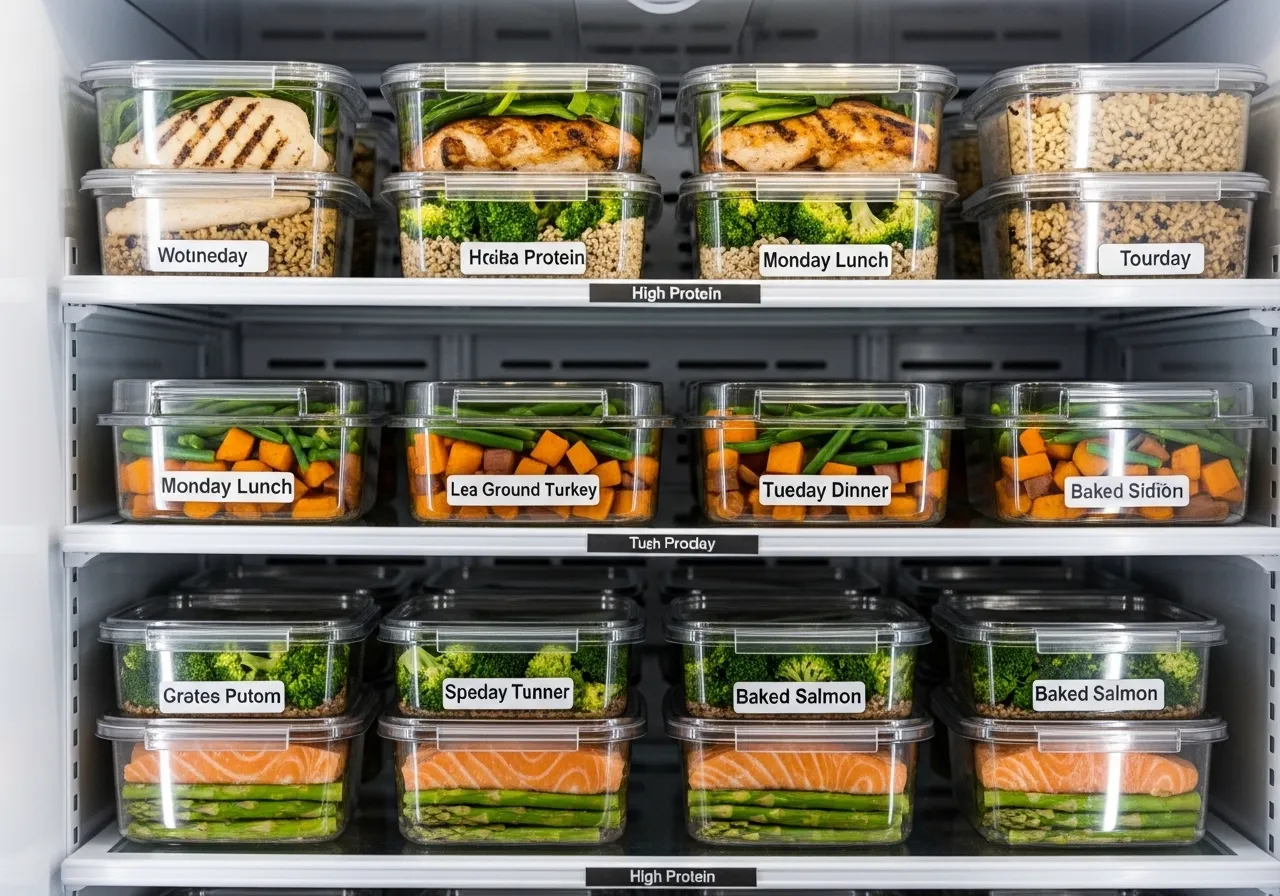
The portioning stage is where the abstract weekly plan becomes physical reality. Each container should be labeled with the day (Mon, Tue, etc.), the meal (lunch, dinner, snack), and the protein content in grams — a simple label system that eliminates any decision-making at mealtime and provides immediate macronutrient confirmation without needing to recall what was put in each container. Use uniform, stackable containers of the same brand and size to maximize refrigerator space efficiency and to simplify the reheating process (consistent container sizes reheat uniformly in the microwave, eliminating the guesswork of timing adjustments for differently sized vessels).
Glass containers with snap-lock lids are preferable to plastic for both food safety and quality maintenance reasons: glass does not absorb food odors or flavors, does not leach chemicals when heated, can be transferred directly from refrigerator to microwave to table without container changes, and lasts indefinitely with proper care compared to plastic containers that degrade over months of repeated use. The initial cost of a complete set of glass meal prep containers ($30 to $60 for a 10-piece set) is recovered within weeks through food waste reduction and reduced restaurant spending, making it a worthwhile investment for anyone planning to meal prep consistently.
| Time | Activity | Notes |
|---|---|---|
| 0 min | Oven on, chicken in, rice on, eggs boiling | All long-cook items start simultaneously |
| 7 min | Ground meat on skillet | Stir occasionally, 15–20 min total |
| 10 min | Prep vegetables for roasting | Uses unattended protein cooking time |
| 17 min | Eggs done → ice bath; vegetables into oven | Piggyback on chicken oven space |
| 30 min | Chicken done; rice done; meat done | All proteins and grains cooling |
| 35–50 min | Chop fresh veg, portion yogurt/cheese, prep sauces | Cold items while hot items cool |
| 50–75 min | Portion everything into labeled containers | Refrigerate; label day + meal + protein grams |
4-5. Batch Cooking Techniques for Maximum Efficiency
Beyond the parallel sequencing described above, several specific batch cooking techniques maximize the efficiency and quality of the protein sources produced in a Sunday prep session. The sheet pan method — cooking proteins and vegetables simultaneously on large, rimmed baking sheets in a hot oven — is the highest-efficiency cooking technique available for most meal prep proteins. A single large oven can accommodate two sheet pans simultaneously: one with seasoned chicken breast on a rack, one with cut vegetables and perhaps a second protein (salmon, ground turkey patties). Rotating the pans at the midpoint of cooking ensures even browning and consistent cooking across the full area of each pan. The sheet pan method requires minimal active attention during cooking, freeing the cook to handle stovetop preparations simultaneously and producing proteins with better surface browning and flavor development than the steamed or poached methods sometimes used for “health” reasons that sacrifice the Maillard reaction browning that is a primary contributor to palatability.
Slow cooker or Instant Pot batch cooking is the optimal method for large-volume, minimally-attended protein preparation. A 6-quart slow cooker can process 2 to 3 kilograms of chicken breast or a large quantity of legume-based stew overnight (8 to 10 hours on low) or during the first half of Sunday (4 to 5 hours on high), producing exceptionally tender, moist proteins and fully developed flavors from cheap cuts that benefit from extended cooking times. The hands-off nature of slow cooking makes it compatible with simultaneous activities — cleaning the kitchen, running errands, spending time with family — that are not possible with active stovetop or oven methods. Using a slow cooker for one protein source while the oven handles another maximizes total output from the prep session within the same time window, further increasing the efficiency of the parallel cooking approach. The first prep session will feel unfamiliar; by the fourth or fifth session the workflow operates with smooth efficiency — a productive Sunday ritual that visibly sets up a successful, well-nourished week in a single structured session. Embrace the learning curve of the first few sessions rather than feeling discouraged by initial inefficiency — the investment in developing this skill pays meaningful, compounding returns every single week for the rest of your training life.
5. Storage Tips to Keep Your Food Fresh All Week
The best meal prep system in the world fails if the food is not fresh and appetizing by the end of the week. Proper storage — understanding which foods keep longest, how to extend freshness, and how to prevent the quality degradation that makes day 5 meal-prepped food feel like a chore to eat — is the skill that determines whether meal prep remains a permanent sustainable habit or becomes a weekly exercise in eating increasingly unpleasant food. The following principles, applied consistently, maintain meal-prepped food quality throughout a five to six day refrigerator cycle.
5-1. Temperature Management: The Foundation of Food Safety
The most important factor in maintaining meal-prepped food safety and quality is rapid cooling after cooking and consistent refrigerator temperature below 4°C (40°F). The danger zone for bacterial growth in cooked food is between 4°C and 60°C — temperatures at which pathogenic bacteria multiply rapidly. Cooked food left at room temperature for more than two hours enters unsafe territory for extended storage. The practical implication for meal prep is to cool cooked food as rapidly as possible before refrigerating: spreading cooked chicken across a wide tray rather than piling it in a deep container, using an ice bath to quickly cool a large pot of cooked grains, and leaving containers uncovered to cool in a cool part of the kitchen before sealing and refrigerating. Never put a large, hot container of food directly in the refrigerator — the temperature of the hot food raises the refrigerator’s internal temperature, potentially compromising the safety of other stored items, and the slow cooling of the thick container keeps the food in the danger zone for too long.
Refrigerator organization also affects food longevity. Raw proteins should always be stored on the lowest shelf of the refrigerator to prevent any potential drip contamination of other foods. Prepared meals should be stored at eye level on the middle shelves where temperature is most consistent — the door shelves experience the largest temperature fluctuations due to repeated opening and should not be used for time-sensitive prepared foods. A refrigerator thermometer is a worthwhile $5 to $10 investment for anyone meal prepping regularly: many household refrigerators run warmer than their dial setting indicates, and identifying a refrigerator that is maintaining 6°C when set to 4°C can explain premature food spoilage and prompt a simple thermostat adjustment that dramatically extends food longevity.
5-2. Food-Specific Storage Lifespans and Best Practices
Different proteins have meaningfully different refrigerator storage lifespans, and organizing your weekly meal plan around these differences prevents quality degradation in the foods consumed later in the week. Chicken breast — the most commonly meal-prepped protein — maintains good quality for 3 to 4 days when properly cooked, rapidly cooled, and stored in airtight containers. For a 5-day meal prep cycle, consider cooking two separate chicken batches: one on Sunday covering days 1 through 3, and a smaller batch on Tuesday or Wednesday covering days 4 and 5. This two-batch approach ensures that all meal-prepped chicken is consumed within its optimal storage window without requiring the logistical complexity of a mid-week full prep session.
Cooked ground meat (beef or turkey) maintains good quality for 3 to 4 days, similar to chicken. Hard-boiled eggs stored unpeeled last up to 7 days and should be kept unpeeled until immediately before consumption — the shell provides a protective barrier against odor absorption and moisture loss that significantly extends shelf life compared to pre-peeled eggs. Cooked grains (rice, quinoa, farro, oats) last 5 to 6 days in the refrigerator when cooled rapidly and stored in airtight containers, making them the most durable cooked component of a typical meal prep spread. Cooked legumes last 4 to 5 days. Roasted vegetables last 4 to 5 days but may become somewhat softer as moisture redistributes during storage — this is acceptable in sauced dishes and grain bowls but may be less appealing in presentations where texture is important.
5-3. Strategic Freezing for Extended Variety
The refrigerator is sufficient for a five-day meal prep cycle, but strategic freezing extends the utility of a single prep session to two full weeks and dramatically reduces the repetitiveness that can undermine long-term meal prep adherence. Ground meat dishes, rice-based meals, and legume stews freeze and reheat with minimal quality loss — freezing does not significantly affect the protein content, flavor, or safety of these foods, and the quality of frozen and reheated food is largely indistinguishable from freshly prepared equivalents when frozen correctly (in airtight containers with minimal air space, at consistent temperatures below -18°C). By cooking double quantities of ground meat dishes or legume-based stews during the Sunday prep session and freezing half, you build a rotating inventory of high-protein meal components that provides variety across the week without additional weekly cooking investment.
Chicken breast is the main exception to the freeze-everything approach: while frozen cooked chicken is safe and usable, the freezing and reheating process tends to produce a drier, more stringy texture than freshly cooked chicken, particularly in lean, low-fat cuts. If freezing chicken is necessary for a longer storage period, incorporating it into a sauced dish (curry, stew, stir-fry) before freezing largely mitigates the texture degradation by keeping the chicken surrounded by moisture during the freezing and reheating cycle.
5-4. Maintaining Freshness Through Sauce Separation
One of the most effective strategies for maintaining meal-prepped food quality throughout the week is keeping sauces and dressings separate from the main components until the moment of consumption. Salad components stored with dressing become soggy within 24 hours; rice dishes stored with sauce absorb all the liquid and become dry and sticky by day three; marinated proteins can become over-saturated and mushy if stored in their marinades for multiple days. The solution is simple: store all liquid elements — sauces, dressings, marinades, gravies — in small separate containers or condiment cups that are packed alongside the main meal containers but not poured over the food until immediately before eating. This separation adds perhaps 30 seconds to the portioning step of meal prep and extends the palatability of every liquid-containing dish from 1 to 2 days to the full 4 to 5 day storage window.
| Food | Fridge Life | Freezer Life | Key Storage Tip |
|---|---|---|---|
| Cooked chicken breast | 3–4 days | 2–3 months | Rapid cool before sealing; add sauce for freezing |
| Cooked ground meat | 3–4 days | 3–4 months | Drain excess fat before storing |
| Hard-boiled eggs | 7 days unpeeled | Not recommended | Keep shell on until consumption |
| Cooked rice/grains | 5–6 days | 1–2 months | Cool quickly; store in portions |
| Roasted vegetables | 4–5 days | 2–3 months | Store sauce separately |
| Cooked legumes | 4–5 days | 2–3 months | Store in cooking liquid for moisture |
5-5. Preventing Cross-Contamination in Multi-Protein Meal Prep
When batch cooking multiple protein sources simultaneously — a common efficiency strategy in high-volume meal prep — cross-contamination prevention becomes an important food safety consideration. Raw chicken, beef, pork, and seafood all carry different potential bacterial loads and must never come into contact with each other or with ready-to-eat foods before cooking. Use separate cutting boards for different protein types (ideally color-coded: red for raw meat, yellow for poultry, blue for seafood), and clean all surfaces, utensils, and hands with hot soapy water between handling different raw proteins. Never place cooked proteins back on the same surface or container that held the raw versions without thorough washing and sanitizing in between.
Container labeling is a food safety practice as well as an organizational one. Clearly noting the date of preparation on each container — “Prep: Sunday 12 Jan” or simply “Day 1/2/3” — ensures that no container is accidentally consumed after its safe storage window has elapsed. A simple system is to use green stickers on containers prepared Sunday that should be consumed by Wednesday, and yellow stickers on containers that must be consumed by Friday. Any container that has been open in the refrigerator for more than 4 days should be discarded regardless of apparent smell or appearance — some pathogenic bacteria produce no detectable odor or visual change before reaching concentrations that can cause foodborne illness, making date-based rather than sensory-based food safety decisions the appropriate protocol for stored prepared foods. Establishing these labeling and dating systems from the very first prep session — before they feel necessary — creates organizational habits that prevent the confusion, food waste, and potential food safety issues that arise when unlabeled, undated containers accumulate in a busy refrigerator. A two-minute investment in labeling every container when it is packed pays for itself within the first week by eliminating the “is this still good?” uncertainty that causes otherwise safe food to be discarded unnecessarily. Proper labeling and dating at the portioning stage represents a small time investment with large returns distributed across every meal of the subsequent week — one of the highest-leverage organizational habits in the entire meal prep system. The few minutes spent on labeling and organizational protocol at the portioning stage deliver food safety, quality assurance, and the mealtime ease that makes reaching into the refrigerator for a prepared container a genuinely pleasurable, confident experience rather than a source of uncertainty or anxiety — a small but meaningful quality-of-life benefit that accumulates pleasantly across hundreds of weekly meals.
6. 5 High Protein Meal Prep Recipes Anyone Can Make
The following five recipes are designed specifically for meal prep efficiency: each produces 4 to 6 portions in a single cooking session, provides 30 to 45 grams of protein per portion, uses ingredients available in any supermarket, requires no advanced cooking techniques, and maintains quality for 4 to 5 days of refrigerated storage. Together they represent a complete week of varied, high-protein meals that can be prepared in a single Sunday session.
6-1. Classic Meal Prep Chicken and Rice Bowls
Makes 5 portions | ~38g protein, ~52g carbs, ~8g fat per portion
This is the foundational meal prep recipe — the one that forms the caloric and protein backbone of the week. In a large baking dish, place 1.5 kilograms of chicken breast seasoned with salt, pepper, garlic powder, smoked paprika, and a drizzle of olive oil. Bake at 200°C for 25 to 30 minutes until internal temperature reaches 74°C. While chicken bakes, cook 500 grams of dry white rice in a rice cooker or pot. Simultaneously, steam or microwave 500 grams of broccoli and 2 sliced bell peppers until tender-crisp. Once everything is cooked and cooled, slice the chicken into strips and portion evenly across five containers with rice and vegetables. For flavor variety across the week, prepare three different sauces in small containers: a simple soy-ginger sauce (soy sauce, ginger, garlic, sesame oil), a Greek lemon herb sauce (lemon juice, olive oil, oregano, garlic), and a spicy sriracha mayo (sriracha, Greek yogurt, lime juice). Applying a different sauce each day transforms what is technically the same base meal into five distinctly different flavor experiences.
6-2. Turkey and Black Bean Taco Bowls
Makes 6 portions | ~35g protein, ~45g carbs, ~12g fat per portion
Brown 1 kilogram of lean ground turkey in a large skillet with diced onion, garlic, cumin, chili powder, smoked paprika, oregano, salt, and pepper until fully cooked through. Add a can of drained black beans in the final 3 minutes of cooking. Cook 400 grams of dry brown rice. Roast 2 sliced zucchini and 2 sliced bell peppers with olive oil and cumin at 200°C for 20 minutes. Portion turkey mixture, rice, and roasted vegetables into six containers. Top each with a spoonful of pre-made Greek yogurt mixed with lime juice and garlic powder (a protein-boosting sour cream substitute). Garnish containers with fresh cilantro if desired. These bowls reheat excellently and taste arguably better on days 2 and 3 than on day 1 as the spice flavors develop and meld.
6-3. Baked Salmon with Quinoa and Asparagus
Makes 4 portions | ~40g protein, ~35g carbs, ~18g fat per portion
Place four 150-gram salmon fillets on a lined baking tray. Season with salt, pepper, garlic powder, dill, and a squeeze of lemon. Bake at 200°C for 15 to 18 minutes until just cooked through (salmon is done when it flakes easily with a fork and the thickest part is no longer translucent). Simultaneously cook 300 grams of dry quinoa. Roast 400 grams of asparagus spears with olive oil and sea salt for 15 minutes alongside the salmon. Portion into four containers. Prepare a lemon-dill Greek yogurt sauce for serving. Note: salmon is best consumed within 3 days of cooking; prepare this recipe for the first half of the week and supplement with a different protein source for days 4 and 5. The combination of omega-3 fatty acids from the salmon, complete protein from quinoa and salmon combined, and the micronutrient density of asparagus makes this the most nutritionally comprehensive of the five recipes.
6-4. High Protein Egg Muffins
Makes 12 muffins (2 per serving) | ~18g protein, ~4g carbs, ~12g fat per serving
Preheat oven to 180°C. Spray or grease a 12-cup muffin tin. Dice and lightly sauté 200 grams of turkey bacon or lean ham, 1 cup of spinach, half an onion, and 1 bell pepper. Divide the mixture evenly across the 12 muffin cups. In a bowl, whisk together 10 large eggs with salt, pepper, and 100 grams of crumbled feta or shredded cheddar. Pour the egg mixture over the filling in each cup, filling to approximately three-quarters capacity. Bake for 20 to 22 minutes until set in the center. Cool completely before storing. These muffins can be eaten cold directly from the refrigerator or reheated in the microwave for 45 to 60 seconds. They last 5 to 6 days in the refrigerator and make a complete high-protein breakfast requiring zero morning preparation. For variety, make two different flavors in the same session by dividing the fillings across the tin: 6 ham and cheese muffins, 6 spinach and feta.
6-5. Lentil and Chicken Soup
Makes 6 portions | ~32g protein, ~38g carbs, ~6g fat per portion
In a large pot, sauté 1 diced onion, 3 minced garlic cloves, 2 diced carrots, and 2 diced celery stalks in olive oil until softened. Add 1 teaspoon each of cumin, turmeric, coriander, and paprika; cook 1 minute until fragrant. Add 400 grams of dried red lentils, 1.2 kilograms of chicken breast cut into 2 cm pieces, 1 can of diced tomatoes, and 2 liters of chicken stock. Bring to a boil, reduce heat, and simmer for 25 to 30 minutes until lentils are fully soft and chicken is cooked through. Season with salt, pepper, and lemon juice. This soup thickens as it cools and stores exceptionally well for 5 days in the refrigerator or up to 3 months in the freezer. Each portion provides the protein of both the chicken and the lentils combined, producing one of the highest-protein-per-calorie soups available from this combination of ingredients.
6-6. Scaling Recipes for Different Household Sizes
The five recipes above are scaled for a single person meal prepping for the full week (5 to 6 portions per recipe). For households of two, simply double all quantities — the cooking time for doubled quantities in the oven or on the stovetop is minimally affected, since the additional food absorbs heat at the same rate when spread across a larger pan or divided across multiple pans. For meal prepping for a family of four, quadrupling the recipes above in a single session is feasible with access to two oven racks and two large skillets or pots operating simultaneously. The efficiency gains of larger-scale meal prep are even more pronounced than for individual meal prep: four people eating from the same prep session require only marginally more cooking time than one person, because the primary time investments (oven preheating, water boiling, prep time) are fixed regardless of quantity up to the capacity limits of the equipment being used.
For households with significantly different dietary preferences or protein requirements — a strength athlete and a sedentary partner, for example — consider prepping a shared carbohydrate base (rice, roasted vegetables) that serves both household members while preparing separate protein portions tailored to each person’s specific targets. The shared base significantly reduces total prep time compared to fully separate meal preparations, while allowing individual protein customization that respects different nutritional needs and preferences within the same household. Batch-cooking three or four different protein sources in a single session and allowing each household member to combine their preferred protein with the shared carbohydrate base across the week provides both nutritional personalization and the efficiency of shared preparation infrastructure.
A word on recipe customization to prevent flavor fatigue specifically in multi-person households: while the meal planner typically has strong opinions about the week’s flavor themes, other household members may have different preferences that the meal planner needs to accommodate for the system to achieve household-wide adoption. Involving other household members in choosing the week’s sauce and spice themes during the Sunday planning step — a 5-minute conversation that costs nothing in additional prep time — dramatically increases buy-in and reduces the “I don’t want to eat that again” resistance that derails household meal prep systems. The most technically perfect meal prep is the one that everyone in the household actually eats, and the social dimension of achieving that consensus is as important as the nutritional and logistical dimensions that receive the majority of meal prep guidance attention. Ultimately, the meal prep system that succeeds long-term within a household is the one that earns genuine buy-in from everyone it feeds — and that buy-in is built through inclusive planning, responsive recipe rotation, and the consistent demonstration that meal-prepped food can be genuinely delicious, varied, and satisfying rather than the monotonous, obligation-food that poorly designed meal prep systems tend to produce. Invest the planning effort required to make the system work for your household specifically, and the returns — financial, nutritional, time-related, and relational — will compound across months and years of shared, well-nourished living.
The nutritional value of meal-prepped food is maximized when the system is treated as a living practice rather than a rigid protocol. Each week provides new opportunities to improve the recipes, refine the workflow, explore new flavor combinations, and adapt the system to the evolving demands of your training, schedule, and preferences. The recipes in this section are proven, reliable starting points — but the most satisfying and effective meal prep system is ultimately the one you have customized through weeks of experimentation to perfectly fit your specific nutritional targets, taste preferences, cooking skills, and lifestyle constraints. That customization process is itself a rewarding dimension of the meal prep practice, and it is what transforms a borrowed recipe collection into a genuinely personal nutritional system that you own completely.
7. How to Avoid Meal Prep Boredom All Week
The most technically perfect meal prep system fails in the real world if the food becomes so monotonous that eating it feels like a chore rather than a pleasure. Flavor fatigue — the loss of appetite for food that was enjoyable on day one but feels repetitive by day four — is the primary reason people abandon meal prep habits and revert to impulsive, less nutritious eating patterns. Preventing flavor fatigue requires deliberate variety strategies that are compatible with the efficiency demands of batch cooking.
7-1. The Sauce Rotation Strategy
The single most effective and logistically straightforward strategy for preventing meal prep boredom is maintaining a rotating library of 5 to 8 sauces and dressings that transform the same base protein and grain into dramatically different flavor experiences. The foundation of this strategy is cooking proteins and grains in a plain, neutral way — minimal seasoning beyond salt and pepper — that makes them maximally versatile as blank canvases for the specific flavor profile being applied at each meal. A plain-cooked chicken breast seasoned with only salt and pepper can become Thai peanut chicken, Italian chicken piccata, Japanese teriyaki, Mexican chili lime, or Greek lemon herb depending entirely on which sauce is added at mealtime — five completely different flavor experiences from a single batch-cooking effort.
Preparing a batch of 5 different sauces during the Sunday prep session — each stored in a small lidded container or condiment cup alongside the main meal containers — requires approximately 20 to 30 minutes of additional prep time and produces the flavor variety that makes a week of meal-prepped food feel genuinely varied rather than repetitively monotonous. Simple sauces that take under 5 minutes to prepare include: peanut sauce (peanut butter, soy sauce, lime juice, garlic, ginger, water to thin), tahini dressing (tahini, lemon juice, garlic, water, salt), teriyaki glaze (soy sauce, honey, garlic, ginger, cornstarch), chimichurri (fresh parsley, garlic, olive oil, red wine vinegar, chili flakes), and harissa yogurt (Greek yogurt, harissa paste, lemon juice).
7-2. Varying Grains and Carbohydrate Bases
Varying the carbohydrate base of meal-prepped bowls — switching between white rice, brown rice, quinoa, farro, barley, noodles, and sweet potato across the week — provides textural and flavor variety that makes a repetitive protein source feel much less monotonous. Cooking three or four different grain options during a single prep session (each taking 20 to 30 minutes in separate pots, easily parallelized) and rotating them across the week’s meals provides genuine textural diversity that is as important as flavor variety for sustained enjoyment of meal-prepped food. The nutritional profiles of different grains also vary meaningfully: quinoa provides the most complete amino acid profile of any grain; farro provides the highest fiber; white rice provides the most rapidly digestible carbohydrate for pre and post-workout timing. Rotating grains is not just a palatability strategy — it is a nutritional diversity strategy that broadens the micronutrient and fiber intake of an otherwise repetitive eating pattern.
7-3. Fresh Toppings and Garnishes
Adding fresh elements at mealtime — elements that were not part of the batch-cooked prep — provides the textural contrast of cold, crisp, or raw foods against the warm, soft textures of batch-cooked proteins and grains. Fresh avocado sliced over a rice bowl, a handful of arugula wilted slightly by warm protein, a squeeze of fresh lemon over fish, freshly diced tomato and cucumber alongside a Greek chicken bowl, a soft-boiled egg cracked over ramen-style noodles — these fresh additions take under 60 seconds to prepare at mealtime and transform the eating experience from “reheated container food” to “fresh, complete meal.” Maintaining a supply of fresh garnishes — avocado, lemons, fresh herbs, cherry tomatoes, cucumber — as part of the weekly shopping list ensures that these mealtime enhancements are always available without requiring significant planning or preparation.
7-4. Macro-Compatible Restaurant Meals as Strategic Variety
Rigidity is the enemy of sustainable meal prep adherence. Allowing one or two meals per week to be restaurant or takeout meals — planned rather than impulsive, chosen with protein content in mind — provides the social flexibility and novelty that prevents the psychological resentment that rigid meal prep regimes often generate. The strategic approach to restaurant meals within a meal prep framework is to identify in advance which meals in the week are designated “flexible meals” — typically dinner on one or two evenings when social plans make cooking unlikely — and to compensate nutritionally by ensuring the other meals of those days hit their protein targets from the prepped food. A day that is 100 percent meal-prepped for breakfast, lunch, and snack allows dinner at a restaurant without compromising the week’s overall protein targets, provided the restaurant meal is chosen with at least a reasonable protein content in mind (a protein-containing entree rather than a purely carbohydrate-dominated dish).
7-5. Seasonal and Thematic Variety Across Weeks
Varying the thematic cuisine focus from week to week — one week Mediterranean-themed meal prep, the following week Asian-inspired, the week after Mexican — maintains the novelty and anticipation that sustains long-term meal prep enthusiasm. The proteins and grains remain constant (chicken, rice, eggs, legumes), but the spice profiles, sauces, and supplementary vegetables change entirely with each cuisine theme. This thematic rotation is easy to implement because the cooking techniques remain the same — the variation is entirely in the seasoning and sauce library, not in the fundamental cooking approach. Building a cuisine theme rotation into your weekly planning adds a creative and enjoyable dimension to meal prep that transforms it from a purely functional exercise into a structured culinary exploration that maintains engagement across months and years of consistent practice.
7-6. Building a Sustainable Long-Term Meal Prep Practice
The strategies above address variety within a single week, but building a meal prep practice that you genuinely enjoy and sustain over months and years requires a longer-term perspective on what keeps the practice engaging and rewarding. One powerful approach is maintaining a personal meal prep recipe library — a physical binder, a digital document, or a dedicated app — that accumulates tested, successful recipes across months of experimentation. Each week that you try a new recipe or sauce variation and find it successful, add it to the library. Over six months of weekly meal prep, a library of 25 to 35 tried-and-true recipes provides a rotation large enough that revisiting any specific recipe never feels repetitive — each recipe comes around approximately once per month rather than every week.
Seasonal eating provides a natural variety structure that aligns meal prep themes with the freshest, most flavorful, and most cost-effective produce available throughout the year. Summer meal prep featuring grilled proteins and fresh salad bases tastes completely different from winter meal prep centered on hearty stews and roasted root vegetables — both can hit identical protein targets while providing the seasonal variety that connects eating to the natural rhythm of the year and makes the food more interesting by the sheer fact of its contextual appropriateness. Shopping for whatever vegetables are in peak season and on sale, then building the week’s sauces and grain choices around those vegetables rather than following a fixed recipe formula, develops the improvisational cooking competence that is the hallmark of experienced meal preppers who have moved beyond rigid recipe dependence to
The five recipes in this guide are starting points, not ceilings. Each one has been chosen for its reliability, nutritional quality, and meal prep suitability — but the real value they provide is not the specific recipes themselves but the templates they represent. The chicken and rice bowl template can become a hundred different dishes through protein substitution and sauce rotation. The egg muffin template adapts to whatever vegetables, cheeses, and cured meats are available. The soup template accommodates any legume, any leafy green, any spice profile that fits the seasonal or cultural culinary direction of a given week. Learning to see the template beneath the specific recipe — and to improvise within that template using the ingredients available and the skills accumulated — is the culinary intelligence that transforms meal prep from a recipe-following exercise into a genuine, creative nutritional practice.
genuine nutritional fluency. This improvisational competence — the ability to look at what is in season, what is on sale, and what your training week requires, and design a complete, delicious, high-protein meal plan from those constraints — is the ultimate expression of meal prep mastery, and it is entirely accessible to anyone who commits to the weekly practice with curiosity and a willingness to experiment beyond the recipes and protocols that initially guided them into the habit.
Frequently Asked Questions
How many days in advance can I meal prep?
Most cooked proteins (chicken, ground meat, fish) maintain good quality for 3 to 4 days in the refrigerator. Cooked grains last 5 to 6 days. For a full 5-day week, consider cooking fish and seafood for the first half of the week and chicken or ground meat for the second half, or do a small mid-week re-prep of fresh fish on Wednesday to cover the latter part of the week. Alternatively, freeze portions intended for days 4 and 5 on Sunday and defrost in the refrigerator overnight on Tuesday.
Do I need special containers for meal prep?
Glass containers with snap-lock lids are ideal — they are microwave-safe, do not absorb odors, last indefinitely, and maintain food quality better than plastic. A 10-piece set of glass meal prep containers costs $30 to $60 and represents a worthwhile one-time investment. If budget is a constraint initially, any food-safe, airtight containers work adequately; upgrade to glass as resources allow.
How do I avoid getting sick of the same food every day?
The sauce rotation strategy is the most effective solution — preparing 4 to 5 different sauces during the Sunday prep session and applying a different one to the same base protein each day transforms the flavor experience entirely. Additionally, varying the grain base across the week (rice Monday, quinoa Tuesday, noodles Wednesday) and adding fresh toppings at mealtime (avocado, fresh herbs, lemon) provides textural and flavor variety that prevents meal fatigue.
Is it cheaper to meal prep than to buy ready-made food?
Significantly. A batch-cooked chicken breast and rice meal costs approximately $2.50 to $4.00 per portion including all ingredients. Equivalent nutritional content from a restaurant, takeout, or meal kit service typically costs $12 to $20 per meal. For five lunches and five dinners per week, meal prep saves approximately $80 to $160 weekly over restaurant and takeout alternatives — $4,000 to $8,000 per year for a single person.
What if I don’t have time to prep on Sunday?
Meal prep does not require a single large Sunday session — it can be distributed across two shorter sessions (Thursday and Sunday, covering four days and three days respectively), or even as 20-minute daily micro-preps where one or two items are batch-cooked each evening for the following day. The principle is consistent preparation in advance; the specific scheduling is flexible to individual lifestyle constraints. A 20-minute session of batch-boiling eggs and cooking rice while dinner is already on the stove requires no additional kitchen time beyond what is already being spent on daily cooking.
Leave a Reply