The Complete Guide to Rest and Recovery for Serious Athl


Why Recovery Is the Most Undervalued Part of Athletic Training
Every serious athlete knows that training produces fitness. Far fewer understand that training produces fitness only through the recovery that follows it — and that the recovery process is not the passive absence of training but an active, physiologically complex sequence of adaptations that training stimulus initiates and recovery conditions determine the quality of. I spent the first three years of serious training treating rest days as necessary evils — the gaps in the training schedule that the body’s limitations imposed rather than the adaptation sessions that the physiology demands. The consequence was the plateau that maximum-effort training without adequate recovery consistently produces: not the progressive performance improvement that the training volume justified but the stagnation that chronic under-recovery imposed as its ceiling. Understanding the recovery science — what specifically happens during recovery, why it requires the conditions that training culture most often neglects, and how to actively optimize it — transformed my training outcomes more than any program change I had made in the preceding years.
The Physiology of Recovery: What Actually Happens When You Rest
The recovery process that follows a training session is a cascade of physiological events that unfolds over hours to days, each phase creating the conditions that the subsequent phase requires. Phase 1 — The immediate post-exercise period (0-2 hours): the termination of the exercise-induced sympathetic nervous system activation allows the parasympathetic recovery mode to reassert, reducing heart rate and blood pressure toward resting values; the acute inflammatory response to the mechanical stress and metabolic disruption of training initiates the repair cascade that mobilizes immune cells to the trained tissue; and the rapid glycogen resynthesis that insulin sensitivity elevation in the post-exercise period supports begins the fuel restoration that the next training session requires. Phase 2 — The early recovery period (2-24 hours): the inflammatory cascade peaks in the muscle and connective tissues that training loaded, producing the immune cell infiltration and the cytokine signaling that activates the satellite cell proliferation and muscle protein synthesis that repair and hypertrophy require; the acute anabolic response to training stimulus peaks and requires the protein substrate that post-training nutrition provides for maximal utilization; and the hormonal environment shifts toward the anabolic state that growth hormone secretion during sleep and the testosterone-cortisol ratio normalization that adequate recovery produces. Phase 3 — The late recovery period (24-72 hours): the repair tissue formation and the muscle protein accretion that the inflammatory and anabolic signaling of phase 2 initiated produces the structural remodeling that constitutes adaptation; the glycogen stores that training depleted are restored if carbohydrate intake is adequate; and the neuromuscular system’s motor pattern encoding that training provided is consolidated into the long-term motor memory that sleep’s memory consolidation process supports. From PubMed research on post-exercise recovery physiology and adaptation mechanisms, the multi-phase recovery cascade that the first 72 hours after training represent requires the specific nutritional, sleep, and stress management conditions that each phase’s biology demands — confirming that recovery is an active physiological process that training design must accommodate rather than a passive rest period that time alone provides.
The Training-Recovery Balance: Finding Your Optimal Stress-Adaptation Ratio
The supercompensation model — the theoretical framework that describes the performance trajectory from the initial post-training fatigue through the recovery adaptation to the supercompensated state that exceeds the pre-training baseline — provides the conceptual foundation for understanding why the training-recovery balance determines adaptation quality. The model’s practical implications: training sessions applied before the recovery from the previous session is complete accumulate fatigue rather than adaptation; training sessions applied too infrequently (after the supercompensation window has passed) miss the elevated fitness state that optimal timing exploits; and the training sessions applied in the supercompensation window capitalize on the adaptation the previous training-recovery cycle produced. The real-world complexity that the simplified supercompensation model obscures: the multiple tissue types and physical qualities that training simultaneously develops (strength, cardiovascular capacity, skill, connective tissue resilience) each have different adaptation and recovery timelines — the neural adaptations that recover in 24-48 hours, the glycogen stores that 24-36 hours of adequate carbohydrate intake restores, the muscle protein synthesis that peaks in the 24-72 hour post-training window, and the connective tissue structural remodeling that requires 48-96 hours — mean that the “fully recovered” state is not a single moment but a complex of varying tissue readiness states that the experienced athlete learns to navigate. The practical training frequency implication: the twice-daily training that elite athletes perform is not appropriate for most recreational athletes because the recovery capacity that supports high-frequency training requires the training age, nutritional precision, and lifestyle management that professionals commit to — the 3-5 sessions per week that recreational athletes can fully recover between sessions provides the adaptation stimulus that full recovery between sessions optimally utilizes.
The Deload Week in Practice: What to Do and What to Avoid
The deload week is the most consistently misimplemented component of periodized training — athletes either skip it entirely (believing the motivation that the training block’s final week provides makes rest counterproductive) or implement it incorrectly (reducing intensity without reducing volume, or reducing volume without maintaining movement quality). The correct deload implementation: 50-60% of the training block’s working volume (sets × reps × load), performed at 60-70% of the working block’s intensities, with full technical attention to movement quality at the lighter loads. The deload week retains the training frequency — the session count remains the same — because the habit maintenance and the technical practice that lower loads allow without fatigue interference both benefit from frequency preservation. The deload week’s specific benefits beyond fatigue clearance: the lighter loads of the deload week allow technical refinement that the heavier working loads of the training block make difficult — the cues and movement patterns that technique videos demonstrate but that heavy loading prevents implementation of become accessible during the deload’s lower demand. The psychological benefit of the deload: the motivated athlete who approaches the deload as technique practice and active recovery rather than passive rest finds that the week passes more productively and provides the mental refreshment alongside the physiological recovery that makes the subsequent training block’s first sessions feel more energized than the deload-preceding sessions had been. The deload timing variation: early deload (every 3 weeks) for the athlete whose recovery capacity is limited by life demands, age, or training intensity; standard deload (every 4-5 weeks) for the typical recreational athlete; and extended training block (every 6-7 weeks) for the athlete with high training age, excellent recovery capacity, and well-managed life stress — the variable that the individual monitoring system provides the data to determine.
Recovery Technology: An Honest Assessment of What’s Worth the Investment
The recovery technology market offers an expanding range of products and devices at prices ranging from modest to extraordinary — and the evidence-based assessment of what actually worth purchasing is both simpler and more conservative than the marketing investment in the category suggests. Worth the investment: a quality sleep tracking wearable (Whoop, Garmin, Oura Ring) that provides consistent HRV and sleep quality monitoring gives the objective recovery data that training load decisions benefit from — the $150-350 annual cost is recovered in the avoided training sessions at insufficient recovery states that the data prevents. A foam roller and lacrosse ball ($20-40 total) provides the mobility and tissue preparation work that expensive percussive therapy devices replicate at substantially higher cost without proportionally better outcomes. Quality blackout curtains ($30-60) for the sleep environment that sleep quality research identifies as a primary determinant of SWS quality. Probably not worth the premium: percussive massage devices (Theragun and equivalents at $200-600) provide recovery benefits equivalent to foam rolling and manual massage without the evidence of superior outcomes at the price premium they command — convenient but not transformative. Pneumatic compression boots ($500-1500) show modest DOMS-reduction evidence in high-volume training contexts but provide benefits that the combination of compression garments and adequate recovery time produces at dramatically lower cost. Cold plunge tubs ($2000-8000) produce the same cold water immersion evidence as a standard bathtub with cold water and ice — a sensory and experience upgrade rather than a physiological improvement over the accessible alternative.

Sleep: The Master Recovery Tool
Sleep is the single highest-impact recovery intervention available to the athlete — more impactful than ice baths, compression, massage, supplements, or any other recovery modality that the industry promotes with greater enthusiasm and cost. The primacy of sleep in athletic recovery is not marketing but mechanistic: the growth hormone secretion, the cortisol regulation, the memory consolidation, and the immune function that recovery requires all peak during specific sleep stages that adequate sleep duration and quality provide.
Sleep Architecture and Athletic Recovery: The Stage-Specific Mechanisms
The architecture of sleep — the cycles of light sleep, deep slow-wave sleep (SWS), and REM sleep that normal sleep progresses through — is not uniformly relevant to athletic recovery; specific sleep stages provide specific recovery mechanisms that the athlete needs to understand for the sleep optimization that recovery management requires. Slow-wave sleep (SWS): the deep sleep stages (N3) that dominate the first half of the sleep period are the primary window for growth hormone secretion — the large-amplitude GH pulse that SWS produces accounts for approximately 70-80% of the daily growth hormone release that tissue repair, protein synthesis, and metabolic restoration require. The SWS-GH connection means that the total duration of SWS — which depends on total sleep duration and the maintenance of sleep continuity — directly determines the growth hormone availability that recovery quality reflects. REM sleep: the rapid eye movement sleep that predominates in the final hours of the sleep period provides the motor skill consolidation, emotional regulation, and cognitive processing that training skill acquisition and motivational recovery require. The endurance athlete who cuts 90 minutes from an 8-hour sleep schedule loses primarily REM sleep (the stages that the lighter late-sleep cycles represent) and consequently the motor pattern consolidation and psychological recovery that the full sleep period provides. The sleep stage disruption mechanisms that athletes most commonly experience: caffeine consumed within 6 hours of sleep suppresses SWS architecture even when sleep onset and total duration are unaffected; alcohol reduces REM sleep in the second half of the night while initially increasing SWS; and the pre-sleep technology exposure that the blue-light-melatonin suppression research documents delays sleep onset and may reduce SWS proportion when the sleep-time compression that late onset produces eliminates early-cycle SWS. From PubMed research on sleep stages and athletic recovery mechanisms, the growth hormone secretion during SWS and the motor skill consolidation during REM represent the sleep architecture-specific recovery mechanisms that total sleep duration must be sufficient to fully include — confirming that sleep duration of 8-9 hours for active athletes is required to provide the complete SWS and REM architecture that recovery requires, not merely to prevent the fatigue that shorter sleep produces.
Sleep Extension: The Most Underutilized Recovery Strategy
Sleep extension — deliberately increasing sleep duration above normal baseline — is among the most compelling recovery interventions with athlete-specific research support. The Mah et al. (2011) landmark study in Stanford basketball players showed that extending sleep to 10 hours per night (compared to the players’ habitual 7-8 hours) produced significant improvements in sprint speed, shooting accuracy, and reaction time over a 5-7 week period — performance benefits from sleep extension alone without any other training or nutritional change. Subsequent studies in tennis players, football players, and swimmers have consistently replicated the pattern: athletes sleeping below their biological sleep need (determined by how much they sleep when schedule permits free sleep) are performing below their potential at the neurological level, and the sleep extension that brings them to biological sufficiency produces performance improvements that are large relative to the trivial cost of sleeping more. The practical sleep extension strategies for the athlete whose schedule constraints limit sleep duration: the sleep time-shift strategy that moves sleep earlier rather than later (earlier bedtime with the same wake time) is more effective for SWS preservation than late-sleep extension because SWS concentrates in early-night sleep cycles; the nap supplement strategy that adds 20-30 minutes of daytime napping (the duration that completes a light sleep cycle without entering the SWS that nap inertia produces on waking from) complements the compressed nighttime sleep; and the weekend sleep extension that allows biological sleep need satisfaction 2 days per week provides partial compensation for the weekday schedule-compressed sleep without the performance benefit that consistent adequate nightly sleep would provide.
Practical Sleep Optimization for the Serious Athlete
The sleep optimization strategies that the sleep research most consistently supports are not expensive or complicated — they require behavioral consistency and environment management rather than technology or supplementation. The sleep schedule consistency that circadian biology demands: the circadian clock that regulates the sleep-wake cycle and the cortisol, melatonin, and growth hormone secretion that recovery physiology requires develops its sharpest anticipatory rhythms with consistent sleep and wake times — the athlete who sleeps at the same time every night within 30 minutes provides the circadian regularity that the hormonal timing that recovery biology requires. The sleep environment optimization: complete darkness (below 1 lux during sleep) is required for the melatonin secretion that sleep onset and architecture requires — the light exposure from streetlights, electronics, and nightlights that most sleeping environments allow suppresses melatonin and reduces both sleep depth and duration; room temperature between 18-20°C supports the core temperature drop that sleep onset requires; and white noise or earplugs that minimize the sleep-fragmenting noise disruptions that urban environments produce maintain the sleep continuity that architecture preservation requires. The pre-sleep routine that sleep science supports: the 60-90 minutes before the target sleep time should exclude the blue-light exposure of screens (phones, tablets, computers), the high-intensity exercise that the cortisol and core temperature elevation from vigorous late-night training suppresses melatonin and delays sleep onset for 3-4 hours, and the mentally stimulating activities that the cognitive arousal reduction that sleep onset requires is opposed by. The wind-down that light reading, gentle stretching, warm bath or shower (the rapid core temperature drop after exiting the warm water accelerates the thermoregulatory sleep initiation), and relaxation breathing practices provide produces the transition to sleep onset that the recovery quality sleep duration requires.
Napping: The Evidence for Strategic Short-Term Sleep
The strategic nap — 10-30 minutes of daytime sleep — has accumulated a compelling evidence base for both athletic performance and recovery acceleration that exceeds what most athletes who dismiss napping as impractical or unnecessary recognize. The nap research in athletic populations: the NASA nap study established the performance-enhancing effects of 26-minute naps for pilots (40% improvement in performance, 100% improvement in alertness) — findings that sport science has replicated in athletic populations showing improved sprint performance, reaction time, and subjective readiness following 20-30 minute post-lunch naps. The recovery mechanism: the light sleep stages (N1 and N2) that a 20-30 minute nap contains provide the cognitive and physiological recovery from morning training that the afternoon training session benefits from — the homeostatic sleep pressure relief that even short sleep provides reduces the accumulated fatigue that morning training generates and from which afternoon training performance suffers without the nap’s partial relief. The nap timing for athletes with twice-daily training: the post-lunch window (1-3 PM) aligns with the circadian dip in alertness that occurs even in well-rested individuals, making the nap biologically timed with the circadian rhythm rather than against it — the sleep onset that the circadian dip facilitates makes this window the most efficient for nap implementation. The nap duration calibration: 10-20 minutes provides the cognitive refreshment without the sleep inertia (the grogginess of waking from deeper sleep stages) that 30+ minute naps risk when they enter N3 slow-wave sleep; 30-minute naps with a 15-minute cushion (setting the alarm for 45 minutes, expecting 15 minutes of onset) provides the full N1-N2 cycle; and 90-minute naps that complete a full sleep cycle (including N3 and REM) provide the most complete recovery at the cost of the longest time commitment and most consistent sleep inertia on waking.

Nutrition for Recovery: The Fuel That Powers Adaptation
The nutritional decisions made in the hours following training determine whether the training stimulus initiates the adaptation response that the investment of training effort deserves — the athlete who trains hard and then provides inadequate nutritional support for the recovery process is failing to collect the adaptation return on the training investment they have made.
The Post-Training Anabolic Window: What It Is and What It Isn’t
The post-training “anabolic window” concept has generated both legitimate nutritional science and significant marketing mythology — the reality is more nuanced than either the “consume protein within 30 minutes or your training is wasted” marketing claim or the “timing doesn’t matter” counter-reaction that protein timing research revision produced. The actual post-training protein timing evidence: the muscle protein synthesis rate is elevated for 24-48 hours following a resistance training session — the entire recovery period is an “anabolic window” in the sense that the trained muscle is more responsive to protein stimulus than the untrained resting muscle for this extended period. However, the protein synthesis rate is highest in the first 2-3 hours post-training and gradually declines toward baseline over the subsequent 24-48 hours — making the early post-training feeding most productive but not making later feeding ineffective. The practical protein timing recommendation that balances the evidence: consuming 30-40g of high-leucine protein (whey, eggs, dairy, meat, fish) within 60-90 minutes of training captures the highest-sensitivity protein synthesis window without the urgency that the “30-minute window” myth implies — the athlete who finishes training, showers, and eats within the hour is appropriately timing rather than racing against a closing window. The protein source quality for post-training recovery: whey protein provides the highest leucine content per gram of any common protein source and the fastest digestion rate that makes it specifically well-suited for the post-training context — the 2.5-3g leucine per 30-40g serving that whey provides reliably crosses the mTOR activation threshold that maximizes protein synthesis stimulation. From PubMed systematic review of protein timing and muscle protein synthesis, consuming adequate protein in the hours following resistance training consistently produces greater muscle protein accretion than isocaloric protein consumption without training-proximity timing — confirming that the post-training protein feeding is a meaningful recovery nutrition decision rather than the irrelevant timing factor that the timing-doesn’t-matter reaction to anabolic window marketing overstated.
Carbohydrate for Recovery: Glycogen Resynthesis and Its Implications
Glycogen resynthesis — the replacement of the muscle and liver glycogen that training depletes — is the nutritional recovery priority that carbohydrate intake determines, and the rate of glycogen resynthesis significantly affects the training quality of the subsequent session for the athlete whose schedule requires less than 24 hours between training sessions. The glycogen resynthesis rate: post-exercise glycogen synthesis occurs at approximately 5% of maximum glycogen content per hour when carbohydrate intake is adequate, making complete glycogen restoration from significant depletion a 20-24 hour process with optimal carbohydrate intake. The carbohydrate dose that maximizes resynthesis rate: 1.0-1.2g per kilogram body weight per hour for the first 4 hours post-training accelerates glycogen resynthesis to the maximum biological rate — the aggressive carbohydrate replacement that the twice-daily training athlete requires but that the once-daily athlete benefits from less urgently because 24-hour total carbohydrate adequacy rather than acute timing is the determining variable. The carbohydrate-protein combination that the research identifies as superior to either macronutrient alone for combined glycogen resynthesis and muscle protein synthesis: a 3:1 carbohydrate-to-protein ratio in the post-training meal (approximately 60-90g carbohydrate and 30-40g protein) maximizes both the glycogen resynthesis and the protein synthesis that the post-training recovery requires simultaneously. The glycogen depletion detection that training performance provides: the unexplained performance decline, the exaggerated fatigue at familiar training intensities, and the cognitive fog that low glycogen produces in the final phases of long sessions are the practical signals that inadequate carbohydrate recovery has accumulated chronic glycogen depletion — the nutritional signal that increases carbohydrate intake and rest addresses before the performance decline deepens.
Micronutrients and Antioxidants in Recovery Nutrition
The micronutrient dimension of recovery nutrition addresses the specific vitamins, minerals, and phytonutrients that the physiological processes of recovery — inflammation resolution, protein synthesis, mitochondrial biogenesis, immune function — require as cofactors, substrates, and signaling molecules. The most recovery-relevant micronutrients: Zinc (required for protein synthesis enzymes, immune function, and testosterone production — the mineral that training sweat losses and inadequate dietary zinc intake from low meat consumption can deplete below the functional threshold that recovery quality suffers from); Iron and ferritin (the oxygen transport and storage that training increases the demand for, and the deficiency that produces the fatigue and performance decline that mimics overtraining in the athlete whose iron status is inadequate); Vitamin C and E (the antioxidant vitamins that modulate the inflammatory response to training — the nuanced recommendation being that the acute inflammatory response to training should not be completely suppressed because it is part of the adaptation signal, but the chronic low-grade inflammation that excessive training volume produces benefits from the antioxidant support that adequate vitamin C and E provides). The anti-inflammatory foods that accelerate inflammation resolution: the omega-3 rich foods (fatty fish, walnuts, flaxseed), the polyphenol-rich foods (berries, cherries, pomegranate, turmeric), and the nitrate-rich foods (beets, leafy greens, arugula) that sport nutrition research has documented as recovery-supporting through their anti-inflammatory, antioxidant, and vasodilatory mechanisms. From PubMed review of nutritional strategies for exercise recovery, the combination of adequate protein, carbohydrate, and anti-inflammatory micronutrients in the recovery nutrition approach consistently produces faster recovery markers and higher subsequent training quality than macronutrient-only recovery nutrition — confirming that micronutrient attention in the recovery meal planning is a meaningful performance and recovery variable.
Active Recovery Methods: What the Research Actually Supports
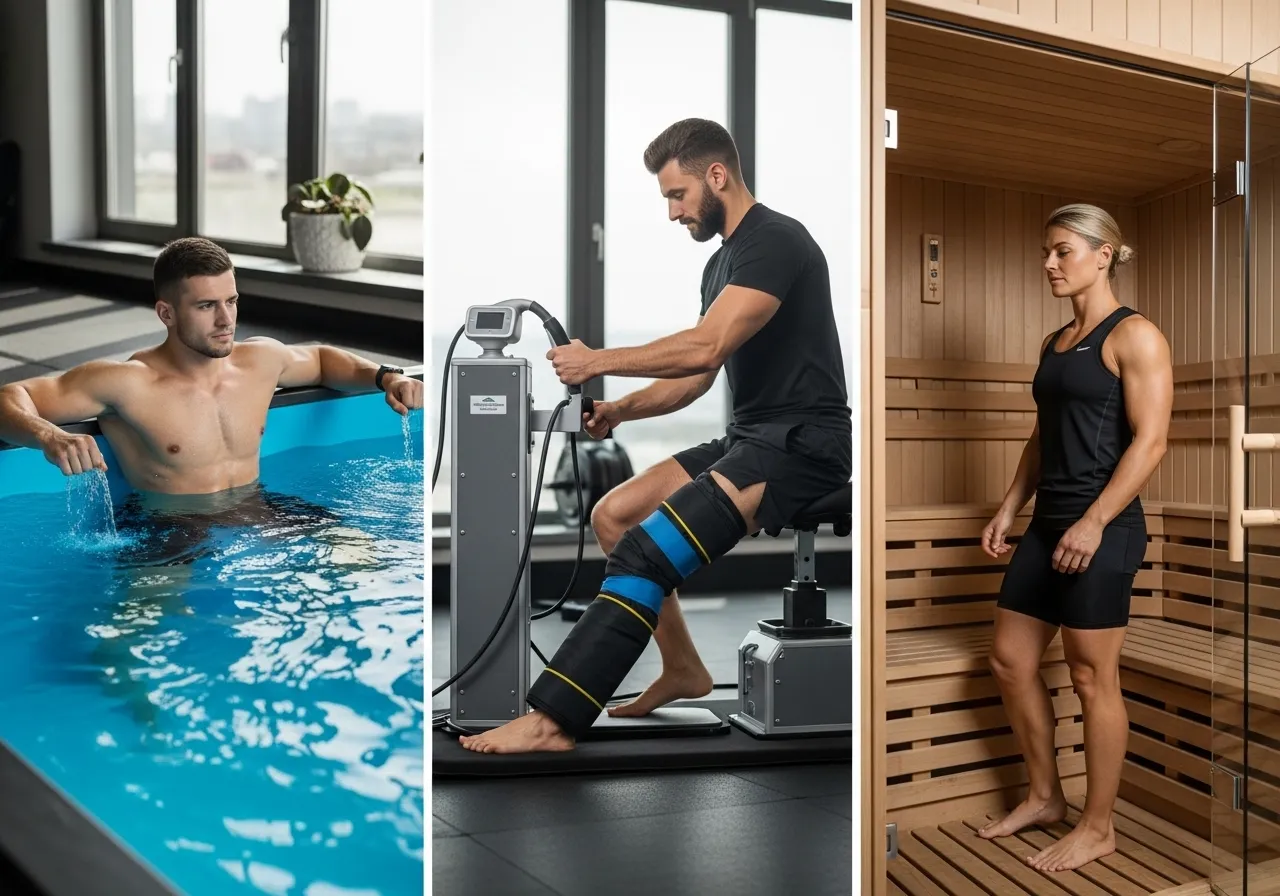
The recovery modality market has expanded dramatically alongside the growth of competitive amateur athletics — from the traditional ice bath to the modern pneumatic compression boot, hyperbaric chamber, and infrared sauna, the options and costs available to the athlete seeking recovery optimization span an enormous range. The evidence base that should guide investment decisions is considerably narrower than the product market suggests.
Cold Water Immersion and Contrast Therapy: The Evidence Assessment
Cold water immersion (CWI) — immersion to the waist or full-body in water at 10-15°C for 10-15 minutes following training — has the most extensive athletic recovery research base of any single recovery modality and provides the most clear-eyed evidence assessment of the modality landscape’s complexity. The CWI benefits with consistent evidence: DOMS reduction (10-15% reduction in peak soreness in the 24-72 hours following training) and perceived recovery improvement (subjective readiness scores that are reliably higher in CWI versus passive recovery conditions); the mechanism likely involving the cold-induced vasoconstriction that reduces the edema accumulation of the inflammatory response and the counterpressure of the hydrostatic environment. The CWI costs that require the benefit accounting: multiple studies have documented that regular post-resistance-training CWI blunts the satellite cell activation and the anabolic signaling that resistance training for hypertrophy requires — the cold-induced vasoconstriction that reduces the inflammatory edema also reduces the blood flow that delivers the anabolic hormones and substrates to the trained muscle. The practical implication: CWI is best reserved for the competition or intensive training period where recovery speed is the priority over maximal adaptation accumulation, rather than routine use throughout the hypertrophy-focused training blocks where the adaptation signal preservation is more important than acute recovery acceleration. Contrast therapy (alternating hot and cold immersion) shows similar but somewhat attenuated evidence for both the recovery benefits and the adaptation blunting compared to CWI alone. From PubMed systematic review of cold water immersion and athletic recovery, CWI consistently reduces DOMS and improves perceived recovery but may impair long-term hypertrophic adaptation with regular use — confirming the strategic rather than routine application that the complete evidence balance supports.
Compression, Massage, and Foam Rolling: The Practical Evidence
The compression, massage, and foam rolling interventions that athletes most commonly use for recovery provide modest evidence-supported benefits that are distinct from the dramatic recovery claims that their commercial promotion often makes. Compression garments: the graduated compression that compression tights, sleeves, and socks provide shows consistent small-to-moderate evidence for reduced DOMS and improved perceived recovery in the 24-48 hours following training — the venous blood return improvement and the reduced edema accumulation that hydrostatic pressure provides are the plausible mechanisms. The magnitude of the compression benefit is modest — sufficient to justify wearing compression tights that an athlete finds comfortable but insufficient to justify significant expense or discomfort for the effect size the evidence documents. Sports massage: the systematic review evidence for sports massage shows consistent small benefits for DOMS reduction and psychological recovery perception — but also reveals that the benefit magnitude does not clearly exceed the attention and human contact placebo that massage inherently provides, making mechanistic claims for specific massage techniques difficult to support beyond the well-supported but mechanism-non-specific relaxation response. Foam rolling (self-myofascial release): the growing evidence base for foam rolling shows consistent improvements in acute joint range of motion (the flexibility benefit that warm-up foam rolling provides), modest DOMS reduction similar to massage, and the psychological relaxation benefit that the self-administered pressure and attention to sensation provides. The foam roller’s value in the training context is probably most accurate when framed as a combined mobility, relaxation, and sensory awareness practice that reduces perceived stiffness and psychological tension rather than a structural tissue change intervention that the “breaking up fascia adhesions” marketing framing implies without evidence support.
Sauna and Heat Therapy: The Growing Evidence Base
The sauna as a recovery modality has accumulated increasing research attention over the past decade, with the Finnish sauna (traditional dry heat at 80-100°C) and the infrared sauna (radiant heat at 45-60°C) both generating research interest that the impressive longevity associations of habitual sauna use in Finnish population studies have motivated. The recovery-specific sauna evidence: heat exposure in the 24-48 hours following training (rather than immediately post-training, which may extend the inflammatory response unnecessarily) shows benefits for DOMS reduction through the heat shock protein upregulation that temperature stress produces, and for the growth hormone release that passive heat exposure stimulates. The mechanism that makes sauna a potentially valuable recovery complement: the plasma volume expansion that regular heat acclimation through sauna use produces (similar to the heat acclimatization that outdoor heat training achieves) — the 10-12% plasma volume increase that 2-3 weeks of regular sauna use produces provides the cardiovascular reserve that endurance performance and recovery circulation benefit from. The practical sauna use protocol for recovery: 15-20 minutes at 80-90°C (or 30-40 minutes at infrared sauna temperatures) 2-3 times per week in the recovery period following training, with adequate pre- and post-sauna hydration replacing the substantial sweat loss that the heat exposure produces. The hydration requirement is the primary practical consideration that sauna recovery use demands — the 0.5-1.0 liters of sweat loss during a sauna session that is not replaced becomes the dehydration that the recovery period’s connective tissue and neuromuscular requirements cannot tolerate. The sauna recovery use requires the hydration protocol that the dehydration chapter of this article series describes, applied specifically to the sauna session.

Managing Life Stress for Optimal Recovery: The Total Load Perspective
The recovery capacity that training adaptation requires is shared between the recovery demands of training and the recovery demands of life stress — the cortisol that the HPA axis produces in response to training loads and the cortisol that psychological and emotional stress produces are physiologically indistinguishable, and the recovery system that manages both has a finite capacity that the total load from both sources determines.
The Total Stress Load Concept and Its Training Implications
The total stress load concept — the integration of training stress and life stress into a single demand on the recovery system — transforms the training load decision from a purely athletic calculation into the full-life-context assessment that sustainable training management requires. The practical implication: the training load that is fully recoverable during a low-life-stress period (the vacation week, the relaxed work period, the uncomplicated life phase) may be substantially over the recovery capacity during a high-life-stress period (the major work deadline, the family health crisis, the relationship disruption, the financial stress) — and the athlete who maintains training load without adjusting for the life stress contribution to the total recovery demand is accumulating the overreaching that the combined load exceeds the recovery capacity to resolve. The cortisol mechanism: the chronic life stress cortisol elevation that the HPA axis produces reduces anabolic hormones (testosterone, IGF-1), increases the catabolic response to training stimulus, impairs the immune function that tissue repair requires, and disrupts the sleep quality that the primary recovery mechanism depends on — each of these effects directly reduces the training adaptation that the maintained training volume intends to generate. The training load adjustment protocol for high-life-stress periods: reducing training volume by 20-40% while maintaining training frequency and effort intensity preserves the training habit, the neuromuscular stimulus, and the psychological benefits that training provides while reducing the total physiological stress that the impaired recovery capacity must manage. From PubMed research on psychological stress and athletic recovery interactions, concurrent high psychological stress and high training load consistently produces greater fatigue, slower recovery, and more frequent illness and injury than either stressor alone — confirming that the total stress load concept is the correct framework for training load decisions rather than the training-stress-in-isolation model that ignores life context.
Mindfulness, Meditation, and Psychological Recovery Practices
The psychological recovery practices that directly affect the physiological recovery processes — through the parasympathetic nervous system activation, the cortisol reduction, and the sleep quality improvement that the mind-body connection provides — are among the most evidence-supported and cost-effective recovery interventions available. Mindfulness-based stress reduction (MBSR): the 8-week MBSR program that Jon Kabat-Zinn developed has been applied in athlete populations with consistent evidence for reduced perceived stress, improved sleep quality, and enhanced recovery perception — the nervous system regulation that mindfulness produces through the attentional reorientation toward present-moment sensory experience reduces the anticipatory cognitive stress that recovery-disrupting cortisol elevation often reflects. Diaphragmatic breathing: the slow, deep breathing that activates the diaphragm and maximally expands the lung volume provides the most immediate parasympathetic activation available — the vagal nerve stimulation that the diaphragmatic breathing pattern provides reduces heart rate, blood pressure, and cortisol within minutes of practice. The practical protocol: 4-7-8 breathing (inhale for 4 counts, hold for 7 counts, exhale for 8 counts) or box breathing (4 count inhale, 4 count hold, 4 count exhale, 4 count hold) practiced for 5-10 minutes before sleep provides the autonomic nervous system transition toward parasympathetic dominance that sleep quality recovery requires. The athlete who dismisses these practices as insufficiently “sport science” misses the mechanistic connection between psychological regulation and physiological recovery that the HPA axis and autonomic nervous system provide as the direct links between mental state and recovery biology.
Recovery and Aging: How Recovery Needs Change Through the Decades
The recovery requirements of the athlete change meaningfully across the decades — the 25-year-old and the 45-year-old performing identical training loads have different recovery demands that the program design must accommodate for equivalent adaptation outcomes. The aging-related recovery changes: anabolic hormone levels (testosterone, growth hormone, IGF-1) that drive the recovery and adaptation processes decline with age — the 45-year-old male athlete typically has 20-30% lower testosterone than the 25-year-old, requiring more recovery time for equivalent training adaptation quality. The protein synthetic response to training: research shows that older muscle (over 40) requires higher per-meal protein doses (40-50g versus the 30-40g that younger athletes require) to maximally stimulate protein synthesis — the anabolic resistance of aging muscle that higher leucine exposure overcomes. The connective tissue recovery extension: the collagen turnover rate slows with age, and the 48-72 hour connective tissue recovery window that younger athletes rely on may extend to 72-96 hours for the over-40 athlete loading heavy compound movements. The practical age-adjusted recovery modifications: for athletes over 40, adding one additional rest day per week beyond the minimum; extending the deload frequency to every 3-4 weeks; increasing post-training protein to 40-50g; and applying the joint health supplement stack that the connective tissue adaptation lag that aging compounds requires as its nutritional support. The age-related sleep change: older adults show the SWS reduction that natural aging produces, making the sleep duration requirement even more important for GH secretion maintenance — the 8-9 hour target remains relevant and may need to be extended to 9 hours for the over-50 athlete to maintain the SWS duration that the compressed SWS percentage of aging sleep architecture produces.

Programming Recovery Into Your Training Plan: Practical Frameworks
The recovery strategies described in this article are most effective when built into the training program structure as non-negotiable scheduled elements rather than implemented reactively when fatigue becomes symptomatic. The program design that embeds recovery within the training architecture produces the sustained adaptation rate that training-without-planned-recovery eventually cannot maintain.
The Periodized Recovery Schedule: Micro, Meso, and Macrocycle Planning
Recovery programming operates at three time scales that training periodization addresses simultaneously. Microcycle recovery (within the training week): the rest day and active recovery day placement within the weekly training schedule that provides the 48-72 hour recovery window for the most heavily loaded muscle groups. The optimal weekly structure for most recreational athletes training 4 sessions per week: two consecutive training days followed by one rest or active recovery day, providing the alternating stimulus and recovery that the weekly adaptation cycle requires. The full body versus split programming recovery difference: full body training three times per week provides 48-hour recovery windows between sessions loading each muscle group; an upper-lower split training four times per week provides 48-72 hours between upper-body and lower-body sessions; and the push-pull-legs split training six times per week requires the exercise-rotation specificity that ensures each muscle group receives 48-72 hours between direct loading. Mesocycle recovery (within the training block): the planned deload week every 4-6 weeks of progressive training that reduces cumulative fatigue and allows the connective tissue and neural adaptation that the accumulation phase stimulates but that cannot complete during the high-fatigue accumulation period. The deload week structure: 50-60% of normal volume at 60-70% of normal intensity, maintaining the movement patterns and training frequency while providing the systemic recovery that full training load prevents. Macrocycle recovery (across the training year): the planned transition periods between major training blocks (2-4 weeks of reduced structure between an intensity-focused block and a hypertrophy-focused block, for example) that provide the deepest recovery and the psychological refreshment that peak-to-peak consecutive training cannot sustain. The annual active vacation — 1-2 weeks of completely unstructured physical activity without performance goals or training metrics — provides the deepest psychological recovery that no amount of deload training replicates.
The Recovery Monitoring System: Tracking Adaptation vs. Fatigue
The systematic monitoring of recovery quality — using both objective markers and subjective assessments — provides the data that the responsive training decisions require. The objective recovery markers that consumer technology now makes accessible: morning HRV provides the autonomic nervous system recovery assessment that the parasympathetic-sympathetic balance reflects; resting heart rate provides the cardiovascular recovery signal; and sleep duration and quality from wearable devices provides the primary recovery modality’s execution quality. The subjective recovery assessment that complements objective monitoring: the brief daily wellness questionnaire (muscle soreness, sleep quality, mood, motivation, and energy rated 1-5) that many professional sport teams use provides the psychological and physical recovery picture that objective markers alone miss — the athlete who shows adequate HRV but rates training motivation as 1/5 for three consecutive days is providing recovery information that the HRV does not capture. The performance-based recovery monitoring: the warm-up set performance that precedes the working sets provides the most direct indicator of neuromuscular recovery quality — the athlete whose warm-up feels inexplicably heavy at familiar weights is experiencing the neuromuscular fatigue that the planned training load may exceed on that day. The responsive training decision from monitoring data: maintaining the session but reducing load by 20-30% when multiple recovery indicators are poor; completing the planned session when recovery indicators are adequate; and exceeding the planned session when all recovery indicators are excellent — the flexible response to recovery status that rigid periodization without monitoring cannot implement. From PubMed research on athlete monitoring systems and recovery-informed training load management, combined objective and subjective monitoring produces significantly better training adaptation outcomes than training program adherence without recovery-based load modification — confirming that the athlete monitoring system is not a luxury for elite sport but a practical training quality investment for the serious recreational athlete whose training quality determines adaptation rate.
The Complete Recovery Protocol: A Day-by-Day Implementation Guide
The integration of the recovery strategies described in this article into a practical daily protocol requires the scheduling specificity that makes execution automatic rather than decision-dependent. Training days: pre-training nutrition (carbohydrate and protein 2-3 hours before), pre-training hydration (500ml electrolyte water 2-3 hours before, 200ml 15 minutes before), and pre-training collagen if the joint health protocol applies (15g with Vitamin C 45 minutes before); post-training nutrition within 60-90 minutes (30-40g protein, 60-90g carbohydrate); post-training hydration (150% sweat loss replacement over 2-4 hours); and post-training cooling down with 10-15 minutes of light movement and mobility work that maintains the active tissue temperature for the static stretching that flexibility maintenance requires. Rest days: active recovery activity (30-45 minutes of very light cardiovascular activity at conversational intensity) that maintains circulation and lymphatic flow without adding training stress; extended mobility and flexibility work (20-30 minutes) that the training day time constraint limits; and the nutrition maintenance that provides adequate protein (1.8-2.2g/kg) and calories to support the tissue repair that rest days complete rather than initiate. Sleep protocol every night: consistent sleep timing (within 30 minutes of the target sleep time every day); sleep environment optimization (darkness, 18-20°C, low noise); pre-sleep routine (no screens 60 minutes before, no vigorous exercise within 3 hours, gentle wind-down activities); and the 8-9 hour sleep window that the recovery biology demands as its primary resource. Weekly structure: at least one full rest day where training is completely absent and recovery emphasis is total; one active recovery day that replaces a training session with the light activity and extended recovery work that the week’s accumulated training fatigue benefits from. Monthly structure: the planned deload week at weeks 4-6 of each training block that resets the fatigue accumulation and allows the connective tissue adaptation that the training block has stimulated. This complete recovery protocol requires perhaps 30-60 additional minutes of daily attention compared to training-only management — the investment that multiplies the adaptation return on every training hour that the protocol supports.
The Mind-Body Recovery Connection: Stress, Cortisol, and Adaptation
The neurological dimension of recovery — the central nervous system fatigue and the psychological stress accumulation that training volume and life demands produce — requires the specific recovery approaches that purely physiological recovery frameworks do not fully address. Central nervous system fatigue: the high-intensity, high-skill, and maximal effort training that heavy resistance training and competitive sport require produces the CNS fatigue that reduces motor unit recruitment efficiency and reduces coordination quality even when the muscular energy systems are adequately recovered. The CNS recovery requirement extends beyond the 48-hour muscular recovery window — the most demanding training sessions (near-maximal strength training, high-volume explosive training, prolonged competitive or technical training) may require 72-96 hours of CNS-specific recovery before equivalent training quality is achievable. The practical CNS fatigue indicator: the involuntary bar speed reduction in the warm-up sets that precedes the working set, the grip strength that morning measurement (using a dynamometer or estimated from the subjective feel of familiar gripping tasks) reflects, and the reaction time test that smartphone applications can measure — each provides the CNS-specific recovery signal that muscle soreness does not accurately reflect. The psychological stress accumulation that recovery addresses: the mental and emotional energy that consistent effortful training requires — the motivation to attempt maximal efforts, the concentration that technical movements demand, the emotional regulation that performance pressure generates — is a genuinely limited resource that recovery replenishes and that chronic training without adequate psychological recovery depletes into the motivational and emotional flatness that burnout reflects. The recovery practices most specific to psychological recovery: the sleep REM stage consolidation, the mindfulness and breathing practices that activate the parasympathetic system, the social recovery of time with friends and family outside the training context, and the intrinsically enjoyable activities that the motivated athlete often trades for additional training without recognizing the psychological recovery cost of the exchange. From PubMed research on central nervous system fatigue and training recovery, CNS fatigue independently limits training quality and adaptation beyond the peripheral muscular fatigue that muscle soreness and glycogen metrics reflect — confirming that recovery management must address both the peripheral and central components of training fatigue for complete adaptation quality optimization.
My Recovery Journey, Common Questions, and Final Framework
The recovery practices I consistently apply today represent the distillation of years of experimentation, research, and the expensive lessons that inadequate recovery taught through the performance plateaus and overuse injuries that training hard without recovering intelligently reliably produces. The evolution from “more training is always better” to the training-recovery balance understanding was not gradual — it required the specific feedback of seeing performance plateau despite increased effort, recognizing the fatigue that increasing volume was accumulating rather than resolving, and connecting the intellectual understanding of recovery physiology to the behavioral commitment that actually implementing it requires.
The Recovery Practices That Made the Most Difference
The five recovery changes that produced the most significant performance and wellbeing improvements in my training, ranked by impact: First, sleep duration extension. Moving from a habitual 6.5-7 hours to a consistent 8-8.5 hours produced the most immediate and significant performance improvement of any single change — the rested nervous system’s strength output, focus quality, and training motivation were qualitatively different from the chronically sleep-restricted state I had normalized. Second, post-training nutrition consistency. The deliberate post-training protein and carbohydrate meal within 60 minutes, previously inconsistent, accelerated recovery between sessions in ways that the soreness reduction and next-session readiness both reflected. Third, planned deload weeks. The resistance to scheduled rest that the motivated athlete develops — the sense that training hard through the deload window is wasted opportunity — was the most persistent behavioral barrier, and overcoming it through the scheduled commitment that removed the weekly decision produced the consistent deload implementation that the previous “deload when I feel I need it” approach had never actually achieved. Fourth, HRV-guided intensity modification. The days where HRV indicated poor recovery and I reduced planned intensity to moderate — previously the days I would have forced the planned session out of schedule commitment — became the active recovery sessions that the data confirmed were the right training decisions. Fifth, the pre-sleep routine. The 60-minute screen-free wind-down that initially felt like a large sacrifice proved to produce consistent sleep onset within 20 minutes versus the 40-60 minute onset delay that the previous screen-until-sleep habit had normalized — the sleep time effectively increased without the earlier bedtime change that I had expected to require. The common thread in these improvements: each required accepting the recovery investment that the performance aspiration demands, rather than treating recovery as the time constraint that training deserves but life doesn’t allocate enough of.
Recovery for Specific Training Types: Endurance, Strength, and HIIT
The recovery requirements that different training types impose differ significantly enough that the recovery protocol should be tailored to the primary training modality. Endurance training recovery: the glycogen depletion and high training volume of endurance sport requires the carbohydrate priority in post-training nutrition (60-90g carbohydrate per hour of intense training), the extended sleep duration that high-mileage athletes particularly benefit from (the Mah et al. Stanford athlete data showing performance improvements with extension to 10 hours is specifically in a team sport context, and endurance athletes in high-mileage phases show similar or greater sleep need), and the iron and electrolyte monitoring that the heavy sweat and red blood cell turnover of high-volume endurance training require. Strength and resistance training recovery: the protein priority (40g high-leucine protein post-training and 1.8-2.2g/kg total daily) and the 48-72 hour rest between sessions loading the same muscle groups are the primary recovery determinants; the sleep growth hormone secretion that SWS provides is particularly important for the muscle protein synthesis that hypertrophy requires; and the connective tissue loading recovery that the resistance training chapter of this series describes specifically applies. High-intensity interval training recovery: the combination of high central nervous system demand (from the supramaximal efforts that HIIT protocols require) and the significant but distributed metabolic disruption of multiple organ systems means that HIIT requires the neural recovery attention that high-volume strength training does not specifically demand — limiting HIIT sessions to 2-3 per week with 48-72 hours between sessions, and managing the session density that prevents the CNS fatigue accumulation that heavy HIIT frequency produces. From ACSM position stand on recovery nutrition and training adaptation, the modality-specific recovery nutrition and rest requirements for endurance, resistance, and high-intensity training are distinct enough to warrant the tailored approaches that this section describes — confirming that the universal recovery protocol requires the modality-specific adjustments that training type variation demands.
Frequently Asked Questions: Rest and Recovery
Q: Is it better to take a complete rest day or do active recovery? A: The evidence moderately favors low-intensity active recovery (20-40 minutes of light cardiovascular activity at 50-60% maximum heart rate) over complete rest for the 24-48 hour recovery period — the circulation and lymphatic flow that light movement maintains accelerates metabolic waste clearance and tissue repair faster than complete immobility. However, complete rest is clearly superior to active recovery for the athlete who is fatigued beyond the functional overreaching threshold or who has an acute injury that requires genuine offloading. Q: How do I know if I’ve recovered enough to train again? A: The combination of morning HRV within 10% of personal baseline, resting heart rate within 5 beats of personal baseline, absence of the muscle heaviness or soreness that limits movement quality, and a subjective readiness score of 7/10 or higher provides the multi-marker readiness assessment that single-marker approaches miss. Q: Do I need to take supplements for recovery? A: The nutrition-first approach covers the majority of recovery needs — adequate protein, carbohydrate, and micronutrient-rich whole foods provide most of the nutritional recovery support. The supplements with the strongest evidence for recovery support beyond dietary adequacy: creatine monohydrate (for phosphocreatine restoration between sets and general muscle function support), magnesium glycinate before sleep (for sleep quality and muscle relaxation), and tart cherry juice or powder (for DOMS reduction through the anthocyanin anti-inflammatory mechanism that multiple trials support). Q: How many rest days per week do I need? A: The minimum of 2 rest or active recovery days per week that provides the 48-hour recovery window for each muscle group trained is the evidence-supported floor for recreational athletes training 3-5 times per week; athletes training 5-6 times per week maintain this minimum through the programming design that ensures each muscle group receives 48-72 hours between direct training sessions regardless of total training frequency. Q: Can I “catch up” on sleep on weekends? A: Partial sleep debt recovery occurs with weekend sleep extension — the most acute cognitive performance deficits from weekly sleep restriction show improvement after extended weekend sleep. However, the full physiological recovery that consistent adequate nightly sleep provides is not completely replicated by weekend sleep extension — the circadian disruption from variable sleep timing and the hormonal timing that consistent daily sleep schedules maintain represent the limitations of the weekend catch-up approach that consistent adequate sleep avoids entirely.