What Every Beginner Should Know About Injury Prevention


Why Beginners Get Injured More Than Experienced Athletes (And How to Change That)
Injury is the single most common reason beginners quit training within the first six months — not lack of motivation, not gym intimidation, not poor programming, but the physical consequence of loading tissues that have not been progressively prepared for the demands that exercise places on them. I have coached dozens of people through their first year of serious training, and the pattern is remarkably consistent: enthusiasm generates aggressive early loading, aggressive early loading produces the pain or injury that forces a break, the break produces deconditioning that makes the return feel like starting over, and the cycle of effort and injury accumulates the frustration that ends the training attempt entirely. What makes this pattern particularly unfortunate is that it is almost entirely avoidable — the injuries that end most beginner training careers are not random bad luck but predictable consequences of specific, addressable training errors that better initial education would prevent. Understanding why beginners are more vulnerable to injury than experienced athletes — and what specifically to do about it — is the foundational knowledge that transforms the first year of training from an injury-interrupted series of restarts into the progressive adaptation that produces lasting fitness.
The Connective Tissue Adaptation Lag: The Core Reason Beginners Get Hurt
The most important physiological fact for every beginner to understand is the differential adaptation rate between muscle and connective tissue — the biological reality that produces the majority of training-related beginner injuries and that no amount of motivation or mental toughness can override. Muscle tissue adapts to training stimulus rapidly: neural efficiency improvements begin within the first few training sessions, and measurable muscle fiber hypertrophy begins within 2-4 weeks of consistent training. The strength gains that beginners experience in their first weeks and months of training are primarily neural — the muscles are not substantially bigger, but the nervous system has become more efficient at recruiting and coordinating the muscle fibers that were always there. This rapid strength increase is motivating and real, and it leads directly to the most common beginner injury mechanism: the beginner whose training strength increases 20-30% in the first 2 months of training feels ready to load significantly heavier, and the muscles — which have genuinely become more capable through neural adaptation — can indeed generate the force that the heavier load requires. The connective tissue (tendons, ligaments, joint cartilage) that the heavier loading also stresses, however, adapts 3-6 times more slowly than the muscular-neural system. The tendon collagen synthesis and structural remodeling that heavy loading requires takes 3-6 months of consistent progressive loading to produce the structural changes that safely support heavy training loads. The beginner at month 2 who is loading based on their muscular capability is frequently loading at a rate that their connective tissue — still in the early stages of its slower adaptation process — cannot safely support. This mismatch between muscle readiness and connective tissue readiness is the biological explanation for the tendinopathies, stress reactions, and joint complaints that disproportionately affect beginners who progress too rapidly despite feeling muscularly capable. From PubMed research on tendon adaptation to mechanical loading, tendon structural properties respond to progressive loading over 12-16 weeks of consistent training, with the first 6-8 weeks showing primarily cellular and metabolic adaptations rather than the structural changes that mechanical load tolerance requires — confirming that the beginner who aggressively loads in the first 2-3 months is loading ahead of the connective tissue adaptation that supports safe heavy loading.
The Most Common Beginner Injuries and Their Specific Causes
The specific injury patterns that beginners most commonly experience reflect the connective tissue adaptation lag mechanism operating at the most loaded anatomical sites during the most commonly performed beginner exercises. Patellar tendinopathy (“jumper’s knee”) is the most common lower body tendon complaint in beginners who rapidly increase squat training load or add jumping and plyometric exercises before the patellar tendon has adapted to the running and bodyweight training that frequently precedes gym-based training — the tendon’s collagen structure has not been progressively prepared for the compressive and tensile forces that heavy squatting and jumping apply. Lower back strain from deadlift and Romanian deadlift training is the most common back complaint in beginners — almost invariably the result of loading the lumbar spine’s posterior chain under conditions where the movement pattern (hip hinge mechanics, spinal neutral position maintenance under load) has not been sufficiently practiced at lighter loads before heavier loads were applied. Shoulder impingement and rotator cuff complaints from overhead pressing are the most common upper body complaints — produced by the combination of pressing volume that exceeds the shoulder’s rotator cuff preparation, mobility restrictions that alter the glenohumeral mechanics under load, and the scapular stabilizer weakness that new gym-goers almost universally present with before dedicated shoulder stability work develops the stabilizer capacity that overhead loading requires. Shin splints and stress reactions from rapid cardiovascular training volume increases — the cardiovascular beginner who dramatically increases running distance without the progressive weekly mileage increases that bone and connective tissue adaptation requires. Each of these injuries shares a common prevention mechanism: the graduated loading progression that matches the loading rate to the connective tissue adaptation rate, combined with the technique development that distributes load appropriately across the joint systems that each movement involves.
Training Age vs. Chronological Age: What “Beginner” Actually Means for Injury Risk
The injury risk that “beginner” status creates is determined by training age — the cumulative years of consistent progressive training — rather than chronological age or general athletic background. The 40-year-old who has played recreational sports for decades but has never done progressive resistance training is a training beginner for resistance training purposes and carries the same connective tissue adaptation lag vulnerability as the 22-year-old who has never exercised at all. The recreational sport background provides some connective tissue preparation in the planes of movement that the sport has loaded (the recreational soccer player has better knee tendon preparation for lower body training than the completely sedentary beginner), but it does not provide the specific preparation for the movement patterns and loading axes of gym-based progressive training. The practical implication: do not allow previous athletic experience or general fitness level to accelerate the progressive loading timeline beyond what the connective tissue adaptation rate supports — the fit, athletic beginner who loads aggressively because their cardiovascular fitness and general strength make them feel capable of heavier training encounters the connective tissue adaptation lag injury risk as readily as the complete exercise novice. Training age for each specific movement pattern or training modality is the relevant variable — a proficient runner who begins swimming is a swimming beginner, a proficient swimmer who begins resistance training is a resistance training beginner, and each movement modality’s specific connective tissue preparation follows its own adaptation timeline regardless of cross-training fitness.
Understanding Overtraining vs. Under-Recovery: The Beginner’s Dilemma
One of the most persistent misconceptions among beginner athletes is the equation of training volume with training benefit — the belief that more sessions, more sets, and more effort directly translate into more adaptation. The reality that the physiology demands is more nuanced: adaptation is the product of the training stimulus and the recovery response to that stimulus, and the magnitude of the stimulus beyond what the recovery capacity can process does not produce proportionally greater adaptation but rather the accumulated deficit that overtraining represents. The true overtraining syndrome — the clinically significant neuroendocrine dysregulation that requires weeks to months of rest to resolve — is rare in beginners who typically cannot sustain the training volume that the syndrome requires. What is common in beginners is functional over-reaching: the accumulated training fatigue from insufficient rest days, inadequate sleep, or dietary inadequacy that depresses performance, elevates injury risk, and mimics overtraining’s symptoms without the weeks-long recovery requirement. The recognition signs of functional over-reaching in the beginner: training performance that declines despite maintained effort for two or more consecutive weeks; elevated resting heart rate (5+ beats above the normal baseline on waking) for three or more consecutive days; the persistent muscle heaviness and fatigue that does not resolve with a single rest day; sleep quality deterioration despite training fatigue; and the motivational decline that the physiological state of over-reaching produces in the athlete whose central nervous system is managing the accumulated training stress. The practical correction: a planned deload week (50-60% of normal training volume at normal technique intensity, maintained frequency) provides the recovery stimulus that resolves functional over-reaching within 5-7 days for the beginner whose training age and accumulated training volume is in the beginner range. Programming deload weeks every 4-6 weeks of training as a proactive measure — rather than reactively after over-reaching symptoms appear — maintains the adaptation rate that the adequate recovery the deload ensures provides across the year of training that the beginner phase represents.

The Four Injury Prevention Principles Every Beginner Must Apply
The injury prevention research in sport science and clinical exercise physiology converges on four principles that, when applied consistently by the beginner, reduce the injury probability to a fraction of the rates seen in beginners who ignore them. These are not complicated concepts — their consistent application is more a matter of patience and information than of technical skill.
Principle 1: Progressive Overload With Conservative Loading Increments
Progressive overload — the systematic, gradual increase of training stress over time — is the fundamental principle that produces adaptation. The error that beginners most commonly make with progressive overload is not the failure to apply it but the application of increments that exceed what the connective tissue adaptation rate supports. The beginner-appropriate loading increments for resistance training: 2.5-5kg increases for lower body compound movements (squat, deadlift) when the current weight allows all prescribed sets and reps with maintained technique quality; 1.25-2.5kg increases for upper body pressing and pulling movements where smaller absolute strength gains require smaller absolute increments. The 10% weekly rule for cardiovascular training volume (running distance, cycling time, swimming yardage) is the most cited guideline in running medicine — increasing total weekly volume by no more than 10% per week provides the time for the bone stress adaptation and connective tissue preparation that larger volume jumps outpace. The frequency increment guideline: add training sessions no faster than one additional session per two weeks, allowing the recovery capacity to adapt to the increased training frequency before the next frequency increase. These conservative increments feel slow to the motivated beginner, and the temptation to accelerate them when feeling physically capable is the most consistent injury risk behavior in beginner populations. The patience reframe: the increments that feel frustratingly slow in isolation compound over months into the substantial training load that heavy progressive training requires — the beginner who adds 2.5kg per week to their squat accumulates 130kg of additional loading capacity over a year of consistent training, a rate that produces elite performance levels from a modest starting point.
Principle 2: Technique Mastery Before Loading
Movement technique serves two simultaneous functions in injury prevention: it distributes the training load across the anatomical structures that the movement is designed to develop (ensuring the target muscles and connective tissues receive the loading that produces adaptation) while avoiding the compensatory loading of anatomical structures that are not designed to bear the movement’s primary load (the spinal disc loading that rounded-back deadlifts produce in excess of the posterior chain loading they intend, for example). The practical technique standard that should precede meaningful load increases: each major compound movement should be performable through the full range of motion that the movement requires, with the spinal alignment and joint mechanics that distribute load appropriately, at a tempo that demonstrates muscular control rather than momentum — and this technical standard should be maintained across all prescribed repetitions of all sets, not just the first clean set. The technique investment timeline: spending 2-4 weeks on each major movement pattern at very light loads (sometimes bodyweight only) before adding meaningful resistance develops the movement competency that protects the joints under load — the early weeks of technique work feel unproductive to the beginner who wants to train intensely immediately, but they represent the investment in the neuromuscular program that high-quality heavy training requires as the foundation that cannot be retrofitted once injury has occurred. The video feedback tool: recording training sessions from the sagittal and frontal planes at regular intervals provides the objective movement quality feedback that subjective feel during training does not — most technique errors are invisible from the athlete’s proprioceptive perspective but obvious on video review, and catching the upper back rounding in the deadlift or the knee valgus in the squat via video before it becomes the loaded injury pattern is the prevention that video monitoring provides. From PubMed research on movement quality and injury risk in resistance training, improper lifting technique is consistently identified as a primary modifiable risk factor for resistance training injuries, with the compound movements (squat, deadlift, overhead press) showing the strongest technique-injury relationships — confirming that technique investment before loading progression is the highest-priority injury prevention measure for the resistance training beginner.
Principle 3: Adequate Recovery Between Sessions
Recovery is not the absence of training — it is the physiological process through which the training stimulus produces the adaptation that training is designed to generate. The beginner who trains every day under the belief that more training produces faster results misunderstands the adaptation mechanism: the training session provides the stimulus, and the recovery period provides the biological response to that stimulus that constitutes the actual adaptation. Training before the recovery from the previous session is complete — the condition that insufficient rest day frequency and excessive training density produce — blunts the adaptation signal and accumulates the tissue damage that exceeds the repair capacity that ultimately produces overuse injury. The minimum recovery guideline for beginners: 48 hours between training sessions that load the same muscle groups, with the practical interpretation that a full body training program should be performed no more than 3-4 times per week with rest days between sessions. The sleep requirement that the recovery process specifically demands: 8-9 hours of sleep per night for the beginner in active training — the growth hormone secretion, cortisol regulation, and protein synthesis that occur primarily during sleep make the recovery process fundamentally dependent on sleep duration and quality in ways that no other recovery strategy compensates for. The nutrition recovery requirement: the protein intake (1.6-2.2g/kg daily) and total caloric adequacy that provide the amino acid and energy substrate that the recovery process requires — the underfed beginner whose caloric intake does not support the protein synthesis demand of the training adaptation creates the recovery deficit that excessive training intensity without adequate nutritional support produces.
Principle 4: Listen to Pain Signals (And Know What They Mean)
The pain signal is the body’s most direct communication about tissue loading status — and the beginner who learns to interpret pain signals accurately, rather than either ignoring them or catastrophizing them, possesses the most important injury prevention tool available. The critical distinction that beginner athletes need to develop: the difference between productive discomfort (the burning of fatigued muscle during a challenging set, the DOMS of the 24-48 hours following a well-executed training session) and warning pain (joint pain during movement, sharp or stabbing sensations, pain that persists or worsens during a set rather than resolving with rest, pain that disrupts sleep or daily function). Productive discomfort should be worked through — it is the training stimulus that drives adaptation. Warning pain signals tissue loading beyond current tolerance and should stop the exercise that produces it. The specific warning pain patterns that require immediate response: any acute sharp pain during training that represents a different quality from the gradual discomfort of muscular fatigue; joint pain (knee, hip, shoulder, elbow, wrist) that is focal, reproducible with specific movements, and present at loads below the normal training weight; pain that is present at rest, that wakes the athlete at night, or that is present during daily activities unrelated to training — these patterns indicate tissue damage that requires rest, evaluation, and graduated reloading rather than the “work through it” approach appropriate for muscular fatigue. The two-session rule that provides a useful triage guideline: if a pain symptom is present in two consecutive training sessions at the same or increasing intensity despite appropriate modification of the provocative exercise, that symptom requires professional evaluation rather than continued training through it. From ACSM physical activity guidelines and injury prevention recommendations, self-monitoring of pain and discomfort during exercise is identified as an essential beginner skill, with the ability to distinguish productive discomfort from injury warning signals representing one of the most important competencies for long-term safe training participation.
The Role of Coaches and Professional Guidance in Beginner Injury Prevention
The question of whether beginners need professional guidance — personal trainers, strength coaches, physiotherapists — is answered differently by the injury prevention research than by the self-sufficiency ethos that many beginner athletes bring to their training. The honest assessment from the clinical exercise science perspective: the majority of beginner resistance training injuries are technique-related and would have been prevented by competent technique coaching in the initial training period. The beginner who self-teaches from video content and written programs can develop technically sound movement patterns — the resources available for self-directed technique development are better than they have ever been — but the error detection and correction that in-person coaching provides is objectively superior to self-monitoring for the specific technique flaws that beginners most commonly develop and that injury eventually reveals. The investment calculation: 6-10 sessions with a qualified strength coach or personal trainer in the first 2-3 months of training, focused specifically on the major compound movement technique establishment, costs the equivalent of one physiotherapy treatment for the injury that poor early technique produces in the months following. Prioritizing the preventive coaching investment over the reactive rehabilitation cost is straightforwardly rational even for the budget-conscious beginner. The professional categories whose involvement reduces beginner injury risk: a qualified personal trainer or strength coach for movement technique and program design; a sports physiotherapist for the initial movement assessment that identifies mobility restrictions and pre-existing structural vulnerabilities; and a sports dietitian for the nutrition optimization that supports the recovery and connective tissue adaptation that injury prevention depends on. The minimum professional engagement for a beginner seeking injury prevention: a single initial physiotherapy movement screen identifies the specific mobility and stability limitations that the individual’s training program should address, and 4-6 technique coaching sessions establishes the compound movement patterns that the subsequent self-directed training maintains — a one-time investment that pays dividends across the entire training career that the injury-free first year enables.
The Warm-Up, Cool-Down, and Mobility Work That Actually Prevents Injury
The warm-up and cool-down are the most consistently underperformed components of beginner training programs — and the underperformance is understandable: they feel like unproductive time compared to the actual training sets that produce the visible results that motivate beginners to train in the first place. The injury prevention value of proper warm-up is not mythological — it is mechanistically specific and well-supported by the research on tissue mechanics under varying temperature and preparation conditions.
The Evidence-Based Warm-Up: What Works and Why
The warm-up serves three specific functions that collectively reduce injury risk in the training session that follows: tissue temperature elevation that improves the viscoelastic properties of tendon and muscle (warmer tissue deforms more gradually under load, absorbing force more effectively than cold tissue whose lower compliance produces higher peak stress concentrations); neural activation that improves the motor unit recruitment efficiency and inter-muscular coordination quality that protects joints through the training session; and movement pattern rehearsal that establishes the proprioceptive and kinesthetic baseline that movement quality monitoring during the working sets requires as a reference point. The evidence-based warm-up structure for resistance training beginners: 5-10 minutes of light cardiovascular activity (brisk walking, cycling, light rowing) that elevates tissue temperature; 5-10 minutes of dynamic mobility exercises specific to the muscle groups and movement patterns of the training session (hip circles, thoracic rotations, shoulder circles, controlled leg swings) that extend the mobility available during the session; and specific warm-up sets for each major exercise (2-3 sets at progressively increasing loads from 40% to 70% of the working weight before the first working set) that neural-prime the movement pattern and provide the loading-specific preparation that the working sets require. The warm-up activities to minimize: long static stretching before training — static stretches held for 30-60 seconds before training have been shown in multiple studies to transiently reduce maximal force production in the stretched muscles, providing no injury prevention benefit compared to dynamic mobility and producing the performance reduction that reduces training quality in the session that follows. Post-training is the appropriate time for static flexibility work when the tissue is fully warmed and the flexibility gains accumulate without the performance cost that pre-training static stretching produces.
Mobility Restrictions as Injury Risk Factors: Assessment and Correction
Mobility restrictions — limitations in the available range of motion at specific joints — are among the most commonly overlooked beginner injury risk factors because they are invisible to athletes who have adapted to their restrictions and unaware that the compensatory movement patterns their restrictions produce are loading joints in ways that injury probability reflects. The most clinically relevant mobility restrictions for common beginner exercises: limited hip flexion range of motion that causes the lumbar spine to flex into the bottom of the squat (the “butt wink” pattern that compresses spinal discs under load); limited ankle dorsiflexion that causes the heels to rise in the squat and forces compensatory forward lean that shifts load from the posterior chain to the lower back; limited thoracic extension that causes the lumbar spine to compensate with increased mobility during overhead pressing and deadlifting, creating the lumbar hyperextension pattern that stresses the posterior lumbar structures; and limited shoulder external rotation that creates the shoulder impingement mechanics during overhead pressing and pull exercises. The mobility assessment approach: a qualified coach or physiotherapist can identify these restrictions in a single movement assessment session, and many self-assessment resources (functional movement screen variants, specific joint range of motion testing) allow the beginner to identify their own major restrictions before they become loaded injury patterns. The correction timeline expectation: meaningful mobility improvement from consistent daily flexibility and mobility work requires 6-12 weeks of sustained effort — the athlete who addresses mobility restrictions during the first month of training while loading conservatively arrives at the 3-month mark with both the mobility and the tendon preparation that safe loading of the previously restricted patterns requires. From PubMed research on mobility restrictions and lower extremity injury risk, limited ankle dorsiflexion and hip mobility are consistently associated with increased knee and lower back injury risk during squatting movements — confirming that mobility assessment and correction is an injury prevention priority alongside progressive loading and technique development for the resistance training beginner.
Recovery Modalities That Support Injury Prevention
The recovery modalities available to the beginner athlete range from the well-evidenced and inexpensive to the expensive and poorly supported — and the injury prevention investment hierarchy should prioritize the former. Sleep is the highest return-on-investment recovery modality available: the protein synthesis, hormone regulation, and systemic repair that adequate sleep (8-9 hours) facilitates produces more recovery benefit than any active recovery intervention, supplement, or technology. The post-training nutrition window (protein and carbohydrate within 60 minutes of training) provides the nutrient availability that the training-stimulated protein synthesis process requires. Light active recovery — easy walking, gentle cycling, slow swimming at 50-60% maximum heart rate on rest days — improves circulation and maintains the lymphatic flow that tissue repair requires without adding training stress that impairs the recovery process. Cold water immersion (10-15 minutes at 10-15°C) shows consistent evidence for reducing DOMS severity and perceived fatigue in the 24-48 hours following training — practically accessible as a cold shower or ice bath and relevant for the beginner managing the high DOMS of the early training months. The recovery modalities with limited evidence that beginners should deprioritize over adequate sleep, nutrition, and rest: foam rolling provides modest acute improvements in tissue mobility and subjective soreness without the structural recovery benefit that the more fundamental recovery modalities provide; compression garments show inconsistent evidence for recovery acceleration beyond the placebo effect that wearing them provides; and expensive recovery technology (electrical muscle stimulation devices, percussive massage tools) provides marginal benefits relative to their cost compared to the free recovery interventions of adequate sleep and proper nutrition that most beginners are underperforming.
The Breathing and Bracing Techniques That Protect the Spine During Lifting
The intra-abdominal pressure management techniques — specifically the Valsalva maneuver and the 360-degree brace — are among the most practically important injury prevention skills for the beginner resistance trainer and among the least commonly taught in beginner programming resources. The mechanism: when lifting heavy loads, the spine is exposed to compressive and shear forces that the passive structural elements (intervertebral discs, ligaments) alone cannot safely manage at loading levels above very light resistance. The intra-abdominal pressure that a full 360-degree abdominal brace creates transforms the torso into a rigid cylinder — the hydraulic mechanism that distributes spinal loading across the entire trunk musculature and reduces the concentration of force on the posterior disc and ligament structures that inadequate bracing allows. The correct technique: before beginning a demanding set, take a large breath into the belly (not the chest), brace the entire abdominal wall as if preparing to receive a punch from all directions simultaneously, and maintain this pressurized brace throughout the concentric and eccentric phases of the lift. The Valsalva maneuver — a complete breath-hold throughout a single repetition — provides the maximum intra-abdominal pressure for the highest-intensity single repetitions but is not appropriate for the multi-repetition sets that beginner programs typically use; the modified brace with controlled breathing that allows oxygen exchange across the set is the appropriate technique for 5-15 repetition sets. The bracing technique errors that beginners most commonly make: only bracing the front of the abdomen (activating rectus abdominis while neglecting the transverse abdominis and posterior oblique system that the full 360-degree brace requires); releasing the brace at the bottom of the movement (the highest-stress position) rather than maintaining it throughout; and bracing the core before setting the spinal position, rather than setting the neutral spine position first and then applying the brace that stabilizes the neutral position. From PubMed research on intra-abdominal pressure and spinal stability during lifting, proper bracing technique that maximizes intra-abdominal pressure significantly reduces spinal compressive and shear forces during resistance training movements — confirming that brace technique teaching is a priority injury prevention investment for the beginner athlete whose spinal loading tolerance is in the early stages of the progressive adaptation that makes heavy loading safe.
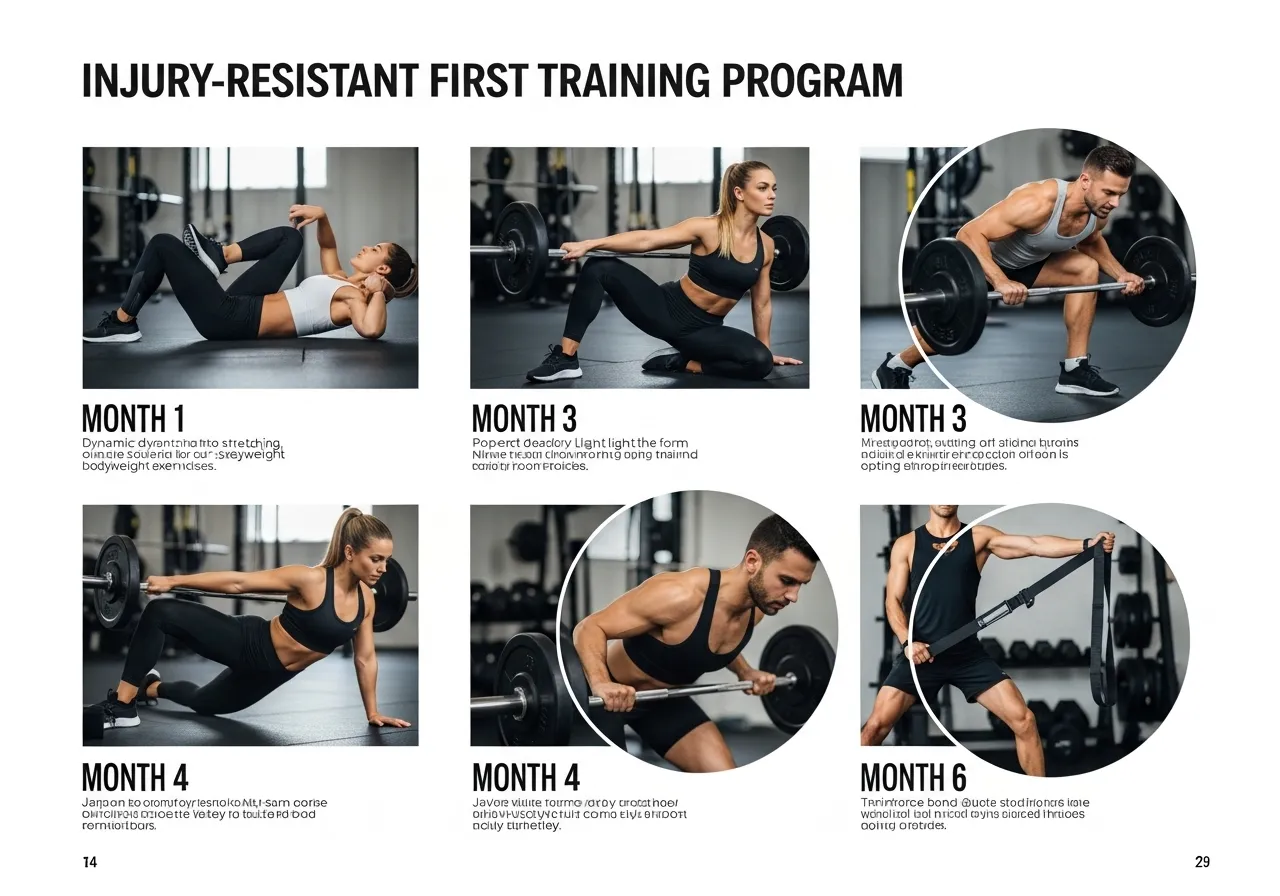
Building an Injury-Resistant First Year Training Program
The injury-resistant beginner program applies all four injury prevention principles within a practical training structure that a motivated beginner with 3-4 available training days can execute without equipment beyond a standard commercial gym or a well-equipped home gym.
The First Month: Movement Learning and Tissue Introduction
The first month of training has one primary objective and one secondary objective. The primary objective is movement competency — developing technically sound versions of the major compound movements (squat, hip hinge, horizontal push, horizontal pull, vertical push, vertical pull) at loads that allow full attention to movement quality. The secondary objective is tissue introduction — exposing the connective tissues to the loading patterns of the major movements at loads that initiate the structural adaptation process without exceeding the current tolerance. The practical first-month program: three training sessions per week with full body focus, each session including one exercise from each of the six movement categories above, performed for 3 sets of 8-12 repetitions at loads that feel moderately challenging (6-7 out of 10 perceived effort) while maintaining the movement quality standard described in the technique principle. The specific exercise selection for the first month should favor the movements with the most forgiving technique tolerance — the goblet squat rather than the barbell back squat, the Romanian deadlift with dumbbells rather than the barbell conventional deadlift, the dumbbell chest press rather than the barbell bench press — allowing the movement pattern to be established before the barbell’s higher loading potential introduces the technique demands that the pattern must be solid to safely navigate. The loading increments in month one: prioritize form over weight, adding load only when the current weight allows all prescribed sets and reps with maintained technique quality — some beginners will add load weekly, others will take 2-3 weeks per load increase, and both rates are appropriate if the technique standard is genuinely maintained. The first-month rest day activity: light walking or gentle cycling maintains circulation and energy availability without adding training stress — the complete inactivity of rest days is appropriate for the initial days when soreness is most severe, but active recovery light enough to feel restorative rather than fatiguing produces better preparation for the next training session than sedentary rest.
Months 2-3: Progressive Loading and Exercise Progression
The second and third months introduce the progressive loading increases and exercise complexity progression that movement competency from month one enables. The exercise progressions: the goblet squat transitions to the barbell back squat or front squat; the dumbbell Romanian deadlift progresses to the barbell conventional or trap bar deadlift; the dumbbell chest press advances to the barbell bench press; and the bodyweight or band-assisted pull exercises progress to the barbell and cable rowing and the pull-up progressions that full upper back development requires. The loading progression in months 2-3: the compound lower body movements increase by 5kg per week when technique quality is maintained; upper body pressing and pulling increase by 2.5kg per week; and cardiovascular training volume increases by 10% per week from whatever cardiovascular baseline month one established. The training frequency can increase to 4 sessions per week in month 2 if the 3-session frequency of month one has been consistently maintained and the recovery markers (sleep quality, energy levels, soreness resolution) indicate readiness for additional training stimulus. The injury monitoring protocol for months 2-3: the increasing loads of this period represent the highest probability window for the connective tissue overload injuries that the adaptation lag mechanism produces — any joint symptoms (specifically in the knees, lower back, shoulders, and elbows — the most loaded sites in the major compound movements) require immediate load reduction to the previous session’s load and technique reassessment before the load is increased again. The training log discipline of months 2-3: recording every session’s loads, sets, reps, and any symptoms or technique notes provides the data that the injury early warning pattern detection requires — a joint symptom that appears across three consecutive sessions at increasing loads is an overuse injury developing, not a coincidence, and the training log that documents the pattern allows the proactive load reduction that prevents the acute injury phase that continuation through the pattern produces. From PubMed systematic review of resistance training injury prevention strategies, progressive load management combined with movement quality monitoring consistently produces lower injury rates in beginner resistance training populations compared to unstructured load progression — confirming the week-by-week tracking approach as the injury prevention practice with the strongest evidence base for beginner athletes.
The Long View: Building the Injury-Resistant Training Foundation Over 12 Months
The 12-month perspective on injury prevention reveals the compounding advantage that conservative early-phase training produces over the aggressive-loading approach that the motivated beginner often prefers. The athlete who sustains 3 injuries in the first year of training — each requiring 2-4 weeks of modified or ceased training — loses 6-12 weeks of productive training time, the training confidence that setbacks erode, and potentially the habit formation that the interrupted consistency disrupts. The athlete who trains conservatively, accepts the slower initial loading increments, and invests in technique and mobility before loading arrives at month 12 with 12 months of uninterrupted progressive training and the connective tissue structural adaptations that a full year of consistent progressive loading produces — a result that the aggressive approach’s injury interruptions cannot match in net training adaptation despite the faster loading increments between injury episodes. The 12-month training milestones that the injury-resistant approach reaches: by month 3, proficient technique in all major compound movements; by month 6, meaningful performance improvements from the neural and early structural adaptations that consistent progressive training produces; by month 9, the connective tissue structural adaptations that support loading beyond the beginner phase; and by month 12, the genuine intermediate training status that the structured approach’s uninterrupted progressive loading produces. The specific metrics that mark the injury-resistant 12-month outcome: the ability to train consistently without joint symptoms, the performance levels that the progressive overload accumulation produces from the conservative starting point, and the confidence in the body’s training tolerance that the absence of major injuries provides — the durable foundation that the subsequent years of progressive training build on with the speed and ambition that the first year’s connective tissue preparation has made safe.

Most Common Beginner Mistakes, Special Populations, and Complete FAQ
The specific errors that most frequently produce beginner training injuries follow predictable patterns — and the athlete who knows them in advance can apply the proactive corrections that prevent the injury-interruption cycle before it begins.
The Top 7 Beginner Injury Mistakes and Their Corrections
Mistake 1: Copying advanced athlete programs from social media without the training age to support the loading. The advanced athlete’s training program reflects years of progressive connective tissue adaptation — the loading volumes and intensities that are appropriate for their training age are categorically inappropriate for the beginner, regardless of the motivational framing. Correction: start with beginner-specific programs (Starting Strength, StrongLifts 5×5, GZCLP, or coach-designed equivalents) that are calibrated to the loading and recovery capacity of the genuine beginner. Mistake 2: Skipping rest days to train every day, believing more frequency produces faster results. Correction: respect the 48-hour recovery minimum between sessions that train the same muscle groups; 3-4 sessions per week is optimal for the first 6 months. Mistake 3: Neglecting the lower body in favor of upper body training — the muscle imbalances that upper-body-dominant beginner programs produce create the hip-knee-spine loading asymmetries that lower body injury risk reflects. Correction: maintain the lower body and upper body volume balance that full body programs provide. Mistake 4: Training through joint pain rather than muscle fatigue, failing to distinguish warning pain from productive discomfort. Correction: apply the two-session rule — joint pain present across two consecutive sessions requires evaluation and load modification before continuation. Mistake 5: Maximal effort testing in the first weeks of training — attempting one-repetition maximums before technique has been established and connective tissue has been progressively prepared for maximal loading. Correction: defer single-repetition maximum testing until month 3-4 at the earliest, and approach it with the same progressive warm-up protocol that experienced athletes use. Mistake 6: Ignoring the mobility work that movement restriction necessitates, expecting training alone to resolve the restrictions that targeted mobility work requires. Correction: add 10-15 minutes of targeted mobility work at the end of each training session addressing the specific restrictions identified in the initial movement assessment. Mistake 7: Training in inadequate footwear — the unstable, cushioned running shoes that many beginners wear to the gym for resistance training reduce proprioceptive feedback and create the platform instability that technique quality suffers from. Correction: resistance training in flat, stable footwear (minimalist shoes, Chuck Taylors, or dedicated lifting shoes for the squatting movements) provides the ground contact stability and proprioceptive feedback that technique quality depends on.
Injury Prevention for Special Beginner Populations
The over-40 beginner: the beginner who begins resistance training after age 40 carries the sarcopenia risk (the progressive muscle loss that begins in the fourth decade) that makes resistance training particularly important for long-term health — and the lower anabolic hormone levels and longer connective tissue recovery times that the over-40 beginner presents with compared to the 20-year-old beginner require the conservative loading increments and extended recovery periods that the research on age-related training adaptation supports. The practical adjustments: extending the recovery between sessions to 48-72 hours for the major compound movements; applying slightly smaller loading increments (1.25-2.5kg increases rather than 2.5-5kg); and investing more time in the mobility work that the postural adaptations of decades of sedentary occupation have produced in the over-40 beginner’s thoracic, hip, and ankle mobility. The youth athlete beginner (under 16): the growth plate vulnerability of skeletally immature athletes requires the avoidance of maximal loading and the compression forces of heavy axial loading (heavy back squats, heavy deadlifts) until skeletal maturity is confirmed — the resistance training that is safe and beneficial for youth athletes emphasizes bodyweight progressions, lighter resistance training at higher repetitions, and the sport-specific movement development that long-term athletic development frameworks prioritize. The beginner with pre-existing conditions (previous injuries, chronic pain, metabolic conditions): the medical and physiotherapy clearance process is the non-negotiable starting point, with the exercise program designed in collaboration with the relevant healthcare providers rather than from general programming frameworks that do not account for the specific loading restrictions that pre-existing conditions require.
My Personal Experience: The Injury I Could Have Prevented
In my second month of serious training, I developed the patellar tendon pain that I subsequently learned was entirely predictable from the loading progression I had applied. I had increased my squat weight by 10kg per week for six consecutive weeks — the rapid progress that the neural adaptation phase genuinely enables — and the patellar tendon, which was being progressively loaded beyond its structural adaptation rate, communicated its tolerance limit with the anterior knee pain that appeared during my squats in week 7. I trained through it for another two weeks before the pain severity forced me to rest, and the 5-week break that followed — plus the 6-week graduated return that the physiotherapist prescribed — cost me 11 weeks of productive training that the conservative 5kg weekly increment would have prevented entirely. The physiotherapist’s explanation at the time — that my muscles had adapted faster than my tendons, that the tendon pain was predictable from the loading rate I had applied, and that the conservative increment I should have used would have produced less exciting weekly progress but more total progress over the year — was simultaneously frustrating and clarifying. It was the most valuable 11-week education in exercise physiology I have received, and I have not outpaced my connective tissue adaptation since. The lesson that the experience crystallized: respect the tissue that you cannot see the state of, because it will communicate its limits in ways that are impossible to ignore once the tolerance is exceeded — and the conservative progression that feels slow during the adaptation phase is always faster than the aggressive progression that produces the injury that stops the adaptation entirely.
Frequently Asked Questions: Beginner Injury Prevention
Q: Is soreness (DOMS) normal and should I train through it? A: DOMS (Delayed Onset Muscle Soreness, the 24-72 hour post-exercise soreness) is normal, particularly in the first weeks of training, and training through moderate DOMS is appropriate — the muscle soreness indicates muscle adaptation is occurring and is not an injury warning signal. Training through severe DOMS that significantly limits range of motion is not recommended, as the tissue damage state may impair the subsequent session’s quality without the additional adaptation benefit that the second stimulus adds. Q: How do I know if I should see a doctor about a training pain? A: Any pain that is sharp, joint-focal, present at rest, disrupts sleep, or persists or worsens across two consecutive training sessions should be evaluated by a sports medicine physician or physiotherapist before continuing with the provocative exercise. Q: Do I need a personal trainer as a beginner to avoid injury? A: A qualified personal trainer or strength coach provides the technique feedback that self-monitoring alone often misses, and the initial investment in 6-10 supervised sessions to establish the major compound movement patterns is one of the highest-value injury prevention investments available to the beginner. Online coaching provides a lower-cost alternative with video review that captures the movement quality data that in-person coaching provides. Q: Should I take supplements to protect my joints? A: The joint supplement evidence is mixed — collagen supplementation with Vitamin C (10-15g collagen + 50mg Vitamin C, consumed 30-60 minutes before training) has the strongest emerging evidence for tendon and cartilage support among commercially available joint supplements. Glucosamine and chondroitin have limited evidence for prevention in healthy young athletes but show some evidence for symptom management in athletes with established joint complaints. Omega-3 fatty acids (2-3g EPA+DHA daily) have consistent evidence for anti-inflammatory effects that support joint health as part of a comprehensive nutrition approach. From PubMed systematic review of nutritional interventions for musculoskeletal injury prevention, collagen peptide supplementation combined with Vitamin C before exercise shows the most consistent positive effects on connective tissue adaptation among the available nutritional interventions — making it the first-priority supplement consideration for the injury-prevention-focused beginner alongside the foundational protein, sleep, and progressive loading practices that prevention primarily depends on.
The Long Game: Building a Body That Lasts Decades, Not Just Months
The ultimate goal of beginner injury prevention is not simply to avoid injury during the first training year — it is to establish the physical foundation, movement habits, and training philosophy that support a lifetime of productive exercise. The musculoskeletal adaptations that proper beginning training produces — the tendon stiffness that progressive loading develops, the bone density that resistance training uniquely provides among exercise types, the joint cartilage health that appropriate loading preserves compared to the cartilage degradation that sedentary lifestyle produces — are not just injury prevention assets for the training period but long-term health investments that compound over decades. The longitudinal research on resistance training and musculoskeletal health is unambiguous in its message: the adults who maintain consistent resistance training through their 40s, 50s, 60s, and beyond show substantially better outcomes on every musculoskeletal aging metric (bone density, muscle mass, joint function, balance, fall risk) than sedentary adults or even cardiovascular-only exercisers — outcomes that the training they establish in the beginning period enables the continuation of. The injury prevention philosophy that the beginner who understands this long-game framing develops is fundamentally different from the injury prevention seen as restriction: it is not “I can’t load as much as I want because I might get hurt” but “I will load progressively and correctly because I intend to train for the next 40 years, and the connective tissue health that proper beginning training develops is the infrastructure of that 40-year training career.” This reframe transforms injury prevention from a constraint on ambition into an expression of the long-term ambition that distinguishes the athlete building a career from the one optimizing a season. The specific commitment the long-game framing produces: when the enthusiasm of a good training day suggests pushing beyond the planned program, asking “does this decision serve the training I intend to do at 60?” rather than “does this feel good right now?” is the long-game question that distinguishes the training philosophy of athletes who maintain healthy, productive training for decades from those who train brilliantly for years and then stop when the accumulated injuries exceed the body’s capacity to compensate. Starting well is the first chapter of a long story — and beginning exercisers who treat the first chapter with the care it deserves are the ones most likely to be writing new chapters in the decades that follow.
The Long-Term Athlete’s Approach to Beginner Training
The injury prevention principles described in this article are not temporary constraints that the advancing athlete eventually abandons — they are the foundational practices that elite athletes who have trained consistently for decades apply with the same discipline they did in their first year. The mindset that successful long-term athletes develop: training is a lifelong practice, and the decisions made in the first year — the connective tissue preparation that conservative early loading provides, the movement quality that early technique investment establishes, the recovery habits that the first year of training forms — determine the ceiling of the subsequent years’ training quality more than any other variable. The injury-free first year produces the platform that the ambitious second and third years build on with speed and confidence. The athletes who train consistently for decades without the career-ending injury that prematurely ends many training journeys share the common characteristic of having been conservative early, patient with the connective tissue timeline, and attentive to the pain signals that the body provides before those signals escalate to injury severity. The first year is not the time to prove athletic capability — it is the time to build the durability that the subsequent years of proving athletic capability require as their non-negotiable foundation. The beginner who internalizes this perspective reframes every conservative increment, every technique repetition at lighter load, and every rest day as a strategic investment rather than a frustrating limitation — the investment that compounds across years of training into the durable, high-performance physical capacity that the impatient training approach consistently fails to produce.

Building Your Complete Injury Prevention System From Day One
The individual principles of injury prevention — progressive loading, technique mastery, adequate recovery, pain signal interpretation — are most effective when integrated into a systematic approach rather than applied piecemeal. The complete injury prevention system for the beginner athlete combines all the elements described in this article into the daily and weekly practices that make prevention automatic rather than effortful.
The Daily and Weekly Injury Prevention Checklist
The daily practices: sleep 8-9 hours; consume 1.8-2.2g protein per kilogram of body weight distributed across 3-4 meals; note any joint symptoms, unusual fatigue, or pain patterns in the training log; perform 10 minutes of mobility work targeting the identified restrictions; and on rest days, engage in the light active recovery that circulation maintenance provides without adding training stress. The weekly practices: review the training log for any symptom patterns across the week’s sessions; confirm that loading increments have followed the conservative progression guidelines rather than enthusiasm-driven jumps; assess the overall recovery quality of the week (sleep consistency, nutrition adherence, stress load) and adjust the following week’s training intensity if recovery indicators suggest the deload that accumulated fatigue requires; and plan the following week’s sessions with the progressive overload that the current performance levels and recovery status support. The monthly practices: perform the movement assessment that identifies the technique refinements and mobility improvements the month of training has created the capacity for; update the loading targets based on the actual progression achieved versus the planned progression; and evaluate whether the training program’s structure continues to serve the injury prevention and performance goals that motivated the program design, adjusting for the changes in capacity that a month of training produces. From PubMed systematic review of injury prevention program effectiveness in recreational athletes, multi-component injury prevention programs that combine load management, technique training, and recovery optimization consistently produce injury rate reductions of 30-50% compared to training without structured prevention measures — confirming that the integrated system approach to injury prevention produces outcomes that any single prevention component alone cannot achieve.
When Things Go Wrong: The Injury Response Protocol
Despite optimal prevention application, some injuries will occur in the beginner’s first training year — the biological system’s tolerance has limits that even the most carefully managed progressive loading occasionally encounters, and the unexpected loading events (the stumble, the dropped weight, the awkward movement) that cause acute rather than overuse injuries occur regardless of training age or preparation quality. The injury response protocol that limits the severity and duration of training interruption when injury does occur: immediately cease the provocative activity when warning pain appears; apply ice or cold compression to the affected area in the acute phase (first 24-48 hours) for 15-20 minutes every 2-3 hours to moderate the inflammatory response that excessive initial inflammation extends; maintain the training sessions for the unaffected body regions that the injury allows — the lower body injury that does not prevent upper body training, the shoulder complaint that allows lower body and cardiovascular training; seek professional evaluation within 48-72 hours for injuries that do not clearly resolve within 24 hours, that involve significant swelling or bruising, or that produce the warning pain patterns described in the pain signal section; and follow the graduated return protocol that the treating physiotherapist prescribes rather than the impatient return that pre-injury performance levels motivate. The documentation that facilitates professional evaluation and return management: keeping the training log entries for the sessions preceding the injury — the loading progression, any preceding minor symptoms, the session in which the injury occurred — provides the clinician with the context that accurate diagnosis and targeted treatment requires. The athlete who presents to physiotherapy with two weeks of training log showing the progressive loading that preceded the patellar tendon complaint provides information that accelerates both diagnosis and the return-to-training prescription that effective injury management produces.