The Best Beginner Dumbbell Workout: A Full-Body 4-Week Program
This article is for general educational purposes only and does not constitute medical or professional fitness advice.
Consult a licensed healthcare provider or certified fitness professional before starting any new exercise program.
Dumbbells are among the most versatile and accessible pieces of fitness equipment — and for beginners, a well-structured dumbbell program can develop full-body strength, coordination, and fitness without requiring machines or a barbell.
This guide provides a complete 4-week beginner dumbbell program, exercise technique notes, and practical guidance for getting started.
Why Dumbbells Are Ideal for Beginners
Key Advantages
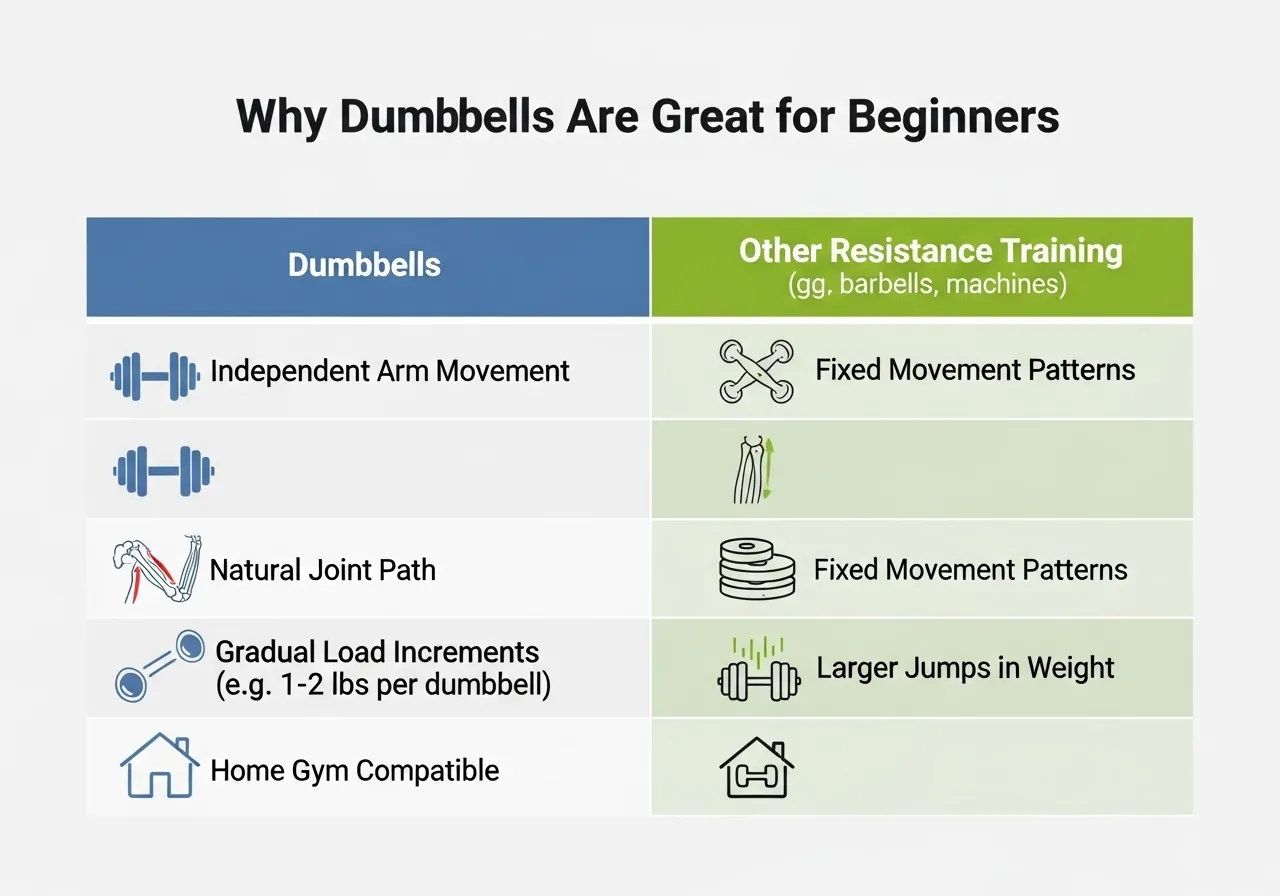
| Advantage | Why It Matters for Beginners |
|---|---|
| Independent arm movement | Each side works independently, helping identify and address strength imbalances early |
| Natural movement paths | Follows the body’s natural joint mechanics rather than a fixed machine path |
| Gradual load increments | Available in small steps (2–5 kg), allowing safer progressive overload |
| Home and gym compatible | A pair of adjustable dumbbells or a small fixed set enables a complete program |
What This Program Covers
The program is designed around the 7 fundamental movement patterns — squat, hinge, push, pull, carry, and rotation — to develop balanced, functional strength across the whole body.
Each session takes approximately 35–45 minutes, including warm-up and cool-down.
The Exercises: Technique Notes for Each Movement
Lower Body
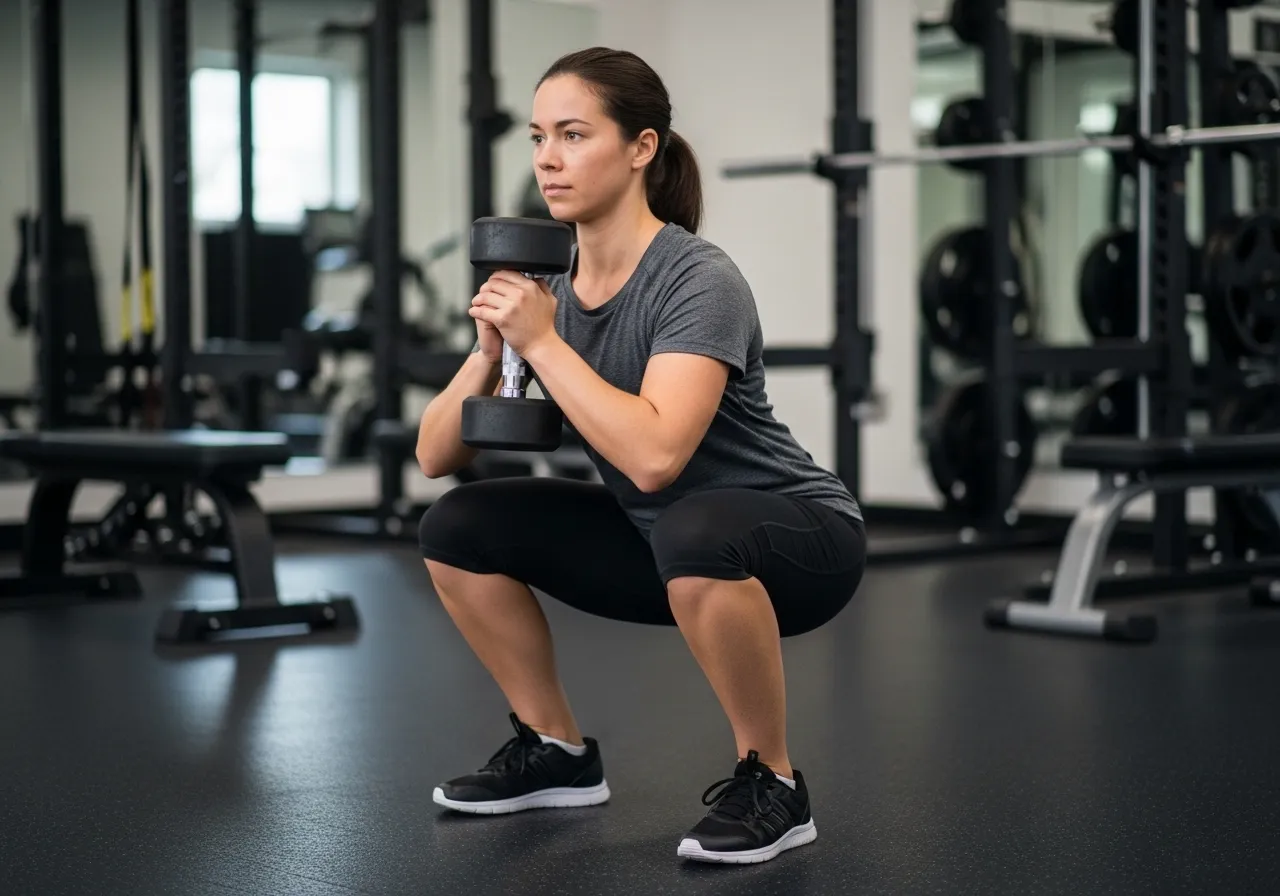
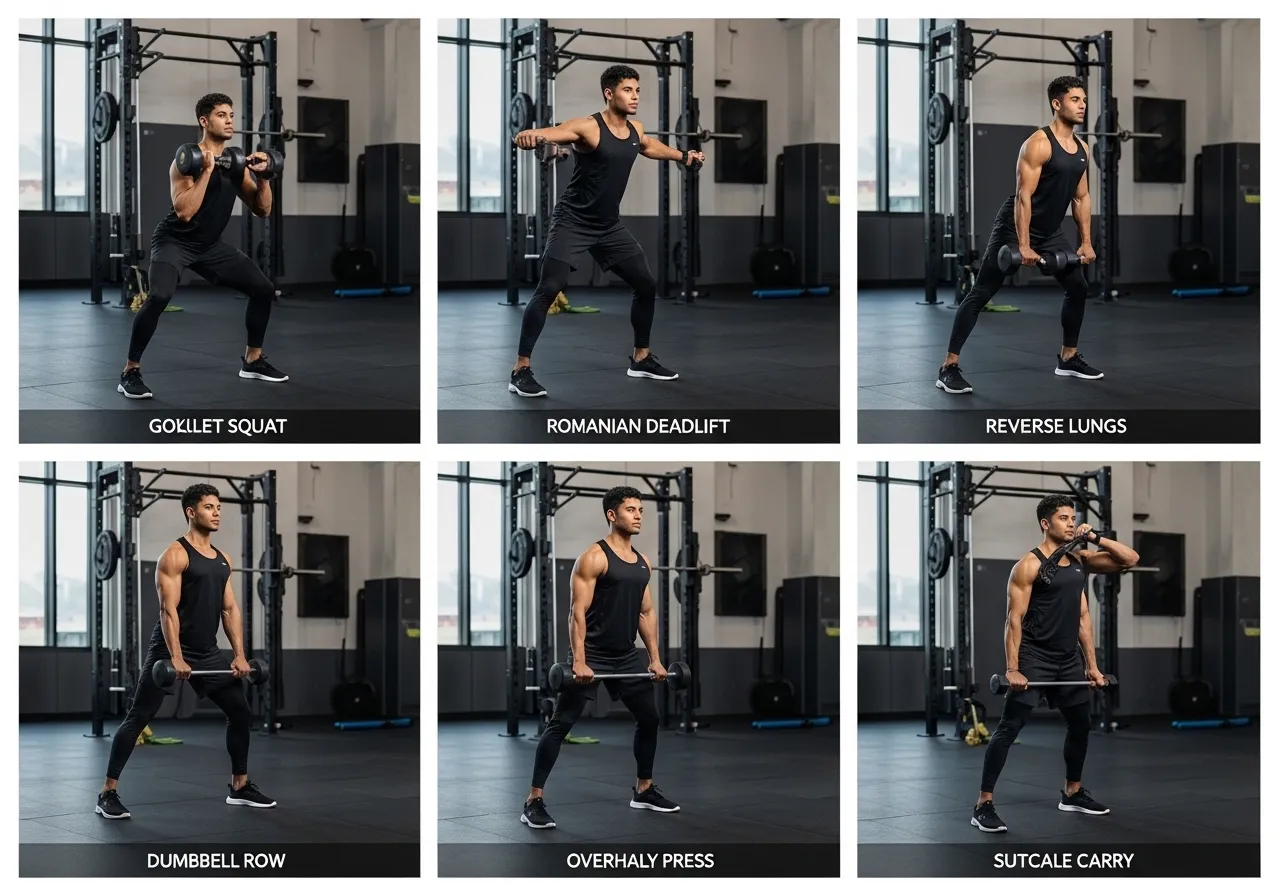
Goblet Squat: Hold one dumbbell vertically at chest height. Feet shoulder-width apart, toes slightly out. Sit the hips down and back, keeping the chest up and knees tracking over toes. Full depth as mobility allows. This front-loaded position naturally encourages an upright torso — making it one of the best beginner squat variations available.
Romanian Deadlift (RDL): Hold dumbbells in front of thighs, hinge at the hips while keeping a neutral spine and soft knee bend, lower until a hamstring stretch is felt (typically mid-shin for most people), then drive hips forward to return. The key distinction from a squat: the hips move backward, not downward.
Reverse Lunge: Step backward, lower the back knee toward (not to) the floor, keep the front shin vertical, and drive through the front heel to return. Stepping backward rather than forward reduces knee stress for most beginners.
Upper Body — Push
Dumbbell Bench Press (or Floor Press): Lie flat or on the floor, dumbbells at chest height with elbows at ~45°. Press directly upward until arms are nearly extended, then lower with control. The floor press is a safer alternative if no bench is available.
Dumbbell Overhead Press: Seated or standing, dumbbells at shoulder height, press overhead in a natural arc until arms are extended. Do not lock the elbows aggressively — a slight bend at the top is preferred.
Upper Body — Pull
Dumbbell Row: One hand and same-side knee on a bench (or both feet on floor in a hinged position), pull one dumbbell toward the hip with the elbow driving upward and back. Avoid rotating the torso — keep it square.
Core
Dumbbell Suitcase Carry: Hold one dumbbell at your side and walk for 20–30 meters, keeping the torso upright without leaning toward the loaded side. This is an anti-lateral flexion exercise (training the core to resist sideways bending) that develops functional core stability efficiently.

The 4-Week Full-Body Dumbbell Program
Program Structure
Frequency: 3 sessions per week (e.g., Mon / Wed / Fri)
Session duration: ~40 minutes
Rest between sets: 60–90 seconds for most exercises
Weekly Session Template (Same Each Week, Increasing Load/Reps)
Warm-up (5 min): Arm circles × 10 each, leg swings × 10 each, bodyweight squat × 10, hip hinge × 10
A1. Goblet Squat — 3 sets
A2. Dumbbell Row — 3 sets (perform A1 then A2 back-to-back, rest 60 sec)
B1. Romanian Deadlift — 3 sets
B2. Dumbbell Overhead Press — 3 sets (same superset structure)
C1. Reverse Lunge — 2 sets each side
C2. Dumbbell Bench/Floor Press — 2 sets
D. Suitcase Carry — 2 × 20 m each side
Cool-down (5 min): Hip flexor stretch, hamstring stretch, shoulder cross-body stretch
Weekly Progression
| Week | Sets × Reps | Focus |
|---|---|---|
| Week 1 | 3 × 8 | Learn the movements — light weight, full focus on form |
| Week 2 | 3 × 10 | Same weight — add 2 reps per set |
| Week 3 | 3 × 8 | Increase weight by 2–4 kg — return to lower reps |
| Week 4 | 3 × 10–12 | Consolidate at new weight before next progression |
How to Choose the Right Starting Weight
The Self-Assessment Approach
Choosing the correct starting weight is one of the most common challenges for beginners.
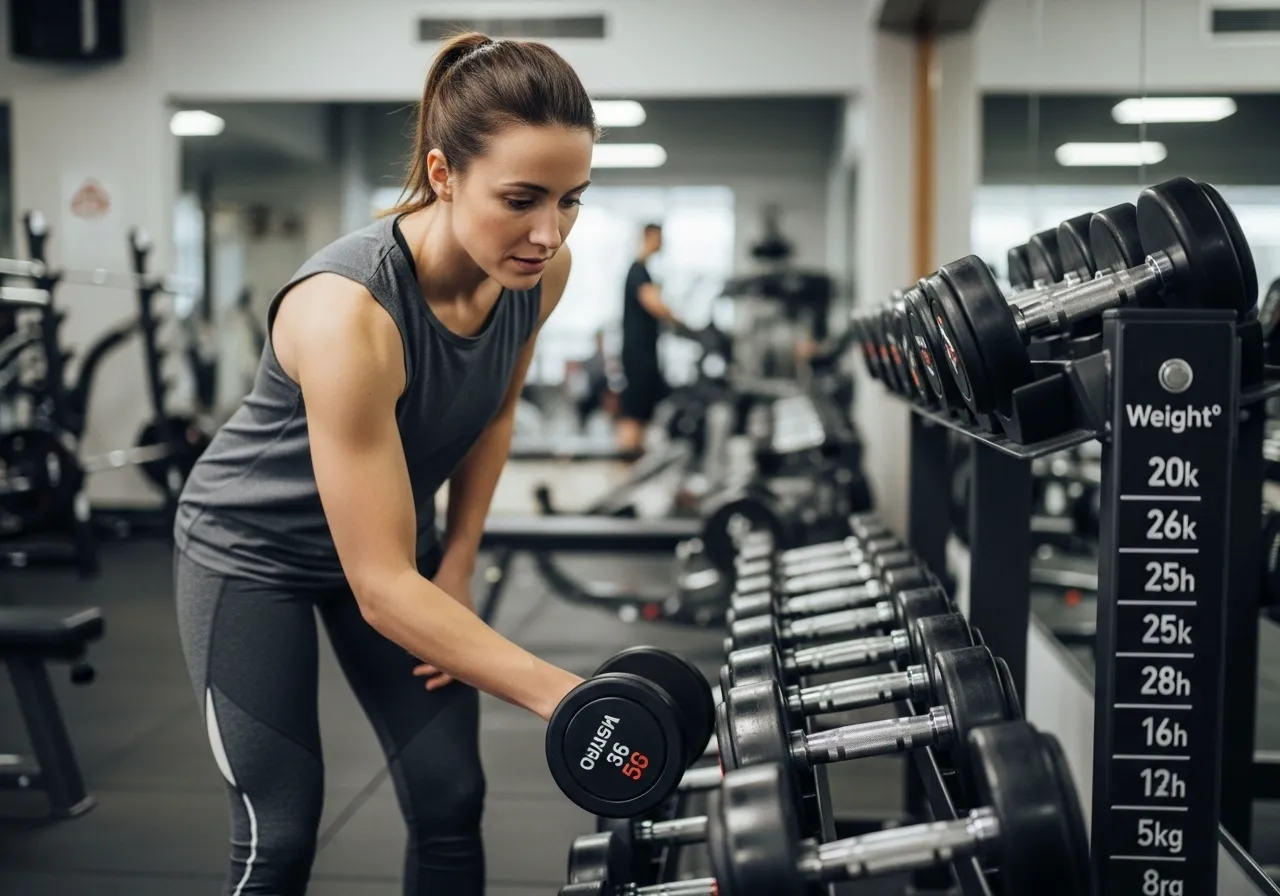
A practical method: pick a weight where the last 2 reps of each set feel genuinely challenging but where form remains clean throughout. If you reach the final rep and could easily do 5 more, the weight is likely too light to drive adaptation.
Goblet squat / RDL: 8–16 kg
Dumbbell row: 8–14 kg per side
Overhead press: 6–10 kg per side
Bench/floor press: 8–12 kg per side
These are illustrative ranges only — individual starting points vary considerably.
Common Beginner Mistakes to Avoid
- Starting too heavy — technique suffers before strength develops; form should always come first
- Inconsistent rest periods — resting 30 seconds between heavy sets produces different (and generally inferior) results compared to 60–90 seconds
- Skipping the cool-down — 5 minutes of post-session stretching supports flexibility and reduces the post-exercise stiffness that discourages the next session
- Missing sessions and trying to “make up” volume — a missed session is gone; simply continue with the next planned session
Frequently Asked Questions About Beginner Dumbbell Training
Q: Can I build real muscle with just dumbbells?
Yes — research consistently shows that dumbbell training at appropriate loads produces muscle hypertrophy outcomes comparable to barbell training at equivalent relative intensities.
The primary practical limitation is that very experienced lifters may eventually exhaust the loading available with standard dumbbell sets. For beginners and intermediate trainees, this is rarely a limiting factor.
Q: How much weight should I expect to gain or lose in 4 weeks?
Visible body composition changes from a 4-week program are typically modest — meaningful changes in both muscle and fat generally take 8–16 weeks of consistent training and appropriate nutrition to become clearly visible.
What does change noticeably in 4 weeks: strength (often significantly, due to neuromuscular adaptations), movement skill, energy levels, and the development of the training habit itself.
Q: Can I do this program at home?
Yes — a pair of adjustable dumbbells or a small set of fixed dumbbells (e.g., 6, 10, 14 kg) and a mat are sufficient to complete the entire program. The floor press replaces the bench press where no bench is available.
If you only have one weight available (e.g., one pair of 10 kg dumbbells), you can still follow the program by manipulating tempo (slower lowering), rest periods, and total sets to adjust the challenge level.
- A dumbbell-only program can develop full-body strength and fitness effectively for beginners
- The program covers all 7 fundamental movement patterns across 3 weekly sessions
- Choose a weight where the last 2 reps feel genuinely challenging but form stays clean
- Progress by adding reps first, then increasing weight — roughly every 2 weeks
- Visible results take 8–16 weeks; strength and movement quality improvements often begin within 2–4 weeks