
3-Day Full Body Workout Routine That Actually Works
⚠️ Disclaimer: The information in this article is for general educational purposes only and does not constitute medical, nutritional, or professional fitness advice. Individual results may vary. Always consult a qualified healthcare professional or certified fitness trainer before starting any new exercise program, changing your diet, or making decisions about injury treatment or recovery. If you experience pain, discomfort, or any unusual symptoms during exercise, stop immediately and seek professional guidance.

Why a 3-Day Full Body Routine Outperforms Most Other Splits
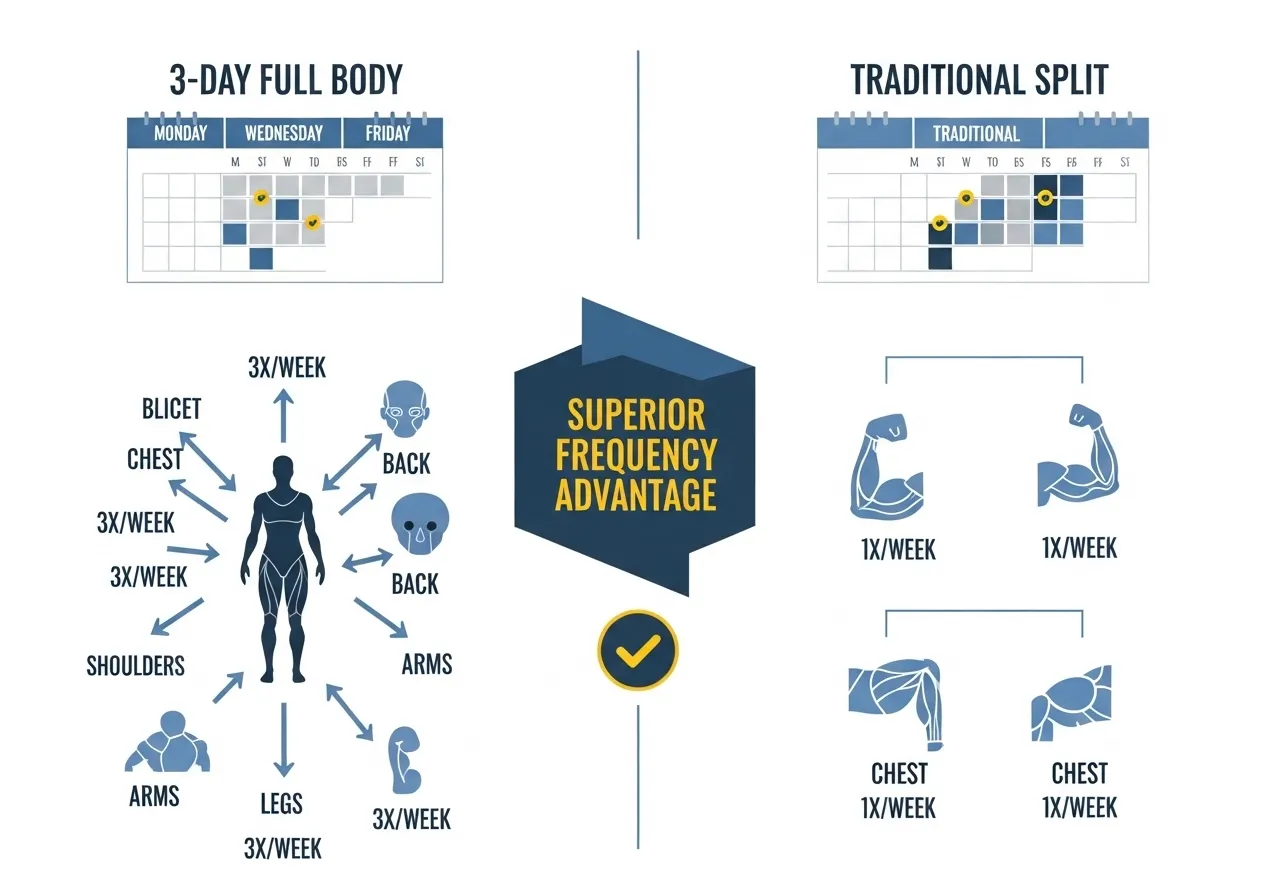
The fitness industry has a complicated relationship with training frequency. For decades, the dominant model was the bodybuilding split — chest Monday, back Tuesday, legs Wednesday, and so on — where each muscle group is trained once per week with high volume. This model produces good results for advanced bodybuilders with specific genetic and pharmacological advantages. For the vast majority of people trying to build a functional, aesthetic, and strong body in a sustainable way, three-day full body training consistently outperforms the once-per-week muscle group approach on virtually every relevant metric.
I ran a classic push-pull-legs split for two years before switching to full body training, and the difference in results and training quality was immediate and significant. Strength improved faster. Muscle development was more balanced. The flexibility to miss a session without losing significant training stimulus was practically valuable in a life with real scheduling demands. And the cumulative fatigue of 5–6 day splits — which I’d attributed to “just what hard training feels like” — largely disappeared. Three days of full body training produced more results with less total time investment and less accumulated fatigue than six days of split training. This isn’t a minority experience — the research consistently supports these outcomes for natural athletes training without pharmaceutical assistance.
Frequency Is King for Natural Athletes
The foundational advantage of full body training is frequency — training each muscle group 3 times per week rather than once. Research on training frequency and muscle protein synthesis shows that muscle protein synthesis (the cellular process that drives hypertrophy) returns to baseline within 48–72 hours after a training stimulus, even after a high-volume session. Training a muscle group once per week means 5–6 days of baseline muscle protein synthesis between stimuli — days when the growth opportunity is essentially lost. Training the same muscle three times per week keeps muscle protein synthesis elevated for a much larger proportion of the total week, producing more total growth stimulus per unit of time.
A landmark meta-analysis on training frequency published in the Journal of Strength and Conditioning Research found that training a muscle group 2–3 times per week produced significantly greater hypertrophy than once-per-week training when total weekly volume was equated. The frequency effect was independent of volume — higher frequency produced more growth at the same total volume. This is the mechanism that explains why many people switching from a traditional split to full body training see faster hypertrophy progress despite doing less total volume per session.
Practical Advantages Over Other Splits
Beyond the physiological advantages, three-day full body training has practical benefits that make it more sustainable for real-life athletes. Missing one session of a muscle group split means losing 100% of that muscle group’s weekly training — missing chest day means zero chest training that week. Missing one session of a full body program means losing one of three training opportunities for every muscle group — a significant but partial loss that the remaining two sessions partially compensate for. This “fault tolerance” makes full body training dramatically more robust to the schedule disruptions that are inevitable in a real life with work, family, travel, and illness.
The cognitive simplicity of full body training is also practically valuable. Every session contains the same fundamental movement patterns — squat, hip hinge, push, pull, carry — which builds efficient neural patterns through repeated practice rather than the once-weekly exposure that split training provides. Complex movements like the squat and deadlift benefit enormously from frequent practice that reinforces the motor pattern — practicing squats three times per week builds the movement automaticity and technique refinement that once-per-week squatters simply cannot achieve at the same rate.
Who Full Body Training Is Best Suited For
Full body training is optimal for beginners and intermediates — the majority of recreational gym-goers — and remains highly effective for advanced natural athletes who prioritize strength alongside hypertrophy. It is the dominant training model in strength sports (powerlifting, weightlifting, and many strength coaching programs), where frequency of practice is recognized as a primary driver of skill and strength development. Bodybuilding-focused advanced athletes who are specifically optimizing for maximum hypertrophy with performance drugs that enhance recovery may genuinely benefit from higher-volume split approaches — but this population is a small minority of recreational gym-goers, and applying their training logic to a natural, performance-oriented athlete is a fundamental error that the fitness industry has long perpetuated.
Athletes with significant scheduling constraints — who can only guarantee 3 training days per week — benefit most from full body training, since every session works the entire body and no muscle group is neglected during busy periods. Athletes with irregular schedules that make split training logistically inconsistent similarly benefit from the full body model’s ability to deliver complete training stimulus in any subset of sessions. The 3-day full body model is not a compromise for those who “can’t” train more — it is the optimal approach for most natural athletes, regardless of schedule.
Comparison With Popular Alternatives
Upper-lower splits (4 days per week) provide twice-weekly frequency for all muscle groups and are an excellent alternative to full body training with only slightly more scheduling demand. Push-pull-legs (6 days per week) provides twice-weekly frequency at higher per-session volume and works well for advanced athletes who recover well and have reliable 6-day per week availability. Body part splits (5–7 days per week) provide once-weekly frequency per muscle group and are supported primarily by bodybuilding tradition and marketing rather than by frequency optimization research for natural athletes. The evidence hierarchy clearly favors higher frequency models — 2–3 times per week per muscle group — with the 3-day full body approach delivering this frequency most efficiently within a sustainable time investment.
The Science of Full Body Training: Frequency, Volume, and Recovery
Building an effective 3-day full body program requires understanding the scientific principles that determine how training produces adaptation. Volume, intensity, frequency, exercise selection, and recovery all interact in ways that determine whether the program produces the intended results. Getting these variables right from the start prevents the most common program design errors that reduce effectiveness.
Volume: How Much to Do Per Session
Training volume — the total amount of work performed — is the primary driver of hypertrophy, but more is not always better. Research on volume-hypertrophy relationships identifies a dose-response curve with three zones: minimum effective volume (below which training produces minimal hypertrophy), maximum adaptive volume (the range that produces maximum hypertrophy with manageable recovery cost), and maximum recoverable volume (above which training produces excessive fatigue that impairs recovery and eventually regression). For most intermediate athletes, the maximum adaptive volume per muscle group per week falls between 10 and 20 working sets.
In a 3-day full body program, weekly volume is distributed across three sessions. For a target of 15 weekly sets per major muscle group, each session contains 5 sets per muscle group — a manageable within-session volume that allows high quality per set without excessive session length. This contrasts with a once-per-week split approach where achieving 15 sets per muscle group means 15 sets in a single session — a volume that requires greater intra-session fatigue management and longer session duration than spreading the same work across three sessions.
The quality of sets is inversely related to within-session volume — the first few sets of an exercise produce higher quality reps at lower fatigue than later sets in a long session. By distributing volume across three sessions, each session’s sets are performed with less accumulated fatigue, producing higher average set quality than a high-volume single-session approach. This quality advantage partly explains the frequency effect on hypertrophy found in research — not just more frequent stimuli but higher quality stimuli per session.
Intensity: How Heavy to Train
Intensity — the load relative to one-rep maximum — determines the neuromuscular demand of training and the specific adaptation produced. Heavy training (85%+ of 1RM, 1–5 reps per set) primarily develops neural drive and maximal strength. Moderate training (65–85% of 1RM, 6–12 reps per set) produces the optimal combination of mechanical tension and metabolic stress for hypertrophy. Lighter training (50–65% of 1RM, 15+ reps per set) develops muscular endurance with modest hypertrophy contribution. Most evidence-based full body programs use a moderate intensity range for the primary work, with variation across exercises and sessions to provide stimuli across the strength-endurance continuum.
For a 3-day full body program, the compound movements (squat, deadlift, bench, row, overhead press) are most effectively trained in the 5–8 rep range — heavy enough for significant strength development, light enough for adequate volume within the session. Accessory exercises (lunges, flies, lateral raises, curls) are better suited to the 10–15 rep range, where the metabolic stress component of hypertrophy is more effectively accessed without the joint stress of heavy loading on single-joint movements. This compound-heavy, accessory-moderate intensity structure is the standard design of most evidence-based full body programs and reflects the different biomechanical properties and training-response characteristics of the two exercise categories.
Exercise Selection: The Movement Pattern Framework
A complete full body training session must address all major movement patterns: lower body knee-dominant (squat pattern), lower body hip-dominant (hip hinge pattern), upper body horizontal push (bench press pattern), upper body horizontal pull (row pattern), upper body vertical push (overhead press pattern), upper body vertical pull (pull-up or lat pulldown pattern), and core stability. Selecting one primary exercise per pattern as the session’s “anchor” movements, with one or two accessory exercises per pattern for additional volume, produces comprehensive development of the entire musculature without gaps.
Movement pattern training is superior to muscle-group thinking for full body programming because it naturally balances agonist and antagonist development. “Training chest and back” can be done imbalanced; “training horizontal push and horizontal pull” inherently creates balance because you’re explicitly addressing both sides of every pushing pattern with a corresponding pulling movement. This balance is important for joint health, injury prevention, and functional strength that transfers outside the gym.
Recovery Between Full Body Sessions
Full body sessions require 48 hours of recovery between sessions — each session trains every major muscle group, and each group needs at least 48 hours for the acute inflammation and soreness to resolve and for muscle protein synthesis to proceed effectively. Monday-Wednesday-Friday and Tuesday-Thursday-Saturday are the standard 3-day scheduling templates that provide 48-hour gaps while maintaining weekly training frequency. Training on consecutive days (Monday-Tuesday-Wednesday) with full body programming is counterproductive — the second session begins before recovery from the first is complete, compounding fatigue without providing the recovery window needed for adaptation. The 48-hour gap is not a guideline but a physiological requirement for the training frequency to enhance rather than impair recovery.
The Warm-Up Protocol for Full Body Sessions
Full body sessions require comprehensive warm-up because every major joint and muscle group will be trained. A 10–15 minute warm-up protocol: 3–5 minutes of light cardiovascular activity (rowing, cycling, jump rope) to elevate heart rate and core temperature; hip and shoulder mobility work (hip circles, arm circles, cat-cow, thoracic rotation) to prepare the primary joints for their training ranges; and specific warm-up sets for the first compound exercise in the session (empty bar, then progressive loading to working weight). This full warm-up prevents the compensation patterns and injury risk that come from beginning heavy compound training with a cold, stiff musculoskeletal system and pays back its time investment in better set quality from the first working set onward.
The Complete 3-Day Full Body Workout Program
The following program is designed for intermediate athletes who have been training for 6+ months and have established foundational movement patterns. It is based on the movement pattern framework, progressive overload principles, and the volume and intensity guidelines discussed in the previous section. Each session takes approximately 50–65 minutes including warm-up.
Session A — Squat Focus
A1. Barbell Back Squat: 4 sets × 5 reps at 80–85% 1RM. The primary lower body exercise of the session. Full depth (below parallel), braced core, controlled descent. Rest 3 minutes between sets. Progressive overload: add 2.5–5 lbs when all 4 sets of 5 are completed with good form.
A2. Incline Barbell Press: 4 sets × 6–8 reps. The primary upper push exercise. Full range — bar to chest, full extension at top. Rest 2 minutes. Provides the upper chest and shoulder emphasis that flat bench alone doesn’t develop.
A3. Barbell Row: 4 sets × 6–8 reps. The primary horizontal pull. Pronated grip, row to lower chest, controlled eccentric. The horizontal pull that balances the horizontal push and develops the mid-back, rhomboids, and rear deltoids.
A4. Romanian Deadlift: 3 sets × 8–10 reps. Hip hinge accessory that develops the hamstrings and glutes through a range of motion the squat doesn’t cover. Lighter load than the primary deadlift, focus on hip hinge mechanics and hamstring stretch.
A5. Dumbbell Lateral Raise: 3 sets × 12–15 reps. Shoulder accessory targeting the lateral deltoid that overhead press underloads. Light weight, controlled movement. Superset with A5.
A6. Plank: 3 × 45–60 seconds. Core stability that reinforces the bracing mechanics used in every compound movement of the session.
Session B — Hinge Focus
B1. Conventional Deadlift: 4 sets × 4–5 reps at 80–85% 1RM. The primary hip hinge exercise — the most systemically demanding exercise in the program. Full setup from the floor: neutral spine, bar over mid-foot, hips down, chest up. Rest 3–4 minutes. Progressive overload: add 5 lbs when all sets are completed with clean form.
B2. Flat Barbell Bench Press: 4 sets × 5–7 reps. The primary horizontal push. Full range — bar to chest, full extension at top. The most efficient exercise for developing pressing strength and chest mass simultaneously.
B3. Weighted Pull-Up or Lat Pulldown: 4 sets × 6–8 reps. Vertical pull to balance the vertical push. Bodyweight or with added load for athletes who can do 8+ unweighted. Full range — dead hang to chin over bar.
B4. Bulgarian Split Squat: 3 sets × 10 reps per leg. Unilateral knee-dominant accessory that develops balance, hip mobility, and quad strength that bilateral squatting alone doesn’t fully address. Use dumbbells or a barbell on the back.
B5. Face Pull: 3 sets × 15–20 reps. External rotation accessory that develops the rear deltoid and external rotators that protect shoulder health during heavy pressing volume. Light weight, full external rotation at the end position.
B6. Dead Bug: 3 sets × 8 reps per side. Anti-extension core exercise that reinforces the posterior pelvic tilt and deep core engagement that supports all the primary lifts in the program.
Session C — Upper Push/Pull Focus
C1. Front Squat or Goblet Squat: 4 sets × 6–8 reps. A squat variation with anterior loading that develops the quadriceps and upper back mobility more directly than the back squat. Lighter load than Session A, emphasizing technique and quad development.
C2. Overhead Press: 4 sets × 5–6 reps. Vertical push that develops the deltoids, triceps, and upper chest in a movement pattern the bench press doesn’t cover. Standing for core engagement, or seated for greater load capacity.
C3. Cable or Dumbbell Row: 4 sets × 10–12 reps. Horizontal pull at higher rep range for additional volume. Focus on scapular retraction and full range of motion. Superset with C2 if time is limited.
C4. Hip Thrust: 3 sets × 10–12 reps. Glute-dominant hip extension at shortened range, complementing the Romanian deadlift’s emphasis on lengthened range. Barbell or band resistance.
C5. Tricep Pushdown + Bicep Curl Superset: 3 sets × 12 each. Direct arm work that supplements the compound pressing and pulling. Accessory work for athletes who want direct arm development.
C6. Pallof Press: 3 sets × 12 reps per side. Anti-rotation core exercise that develops the lateral core stability important for safe loading in all three sessions’ primary movements.
Sample 12-Week Schedule Overview
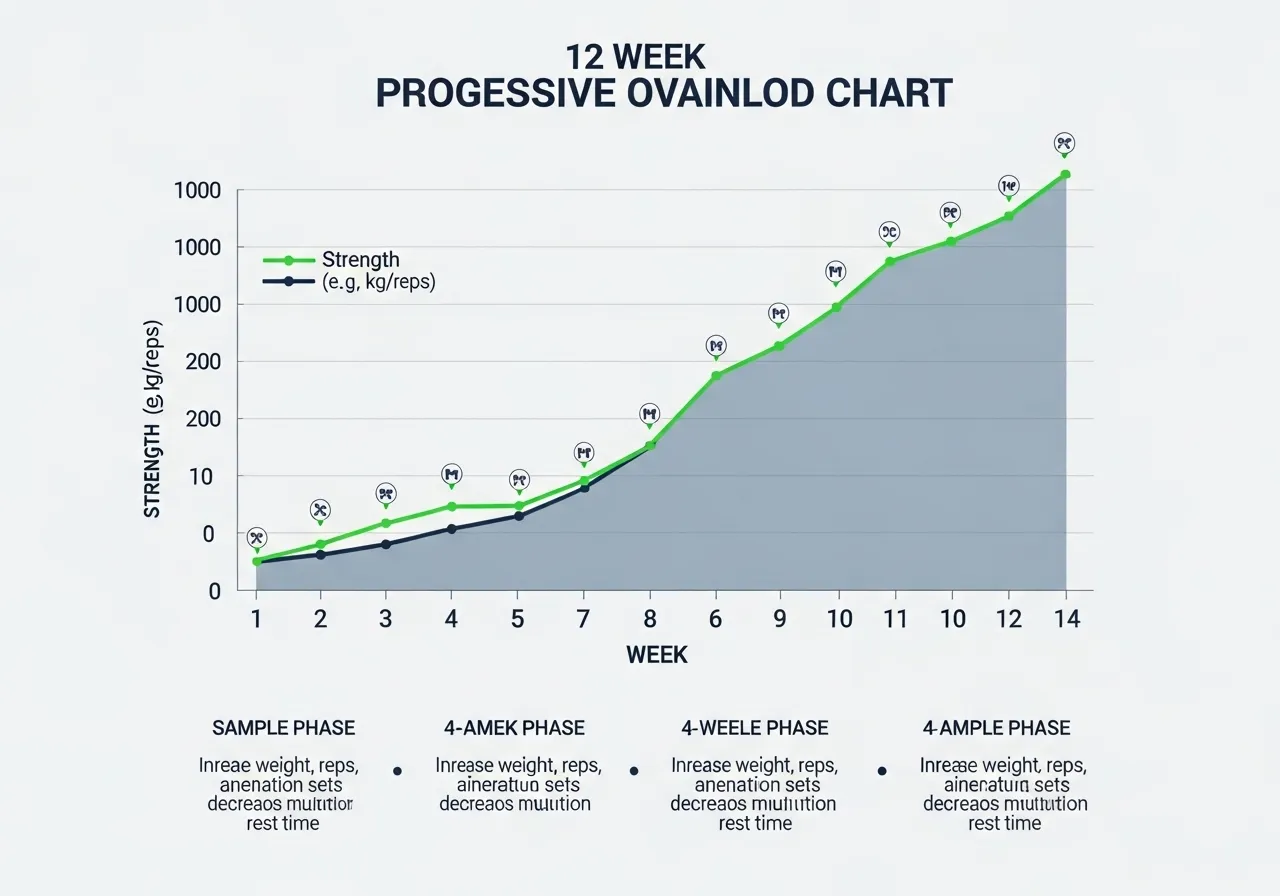
Weeks 1–4: Learn the exercises, establish working weights, prioritize form over load. Aim to feel comfortable with every movement before pushing intensity. Weeks 5–8: Apply progressive overload consistently — add load when sets are completed cleanly, push for the upper end of each rep range. This is the primary adaptation phase. Weeks 9–11: Intensity peak — push for personal records on primary lifts, reduce rep ranges slightly and increase load. Week 12: Deload — reduce volume by 50%, maintain intensity, allow accumulated fatigue to clear before testing new maxes or starting a new program cycle.
How to Progress, Adapt, and Customize the Program Over Time
The program outlined in the previous section is a starting framework — not a permanent prescription. Intelligent adaptation of the program over time, guided by individual response and evolving training goals, is what separates athletes who continue improving for years from those who plateau after a few months of good initial results.
Progressive Overload: The Non-Negotiable Principle
Progressive overload — systematically increasing training demand to drive continued adaptation — is the single most important principle in resistance training. Without it, the training stimulus remains constant and adaptation ceases. With it, adaptation continues as long as recovery can support the increasing demand. The most accessible progressive overload strategy for the primary lifts is linear load progression: add 2.5–5 lbs to the barbell whenever you complete all prescribed sets and reps with good form. For beginners and early intermediates, this produces weekly strength improvements that compound into substantial strength gains over months.
When linear progression stalls — when you consistently fail to complete all sets at a given weight — there are several strategies for continuing progress: reduce the weight by 10% and build back up (a “reset” that’s common in linear progression programs); switch to a double progression model (progress by reps before increasing weight — complete the full rep range for all sets at current weight before adding load); or change the rep range and retest (moving from 5×5 to 4×8 changes the stimulus and often allows continued load progression).
Exercise Substitution and Variation
Not every exercise in the template program will be appropriate for every individual. Lower back issues may make conventional deadlifts inappropriate — trap bar deadlifts, Romanian deadlifts, or kettlebell swings provide hip hinge stimulus without the spinal loading that conventional deadlifts involve. Shoulder issues may make overhead pressing painful — dumbbell pressing with neutral grip, landmine press, or neutral grip machine press substitutes the vertical push pattern without the shoulder impingement risk that barbell overhead press can cause in certain shoulder anatomies. The movement pattern is the non-negotiable element — the specific exercise within each pattern can and should be adapted to individual anatomy, injury history, and equipment availability.
Periodically rotating exercises within movement patterns every 6–8 weeks prevents adaptation stagnation and maintains novelty that supports psychological engagement. The fundamental movement patterns remain constant; the specific exercises used to train them rotate on a structured schedule. This rotation also prevents the overuse issues that can develop from performing identical movement patterns indefinitely — tendons and connective tissue adapt to specific movement patterns and benefit from the load redistribution that exercise variation provides.
Scaling for Different Experience Levels
The program as written is intermediate-appropriate. Beginners need a simplified version: 2–3 exercises per session, lower total volume (3 sets per exercise rather than 4), and a longer adaptation period before adding load. For beginners, the primary goal is learning movement patterns under low fatigue — this means starting with goblet squats before barbell squats, Romanian deadlifts before conventional deadlifts, and dumbbell rows before barbell rows. Pattern quality takes priority over load progression for the first 2–3 months. Advanced athletes can progressively increase total weekly volume, introduce more complex periodization (undulating periodization with varying rep ranges across sessions), and add a fourth training day for additional volume as recovery capacity allows.
Adapting for Specific Goals
The template program is designed for the balanced goal of strength plus hypertrophy plus functional fitness — appropriate for most recreational athletes. Athletes with specific goals can adapt the program accordingly. Strength focus: Reduce rep ranges on all primary lifts to 3–5, increase rest periods to 4–5 minutes, and add sets to the primary lifts while reducing accessory volume. Hypertrophy focus: Shift primary lifts to 6–10 rep range, maintain moderate rest periods (90–120 seconds), and add more accessory volume in the 10–15 rep range for targeted muscle group development. Fat loss focus: Maintain load progression (preserving muscle through the fat loss phase), add finisher conditioning work at the end of sessions (10-minute HIIT), and manage nutrition rather than dramatically reducing training volume.
Integrating Cardio With the Full Body Program
Cardio and resistance training can coexist productively within a 3-day full body program structure. On training days, cardio is best performed after the resistance session — pre-session cardio depletes glycogen needed for strength performance and produces neural fatigue that impairs the quality of compound lifting. Post-session low-to-moderate intensity steady-state cardio (20–30 minutes of walking, cycling, or rowing at easy effort) adds cardiovascular conditioning without meaningful interference with resistance training adaptation. On non-training days, dedicated cardio sessions (30–45 minutes of moderate intensity) or HIIT (20 minutes) provide cardiovascular development without competition for recovery resources. For most athletes, 2–3 cardio sessions per week alongside 3 resistance sessions is the practical maximum that most recovery budgets support without performance regression.
When to Change Programs
The full body template should be run for at least 12 weeks before evaluating whether to continue or change programs — insufficient time in any program prevents the full adaptation cycle from completing and produces the premature plateau that comes from constant program switching. After 12 weeks, if progressive overload is still occurring (you are still able to add load or reps to primary lifts), continue the program with minor modifications to prevent staleness. If primary lift progress has completely stalled despite proper nutrition and recovery, a program change with different periodization structure is appropriate. The goal is to stay in the program long enough for the full adaptation cycle while recognizing when genuine stagnation (not temporary plateau) has occurred and a new stimulus is needed.

Nutrition, Recovery, and the Lifestyle Habits That Make It Work
Training is the stimulus; nutrition and recovery are the response. The 3-day full body program produces excellent results when nutrition and recovery are adequate — and mediocre results when they aren’t, regardless of how well the training is designed. This section covers the nutritional and recovery principles that support full body training specifically, with practical guidance that extends beyond generic “eat protein and sleep” advice.
Protein: The Non-Negotiable Nutritional Foundation
Muscle protein synthesis — the cellular process that rebuilds and strengthens muscle tissue after training — requires continuous provision of dietary amino acids. Research on protein requirements for resistance-trained athletes converges on a recommendation of 1.6–2.2 grams of protein per kilogram of bodyweight per day for optimal muscle protein synthesis. For a 180-pound (82 kg) athlete, this translates to 131–180 grams of protein daily. Achieving this through whole food sources — chicken, fish, eggs, dairy, lean red meat, legumes — is preferable to supplement dependence, though protein supplements (whey, casein, plant-based blends) are legitimate tools for athletes who struggle to meet protein targets through food alone.
Protein distribution throughout the day affects muscle protein synthesis as much as total daily quantity. Research shows that distributing protein intake across 4–5 feedings of 30–40 grams each maximizes the rate of muscle protein synthesis throughout the day, compared to consuming the same total protein in 1–2 large meals. For a full body training program where all muscles are stimulated 3 times per week, the systemic demand for amino acids is consistently elevated — frequent protein feedings ensure that demand is met continuously rather than intermittently. A practical daily structure: protein-rich breakfast (30–40g), protein-rich lunch (30–40g), post-workout protein if applicable (30–40g), protein-rich dinner (30–40g), and optional evening snack with casein (cottage cheese, Greek yogurt) for overnight muscle protein synthesis support.
Carbohydrates for Performance and Recovery
Full body training creates significant glycogen demand — three sessions per week each depleting muscle glycogen stores that must be refilled before the next session. Dietary carbohydrate intake determines glycogen replenishment rate, which in turn determines whether the next session begins with full or partial glycogen stores. Full glycogen stores enable maximum training volume and intensity; partial glycogen produces earlier fatigue and reduced performance that accumulates over consecutive sessions of insufficient carbohydrate intake. The practical recommendation for athletes following a 3-day full body program: 3–5 grams of carbohydrate per kilogram of bodyweight daily, with emphasis on carbohydrate timing around training (1–1.5 g/kg in the 2–3 hours before training, additional carbohydrates with post-workout protein).
Carbohydrate type affects training support. Complex carbohydrates (oats, rice, sweet potato, quinoa) provide sustained glucose delivery appropriate for the 2–3 hour pre-training window. Simple carbohydrates (fruit, white rice, sports drinks) provide rapid glucose delivery appropriate for the 30–60 minute pre-training window or intra-workout supplementation during longer sessions. Vegetables provide micronutrients and fiber without contributing significantly to carbohydrate targets — they should be consumed generously alongside the starchy carbohydrates that fill glycogen stores. Post-training carbohydrates, consumed with protein within 2 hours of session completion, accelerate glycogen resynthesis and shift the muscle protein synthesis rate favorably by providing the insulin signal that transports amino acids into muscle cells.
Sleep: The Most Underutilized Performance Variable
Sleep is where training adaptation actually occurs. During slow-wave sleep, growth hormone is released at its highest daily concentration, directly stimulating muscle protein synthesis and fat oxidation. Neural recovery from the complex motor demands of compound training occurs during REM sleep. Inflammatory resolution — the process by which training-induced muscle damage is repaired — is sleep-dependent, with anti-inflammatory cytokine activity peaking during sleep. Research on sleep and resistance training adaptation shows that chronic sleep restriction (6 hours or less per night) reduces strength gains, impairs body composition outcomes, and increases injury risk compared to adequate sleep (7–9 hours) during the same training program.
For the 3-day full body program specifically, the 48-hour recovery windows between sessions are most productive when those hours include 7–9 hours of sleep per night. Sleep optimization: maintain a consistent sleep schedule (same bedtime and wake time daily, including weekends); create a dark, cool sleeping environment (65–68°F is optimal for sleep quality); avoid screens for 60 minutes before sleep (blue light suppresses melatonin onset); and limit alcohol, which fragments sleep architecture and reduces the restorative sleep stages where training adaptation occurs. These habits are not trivial — their cumulative effect on training outcomes over months is substantial.
Stress Management and the Cortisol Connection
Psychological stress elevates cortisol — the primary catabolic hormone that opposes the anabolic environment that training tries to create. Chronically elevated cortisol from work stress, relationship stress, financial stress, or any other source impairs muscle protein synthesis, increases muscle protein breakdown, suppresses testosterone, and impairs sleep quality — all of which directly reduce the effectiveness of the training program. Athletes who manage stress effectively — through exercise, social connection, mindfulness, adequate leisure time, or any other personally effective approach — consistently produce better training outcomes than equally trained athletes under chronic stress.
This is not to suggest that stress can be eliminated — it’s an inevitable part of modern life. But recognizing the physiological impact of chronic stress on training outcomes, and actively managing it rather than simply accepting it as background noise, is one of the most impactful non-training interventions available to recreational athletes. The training program creates the stimulus for adaptation; stress management maintains the hormonal environment in which adaptation can occur. Both are necessary; neither is sufficient alone.
Hydration and Electrolytes During Full Body Sessions
Full body sessions that train the entire musculature create significant sweat output, particularly when sessions include large compound movements performed with high effort. Dehydration of even 1–2% of body weight reduces strength output and increases perceived exertion, meaning that dehydrated athletes perform more work for the same result than well-hydrated athletes. Pre-session hydration target: 16–20 oz of water in the 2 hours before training. Intra-session: 8–16 oz of water per 30 minutes of training, with electrolytes (sodium, potassium, magnesium) added for sessions exceeding 60 minutes or performed in heat. Post-session: replenish 1.5x the fluid lost during exercise, assessed by pre/post-session weight comparison.
Frequently Asked Questions About 3-Day Full Body Training
Can I add a fourth day to the program? Yes, if recovery allows. A fourth day can be used for additional accessory volume (a “pump day” with isolation exercises), dedicated cardio and mobility work, or a lighter version of one of the three sessions. The key is ensuring the fourth day doesn’t impair quality of the three primary sessions — if Monday through Thursday training produces noticeably reduced performance on Friday’s primary session, the fourth day is overloading recovery capacity and should be reduced or removed.
What if I can only train twice per week? A 2-day full body program with 2 sessions per week provides meaningful training stimulus — significantly better than nothing, and adequate for maintaining fitness and producing modest improvements. Each session should cover all major movement patterns with slightly higher per-session volume to compensate for lower frequency. Twice-weekly training is not optimal for maximum adaptation but is highly effective for fitness maintenance and represents the minimum effective dose for most people to avoid significant detraining.
Should I train to failure on every set? No. Training to failure on every set produces excessive fatigue that impairs recovery and reduces total weekly volume — the opposite of what maximum adaptation requires. Most working sets should stop 1–2 reps before failure (leaving reps “in reserve”). This allows more total sets to be performed at high quality, producing more total training stimulus across the session and week. True failure sets are appropriate occasionally — for the last set of a given exercise, or for testing maximum capacity — but should not be the standard intensity for all working sets.
How long will it take to see results? Strength improvements typically begin within 2–4 weeks as neuromotor efficiency improves. Visible body composition changes — increased muscle definition and mass — typically become apparent to others at 8–12 weeks of consistent training. Significant structural changes that others consistently notice require 4–6 months of consistent training and adequate nutrition. These timelines are realistic and evidence-based — marketing that promises dramatic visible transformation in 30 days is systematically misleading about the timeline of genuine physiological adaptation.

How to Adapt the 3-Day Full Body Routine for Your Goals and Level
The three-day full body framework presented in this article is a template, not a rigid prescription. The principles — full body coverage each session, compound movement priority, progressive overload, non-consecutive scheduling — are non-negotiable. The specific exercises, rep ranges, and volumes within that framework can and should be adapted to individual goals, experience levels, equipment availability, and physical limitations. Understanding how to make these adaptations allows the program to serve a wide range of trainees effectively.
Beginner Adaptation (0–6 Months of Consistent Training)
Beginners have two characteristics that affect program design: they make rapid adaptation gains from almost any consistent, progressive training (due to the large neural adaptation component of early strength gains), and they lack the movement experience to safely execute complex exercises at meaningful loads. The beginner adaptation simplifies exercise selection toward the most teachable versions of each movement pattern and uses lower weekly volume to account for the higher relative recovery cost of training on unaccustomed musculature.
Beginner-adapted session A: Goblet squat (instead of back squat), Romanian deadlift with dumbbells, dumbbell bench press, seated cable row, dumbbell shoulder press, lat pulldown. Three sets of eight reps on every exercise. Two minutes rest between sets. No accessories initially — just the six main movements. This produces all the foundational adaptation a beginner needs while developing the movement patterns that will support more complex exercise selection as experience grows.
Progress the beginner version for 8–12 weeks before transitioning to the barbell-based exercises in the main program. By that point, the movement patterns are sufficiently learned that adding barbell loading to them is appropriate rather than premature. Research on beginner training consistently shows that the specific exercises matter less than the consistency of progressive overload in the first 3–6 months — excellent results can be produced from any set of compound movements executed progressively, making simplicity the primary program design virtue at this stage.
Intermediate Adaptation (6–24 Months of Consistent Training)
The main program in this article is designed primarily for intermediate trainees — people who have established basic movement patterns and need a structured approach to continued progression. Intermediate adaptations that can improve results: adding one or two accessory exercises per session for lagging body parts (if the upper chest is a weakness, add incline work; if the rear delts are underdeveloped, add face pulls), implementing RPE (rate of perceived exertion) based loading rather than fixed percentages (using the subjective feel of the effort as a guide to daily load selection based on readiness), and cycling through different rep ranges every 4–6 weeks (a strength phase at 3–5 reps, a hypertrophy phase at 8–12 reps) to address different mechanisms of adaptation.
Advanced Adaptation (24+ Months of Consistent Training)
Advanced trainees have exhausted the easy gains of early training and need more sophisticated programming to continue progressing. The three-day full body framework can still serve advanced trainees, but the implementation looks different: higher total volume per session (more sets per movement), more planned variation in exercise selection across the training week, explicit periodization with loading blocks of 4–6 weeks and deloads between them, and potentially adding a fourth training day as the athlete’s work capacity and recovery allow. Advanced athletes also benefit from more specific accessory work targeting individual weak points that are now limiting compound lift performance — for example, adding targeted lat work to improve squat stability and back work to drive deadlift performance.
Equipment Modifications
Not everyone has access to a full barbell gym. The three-day full body program can be effectively run with dumbbells only, with resistance bands, or with a combination of limited gym equipment and bodyweight progressions. Dumbbell substitutions: goblet squat for back squat, dumbbell RDL for barbell RDL, dumbbell bench press for barbell bench press, dumbbell row for barbell row, dumbbell shoulder press for barbell overhead press, and pull-ups or lat pulldown for vertical pulling. Bodyweight progressions: pistol squat for lower body, Nordic hamstring curl for hip hinge, push-up variations (archer push-up, decline push-up, weighted vest push-up) for horizontal push, and pull-up variations for vertical pulling. The movements matter more than the specific implements used to perform them — the compound, multi-joint patterns of squat, hinge, push, and pull can be effectively trained with a wide range of equipment.
Special Considerations: Training Around Injuries
Training with an existing injury requires modification rather than cessation in most cases. The principle is to identify what you can do that doesn’t aggravate the injury and train those movements at full capacity, while substituting around the injured area. A knee injury that limits squatting doesn’t prevent hip hinge training, upper body pressing and pulling, or core work — three of the six main movement categories remain fully available. A shoulder injury that limits overhead pressing doesn’t prevent lower body training, horizontal pulling, or core work. The “train around” approach maintains overall training stimulus, preserves uninjured muscle mass, and keeps the training habit intact during the recovery period, allowing a faster return to full training than complete rest followed by deconditioning-based restart.
For persistent or recurrent injuries — pain that returns consistently on specific exercises despite modification and rest — consultation with a sports physiotherapist who can assess the specific biomechanical factors contributing to the injury is far more valuable than any general advice. The investment in professional assessment of a persistent injury typically returns its cost many times over through the training time saved by addressing the root cause rather than working around symptoms indefinitely.
Frequently Asked Questions About the 3-Day Full Body Routine
Can I build significant muscle on only 3 days per week? Yes — research consistently shows that 3-day full body programs produce comparable or superior hypertrophy results to higher-frequency split programs at the same weekly volume. The frequency advantage of hitting each muscle group three times per week provides more muscle protein synthesis windows per week than once-per-week splits, producing equivalent or better muscle-building results with less total gym time.
Should I do cardio on this program? Light to moderate cardiovascular exercise (20–30 minutes of walking, cycling, or steady-state cardio) on rest days is compatible with the program and supports cardiovascular health and caloric management. High-intensity cardio on training days adds recovery demand that may compromise strength session quality. If fat loss is a primary goal, managing nutrition to create a caloric deficit is more effective and less recovery-costly than attempting to out-exercise a poor diet with added cardio sessions.
How long before I see visible results? Strength improvements are typically noticeable within 2–4 weeks as neural efficiency improves. Visible body composition changes — muscle definition, reduced body fat — typically become apparent at 8–12 weeks of consistent training combined with appropriate nutrition. The timeline varies by genetics, nutrition quality, sleep, and consistency, but virtually everyone who follows this program consistently for 12 weeks with adequate protein intake reports meaningful improvements in both strength and body composition.
Can women follow this exact program? Absolutely. Women respond to resistance training through the same physiological mechanisms as men and benefit from the same compound, progressive training approach. Women on average have lower absolute strength levels and slightly different aesthetic goals than the average male trainee, but neither of these factors requires a fundamentally different program structure. The exercises, progressive overload system, and recovery principles in this program are equally effective regardless of sex. Women who are concerned about “getting bulky” from this program can be assured that the hormonal environment (significantly lower testosterone than men) makes the degree of muscle mass gain that produces a “bulky” appearance extremely difficult to achieve without years of dedicated training and specific dietary approaches far beyond what most people implement.
Setting Realistic Expectations and Measuring Success
One of the most important factors in long-term training adherence is accurate expectations. Fitness marketing creates unrealistic timelines — promising dramatic transformations in 30 or 60 days — that lead to premature abandonment when real-world results follow the slower, more variable trajectory that actual physiology produces. Setting realistic expectations for this program prevents the demoralization that causes people to abandon effective training before it has had time to work.
Realistic 12-week outcomes on this program for a beginner or returning trainee with consistent execution and adequate nutrition: squat and deadlift increases of 50–100 lbs, bench press increases of 25–50 lbs, overhead press increases of 20–40 lbs, visible improvements in muscle definition and body composition, significantly improved movement quality and physical confidence, and the beginning of genuine gym habit formation. These outcomes are genuinely impressive — a squat that increases by 80 lbs in 12 weeks represents fundamental functional development that transforms everyday physical capability. Measuring success through performance benchmarks rather than appearance alone provides consistent evidence of progress that sustains motivation even during phases when body composition changes are less visible. Strength gains on the scale of those described above are achievable by virtually anyone who follows this program consistently for 12 weeks — they are not exceptional outcomes but typical ones for people who execute with consistency and adequate nutrition support.