
How to Increase Your Pull-Up Count Fast
⚠️ Disclaimer: The information in this article is for general educational purposes only and does not constitute medical, nutritional, or professional fitness advice. Individual results may vary. Always consult a qualified healthcare professional or certified fitness trainer before starting any new exercise program, changing your diet, or making decisions about injury treatment or recovery. If you experience pain, discomfort, or any unusual symptoms during exercise, stop immediately and seek professional guidance.

Why Most People Stay Stuck at the Same Pull-Up Count
The pull-up is one of the most frustrating exercises in fitness. People can stay stuck at the same number — 3, 5, 8 — for months or even years despite training consistently. They show up, they do their pull-ups, they fail at the same rep as always, and they wonder why nothing is changing. The answer is almost always the same: they are repeating performance rather than training for improvement. Doing 5 pull-ups every session because 5 is your max doesn’t build toward 6 — it just practices failing at 6 over and over.
I was stuck at 7 pull-ups for nearly eight months. I did pull-ups three times a week, always maxing out, always hitting 7, occasionally squeezing out 8 on a good day. It felt like training. It wasn’t — it was performance. The moment I shifted to a structured progression protocol with volume, frequency, and specificity built in, my pull-up count went from 7 to 15 in 10 weeks. The physical capacity was always there. The training approach was the problem.
The Repetition Without Progression Trap
The most common pull-up training mistake is treating the exercise as a test rather than a training stimulus. Maxing out every session — doing as many reps as possible every time — generates fatigue but not the specific adaptation needed to do more reps. Max effort pull-up sets are primarily limited by local muscular endurance and CNS fatigue, not by the structural capacity of the muscles involved. Training that builds that structural capacity — the lat, bicep, rear delt, and scapular stabilizer hypertrophy and strength that supports more reps — requires volume and load variation beyond simply grinding out maximums repeatedly.
The pull-up is a strength-endurance hybrid exercise. Getting better at it requires both components: the strength to complete each rep and the muscular endurance to sustain quality reps across a set. Training only at maximum intensity addresses neither component optimally — max sets are too fatiguing for pure strength development and too low in volume for meaningful endurance adaptation. Structured protocols that use submaximal sets, volume accumulation, and progressive overload address both simultaneously.
Specificity and the Role of Supporting Exercises
A second major reason people plateau on pull-ups is insufficient training of the supporting musculature. The pull-up is primarily a lat exercise, but it requires meaningful contributions from the biceps, rear deltoids, rhomboids, lower trapezius, and scapular stabilizers. Weakness in any of these supporting muscles creates a limiting factor that prevents the lats — which may be strong enough for more reps — from expressing that strength. The athlete with weak scapular stabilizers cannot maintain the shoulder positioning that allows efficient force production through the pull. The athlete with underdeveloped biceps loses the elbow flexion component at high rep counts. Addressing these supporting muscles through targeted accessory work is as important as pull-up practice itself for breaking through a plateau.
Recovery Deficits and Frequency Errors
Pull-up frequency errors go in both directions. Training pull-ups too infrequently — once per week or less — provides insufficient practice stimulus for neuromotor adaptation. The pull-up is a skill as well as a strength exercise, and skills require frequent practice to encode neural patterns. Training too frequently without adequate recovery — daily max effort sets — creates cumulative fatigue that masks true performance and increases injury risk in the tendons and connective tissue around the elbow and shoulder. The sweet spot for most people is 3–4 sessions per week with varied intensity — some sessions at submaximal effort for volume, some at high intensity for strength, and adequate recovery between sessions to allow supercompensation rather than compounding fatigue.
The Expectation Problem
Pull-up progress is not linear, and expecting consistent weekly improvements leads to premature frustration and program abandonment. Strength adaptations occur in steps — weeks of maintained performance followed by a jump, then maintained at the new level. The athlete who expects to add one rep per week and abandons the program when week 3 shows no improvement misses the adaptation that was building during the “flat” period. Research on strength development shows that neuromuscular adaptations — which drive early strength gains — occur over 4–8 week periods of consistent training. Committing to a structured pull-up program for at least 6 weeks before evaluating its effectiveness, rather than week-by-week assessment, is the realistic expectation framework that allows the program to work.
The Ego Trap: Why Training Feels Like Progress But Isn’t
There is a powerful psychological pull toward training in ways that feel productive but aren’t. Failure training is intense, familiar repetition feels safe — but neither correlates with pull-up improvement. The training approaches that actually produce results feel less dramatic: submaximal sets feel “too easy,” band-assisted work feels “like cheating.” These methods are psychologically unsatisfying precisely because they don’t produce maximal effort sensation — but they produce the adaptations that lead to objective improvement.
Track objective data rather than subjective sensation: log total reps per week and monthly maximum tests. Data-driven training prevents abandonment of effective methods based on how they feel. Weeks where sessions felt poor often show measurable improvement in the monthly test that the daily experience didn’t predict.
The pull-to-push ratio in weekly training volume also matters significantly. Athletes who train pressing movements far more than pulling develop anterior shoulder dominance that mechanically disadvantages pull-ups by limiting scapular retraction. A ratio of at least 1:1 pulling to pushing, ideally 2:1, supports the shoulder balance that allows optimal pull-up mechanics. If your program has significantly more pressing than pulling, redistributing volume toward pulling movements will likely improve pull-ups even without changing pull-up training specifically.
Periodization — planned variation of training intensity and volume across weeks — prevents the adaptation plateau that comes from constant-stimulus training. Alternating between high-volume lower-intensity weeks and lower-volume higher-intensity weeks every 3–4 weeks produces continuous adaptation signals that constant-intensity training cannot provide. Even simple wave periodization — easy week, medium week, hard week, deload week — applied to pull-up training produces measurably better long-term progression than linear or constant-load approaches across 12+ week training periods.
The Science of Pull-Up Progression: What Your Body Needs
Understanding the physiology behind pull-up improvement helps explain why certain training methods work and others don’t. The pull-up involves a complex chain of muscular and neural adaptations that must be developed simultaneously for rep count to increase meaningfully and sustainably.
Primary Muscles and Their Roles
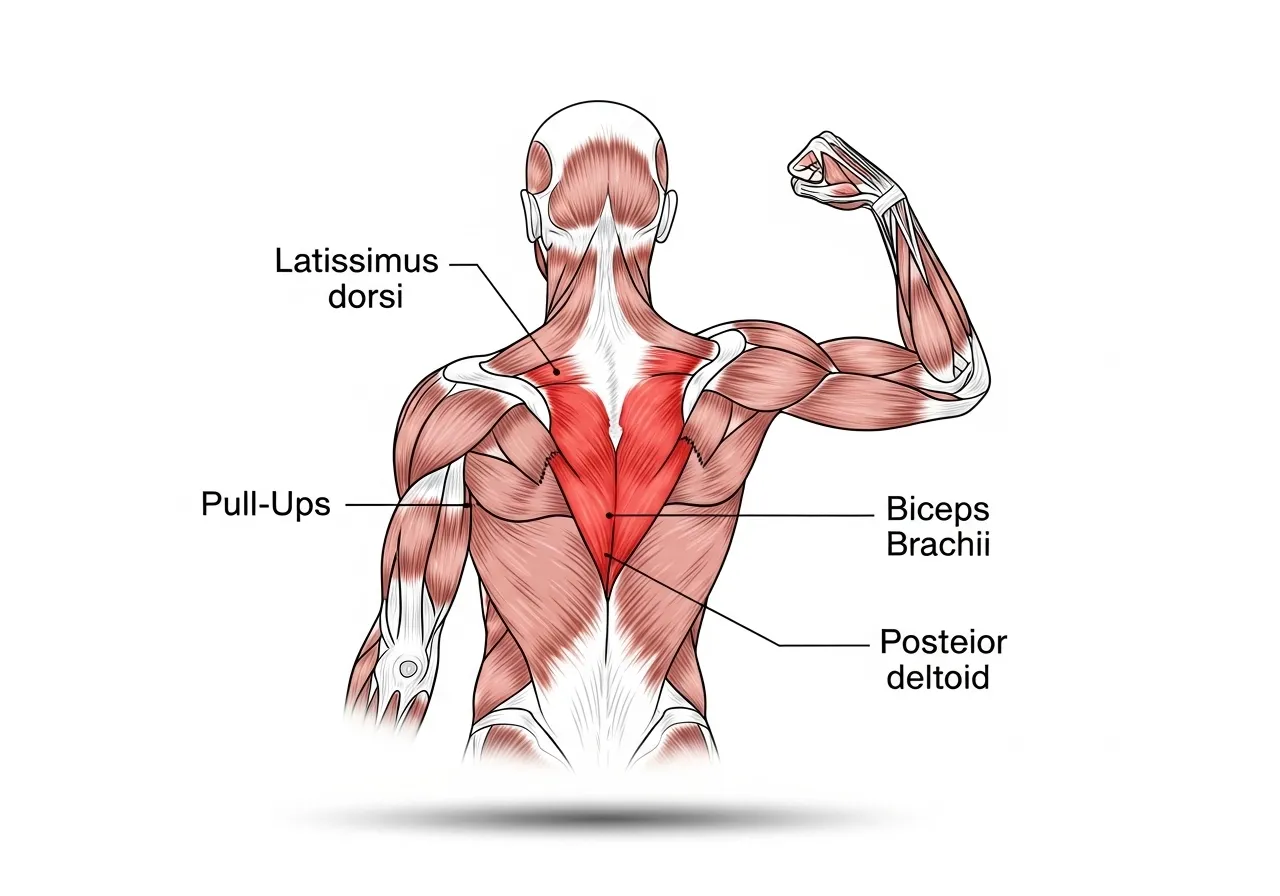
The latissimus dorsi — the large, wing-shaped muscles of the back — are the primary movers in the pull-up. They originate from the thoracolumbar fascia and lower vertebrae and insert into the humerus, producing the shoulder extension and adduction that drives the body upward. Lat strength and hypertrophy are the primary determinants of pull-up performance, but they cannot be trained in isolation — the lats are mechanically linked to the biceps, rear deltoids, and scapular stabilizers in ways that make the pull-up a true compound movement requiring the coordinated development of the entire pulling chain.
The biceps brachii contribute meaningfully to elbow flexion through the pull range, particularly in the upper half of the movement where elbow angle is most acute. Athletes with underdeveloped biceps typically experience failure in the upper portion of the pull, unable to complete the chin-to-bar or chest-to-bar position even when lat strength is adequate. The rear deltoids stabilize the shoulder joint throughout the movement and contribute to the horizontal abduction component of scapular retraction. The lower trapezius and serratus anterior stabilize the scapula, allowing the shoulder to move through full range without impingement or compensatory patterns that reduce efficiency.
Neural Adaptations Drive Early Improvements
The rapid pull-up improvements that occur in the first 4–6 weeks of a new training program are primarily neurological, not structural. The nervous system becomes more efficient at recruiting the motor units involved in the pull-up pattern, coordinating the timing of muscle activation across the pulling chain, and reducing co-contraction of antagonist muscles that opposes the pulling motion. These neural efficiency gains can produce significant performance improvements without meaningful changes in muscle size — which is why beginners can experience dramatic pull-up count increases early in training that slow as the neural ceiling is approached.
After the initial neural adaptation phase, further improvement requires structural changes — actual hypertrophy of the muscles involved. This slower process takes 8–12+ weeks of consistent training and is the phase where most people give up because progress has slowed from the rapid early gains. Understanding that the slowdown is not the program failing but the training entering the structural adaptation phase — which produces more durable, strength-based improvements — is essential for maintaining the training commitment through this critical period.
The Importance of Full Range of Motion
Full range of motion pull-ups — dead hang starting position to chin above bar — develop the complete strength and flexibility across the movement that partial reps cannot. Research published in the Journal of Strength and Conditioning Research consistently shows that full ROM training produces superior hypertrophy and strength gains compared to partial ROM training across multiple exercises. For pull-ups specifically, the dead hang position provides a full stretch of the lats and improves overhead shoulder mobility; the top position develops the shortened-range strength that converts to more reps per set. Performing half-reps to inflate numbers trains only the midrange and produces strength only in that limited arc.
Progressive Overload Mechanisms for Pull-Ups
Progressive overload — systematically increasing training demand to drive continued adaptation — can be applied to pull-ups through multiple mechanisms: adding reps at the same bodyweight, adding sets, adding load (weighted belt or vest), reducing rest periods, increasing time under tension (slow eccentric phase), or increasing frequency. The most common approach is rep progression — simply trying to do more reps — but this is only one of many levers. When rep progression stalls, shifting to a different progressive overload mechanism (adding load, adding volume, slowing the eccentric) provides a new stimulus that breaks the adaptation plateau without requiring more reps from a fatigued system.
The Role of Body Composition
Pull-ups are a bodyweight exercise, meaning that body composition directly affects performance in a way that barbell exercises do not. Every pound of excess body fat increases the load that must be lifted without contributing any contractile force. The practical implication: body composition improvement (reducing fat while maintaining or building muscle) produces pull-up improvement through two simultaneous mechanisms — reduced load and increased force production. Athletes who combine pull-up training with appropriate nutrition for fat loss typically see faster pull-up progress than those improving strength alone, particularly when starting from higher body fat levels. This is not to suggest that lean athletes can’t struggle with pull-ups — but for athletes with body fat above 20–25%, body composition is often a significant limiting factor that training alone cannot fully address.
Motor Learning and the Skill Component of Pull-Ups
The pull-up is a motor skill as well as a strength exercise. External focus cues — “pull the bar to your chest” — produce better motor learning than internal cues like “contract your lats” for most athletes, per research on attentional focus and skill acquisition. Mental rehearsal before a set — vividly imagining the scapular set, the pull, the chin over the bar — activates the same neural pathways as physical practice and has been shown to improve physical performance across multiple movement contexts.
Video feedback is among the most underused pull-up improvement tools. Athletes who review 2–3 minutes of pull-up video weekly identify and correct form errors invisible from inside the movement — elbow flare, insufficient ROM, premature shoulder elevation — that cue-based coaching cannot fully replace. Even monthly video review produces meaningful technique improvement compared to training without any visual feedback. The combination of motor learning principles with strength programming produces faster improvement than either element alone.
The brain’s adaptation to a movement pattern — often called “skill transfer” — means that improvements in pull-up mechanics produce performance gains that are independent of muscle size changes. An athlete who has mastered perfect scapular engagement, optimal body position, and efficient breathing will perform more reps per unit of muscular effort than an athlete of identical strength who hasn’t automated these technical elements. Technical mastery is therefore not separate from performance — it is a primary performance variable that compound training time invested in it directly and measurably.
Blocked practice — all pull-up training before moving to accessory work — produces better skill consolidation for beginners than interleaved practice. As skill level increases, variable practice (occasional grip width changes, tempo variations, load variations) builds more robust motor patterns. This progression from blocked to variable practice mirrors the skill acquisition model used in coaching elite athletes across gymnastics, swimming, and other movement-intensive sports, and applies meaningfully to the pull-up as a technical movement requiring both strength and refined neuromuscular patterning.
The Best Training Methods to Increase Pull-Ups Fast
Multiple evidence-supported training methods have been shown to effectively increase pull-up count. The optimal approach for an individual depends on current ability level, available training time, and specific performance goals. The methods below are ranked from most accessible to most advanced, with guidance on which populations benefit most from each.
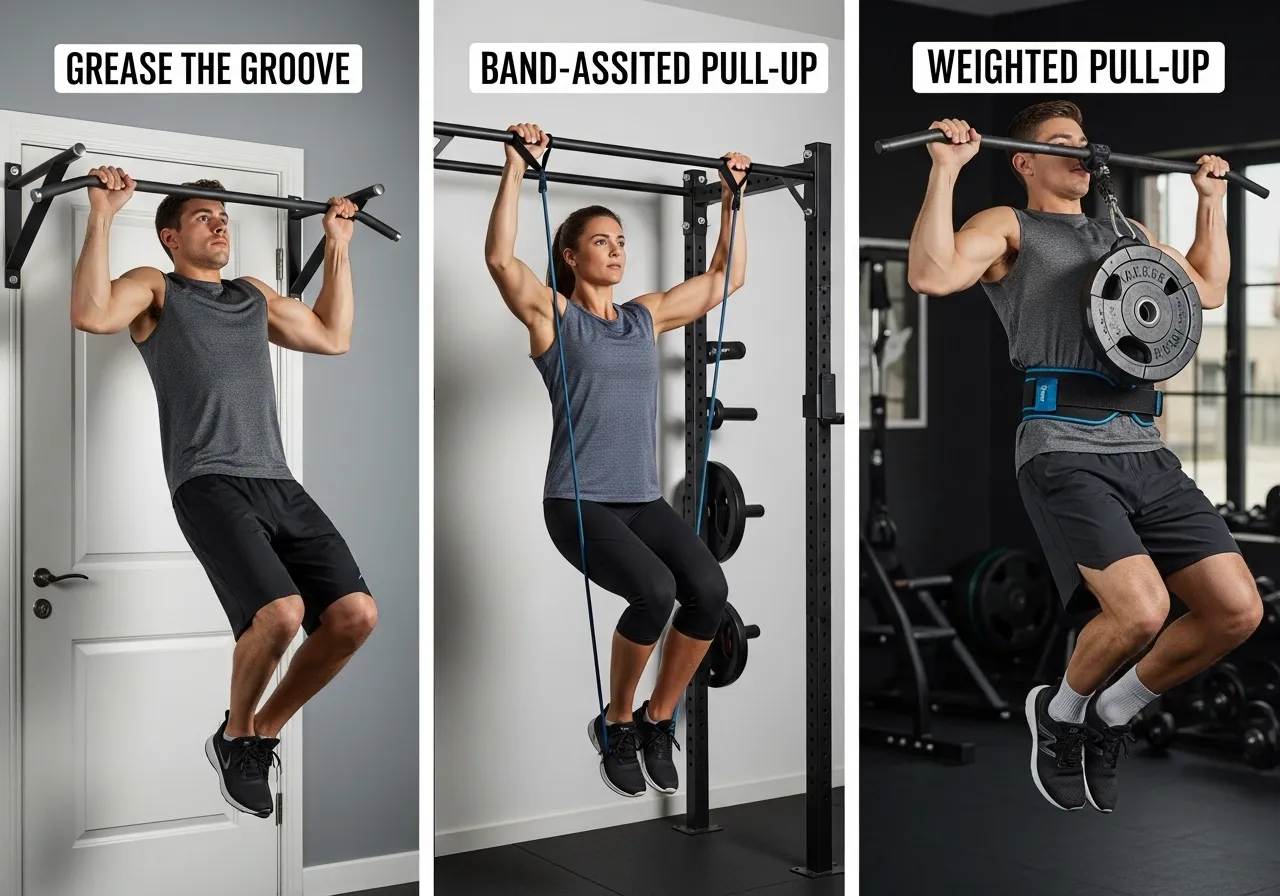
Grease the Groove (GTG): Frequency-Based Volume
Grease the Groove, popularized by strength coach Pavel Tsatsouline, is a frequency-based training method that involves performing frequent submaximal sets throughout the day, never approaching muscular failure. The principle is that movement quality and neural efficiency improve through repeated practice at submaximal intensities, similar to how a skill improves through frequent low-fatigue repetition. For pull-ups, GTG typically involves performing 50% of maximum reps every 1–2 hours throughout the day — so an athlete who can do 10 pull-ups performs sets of 5 every hour or two, accumulating high weekly volume without the fatigue of max effort training.
GTG works exceptionally well for athletes who have access to a pull-up bar throughout the day (a doorframe bar at home, a bar at work) and who are not recovering from a high-volume training program in their other sessions. Research on practice density and motor learning supports the principle that more frequent practice at moderate intensity produces faster neural efficiency gains than less frequent practice at maximum intensity — the same principle used in elite skill sports coaching. Athletes using GTG for 4–6 weeks consistently report significant pull-up improvements, with many doubling their previous max rep count through purely neural efficiency gains without meaningful muscle size increases.
Cluster Sets for Strength Development
Cluster sets — short rest periods (10–30 seconds) within a set, allowing more total reps at high quality than a continuous set would produce — are highly effective for building the strength component of pull-up performance. A cluster set of pull-ups might look like: 3 reps, 15-second rest, 3 reps, 15-second rest, 3 reps — providing 9 total high-quality reps at an intensity level that continuous effort would limit to 5–6. The partial intra-set rest allows partial phosphocreatine resynthesis and CNS recovery, enabling more work at higher quality than traditional set-and-rep schemes.
Cluster sets are particularly effective for athletes who can already do 5+ pull-ups and are trying to break through to higher rep counts. The additional quality reps at near-maximal effort produce the strength adaptation that drives rep count improvements more effectively than submaximal work alone.
Eccentric-Focused Training for Beginners
For athletes who cannot yet complete a full pull-up or who can only do 1–3, eccentric (lowering phase) training provides an accessible way to build the specific strength needed for the concentric phase. Eccentric pull-ups involve jumping or stepping to the top position and lowering slowly (5–8 seconds) to a dead hang. The muscles used in the eccentric phase are identical to those in the concentric, and the eccentric produces greater mechanical tension and muscle damage — which drives hypertrophy — per unit of perceived effort than the concentric phase alone.
Research consistently shows that eccentric training produces superior hypertrophy per session compared to concentric-only training at the same load. For pull-up beginners, 3–4 sets of 5–6 slow eccentric pull-ups, performed 3 times per week, builds the lat, bicep, and stabilizer strength that converts to concentric pull-up ability within 4–6 weeks of consistent practice. The transition from eccentric-only to concentric pull-ups should be attempted after 3–4 weeks — many athletes are surprised to find they can complete a full concentric rep sooner than expected once the eccentric foundation has been built.
Band-Assisted Pull-Ups: Volume Building With Progression
Resistance bands looped over the pull-up bar and under the feet or knees reduce the effective bodyweight being lifted, allowing higher rep counts for volume accumulation. Starting with a heavier band (more assistance) and progressively moving to lighter bands over weeks builds pull-up volume capacity at a level of difficulty that tracks with improving strength. Band-assisted pull-ups are appropriate for all ability levels — beginners use heavy bands to complete full range reps; intermediate athletes use light bands to accumulate volume above their bodyweight max rep count.
The limitation of band-assisted work is that it doesn’t fully replicate the neuromuscular recruitment pattern of bodyweight pull-ups — the band changes the resistance curve. Using band-assisted work as a volume supplement to bodyweight practice (rather than a replacement for it) provides the benefits of both: the neural specificity of bodyweight pull-ups and the volume accumulation of assisted work that would be impossible at bodyweight alone.
Weighted Pull-Ups for Advanced Athletes
For athletes who can perform 10+ bodyweight pull-ups, adding external load via a weight belt, weighted vest, or dumbbell between the feet provides the progressive overload stimulus that bodyweight alone can no longer provide. A single rep of pull-ups with 25 lbs added produces a greater strength stimulus than 15 reps at bodyweight — and the strength built with added weight transfers back to bodyweight pull-ups as increased rep capacity. Periodically cycling weighted pull-up phases (4–6 weeks of weighted work) with bodyweight rep count assessment phases produces long-term pull-up count improvements that bodyweight work alone reaches a ceiling on.
Advanced Pull-Up Variations for Continued Progress
After achieving 12+ strict pull-ups, continuing to improve requires either adding load or exploring advanced variations that provide new training stimuli. L-sit pull-ups — maintaining legs extended horizontally throughout the movement — add significant core demand and change the mechanical challenge of the pull, producing core and hip flexor development alongside continued lat work. Archer pull-ups — extending one arm while pulling with the other — develop unilateral strength and are the prerequisite for one-arm pull-up attempts. Ring pull-ups — performed on gymnastic rings rather than a fixed bar — demand continuous stabilization through the unstable ring surface, producing greater shoulder and stabilizer development than fixed-bar work at equivalent rep counts.
The one-arm pull-up — the ultimate pull-up achievement for most recreational athletes — requires a systematic multi-year progression through weighted pull-ups, assisted one-arm work (band assistance on the working arm), and archer pull-ups before an unassisted attempt is realistic. Athletes with 15+ strict pull-ups and 2–3 years of consistent training can realistically work toward one-arm pull-ups; those with less foundation should build it before targeting this goal. The physiological and technical demands of the one-arm pull-up are qualitatively different from two-arm work — not simply “harder” but a fundamentally different expression of strength that requires dedicated preparation.
For athletes interested in competitive pull-up performance (military fitness tests, CrossFit competitions, or simply personal records), kipping pull-ups — using hip and leg momentum to assist the pull — allow dramatically higher rep counts but should only be trained after solid strict pull-up mechanics are established. Kipping on an unstable strict pull-up base produces significant shoulder injury risk. The appropriate progression: master strict pull-ups to 12+ reps, then learn the kipping swing mechanics, then combine them into kipping pull-ups under coach supervision or with careful self-guided video review.
Programming Pull-Up Training Into Your Weekly Routine
How pull-up training is integrated into the overall training week determines whether it produces consistent improvement or creates interference with other training goals. The following programming principles address frequency, placement within sessions, and integration with other pulling exercises.
Optimal Training Frequency: 3–4 Times Per Week
The evidence on training frequency for strength and skill development converges on 3–4 sessions per week as optimal for most intermediate athletes. This frequency provides enough practice stimulus for neural adaptation (which requires frequent exposure) while allowing adequate inter-session recovery for structural adaptation (which requires protein synthesis and rest). Daily pull-up training is appropriate for GTG protocols with genuinely submaximal efforts, but is counterproductive for max-effort or high-volume sessions that require 48+ hours of recovery. A practical scheduling structure: pull-up training on upper body days if following a split program, or 3 days per week (Monday, Wednesday, Friday or similar) in a full-body program.
Session Placement: First vs. Last in a Session
Where pull-up training is placed within a session significantly affects its quality. Performing pull-ups early in the session — after a warm-up but before other exercises — provides the freshest neuromuscular state for the most demanding sets. This is appropriate when pull-up improvement is the primary goal. Performing pull-ups later in a session — after other rowing or pressing exercises — trains them under a degree of fatigue that is actually useful for developing endurance at the specific rep range needed. Both placements have value; varying between them across different sessions trains different aspects of pull-up performance.
Weekly Volume Targets
Research on volume and hypertrophy suggests that most athletes need 10–20 weekly sets per muscle group for continued development. For pull-up programming, targeting 15–25 total pull-up sets per week — across all sessions and including warm-up sets — provides the volume stimulus for meaningful lat and bicep development. This includes all pull-up variations and lat-dominant rows, not just strict pull-ups. A sample week: Session 1 — 5 sets strict pull-ups; Session 2 — 4 sets weighted pull-ups + 3 sets lat pulldown; Session 3 — 5 sets pull-ups + 3 sets assisted pull-ups. This provides 20 total sets with variety in stimulus across the week.
Integrating Accessory Exercises
Supporting exercises accelerate pull-up progress by developing the secondary movers and stabilizers that limit performance. The most valuable pull-up accessory exercises are: lat pulldowns (same movement pattern with adjustable load, excellent for volume accumulation and technique work); barbell or dumbbell rows (develop the rhomboids, rear delts, and lower trap that stabilize the shoulder during pull-ups); dead hangs (build grip strength and shoulder mobility in the starting position); face pulls (develop external rotators and rear delts that prevent shoulder impingement during high-rep pull-up work); and bicep curls (address the elbow flexion weakness that often limits upper-range pull-up performance). Programming 2–3 of these accessory exercises after main pull-up training each session provides comprehensive development of the entire pulling chain.
Sample Weekly Pull-Up Programming
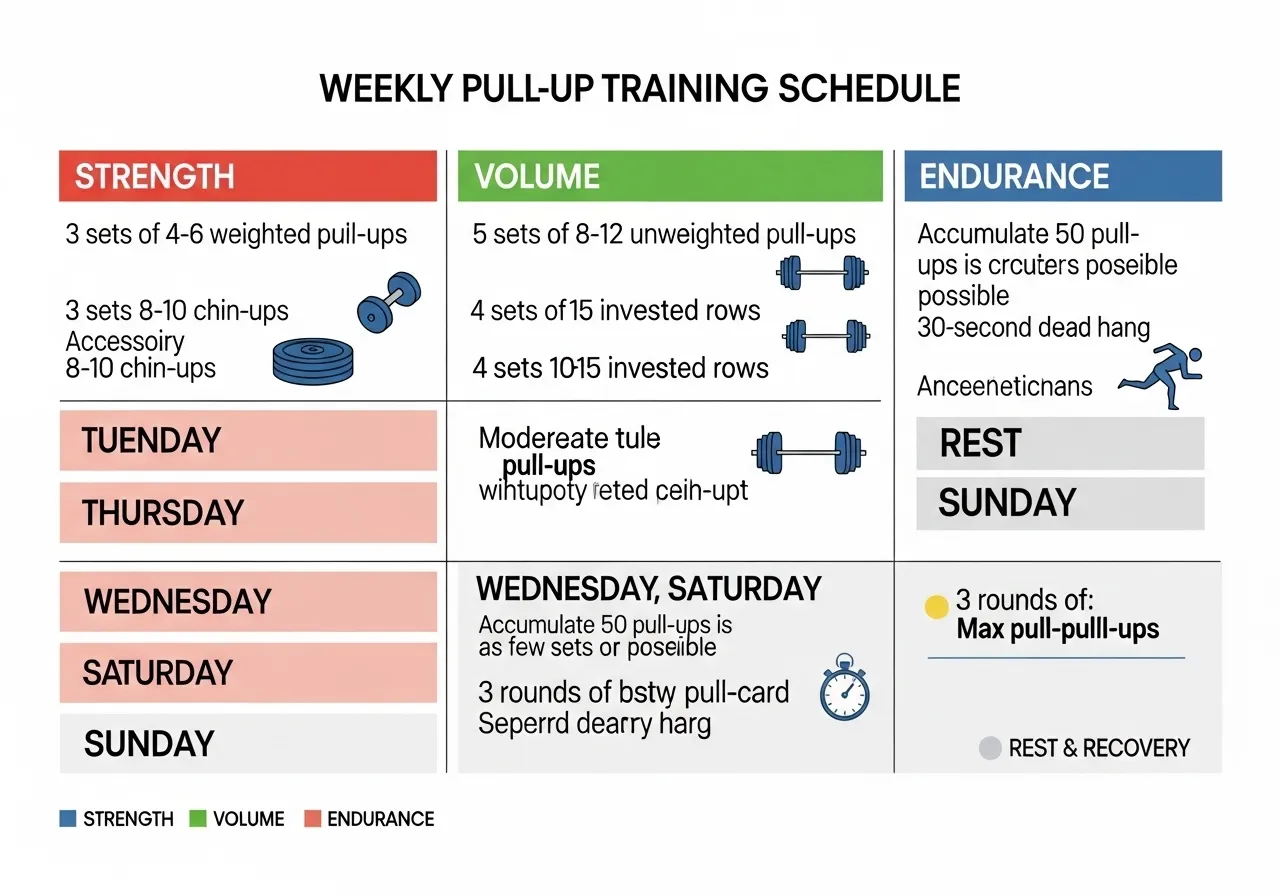
A practical 3-day-per-week pull-up focused program for an athlete who can currently do 8 pull-ups:
Day 1 (Strength Focus): Pull-ups: 5 sets × 5 reps (rest 3 minutes between sets, add 2.5 lbs if all reps clean) → Weighted chin-ups: 3 sets × 6 reps → Barbell row: 4 sets × 8 reps → Dead hang: 3 × 30 seconds.
Day 2 (Volume Focus): Pull-ups: 6 sets × 6 reps (rest 90 seconds) → Lat pulldown: 4 sets × 10 → Face pulls: 3 sets × 15 → Bicep curls: 3 sets × 12.
Day 3 (Endurance/Density Focus): Pull-up ladder: 1-2-3-4-5-4-3-2-1 (one rep pause between each, no rest between sets) → Band-assisted pull-ups: 3 sets × 12 → Seated cable row: 4 sets × 10.
This structure alternates between strength, volume, and endurance stimuli — addressing all three components of pull-up performance across the week. The variety of stimuli prevents the stagnation that comes from doing the same session type repeatedly and ensures comprehensive development of both neural efficiency and structural capacity.
Tracking Progress Beyond Rep Count
Rep count is the most intuitive pull-up progress metric but not the only valuable one. Supplementary metrics provide a more complete picture of development: total weekly pull-up volume (total reps across all sessions, which should be trending upward over months); maximum load for a single pull-up (weighted vest or belt weight at which you can complete one rep); time to complete 50 total pull-up reps (a measure of strength-endurance that improves independently of max rep count); and hang time from a dead hang (grip and shoulder endurance). Tracking multiple metrics prevents the frustration of periods when max rep count is plateaued but other metrics are improving — cross-metric improvement provides evidence that training is working even when the headline metric is momentarily flat.
Photography and video documentation every 4–6 weeks provides visual evidence of the muscular development associated with pull-up training — lat width, rear deltoid development, and overall upper body muscularity improve meaningfully over months of consistent pull-up work in ways that are invisible session-to-session but striking in comparison across months. These visual records serve both motivational and technical functions: motivation from seeing structural changes, and technique reference for identifying how form has evolved (or where it has regressed) over time.
Performance-to-bodyweight ratio is a useful comparative metric that normalizes pull-up performance across body sizes. Expressing pull-up strength as a ratio of additional load to bodyweight — “I can do pull-ups with 50% of my bodyweight added” — allows fair comparison across athletes of different sizes and is the standard used in military and law enforcement fitness assessments worldwide. Tracking this ratio alongside absolute rep count gives a more complete picture of where you stand relative to both your previous self and general performance benchmarks.

Grip Strength, Form, and the Technical Factors That Matter
Technical mastery of the pull-up produces efficiency gains that are equivalent to meaningful strength improvements. Poor form wastes energy, reduces muscle recruitment, and creates compensation patterns that limit rep count and increase injury risk. Addressing the technical aspects of the pull-up — grip width and type, scapular engagement, body position, and breathing — can produce immediate performance improvements without any training load changes.
Grip Width and Its Effects on Muscle Recruitment
Grip width significantly alters muscle recruitment in the pull-up. A shoulder-width grip produces the most balanced lat, bicep, and stabilizer recruitment — making it the most efficient for building overall pull-up capacity. A wider grip (hands outside shoulder width) increases the lat stretch and emphasizes the upper lat, but reduces mechanical advantage and shortens the range of motion, producing a harder but shorter movement. A narrower grip (hands inside shoulder width, the chin-up position) increases bicep recruitment and produces more mechanical advantage, making it easier per rep — useful for volume work but producing less lat-specific development.
For pull-up count improvement, training primarily at shoulder width with occasional wider and narrower grip variations provides the best overall development. The shoulder-width grip maximizes range of motion, distributes load across the entire pulling chain, and develops the specific motor pattern that transfers most directly to improved max rep performance. Wide-grip work as an occasional accessory builds the upper lat that contributes to the aesthetic width many athletes seek; narrow grip work builds the mechanical efficiency and bicep strength that supports high-rep performance.
Scapular Engagement: The Foundation of Safe, Efficient Pull-Ups
Proper scapular engagement is the single most important technical element of the pull-up and the one most commonly neglected by self-taught practitioners. Before initiating the pull, the scapulae should be depressed (pulled down away from the ears) and retracted (pulled together toward the spine). This scapular set position protects the shoulder joint from impingement, activates the lower trapezius and serratus anterior that stabilize the shoulder blade, and positions the lats optimally for maximum force production through the pull.
Athletes who pull without scapular engagement — starting from a completely passive dead hang and immediately pulling with the arms — typically experience shoulder discomfort at high rep counts, reduced lat recruitment (the arms do disproportionate work), and inefficient movement patterns that waste energy. The scapular set should happen as a brief preparation movement before every rep — slight depression and retraction before initiating the upward pull. This becomes automatic with practice but requires deliberate attention during the initial learning phase. A useful cue: “put your shoulder blades in your back pockets” before each rep.
Body Position and Anti-Rotation Stability
The body position during the pull-up affects both efficiency and safety. The torso should maintain a slight anterior lean (chest tilted slightly toward the bar) rather than a completely vertical position — this keeps the lats in a more mechanically advantageous position and reduces shoulder impingement risk at the top of the movement. The legs should be in a consistent position throughout the set — either extended and crossed or bent at 90 degrees — rather than swinging or kipping (unless training kipping pull-ups specifically). Leg swing reduces the stability demand on the core and transfers energy through momentum rather than muscular force, inflating the rep count without building the true strength that transfers to strict reps.
Breathing Pattern for Maximum Reps
Breathing pattern affects pull-up performance more than most athletes realize. The Valsalva maneuver — breathing in at the bottom, holding briefly during the pull, exhaling at the top or during the descent — provides intra-abdominal pressure that stabilizes the core and transfers force more efficiently through the kinetic chain. Breathing haphazardly — gasping at any point in the rep — reduces stability and allows energy leakage that reduces power output. For max effort sets, a controlled breathing pattern (one breath cycle per rep — exhale fully on the way down, inhale at the bottom, brief hold during the pull) maintains stability while providing adequate oxygen for high rep counts. As fatigue accumulates in a set, the natural tendency is to breathe more rapidly and lose pattern control — deliberately maintaining the breathing pattern during the fatiguing final reps is a high-leverage performance skill.
Grip Strength: The Often-Overlooked Limiting Factor
Grip failure — the hands letting go before the lats, biceps, or other primary movers are exhausted — is a common but underappreciated limiting factor in pull-up performance, particularly for athletes transitioning to higher rep counts or weighted variations. Grip strength is developed through dead hangs (straight arm, full bodyweight, held for maximum time), farmer’s carries, plate pinches, and direct forearm training. Adding 2–3 sets of dead hangs (30–60 seconds each) to the end of pull-up sessions directly addresses grip as a limiting factor. Research from the Journal of Human Kinetics shows that grip strength is highly correlated with overall upper body pulling performance and is a significant predictor of pull-up performance across populations. Athletes who address grip training directly typically find that their pull-up failure point shifts from grip exhaustion to genuine lat or bicep fatigue — the appropriate limiting factor for meaningful strength development.
Common Technical Errors and Their Corrections
Beyond the foundational technical elements discussed earlier, several specific form errors are widespread in recreational pull-up training and produce both performance limitations and injury risk. Shoulder shrugging — elevating the shoulders toward the ears at the bottom of the rep — reduces mechanical advantage and compresses the shoulder joint. The correction: actively depress the shoulder blades (push shoulders away from ears) before every rep as part of the scapular set. This single correction often adds 1–2 reps immediately by improving mechanical efficiency.
Elbow flare — elbows pointing wide to the sides rather than tracking toward the hips — reduces lat engagement and shifts load to the biceps and shoulders in mechanically disadvantaged positions. The correction: consciously cue “elbows toward hips” through the pull, which naturally guides the elbows into a better tracking position and maximizes lat engagement through the full range. This cue is more effective than “retract your shoulder blades” as an external focus that guides the movement pattern rather than requiring specific anatomical awareness.
Half-reps — not achieving full arm extension at the bottom or not reaching chin to bar at the top — train only the midrange and build midrange-specific strength that doesn’t transfer to the full movement. The correction is simple: establish start and end position standards and enforce them strictly in every rep, even if this means reducing total reps to maintain full range. Ten full-range reps develop pull-up capacity more effectively than fifteen half-reps, even though the latter feels like more work. Quality standards applied consistently are more important than any specific rep target.
A 6-Week Pull-Up Progression Plan From Zero to Strong
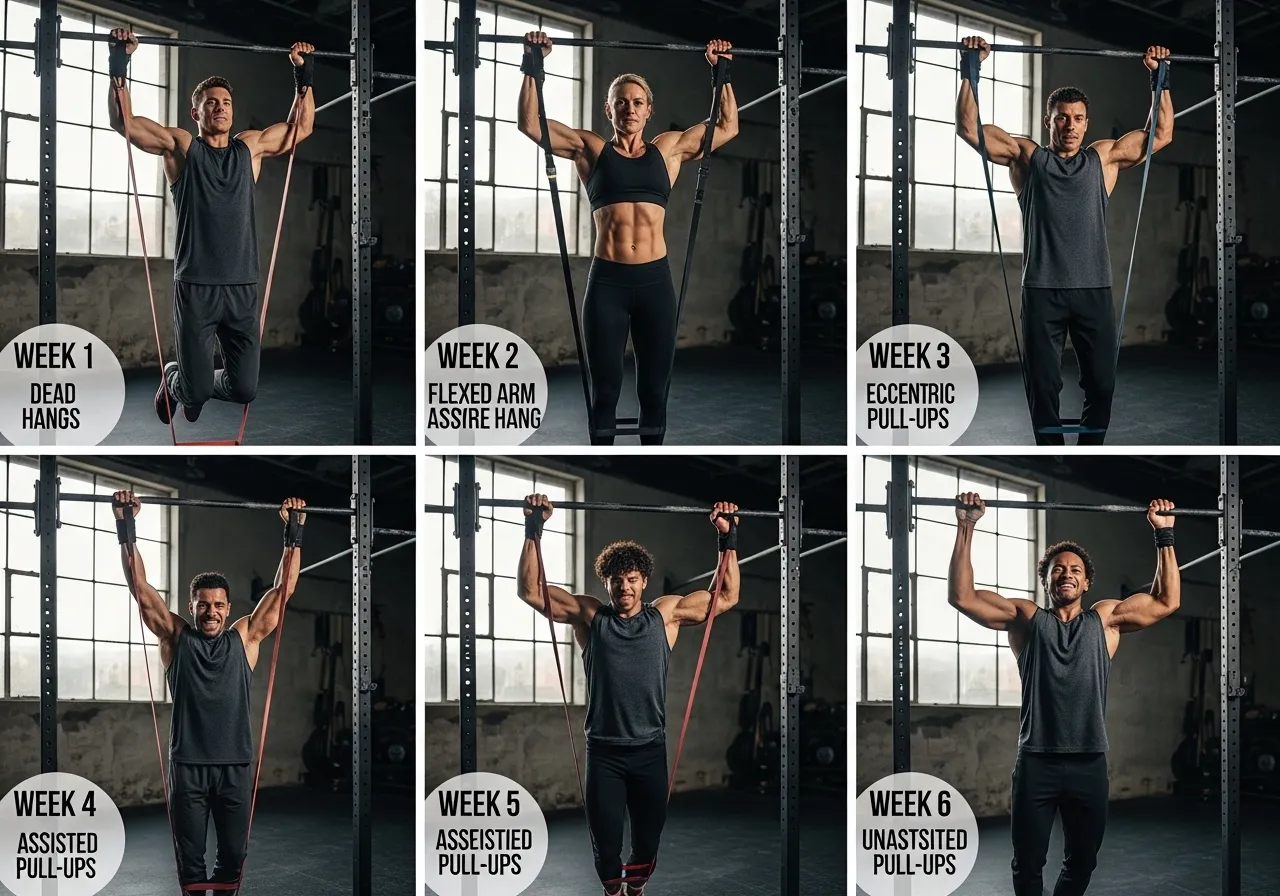
The following 6-week plan is designed for athletes at varying starting points, with progressions for beginners who cannot yet complete a pull-up, intermediate athletes in the 3–8 rep range, and more advanced athletes targeting 12+ reps. Select the appropriate track and follow it consistently for the full 6 weeks before reassessing.
Weeks 1–2: Building the Foundation
Beginner track (0–3 pull-ups): Focus on eccentric pull-ups and band-assisted work. 3 sessions per week: 4 sets × 5 slow eccentric pull-ups (5-second descent) + 3 sets × 8 band-assisted pull-ups with medium resistance band. Dead hang: 3 × max hold (build to 30 seconds). Rest 2 minutes between sets. The goal of weeks 1–2 is to build the foundational strength in the lats, biceps, and stabilizers without attempting concentric reps that form allows.
Intermediate track (3–8 pull-ups): 3 sessions per week. Session A: 5 sets × (50% of max reps) with 90-second rest — pure volume accumulation at submaximal intensity. Session B: 4 sets × maximum reps with 3-minute rest — performance testing and strength work. Session C: GTG throughout the day, sets of 3 (or 50% max). Total weekly volume target: 60–80 pull-up reps.
Advanced track (8+ pull-ups): Introduce weighted pull-ups. 3 sessions per week. Session A: 5 sets × 5 pull-ups with 10–20 lbs added (rest 3 minutes). Session B: 5 sets × max bodyweight reps (rest 2 minutes). Session C: Density training — complete 50 total pull-up reps as fast as possible (record time as the progression metric).
Weeks 3–4: Intensity and Specificity
Maintain the same session structure but increase demand: beginners attempt first concentric reps (band-assisted with lighter band or attempt 1–2 bodyweight reps); intermediates add 1–2 reps to each set target from weeks 1–2; advanced athletes increase weight by 5 lbs or add 1 rep per set. Introduce cluster sets in one session per week for all tracks: 3 mini-sets of (50% max reps, 15-second rest) × 3 total clusters. This concentrated work builds the specific strength at high rep counts that continuous sets cannot provide. Track soreness carefully — if any shoulder or elbow discomfort develops, reduce volume and prioritize scapular engagement technique before continuing progression.
Weeks 5–6: Peak and Test
Maintain training through week 5 with continued progression. Begin week 6 with a 3-day reduced volume deload (50% of normal volume, no max effort sets) to allow accumulated fatigue to clear. On the final day of week 6, perform a max rep test under fresh conditions: one max set after a thorough warm-up, with full range of motion, no assistance. Compare to starting point. Most athletes following this program consistently report: beginners completing their first full bodyweight pull-up; intermediate athletes adding 3–6 reps to their previous max; advanced athletes adding 2–4 reps or achieving a new weighted max.
Beyond 6 Weeks: Continuing the Progression
After the 6-week test, reassess which track is now appropriate and restart the program at the new level. The most effective long-term pull-up strategy alternates between phases: 6 weeks of volume-focused training → 6 weeks of strength-focused training (weighted pull-ups) → 2-week deload and testing phase → repeat. This undulating approach prevents the adaptation plateau that comes from constant exposure to the same training stimulus and produces continuous improvement across months and years of training.
Frequently Asked Questions About Pull-Up Improvement
How many pull-ups should I be able to do? General fitness standards: 5–8 is considered good for most adult men; 3–5 for most adult women. Athletic standards are higher: 12–15+ for men involved in serious fitness training; 8–10 for women. Special operations military standards (15–20+ dead hang pull-ups for men) represent the high end of practical pull-up performance. These numbers are reference points, not judgments — consistent improvement from your current baseline is the relevant metric.
Do pull-ups get easier with practice? Yes, significantly. The neuromotor efficiency gains from consistent pull-up practice make the movement feel easier even before strength increases substantially. Most athletes who commit to a structured program for 4 weeks report that the movement feels qualitatively different — more controlled, less effortful per rep — even when objective rep counts haven’t yet increased dramatically.
Should I use a chin-up grip or pull-up grip? Both are valuable and train the same muscles with different emphasis. Pull-up grip (overhand) emphasizes the lats more; chin-up grip (underhand) emphasizes the biceps more. Training both produces more complete development than specializing in one. For most athletes focused on rep count improvement, chin-ups are slightly easier due to greater bicep contribution and provide useful volume accumulation above pull-up max capacity.
How do I avoid shoulder pain during pull-ups? The most common cause of shoulder pain during pull-ups is impingement from poor scapular mechanics. Ensure scapular depression and retraction before each rep, avoid externally rotating the elbows excessively, and don’t reach for maximum height at the top if it produces shoulder clicking or pain. If pain persists despite technique corrections, have the shoulder assessed by a physiotherapist before continuing high-volume pull-up training.
Nutrition and Recovery for Pull-Up Development
Pull-up improvement is a training outcome that depends on recovery as much as training. The lat and bicep hypertrophy that supports higher rep counts occurs during recovery — specifically during sleep and the protein synthesis window following training — not during training itself. Inadequate protein intake (below approximately 1.6 grams per kilogram of bodyweight daily) limits the rate of muscle protein synthesis, slowing the structural adaptation that enables higher rep counts. Ensuring adequate total daily protein is the nutritional foundation that makes any pull-up training program more effective.
Sleep quality and duration directly affect the rate of neuromuscular adaptation from training. Research consistently shows that chronic sleep restriction below 7 hours reduces strength adaptation from resistance training. For athletes focused on pull-up improvement specifically, prioritizing 7–9 hours of quality sleep accelerates the neural efficiency gains that produce the most dramatic early pull-up improvements. The combination of adequate protein and adequate sleep is the recovery foundation without which even perfect training programming produces suboptimal results.
Creatine monohydrate supplementation is one of the most extensively researched and consistently effective ergogenic aids for strength and high-rep bodyweight performance. Research shows that creatine supplementation increases maximal strength, improves high-rep performance, and accelerates recovery between sets — all of which directly benefit pull-up training. At the standard dose of 3–5 grams daily (no loading phase necessary), creatine is safe, inexpensive, and evidence-based. For athletes who haven’t yet tried creatine, it represents a meaningful and well-supported addition to a pull-up improvement program.
Frequently Asked Questions About Pull-Up Progression
How long will it take to go from 0 to 10 pull-ups? With consistent training 3 times per week following a structured progression, most athletes with no prior pull-up ability reach their first full pull-up within 4–6 weeks and 10 pull-ups within 4–6 months. Individual variation is significant — genetics, body composition, and prior training history all affect the timeline. Consistency of training is the dominant variable: athletes who train consistently for 4 months almost universally reach 10 pull-ups; those who train inconsistently may take years or never reach the goal.
Is it better to do pull-ups every day? For GTG-style submaximal practice, daily pull-ups are appropriate and effective. For max-effort or high-volume sessions, daily training accumulates fatigue faster than most athletes recover, producing performance regression rather than improvement. The optimal frequency for most people is 3–4 structured sessions per week with optional GTG practice on other days at genuinely submaximal intensity.
Why do my pull-ups feel harder in the evening than morning? Muscle strength and neuromotor efficiency are influenced by circadian rhythms, with most people experiencing peak performance in the late afternoon to early evening (typically 3–7pm). Morning training — particularly within 1–2 hours of waking — is mechanically and neurologically less optimal due to lower core temperature, dehydration from overnight fasting, and incomplete awakening of the nervous system. If training in the morning, a more thorough warm-up and lower performance expectations for the first few sets are reasonable accommodations for the circadian disadvantage.