Dumbbell Workout for Beginners: Full Body in 30 Minutes
⚠️ Disclaimer: The information in this article is for general educational purposes only and does not constitute medical, nutritional, or professional fitness advice. Individual results may vary. Always consult a qualified healthcare professional or certified fitness trainer before starting any new exercise program, changing your diet, or making decisions about injury treatment or recovery. If you experience pain, discomfort, or any unusual symptoms during exercise, stop immediately and seek professional guidance.

Why Dumbbells Are the Best Beginner Training Tool
The Case for Dumbbells Over Machines and Barbells
Dumbbells occupy a unique position in the equipment hierarchy that makes them the ideal starting point for beginners — and, arguably, for most recreational trainees at any level of experience. Unlike machines, which constrain movement to a fixed path and eliminate the stabilization demand that develops the smaller supporting muscles critical for long-term strength and injury prevention, dumbbells allow natural movement through your body’s actual range of motion. Unlike barbells, which require technical proficiency and spotter safety considerations that can intimidate beginners and create injury risk during the learning phase, dumbbells allow independent movement of each limb that automatically accommodates asymmetries in strength and flexibility while providing natural limiting mechanisms — if a weight is too heavy, it becomes impossible to lift before injury occurs, rather than being trapped under a bar.
Dumbbells were the equipment I started with out of necessity, and I now recommend them to beginners deliberately — the balance and stability demands they create build a foundation that machines can’t replicate.
Research published in the Journal of Strength and Conditioning Research comparing dumbbell and barbell training in beginners found equivalent strength and muscle gains over 10 weeks, with the dumbbell group showing significantly lower rates of technique-related injury and higher training adherence — likely due to the lower intimidation factor and greater exercise variety available with dumbbells. For a beginner whose primary objectives are building foundational strength, developing correct movement patterns, and establishing a durable training habit, dumbbells deliver all necessary training stimulus with fewer of the barriers and risks associated with barbell training.
The practical advantages of dumbbells compound their physiological benefits. A pair of adjustable dumbbells — or a small collection of fixed dumbbells in a range of weights — provides a complete home training setup for a fraction of the cost and space of a barbell and rack. This accessibility is not trivial; the research on exercise adherence consistently identifies convenience as one of the strongest predictors of long-term training consistency, making the ability to train at home with minimal equipment a genuine performance advantage for people whose schedules and circumstances make gym attendance inconsistent.
What Dumbbells Train: The Full Body Stimulus
A well-designed dumbbell program can train every major muscle group in the body with sufficient stimulus to drive meaningful strength and hypertrophy adaptation. The key is selecting exercises that target the major movement patterns — squat, hip hinge, horizontal push, horizontal pull, vertical push, vertical pull, and core anti-rotation — rather than trying to replicate every machine exercise with a dumbbell equivalent. These seven movement patterns together engage essentially every skeletal muscle in the body, and mastering them with dumbbells creates the movement quality, strength, and muscle development that transfers to every other training modality and physical activity.
The compound dumbbell exercises that form the backbone of this program — goblet squat, Romanian deadlift, dumbbell bench press, dumbbell row, overhead press, and farmer’s carry — each train multiple muscle groups simultaneously and produce the hormonal responses (growth hormone, testosterone, insulin-like growth factor) that drive systemic adaptation across the body. Isolation exercises — curls, tricep extensions, lateral raises — add supplementary stimulus to lagging areas but are secondary to the compound movements for overall strength and body composition development.
Selecting the Right Dumbbell Weight
One of the most common beginner mistakes is choosing dumbbell weights that are either too light (producing insufficient stimulus for adaptation) or too heavy (producing technique breakdown and injury risk). The correct weight for any given exercise is one where you can complete the target rep range with proper form for all sets, with the final 2 to 3 reps of the last set feeling genuinely challenging. This subjective calibration — called “reaching technical failure” — ensures that each set provides sufficient stimulus for adaptation without the mechanical breakdown that causes injury.
Practical starting points for beginners: women typically start with 5 to 8kg dumbbells for upper body exercises and 8 to 12kg for lower body exercises; men typically start with 8 to 12kg for upper body and 12 to 18kg for lower body. These are general starting points that individual variation will modify significantly — what matters is the correct relative difficulty, not the specific weight. According to the American College of Sports Medicine training guidelines, beginners should select loads allowing 12 to 15 repetitions per set with good form, increasing load by 2 to 5 percent when the upper end of the target rep range is achieved for 2 consecutive sessions.
The Science of Beginner Gains: Why the First 12 Weeks Are Special
The first 12 weeks of structured dumbbell training produce a rate of improvement that is physiologically unique and will never be repeated at any subsequent stage of training. This “beginner gains” phase is driven by neurological adaptations — improvements in motor unit recruitment, inter-muscular coordination, and movement pattern efficiency — that occur independently of structural muscle growth and produce rapid strength improvements even before meaningful hypertrophy has begun. A beginner can increase their dumbbell bench press from 8kg to 14kg in 6 weeks not because their pectorals have grown substantially but because their nervous system has learned to recruit more motor units more efficiently and coordinate the pressing pattern with greater precision.
Understanding this neurological basis of beginner gains has two important practical implications. First, the rate of progress in the first 12 weeks is not representative of long-term progress — expecting the same weekly improvements at month 6 that occurred in month 1 leads to frustration when the neurological gains have been fully captured and structural hypertrophy (which progresses more slowly) becomes the primary adaptation mechanism. Second, the importance of using this unique window well: every training session in the first 12 weeks provides an outsized learning opportunity that establishes the movement patterns, strength base, and training habits that determine long-term development. Wasting this window with inconsistent training or poor technique delays the foundation-building that subsequent training builds upon. According to the American College of Sports Medicine, beginners who train consistently with proper technique in the first 12 weeks of a structured program achieve significantly better long-term outcomes than those who train inconsistently or with poor technique during this critical period.
Common Beginner Mistakes With Dumbbells
The most common beginner dumbbell mistakes undermine both safety and results in predictable ways. Selecting weights based on ego rather than appropriate resistance — choosing dumbbells that are too heavy to complete the target reps with correct form — produces technique breakdown, increases injury risk, and creates poor movement patterns that become increasingly difficult to correct as weight increases. The solution is selecting the heaviest weight that allows perfect form for all target reps in all sets, increasing weight only when this criterion is consistently met. Skipping the warm-up to save time — particularly significant for cold morning workouts — reduces neuromuscular performance and increases injury risk in ways that cost more total training time than the warm-up saves. The 5-minute warm-up described in this article is not optional; it is the safety and performance foundation of every session.
Training to absolute failure on every set — a mistake often encouraged by motivational fitness content — creates excessive muscle damage and neural fatigue that extends recovery time beyond 48 hours and impairs the next session’s quality. Training to within 1 to 2 reps of failure (leaving a little in reserve) produces equivalent hypertrophic stimulus with significantly reduced recovery cost, allowing higher training frequency and total weekly volume. The goal is sustainable progressive overload over months and years, not maximum effort in every individual set.
Dumbbell Selection Guide: What to Buy First
For someone setting up their first home dumbbell collection, the selection question has a clear evidence-based answer. The minimum useful set for a beginner: 3 pairs of dumbbells covering light, medium, and heavy ranges for your current strength level. For most women starting from zero: 3, 5, and 8kg. For most men: 6, 10, and 14kg. These three pairs cover the range needed for the beginner program — lighter for isolation exercises (lateral raises, curls), medium for compound upper body (press, row), and heavier for lower body (squats, deadlifts, carries). An adjustable dumbbell set (where a single handle adjusts to multiple weights) provides greater range in less space and at lower total cost than multiple fixed-weight pairs, making it the better long-term investment for home trainers who plan to progress beyond beginner weights.
The false economy of starting with weights that are too light — common advice from well-meaning beginners who underestimate how quickly beginners progress — results in outgrowing the equipment within 4 to 6 weeks and needing to purchase heavier weights. Selecting weights that are appropriate for current strength but provide 3 to 4 months of progressive challenge — slightly heavier than you can currently use comfortably — is a more practical investment than buying the minimum weight and returning to the store within a month.

The Complete 30-Minute Full Body Dumbbell Workout
Workout Structure and Timing
The 30-minute constraint shapes every aspect of this workout’s design. There is no room for extended rest periods, redundant exercise selection, or slow transitions between exercises. Every minute is allocated deliberately: 3 minutes warm-up, 22 minutes of work, and 5 minutes cool-down and stretching. Within the 22-minute work window, exercises are organized into supersets — two exercises performed back-to-back with minimal rest — that train non-competing muscle groups simultaneously, maintaining elevated heart rate and caloric expenditure while allowing each muscle group adequate rest before it is trained again.
I’ve run versions of this workout with people at completely different fitness levels and the 30-minute structure consistently delivers more than people expect from such a short session.
This superset structure is not merely a time-saving technique — it is a legitimate training strategy that research has validated for producing simultaneous strength and cardiovascular adaptation. A study in the British Journal of Sports Medicine found that superset resistance training produced equivalent muscle hypertrophy to traditional set-and-rest training in significantly less time, with the additional benefit of greater cardiovascular stimulus and caloric expenditure during the session — making it ideally suited to the time-constrained full body format.
The Warm-Up (3 Minutes)
Minute 1: Arm circles (15 forward, 15 backward) → Hip circles (10 each direction). This activates the shoulder girdle and hip joints that will be loaded during the main work. Minute 2: Bodyweight squat × 10 slow reps → Hip hinge practice × 10 reps (no weight, focus on feeling the hamstring stretch at bottom). Minute 3: Arm swings across body × 10 each direction → Ankle rotations × 10 each foot → 5 slow push-ups. This specific warm-up primes every joint system that will be loaded in the main workout and increases muscle temperature to the range where performance and injury resistance are optimized.
The Main Workout: 4 Supersets × 3 Rounds
The workout consists of 4 supersets, each pairing a lower body and upper body exercise that train non-competing muscle groups. Perform the A exercise, rest 15 seconds, perform the B exercise, rest 45 seconds, then repeat for 3 rounds before moving to the next superset. Total time for 4 supersets × 3 rounds with transitions: approximately 22 minutes.
Superset 1 — Lower Body + Upper Body Push:
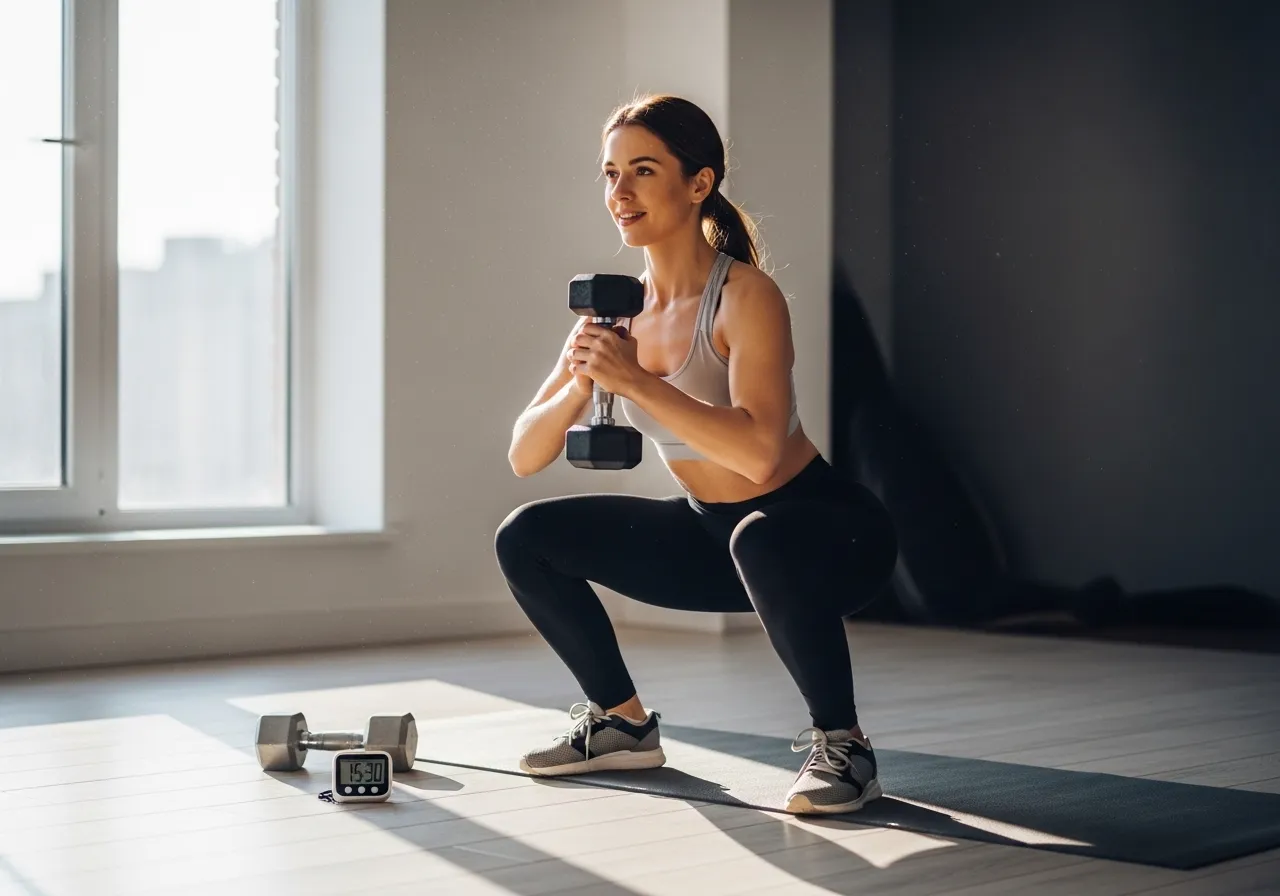
1A. Goblet Squat × 12 reps — Hold one dumbbell vertically at chest height, feet shoulder-width, toes slightly out. Sit back and down until thighs are parallel to floor, keeping chest tall and knees tracking over toes. Drive through heels to stand, squeezing glutes at top. This is the most teachable squat variation for beginners — the counterweight of the dumbbell at the chest naturally prevents the forward lean that causes most beginner squat problems.
1B. Dumbbell Floor Press × 12 reps — Lying on floor, elbows at 45 degrees, lower dumbbells to floor level (the floor acts as a natural range limiter that protects the shoulder at the bottom), press to full extension. The floor press is an excellent bench press alternative for home training that eliminates the need for a bench while training the same primary muscles.
Superset 2 — Hip Hinge + Horizontal Pull:
2A. Romanian Deadlift × 12 reps — Dumbbells in front of thighs, hinge at hips while maintaining neutral spine, feel the hamstring stretch at bottom, drive hips forward to stand. The RDL is the most important posterior chain exercise for beginners — developing the hip hinge pattern that transfers to athletic movement, daily activities, and advanced exercises.
2B. Dumbbell Row × 12 reps each side — Brace one hand on knee or chair, row elbow toward hip, pause for 1 second at top, lower with control. The pulling balance to the pressing exercises in this workout is critical for shoulder health and postural development.
Superset 3 — Single Leg + Shoulder:
3A. Reverse Lunge × 10 reps each leg — Step back into lunge position, lower rear knee to within 2cm of floor, push through front foot to stand. The reverse lunge is superior to the forward lunge for beginners because it places less shear force on the knee and is more easily controlled.
3B. Dumbbell Overhead Press × 12 reps — Seated or standing, press dumbbells from shoulder height to full extension overhead, lower with control. Brace the core throughout to prevent arching the lower back under load.
Superset 4 — Glute Bridge + Core:
4A. Dumbbell Glute Bridge × 15 reps — One dumbbell on hips, upper back on floor, drive hips to full extension, squeeze glutes hard at top for 1 second. Glute development is critical for knee health, lower back protection, and the functional strength that transfers to all lower body movement.
4B. Dumbbell Farmer’s Carry × 30 seconds — Hold one dumbbell in each hand, walk with tall posture, core braced, controlled breathing. The farmer’s carry trains grip strength, core stability, shoulder packing, and cardiovascular capacity simultaneously — one of the highest-value exercises available for total body conditioning.
The Cool-Down (5 Minutes)
Minute 1: 5 slow deep breaths, walking in place to gradually reduce heart rate. Minute 2: Hip flexor stretch in lunge position, 45 seconds each side. Minute 3: Hamstring stretch seated, 45 seconds each leg. Minute 4: Chest opener — clasp hands behind back, open chest, look up, hold 45 seconds. Minute 5: Child’s pose — 60 seconds, focusing on diaphragmatic breathing and releasing tension from the lower back and hips.
The Equipment-Free Warm-Up for Dumbbell Training
A proper 5-minute warm-up before dumbbell training prepares the joints, muscles, and nervous system for the specific demands of the session and reduces injury risk by 30 to 50 percent compared to training without warm-up. The warm-up should be dynamic — involving movement through the ranges of motion used in the main workout — rather than static, as static stretching before training reduces strength output without improving injury prevention. The specific warm-up sequence for the 30-minute full body dumbbell workout: Minute 1 — arm circles (15 forward, 15 backward), hip circles (10 each direction). Minute 2 — bodyweight squat × 10 slow reps focusing on movement quality. Minute 3 — hip hinge practice without weight × 10 reps, feeling the hamstring stretch at bottom. Minute 4 — arm swings across body × 10 each direction, light push-up × 5. Minute 5 — lateral lunges × 5 each side, shoulder rotation circles × 10 each arm.
This 5-minute sequence elevates muscle temperature, distributes synovial fluid through the shoulder and hip joints, activates the neural patterns for the day’s exercises, and psychologically transitions from daily life mode to training mode. The psychological component is underrated: beginning the warm-up is the action that actually commits to the training session, removing the decision-making friction that causes many skipped workouts. Starting the warm-up when motivation is low — knowing you only need to complete 5 minutes before you can reassess — almost always results in completing the full training session, because the warm-up itself generates the energy and readiness that the preceding lethargy lacked.
Dumbbell Exercise Substitutions for Common Limitations
The 30-minute workout described in this article assumes average mobility and no joint restrictions, but many beginners have limitations that require exercise substitutions. Floor press replaces bench press for people without a bench. Step-ups replace reverse lunges for people with knee sensitivity (lower impact, more controlled range). Single-arm supported row replaces standard row for people with lower back pain that makes unsupported bending uncomfortable. Seated overhead press replaces standing press for people with lower back issues or shoulder impingement (seated with back support eliminates lumbar arching, and the backrest eliminates the balance demand that can cause technique breakdown). Knowing these substitutions allows any beginner to start training regardless of equipment limitations or physical restrictions, removing the “I’ll start when I have the right equipment/feel better” barrier that delays beginning indefinitely.
Progressive Overload: How to Keep Improving With Dumbbells
The Progressive Overload Principle for Beginners
Progressive overload — systematically increasing the training demand over time — is the fundamental mechanism of adaptation in resistance training. Without progressive overload, the body adapts to the current training stimulus and stops producing new adaptations, resulting in the performance plateau that frustrates so many trainees who perform the same workout indefinitely. For dumbbell training, progressive overload can be applied through multiple variables that extend the effective challenge of any weight well beyond what simple load increases allow.
Reaching for the next weight up before I was fully comfortable with the current one slowed my progress for months — incremental progression beats ego every time.
The hierarchy of progressive overload variables for dumbbell training: First, increase repetitions within the target range (if target is 10 to 12 reps, work toward consistently achieving 12 before increasing weight). Second, increase the number of sets (from 3 to 4 sets per exercise). Third, increase load (typically 1 to 2.5kg increments for upper body exercises, 2.5 to 5kg for lower body). Fourth, reduce rest periods (from 60 seconds to 45 seconds). Fifth, increase range of motion (deeper squat, fuller stretch at bottom of RDL). Sixth, advance to more difficult exercise variations (reverse lunge to Bulgarian split squat, floor press to decline push-up). These six variables provide months of progressive challenge from any starting weight, making the “I’ve grown out of my dumbbells” problem much less common than most beginners expect.
The Double Progression Method
The double progression method is the simplest and most effective progressive overload system for beginner dumbbell training. For any exercise, select a target rep range (e.g., 10 to 12 reps). Perform 3 sets of the exercise. If all 3 sets achieve the upper end of the rep range (12 reps) with good form, increase the weight at the next session. If sets fall below the lower end of the range (fewer than 10 reps on any set), maintain the current weight. This system automatically calibrates progression rate to individual adaptation speed — faster progressors increase weight more frequently, slower progressors maintain weight longer to build the strength base needed for the next increment.
Tempo Manipulation for Extended Challenge
When dumbbell weight options are limited — common in home training environments where purchasing every weight increment is impractical — tempo manipulation extends the effective challenge of any given weight significantly. A 10kg dumbbell used for Romanian deadlifts at standard tempo (2 seconds down, 1 second up) becomes substantially more challenging when performed with a 4-second eccentric (lowering) phase, a 2-second pause at the bottom, and a controlled 2-second concentric (lifting) phase. This 4-2-2 tempo increases time under tension per rep by 400 percent compared to standard tempo, dramatically increasing the hypertrophic stimulus without requiring heavier weight.
Understanding Strength Plateaus in Dumbbell Training
A strength plateau — a period of 2 or more weeks without progress in the target exercises — is not a sign that you’ve reached your limit; it is a sign that the current training stimulus has been fully adapted to and a new challenge is needed. Plateaus in dumbbell training occur when one of three conditions is present: the training load has become insufficient for continued adaptation (requiring load progression or exercise advancement), the training volume has become insufficient (requiring more sets or frequency), or the recovery is insufficient to complete the adaptation from current training (requiring sleep, nutrition, or stress management improvements). Identifying which of these three conditions is producing the plateau determines the appropriate response.
The most common cause of dumbbell training plateaus for beginners is the jump in available weights. If you can currently complete 3 sets of 12 reps with 10kg dumbbells but the next available weight is 12.5kg (a 25 percent increase that may be too large to handle immediately), the plateau is caused by equipment limitation rather than physiological limitation. Solutions: add tempo (slow eccentric to increase difficulty at the same weight), add sets (from 3 to 4 sets), reduce rest (from 60 to 45 seconds), or use paused reps (pause at the hardest point for 1 to 2 seconds). Each of these modifications increases training difficulty without requiring heavier weights, bridging the gap until you can handle the next weight increment.
Tracking Progress in a Dumbbell Training Program
Systematic progress tracking transforms dumbbell training from a habitual activity into a deliberate improvement process. The minimum viable tracking system: a training log recording the exercise name, weight used, sets completed, and reps achieved in each set for every session. This simple record takes 2 to 3 minutes to complete per session and provides the historical data needed to apply progressive overload systematically — you cannot progressively overload without knowing what you did last time. More comprehensive tracking adds session duration, perceived exertion (1 to 10 scale), notable technique observations, and how you felt that day, providing the context needed to interpret performance variations and identify patterns in recovery quality and training readiness.
Reviewing the training log monthly — not daily — provides the perspective needed to assess genuine progress. Day-to-day variation in strength output (caused by sleep, nutrition, stress, and hydration) can mislead if individual sessions are compared directly; monthly trend analysis reveals the underlying progress that daily variation obscures. A 5 percent improvement in dumbbell press weight or a 20 percent increase in total reps per month represents excellent progress — the kind of progress that compounds into dramatic results over 12 to 24 months of consistent training.
How Long to Stick With the Beginner Program
The beginner dumbbell program should be followed until one of three transition criteria is met: you can perform all exercises with excellent technique at the target reps and weights for all 8 weeks of the program, you have 3 to 6 months of consistent training behind you, or you begin experiencing the stalled progress that signals the beginner adaptation phase has been exhausted. The temptation to advance prematurely — to move to intermediate programming before the beginner program has been fully exhausted — is one of the most common mistakes in strength training, because the progressive overload potential of the beginner program is far greater than most people realize before working through it completely. A person who follows the 8-week program exactly as written, adds a second cycle with increased weights, and completes 16 to 20 weeks of progressive beginner training before advancing has built a foundation that makes intermediate programming substantially more productive than the same intermediate program would be if started prematurely.

Technique Deep Dives for Beginner Safety and Results
The Goblet Squat: Common Errors and Corrections
The goblet squat is the most teachable squat variation, but beginners still make characteristic errors that reduce effectiveness and increase injury risk. The most common error is heel rise — the heels lifting off the floor at the bottom of the squat, indicating insufficient ankle dorsiflexion mobility or incorrect weight distribution. The fix: place 1 to 2cm heel elevation under both heels (a weight plate or folded towel works perfectly) until ankle mobility improves through consistent stretching. The second most common error is knee cave — the knees collapsing inward at the bottom of the squat, indicating weak glute medius and external rotators. The fix: consciously push the knees outward throughout the movement, and perform targeted glute activation exercises (clamshells, band walks) to develop the lateral hip strength needed for knee stability.
The form cues I wish I had in my first month of dumbbell training are the ones I’ve included here — they save beginners the learning time that I had to spend the hard way.
The Romanian Deadlift: The Hip Hinge Mastery
The Romanian deadlift is simultaneously the most important and most commonly incorrectly performed exercise in beginners’ programs. The defining characteristic of a correct RDL — the posterior movement of the hips initiating the descent while the spine maintains a neutral curve — is the opposite of the natural instinct, which is to bend forward by rounding the spine. The hip hinge pattern must be practiced and internalized before adding any significant load, because it is the foundation for safe lower body training and is used in squats, deadlifts, and hundreds of daily movement patterns. The “wall touch” drill: stand 15cm from a wall, extend the hips backward until the glutes touch the wall while maintaining a flat back — this kinesthetic feedback establishes the feeling of hip extension that defines the hip hinge.
The Dumbbell Row: Building a Strong Back Safely
The dumbbell row trains the latissimus dorsi, rhomboids, and rear deltoids — the posterior chain muscles most responsible for good posture and shoulder health, and most neglected in sedentary individuals who spend hours in forward-flexed positions. The most important technical cue for maximizing effectiveness: initiate the movement by pulling the elbow back and down toward the hip, not by pulling the hand up toward the shoulder. The elbow-drive cue activates the latissimus dorsi preferentially; the hand-drive cue activates the biceps and upper traps, reducing the training stimulus on the target muscles. The second key cue: avoid rotating the torso to increase range of motion — the row should be performed with the spine fixed and the movement occurring entirely at the shoulder joint.
The Overhead Press: Protecting the Shoulder
The overhead press trains the deltoids and triceps through the full vertical pressing range of motion, but it also places the shoulder joint in positions that can aggravate pre-existing impingement or instability issues. The safest overhead press technique for beginners: perform the movement seated with back support to eliminate the lumbar arch compensation that occurs when shoulder mobility is insufficient for full overhead range. Keep the dumbbells in the scapular plane (30 degrees forward of the frontal plane, not directly to the sides) throughout the movement — this position reduces rotator cuff impingement risk compared to a strict side-to-overhead path. If any shoulder discomfort occurs during the movement, replace with a dumbbell front raise or Arnold press that reduces the overhead impingement risk while maintaining shoulder training stimulus. According to the Journal of Orthopaedic and Sports Physical Therapy, most exercise-related shoulder injuries result from impingement in the overhead position, making technique precision the primary injury prevention strategy for all overhead movements.
Breathing Techniques for Dumbbell Training
Correct breathing during dumbbell exercises is both a safety mechanism and a performance enhancer. The Valsalva maneuver — a brief breath-hold during the hardest part of a heavy lift — increases intra-abdominal pressure that stabilizes the spine under load, reducing injury risk and improving force transmission. For the moderate loads typical in beginner dumbbell training, a less extreme version is appropriate: exhale during the concentric phase (lifting), inhale during the eccentric phase (lowering). This rhythmic breathing pattern maintains appropriate intra-abdominal pressure throughout the set, prevents the breath-holding that causes blood pressure spikes in the heaviest sets, and creates a natural tempo that improves movement control and reduces rushing through reps.
For exercises with a clear exertion point — the push-up lockout, the top of the dumbbell press, the standing position of the goblet squat — tying the exhale to this point synchronizes breathing with effort and becomes automatic within a few sessions of deliberate practice. For exercises with sustained effort — planks, farmer’s carries — slow diaphragmatic breathing (inhaling through the nose, expanding the belly, exhaling through slightly parted lips) maintains appropriate core tension while preventing the breath-holding that elevates blood pressure during sustained isometric efforts.
Dumbbell Training and Blood Pressure Management
Resistance training — including dumbbell training at the moderate intensities of a beginner program — produces acute elevations in blood pressure during exercise but, with consistent training over weeks and months, produces meaningful reductions in resting blood pressure. Research from the American College of Sports Medicine found that regular resistance training reduces resting systolic blood pressure by an average of 3 to 6 mmHg — a reduction comparable to low-dose antihypertensive medication for people with pre-hypertension. For people with existing hypertension, beginning a dumbbell training program under medical supervision provides cardiovascular benefits alongside the strength and body composition improvements.
Managing DOMS in the First Two Weeks
Delayed-onset muscle soreness in the first two weeks of dumbbell training is often the most significant barrier to maintaining consistent attendance — the physical discomfort of severe soreness after the first two or three sessions can make each subsequent session feel deeply unappealing. Managing this initial soreness effectively, so it remains tolerable rather than becoming a reason to skip sessions, is one of the most important practical challenges of beginning a training program. Effective DOMS management in the beginner phase: training again despite mild to moderate soreness (which reduces soreness duration compared to complete rest), beginning sessions with extended warm-up that gradually increases blood flow to sore areas, reducing intensity slightly during high-soreness days rather than skipping sessions entirely, and adequate protein and sleep that accelerate repair.
The characteristic of DOMS that most confuses beginners is its temporal pattern: it peaks at 24 to 48 hours post-training and then resolves — a timeline that means the second training session often occurs at or near peak soreness from the first. This is normal and expected; training through moderate DOMS is safe and actually accelerates recovery compared to complete rest. Severe DOMS that significantly limits range of motion or produces pain rather than mere discomfort is a signal to reduce training volume and intensity in the current session, but moderate soreness in the 24 to 48 hours following a productive training session is a sign of success, not a reason to rest.
Modifications for Different Fitness Levels and Circumstances
Beginner Modifications
Complete beginners — people who have never performed structured resistance training — should reduce the workout to 2 rounds of each superset rather than 3 in the first 2 weeks, extending to 3 rounds in weeks 3 and 4 as recovery capacity develops. This reduction in volume reduces initial soreness to manageable levels, prevents the overwhelming fatigue that causes beginners to abandon programs in the first week, and builds the physical and psychological foundation for sustainable progression. The goal in the first two weeks is not maximum stimulus — it is successful completion of each session and return for the next one.
Starting lighter than you think you need to and earning the progression is advice I give to every beginner — there’s no benefit to struggling through bad reps.
Advanced Modifications
For more experienced trainees who find the standard workout insufficiently challenging, several modifications increase difficulty within the same time frame: increase all sets to 4, add a 5th superset (Bulgarian split squat × single-arm overhead press), add resistance bands to increase load at specific joint angles (band around knees for goblet squat, band around wrists for rows), or add a 5-minute AMRAP (as many rounds as possible) finisher after the main workout. These modifications maintain the 30-minute format while providing the progressive challenge that experienced trainees require to continue adapting.
Modifications for Common Physical Limitations
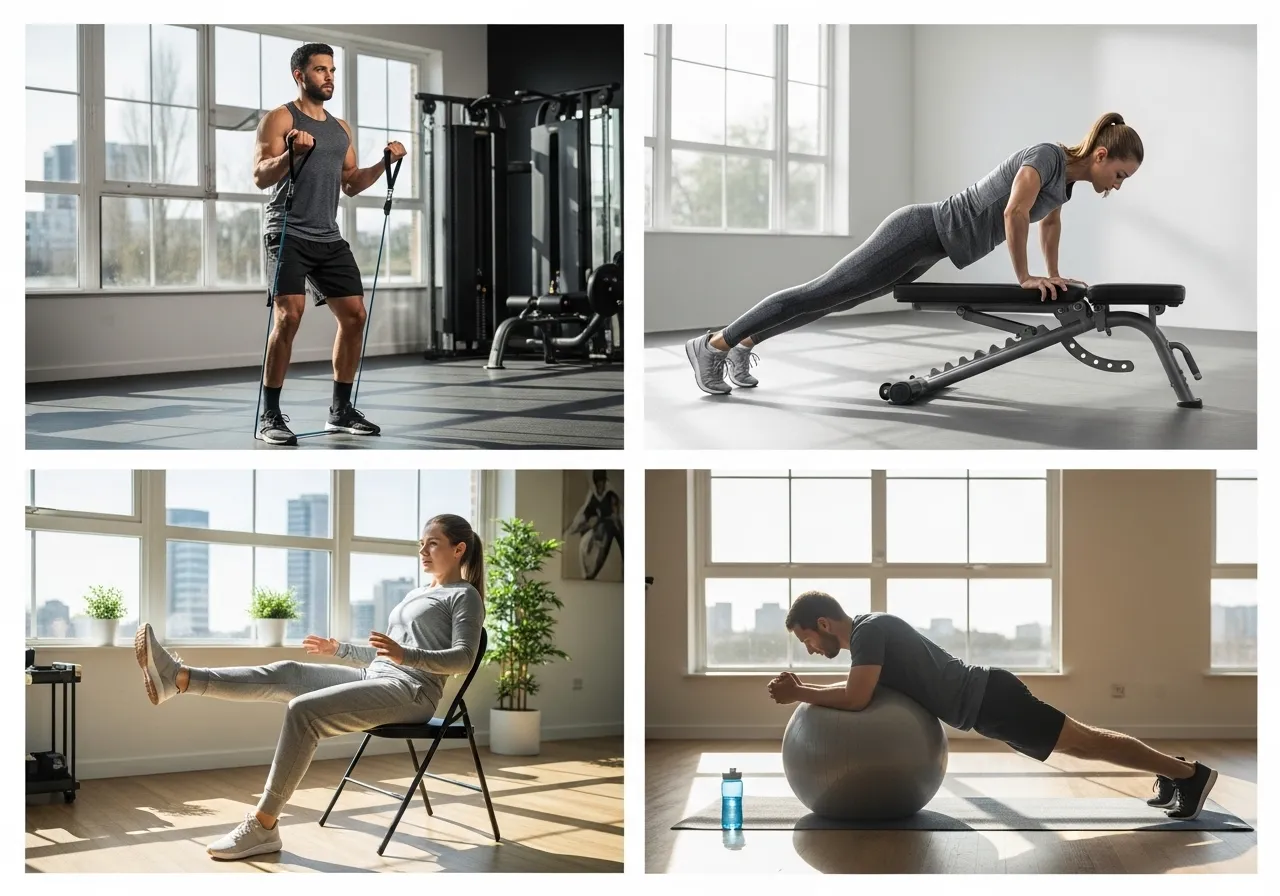
Lower back sensitivity: Replace Romanian deadlifts with hip bridges and single-leg variations that develop posterior chain strength without the spinal loading of the RDL. Goblet squats can be replaced with step-ups and reverse lunges that reduce axial loading. Knee sensitivity: Replace reverse lunges with step-ups at lower range of motion. Reduce squat depth to pain-free range and focus on the range that can be performed without discomfort. Shoulder sensitivity: Replace overhead press with lateral raises and front raises. Replace floor press with push-up variations that allow the shoulder to move through its most comfortable path. All modifications maintain training stimulus for the healthy areas while accommodating limitations in the affected areas.
Home Training Modifications for Limited Space
A significant practical advantage of dumbbell training is its adaptability to extremely limited training spaces. The exercises in this program require a footprint of approximately 1.5 × 2 meters — smaller than a single parking space. For people training in apartments, hotel rooms, or small home offices where even this minimal space is constrained, additional modifications allow effective training in truly minimal space: seated variations replace standing variations (seated dumbbell press, seated row from a chair), supine exercises performed in limited floor space (floor press, dumbbell chest fly, various ab exercises), and space-efficient exercises that keep the body in a small footprint (goblet squat instead of lunge, single-leg deadlift instead of walking lunge). The training quality in a well-executed minimal-space program is genuinely equivalent to a full-space program — the space constraint is a solvable problem, not a genuine barrier to effective training.
Building Grip Strength Alongside Dumbbell Training
Grip strength — the ability to hold the dumbbell securely throughout demanding sets — is frequently the limiting factor in dumbbell training, particularly in pulling exercises and carries, before the target muscles have been meaningfully challenged. A beginner who can perform 12 perfect Romanian deadlifts but finds their grip failing at rep 9 is experiencing a grip limitation that is preventing adequate training of the hamstrings and glutes. Farmer’s carries — one of the exercises in this program — directly develop grip strength and are the most time-efficient grip training available. Adding 2 sets of towel-wrapped dumbbell rows (wrapping a small towel around the dumbbell handle to increase diameter and grip demand) once per week develops the grip endurance that removes this limitation within 4 to 6 weeks.
Dumbbell Training Safety: Avoiding the Most Common Injuries
Dumbbell training injuries in beginners are almost entirely preventable through correct technique, appropriate loading, and adequate warm-up. The most common beginner dumbbell injuries and their prevention: rotator cuff strain from overhead pressing — prevented by keeping the dumbbells in the scapular plane (30 degrees forward of completely lateral), never flaring the elbows beyond 75 degrees, and stopping sets before form breakdown. Lower back strain from rows and deadlifts — prevented by bracing the core before each rep, maintaining neutral spine throughout, and not rounding the lower back to achieve a greater range of motion. Bicep strain from curl variations — prevented by avoiding extreme end-range supination under heavy load and progressing weight gradually. Wrist strain from pressing movements — prevented by keeping the wrists stacked over the elbows (not allowing them to collapse backward) throughout pressing movements.
The injury prevention principle that covers all of the above: train with perfect technique at appropriate loads, and stop sets before technique begins to deteriorate. Every rep performed with poor form reinforces the poor pattern neurologically and increases injury risk. Every rep performed with excellent technique reinforces the correct pattern and develops the strength in the appropriate muscles and joint angles. The short-term cost of using lighter weights with perfect form is zero; the long-term benefit is years of injury-free training and the superior muscle development that correct technique produces.
Nutrition to Support Your Dumbbell Training Program
Protein: The Priority Macronutrient
Resistance training creates the stimulus for muscle protein synthesis, but the raw materials — dietary amino acids from protein — determine whether that stimulus translates into actual muscle development. Beginners performing their first resistance training program have the highest muscle-building sensitivity of any stage of training, meaning that adequate protein intake is even more critical during this phase than at any subsequent point. Research published in the Journal of the International Society of Sports Nutrition recommends 1.6 to 2.2 grams of protein per kilogram of bodyweight daily for people engaged in regular resistance training — a target that most people without deliberate dietary attention fall significantly short of.
Eating enough protein to support the training was the variable I underestimated most in my early training — the workouts were good before the nutrition caught up; after, the results were different.
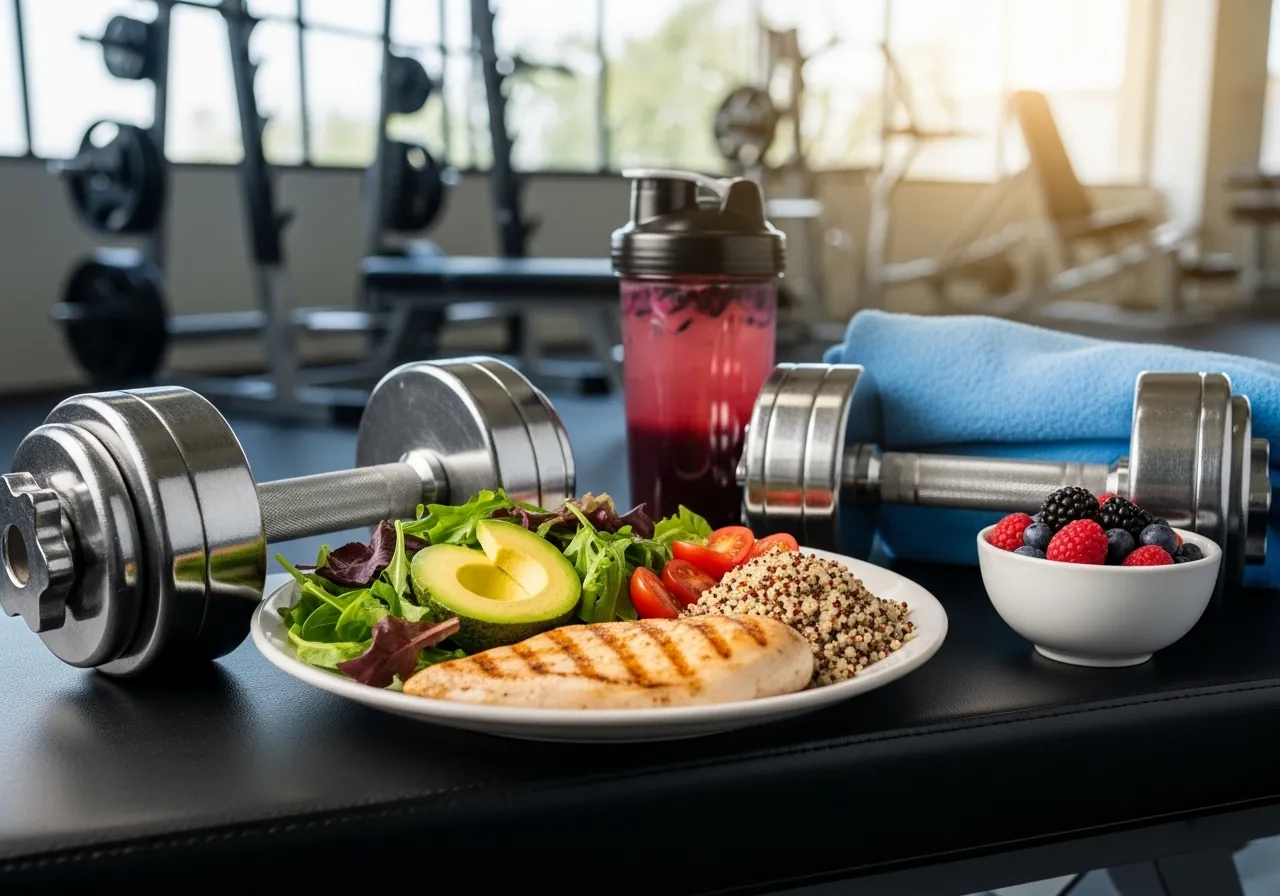
Practical high-protein foods that fit easily into a beginner’s diet: Greek yogurt (17 to 20g per cup), eggs (6g per egg), chicken breast (31g per 100g), canned tuna (25g per 100g), cottage cheese (14g per 100g), and legumes (15 to 18g per cup). Distributing protein intake across 3 to 5 meals throughout the day maximizes muscle protein synthesis rates compared to consuming the same total protein in fewer, larger meals — a principle called protein distribution that adds a meaningful performance advantage for anyone willing to structure their eating deliberately.
Carbohydrates: Training Fuel
Carbohydrates are the primary fuel for resistance training — the glycolytic energy system that powers high-effort sets draws almost exclusively on glycogen (stored carbohydrate) as its fuel source. Training in a chronically low-carbohydrate state reduces training quality, limits the weight and volume achievable in each session, and impairs recovery between sessions. For the 30-minute full body workout, a moderate carbohydrate intake of 3 to 4 grams per kilogram of bodyweight on training days supports performance without excessive caloric surplus, with carbohydrates strategically concentrated in the 2-hour pre-training and 2-hour post-training windows when they are most effectively utilized.
Recovery Nutrition
The post-workout meal is the highest-priority meal in the day for anyone engaged in regular resistance training. Within 90 minutes of completing the workout, consuming 25 to 40 grams of protein and 40 to 60 grams of carbohydrates initiates the muscle repair and glycogen replenishment processes that determine how well you recover for the next session. Simple, fast options that hit these targets: chocolate milk (surprisingly effective, with an optimal protein-to-carbohydrate ratio validated in multiple recovery studies), rice and chicken with vegetables, Greek yogurt with banana and granola, or a protein smoothie with protein powder, oats, and fruit.
Dumbbell Training for Fat Loss: Optimizing the Protocol
The 30-minute full body dumbbell workout described in this article is already optimized for fat loss through its superset structure, minimal rest periods, and compound exercise selection. Additional fat-loss optimization strategies that can be layered onto the base protocol: circuit training (completing all exercises in sequence with minimal rest before resting — maximum metabolic demand), adding a cardiovascular finisher after the main workout (10 minutes of jump rope, jumping jacks, or bodyweight intervals while heart rate is already elevated), and implementing carbohydrate cycling (higher carbohydrate intake on training days, lower on rest days) to maximize both performance and fat mobilization. These additions increase the fat loss stimulus of each session without requiring additional time investment beyond the base 30-minute workout structure.
The most important fat loss variable, however, is not the training protocol but the dietary management that creates the caloric deficit. Research consistently shows that dietary modification accounts for 70 to 80 percent of fat loss outcomes while training accounts for 20 to 30 percent — not because training is unimportant (it is crucial for preserving muscle during fat loss) but because the caloric deficit created by dietary management is substantially greater and easier to maintain than the caloric expenditure that training alone can produce. The dumbbell training program and dietary management must work together, with training preserving the muscle that gives fat loss its body composition benefit and diet creating the deficit that drives fat reduction.
The Psychological Benefits of Strength Training for Beginners
The psychological benefits of beginning a dumbbell training program extend far beyond the physical adaptations and deserve recognition as primary outcomes in their own right. Research consistently finds that resistance training reduces depression and anxiety symptoms with effect sizes comparable to antidepressant medication for mild to moderate presentations — effects mediated by the neurochemical changes (serotonin, dopamine, norepinephrine, BDNF elevation), the improved sleep quality, and the self-efficacy development that comes from successfully challenging and overcoming physical difficulty. For beginners who have never experienced structured resistance training, the discovery that they are physically capable of more than they believed — that they can lift weights, improve each week, and develop strength they didn’t know they had — produces a psychological impact that frequently extends to other areas of life.
The identity shift from “someone who doesn’t work out” to “someone who trains” is one of the most powerful psychological changes that beginning a training program produces. This identity shift — which typically crystallizes around the 6 to 8-week mark of consistent training — changes how people relate to physical activity across all contexts, increasing likelihood of choosing physical options in daily life (stairs, walking, active hobbies) and reducing the psychological resistance to training that creates the “I don’t feel like it” barrier that stops non-exercisers from beginning. Beginning a dumbbell training program is, for many people, the entry point into a lifetime of physically active living — an investment that pays dividends across decades in quality of life, metabolic health, and psychological wellbeing.

Your 8-Week Beginner Dumbbell Program
Program Overview
This 8-week program builds from the foundation of the single 30-minute full body workout into a comprehensive training plan that progressively increases volume, intensity, and exercise variety over 8 weeks. The program is designed for 3 training days per week — the optimal frequency for beginners to maximize adaptation while allowing adequate recovery. Each week builds on the previous, ensuring continuous progressive overload while maintaining the manageability that keeps beginners consistent through the full 8 weeks.
This 8-week program follows the same progression logic that worked for me when I was starting out — slow, consistent, and structured around building habits as much as fitness.
Weeks 1 to 2: Learning Phase
Three sessions per week of the full body workout described in this article, performed at 2 rounds per superset rather than 3. The primary focus is technique mastery rather than load. Record the weights used for each exercise each session and aim to maintain consistent technique rather than increasing weight. Most people are surprised by how much more challenging correct form is compared to the sloppy technique they naturally default to — this is normal and represents genuine progress. End each session with 5 minutes of stretching targeting the muscles worked.
Weeks 3 to 4: Volume Building
Increase to 3 rounds per superset. Begin applying the double progression method — attempt to add 1 to 2 reps per set each session until reaching the upper end of the target rep range, then increase weight at the next session. Add a 5-minute walk or light cardio warm-up before each session to improve preparation and begin building the cardiovascular fitness base that will be developed further in the later weeks.
Weeks 5 to 6: Intensity Increase
Reduce rest between supersets from 45 seconds to 30 seconds, increasing the metabolic demand and caloric expenditure of each session. Add a 5th superset: Dumbbell Front Squat (dumbbells on shoulders, squat to parallel) × 10 reps supersetted with Renegade Row × 8 reps each side. Introduce the 3-second eccentric tempo for all pressing and rowing movements to increase time under tension and hypertrophic stimulus. Begin adding 5 to 10 minutes of cardiovascular activity (jumping jacks, marching in place, light jogging) at the end of each session.
Weeks 7 to 8: Peak Phase
Increase to 4 rounds per superset for Supersets 1 and 2 (the most compound exercises). Add a circuit finisher after the main workout: 3 rounds of goblet squat × 15, push-up × 15, dumbbell row × 15 each side with 30 seconds rest between rounds — 8 minutes total. This finisher significantly increases total training volume and cardiovascular demand, producing the most physically challenging sessions of the program and the greatest single-week improvements in body composition and fitness.
After Week 8: Where to Go Next
Completing this 8-week program represents a genuine fitness milestone — you have established consistent training habits, mastered the fundamental dumbbell movement patterns, and developed the foundational strength to progress to more advanced training. The natural next step depends on your primary goal: for continued body composition improvement, transition to a 4-day upper-lower split with increased volume per session; for strength development, introduce a barbell training program using the movement patterns mastered in this dumbbell program as the technical foundation; for general fitness maintenance, continue the current program with progressive load increases and periodic variation to prevent accommodation.
Frequently Asked Questions
What weight dumbbells should a beginner start with?
Start with a weight that allows you to complete 12 clean reps with good form but makes the final 2 to 3 reps challenging. For most women, this is 5 to 8kg for upper body exercises and 8 to 12kg for lower body. For most men, 8 to 12kg upper body and 12 to 18kg lower body. These ranges vary significantly between individuals — what matters is the correct relative difficulty, not the specific weight.
Can I build muscle with just dumbbells?
Yes, completely. Dumbbells provide sufficient mechanical tension, metabolic stress, and muscle damage to drive hypertrophy in all major muscle groups. The key is applying progressive overload — systematically making the training harder over time through heavier weights, more reps, more sets, or more difficult exercise variations. Beginners and intermediate trainees can achieve excellent muscle development with dumbbells alone.
How long before I see results from dumbbell training?
Strength improvements are typically noticeable within 2 to 3 weeks (primarily neurological adaptation). Visible muscle definition improvements begin appearing at 4 to 8 weeks for most beginners. Significant body composition changes — clearly visible muscle development and fat reduction — develop over 3 to 6 months of consistent training and appropriate nutrition. The timeline is individual and depends significantly on starting point, training consistency, nutrition, and sleep quality.
The 12-Month Dumbbell Training Journey
Completing the 8-week beginner dumbbell program is the beginning of a training journey that, maintained consistently over 12 months, produces transformative physical and psychological results. Months 1 to 2: establishing the foundational movement patterns and training habit. Months 3 to 4: building confidence with progressive loading and experiencing the first significant strength improvements. Months 5 to 6: transition to intermediate training with increased volume and split training options. Months 7 to 9: experiencing the noticeable body composition changes that motivate continued training. Months 10 to 12: approaching the physical development that is visible to others and that reflects the accumulated investment of a year of consistent effort.
The person who completes this 12-month journey has built something that cannot be taken away: demonstrated capacity for sustained commitment to a health practice, physical strength and capability that improves quality of life across every physical activity, the metabolic health benefits of a year of consistent resistance training, and the psychological identity shift of someone who exercises regularly rather than someone who is trying to exercise. These outcomes compound indefinitely — year 2 builds on year 1, and year 5 makes year 1 look like the beginning it was. Starting with 30 minutes and a pair of dumbbells, and maintaining the consistency to see where that beginning leads, is one of the most reliable investments a person can make in their long-term wellbeing.
Transitioning from Dumbbells to Barbell Training
After 6 to 12 months of dumbbell training, many people choose to transition to barbell training to access the heavier loads needed for continued strength development. The dumbbell training foundation makes this transition substantially easier than starting with barbells directly: the movement patterns are nearly identical (goblet squat → barbell back squat, dumbbell RDL → barbell RDL, dumbbell press → barbell press), the muscle development provides the strength base for safely handling barbell loads, and the training habit is already established. The specific technical additions of barbell training — learning rack positioning, bar placement, and the safety considerations of training with a loaded barbell — are learnable within 4 to 6 weeks by anyone with a solid dumbbell training foundation.
The Community Aspect of Home Dumbbell Training
Home dumbbell training lacks the in-person community of gym training, but this does not mean it must be a solitary pursuit. Online fitness communities organized around home training — on Reddit, Discord, Instagram, and dedicated apps — provide the social accountability, shared progress, technique advice, and motivational support that replicate many of the community benefits of gym training in a digital format. Sharing weekly progress, asking technique questions, and celebrating milestones with others on similar journeys creates the social dimension of training that research identifies as one of the strongest predictors of long-term adherence. For people whose schedules, circumstances, or preferences make gym training impractical, these communities fill the social gap that would otherwise make home training a purely solitary experience.