The Best Functional Training Exercises for Daily Life
1. What Is Functional Training and Why It Beats Traditional Gym Work for Real Life
Functional training is one of those fitness terms that gets used so broadly it has nearly lost its meaning — applied to everything from TRX suspension exercises to kettlebell swings to yoga, often with little more justification than that the exercise feels “athletic” or “real.” The actual definition is more precise and more useful: functional training develops the strength, stability, mobility, and coordination for the specific movement patterns that the individual’s daily life, sport, or occupation demands. The key word is specific — a functional exercise for a 70-year-old whose primary concern is getting up from the floor without assistance (a single-leg squat pattern) is different from a functional exercise for a football linebacker (reactive hip drive and change-of-direction power) or a construction worker (loaded carries and rotational pushing). This specificity principle means that functional training cannot be defined by a list of exercises but by the relationship between the training and the life demands it prepares the individual for. I spent three years training exclusively with traditional gym exercises — bench press, bicep curls, leg press, lat pulldown — building measurable strength in isolated muscle groups while remaining stiff, poorly coordinated in athletic movements, and prone to the lower back pain that seated machine training does nothing to prevent. The transition to functional training eliminated the back pain within 8 weeks, improved my athletic movement quality more in 3 months than the previous 3 years of machine training had, and made daily physical tasks — carrying groceries, playing with children, hiking, moving furniture — dramatically easier and more comfortable. This is the transformation that genuine functional training produces.
The Six Fundamental Movement Patterns: The Framework for Functional Training
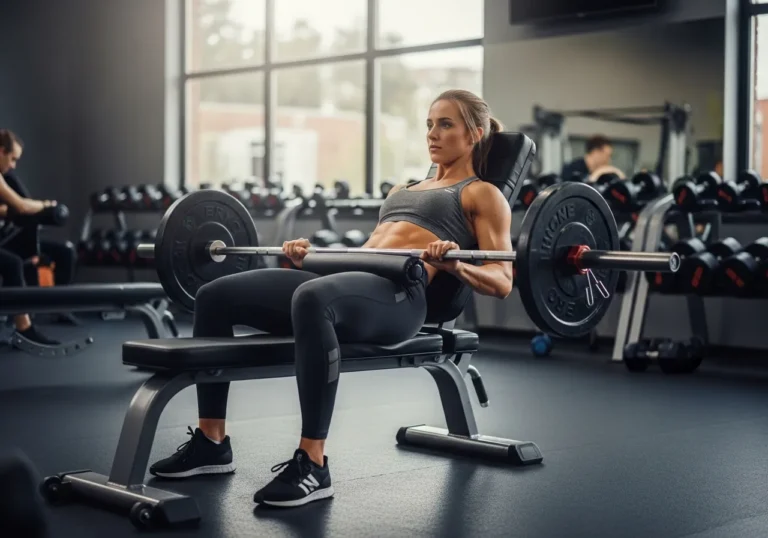
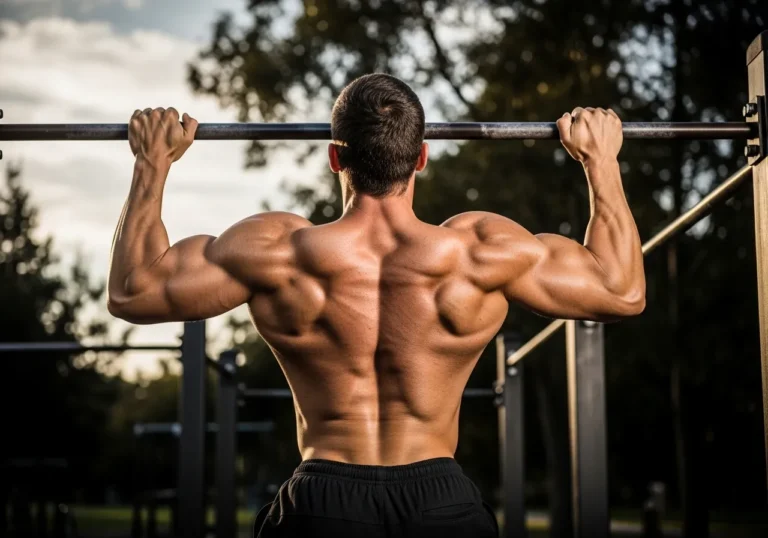
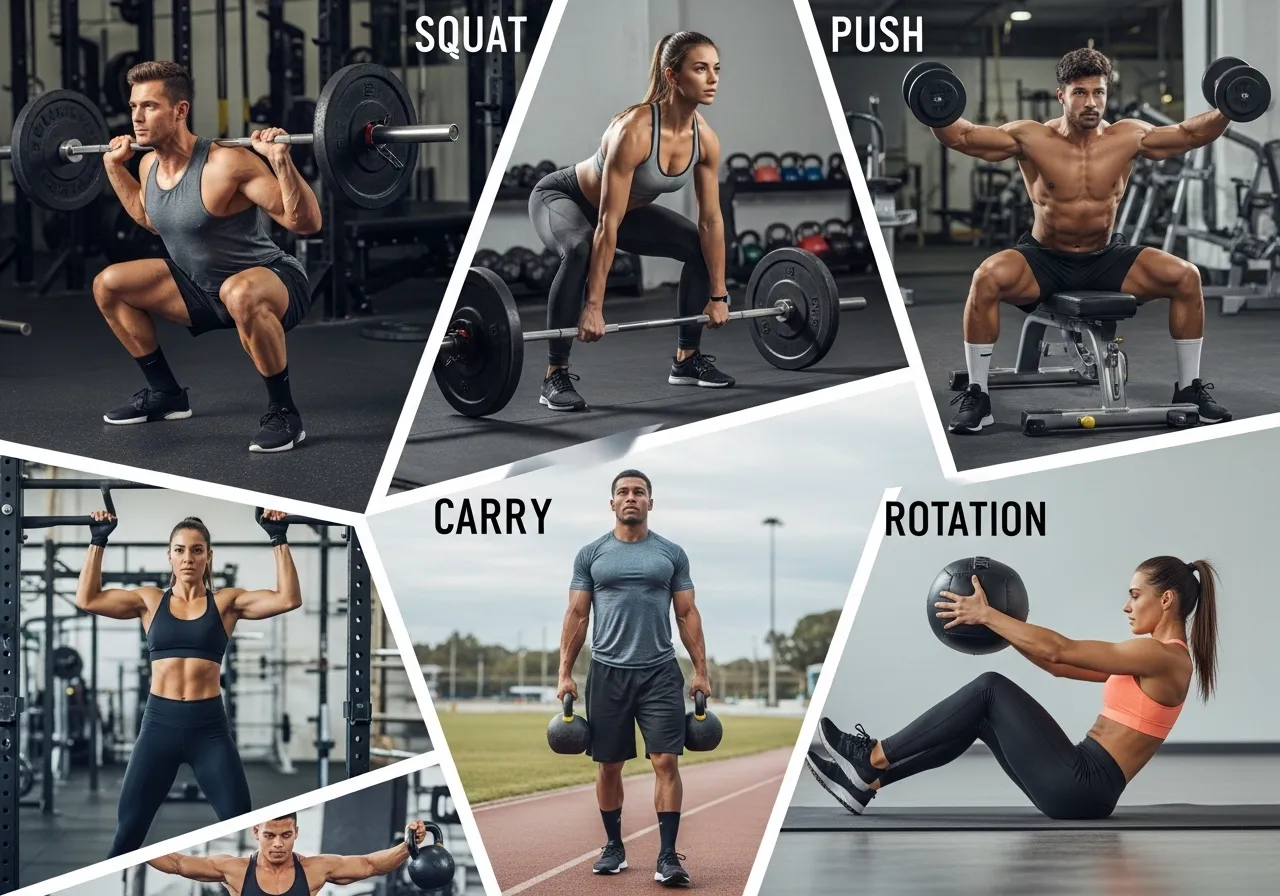
All human movement — in sport, daily life, and occupational activity — can be organized into six fundamental movement patterns that functional training develops. The squat pattern: the hip-dominant, knee-bending movement of sitting down, standing up, picking up objects, and any athletic position that requires lowering and raising the body’s center of mass. The squat pattern is the most fundamental movement in human locomotion and the most important to maintain throughout life — the inability to perform a full-depth bodyweight squat is a significant predictor of functional decline in aging populations. The hinge pattern: the hip-dominant forward lean that loads the posterior chain (hamstrings, glutes, lower back) — the movement of picking objects up from the floor, loading a dishwasher, or any activity requiring forward trunk lean with a load. The hinge is distinct from the squat in its greater hip flexion and lesser knee flexion — the deadlift and kettlebell swing are the archetypal loaded hinge exercises. The push pattern: horizontal pushing (the movement of pushing a door open, a car that won’t start, or a child on a swing) and vertical pushing (pressing overhead to put items on high shelves, throwing, or any activity requiring upward arm extension against resistance). The pull pattern: the opposite of the push — horizontal pulling (opening a door, starting a lawnmower, rowing a boat) and vertical pulling (climbing, pulling yourself up from the floor, or any pulling motion). The carry pattern: moving a load through space while maintaining postural stability — the most universally applicable functional movement, mimicking grocery carrying, child carrying, luggage handling, and any occupational load transport. The carry develops the anti-lateral flexion core stability and grip strength that no gym machine trains effectively. The rotation pattern: the twisting and anti-twisting movements that throwing, striking, opening jars, swinging a golf club, and virtually every sporting movement requires — the pattern most neglected in traditional gym training and most important for upper body athletic performance. From JSCR research on functional movement patterns, training programs that develop all six fundamental patterns produce superior real-world performance improvements compared to programs that isolate individual muscles without addressing movement pattern integration.
Functional Training vs. Traditional Gym Training: The Key Differences
Traditional gym training — the chest/back/shoulders/arms/legs split performed on machines and with barbells in fixed movement planes — develops muscular strength and hypertrophy effectively but with significant limitations for real-world functional performance. Machine training: machines constrain movement to a single plane and a fixed path, removing the stabilization demand that free-weight and bodyweight exercises require — building the primary movers while leaving the stabilizer muscles under-developed. A person who develops strong quadriceps on the leg press but has never trained single-leg stability will have large, strong quads that cannot prevent the knee collapse that uneven surfaces and unexpected loading changes produce. Traditional gym training is bilateral-dominant: most exercises train both limbs simultaneously (leg press, bench press, shoulder press), while real-world activities are predominantly unilateral — walking, climbing stairs, carrying, and most sport movements involve one limb loading at a time. The strength built through bilateral training transfers incompletely to the unilateral demands of daily life. Functional training addresses both limitations: by using free weights, bodyweight, and implements (kettlebells, sandbags, medicine balls) that require active stabilization; by training movement patterns rather than muscle groups; and by including the rotation, single-leg balance, and loaded carry that traditional training omits. The most effective training approach: combining the strength foundation that traditional compound lifts (barbell squat, deadlift, bench press) provide with the movement quality, stability, and pattern variety that functional training develops — neither approach alone produces the complete athletic development that both together achieve.
Who Benefits Most from Functional Training
Functional training provides disproportionate benefits for four specific populations: sedentary adults returning to fitness (who need movement pattern restoration before heavy loading — functional training’s emphasis on movement quality before load makes it the appropriate starting point for anyone who has been inactive); aging adults (for whom maintaining the squat, hinge, carry, and balance patterns that independent daily function requires is the primary fitness objective — fall prevention through single-leg balance training and the ability to get up from the floor being the highest-priority functional outcomes); athletes in rotation and multi-directional sports (whose sport performance depends on the power transfer through rotation and the reactive stability in multi-planar movement that traditional gym training does not develop); and office workers with postural dysfunction (whose hours of seated, forward-flexed posture create the hip flexor tightness, thoracic stiffness, and posterior chain weakness that functional training’s hip hinge, thoracic rotation, and pull pattern emphasis specifically addresses). The population that benefits least from exclusive functional training: advanced strength athletes (powerlifters, Olympic weightlifters) whose sport performance is maximized through specificity to their competitive movements — functional training provides useful supplementary work but should not replace the sport-specific barbell training that their performance demands. For the vast majority of recreational athletes and general fitness participants, functional training provides more practical return on training investment than traditional gym programs — the strength, mobility, stability, and coordination it develops directly improve the daily life and recreational activities that most people actually care about.
The evidence for functional training’s superiority for real-world outcomes is compelling and consistent: a 2019 systematic review in the British Journal of Sports Medicine found that functional training programs produce greater improvements in activities of daily living, balance, and quality of life compared to traditional resistance training programs at equivalent training volumes. The mechanism is not that functional exercises are intrinsically superior to traditional exercises for building muscle or strength — they are not, in many cases — but that functional exercises develop the coordination, stability, and movement integration that applies the strength directly to the real-world activities that matter. A person who develops a 200kg leg press but cannot squat below parallel with their bodyweight has built leg strength that their daily movement patterns cannot access. A person who develops a 100kg goblet squat through years of progressive functional training has built strength that directly transfers to every sit-to-stand, stair-climbing, and athletic movement they perform — strength that is expressed rather than isolated. The goal of functional training is expressed strength: the capacity to apply force through the full range of coordinated movement that life demands, not the maximum force available in a constrained machine-guided arc that life never replicates. This is the fundamental insight that functional training is built on, and it explains why the population that trains functionally — regardless of absolute strength levels — consistently outperforms their traditionally-trained peers in the real-world physical tasks that fitness is ultimately for. Functional training’s superiority for general fitness populations is also reflected in the injury prevention data — athletes who train through functional movement patterns consistently demonstrate lower rates of overuse injury than those who rely exclusively on machine-based or isolation exercise training. The mechanism: functional training develops the joint stability, movement pattern coordination, and muscle balance that prevents the compensatory movement patterns that overuse injuries arise from. The rotator cuff strengthening that functional overhead pressing and pulling patterns develop; the hip abductor and external rotator strength that single-leg exercises build; and the anti-rotation core stability that carries and rotational exercises produce — all directly reduce injury risk in the specific tissue locations that traditional training leaves vulnerable. Athletes who transition from traditional gym training to functional training frequently report the resolution of chronic shoulder, knee, and lower back discomfort that their previous training had not addressed — because the functional training corrects the muscle imbalances and movement compensations that the discomfort was signaling. The practical takeaway from the research and experience documented in this section: functional training is not a trend or a marketing category — it is the training philosophy that most closely aligns with how the human body was designed to move and what it needs to remain capable, pain-free, and athletic across a lifetime. The six fundamental patterns are not arbitrary exercise classifications but the movement vocabulary that human evolution optimized over millions of years of physical activity. Training them develops not just the muscles involved in each movement but the neural patterns, joint stability, and movement integration that make the whole body function as the coordinated system it is, rather than the collection of isolated parts that machine training treats it as. Functional training, at its best, is not a collection of exercises but a philosophy of physical development — the belief that strength should be expressed through movement, that stability should supp Functional training’s greatest contribution to athletic development is not any specific exercise or protocol but the paradigm shift it produces in how athletes understand physical preparation. When an athlete begins thinking in movement patterns rather than muscle groups, in real-world transfer rather than gym performance metrics, and in long-term capability rather than short-term performance, the entire approach to training changes — and the results reflect that change in every physical activity the athlete pursues outside the gym. The functional training athlete who can sprint, jump, throw, carry, and move through any environment with coordination and power has not just trained their body — they have developed their physical intelligence, the embodied knowledge of how to use the body effectively that no machine can teach and no isolation exercise can develop. This is the deepest value of functional training, and it accumulates across years of consistent, intelligent practice into the physical capability that makes life genuinely better at every age and stage. Move well, move often, and move with purpose. Begin now.

2. The 10 Best Functional Training Exercises and How to Do Them
The exercises in this section were selected based on their coverage of multiple fundamental movement patterns, their high transfer to daily life and sport performance, and their scalability from beginner to advanced. Each exercise is described with complete technique detail, the functional patterns it develops, and the progression options that allow long-term progressive overload.
Exercises 1–4: Foundation Movements
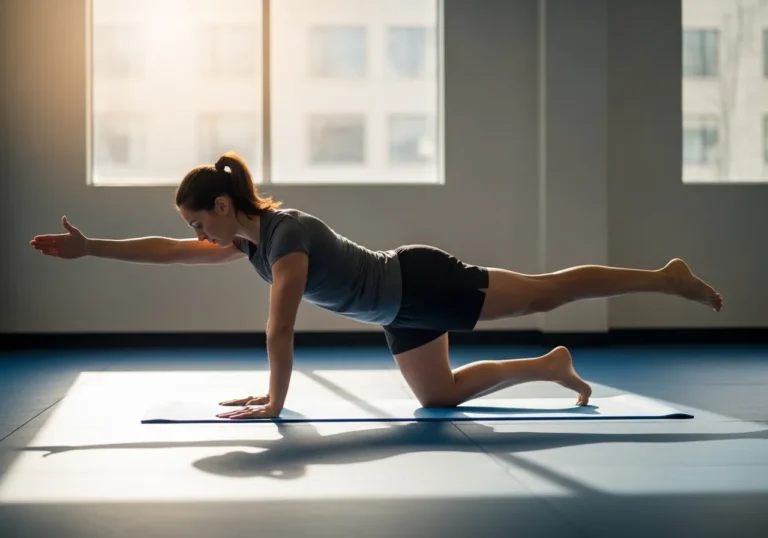
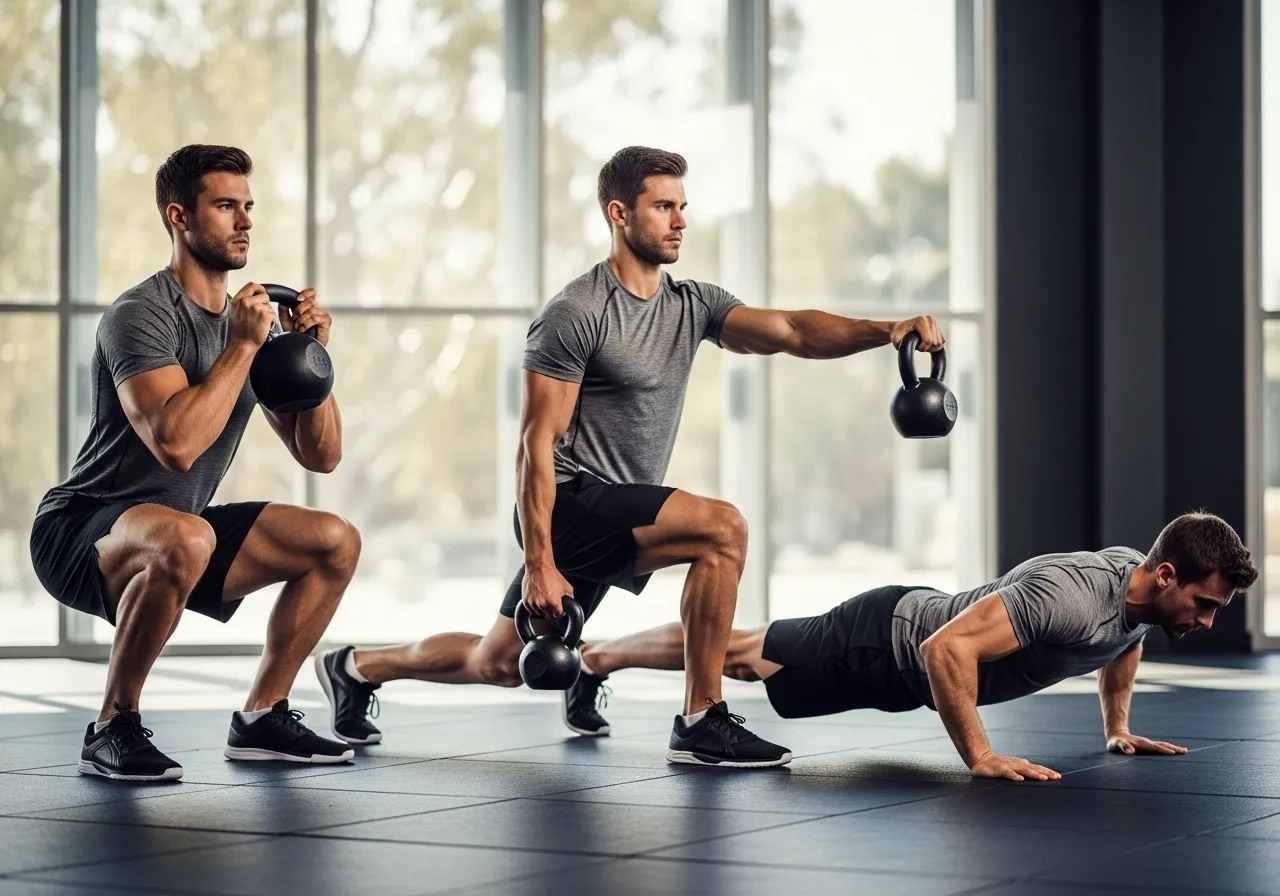
Exercise 1 — Goblet Squat: holding a kettlebell or dumbbell vertically at the chest, perform a full-depth squat with the elbows tracking inside the knees at the bottom. The goblet squat is the most beginner-accessible loaded squat variation — the counterbalance of the front-held load allows deeper squat depth with better upright torso position than the bodyweight squat for many beginners, making it the ideal starting point for squat pattern development. Technique: feet shoulder-width apart with toes turned out 15–30 degrees; sit between the heels rather than pushing them up; keep the chest tall and the elbows inside the knees at the bottom; stand by driving through the entire foot. Functional application: every time you sit down and stand up, you perform a squat pattern — the goblet squat develops the strength and mobility that makes this movement pain-free and powerful across decades of daily repetition. Exercise 2 — Romanian Deadlift (RDL): holding dumbbells or a barbell at thigh height, hinge at the hips by pushing the hips backward while maintaining a neutral spine and slight knee bend, lowering the weight along the legs until a strong hamstring stretch is felt, then drive the hips forward to return to standing. The RDL is the fundamental hinge pattern exercise — it develops the hamstring and glute strength, hip mobility, and spinal stability that picking objects up from the floor, carrying loads, and any forward-lean activity requires. Exercise 3 — Single-Leg Deadlift: the unilateral hinge pattern performed on one leg — the most important exercise for hip stability, balance, and the single-leg strength that walking, stair climbing, and sport movement demands. Begin without weight, focusing on the balance and hip stability; progress to holding a dumbbell in the opposite hand to the standing leg for the diagonal stability challenge that mimics real-world unilateral loading. Exercise 4 — Push-Up with Rotation: perform a standard push-up, then at the top rotate the body to one side, extending the top arm toward the ceiling in a side plank position. Return to push-up position and repeat on the other side. This movement combines the horizontal push pattern with the rotation pattern and the anti-rotation stability demand — developing the chest, shoulder, tricep, and core strength that all pushing movements require alongside the rotational mobility that daily life constantly demands.
Exercises 5–8: Athletic and Carry Patterns
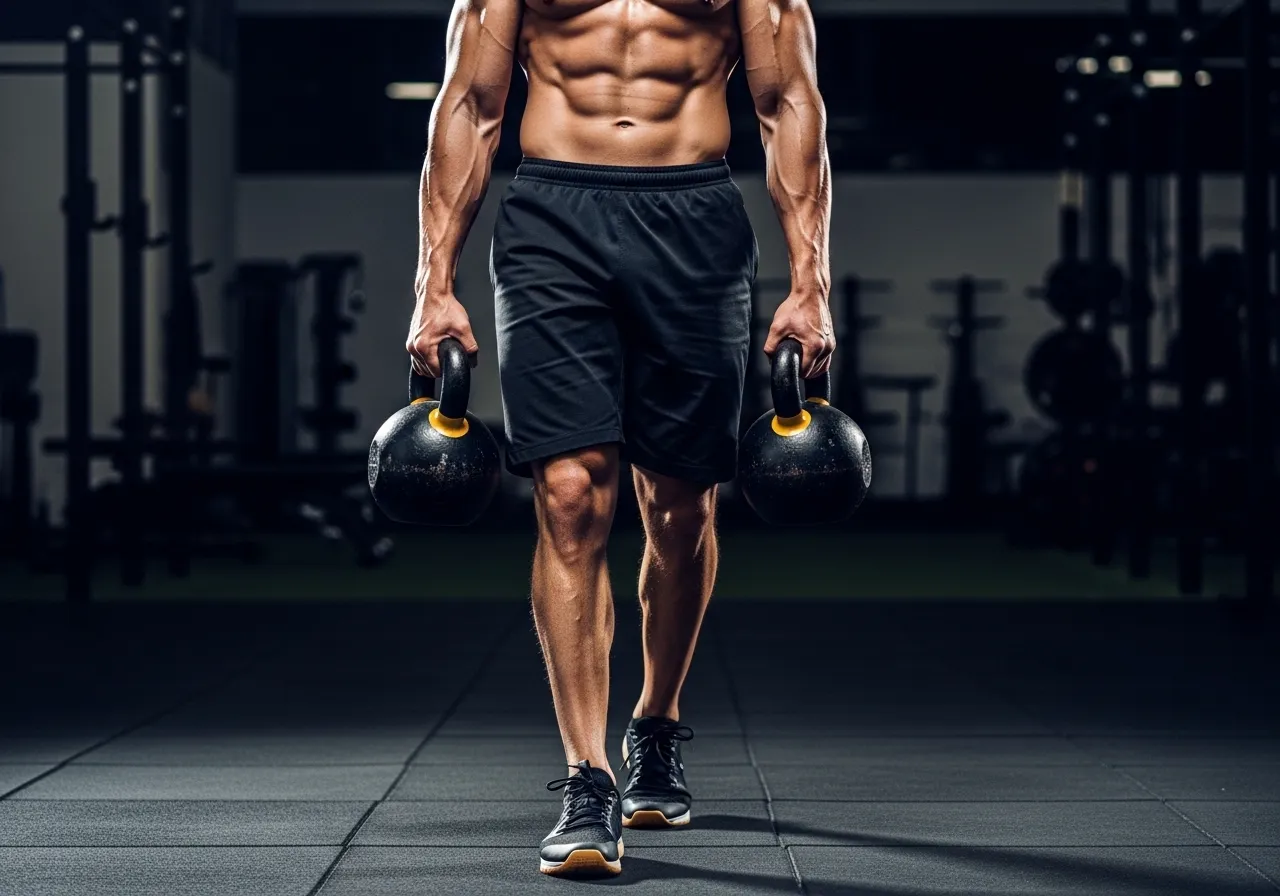
Exercise 5 — Kettlebell Swing: the archetypal ballistic hinge — hike the kettlebell back between the legs with a hip hinge, then explosively drive the hips forward to project the kettlebell to chest height. The swing develops explosive hip extension power (the athletic quality that sprinting, jumping, and any sport requiring speed and power depends on), cardiovascular conditioning through its metabolic demand, and the posterior chain strength that prevents the lower back pain that anterior-dominant training and prolonged sitting produce. The swing is the highest-transfer-per-minute exercise available to most athletes — developing simultaneously the hip power, core stability, and cardiovascular fitness that most sport activities require. Exercise 6 — Farmer’s Carry: pick up a heavy dumbbell or kettlebell in each hand and walk for distance or time, maintaining upright posture, packed shoulders, and neutral spine throughout. The farmer’s carry is arguably the most functional exercise available — it exactly mimics carrying groceries, luggage, children, and any loaded walking activity while developing the grip strength, core anti-lateral flexion stability, and postural endurance that daily life demands. Unilateral variation (suitcase carry — one hand only): increases the anti-lateral flexion demand on the unloaded side, training the quadratus lumborum and obliques that prevent lateral trunk collapse under asymmetric loads. Exercise 7 — Turkish Get-Up: lying on the floor holding a kettlebell or dumbbell overhead in one hand, use a specific sequence of movements to rise from the floor to standing while keeping the weight overhead throughout. The Turkish get-up develops the shoulder stability, hip mobility, rotational core strength, and complex multi-joint coordination that are unique among exercises — it literally trains the movement of getting up from the floor, which is the most important functional movement for aging adults. Exercise 8 — Landmine Press: anchoring a barbell in a landmine attachment or a corner, press the free end diagonally from shoulder height to full arm extension. The diagonal pressing pattern of the landmine press trains the shoulder in the movement plane that most real-world pushing occurs in — neither pure horizontal (bench press) nor pure vertical (overhead press) but the diagonal that throwing, pushing objects up slopes, and most athletic pushing demands. From Sports Medicine Journal functional training research, the landmine press is identified as one of the safest shoulder loading exercises for athletes with shoulder impingement history due to its externally rotated starting position that avoids the impingement zone.
Exercises 9–10: Rotation and Reactive Stability
Exercise 9 — Medicine Ball Rotational Throw: standing sideways to a wall or partner, rotate explosively through the torso to throw the medicine ball against the wall or to the partner, catch the rebound and immediately repeat. The rotational throw is the most direct training for the athletic power transfer through rotation that every throwing, striking, and swinging sport movement requires — developing the sequential activation of hips, thoracic spine, shoulders, and arms that efficient rotational power depends on. The medicine ball throw is the power development exercise for the rotation pattern: the explosive intent and the resistance of the ball provide the combination of speed and load that develops rotational power rather than merely rotational mobility. Exercise 10 — Box Step-Up with Knee Drive: step onto a box or bench with one foot, drive the opposite knee toward the chest as the body rises, then step back down under control. The step-up with knee drive trains the unilateral squat pattern (the glute and quad of the stepping leg), the hip flexor and core strength of the knee drive, and the eccentric control of the lowering phase — a functional movement that directly trains stair climbing, hill hiking, and any step-up activity. Progress by adding dumbbells in each hand as strength increases, or increasing box height for greater range of motion demand.
The 10 exercises described in this section represent the most effective tools for developing all six fundamental patterns — but the most important principle governing their use is quality before quantity, technique before load, and mastery before advancement. An athlete who performs the goblet squat with a 20kg kettlebell through full range of motion with perfect technique is developing more functional capacity than one who performs the same squat with 40kg through half range with collapsed knees and a rounded lower back — because the movement pattern being reinforced in the first case is the functional pattern that life demands, while the movement pattern in the second case is a compensation that will appear (and potentially injure) in every squat-pattern activity outside the gym. Master the technique of each exercise before pursuing load, and master the foundational exercises before advancing to complex combinations — the progression is the program, and there are no shortcuts that produce durable functional strength. The exercises in this section, practiced consistently with progressive loading over months and years, develop the physical capability that makes the athlete genuinely stronger, more mobile, more balanced, and more resilient in every activity they pursue — the comprehensive functional development that isolated gym training simply cannot replicate. The ten exercises described in this section can be combined into effective training sessions in multiple formats — straight sets, supersets, circuits, and EMOM (every minute on the minute) protocols — each producing different training emphases within the same exercise selection. The circuit format (performing exercises back-to-back with minimal rest) emphasizes cardiovascular conditioning and metabolic demand alongside strength development — appropriate for athletes whose functional fitness goals include cardiovascular conditioning and general athleticism. The straight set format (3–5 sets of each exercise with full recovery) emphasizes strength development — appropriate when the primary goal is functional strength rather than conditioning. The EMOM format (performing a set number of reps at the start of each minute, resting for the remainder) combines intensity control with time efficiency — allowing challenging training within fixed time budgets. Choose the format that best matches the session’s primary goal and the available time, and vary formats across training weeks to prevent accommodation and maintain the comprehensive development that functional training is designed to produce. The exercise library presented in this section is deliberately curated rather than comprehensive — the 10 exercises were chosen because they provide the highest functional return per unit of training time, the clearest progression pathway from beginner to advanced, and the broadest coverage of functional movement demands across all six patterns. Athletes who master these 10 exercises have built a functional training foundation that supports any subsequent athletic goal — sport-specific conditioning, aesthetic development, maximum strength, or the general fitness and health maintenance that most people ultimately train for. Start with the foundational movements, progress systematically, and allow the compound return of years of consistent functional training to build the physical capability that makes every aspect of athletic and daily life better. Functional training, at its best, is not a collection of exercises but a philosophy of physical development — the belief that strength should be expressed through movement, that stability should supp The long-term athlete who commits to functional training as their primary physical development approach discovers something that surprises many who come from traditional gym backgrounds: the training becomes more enjoyable, not less, as complexity increases. The skill acquisition element of functional training — learning the Turkish get-up, developing the kettlebell swing, progressing toward advanced single-leg movements, building rotational power — provides the continuous learning and mastery that straight sets on fixed machines simply cannot match. Every session offers the opportunity to improve a movement quality, add load to a pattern, or master a more challenging variation — the endless progression that keeps training fresh, challenging, and genuinely interesting across years and decades of practice. This is perhaps functional training’s most underappreciated benefit: it makes physical training an engaging, skill-developing practice rather than a repetitive maintenance chore. Engage with it fully, pursue mastery of the movements, and allow the skill development alongside the physical development to make every training session worth showing up for. That is functional training at its finest. Go train.
3. Functional Training Programs: Weekly Plans for Every Level
The exercise knowledge from Section 2 requires a structured program framework to produce the progressive adaptation that consistent functional training delivers. The three programs in this section — beginner, intermediate, and advanced — provide the complete weekly structure for different experience levels.
The Beginner Functional Training Program (3 Days Per Week)
The beginner program focuses on movement quality before loading — establishing the six fundamental patterns with bodyweight and light loads before progressive overload is applied. Day 1 (Monday): Goblet squat 3×10 (light kettlebell or dumbbell), Romanian deadlift 3×10 (dumbbells, light load), push-up 3×max (or knee push-up), farmer’s carry 3×20 meters (light dumbbells), dead bug 3×10 per side. Day 2 (Wednesday): single-leg deadlift 3×8 per leg (bodyweight or light dumbbell), push-up with rotation 3×8 per side, step-up with knee drive 3×10 per leg, medicine ball rotational throw 3×8 per side (light ball against wall), side plank 3×30 seconds per side. Day 3 (Friday): full-body circuit combining all movements — goblet squat (8 reps), RDL (8 reps), push-up (max reps), farmer’s carry (20m), step-up (8 per leg), dead bug (8 per side). Perform 2–3 rounds with 90 seconds rest between rounds. The beginner program runs for 6–8 weeks before advancing to intermediate — sufficient time for movement patterns to become automated and for the initial strength adaptation that supports heavier loading in the intermediate program. From PubMed functional training research, 6–8 weeks of movement-quality-focused training produces the neuromuscular foundation that makes subsequent progressive loading safe and effective across all functional movement patterns.
The Intermediate and Advanced Programs
The intermediate program (4 days per week, 3–6 months of training experience) adds loading to the beginner movement patterns and introduces the kettlebell swing and Turkish get-up that require the foundational movement quality that the beginner program establishes. Day 1 (lower body dominant): barbell or goblet squat 4×6–8, single-leg deadlift 3×8 per leg (dumbbell), step-up with load 3×10 per leg, farmer’s carry 4×30 meters (heavier). Day 2 (upper body dominant): push-up with rotation 4×8 per side, landmine press 3×10 per side, medicine ball rotational throw 4×10 per side, TRX or ring row 4×10. Day 3 (hinge and power): kettlebell swing 5×15, Romanian deadlift 4×8 (heavier), Turkish get-up 3×3 per side, suitcase carry 3×30 meters per side. Day 4 (full body and conditioning): functional circuit combining all six patterns at moderate load — 4 rounds, 45 seconds per exercise, 15 seconds transition. The advanced program (6+ months, for athletes with solid functional movement foundation) adds complexity through increased load, single-limb variations, and reactive and power-based progressions of all foundational exercises — replacing the goblet squat with front squat, the RDL with single-leg RDL under significant load, and adding box jumps, medicine ball slams, and loaded rotational patterns that approach the training specificity of athletic conditioning programs.
Programming Principles: How to Progress Functionally
Functional training progression follows the same overload principles as traditional strength training — adding load, volume, complexity, or reducing rest — but applies them to movement patterns rather than individual exercises. The progression hierarchy for functional training: first improve technique quality to a consistent standard; then add repetitions within the current load; then add load when the repetition target is achieved with excellent form; then advance to a more challenging exercise variation when the current exercise no longer provides sufficient challenge. The Turkish get-up example: begin with no load (bodyweight) for 5 per side until smooth and confident; progress to a 4kg weight for 5 per side; increase weight by 2–4kg when the previous load is comfortable; eventually performing weighted get-ups provides the shoulder stability and core strength benchmark that correlates with elite-level functional fitness. The carry progression: begin with 50% bodyweight total load (25% per hand in farmer’s carry) for 20 meters; progress to 75% for 30 meters; eventually single-arm carries at 40–50% bodyweight for 40 meters represent the advanced standard that exceptional functional strength achieves.
The programming principles that govern functional training progression also govern long-term program design: vary the emphasis across training blocks (emphasizing strength in some blocks, power in others, and movement quality and volume in still others) to prevent accommodation to any single stimulus; maintain all six fundamental patterns in every programming phase even when emphasis shifts (the pattern not trained is the pattern that regresses); and schedule deload weeks every 4–6 weeks to allow the accumulated neuromuscular fatigue of progressive loading to resolve before the next loading block. The functional training athlete who applies these programming principles across years of consistent training develops the comprehensive physical capability that recreational athletes pursuing general fitness consider the gold standard — not the maximum strength of a powerlifter or the maximum endurance of a marathon runner, but the complete athletic development that excels across all physical demands simultaneously. This is the promise of functional training, and it is a promise that the six fundamental patterns, applied consistently and progressively, reliably deliver. The long-term programming framework for functional training — the annual plan that organizes training across months rather than weeks — follows the same periodization principles that elite athletic conditioning programs employ. The accumulation phase (8–12 weeks of higher volume, moderate intensity training that builds the movement quality and work capacity that subsequent loading requires); the intensification phase (6–8 weeks of lower volume, higher intensity training that develops maximum functional strength through progressively heavier loads in the fundamental patterns); and the realization phase (4–6 weeks of reduced volume at maintained intensity that produces peak performance while allowing accumulated fatigue to dissipate). This annual structure prevents the monotony that linear progression eventually produces, maintains the progressive challenge that adaptation requires, and systematically develops all physical qualities — volume-driven capacity in the accumulation phase, intensity-driven strength in the intensification phase, and the expression of peak capability in the realization phase. The weekly program structures provided in this section are starting points — the minimum structure that produces meaningful functional adaptation for each experience level. As experience accumulates, personalize the program based on individual movement quality assessment (which patterns need the most development?), specific goals (which functional demands matter most in your sport or daily life?), and recovery capacity (how many sessions per week can you complete with full quality?). The best functional training program is the one most specifically matched to the individual’s movement needs, goals, and lifestyle — the general programs here provide the framework that intelligent personalization refines into the most effective possible individual approach. Functional training, at its best, is not a collection of exercises but a philosophy of physical development — the belief that strength should be expressed through movement, that stability should supp The intermediate program’s four-day structure allows sufficient frequency for continued adaptation while providing the recovery days that progressive loading requires. The most important programming decision in the intermediate phase: which two days are training days and which are rest days matters less than the consistency of showing up for all four sessions each week. Athletes who miss sessions irregularly — completing 2 of 4 planned sessions some weeks, 4 of 4 other weeks — produce significantly less adaptation than those who consistently complete 3 of 4 sessions every week. Consistent moderate adherence outperforms irregular perfect adherence for long-term functional development. The advanced program pushes into the territory of sport-specific conditioning — the reactive agility, power, and multi-planar stability that competitive athletic performance demands — while maintaining the movement quality foundation that the beginner and intermediate programs establish. Advanced athletes who skip the foundational progression and jump directly to advanced functional training consistently demonstrate the movement compensations and injury vulnerabilities that inadequate foundational development produces. The progression is not optional — it is the program. Functional training’s integration with everyday life is its most powerful long-term advantage. Every walk, climb, carry, and athletic movement becomes the expression of training investment compounded across months and years of consistent practice. The functional training athlete does not leave fitness in the gym — they carry it into every moment of physical life, expressing the capability that training builds in every activity that demands it. Begin the functional training journey today, commit to the six fundamental patterns, and build the physical life that genuine functional capability makes possible. Start today. Your body is ready. Move well.

4. Functional Training for Specific Goals: Athletes, Seniors, and Office Workers
The six fundamental patterns provide the universal framework, but the exercise selection, loading parameters, and emphasis within each pattern differ significantly based on the specific functional demands of different populations and goals.
Functional Training for Seniors: Independence and Fall Prevention
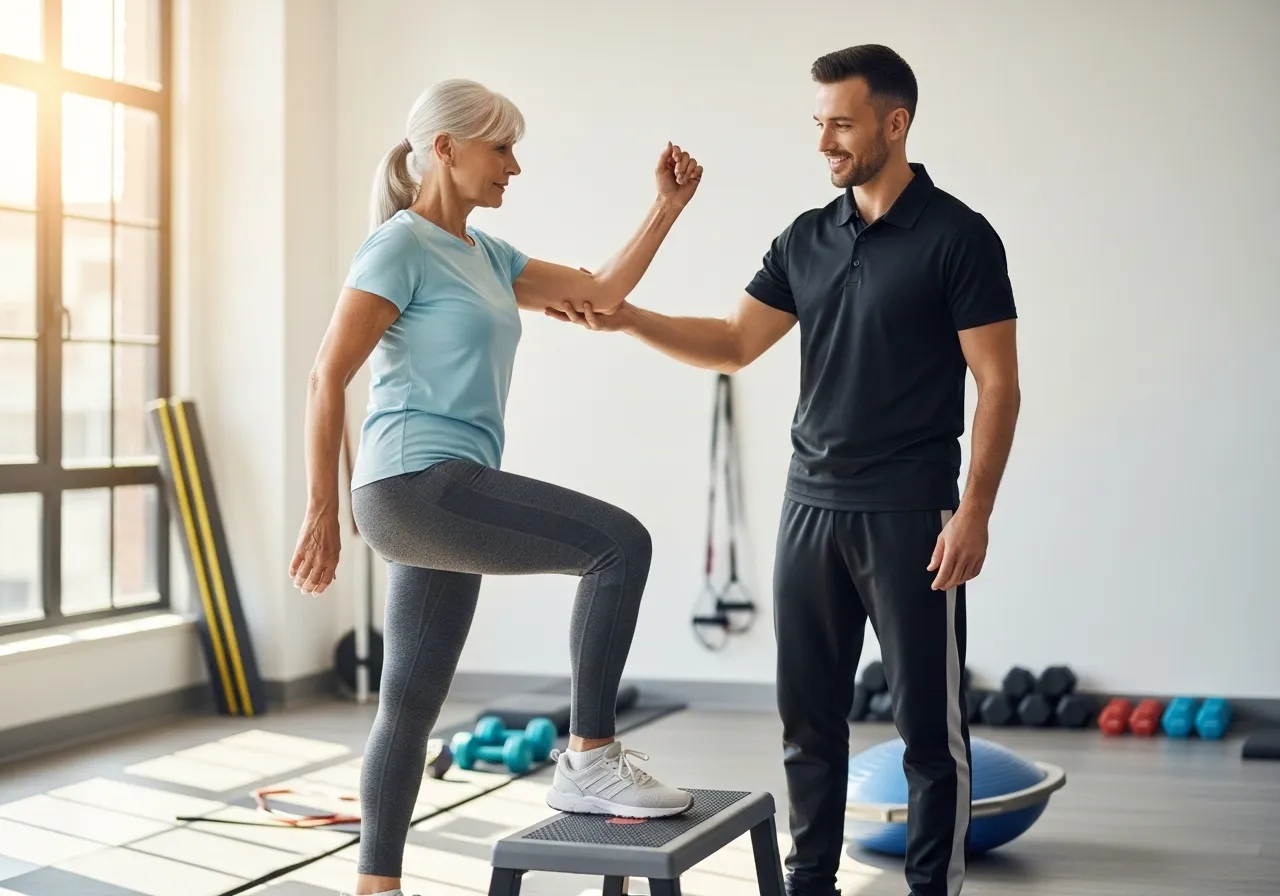
For adults over 65, functional training is not optional — it is the primary intervention that preserves the independent function that aging otherwise erodes. The functional training priorities for seniors: the sit-to-stand (goblet squat pattern) that prevents the chair dependence that loss of leg strength produces; the get-up-from-floor (Turkish get-up pattern) that enables safe floor-level activity and recovery from falls; the single-leg balance and stepping patterns that prevent falls — the leading cause of injury-related mortality in adults over 65; and the loaded carry that maintains the grip strength and postural stability that daily life requires. Research from ACSM guidelines on exercise for older adults identifies balance and resistance training as the two most impactful exercise modalities for fall prevention and functional independence preservation — both of which functional training simultaneously provides. The senior functional training program: 2–3 sessions per week, 30–40 minutes per session, focusing on chair squats progressing to goblet squats, modified Turkish get-ups, single-leg balance progression on stable then unstable surfaces, and light farmer’s carry or grocery bag carry simulation. The resistance should be challenging but manageable — the goal is the movement pattern development and strength maintenance that prevents functional decline, not the maximum strength development that competitive athletes pursue.
Functional Training for Athletes and Office Workers
Athletes in rotational and multi-directional sports (tennis, golf, baseball, basketball, football) benefit from functional training’s emphasis on rotational power, single-leg stability, and reactive movement that traditional gym work underdevelops. The athlete functional training program adds to existing sport-specific training: medicine ball rotational throws (3×10 each direction, twice weekly) for rotational power development; single-leg RDL and step-up progressions (twice weekly) for the unilateral leg strength that sport movement demands; and loaded carries in multiple directions (forward, lateral, and rotational) for the multi-planar stability that athletic movement requires. Office workers — who spend 8+ hours in a position of hip flexion, thoracic flexion, and shoulder internal rotation — have specific functional deficits that their training should address: hip extension (counteracting the hip flexor tightness of prolonged sitting through hip hinge and glute activation exercises); thoracic extension and rotation (counteracting the thoracic kyphosis of desk posture through thoracic mobility and rotational exercises); and shoulder external rotation and retraction (counteracting the forward shoulder and internal rotation of keyboard use through face pulls, band pull-aparts, and rowing movements). The office worker functional training program prioritizes these corrective elements in every session, ensuring that training actively reverses the postural dysfunction that occupational sitting accumulates rather than reinforcing it with additional anterior chain dominant exercises.
The specific application of functional training principles to the senior population deserves extended attention because the stakes are highest for this group: functional training is not merely beneficial for seniors — it is the primary modifiable factor determining whether the later decades of life are characterized by independence and vitality or by dependence and functional decline. The research on functional training for older adults is among the most compelling in exercise science: progressive resistance training focused on fundamental movement patterns reduces fall incidence by 23–40% in adults over 65; improves balance and gait speed (independent predictors of longevity and functional independence); reduces the progression of sarcopenia (the age-related muscle loss that begins accelerating in the sixth decade); and improves the quality of life, mood, and cognitive function that physical activity consistently benefits across the lifespan. The senior-specific functional training program should be supervised initially by a qualified fitness professional or physiotherapist — ensuring that movement quality is established before loading, that any pre-existing joint conditions are accommodated, and that the program is appropriately progressed as capacity develops. Family members of aging parents and grandparents who want to support their functional independence have no more impactful intervention available than connecting them with a qualified functional training program — the investment in a few months of supervised functional training may prevent the fall, hip fracture, or functional decline that otherwise ends independent living. The application of functional training to injury rehabilitation deserves specific attention, as functional training principles underlie much of modern physical therapy for common musculoskeletal conditions. Low back pain — the most prevalent musculoskeletal complaint in the developed world — responds particularly well to functional training rehabilitation: the hip hinge pattern that teaches dissociation of lumbar and hip movement; the farmer’s carry that develops the anti-lateral flexion core stability that protects the lumbar spine under load; and the single-leg exercises that address the hip abductor weakness that forces lumbar compensation during walking and stair climbing are all functional training staples that physiotherapists prescribe for back pain rehabilitation. Knee pain — particularly the patellofemoral pain that poor lower limb alignment produces — responds to the hip abductor and external rotator strengthening that single-leg functional exercises develop, correcting the knee valgus that driving the knee inward during squat and lunge patterns produces. Shoulder impingement — the most common shoulder complaint in gym-going populations — responds to the thoracic extension and rotation mobility, rotator cuff strengthening, and scapular stability that functional training’s pulling patterns and overhead mobility work develop. In each case, the functional training exercise is not an alternative to medical treatment but the functional restoration component that enables lasting resolution of the movement dysfunction that the pain is signaling. The population-specific programs outlined in this section reflect a core principle of functional training: the training must be appropriate for the person, not just appropriate for the exercise. A Turkish get-up is an excellent functional exercise — but the appropriate load, technique modification, and progression rate for a 70-year-old returning to exercise after a hip replacement differ dramatically from those for a 30-year-old competitive athlete. Functional training’s fundamental adaptability — the ability to scale any exercise to any fitness level through load, range of motion, stability surface, and complexity modification — makes it uniquely appropriate for diverse populations in ways that traditional fixed-weight machine training cannot replicate. Functional training, at its best, is not a collection of exercises but a philosophy of physical development — the belief that strength should be expressed through movement, that stability should supp The office worker application of functional training extends beyond the training session itself to the movement breaks and postural habits that prevent the dysfunction from accumulating during work hours. Every 45–60 minutes of seated work, stand and perform 10 hip hinge movements (a simple standing forward lean with hands sliding down the thighs), 10 thoracic rotations (arms crossed on chest, rotating the thoracic spine left and right), and a 30-second hip flexor stretch (one knee on the floor, the other foot forward, driving the hips forward gently). These 2-minute movement breaks — totaling 16–20 minutes of movement across an 8-hour workday — substantially reduce the postural dysfunction accumulation that hours of continuous sitting produce, and they complement the functional training sessions that address the accumulated dysfunction at a structural level. The combination of intentional movement breaks during the workday and functional training sessions 3–4 times weekly provides the comprehensive movement practice that desk-bound work requires for long-term musculoskeletal health. Functional training for seniors, athletes, and office workers alike shares one common outcome: a body that works better in the life it lives. That is the ultimate measure of functional fitness, and it is the measure that matters most. Train functionally. Live fully.
5. Common Mistakes, Equipment Guide, and FAQs
Functional training is frequently misunderstood, poorly programmed, and executed with technique errors that undermine both safety and effectiveness. This section addresses the most common mistakes and the most frequently asked questions.
The Most Common Functional Training Mistakes
Prioritizing complexity over quality: the most prevalent mistake — performing advanced, multi-component movements (Turkish get-ups with heavy load, complex medicine ball patterns) before the foundational single-pattern movements are established with correct technique. The result is compensatory movement that reinforces dysfunction rather than correcting it. Fix: progress through the movement hierarchy strictly — bodyweight before loaded, bilateral before unilateral, stable before unstable, single-pattern before combined-pattern. Using instability for instability’s sake: standing on BOSU balls while performing exercises, using suspension trainers for movements that free weights perform better, or prioritizing unstable surface training over functional strength development. Research consistently finds that unstable surface training reduces the force that can be generated and therefore the strength stimulus that exercises provide — unstable surfaces are appropriate for balance-specific training goals, not as a universal intensity modifier for all functional exercises. Neglecting loading: the opposite error of excessive instability — performing only bodyweight functional training without progressive loading. Bodyweight training develops movement quality and baseline strength but cannot provide the progressive overload that continued strength development requires. True functional training uses progressively heavier loads applied to functional movement patterns — the farmer’s carry with heavy kettlebells, the goblet squat with a significant load, the single-leg deadlift with a challenging dumbbell. Ignoring the carry patterns: most functional training programs include squats, hinges, pushes, and pulls but omit loaded carries — the pattern with the highest transfer to daily life and the most comprehensive functional development (grip, core, posture, and locomotion simultaneously). Adding one loaded carry variation to every training session is the most impactful single change available to most functional training programs.
Equipment Guide: What You Actually Need
Functional training requires less equipment than traditional gym training and can be performed with a surprisingly minimal toolkit. The minimum equipment for a complete functional training program: a pair of kettlebells (one moderate weight for swings and get-ups, one heavier for carries and loaded squats — approximately 12–16kg and 20–24kg for men, 8–12kg and 14–18kg for women); a resistance band set (for pull-aparts, face pulls, and mobility work); and a yoga mat. Total cost: $100–200. This minimal kit covers all six fundamental patterns: squat (goblet squat with kettlebell), hinge (RDL and swing with kettlebell), push (push-up progressions), pull (band rows and pull-aparts), carry (farmer’s carry with kettlebells), and rotation (medicine ball throws against wall — or the wall throw alternative of band rotational pulls). The equipment additions that most enhance the program: a pull-up bar ($20–40 — for the vertical pull pattern that no band substitute fully replaces); a medicine ball ($30–60 — for rotational throws that band rotation cannot fully replicate in terms of explosive power development); and a suspension trainer such as TRX ($150–200 — for inverted rows, pikes, and the full range of suspension-based exercises that add variety and adjustable difficulty to the push and pull patterns). A fully equipped functional training home gym costs $300–500 — a fraction of a traditional home gym setup and sufficient to support complete athletic development across all six movement patterns indefinitely.
Frequently Asked Questions About Functional Training
Can functional training replace the gym entirely? Yes, for most recreational athletes whose goals are general fitness, health, and real-world performance. Athletes pursuing maximum strength (powerlifters) or sport-specific conditioning may need gym equipment for specific modalities. How many days per week should I do functional training? 3 days per week is the minimum for significant adaptation; 4–5 days provides continued development for intermediate athletes. Full-body sessions 3 times weekly outperform body-part split programs for functional training goals. Is functional training safe for people with lower back pain? Functional training with appropriate movement quality emphasis — specifically the hip hinge pattern, loaded carries, and core anti-extension exercises — is frequently used as the primary rehabilitation intervention for chronic lower back pain. Begin with a physiotherapist if pain is significant. How long before I see results from functional training? Movement quality improvements appear within 2–4 weeks; strength improvements within 4–6 weeks; and the postural and functional changes that daily life reveals (reduced back pain, easier stair climbing, better athletic performance) within 6–12 weeks of consistent training. Can I combine functional training with traditional gym workouts? Yes — the ideal combination uses traditional compound lifts (squat, deadlift, bench press) for maximum strength development and functional training exercises for movement quality, stability, and the pattern variety that traditional training omits. Many elite athletes and coaches use exactly this hybrid approach. What is the single best functional exercise? The farmer’s carry — it trains the carry pattern, grip strength, core anti-lateral flexion stability, postural endurance, and walking mechanics simultaneously, transfers directly to the most common daily life loading activity, and can be scaled from any fitness level through load adjustment. If you add only one functional exercise to an existing program, make it the farmer’s carry.
The FAQ section addresses the most common concerns that prospective functional training athletes raise — but one question deserves deeper exploration than the brief answer above provides: whether functional training can replace traditional gym training entirely. The complete answer depends on the individual’s goals and honest assessment of what they are training for. For athletes whose primary goals are health, longevity, pain prevention, real-world performance, and general athletic capability, functional training alone — performed consistently with progressive loading — provides everything they need and more than traditional machine-based gym training delivers. For athletes with specific strength performance goals (competing in powerlifting, bodybuilding, or Olympic weightlifting), functional training complements but cannot replace the sport-specific barbell training that performance in these sports requires. For athletes with aesthetic goals (maximum muscle development), traditional hypertrophy training with isolation exercises produces superior results for certain muscle groups compared to functional training alone — though a functional foundation improves the quality and longevity of the aesthetic training that builds on it. The honest recommendation: begin with functional training to establish the movement quality, stability, and coordination foundation; add traditional compound lifts once this foundation is solid; use functional training principles to inform the exercise selection, progression, and program design of whatever training approach you ultimately pursue. The movement competency that functional training develops makes every other training modality safer, more effective, and more sustainable — it is the prerequisite for training well, regardless of what training goal you are ultimately pursuing. Building a sustainable functional training practice over years requires attending to the recovery and lifestyle factors that training adaptation depends on as carefully as to the training itself. Sleep is the primary recovery tool — 7–9 hours per night supports the hormonal environment (growth hormone, testosterone, cortisol balance) that muscle protein synthesis and neuromuscular adaptation require. Nutrition provides the substrate — protein at 1.6–2.0g per kg of body weight supplies the amino acids that muscle repair demands; carbohydrates around training sessions fuel the intensity that progressive loading requires; and overall caloric adequacy prevents the energy deficit that impairs both training performance and recovery. Stress management matters — chronic psychological stress elevates cortisol that both impairs muscle protein synthesis and increases injury risk by reducing tissue tolerance. The athlete who sleeps well, eats adequately, manages stress, and trains functionally 3–4 times per week will consistently outperform the athlete who trains more frequently but sleeps poorly, eats inadequately, and carries chronic stress — because the training stimulus is only as effective as the recovery environment allows it to be. Functional training, embedded in a recovery-supportive lifestyle, produces the lasting physical development that makes every year of training more capable than the last. The functional training questions answered in this section reflect the concerns of athletes at different stages of the functional training journey — from the beginner wondering whether the approach will work for their goals to the experienced athlete considering how to integrate functional principles with existing training. The consistent message across all answers: functional training works, for virtually everyone, across virtually all goals, when applied with appropriate technique, progressive loading, and consistency. The investment in developing the six fundamental movement patterns is among the highest-return fitness investments available — the strength, stability, mobility, and movement quality it produces compound across years of training, making every subsequent physical activity safer, more effective, and more enjoyable than it would be without the functional foundation that this training approach builds. Functional training, at its best, is not a collection of exercises but a philosophy of physical development — the belief that strength should be expressed through movement, that stability should supp The six fundamental movement patterns — squat, hinge, push, pull, carry, and rotate — are not a training methodology invented by fitness professionals but the movement vocabulary that the human body evolved to perform across millions of years of physical activity. Training them develops not just the muscles involved in each pattern but the neuromuscular coordination, joint stability, and movement integration that the whole body requires to function as the capable, pain-free, athletic system it was designed to be. Every goblet squat develops the sitting and standing strength that independence across decades requires. Every RDL develops the posterior chain that picking up children, luggage, and heavy objects demands. Every farmer’s carry develops the grip and postural endurance that carrying the loads of daily life requires without pain. Every rotational throw or landmine press develops the power transfer through the torso that sport, recreation, and the physical spontaneity of active life depends on. Functional training is not a gym exercise category — it is the physical preparation for the life you want to live. Train the patterns, build the movement quality, progress the loads, and arrive at every physical challenge in your life — sport, work, family, and recreation — with the capability that functional training develops and traditional training alone cannot provide. Functional training is the foundation of physical life done well. Build it deliberately, maintain it consistently, and let it serve you across every decade of active living ahead. Every rep counts.