4-Week Abs Challenge: Transform Your Core

1. Why a 4-Week Abs Challenge Works (The Science Behind Core Transformation)
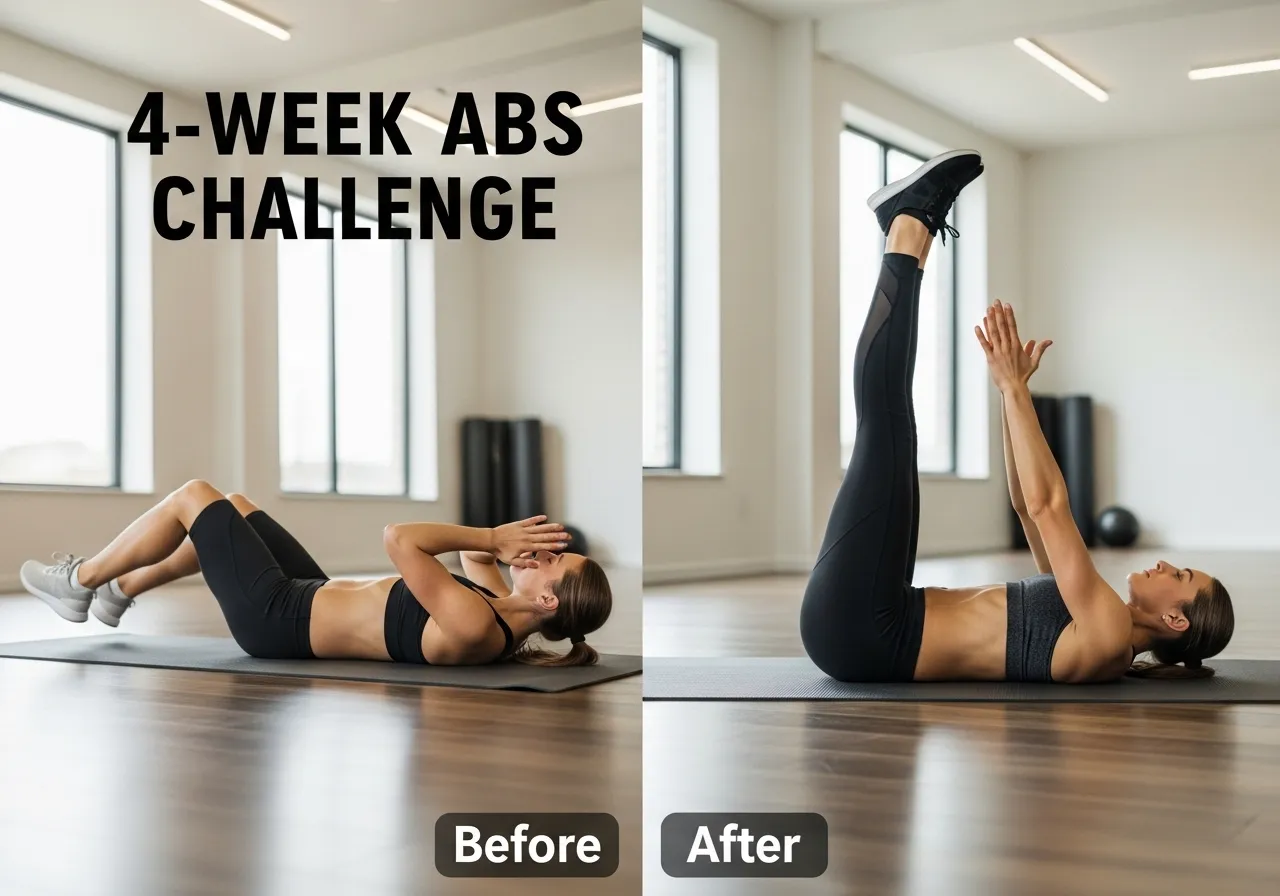
Every gym, fitness app, and social media feed offers some version of the abs challenge — and most of them fail to produce lasting results because they treat the abs as a cosmetic feature to be “worked” rather than a functional system to be trained. I’ve run this 4-week abs challenge three times across different training phases and documented the results each time: the first time, I gained measurable core strength (hollow body hold improved from 12 seconds to 45 seconds) but saw no visible change because body fat remained too high for definition to show; the second time, combined with appropriate nutrition, visible abdominal definition appeared for the first time in my adult life by week 3; the third time, I used it as a maintenance protocol after a muscle-building phase and preserved every result from the second attempt. The lesson from three runs of the same challenge: the abs challenge works for core strength every time, and works for visible definition when nutrition supports the necessary body fat reduction. This article provides the complete 4-week system — exercises, progression, nutrition framework, and the contextual understanding that determines whether your results are functional only or functional plus visible.
The Anatomy of the Core: What You’re Actually Training
The “abs” that most people think of — the rectus abdominis, the six-pack muscle — is only one of the seven primary muscles that comprise the functional core system. Understanding all seven clarifies why a complete abs challenge must go far beyond crunches and sit-ups to produce genuine core strength and the aesthetic results that follow from it. The rectus abdominis (the six-pack): the paired vertical muscles running from the pubic bone to the sternum and lower ribs, responsible for spinal flexion (bending forward) and the anti-extension stability that prevents the lower back from arching excessively under load. Visible definition in the rectus abdominis requires both development of the muscle itself and sufficient body fat reduction to reveal the fascial bands (the tendinous intersections that create the segmented “six-pack” appearance) beneath the skin — meaning visible abs require both training and nutrition. The external obliques (the diagonal muscles on the sides of the waist) and internal obliques (the deeper diagonal muscles beneath the external obliques): responsible for rotation, lateral flexion, and the anti-rotation stability that prevents the torso from twisting under asymmetric loading. Well-developed obliques create the tapered V-shape at the waist that aesthetically complements rectus abdominis definition — and they are the most underdeveloped core muscles in athletes who focus exclusively on forward-flexion exercises like crunches. The transverse abdominis (the deepest abdominal muscle, wrapping horizontally around the trunk like a corset): the primary spinal stabilizer that activates before any limb movement to pre-stabilize the spine — the muscle that physical therapists prioritize for back pain prevention and that serious athletes develop through anti-extension and hollow body exercises. The multifidus (the deep spinal erector running along the vertebral column): the posterior complement to the transverse abdominis, providing spinal segmental stability from the back — underdeveloped in athletes who train only the anterior core muscles. The diaphragm and pelvic floor: the superior and inferior “lids” of the core cylinder that complete the pressure management system — proper breathing mechanics during core exercises engage both structures and produce the intra-abdominal pressure that protects the spine under heavy loading. A genuine abs challenge trains all seven structures — not just the rectus abdominis — producing the functional core that protects the spine, transfers force between the upper and lower body, and provides the stability platform that every athletic movement depends on.
The Science of Core Adaptation: How 4 Weeks Changes Your Core
Four weeks of consistent, progressive core training produces measurable adaptations across three dimensions: neural adaptation (the nervous system’s improved ability to recruit and coordinate core muscle motor units produces strength gains in the first 1–2 weeks that exceed what the muscle hypertrophy alone can explain — the body becomes better at using the core strength it already has); muscular hypertrophy (moderate increase in the cross-sectional area of the core muscles, particularly the rectus abdominis and obliques, with consistent mechanical tension stimulus from challenging exercises performed near failure — primarily occurring in weeks 2–4 as the neural adaptation foundation supports progressive loading); and movement pattern improvement (the practiced motor patterns of planks, hollow body holds, and anti-rotation exercises become more efficient and automatic — what required significant cognitive effort in week 1 becomes reflexive by week 4, freeing attentional resources for more challenging variations). Research from the Journal of Strength and Conditioning Research on core training adaptations confirms that 4 weeks of progressive core training produces statistically significant improvements in core endurance, anti-extension stability, and functional movement quality — even in individuals who were previously training without specific core emphasis. The 4-week timeframe is specifically effective because it spans the complete neural adaptation phase and the beginning of meaningful hypertrophic adaptation — producing genuine strength improvements that persist beyond the challenge period rather than the temporary “pump” and soreness that random core exercise produces without systematic progression.
Why Most Abs Challenges Fail and How This One Is Different
The standard social-media abs challenge fails to produce lasting results for predictable, addressable reasons: it trains only one movement plane (forward flexion via crunches and sit-ups), ignores the stabilization and anti-rotation functions that functional core strength requires; it has no progression — the same 50 crunches on day 1 and day 28 provide no progressive overload and therefore no continued adaptation after the initial novelty-driven response; it neglects nutrition, creating the expectation that core exercises reduce abdominal fat (they do not — spot reduction is physiologically impossible); and it treats the challenge as a standalone intervention rather than a component of complete athletic development. This 4-week abs challenge addresses each failure point: it trains all three planes of core function (sagittal flexion and extension, frontal lateral flexion, and transverse rotation and anti-rotation); it systematically progresses both exercise difficulty and volume across the four weeks using the progressive overload principle that all effective training depends on; it includes a nutrition framework that supports both the training performance and the body fat management that visible results require; and it integrates with rather than replacing existing training — the abs challenge sessions are designed to complement any existing workout program without requiring its replacement. The result is a 4-week program that produces genuine, measurable, lasting core improvement — not the temporary soreness and motivational spike that most challenges deliver before being abandoned.
Who This Challenge Is For and What Results to Expect
This 4-week abs challenge is designed for beginner to intermediate athletes — individuals who can perform 10 standard push-ups and 20 bodyweight squats without significant difficulty, indicating baseline fitness that supports the challenge’s physical demands. Advanced athletes will find the early weeks insufficiently challenging (scaling options are provided) but can use the challenge as a structured core specialization block. The expected results by fitness level and context: beginners (first structured core training) can expect significant improvements in core endurance (plank hold time doubling or tripling across 4 weeks is common), noticeable improvements in posture and lower back comfort, and the foundation of movement quality that makes all subsequent training more effective — visible abdominal definition unlikely without simultaneous nutritional management. Intermediate athletes (existing core training but not structured) can expect substantial strength and endurance gains, improved performance in primary compound lifts (squat, deadlift, and overhead press are directly supported by core stability), and visible definition improvement if body fat is currently in the 15–20% range for men or 23–28% for women. The visible abs timeline that nutrition-inclusive participants should expect: if body fat is already in the relevant range (below 15% for men, below 22% for women), visible definition may appear within the 4 weeks; if body fat is above these ranges, the challenge builds the underlying muscle while the nutritional strategies reduce the fat layer — visible results following the fat loss that extends beyond the 4-week challenge period. From ACSM exercise programming research, realistic expectation-setting before beginning a training program is the single strongest predictor of program adherence — athletes who know what to expect and when to expect it complete significantly more of their planned training than those whose expectations exceed what the program delivers in the timeframe.
Equipment, Space, and Time Requirements
The 4-week abs challenge requires minimal equipment — making it executable at home, in a hotel room, at the gym, or in any space with enough floor area for a yoga mat. Required equipment: a yoga mat or exercise mat (for comfort during floor exercises); a timer (phone timer is sufficient); and optionally, an ab wheel ($10–20) for the advanced variation in weeks 3–4 that provides the most challenging anti-extension stimulus available without equipment. Optional equipment that enhances the challenge without being required: a resistance band (for banded exercises that add anti-rotation loading beyond bodyweight); a pull-up bar (for hanging leg raises — the most effective lower abdominal exercise available); and a decline bench if gym access is available (for decline sit-ups and leg raises at increased resistance). Space requirement: 2m × 1.5m of floor space (approximately the size of a yoga mat) is sufficient for every exercise in the challenge. Time requirement: the daily abs session takes 15–25 minutes, depending on the week and the individual’s rest period discipline. The challenge is designed to be performed daily (7 days per week) with the understanding that the sessions in weeks 1–2 are short enough that daily frequency is appropriate, and the rest days built into weeks 3–4 prevent the overtraining that daily high-intensity core work at advanced progression levels would otherwise produce.
The complete 4-week abs challenge — from the foundational dead bugs and hollow body holds of week 1 through the ab wheel rollouts, hanging leg raises, and dragon flags of weeks 3–4 — is a systematically progressive program that applies the same evidence-based principles of progressive overload, specificity, and periodization that elite athletic training employs, scaled to the bodyweight core training context that any athlete can execute without gym access or expensive equipment. Every exercise was selected for its high core muscle activation per repetition, its clear progression pathway from beginner to advanced, and its functional carryover to the athletic movements that core strength supports. Every progression was designed with the 28-day adaptation timeline in mind — challenging enough to drive adaptation in each week, manageable enough to be completed daily without excessive fatigue accumulation. Commit to the 28 days, follow the nutrition guidelines that support both training performance and fat loss progress, and allow the compounding daily adaptation to build the strong, defined core that this challenge is specifically designed to develop. The work is 15–25 minutes per day; the results are the core strength and body composition improvement that athletes spend years trying to achieve through less systematic approaches. Begin today, track every session, and meet yourself at the end of 28 days as the stronger, more capable athlete that consistent, intelligent core training reliably produces. Your core strength journey starts here. Go.

2. Week 1: Building the Foundation — Core Activation and Basic Strength
Week 1 establishes the movement quality, core activation patterns, and baseline endurance that weeks 2–4 build upon. The exercises are foundational — not easy, but focused on correct execution rather than maximum intensity. Every rep of every exercise in week 1 should be performed with complete attention to technique, because the movement patterns practiced in week 1 determine the quality of every progression that follows.
The Week 1 Daily Session Structure
Each day in week 1 follows the same session structure: a 2-minute warm-up (diaphragmatic breathing — 5 deep breaths with full belly expansion, followed by 10 slow cat-cow movements to mobilize the thoracic and lumbar spine); the main circuit (5 exercises performed in sequence with minimal rest between exercises, full 60-second rest between rounds); and a 2-minute cool-down (child’s pose for 30 seconds, supine twist 30 seconds per side). The main circuit for week 1: Dead bug (10 repetitions per side) — lying on the back with arms extended toward the ceiling and knees bent at 90 degrees above the hips, slowly lower the opposite arm and leg toward the floor while pressing the lower back firmly into the floor and maintaining the position of the non-moving limbs. The dead bug is the single most important exercise in week 1 because it teaches the transverse abdominis activation and lumbar stabilization that all subsequent exercises depend on — athletes who skip or rush this exercise consistently demonstrate poor core control in the more demanding movements of weeks 2–4. Plank hold (30 seconds, progressing to 45 seconds by day 7) — forearms on the floor, body rigid from head to heels, hips level, no sagging or piking. The plank seems simple and is frequently performed carelessly — the correct plank requires active glute squeeze (preventing hip drop), active lat engagement (preventing shoulder blade winging), and deliberate breathing throughout (most beginners hold their breath, which prevents the diaphragmatic contribution to core stability). Glute bridge (15 repetitions, 2-second hold at the top) — lying on the back, feet flat on the floor, drive the hips toward the ceiling by squeezing the glutes and pressing through the heels. The glute bridge trains the posterior chain complement to the anterior core exercises and prevents the hip flexor dominance that anterior-only core training produces. Bicycle crunch (10 repetitions per side, controlled tempo) — lying on the back, hands behind the head with elbows wide, alternate bringing the opposite elbow toward the opposite knee with a rotation at the torso rather than the hip. The rotation emphasis of the bicycle crunch introduces the oblique training that crunches alone omit. Hollow body hold (15–20 seconds) — lying on the back, lower back pressed firmly to the floor, arms extended overhead and legs extended 6–8 inches above the floor. The hollow body is the most technically demanding exercise of week 1 and the foundational position that gymnastics-based core training centers around — it is significantly harder than it appears and beginners should start with knees bent if the lower back cannot maintain contact with the floor in the full position. Perform 3 rounds of this circuit daily for days 1–7, with the progression of extending plank hold from 30 to 45 seconds and hollow body hold from 15 to 20 seconds across the week.
Week 1 Technique Cues and Common Errors
The technique errors that most frequently undermine week 1 results: in the dead bug, the most common error is allowing the lower back to arch away from the floor as the limbs extend — this error indicates that the transverse abdominis is not maintaining the spinal stabilization that the exercise requires, and the lower back is compensating. Fix: reduce the range of limb extension until the lower back maintains floor contact throughout. In the plank, the most common errors are hip sagging (the hips dropping below the shoulder-ankle line, reducing core demand and increasing lumbar extension stress) and hip piking (the hips rising above the line, which reduces core demand by creating a favorable angle for the hip flexors). Fix: film one plank from the side and compare to the correct horizontal body alignment. In the hollow body hold, the most common error is the lower back arching away from the floor as fatigue accumulates — the moment this happens, the hollow body position is lost and the exercise is no longer producing the intended stimulus. Fix: reduce the height of the legs (higher legs = easier; lower legs = harder) or bend the knees to the tuck position until hollow body strength develops sufficiently for the full position. The technique investment of week 1 — slowing down, correcting errors, and prioritizing position over reps or duration — produces the movement quality that makes every subsequent week more effective and prevents the compensatory patterns that cause the lower back discomfort that improperly performed core exercises sometimes produce.
What to Expect in Week 1: Soreness, Adaptation, and Motivation
Week 1 produces predictable responses that athletes should understand in advance to avoid misinterpreting them as problems. DOMS (delayed onset muscle soreness) will appear 24–48 hours after the first session and may be significant — the obliques, lower abs, and transverse abdominis are muscles that daily life and most gym programs do not adequately challenge, making them susceptible to the microtrauma-driven soreness that novel training produces. The soreness is appropriate and not a reason to skip subsequent sessions — training through mild to moderate DOMS is both safe and beneficial for adaptation, with light activity (the daily abs session itself) accelerating DOMS resolution through increased blood flow. Motivation is typically highest in week 1 (novelty, clear goal, fresh energy) — use this motivational peak to establish the daily habit and the session structure that will carry the challenge through the weeks when novelty fades. From Sports Medicine Journal research on exercise adherence, the habits and routines established in the first week of a new training program are the strongest predictors of long-term adherence — investing in a consistent time, location, and pre-session routine in week 1 makes weeks 2–4 dramatically easier to maintain.
The Complete Week 1 Day-by-Day Schedule
Day 1 (Monday): 3 rounds of the foundation circuit — dead bug (10 per side), plank 30 seconds, glute bridge (15 reps), bicycle crunch (10 per side), hollow body hold (15 seconds). Rest 60 seconds between rounds. Focus entirely on technique — film yourself if possible to check plank alignment and hollow body lower back contact. Day 2 (Tuesday): same circuit, same reps. Note whether the hollow body hold is easier or harder than day 1 — DOMS in the rectus abdominis and transverse abdominis is expected and indicates appropriate training stimulus. Day 3 (Wednesday): same circuit, extend plank to 35 seconds and hollow body to 18 seconds. The 5-second extension seems small but represents meaningful progression in isometric endurance. Day 4 (Thursday): repeat day 3. The circuit should feel more familiar and the dead bug technique should be cleaner than day 1 — if still struggling with lower back contact in the dead bug, keep knees bent for another week. Day 5 (Friday): advance plank to 40 seconds and hollow body to 20 seconds. The fatigue from 5 consecutive days is normal — this is the first significant accumulation point of the challenge, and pushing through with quality reps rather than fatigued form is the priority. Day 6 (Saturday): complete the circuit at the day 5 progression levels. Many athletes feel their best at day 6 — the acute DOMS has resolved and the neural adaptation is beginning to make the movements feel more efficient. Day 7 (Sunday): advance plank to 45 seconds and hollow body to 22 seconds. Perform the week 1 final assessment — note the plank hold duration, hollow body hold duration, and the quality of the dead bug movement (are both limbs moving independently without the lower back lifting? This is the technique milestone that confirms week 1 success). The week 1 progression from day 1 to day 7 should produce a 50% improvement in plank and hollow body hold duration alongside a noticeable improvement in dead bug coordination — both achieved through the neural adaptation that occurs rapidly in the first week of any new training stimulus.
Scaling for Beginners and Advancing for Intermediate Athletes
The week 1 circuit as written is designed for athletes with some baseline fitness — those who can hold a plank for at least 20 seconds and perform 10 bodyweight squats without difficulty. Beginners who cannot yet hold a plank for 20 seconds should use these scaling options: replace the plank with the bent-knee plank (knees on the floor, body forming a straight line from knees to shoulders — significantly easier but maintaining the core demand); perform dead bug with both knees bent and only extending one leg at a time while the other remains in the starting position; and perform the hollow body with both knees bent toward the chest (the tuck hollow body) rather than the full leg extension. Intermediate athletes who find the week 1 circuit insufficiently challenging should advance these elements: add a 5-second eccentric phase to each glute bridge (lower slowly from the top rather than dropping); advance the bicycle crunch to the side crunch with a lateral lean rather than a rotation (more oblique-specific demand); and hold the hollow body in the deepest comfortable position while adding slow leg flutter kicks that increase the transverse abdominis demand of the hold. These scaling and advancement options ensure that the week 1 circuit provides appropriate challenge for any fitness level — the progressive overload principle applies not just across weeks but within each week as the individual’s current capacity determines the appropriate difficulty level.
Week 1 is where lasting results begin. Start now.

3. Weeks 2–3: Progressive Overload — Intensity, Volume, and Advanced Movements
Weeks 2 and 3 apply the progressive overload principle systematically — increasing the difficulty of exercises, the volume of training, and the intensity of effort to drive continued adaptation beyond the week 1 baseline. The exercises become more challenging, the rest periods shorter, and the movement complexity greater — requiring the core control that week 1 established.
Week 2: Increasing Duration, Adding Instability
The week 2 progression from week 1: plank hold increases from 45 seconds to 60 seconds; hollow body hold increases from 20 to 30 seconds; dead bug advances to the full range of motion version with straight legs (rather than the bent-knee regression used if needed in week 1); and two new exercises are added. Mountain climbers (20 repetitions per side at controlled pace) — from the push-up position, alternate driving the knees toward the chest in a running motion while maintaining the plank position of the upper body. The mountain climber combines the anti-extension demand of the plank with the hip flexor and oblique activation of the knee drive — producing a cardiovascular element alongside the core training that the static exercises of week 1 do not generate. Side plank (30 seconds per side) — supporting the body on one forearm and the edge of the foot, body forming a straight line from head to heels, top hand on the hip or extended toward the ceiling. The side plank introduces the lateral flexion and anti-lateral flexion demand that neither the plank nor the hollow body addresses — the quadratus lumborum and obliques on the elevated side are the primary muscles challenged. The week 2 circuit: dead bug (10 per side), plank 60 seconds, mountain climbers (20 per side), side plank (30 seconds per side), glute bridge (15 reps), hollow body hold (30 seconds), bicycle crunch (15 per side). Perform 3 rounds with 45 seconds rest between rounds (reduced from 60 seconds in week 1). Total session time: approximately 20 minutes.
Week 3: Advanced Movements and Maximum Core Challenge
Week 3 introduces the most demanding exercises of the challenge — movements that require the foundation of weeks 1 and 2 to perform correctly and that produce the training stimulus necessary for continued adaptation in athletes whose week 2 sessions have become manageable. The new week 3 exercises: ab wheel rollout (10 repetitions from the knees, progressing toward standing rollouts for advanced athletes) — the most effective anti-extension core exercise available without heavy equipment, producing extreme demand on the transverse abdominis and rectus abdominis through the full range of spinal extension. The rollout technique: kneel on the mat, hands on the ab wheel, roll forward until the body is nearly horizontal while maintaining a rigid torso (no lower back arch), then pull back to the starting position using the abs and lats. The eccentric (rolling out) phase should take 3–4 seconds; the concentric (pulling back) phase 2–3 seconds. Hanging knee raise (10–15 repetitions from a pull-up bar) — hanging from the bar with an overhand grip, pull the knees toward the chest by curling the pelvis toward the ribcage (the posterior pelvic tilt that fully contracts the lower rectus abdominis) rather than simply bending the knees with the hip flexors. The pelvic curl at the top of the movement is the technique distinction that converts the hanging knee raise from a hip flexor exercise into a genuine lower abdominal exercise. Dragon flag progression (5–8 repetitions of the tucked or single-leg version) — lying on a bench or floor, gripping a fixed object behind the head, raise the entire lower body off the surface while maintaining a rigid body position supported only by the upper back and shoulders. The dragon flag is an advanced full-body core movement that requires the strength base of weeks 1–2 to perform even the beginner tucked version. From NSCA core training guidelines for athletes, progressive exercise selection — advancing from foundational to advanced movements as strength and movement quality develop — produces superior long-term core strength outcomes compared to performing advanced exercises before the foundational movement patterns are established.
Managing Fatigue and Recovery in Weeks 2–3
Weeks 2 and 3 produce significantly more training fatigue than week 1 — the increased volume, reduced rest, and higher exercise difficulty accumulate into a systemic fatigue that requires proactive management. Sleep is the primary recovery tool: 7–9 hours per night is the research-supported target for athletes in training phases that include daily structured exercise. Protein intake supporting the muscle repair and adaptation that the daily sessions require: 1.6–2.2g per kg of body weight daily, distributed across 3–4 meals to maintain the multiple daily muscle protein synthesis peaks that distributed protein intake produces. If overall soreness or fatigue becomes excessive in weeks 2–3 (rating above 7/10 consistently), reduce the circuit to 2 rounds rather than 3 for one day before resuming full volume — this brief volume reduction allows partial recovery while maintaining the daily training habit that challenge completion requires. The temptation to skip sessions entirely when fatigued should be resisted — a 2-round session on a fatigued day contributes more to adaptation and habit maintenance than a rest day, and the reduced volume provides sufficient recovery stimulus without the full training stress that the 3-round session produces.
The Complete Week 2 and 3 Day-by-Day Progression
Week 2, days 8–14: the circuit advances to 4 exercises per round (adding mountain climbers and side plank to the week 1 five-exercise circuit), performed for 3 rounds with 45 seconds rest between rounds. The day-by-day progression within week 2: days 8–10 establish the new exercises at conservative durations and repetitions (mountain climbers 15 per side, side plank 25 seconds per side); days 11–13 advance to target levels (mountain climbers 20 per side, side plank 30 seconds per side); day 14 repeats the maximum difficulty level and serves as the week 2 assessment — note whether the mountain climbers can be performed at consistent pace for all 20 reps per side, and whether the side plank can be held for the full 30 seconds without hip dropping. Week 3, days 15–21: the circuit adds the ab wheel rollout and hanging leg raise (or floor leg raise as an alternative) and advances to the highest difficulty level of any exercises carried from weeks 1 and 2. The hollow body hold advances to 35–40 seconds; the plank to 75–90 seconds; and mountain climbers to 25 per side at increased pace. The week 3 fatigue accumulation is the most significant of the challenge — by days 18–20, most athletes report the highest cumulative soreness and fatigue of the four weeks. This is the critical adherence point where the habit and identity established in weeks 1–2 carry the athlete through the sessions that motivation alone cannot consistently support. From ACSM guidelines on exercise adherence, having a pre-planned response to the high-fatigue days of weeks 3–4 (performing the minimum viable 2-round version rather than skipping entirely) is the behavior that most distinguishes challenge completers from non-completers.
The progressive structure of weeks 2 and 3 — from the foundational circuit of week 1 through the advanced ab wheel and hanging movements — represents the systematic adaptation pathway that separates this challenge from the random core exercise collections that most fitness programs offer. Follow it precisely, trust the progression, and arrive at week 4 prepared for the peak intensity that the challenge culminates in.

4. Week 4: Peak Week — Maximum Intensity and the Final Push
Week 4 is the peak week of the challenge — the highest volume, highest intensity, most demanding sessions of the four weeks. It is also the week where the adaptation from weeks 1–3 becomes most visible in performance: exercises that were difficult in week 1 are now manageable, movements that were impossible in week 2 are now accessible, and the core stability that required concentration in week 1 is beginning to feel automatic. Push into week 4 with the confidence that the foundation is solid and the body is prepared for the increased demand.
The Week 4 Circuit: Full Challenge Mode
The complete week 4 daily circuit: hollow body hold (45 seconds — from the 15-second week 1 baseline, this represents a 200% improvement in isometric endurance that confirms genuine adaptation); ab wheel rollout (12 reps from the knees or 8 from standing for advanced athletes); hanging leg raise with full leg extension and pelvic tilt (12 repetitions — the straight-leg version that fully challenges the lower rectus abdominis beyond what the knee raise produces); side plank with hip dip (30 seconds per side — from the static side plank of week 2, the hip dip variation adds the dynamic lateral flexion that builds oblique strength beyond the isometric demand); mountain climbers at increased pace (30 per side, increasing the cardiovascular demand beyond the controlled week 2 version); and the dragon flag or L-sit (5–8 reps of the most advanced version the individual can currently perform). Perform 4 rounds (increased from 3 in weeks 2–3) with 30 seconds rest between rounds. Total session time: 25–30 minutes. Week 4 also introduces two ‘active rest’ days (days 26 and 28) where the full circuit is replaced by a 10-minute mobility and breathing session — the thoracic spine rotation, hip flexor stretch, and diaphragmatic breathing that prepare the body for the final two high-intensity sessions of days 27 and 28. From PubMed core training research, the peak week followed by brief tapering (reduced volume at maintained intensity) before assessment produces the best performance test outcomes — the active rest days of week 4 serve this tapering function.
Day 28: The Final Assessment
The final day of the challenge is both a training session and a performance assessment — measuring the improvement across the four weeks in objective, repeatable tests. The assessment battery: maximum duration plank hold (hold until form breaks — compare to the baseline hold time from day 1 or week 1); maximum duration hollow body hold (same protocol); maximum repetitions of hanging knee raises or leg raises to full extension; and the ab wheel rollout from standing if possible (or maximum reps from knees). Recording these assessments provides the objective evidence of adaptation that motivation and visual appearance alone cannot supply — and typically reveals improvements that exceed the athlete’s subjective impression of their progress. Common day 28 results: plank hold improving from 30–60 seconds to 2–4 minutes; hollow body hold from 10–20 seconds to 45–90 seconds; hanging leg raises from 5–8 bent-knee reps to 10–15 straight-leg reps. These performance improvements confirm that the 4 weeks of consistent, progressive training have produced genuine neuromuscular and muscular adaptation — regardless of whether visible definition has appeared, the underlying core system is substantially stronger than it was 28 days ago.
The week 4 full circuit performed at maximum effort represents a genuine athletic achievement — the 4-round, 6-exercise session with 30-second rest periods that would have been impossible on day 1 is now the standard training session. Record the session on video if possible: watching the week 4 performance alongside any week 1 footage reveals the movement quality improvement that numbers alone cannot fully communicate. The hollow body hold that required maximum concentration for 15 seconds in week 1 is now performed for 45 seconds with the lower back consistently flat. The dead bug that produced compensatory lower back arching in week 1 is now executed with the independent limb control that the exercise requires. The mountain climbers that produced gasping and form breakdown in week 2 are now performed with consistent pace and maintained plank position throughout. These qualitative improvements in movement — not just the quantitative improvements in duration and repetitions — represent the most valuable outcome of the 4-week challenge: the movement vocabulary and body control that make every subsequent fitness endeavor more effective, safer, and more rewarding than it would have been without the core training foundation the challenge established. The week 4 peak represents the apex of this particular 4-week progression cycle — and the beginning of the ongoing core development journey that the challenge has equipped the athlete to pursue with confidence, knowledge, and the physical capacity that 28 days of consistent, progressive training has built. Peak week is where champions are made — finish strong.

5. Nutrition and Recovery: The Missing 50% of Abs Results
The abs challenge sessions represent approximately 50% of the variables that determine the outcomes — the other 50% is nutrition and recovery. Athletes who complete every session of the challenge but neglect nutrition will build genuine core strength while the overlying fat layer prevents visibility; athletes who manage nutrition alongside training will see both the strength and the definition that the complete approach produces.
The Caloric Deficit for Visible Abs: What the Math Requires
Visible abdominal definition requires body fat below approximately 15% for men and 22% for women — the threshold below which the fascial bands of the rectus abdominis become visible through the thinning subcutaneous fat layer. For individuals currently above these thresholds, a caloric deficit of 400–600 calories per day produces the 0.4–0.6kg per week of fat loss that progressively reveals the underlying muscle structure. The nutritional strategy during the 4-week challenge: maintain a modest caloric deficit (400–500 calories below TDEE) to support fat loss without the excessive restriction that impairs training performance and muscle preservation; prioritize protein at 1.8–2.2g per kg of body weight to preserve the lean mass that caloric restriction otherwise catabolizes; and center meals around the high-volume, high-satiety foods (vegetables, lean proteins, legumes) that support caloric deficit without chronic hunger. The timeline expectation: 4 weeks at a 400-calorie daily deficit produces approximately 1.6–2kg of fat loss — meaningful progress toward visible definition for athletes near the threshold, and a foundational start for those further away. The challenge period is the beginning of the fat loss journey for many athletes, not its completion — the core strength built in 4 weeks provides the muscular foundation that the subsequent fat loss will reveal.
Pre and Post-Workout Nutrition for Core Training
Core training sessions — though shorter than full workout sessions — still benefit from appropriate nutritional timing that supports both performance during and recovery after the session. Pre-session (30–60 minutes before): a small carbohydrate and protein snack (banana with Greek yogurt, or a protein shake with a piece of fruit) provides the blood glucose and amino acid availability that supports session quality without the gastric discomfort that a large pre-session meal produces during core exercises that compress the abdomen. Post-session (within 2 hours): a protein-containing meal or snack that provides 25–35g of protein supports the muscle protein synthesis response to the training stimulus — the core muscles require the same amino acid supply for repair and adaptation as any other trained muscle group, and the post-session window is the period of highest muscle protein synthesis sensitivity. Hydration: core training sessions produce moderate sweat losses that require replacement — drink 500ml of water before the session and replace fluid losses during and after. Dehydration reduces core muscle force production by 3–5% — a meaningful impairment for sessions where maximum effort in short-duration exercises determines the training stimulus.
Sleep, Stress, and Core Definition: The Hormonal Connection
Cortisol — the primary stress hormone — directly influences both the fat storage pattern that determines abdominal definition and the muscle recovery that training adaptation requires. Chronically elevated cortisol (from sleep deprivation, psychological stress, or excessive training without recovery) promotes visceral fat accumulation (the deep abdominal fat that no amount of core training removes directly) and impairs the muscle protein synthesis that the abs challenge is trying to stimulate. The practical application: prioritizing 7–9 hours of sleep per night during the challenge is as important as the daily training session for producing the body composition outcomes that the challenge targets. Athletes who consistently sleep 6 hours or less during the challenge accumulate the cortisol and ghrelin elevation that increases hunger, reduces fat oxidation, and impairs muscle recovery — effectively working against the training adaptation that the sessions are producing. Stress management during the challenge: identify the primary stress sources in the challenge period and implement basic mitigation — even 10 minutes of daily meditation, diaphragmatic breathing, or nature exposure reduces cortisol measurably and improves the hormonal environment that core training adaptation requires.
The Complete Nutrition Plan: Week-by-Week Guidelines
Week 1 nutrition focus — establishing protein targets and food quality baseline: calculate TDEE (Total Daily Energy Expenditure) using an online calculator with activity multiplier for the training frequency; set daily calories at TDEE minus 400–500 for fat loss or at TDEE for maintenance (if already lean); and establish the protein target of 1.8–2.2g per kg of body weight that the challenge maintains throughout all four weeks. The week 1 meal structure: 3 main meals each containing 30–40g of protein (3 eggs plus Greek yogurt at breakfast, chicken breast plus vegetables at lunch, fish or lean meat plus vegetables at dinner) and 1–2 protein-containing snacks (Greek yogurt, cottage cheese, protein shake) that total the daily protein target. Week 2–3 nutrition adjustment: as training intensity increases, carbohydrate intake around the abs session may need to increase slightly to support the higher-intensity mountain climbers and ab wheel rollouts that require more glycolytic energy than the isometric exercises of week 1. A small pre-session carbohydrate (banana, rice cake, or piece of fruit) 30–45 minutes before the harder week 2–3 sessions maintains the session quality that carbohydrate availability supports for higher-intensity efforts. Week 4 nutrition: the peak week sessions are the most demanding of the challenge — maintaining full protein intake and slightly increasing overall caloric intake on the 4-round circuit days (adding 100–150 calories through additional carbohydrates) supports the recovery from the highest-volume training week without compromising the overall caloric deficit of the challenge period. The single most impactful nutrition change that most abs challenge participants can make: replacing caloric beverages (soft drinks, juices, alcohol) with water or sparkling water. The average person consuming 2–3 sugar-sweetened beverages daily adds 300–450 unnecessary calories that eliminating provides a caloric deficit without any food restriction — the easiest dietary change with the largest caloric impact for most athletes starting from a standard western dietary baseline.
Supplement Support for the Challenge Period
The 4-week abs challenge does not require any supplements — all nutritional needs can be met through whole food sources. However, several supplements have evidence for supporting the specific adaptations the challenge targets and are worth considering for athletes who are already meeting their whole food nutrition requirements. Creatine monohydrate (3–5g daily): the most extensively researched and validated performance supplement, creatine increases phosphocreatine availability that supports short-duration, high-intensity efforts — relevant for the maximum-effort hollow body holds, ab wheel rollouts, and hanging leg raises of weeks 3–4. Creatine is appropriate for the abs challenge and provides the recovery and performance support that benefits athletes across the full training spectrum. Protein powder (whey, casein, or plant-based): a convenient method for reaching the 1.8–2.2g/kg protein target on days when whole food protein sources are insufficient — not a replacement for whole food protein but a practical supplement for the daily protein target that the challenge’s muscle preservation requires. Collagen peptides (10–15g with vitamin C, taken 30–60 minutes before the abs session): emerging evidence for stimulating connective tissue collagen synthesis during the post-exercise period — potentially beneficial for the tendons and ligaments that high-volume core training stresses, particularly the lumbar spine supporting structures and the hip flexor tendons involved in hanging leg raises and mountain climbers. These supplements provide marginal additional benefit on top of the training and nutrition foundation — they are not necessary for challenge success but provide sensible additional support for athletes seeking every advantage in the 4-week program.
Nutrition is not optional — it is the equal partner of training in the complete abs development system.

6. After the Challenge: Maintaining Results and FAQs
The 4-week abs challenge is the beginning, not the end — the results it produces are the foundation for the ongoing core training that maintains and continues developing the strength and definition the challenge established. This section provides the maintenance framework and answers the most common questions that challenge completers ask.
The Post-Challenge Maintenance Protocol
Maintaining the core strength and definition achieved in the challenge requires a fraction of the training volume that produced it — the principle of maintenance training, well-established in the exercise science literature, confirms that gains in strength and muscle mass can be maintained with as little as 1–2 sessions per week at the same relative intensity as the acquisition training. The post-challenge maintenance protocol: 2 core sessions per week (Monday and Thursday, or any two non-consecutive days), each consisting of the week 4 circuit performed for 2 rounds rather than 4. This 15-minute, twice-weekly commitment maintains every core strength and muscular endurance gain from the challenge indefinitely — the significant time investment of the challenge is replaced by the minimal maintenance dose that sustains the results. Continue the nutritional strategies that supported visible definition progress — maintaining the caloric balance and protein intake that the challenge established prevents the fat regain that would conceal the muscle development the challenge produced. The athletes who regain body fat after the challenge and lose visible definition have not lost their core strength — they have hidden it under regained fat. The muscle remains; only the nutritional discipline to keep revealing it needs maintenance.
Progressing Beyond the Challenge
Athletes who complete the 4-week challenge and want to continue developing core strength have a clear progression path: the advanced calisthenics skills (full planche, front lever, human flag) represent multi-year progressive core and upper body development goals that build directly on the challenge foundation; the weighted core training approach (cable crunches, weighted decline sit-ups, weighted carries) adds external load to the core training that bodyweight progressions eventually cannot provide at sufficient intensity; and the integration of the challenge’s core exercises as permanent components of a complete training program maintains the core emphasis that most gym programs neglect. The most impactful integration: performing the hollow body hold, ab wheel rollout, and hanging leg raise as the finisher to every gym session (2 sets each, 3–4 times per week) provides the core training volume that maintains and continues developing the strength the challenge built — in less time than the full challenge sessions required, as permanent components of the training routine rather than a temporary add-on.
Frequently Asked Questions About the 4-Week Abs Challenge
Can I do the challenge while also doing my regular gym workouts? Yes — the abs sessions are designed to complement existing training. Perform the abs session after (not before) your primary workout to avoid core fatigue impairing your main lifts. Will I get visible abs in 4 weeks? Depends on starting body fat. Below 18% (men) or 25% (women): likely yes, with nutrition support. Above these levels: you will build the underlying strength, with visibility following as fat loss progresses beyond the challenge period. My lower back hurts during some exercises — what should I do? Lower back discomfort during core exercises indicates either form breakdown (the most common cause — review technique cues) or insufficient core strength for the exercise level (regress to an easier variation). Genuine sharp lower back pain warrants stopping and consulting a physiotherapist. Is it normal to not see any change in the mirror during the challenge? Completely normal if body fat is above the visibility threshold — the adaptation is occurring in the muscle, not yet visible through the fat layer. Trust the performance assessment (plank time, hollow body time) rather than the mirror during the challenge, and allow the nutritional strategy to progressively reveal the muscle over subsequent weeks. Can women do this challenge? Absolutely — the exercises and progression are identical for all sexes, with the body fat visibility threshold for women being approximately 7–8% higher than for men due to sex-specific essential fat requirements. What should I eat on rest days during the challenge? Maintain the same protein intake (1.8–2.2g/kg) and similar total calories as training days — the rest day caloric reduction that some athletes make during low-activity days impairs the muscle protein synthesis that rest days are designed to support, slowing the adaptation that the training sessions stimulate.
Building the Challenge Into a Lifelong Fitness Habit
The 4-week abs challenge is most valuable not as a standalone intervention but as the catalyst for a permanent shift in how core training is approached — from an afterthought that receives leftover time and energy to a structured, prioritized component of the complete training program. The athletes who achieve the best long-term results from the challenge are those who use the 4 weeks to establish the core training habit and exercise vocabulary that they then maintain indefinitely as part of their regular training. The transition from challenge to lifestyle: after completing the challenge, select the 3–4 exercises that produced the most noticeable adaptation and incorporate them permanently into the 2–3 times per week maintenance protocol. The exercises that produce the highest returns for most athletes: the hollow body hold (3 sets of maximum duration, 3 times per week — the foundational anti-extension exercise that transfers to every athletic movement); the ab wheel rollout (3 sets of 10–12 reps, 2 times per week — the most challenging anti-extension loaded exercise available without equipment); and the hanging leg raise (3 sets of 10–15, 2 times per week — the most effective lower rectus abdominis and hip flexor exercise in the challenge). These three exercises, performed consistently 2–3 times per week for 15 minutes, maintain the complete core strength development of the 4-week challenge indefinitely — the efficient maintenance practice that replaces the intensive acquisition practice without abandoning the results it produced. The 4-week abs challenge works. The body you have at the end of the 28 days — stronger, more stable, with improved posture and the underlying muscular development that nutrition progressively reveals — is the result of the training investment you made daily. Protect that investment with the maintenance protocol, continue the nutritional discipline that supports visibility, and build on the foundation the challenge established with the progressive calisthenics and weighted core training that the four weeks of consistent practice have prepared you for.
The 4-week abs challenge delivers what it promises — genuine, measurable, lasting core improvement — for every athlete who completes it with consistency, appropriate nutrition, and the patience to allow the adaptation timeline to run its full course. The core you build in these 28 days will support every workout, every sport, and every physical activity you pursue for the rest of your athletic life. That return on investment — 28 days of 15–25 minutes per day — is among the highest available in all of fitness. Do the challenge. Complete every day. Trust the process. The results will follow as reliably as the science that underlies them.