How to Work Out with a Busy Schedule (5 Simple Tips)


1. Why Busy People Struggle to Exercise (And the Mindset Shift That Changes Everything)
Time is the number one reason people give for not exercising — and it is simultaneously the most legitimate barrier and the most frequently misused excuse in fitness. I spent three years using busyness as my primary reason for inconsistent training: a demanding work schedule, family responsibilities, a commute that consumed two hours daily, and the genuine exhaustion that followed. The training I managed was sporadic, guilt-ridden, and ineffective — the worst of all worlds. The change that transformed my relationship with exercise under the same time constraints was not finding more time but changing how I thought about the time I already had. This article is not about telling you to wake up at 4 AM or eliminate leisure from your life. It is about the five strategies that genuinely work for people whose schedules are genuinely full — strategies that I and the hundreds of clients I have coached through the same constraints have applied to build consistent, effective training habits without the perfect schedule that fitness magazines implicitly assume their readers have.
The Time Barrier: Real vs. Perceived
Research consistently finds that most adults have more discretionary time than they perceive — but the way that time is distributed across the day makes it feel unavailable for structured exercise. The 2016 American Time Use Survey found that the average employed adult has approximately 4.5 hours of leisure time daily — but this time is fragmented across the morning, lunch break, commute, and evening in chunks that feel too small for “a real workout.” The perception problem: most people mentally require a minimum workout threshold (45–60 minutes minimum, gym access preferred, workout clothes required, shower to follow) that makes any time block smaller than this seem insufficient for exercise. This mental threshold is the primary barrier — not the actual time available. Athletes who reframe what constitutes a valid workout (20 minutes of bodyweight training in work clothes before the shower they were already taking; a 15-minute walk at genuine pace during a phone call; 10 minutes of resistance training before bed) consistently find the time that the larger threshold prevents them from seeing. The mindset shift is not about lowering standards — it is about accurately assessing what exercise actually requires versus what social conditioning has led most people to believe it requires.
The “All or Nothing” Trap and How to Escape It
The all-or-nothing approach to exercise — “I can only do my full 60-minute workout or I won’t bother” — is the behavioral pattern most responsible for the complete inactivity that busy adults fall into when schedules tighten. The research on exercise dose-response is unambiguous: something is dramatically better than nothing. A 10-minute brisk walk produces measurable cardiovascular benefits; 15 minutes of resistance training produces meaningful strength and muscle maintenance stimulus; 20 minutes of high-intensity interval training produces significant metabolic and cardiovascular adaptation. The busy person who performs three 15-minute sessions across the day (morning, lunch, evening) accumulates 45 minutes of quality exercise with better recovery between bouts than a single 45-minute session — and significantly better outcomes than the zero minutes that the all-or-nothing mindset produces when the full session is unavailable. From ACSM physical activity guidelines for busy adults, accumulated physical activity — multiple shorter bouts across the day — produces health and fitness benefits equivalent to the same duration performed in a single continuous session. This research-backed permission to count shorter sessions is the practical escape from the all-or-nothing trap that prevents busy people from exercising consistently.
Identity-Based Habit Formation: Becoming Someone Who Exercises
The most durable solution to the busy schedule exercise problem is not a scheduling strategy or a workout plan but an identity shift — moving from “I am trying to exercise more” to “I am a person who exercises.” Identity-based habit formation, described extensively in behavioral psychology research and popularized by James Clear’s work on habit science, explains why some people maintain exercise through the busiest periods of their lives while others abandon it when schedules tighten: the people who maintain it do not require motivation or ideal conditions because exercise is part of who they are, not just something they are trying to do. The practical implementation of identity-based exercise habits: start with the smallest possible commitment that confirms the identity — a daily 10-minute walk, a 5-minute morning stretch, or a single set of push-ups before bed. These small commitments are not the workout; they are the identity confirmation that builds the “person who exercises” self-concept that makes larger training blocks easier to schedule and maintain as time allows. Every tiny workout completed reinforces the identity; every skipped workout undermines it. Start small enough to succeed every day, and allow the identity to grow through consistent confirmation.
What the Research Says About Minimum Effective Exercise Doses
Understanding the minimum exercise doses that produce meaningful health and fitness benefits is liberating for busy people who assume that anything less than a full workout is worthless. The research-supported minimum effective doses: for cardiovascular health, 150 minutes of moderate-intensity activity per week — which averages to just 22 minutes daily, achievable even on the busiest schedules through accumulated shorter bouts. For strength maintenance, 2 resistance training sessions per week of 20–30 minutes each are sufficient to maintain existing muscle mass and strength, with more sessions required for development. For metabolic health improvements (blood glucose control, insulin sensitivity, cholesterol management), even a single 10-minute brisk walk after meals produces measurable acute benefits that accumulate over weeks into sustained metabolic improvements. From PubMed research on short-duration exercise effectiveness, the dose-response relationship between exercise and health benefits is steepest at the low end — moving from sedentary to minimally active produces the greatest health improvement per unit of exercise, while moving from moderately active to highly active produces proportionally smaller additional benefits. For busy people, this means that the most important thing is not optimizing the workout but simply doing something — any movement produces significant benefits for those starting from sedentary, making the perfect the clear enemy of the good.
The Compounding Cost of Exercise Avoidance
Understanding the long-term consequences of consistently skipping exercise due to busyness provides the motivational context that makes the effort of fitting training into a busy schedule feel worthwhile. The health cost of physical inactivity is not theoretical — it is quantified in both health outcomes and economic terms. Physically inactive adults have a 25–35% higher risk of cardiovascular disease, a 30% higher risk of type 2 diabetes, and a 20–30% higher risk of several common cancers compared to regularly active adults. The functional cost of inactivity compounds across decades: the sedentary adult who does not maintain muscle mass and bone density through resistance training loses approximately 3–5% of muscle mass per decade from age 30 onward through sarcopenia — a loss that accelerates the functional decline that makes aging physically limiting. The busy professional who deprioritizes exercise throughout their 30s and 40s to focus on career and family is making a physiological investment decision with compounding negative returns — trading short-term time savings for long-term health and functional capacity that medication and interventions cannot fully restore. The awareness of these costs is not intended to produce guilt but to provide perspective: the 20–30 minutes three times per week that consistent exercise requires is not a sacrifice of important time but an investment in the health and physical capacity that makes the remaining time more productive, energetic, and enjoyable. Exercise is not something that busy people do with leftover time — it is the foundation that makes the busy schedule sustainable over the long term.
Exercise as Energy Investment: The Productivity Paradox
One of the most consistently reported but counterintuitive benefits of regular exercise is the net energy and productivity gain it produces — despite the time investment it requires. The mechanism: regular aerobic exercise improves mitochondrial density and efficiency, producing greater energy availability from the same caloric input; it reduces chronic fatigue by improving sleep quality and the hormonal environment that sustained energy depends on; and it reduces the cognitive fatigue that sustained mental work produces through its neurobiological effects on brain-derived neurotrophic factor and the neurotransmitters that focus and mood depend on. Research from multiple studies on exercise and workplace productivity finds that employees who exercise regularly report 15–25% higher productivity on exercise days, take 27% fewer sick days, and demonstrate better concentration, memory, and creative thinking than their sedentary counterparts. For the busy professional who views exercise time as time stolen from productive work, this research suggests the opposite framing: exercise time is an investment in the productivity that makes the remaining work time more effective. The 25 minutes spent on a lunchtime run or morning workout may generate 30–40 minutes of additional effective work time through the afternoon energy, focus, and mood it produces — making the exercise time economically positive, not merely a health cost to be minimized.
Redefining What Counts as a Workout
The mental model that limits most busy people’s exercise is the belief that only gym-based sessions of 45 minutes or longer constitute “real” workouts. Expanding this definition to include any deliberate physical effort above resting level — regardless of duration, location, equipment, or intensity — dramatically increases the exercise opportunities visible within any schedule. A 12-minute bodyweight circuit before the morning shower counts. A 15-minute brisk walk during the lunch break counts. Ten minutes of yoga or stretching before bed counts. Three sets of push-ups and squats between conference calls count. Each of these short movement sessions produces physiological benefits — increased caloric expenditure, cardiovascular stimulus, muscle activation, mood improvement — that accumulate into meaningful health outcomes over weeks and months of consistent practice. The athlete who performs a 12-minute bodyweight circuit daily accumulates 84 minutes of weekly training — more than twice the minimum recommendation — through sessions that fit within any morning routine. Redefine what counts, and discover that your schedule contains far more exercise opportunity than the gym-centric mental model allows you to see.
The five strategies in this article are not five separate interventions to be adopted individually but a coordinated system that works together — scheduling provides the structure, time auditing reveals the opportunities, HIIT and compound training maximize the return from limited time, habit formation makes exercise automatic, and the weekly plans provide the specific implementation that transforms strategy into consistent action. Implement all five together, starting this week, and allow the synergistic effect of the complete system to produce the consistent exercise habit that no single strategy achieves alone.

2. Tip 1–2: Scheduling Like an Athlete and Finding Hidden Time in Your Day
The first two tips address the fundamental time management challenge that busy people face — and the strategies that elite athletes and high-performing professionals consistently use to maintain training despite demanding schedules.
Tip 1: Schedule Workouts as Non-Negotiable Appointments
The single most impactful behavioral change for exercise consistency in busy schedules is treating workouts as calendar appointments with the same non-negotiability as a doctor’s appointment or a work meeting. The exercise sessions that busy people actually complete are the ones that exist in the calendar before the week begins; the sessions that get skipped are the ones intended to happen “when there’s time” — which means they compete with every other demand for the time that never materializes as expected. The implementation: every Sunday, open the calendar for the coming week and schedule every training session as a specific appointment with a specific time, location, and duration. Monday 6:15–6:45 AM: bodyweight workout (home). Wednesday 12:15–12:45 PM: gym session (office gym). Friday 6:15–6:45 AM: bodyweight workout (home). These appointments then become fixed commitments that other scheduling requests work around rather than displace. The psychology behind this strategy: behavioral commitment devices — pre-committing to specific actions at specific times — produce significantly higher follow-through rates than intention-only approaches. The person who decides on Sunday to exercise three times next week at specific times completes significantly more sessions than the person who intends to exercise when convenient. From Journal of Behavioral Medicine exercise adherence research, implementation intentions — the specific “when, where, and how” plan that calendar scheduling provides — are the single strongest predictor of exercise adherence in individuals with time barriers, producing 2–3 times higher session completion rates compared to goal-only intentions without specific implementation plans.
The Morning Workout Advantage for Busy Schedules
Morning exercise deserves specific attention for busy people because it occupies the time window least subject to schedule displacement — the meetings, family demands, work crises, and social obligations that routinely eliminate evening workout intentions rarely occur at 5:30–6:30 AM. The morning workout advantage is behavioral, not physiological: while some research suggests slight performance advantages for afternoon exercise in terms of muscle temperature and testosterone levels, the behavioral advantage of morning exercise — the dramatically higher completion rate that exercising before the day’s demands begin produces — significantly outweighs any physiological disadvantage. The morning workout habit requires a specific setup: clothes and equipment prepared the night before (eliminating the friction and decision time of morning preparation); a consistent alarm time that allows sufficient workout time before morning responsibilities begin; and the cognitive reframe that the workout is the first scheduled commitment of the day rather than the last — receiving the fresh energy and undivided attention that the end-of-day workout rarely gets. Morning exercise also produces the mood, energy, and cognitive benefits that persist across the workday — the productivity improvement that morning exercisers consistently report suggests that the time invested in morning exercise partially recovers itself through improved afternoon focus and efficiency.
Tip 2: Audit Your Week for Hidden Exercise Opportunities
Most busy people significantly underestimate the exercise opportunities already present in their week — the time exists but is not recognized as exercise-compatible. The hidden time audit: review the past week and identify every 10–30 minute block that was spent on low-value activities (scrolling social media, watching television without full engagement, waiting in various locations). These blocks represent the available exercise time that existing habits are occupying. The average adult spends 3–4 hours daily on screens outside of work — including social media, streaming, and casual browsing. Replacing 30–45 minutes of this daily with exercise does not require waking earlier or sacrificing meaningful leisure; it requires only replacing the lowest-value screen time with the higher-value physical activity. Additional hidden time opportunities: the lunch break (30–45 minutes that most office workers spend eating at their desk or socializing, often available for a brisk walk or gym session); the commute (cycling, walking the final mile, or getting off public transport one stop early converts commute time into exercise time); and the incidental movement opportunities (stairs instead of elevator, walking meetings, parking at the far end of the lot) that accumulate meaningful daily activity without requiring dedicated workout time. From British Journal of Sports Medicine research on incidental physical activity, non-exercise physical activity — the movement accumulated through daily choices rather than structured exercise — contributes substantially to total daily energy expenditure and health outcomes, with high-incidental-activity individuals demonstrating metabolic health profiles comparable to moderate exercisers despite no structured training.
The Commute Workout: Turning Travel Time into Training Time
For adults with significant commute times, converting commute to active transport is the highest-leverage exercise time intervention available — it adds exercise without adding any time to the day, simply redirecting existing commute time. Cycling to work: a 20–30 minute each-way bike commute provides 40–60 minutes of moderate-to-vigorous cardiovascular exercise daily — exceeding the weekly exercise recommendations within three commuting days. Walking the final mile: leaving public transport one stop early and walking the remaining distance adds 15–20 minutes of walking to each commuting direction without requiring wardrobe changes, gym access, or schedule modification. Running the commute: for those within 5km of work, running the commute with a small backpack is practiced by a growing number of urban commuters — providing vigorous exercise while eliminating the travel time that driving or public transit would have required. These commute-as-exercise strategies require planning (shower access at work, locker facilities, weather preparation) but for those with suitable commutes, they are the single most time-efficient exercise strategy available — converting time that would be spent regardless into productive physical activity.
Weekend Warrior Strategy: Concentrated Training for Severely Constrained Schedules
For individuals whose weekday schedule genuinely cannot accommodate exercise on 3–4 days, the weekend warrior strategy — concentrating the majority of weekly exercise volume into 1–2 weekend sessions — produces surprising health benefits relative to the zero exercise it replaces. Research on weekend warriors (individuals who perform all or most of their weekly exercise in 1–2 sessions) finds that this pattern produces cardiovascular health benefits equivalent to spreading the same volume across the week — with 30% lower cardiovascular disease risk and 18% lower cancer risk compared to inactive individuals, despite the concentrated session pattern. The weekend warrior workout: 60–90 minutes of mixed training (30 min cardiovascular, 30 min resistance training, 10–20 min flexibility) on Saturday and Sunday provides the full weekly exercise recommendation in two concentrated sessions. This strategy is not optimal — distributed training produces better fitness adaptation — but it is dramatically better than inactivity and provides a realistic option for the genuinely schedule-constrained week. Supplementing weekend warrior sessions with brief weekday activity (10-minute morning walks, staircase climbing, standing desk use) maximizes the health return from the concentrated weekend effort.
Protecting Exercise Time from Meeting Culture and Schedule Creep
For office-based professionals, the primary threat to scheduled exercise time is meeting culture — the organizational tendency to schedule meetings without regard for existing calendar commitments, including exercise blocks. Protecting exercise appointments from meeting encroachment requires the same assertiveness that professional meetings receive: blocking the calendar as “busy” rather than “available,” declining meeting invitations that conflict with exercise blocks when alternative times exist, and communicating exercise commitments to colleagues and managers as non-negotiable in the same way that personal medical appointments are protected. Research on high-performing executives consistently finds that the most productive leaders are disproportionately regular exercisers — suggesting that organizations that respect employees’ exercise time are investing in the performance and health that reduces sick days, improves decision quality, and sustains the energy that demanding careers require. The professional who exercises consistently is not being selfish with their time — they are maintaining the physical and mental capacity that their professional performance depends on, and protecting that capacity with the same boundary-setting that any important commitment requires.
The Lunch Break Workout: Making the Most of Midday Time
The lunch break is the most consistently available and most consistently underutilized exercise window for office-based professionals — a guaranteed daily break from desk work that most employees spend eating at their desk or engaging in low-value social behavior. A structured 30-minute lunch workout protocol: 5 minutes of changing and transition, 20 minutes of training (HIIT circuit, resistance training, or brisk walking), and 5 minutes of transition back — fitting within a standard 30-minute break with a second 5–10 minutes for a quick meal or snack if the break is 45–60 minutes. The lunch workout advantages beyond the exercise itself: it provides a genuine cognitive break that reduces afternoon mental fatigue; it eliminates the post-lunch energy slump that sedentary eating produces; and it separates the morning work session from the afternoon with a physical and mental reset that many professionals report improves afternoon productivity and creativity. The practical requirements for successful lunch workouts: a gym within 5–10 minutes of the office or shower facilities in the building (or a low-sweat workout format on days without shower access); pre-packed gym bag kept at the office; and a light pre-workout lunch that avoids the gastrointestinal discomfort that training after a large meal produces. The lunch workout habit, once established, is among the most sustainably integrated exercise routines available to the office professional — using existing break time rather than requiring additional schedule allocation.
Efficiency is everything.
3. Tip 3–4: Training Smarter with Short, High-Efficiency Workouts
Tips 3 and 4 address the workout design challenge — how to structure the limited time available for maximum training return, using the exercise formats that research identifies as most effective for time-constrained athletes.
Tip 3: Use High-Intensity Interval Training (HIIT) for Maximum Time Efficiency
High-intensity interval training — alternating periods of near-maximum effort with periods of active recovery — produces cardiovascular and metabolic adaptations in 15–25 minutes that moderate-intensity continuous training requires 45–60 minutes to achieve. The time efficiency of HIIT is the most consistently replicated finding in exercise science: multiple studies comparing HIIT protocols (15–25 minutes total, including warm-up and cool-down) with moderate-intensity continuous exercise (45–60 minutes) find equivalent or superior improvements in VO2max, insulin sensitivity, and cardiovascular health markers in the HIIT group at dramatically lower time investment. The mechanism: the brief periods of near-maximum intensity produce metabolic and cardiovascular stress that the longer moderate-intensity session cannot replicate — and the recovery periods within the session allow the intensity to be repeated multiple times within a short duration, producing a total adaptation stimulus that efficiency of sustained work cannot match. The practical HIIT formats for busy people: the 15-minute protocol (5 min warm-up, 10 rounds of 20 seconds maximum effort and 40 seconds recovery, 5 min cool-down — total 20 minutes); the Tabata protocol (4 minutes of 20 seconds on, 10 seconds off — effective as a single conditioning block for extremely time-limited sessions); and the 20-minute bodyweight HIIT circuit (5 exercises, 40 seconds work, 20 seconds rest, 4 rounds). From Sports Medicine Journal HIIT research, HIIT produces significant improvements in cardiorespiratory fitness, metabolic health, and body composition in as little as 3 sessions per week of 15–20 minutes — making it the scientifically validated solution for the busy person who cannot commit to longer sessions.
The Best HIIT Exercises for No-Equipment Busy Schedule Training
The most effective HIIT exercises for time-constrained athletes are those requiring no equipment, no gym access, and minimal space — allowing the workout to happen in a hotel room, living room, office, or any available space without the friction of travel and setup. The top exercises by training effect: burpees (full-body conditioning exercise producing the highest caloric expenditure per minute of any common bodyweight exercise — combining a push-up, jump squat, and plyometric component in a single fluid movement); jump squats (plyometric lower body exercise developing explosive leg power and cardiovascular demand simultaneously); mountain climbers (core-intensive, cardiovascular exercise requiring only floor space and producing simultaneous core and cardiorespiratory training); high knees (running in place with deliberate knee drive — portable cardiovascular exercise with zero equipment); and push-up variations (for the upper body strength component that pure cardiovascular HIIT lacks). A 20-minute HIIT circuit combining these exercises — burpees (30s), rest (15s), jump squats (30s), rest (15s), mountain climbers (30s), rest (15s), high knees (30s), rest (15s), push-ups (30s), rest (60s), repeated 4 times — provides both the cardiovascular and the muscular training that a complete short workout requires.
Tip 4: Embrace Compound Resistance Training for Full-Body Efficiency
When resistance training time is limited, the exercise selection determines whether the available time produces meaningful training stimulus or merely exhausts the individual without adequate training effect. Compound exercises — movements engaging multiple muscle groups simultaneously — produce the greatest training stimulus per unit of time and should comprise the entire workout when time is constrained, with isolation exercises eliminated or reserved for longer sessions. The five compound exercises that provide a complete full-body training stimulus in minimal time: the squat (quadriceps, hamstrings, glutes, core, and spinal erectors — the single exercise with the greatest total muscle recruitment); the deadlift or Romanian deadlift (posterior chain — hamstrings, glutes, lower back, and upper back — the highest-load compound hinge available); the push-up or bench press (chest, shoulders, and triceps in horizontal push); the row (upper back, biceps, and rear deltoids in horizontal pull); and the overhead press (shoulders, triceps, and upper back in vertical push). A workout consisting of these five exercises — 3 sets of 8–10 repetitions each with 60 seconds rest between sets — takes 25–35 minutes and provides more comprehensive muscular stimulus than a 60-minute workout of isolation exercises. The busy person’s resistance training rule: never perform an isolation exercise (bicep curl, leg extension, lateral raise) when a compound alternative (row, squat, overhead press) is available. Compound exercises first, always, when time is limited.
The 20-Minute Full-Body Resistance Workout for Busy Days
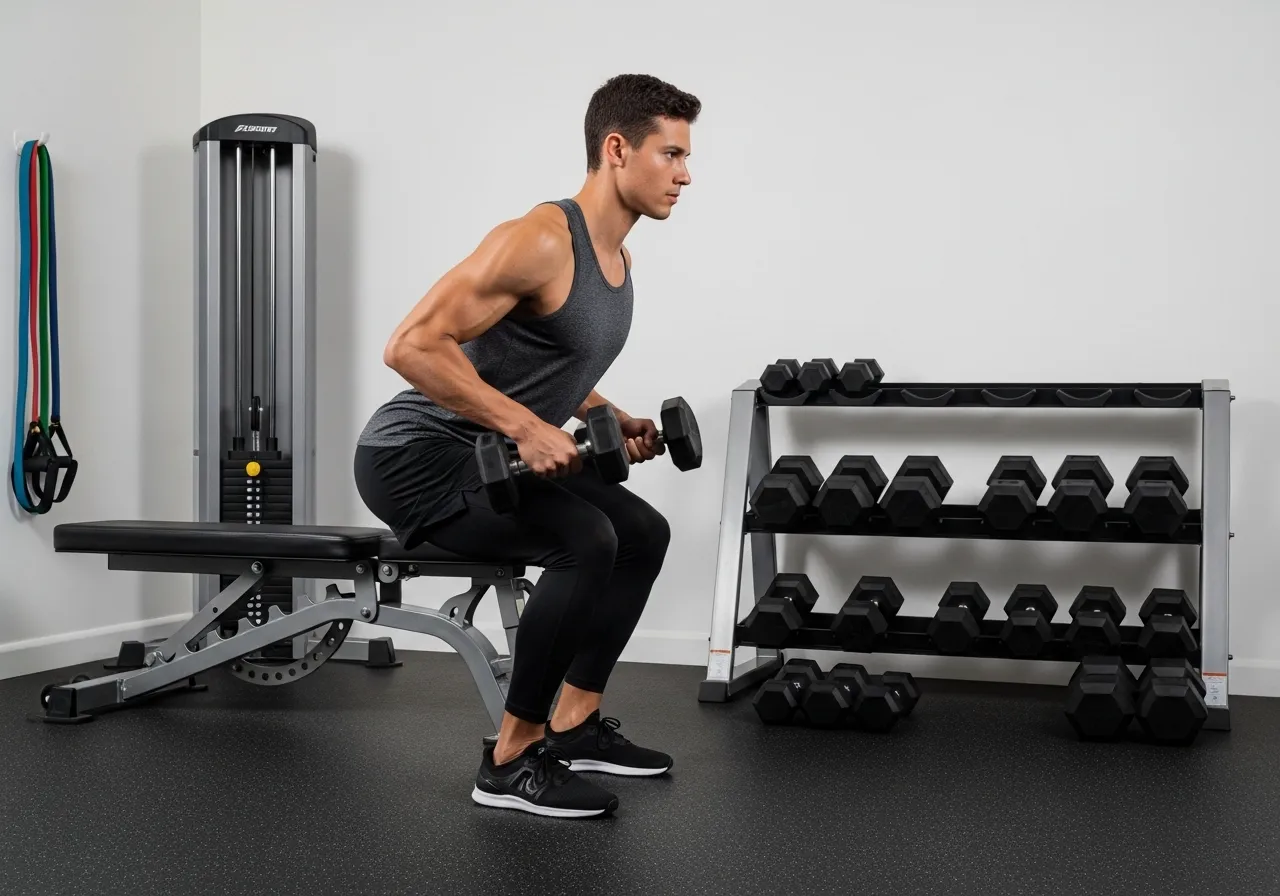
The complete 20-minute resistance training session for time-constrained athletes: warm-up (3 minutes — 20 jumping jacks, 10 arm circles each direction, 10 hip circles, 5 slow deep squats); main circuit — goblet squat or bodyweight squat (12 reps), push-up (10 reps), dumbbell or bodyweight Romanian deadlift (12 reps), dumbbell row or TRX row (10 per side), plank (30 seconds). Perform 3 rounds with 30 seconds rest between exercises and 60 seconds rest between rounds. Total time: 18–22 minutes. This session trains all major muscle groups with sufficient volume for strength maintenance and modest development, produces cardiovascular demand through the circuit format, and requires minimal equipment (a pair of dumbbells and a floor are sufficient). The 20-minute resistance workout is not optimal — a 45-minute session with more volume and exercise variety would produce better results — but it is significantly better than the zero minutes that time pressure otherwise produces, and it provides the minimum effective stimulus for strength maintenance that busy periods require.
Workout Stacking: Combining Exercise with Existing Commitments
Workout stacking — combining exercise with activities that already occur in the daily schedule — is the most creative approach to fitting exercise into a genuinely full day. The most effective workout stacking strategies: walking meetings (replacing seated conference room meetings with walking conversations — studies find that walking meetings improve creative thinking by 81% and produce ideas of higher quality than seated meetings, making them not just exercise opportunities but productivity improvements); podcast and audio book walks (replacing stationary podcast listening with walking listening, converting passive audio consumption into moderate exercise without any additional time); watching television while performing bodyweight exercises or using a stationary bike (converting passive evening entertainment into active recovery exercise); and performing resistance exercises (wall sit, calf raises, push-ups against desk) during phone calls that do not require computer use. These stacking strategies require no additional time allocation — the exercise occurs within the time already committed to the parallel activity, making them the purest form of exercise efficiency available.
Nutrition Strategies for Busy Athletes: Fueling Short Workouts Efficiently
Busy people training in short sessions face a specific nutritional challenge: the pre-workout meal and post-workout recovery nutrition that optimal performance and adaptation require must fit into the same compressed schedule that the workout itself must navigate. The busy athlete’s nutritional shortcuts: pre-workout nutrition for sessions under 45 minutes is optional for those who ate within 3 hours — skipping the pre-workout snack eliminates both the time investment and the gastrointestinal management that pre-workout eating requires, without meaningfully impairing short session performance for fed athletes. Post-workout nutrition priority for busy athletes: protein within 60 minutes of training is the non-negotiable recovery investment — a Greek yogurt at the desk, a protein shake prepared in advance and consumed during the post-workout shower, or a high-protein lunch prepared the previous evening and requiring only refrigerator retrieval after training. The 2-minute post-workout nutritional habit — a protein shake or high-protein snack immediately after the session — produces 80% of the recovery nutrition benefit in 5% of the meal preparation time that a complete recovery meal requires, making it the most time-efficient recovery nutrition strategy available to athletes whose schedule does not allow post-workout meal preparation.
Resistance Band Training: The Busy Person’s Portable Gym
Resistance bands deserve specific attention as the most underutilized training tool for busy schedules — providing genuine resistance training stimulus in a package that fits in a coat pocket, requires no gym, and can be used anywhere from a hotel room to an office to a living room floor. A set of resistance bands ($15–30) covering light, medium, and heavy resistance allows training of every major muscle group through the fundamental movement patterns: squats and deadlifts with band resistance (lower body); push-ups with band across the back for added resistance and band pull-aparts for rear deltoid training (upper body push and pull); and pallof press and rotational movements for core anti-rotation training. The resistance band workout for a 20-minute busy schedule session: banded squat (15 reps), band pull-apart (15 reps), banded Romanian deadlift (12 reps), banded push-up (max reps), resistance band row (12 per side), and pallof press (10 per side). Perform 3 rounds with 45 seconds rest between exercises. The total equipment cost of a portable training system that makes gym-quality resistance training available in any location, at any time, without requiring travel or preparation beyond opening a bag — representing the best fitness return per dollar available to the time-constrained athlete.
The band pays for itself in the first week of consistent use.

4. Tip 5: Building the Sustainable Habits That Outlast Motivation
The first four tips address the practical logistics of exercising with a busy schedule. Tip 5 addresses the deeper challenge — building the behavioral systems that make exercise automatic rather than effortful, so that the busy schedule’s inevitable variation does not repeatedly derail the exercise routine that inconsistent motivation cannot sustain.
The Science of Habit Formation Applied to Exercise
Habits — behaviors that become automatic through repetition in consistent contexts — are the behavioral foundation that exercise consistency requires. Motivation is variable and unreliable: it peaks when starting a new program, fluctuates with life stress and competing demands, and reliably fails to appear on the days when the schedule is most challenging and the workout is most needed. Habit is consistent by design: the habitual exerciser does not decide whether to exercise each day the way the motivated exerciser does — they perform the trigger-behavior-reward sequence that their exercise habit comprises with the same automaticity that tooth brushing occurs. The habit formation process for exercise: identify the existing routine that will serve as the habit trigger (morning alarm, office lunch break start, returning home from work); attach the exercise behavior to this trigger through deliberate practice for 21–66 days (the range that habit formation research supports for behavioral automation); and establish a post-exercise reward that reinforces the behavior (a specific enjoyable breakfast, a preferred post-workout beverage, the permission to watch a specific show). From British Journal of Sports Medicine behavioral exercise research, exercise habits that are successfully automated through consistent trigger-behavior-reward sequences are maintained through lifestyle disruptions (travel, illness, work demands) that motivation-dependent exercise routines cannot survive — the habit persists because it is not dependent on the motivational state that life circumstances reliably disrupt.
Reducing Friction: The Environmental Design of Exercise Habits
Behavioral research consistently finds that the effort required to begin a behavior is the primary determinant of whether that behavior occurs — small increases in friction (having to find gym clothes, pack a bag, drive to a location) produce disproportionately large decreases in behavior frequency. The environmental design of exercise habits removes friction from the exercise decision and path to training, making exercise the path of least resistance rather than a deliberate effortful choice. The friction reduction strategies for busy exercisers: sleep in workout clothes on days with morning exercise planned (eliminating the friction of getting dressed at 5:30 AM); keep gym bag packed and ready at the door before sleeping (eliminating packing time and the excuse of unpreparedness); place running shoes at the front door as a visual trigger and obstacle to leaving without exercising; install a pull-up bar in a doorframe that is used multiple times daily (creating the opportunity for brief resistance training without any preparation); and use a home workout program for the days when gym travel is impossible (eliminating gym access as a barrier for high-demand schedule days). Each friction reduction makes the habit easier to perform and harder to rationalize skipping — producing the environment that supports exercise regardless of motivational state.
Accountability Systems That Work for Busy People
Social accountability — the behavioral mechanism through which commitment to other people produces follow-through that self-commitment alone does not — is among the most powerful behavioral tools for exercise consistency in busy people. The accountability formats that work best for busy schedules: a training partner with a similar time-constrained schedule who shares the early morning or lunch workout commitment (mutual accountability without additional time requirement); a fitness app that tracks streaks and sends completion notifications (digital accountability that requires no scheduling coordination); a personal trainer for 2–4 sessions per month (scheduled appointments with financial commitment that prioritizes the sessions the way doctor appointments are prioritized); or a group fitness class with advance registration (the social and financial commitment of a reserved spot that requires active cancellation to skip). The accountability system that is most likely to be maintained is the one with the lowest additional time requirement and the highest commitment mechanism — for most busy people, the pre-scheduled training partner or advance-registered class provides sufficient accountability with minimal additional time investment.
The Two-Minute Rule: Starting When Starting Is Hard
The hardest part of any workout for a tired, busy person is starting — the transition from rest to movement that the body and mind resist when energy is low and competing demands are high. The two-minute rule — committing only to the first two minutes of the planned workout — is the behavioral technique that eliminates the starting resistance by reducing the commitment to a manageable threshold. The implementation: when the planned workout feels impossible due to fatigue or time pressure, commit only to starting — putting on workout clothes, stepping onto the mat, and beginning the warm-up with the explicit permission to stop after two minutes if the motivation or energy is genuinely absent. In practice, the two-minute rule almost never ends at two minutes: the act of starting triggers the physiological and neurological responses (increased blood flow, endorphin release, cognitive activation) that make continuing the workout feel natural rather than effortful. The rare genuine two-minute stop — when the body is genuinely too fatigued or the schedule too compressed for more — is still a successful execution of the habit trigger rather than a complete skip, maintaining the behavioral consistency that habit formation requires even when the full workout is impossible.
Recovery, Sleep, and the Sustainability of High-Frequency Training
Busy people who successfully integrate exercise into demanding schedules often discover a paradox: the increased time investment in training requires corresponding investment in recovery to prevent the accumulated fatigue that ultimately impairs both training and work performance. The minimum recovery requirements for sustainable high-frequency training: 7–9 hours of sleep per night (exercise increases the restorative growth hormone secretion that sleep provides, making the combination of training and insufficient sleep particularly counterproductive — the exercise-induced muscle damage goes unrepaired and the hormonal environment that training adaptation requires is suppressed); adequate protein intake (1.4–1.8g per kg of body weight) to support the muscle repair that resistance training requires; and at least one full rest day per week to allow the neuromuscular recovery that prevents the overuse injuries that high-frequency training without adequate recovery produces. The busy person who adds exercise without adjusting sleep and nutrition often experiences the fatigue and performance decline that unsupported training accumulates — mistakenly attributing the decline to the exercise itself rather than the insufficient recovery that the lifestyle provides for it. Protect sleep above all other recovery variables — no training plan produces positive outcomes when the sleep that makes adaptation possible is chronically insufficient.
Technology Tools That Support Busy Schedule Training
Technology has dramatically expanded the exercise options available to busy people — eliminating the gym-access requirement that previously constrained exercise to specific locations and times. The most useful technology tools for busy schedule training: fitness apps with guided short workouts (Nike Training Club, Apple Fitness+, and similar platforms offer thousands of 10–30 minute guided sessions that require no equipment and no gym, allowing immediate workout initiation anywhere); smartwatch activity prompts (hourly movement reminders that promote the incidental activity accumulation that sedentary office work otherwise prevents); calorie and activity tracking apps (providing the real-time feedback on daily activity that reveals when additional movement is needed to meet daily targets); and online coaching platforms that provide personalized short workout programming and accountability check-ins for busy athletes who benefit from professional guidance without in-person session scheduling. These technology tools eliminate the two most common busy-schedule exercise barriers — not knowing what to do in a short session, and lacking the accountability structure that gym visits provide — making them particularly valuable for athletes building a new exercise habit in a busy lifestyle context.
Partner and Family Exercise: Combining Social Time with Training Time
For busy parents and professionals whose social commitments compete with exercise time, combining exercise with family and social activities eliminates the either-or tension that makes exercise feel like it comes at the cost of relationships. The family exercise strategies that work for busy parents: weekend hiking or cycling with children (providing genuine cardiovascular exercise for adults at a pace manageable for children); backyard or park-based family games with high movement content (tag, soccer, frisbee, and similar activities producing moderate exercise without the structured workout format that children resist); and morning walks or runs with a partner that convert relationship time into exercise time simultaneously. The social exercise approach: replacing one weekly social coffee or lunch with a walking conversation produces 30–60 minutes of exercise without reducing the social connection that the original meeting provided. These combined approaches do not solve the time scarcity problem by finding additional hours — they solve it by making exercise and the social connections that busy people also struggle to maintain compatible rather than competing demands on the same limited time.

5. Sample Weekly Workout Plans for Busy People and FAQs
The five tips need to be assembled into complete weekly workout plans that a busy person can implement immediately — plans for different time availabilities and equipment access levels that provide the structure that turns strategy into action.
The 3-Day Minimal Time Workout Plan (45 Minutes Per Week)
For the busiest schedules — parents with young children, executives during high-demand periods, students in exam periods — the 45-minutes-per-week plan provides the minimum effective exercise dose that research supports for health and basic fitness maintenance. Monday (15 minutes, bodyweight): 5 min warm-up, then 2 rounds of: push-ups (max reps), squat jumps (20), mountain climbers (30 seconds), plank (30 seconds). Wednesday (15 minutes, HIIT): 5 min warm-up, 8 rounds of 20 seconds maximum effort (burpees or sprinting in place) and 40 seconds recovery. Friday (15 minutes, strength): 5 min warm-up, then 2 rounds of: goblet squat or squat (15 reps), push-up (max reps), glute bridge (15 reps), dumbbell row or band row (12 per side). This plan requires zero gym access, 15 minutes three times per week, and produces meaningful cardiovascular conditioning, strength maintenance, and metabolic health benefits — the non-negotiable minimum that no schedule should be too busy to accommodate.
The 4-Day Intermediate Plan (60–80 Minutes Per Week)
For schedules that allow slightly more training time but still require efficiency, the 4-day plan adds a second resistance session and extends the HIIT session for improved results. Monday (20 min strength — lower body): goblet squat 3×10, Romanian deadlift 3×10, step-up 3×10 per leg, glute bridge 3×15. Tuesday (20 min HIIT cardio): 5 min warm-up, 10 rounds of 30 seconds maximum effort and 30 seconds recovery, 5 min cool-down. Thursday (20 min strength — upper body): push-up 3×max, dumbbell row 3×10 per side, overhead press 3×10, face pull or band pull-apart 3×15. Saturday (20 min full body circuit): all major movement patterns in circuit format, 3 rounds, 40 seconds per exercise. This plan provides adequate training stimulus for meaningful strength development and cardiovascular fitness improvement — suitable as a long-term maintenance plan or a minimum viable plan during high-demand life periods. From ACSM exercise programming guidelines, 4 days per week of training at this intensity and volume produces significant improvements in both strength and cardiovascular fitness for previously sedentary or minimally active adults, confirming that the 4-day plan is not merely a compromise but a genuinely effective training approach for the time constraints it accommodates.
Frequently Asked Questions About Working Out with a Busy Schedule
Is 20 minutes of exercise really enough to make a difference? Yes — research consistently demonstrates that 20 minutes of moderate-to-high intensity exercise produces meaningful health and fitness benefits, particularly for previously sedentary individuals. The dose-response relationship is steepest at the low end: moving from zero to 20 minutes of daily exercise produces the greatest health improvement per minute of exercise investment. What is the single best exercise for someone with only 10 minutes? If only 10 minutes is available, 10 minutes of high-intensity bodyweight exercise (burpees, jump squats, mountain climbers) at near-maximum effort produces more cardiovascular and metabolic benefit than any moderate-intensity activity in the same duration. Alternatively, a brisk 10-minute walk after a meal is the most accessible option for those who cannot perform high-intensity exercise. How do I stop skipping workouts when I’m tired after work? Switch to morning workouts — evening workout skipping is predominantly caused by the fatigue and competing demands that accumulate across the workday and reliably derail evening exercise intentions. Morning exercise occurs before these demands materialize. If morning training is impossible, keep a gym bag at work and exercise before going home — once at home, workout completion rates drop dramatically. Can I split my workout into multiple short sessions across the day? Yes — accumulated exercise across multiple short bouts produces health benefits equivalent to the same duration in a single continuous session. Three 10-minute sessions produce the same cardiovascular benefit as one 30-minute session. How do I maintain fitness while traveling for work? Hotel room bodyweight workouts (push-ups, squats, lunges, planks, mountain climbers) require no equipment and no gym access. A resistance band in the luggage extends the exercise variety available in any hotel room. Most hotels have a gym; scheduling the workout as the first morning activity before the day’s work begins ensures it occurs despite the schedule variability that travel produces. What if my schedule changes week to week? Maintain a flexible minimum commitment (at least 2 sessions per week, no matter what) and a target of 3–4 sessions in normal weeks. The flexible minimum prevents the complete exercise abandonment that rigid weekly plans produce when the schedule inevitably changes.
Making Exercise Non-Negotiable: The Long-Term Perspective
The busy schedule that makes exercise feel impossible is almost certainly permanent — the demands of career, family, and adult life do not reliably diminish over time, and waiting for the schedule to clear before committing to exercise is the strategy most likely to result in never exercising consistently. The athletes who maintain fitness through decades of demanding careers and family life are not those with better schedules — they are those who decided that exercise was a permanent, non-negotiable component of life and built the systems (scheduling, habit design, accountability, and efficient workout formats) that make it happen regardless of what each week brings. The 5 tips in this article are not temporary measures for a temporarily busy period — they are the permanent operational framework for exercising as an adult with adult responsibilities. Implement them not as a 30-day challenge but as the permanent approach to fitness that your schedule actually requires. The consistent, sustainable exercise that these strategies enable produces more health benefit, more athletic development, and more quality of life improvement than the perfect training program that gets abandoned every time life gets complicated. Be the person who exercises imperfectly but consistently — for the rest of your life — rather than the person who exercises perfectly for three weeks before disappearing until the next new year’s resolution arrives.
When Life Gets Overwhelming: Minimum Viable Exercise for Crisis Periods
Every busy person will experience periods when even the minimal training plans above are impossible — new parenthood, project deadlines, illness, family emergencies, or travel schedules that eliminate every workout opportunity. Having a pre-defined minimum viable exercise protocol for these crisis periods prevents the complete training abandonment that often follows disruptions. The minimum viable protocol: 10 push-ups, 10 squats, and a 5-minute walk every day — a commitment so small that it can be completed in any circumstances, but one that maintains the exercise identity and habit trigger that a return to normal training depends on. The crisis period minimum is not a workout — it is a habit preservation strategy that keeps the behavioral pattern alive through the disruption, making resumption of normal training feel like continuation rather than restart. Athletes who maintain even minimal exercise during disruptions resume full training significantly faster than those who stop completely — the habit, once established, is easier to scale up from minimal than to rebuild from zero. Define your personal crisis minimum before the crisis arrives, commit to it regardless of circumstances, and protect the exercise identity through every challenge the schedule presents.
Measuring Progress When Training Time Is Limited
Tracking progress provides the evidence that limited training is working — and the motivational reinforcement that sustains the habit when results seem slow. The progress metrics most meaningful for time-constrained athletes: strength improvements (can you do more push-ups, squat more weight, or hold a plank longer than you could four weeks ago?); resting heart rate trend (improving cardiovascular fitness reduces resting heart rate measurably over 4–8 weeks of consistent training); energy and wellbeing ratings (self-reported energy levels, mood, and sleep quality consistently improve within 2–4 weeks of regular exercise — evidence of benefit that appears before physical appearance changes); and body composition measurements (tape measure and mirror assessments that reflect the fat loss and muscle maintenance that even limited training produces). Track at least one of these metrics weekly — the evidence of progress sustains motivation through the periods when the mirror shows no obvious change and the schedule feels too full for adequate training. Progress is occurring; the right measurement reveals it.
The Long Game: Exercise as a Career-Long Investment
The busy professional who successfully integrates exercise into their demanding schedule is not merely maintaining health in the present — they are making an investment in the sustained performance, cognitive capacity, and physical resilience that a demanding career across decades requires. Longitudinal research on exercise and aging consistently finds that the adults who maintain regular physical activity through their 40s and 50s demonstrate better cognitive function, lower rates of chronic disease, and higher functional capacity in their 60s and 70s than those who were inactive during their peak career years. The professional who exercises consistently through their busiest career decades arrives at the later stages of professional and personal life with the energy, health, and functional capacity that their sedentary counterparts lack — able to pursue the activities, travel, and relationships that accumulated wealth and experience make possible. The time invested in exercise during the busy middle decades is not stolen from career and family success — it is the physical infrastructure that makes the full enjoyment of that success possible for the decades that follow. Think of exercise not as a current sacrifice but as a future investment: every session completed today is buying the physical capacity and health that the future you will depend on. The 25 minutes that the morning workout requires is the most valuable 25-minute investment available to any professional who intends to remain productive, healthy, and physically capable through decades of demanding work and fulfilling life. Begin today. Schedule it. Protect it. Make it the permanent, non-negotiable commitment that your future health requires.