5 Things You Should Never Do at the Gym

1. Why Gym Etiquette Matters More Than You Think
Gym etiquette — the unwritten code of behavior that makes shared training spaces function for everyone — is one of the most underappreciated aspects of the fitness experience. The gym behaviors that frustrate, endanger, or disrespect other members are not minor social infractions — they have direct consequences for training quality, safety, and the psychological environment that motivation and consistency depend on. I have trained in dozens of gyms across different countries and fitness cultures, and the correlation between the etiquette culture of a gym and the quality of training environment it provides is striking: gyms where members consistently demonstrate respect for the space and each other are better organized, safer, and more motivating than those where individual convenience takes precedence over shared norms. This article addresses the five most impactful gym behavior mistakes — the ones with the greatest consequences for the people making them and for those training around them — alongside the practical alternatives that make the gym a better experience for everyone.
The Real Cost of Poor Gym Etiquette
Poor gym etiquette has costs that extend beyond the social discomfort of mildly inconsiderate behavior — it produces measurable impacts on training effectiveness, safety, and the membership environment that gyms depend on for sustainable operation. Training effectiveness consequences: hoarding equipment (keeping multiple dumbbells, barbells, or machines occupied while alternating between exercises) forces other members to wait, interrupt their rest periods, or substitute less effective exercises — directly impairing the training quality of those affected. Safety consequences: not re-racking weights creates trip hazards; improperly secured barbell collars risk catastrophic plate drops; unsupported advice to inexperienced lifters produces technique errors that injury follows. Membership environment consequences: gyms that tolerate consistent poor etiquette lose members who will train elsewhere for a better experience — the revenue and community damage that poor etiquette culture produces is a genuine business and community problem beyond individual social friction. From a personal experience perspective, the motivation and training quality effects of a well-managed, respectful gym environment are real and measurable: training in an environment where equipment is available, other members are helpful, and the physical space is organized and clean produces consistently better workouts than the equivalent training in a disorganized, inconsiderate environment.
Understanding Why People Develop Bad Gym Habits
Understanding the origins of common gym etiquette failures — rather than simply condemning them — provides the perspective that produces genuine behavioral change rather than resentful compliance. The most common gym etiquette violations develop through specific identifiable pathways: ignorance (many gym members, particularly newer ones, genuinely do not know the norms — they did not receive an orientation, did not observe the behavior being modeled, and were not told that their behavior was problematic); convenience bias (the natural human tendency to optimize for personal convenience without fully accounting for the impact on others — leaving weights unre-racked saves 90 seconds at a cost distributed across every member who uses that area after them); and permission through observation (members who see others violating norms without consequence conclude that the behavior is acceptable — the normalization of poor behavior creates a race to the lowest common standard). These pathways suggest that the solutions involve education (clear communication of norms), environment design (making the correct behavior the easy behavior through signage, equipment placement, and staff modeling), and consistent norm enforcement through gentle social correction rather than the shame and confrontation that produce resentment without behavioral change. From British Journal of Sports Medicine training environment research, the social and environmental norms of exercise spaces significantly influence individual training behaviors — members are more likely to follow etiquette norms in gyms where those norms are visibly modeled, clearly communicated, and consistently reinforced by staff and experienced members.
The Gym as a Shared Community Space
Conceptualizing the gym as a shared community space — not merely a personal training facility that other people happen to use simultaneously — is the fundamental mindset shift that underlies genuine, durable gym etiquette. The community space framework: every piece of equipment is shared property that each user has an equal claim to; the cleanliness and organization of the gym belongs to everyone who uses it; and the experience of every member training at the same time is influenced by the choices of every other member. This interdependence is not a constraint on individual training freedom but a recognition of the conditions that make the shared training environment valuable for everyone, including oneself. The member who monopolizes equipment impairs their own training environment by contributing to the overcrowding and equipment unavailability that frustrate them on the days when others do the same; the member who wipes equipment after use benefits from the gym culture where others do likewise; the member who provides appropriate encouragement contributes to the motivating atmosphere that their own training benefits from. Gym etiquette is not altruism at personal cost — it is the reciprocal investment in a shared environment that benefits everyone who contributes to it, including the contributor.
Gym Etiquette Across Different Training Environments
Gym etiquette norms vary meaningfully across different types of training facilities — the expectations in a commercial gym differ from those in a CrossFit box, a powerlifting gym, or a boutique fitness studio, and understanding these environment-specific norms prevents the violations that occur when members bring assumptions from one environment into another. Commercial gym etiquette (large franchise gyms): the broadest and most diverse membership creates the most need for explicit, consistent courtesy norms — the commercial gym serves everyone from beginners to advanced athletes across age ranges and fitness backgrounds, and the etiquette that serves this diversity prioritizes consideration over performance culture. Powerlifting and strength gym etiquette: chalk is expected, deadlift dropping is often permitted, and the performance culture is more tolerant of training-specific sounds and intensity — but the equipment respect and community reciprocity that serve every gym apply equally here. CrossFit and functional fitness box etiquette: the community-focused culture of most CrossFit boxes creates strong social norms around cleaning up (putting away every piece of equipment after every class is typically a mandatory expectation, not a courtesy), cheering for others, and the accountability of recording scores honestly. Boutique fitness studios: the class-based format creates clear instructor-member relationship expectations — arriving on time, following instructor cues, and maintaining the energy of the class for other participants are the primary etiquette considerations. Home gym etiquette (for those who train in shared building gyms): the smaller membership and more intimate environment amplifies the impact of every etiquette choice — the one person who never wipes down equipment in a 20-member apartment building gym has a far larger proportional impact than the same person in a 2,000-member commercial gym.
The Role of Gym Staff in Etiquette Enforcement
Gym staff — front desk personnel, floor trainers, and management — play the critical institutional role in establishing and enforcing the etiquette standards that member self-regulation alone cannot fully maintain. The most effective gym etiquette cultures are those where staff actively model, encourage, and enforce the courtesy norms that management has established: greeting members by name, demonstrating equipment return and cleaning habits visibly, and addressing violations with the professional directness that member-to-member enforcement lacks authority to employ. The member’s relationship with gym staff in etiquette matters: report significant violations (safety hazards, harassment, repeated equipment hoarding during peak hours) to staff rather than attempting personal resolution — staff have the institutional backing and the conflict resolution tools that individual members lack. Compliment staff and management when the gym’s etiquette culture is excellent — the positive feedback that reinforces the standards that management invests in maintaining is as valuable as the complaint reports that identify standards failures. From Journal of Physical Activity and Health exercise environment research, the quality of the exercise environment — including social norms, cleanliness, and staff-member relationships — is one of the strongest predictors of member retention and exercise adherence, with well-managed facilities demonstrating significantly higher training consistency among members than facilities with poor etiquette cultures.
How Gym Culture Has Evolved: From Intimidating to Inclusive
The gym culture of the 1970s and 1980s — epitomized by the hardcore bodybuilding gym environment immortalized in film and fitness media — was deliberately intimidating, exclusively performance-focused, and deeply unwelcoming to beginners, women, and anyone outside the narrow demographic of competitive bodybuilders and powerlifters. The transformation of gym culture over the past three decades toward inclusivity, diverse membership, and beginner friendliness is the direct result of the etiquette evolution that expanding membership diversity required. The commercial gym’s business model required welcoming the full population — not just competitive athletes — and the etiquette standards that this broader membership required were fundamentally different from the hardcore gym’s “earn your place” mentality. The inclusivity of modern gym culture is not weakness or dilution of athletic standards — it is the recognition that fitness serves everyone, that everyone’s fitness journey is valid regardless of starting point, and that the gym environment should support the full range of human physical development rather than celebrating only the already-advanced. The etiquette standards in this article reflect this inclusive vision: a gym where the beginner on their first week is treated with the same respect as the competitive powerlifter, where the older adult learning to move safely is as welcome as the collegiate athlete, and where every person who walks through the door has access to the clean, available, considerate training environment that their fitness journey deserves.
Together.
2. The 5 Things You Should Never Do at the Gym (and What to Do Instead)
The five behaviors below are the most impactful gym etiquette violations — those with the greatest consequences for training quality, safety, and the shared environment. Each is followed by the simple alternative that addresses the same underlying need without the cost to others.
Never Do #1: Hoard Equipment
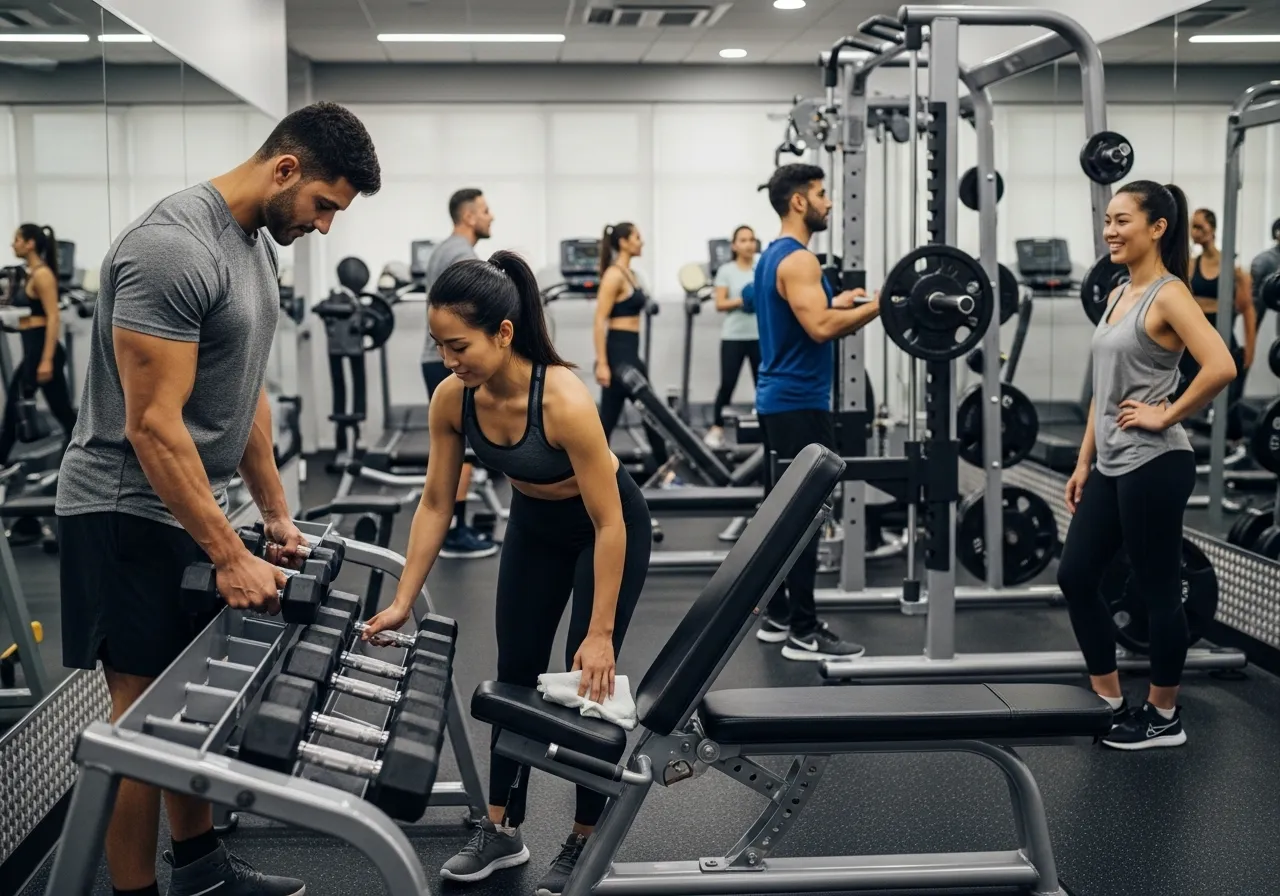
Equipment hoarding — occupying multiple pieces of equipment simultaneously (four dumbbells spread across a bench, a barbell loaded and untouched for 10 minutes while performing other exercises, or a machine “reserved” with a towel or water bottle while the member is elsewhere) — is the gym behavior with the most direct and widespread impact on other members’ training quality. In busy commercial gyms where equipment availability limits training, hoarding a bench and two sets of dumbbells for 40 minutes prevents other members from using any of those items for the duration, effectively blocking 3 equipment resources simultaneously for personal convenience. What to do instead: plan supersets and circuits around equipment in the same physical area that does not require claiming multiple distant items; ask nearby members if they need specific equipment before setting up at multiple stations; return dumbbells to the rack between sets if others are waiting rather than leaving them on the floor at your feet; and if a machine or bench is occupied and the gym is busy, wait or use an alternative exercise rather than “reserving” another space. The legitimate exception: many gyms explicitly allow or encourage superset training during off-peak hours — the appropriateness of using multiple pieces of equipment simultaneously depends on the gym’s density at that time. During peak hours when equipment is genuinely scarce, the community impact of multi-equipment use is high; during off-peak hours when equipment is abundant, the same behavior has minimal impact.
Never Do #2: Fail to Re-Rack Weights
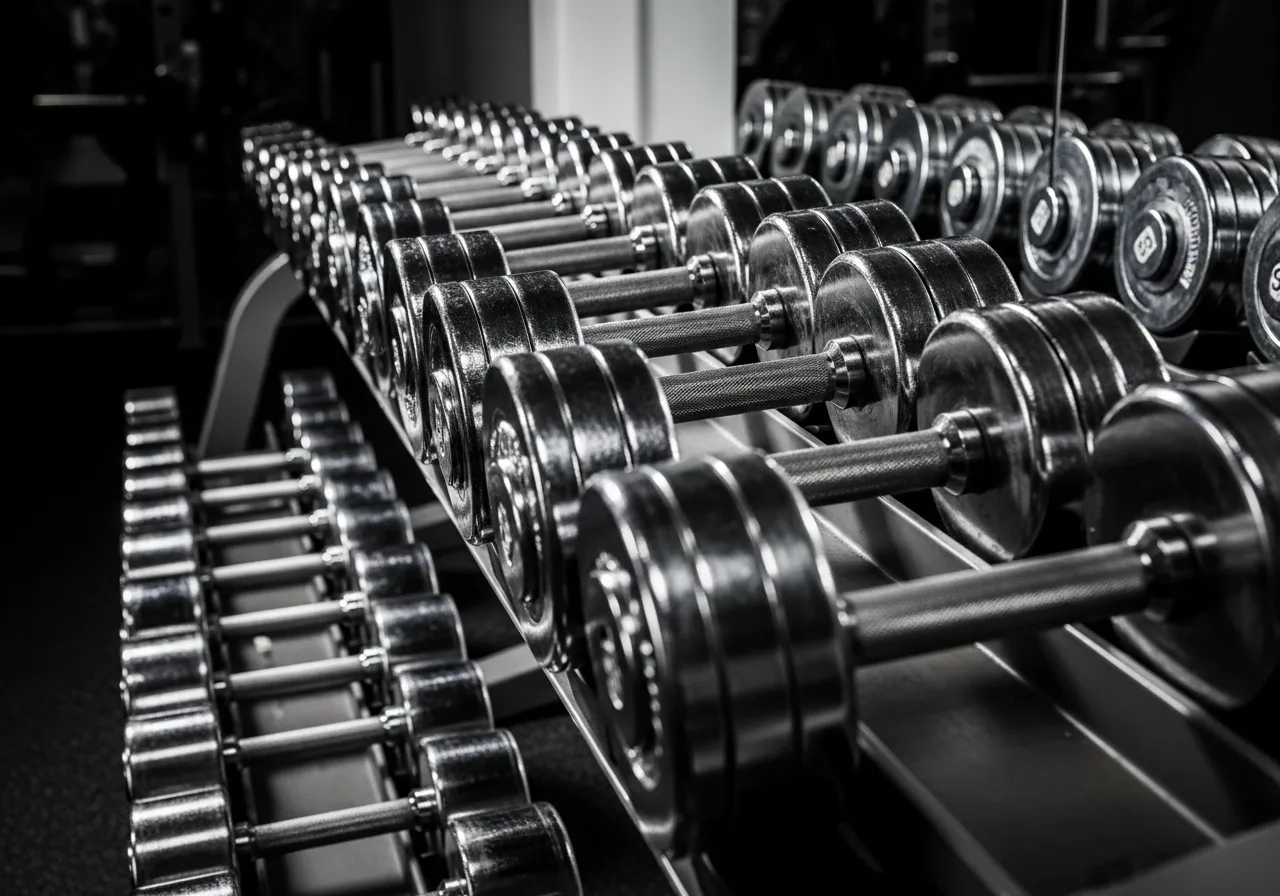
Leaving weights on barbells, on the floor beside equipment, or elsewhere than the designated storage is the most universally cited gym etiquette violation — and for good reason. Unreturned weights create multiple distinct problems: physical hazards (plates left on the floor are trip risks; barbells left loaded at one end tip hazardously when the unloaded end is lifted); equipment unavailability (other members cannot use a bench press with 140kg loaded on it if they need 60kg, and must strip the bar before using it — adding both time and frustration to their workout); and environmental degradation (the accumulation of unreturned weights across the gym creates the disorganized, demotivating environment that members find in gyms where re-racking is not enforced). What to do instead: re-rack every weight every time — dumbbells to their designated rack position (lowest to highest, in ascending order as designed), barbell plates to the plate trees or racks in correct size order, cable machines returned to their starting positions. The time investment is 30–60 seconds per exercise station; the community benefit is experienced by every member who uses that space for the remainder of the day. From NSCA gym safety guidelines, unreturned weights are among the most common causes of gym floor accidents, with plate falls, ankle rolls over floor-placed dumbbells, and unbalanced barbell tips producing injuries that adequate equipment storage would have prevented.
Never Do #3: Offer Unsolicited Training Advice
Unsolicited coaching — approaching another member who has not requested feedback to offer technique corrections, program suggestions, or exercise recommendations — is one of the most commonly resented gym behaviors, particularly when directed from men toward women or from experienced-appearing members toward beginners. The intentions behind unsolicited advice are often genuinely good: the experienced lifter who notices a potentially injurious technique error and wants to help. But the impact is frequently the opposite of helpful — interrupted focus during a set, unwanted assessment by a stranger, and the implication that the member’s current approach is inadequate. What to do instead: if you observe a technique error that appears to create imminent injury risk (a spinal flexion deadlift with very heavy weight, a bench press with no spotter and dangerously loaded bar), a brief, specific offer is appropriate — “I noticed your back might be rounding on those — would you like a quick tip?” — that gives the member the choice rather than imposing the advice. For everything below genuine injury risk: resist the impulse, focus on your own training, and let the other member train as they choose. If the member asks for advice — an explicit, direct question — provide it helpfully and specifically. Advice given in response to a genuine request is received completely differently from unsolicited coaching, and the distinction makes all the difference to the member’s experience.
Never Do #4: Use Your Phone in Ways That Affect Others
Phone use at the gym exists on a spectrum from minimally impactful (checking a workout app between sets) to genuinely problematic (occupying a bench or machine while conducting a lengthy call, filming content that captures other members without consent, or having speakerphone conversations that fill the training area with one-sided audio). The most impactful phone etiquette violations: occupying equipment for extended periods while distracted by non-training phone use; filming others without consent (a privacy violation with potential legal implications in many jurisdictions); loud phone calls on speakerphone or headphoneless that intrude on the concentration of surrounding members; and the passive equipment occupation that the combination of phone use and rest periods between sets can produce — sitting on a machine bench actively using a phone for 5–10 minutes between sets while others wait. What to do instead: designate phone use to between-set rest periods and step away from occupied equipment when conducting anything beyond brief exercise app use; use headphones or earbuds for all audio content; get explicit verbal consent before filming any content that includes other members; and set a phone use policy for yourself during workouts (e.g., phone only during rest periods of explicitly limited duration, not during active exercise sets or while occupying equipment others may need).
Never Do #5: Ignore Hygiene and Equipment Cleaning
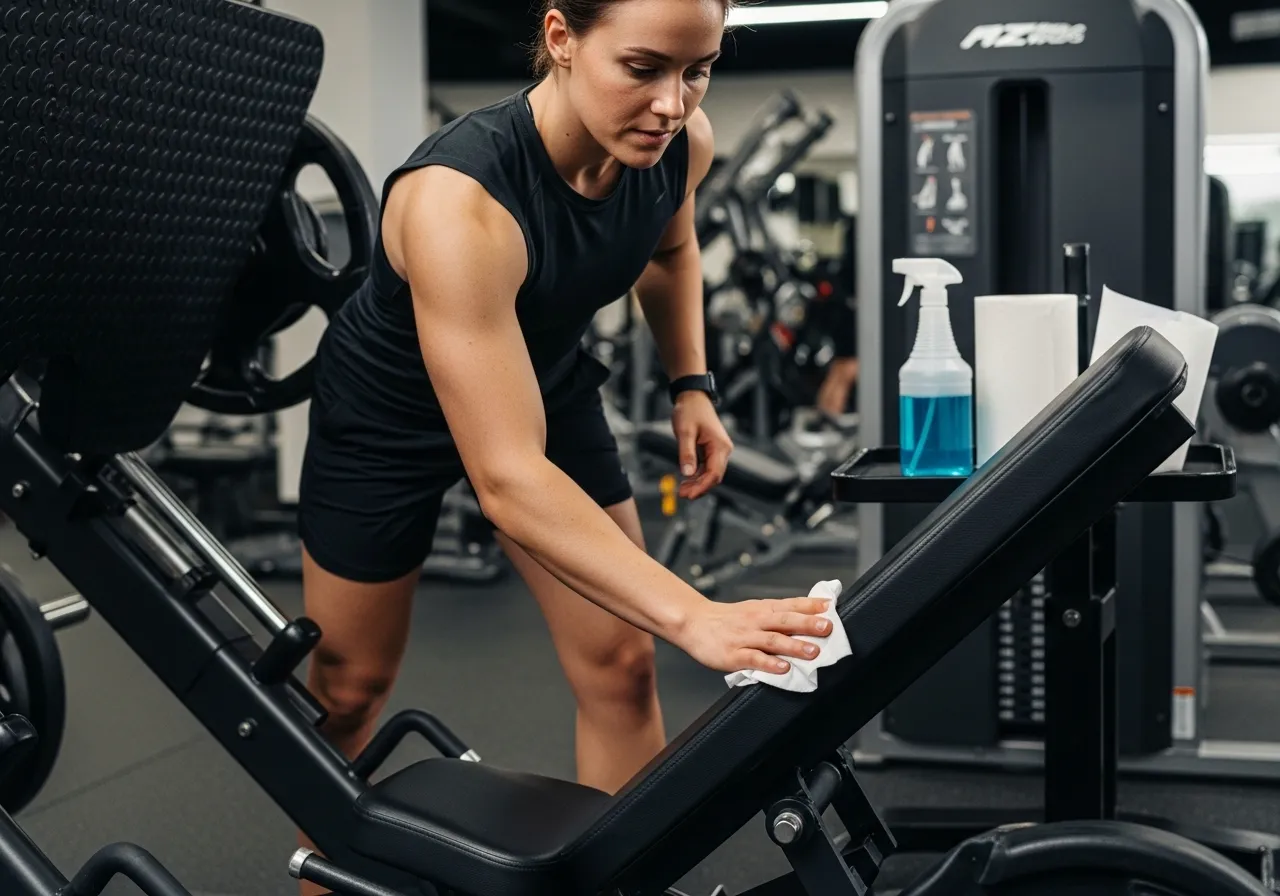
Gym hygiene — personal hygiene, equipment cleaning after use, and the overall cleanliness practices that shared training environments require — affects every member who uses the space and reflects directly on the member’s respect for the community. The hygiene violations with greatest community impact: training with strong body odor in a shared space (particularly problematic in enclosed gym areas); failing to wipe equipment after use (sweat on benches, machines, and mat surfaces); re-using gym towels without washing (the common gym bacteria that inadequate hygiene practices spread produce genuine health risks for members with compromised immune systems); and leaving food, protein shake residue, or other personal items on equipment or in the training area. What to do instead: arrive at the gym with clean training attire and appropriate personal hygiene; carry and consistently use a personal training towel for both body sweat and equipment surfaces; use the gym-provided cleaning spray and paper towels that most facilities provide to wipe all contact surfaces after use; and remove all personal items from the training area promptly after completing each exercise. From JSCR training environment research, the hygiene and cleanliness culture of fitness facilities significantly influences member retention and satisfaction — the members who contribute to a clean, well-maintained training environment are investing in the facility quality that benefits their own training experience as much as those around them.
Phone and Technology Use: The Modern Gym Etiquette Challenge
Smartphone use in gyms is the most common contemporary source of etiquette friction — the device that provides workout music, training app guidance, and video demonstrations also produces the equipment monopolization and social disconnection that traditional gym etiquette did not anticipate. The balanced technology use approach: use your phone for training-specific purposes (music, timers, exercise videos) while keeping non-training screen time to rest periods and off the equipment. Download workout programs, playlists, and reference videos before arriving at the gym to minimize the in-gym screen time that preparation-during-training produces. Take phone calls outside the training floor — the private conversation you are having is not private to the people training around you, and the phone call that extends your rest periods indefinitely while occupying equipment is the overlap of phone etiquette and equipment hoarding violations. Set notifications to silent or do-not-disturb during training — the notification that pulls attention from training every few minutes extends sessions and disrupts the focus that effective training requires. The test for appropriate phone use in the gym: is the phone use directly serving the training session, or is it general entertainment and communication that happens to be occurring in the gym? The former is appropriate; the latter produces the equipment monopolization and social withdrawal that other members find frustrating.
Gym Etiquette During Peak Hours vs. Off-Peak Hours
The etiquette standards that apply during peak hours — when equipment demand exceeds availability and every decision about equipment use affects waiting members — are stricter than the standards appropriate during off-peak hours when the gym is lightly populated and individual preferences can be accommodated more freely. The peak-hour etiquette adjustments: limit superset combinations to adjacent, single-category equipment (two dumbbells of different weights rather than a dumbbell station plus a cable machine plus a bench); strictly observe the time limits posted on cardiovascular machines; actively offer to work in with waiting members rather than passively continuing solo use; and complete planned sets without unplanned extended rest periods that the occupied equipment prevents others from using. The off-peak etiquette freedoms: during genuinely quiet periods, using multiple pieces of equipment for a circuit, extending rest periods for recovery between high-intensity sets, and performing exercises with greater space requirements are all reasonable choices that affect no one when the gym is nearly empty. The awareness required is real-time assessment of the current demand state — the gym that was empty when you arrived may fill significantly during a peak hour transition, requiring the adjustment of your training approach to the changed demand environment. Off-peak freedoms do not extend to leaving equipment uncleaned, weights un-racked, or machines in non-neutral states — these baseline standards apply regardless of how empty the gym is.
3. Unwritten Gym Rules That Every Member Should Know
Beyond the obvious etiquette violations, gyms operate on a set of unwritten rules that experienced members understand intuitively but that new members may violate without realizing — creating friction and discomfort that erodes the welcoming gym culture that everyone benefits from.
Spatial Awareness: Respecting Personal Space and Training Zones
Gym spatial awareness — the ability to move through and occupy the training environment in ways that respect others’ workout needs — is one of the most important and least discussed aspects of gym etiquette. The spatial awareness principles that experienced gym members observe: never set up directly next to another person when the area is otherwise open — the same instinct that leads people to leave empty seats between strangers on a train applies in gym floor areas; avoid walking through someone’s line of sight during a set — the mirror that lifters use to monitor form is a functional tool, not decoration, and walking through the reflection disrupts the visual feedback that technique monitoring requires; give cardiovascular machine users adequate space — the person running on the treadmill next to an empty treadmill should not suddenly find someone running 30cm to their side when 10 other machines are available; and observe the invisible boundaries of defined training areas — the squat rack area, the stretching mat, and the dumbbell section each have natural zones that define where their users will be moving, and walking through these zones without awareness creates collision risks and interrupts training flow. Spatial awareness also extends to noise: grunting and vocalization during maximum effort lifting is physiologically understandable and generally accepted; sustained, theatrical vocalizations designed to draw attention rather than manage exertion are a spatial imposition on the people around the vocalizer. The guideline is genuine necessity rather than performance — exert the effort, manage the exertion authentically, and let the training speak for itself without the theatrical accompaniment that disturbs the training environment for others.
The Equipment Waiting and Working-In System
The system for managing high-demand equipment during busy gym periods — the protocol for waiting for equipment and offering to work in with others — is one of the most practically important unwritten rules of gym etiquette. The working-in protocol: when a piece of equipment you need is occupied by a single user, it is acceptable to ask “Can I work in between your sets?” — most experienced gym members will say yes if you ask respectfully, and working in (both users sharing the equipment and alternating sets) is often beneficial for both parties by providing forced rest periods between sets. The waiting protocol: if working in is not possible, stand at a respectful distance (not immediately behind the person using the equipment) and make eye contact when the person completes their set — this signals that you are waiting without the verbal interruption or physical hovering that makes the equipment user feel rushed. For cardiovascular machines with posted time limits during peak hours, observe the posted limits consistently — the person who routinely uses the treadmill for 45 minutes during the posted 20-minute peak-hour limit is imposing on every person who waits for a machine that policy and courtesy dictate should be available. The unwritten rule for all equipment: leave the equipment in better condition than you found it — wiped down, weights re-racked, cables returned to neutral position, and any personal equipment (towels, water bottles) removed from the area so that the next user arrives to a clean, ready-to-use station.
Locker Room and Changing Area Etiquette
The locker room is the gym space where etiquette violations are most personally uncomfortable and most likely to damage the overall gym experience — the shared vulnerability of a changing environment makes consideration for others particularly important. The locker room etiquette principles: limit the space your belongings occupy during peak times — spreading across an entire bench when the locker room is crowded is the changing room equivalent of hoarding equipment; shower with reasonable efficiency during high-demand periods — the long, leisurely shower that is perfectly appropriate in an empty locker room at 6 AM becomes a significant imposition when 12 people are waiting to shower after a busy morning class; keep phone use in the locker room minimal and call-free — conversations in changing areas are uncomfortable for others, and the camera proximity that smartphone use involves creates legitimate privacy concerns; and maintain the locker that is assigned for the session rather than occupying additional lockers or leaving lockers occupied between sessions. The reciprocity principle in locker rooms is particularly strong: the consideration you extend to others is the consideration they extend to you, and the locker room culture of a gym reflects the collective etiquette of its membership more directly than any other space in the facility.
Personal Trainer and Class Etiquette: Respecting Professional Boundaries
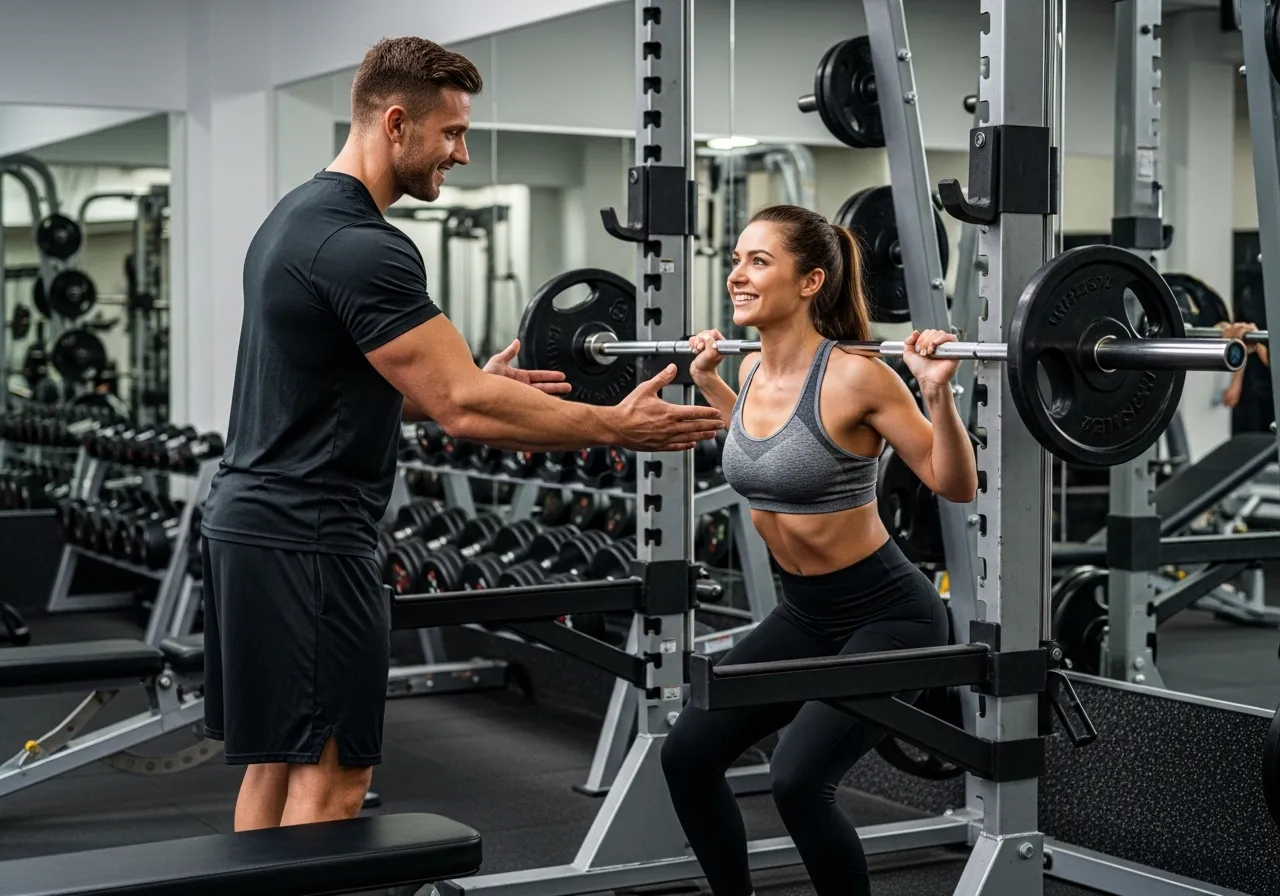
The gym relationships between members and fitness professionals — personal trainers and group fitness instructors — have specific etiquette considerations that members may not intuitively understand. The personal trainer etiquette principles: do not approach personal trainers during paid training sessions with other clients — the trainer’s attention is professionally committed to their client during that time, and interrupting a paid session for a free consultation is both professionally inappropriate and unfair to the client; if you want advice or information from a trainer, approach them during transitions or when they are clearly available, and acknowledge that substantive training guidance is their livelihood rather than a casual favor; and do not replicate programmed workouts from a trainer’s paid client sessions without the trainer’s permission — training programs are professional products that trainers invest significant time and expertise in creating. Group fitness class etiquette: arrive before class begins rather than entering after the instructor has started — late arrivals disrupt the class setup and flow that the instructor has designed; use the equipment designated for the class rather than substituting different equipment that requires setup adjustments; and leave the class space in the same condition that you would want to find it — mats returned, equipment stored, and the floor clear for the next class’s setup.
Cardio Equipment and Treadmill Etiquette Specifics
Cardiovascular equipment — treadmills, ellipticals, stationary bikes, and rowing machines — has specific etiquette considerations beyond the general gym norms, primarily because these machines are frequently in high demand during peak hours and are used for extended durations that amplify the impact of any single user’s behavior on the queue behind them. The time limit principle: most commercial gyms post 20–30 minute time limits on cardiovascular machines during peak hours — observing these limits when the facility is busy is basic courtesy, regardless of whether they are enforced by staff. If you need longer cardiovascular training during peak hours, break the session into separate machines (20 minutes treadmill, 20 minutes bike) rather than monopolizing a single machine for 60 minutes while others wait. The neighbor selection etiquette on cardiovascular equipment mirrors the selection etiquette in public spaces: when multiple machines are available, choose one that does not place you immediately adjacent to the only other user — providing the personal space that the person exercising alone on one end of a 20-treadmill bank reasonably expects. Adjusting machine speed, incline, or resistance settings for the next user to neutral positions upon completion reduces the setup time and prevents the potentially hazardous surprise of a treadmill that starts at another user’s maximum speed when the next person presses start without noticing the pre-set.
Outdoor and Non-Traditional Training Space Etiquette
The etiquette principles that apply in commercial gyms extend to outdoor and non-traditional training spaces — park fitness stations, outdoor tracks, public pools, and shared functional training areas — with adaptations for the specific norms these environments require. Park fitness station etiquette mirrors gym equipment etiquette: allow others to work in, do not occupy all stations simultaneously, and leave equipment in the condition you found it. Outdoor track etiquette: walk or jog in the outermost lanes and run in inner lanes, pass on the left, and announce your presence before overtaking slower runners. Public pool etiquette for lap swimmers: circle swim in shared lanes, notify the lane’s current user before entering, match your speed to the lane’s posted pace designation (slow, medium, fast), and limit wall resting to brief moments rather than extended conversations that block the turn end. The common thread across all shared training environments is the spatial awareness and consideration for others that gym etiquette embodies — the training spaces we share are only as good as the collective courtesy of the people who use them, and extending gym etiquette principles to every shared training environment maintains the quality and accessibility that all athletes benefit from.
4. How Bad Gym Habits Affect Your Training and Others Around You
Poor gym etiquette is not merely a social inconvenience — it produces measurable negative effects on training quality, safety, and the psychological experience of the gym environment that affect both the violator and the people around them.
The Training Quality Impact of Poor Gym Etiquette
Bad gym habits undermine training quality in ways that the person practicing them may not recognize — the hoarding of equipment that prevents efficient workout completion, the failure to re-rack weights that wastes training time on equipment preparation, and the phone-based distraction that lengthens rest periods beyond the intervals that training programming intends. The training efficiency cost of poor etiquette: a training session planned for 45 minutes with specific rest periods becomes a 75-minute session when equipment is unavailable due to hoarding, weights need to be stripped and reconfigured between sets, and phone distractions extend rest periods from 60 seconds to 3–5 minutes. The cumulative weekly training quality loss from these inefficiencies — across 3–5 sessions per week — is substantial enough to measurably impair the training consistency and session quality that adaptation requires. The person who arrives to a gym where equipment is hoarded, weights are not reracked, and multiple stations are occupied by phone users is not merely mildly inconvenienced — they are experiencing genuine impediment to the training outcomes that their investment in gym membership and training time is intended to produce. From ACSM fitness facility standards research, the gym environment quality — including equipment availability, cleanliness, and the courtesy of other members — is among the top predictors of member satisfaction, retention, and training adherence, confirming that gym etiquette is not a soft social concern but a hard factor in training outcomes.
Safety Hazards Created by Etiquette Violations
Several common gym etiquette violations create genuine physical safety hazards that extend beyond social discomfort to injury risk. Un-racked weights on floor areas create trip hazards — barbells left across walkways, dumbbells placed on the floor rather than returned to the rack, and weight plates leaned against equipment rather than stored on the appropriate rack are the most common causes of gym-related injuries that are not exercise-related. Excessive loading of barbells without collars (weight clips) creates the risk of plate slide during uneven loading — a 20kg plate sliding off one end of a barbell during a squat or bench press creates a dangerous imbalance that can result in serious injury to the lifter and anyone nearby. Swinging or uncontrolled exercise execution in crowded areas — the kettlebell swing, the medicine ball slam, and the aggressive cable exercise performed in close proximity to other users — creates the collision risk that controlled exercise in appropriate spacing prevents. The assumption that other gym members will observe adequate spatial awareness does not eliminate the performer’s responsibility to ensure that their training execution is safe for everyone in the vicinity. Leaving equipment in mid-exercise states — a loaded barbell on the rack at partial height, a cable stack with the pin in an unusual position, or a machine adjusted to an extreme range of motion — creates hazards for the next user who may not notice the unusual setup before engaging with the equipment.
The Psychological Environment: How Etiquette Violations Affect Motivation
The psychological impact of gym etiquette violations on training motivation and gym membership retention is significant and well-documented. Members who regularly experience equipment hoarding, unsolicited advice, poor hygiene, and crowded machine monopolization consistently report reduced gym enjoyment, lower motivation to attend, and higher likelihood of cancelling membership or seeking alternative training locations. The new gym member — already navigating the unfamiliarity and vulnerability of a new exercise environment — is disproportionately affected by etiquette violations: the experienced lifter who offers unsolicited technique correction may intend helpfulness but produces the intimidation that drives new members away from the gym environment that their fitness depends on. The gym culture that etiquette creates or destroys determines who feels welcome in the training environment: inclusive, respectful gym cultures attract and retain diverse membership populations, including the beginners, older adults, and people from non-traditional fitness backgrounds who most benefit from consistent training access but who are most sensitive to the exclusionary signals that poor etiquette produces. Every member’s daily etiquette choices contribute to this culture — positively through the courtesy and consideration that welcomes everyone, or negatively through the violations that signal to less experienced or less confident members that the gym is not a welcoming space for them. From British Journal of Sports Medicine exercise environment research, the social environment of exercise settings is among the strongest predictors of long-term exercise adherence — the gym that feels welcoming and respectful retains members who achieve their health goals, while the gym with poor social culture drives away the members who most need consistent exercise access.
Giving and Receiving Feedback in the Gym: The Right and Wrong Ways
The question of when and how to give feedback to other gym members — and how to receive unsolicited feedback graciously — is one of the most delicate etiquette challenges in the gym environment. The situations that warrant feedback: if someone’s exercise execution creates an immediate safety risk (a spotter who appears needed but hasn’t asked, someone about to load more weight than appears safe with a form breakdown already apparent, or a genuine equipment hazard that the person has not noticed), a brief, non-judgmental observation (“heads up, that plate looks like it might slide” or “do you want a spot for this set?”) is appropriate and appreciated. The situations that do not warrant unsolicited feedback: technique preferences that differ from the observer’s preferences without creating safety risk, exercise choices that differ from what the observer would program, body composition observations of any kind, and any comment on a person’s weights, fitness level, or training progress. The receipt of unsolicited feedback: a brief “thanks, I’ll keep that in mind” terminates the interaction graciously without either accepting the advice or creating conflict — the diplomatic exit that preserves the gym atmosphere while protecting your autonomy to train as you choose.
Gym Bags, Belongings, and Storage Etiquette
The management of personal belongings in the gym — bags, water bottles, towels, and accessories — creates etiquette considerations that extend the equipment and space awareness principles to personal property management. The minimum footprint principle: keep personal belongings in the locker or at the edge of the training area rather than spreading across the floor, multiple benches, or adjacent equipment. A gym bag on the training floor is a trip hazard and a space imposition; a gym bag in a locker or at the designated bag storage area creates neither problem. Water bottle placement: keep your water bottle on the floor adjacent to your training area rather than on equipment surfaces (where it can roll off and create hazards) or on benches (where it claims additional space). Towel management: a personal towel placed on a bench or equipment claims that equipment — the towel reservation norm is generally respected for brief departures but creates the same hoarding problem as a water bottle left to hold equipment during extended absences. The simplest rule for personal belonging management: if your belongings are not directly in use during your current set, they should be stored rather than placed on or adjacent to equipment that others may need.
Gym Etiquette as Athletic Character Development
The discipline of consistent gym etiquette — returning equipment, considering others, managing space courteously — develops the same character traits that athletic training itself develops: attention to detail, consideration of how individual actions affect collective outcomes, and the consistency of doing the right thing when it would be easier not to. The athlete who builds genuine etiquette habits is not merely following social rules — they are developing the considerate awareness and the consistent follow-through that athletic character requires. The training environment that good etiquette creates is the environment where consistent training is most sustainable: where equipment is reliably available, where the energy is positive and welcoming, and where the shared purpose of physical improvement creates the community that makes regular gym attendance feel like a privilege rather than an obligation. Invest in the etiquette habits that make you the gym member everyone is glad to train beside, and discover that the gym culture you help create returns its investment in your own training experience many times over across the years of consistent training that athletic development requires.
Courtesy is always worth the effort.
5. Building Good Gym Culture: Tips for New and Experienced Members
Gym etiquette is ultimately about building and maintaining a training culture that serves every member — beginners finding their footing, experienced athletes pursuing performance goals, and everyone in between. Every member has a role in shaping this culture through their daily choices in the training environment.
A New Member’s Guide to Gym Etiquette from Day One
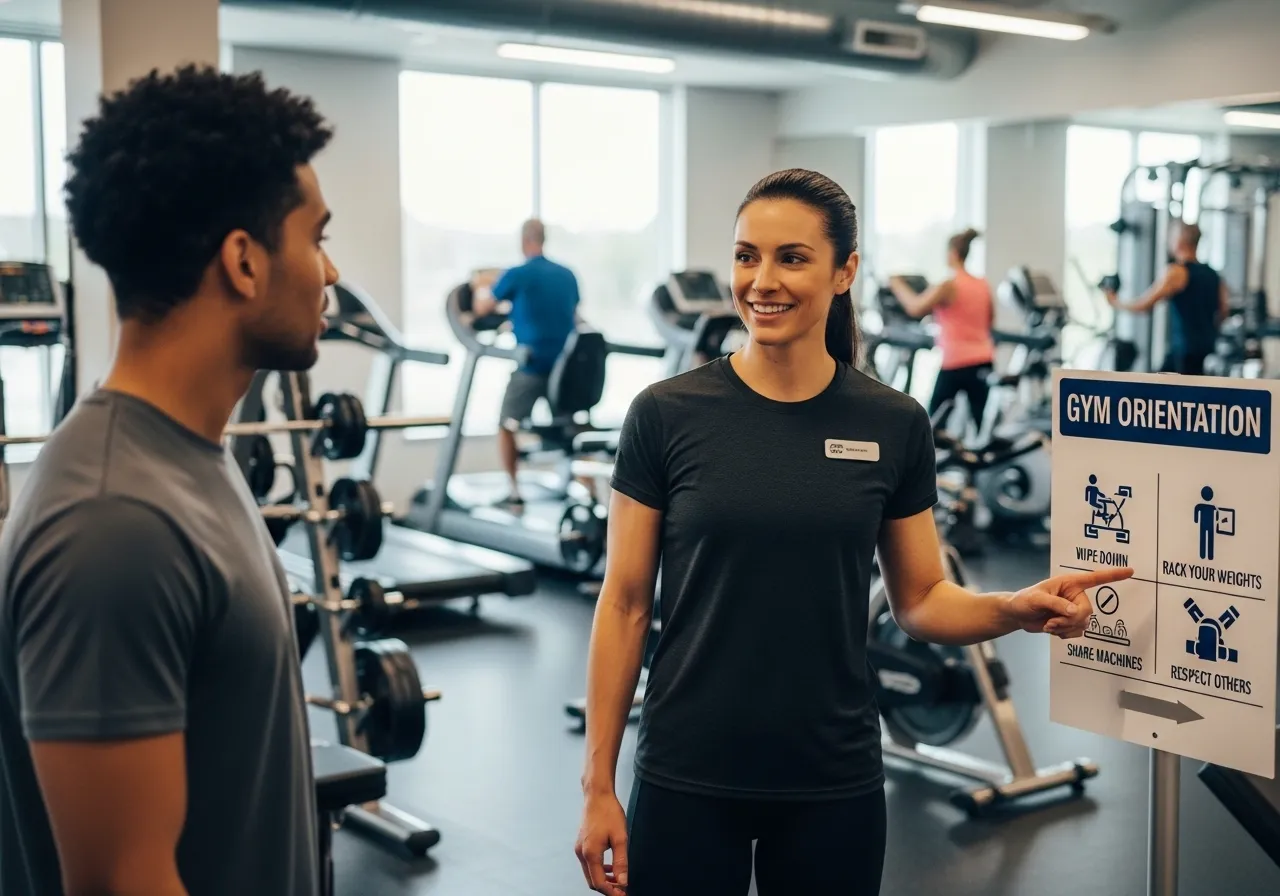
The new gym member arrives in an environment with established norms that experienced members navigate automatically but that newcomers must learn — often through the uncomfortable experience of inadvertent violation. The orientation approach: ask the gym staff during the initial tour about the specific policies and norms of that facility — different gyms have different rules around chalk use, deadlift dropping, equipment reservation, and bag storage, and asking directly prevents the learning-through-violation experience. Observe before participating: spend the first few visits watching how experienced members interact with equipment, manage transitions between exercises, and navigate the shared space — the implicit norms of any gym are visible in the behavior of its established members. Start with a clear, simple program that minimizes equipment needs: a beginner who occupies a cable machine, a barbell, two dumbbells, and a bench simultaneously while learning to use all of them is making life more difficult for everyone including themselves. Build familiarity with one or two pieces of equipment at a time before expanding the training footprint. Ask for help appropriately: gym staff are available to assist with equipment operation, proper form for basic movements, and facility navigation — using this resource reduces both the equipment misuse risk and the awkward situation of an experienced member feeling obligated to intervene when technique creates safety concerns. From IHRSA gym member experience research, new members who receive orientation and feel welcomed by staff and other members in their first 30 days have significantly higher retention rates and training consistency than those who navigate the gym environment without guidance — confirming that new member support is not merely good customer service but a genuine fitness outcome factor.
How Experienced Gym Members Can Lead Positive Culture
Experienced gym members have disproportionate influence on gym culture — their behavior sets the norm that newer members observe and emulate, their willingness to be helpful shapes the welcoming character of the training environment, and their consistent modeling of respectful equipment use and considerate behavior establishes the expectations that the training community collectively enforces. The experienced member’s cultural leadership opportunities: re-rack weights with conspicuous care — the experienced lifter who returns every weight to its labeled position signals that this standard applies to everyone; wipe down equipment consistently — modeling the hygiene standard makes it a community norm rather than a rule that requires enforcement; make brief, genuine welcomes to new or unfamiliar faces — the experienced member who nods in acknowledgment to a clearly uncertain newcomer provides the belonging signal that early gym experiences critically need; and share equipment graciously during busy periods without requiring that the waiting person ask — the working-in offer extended before it is requested signals the generosity that builds training community. The experienced member’s cultural responsibility also includes the restraint that good etiquette requires: not offering unsolicited advice to form-perfect beginners using lighter weights than the experienced member would use; not occupying prime equipment for extended periods during peak hours regardless of entitlement based on tenure; and not allowing the comfort of established routine to make the training environment less welcoming to the newer members who will eventually become the experienced members who set the culture.
Handling Etiquette Violations: What to Do When Someone Crosses the Line
Despite good intentions and general awareness, etiquette violations occur in every gym — and knowing how to respond when they affect your training determines whether the situation escalates or resolves. The response hierarchy for etiquette violations: first, assess whether the violation is intentional or inadvertent — the majority of gym etiquette violations are inadvertent, from members who genuinely did not learn the norms rather than members who are deliberately inconsiderate. An inadvertent violation warrants a brief, non-confrontational observation rather than a complaint: “Hey, I think you may have left some plates on the bar” addresses the situation without accusation. For repeated violations that affect your training, a respectful direct conversation during a non-training moment (between sets, not during the violator’s exercise) addresses the specific behavior without creating the public confrontation that gym environments find uncomfortable. For serious or persistent violations — genuine safety hazards, harassment, or repeated deliberate inconsideration — involve gym staff rather than attempting personal resolution: the staff have both the authority and the conflict resolution training that member-to-member escalation lacks, and the gym has the responsibility to maintain the safe, respectful environment that membership fees pay for. The framing that reduces confrontation in all these situations: approach the person as someone who may not know the norm rather than someone who is deliberately violating it — this charitable assumption is usually accurate, and the resulting interaction feels like helpful information rather than accusation.
Gym Etiquette in the Digital Age: Social Media, Filming, and Privacy
The smartphone and social media era has created gym etiquette challenges that previous generations of gym members never navigated — the intersection of personal filming, social media content creation, and the privacy expectations of gym members in a shared space. The filming etiquette principles: film your own training in ways that clearly frame only yourself and your equipment, using angles and compositions that keep other members out of frame; if another person appears in the background of footage you intend to post publicly, blur or crop them out before posting — the person who came to the gym to exercise did not consent to appearing in your social media content; do not film other members without explicit permission regardless of intent — the person documenting poor form for personal amusement, collecting “gym fails” content, or filming physique inspiration without consent is violating the privacy of the people they film in ways that are both ethically wrong and potentially legally actionable. The content creation etiquette: fitness content creators who use gyms for content should coordinate with gym management about filming policies, avoid monopolizing equipment for filming purposes during busy periods, and be transparent about the filming activity with nearby members who may be uncomfortable with camera presence. The general principle: the gym is a shared private space — not public — and the privacy expectations of its members deserve the same respect that filming in any private space requires.
Frequently Asked Questions About Gym Etiquette
Is it okay to save equipment with a towel or water bottle while I get another piece of equipment? Brief reservation for 2–3 minutes to get an adjacent piece of equipment is generally acceptable; using belongings to hold equipment for 10+ minutes while you perform other exercises elsewhere is equipment hoarding regardless of the reservation method. How do I politely tell someone they smell bad at the gym? You cannot — this conversation is the gym staff’s responsibility. Report significant hygiene concerns to gym staff who can address them professionally and without embarrassment to either party. Is it okay to grunt or make noise when lifting heavy? Genuine exertion sounds are accepted in most gyms; theatrical, sustained vocalizations designed for attention are generally considered inconsiderate. Can I ask someone on the gym floor for a date? Generally not — the gym is a workout space where people are focused on training, and romantic solicitation creates the uncomfortable experience that many gym-goers (particularly women) report as a significant barrier to gym attendance. What should I do if someone takes my equipment while I’m in the middle of a superset? If your equipment was left without any indication that you were using it (no towel, water bottle, or nearby presence), this is a misunderstanding rather than deliberate taking — politely explain you were mid-set and most members will immediately return the equipment. If you are using multiple pieces of equipment in a superset during peak hours, briefly notifying nearby members that you are using both pieces prevents the misunderstanding.
Building Your Own Positive Gym Reputation
The gym members who are most welcome in every training environment — who receive working-in requests answered with genuine enthusiasm, who find that staff go out of their way to help them, and who experience the gym as a genuinely supportive community — are not necessarily the strongest, most experienced, or most attractive athletes. They are the members whose consistent courtesy, consideration, and positive energy have built a reputation as people who make the gym better for everyone around them. The long-term gym reputation is built through the accumulation of small, consistent etiquette choices: the weights always re-racked, the equipment always wiped, the new member always acknowledged, the working-in request always accepted generously. These small acts do not require significant time or effort — they require only the awareness and intention to consider how each training session choice affects the shared environment and the people who share it. The gym member with the best reputation in any facility is rarely the one with the most impressive physique or the heaviest lifts — they are the one who makes every person around them feel that their presence in the gym is valued and their training matters. Build that reputation through consistent courtesy, and discover that the gym transforms from a facility you use into a community you belong to — a distinction that makes every training session more enjoyable and more sustainable across the long athletic career that community support enables.
The Economics of Good Gym Etiquette: How Courtesy Protects Your Membership Value
The commercial gym operates as a shared resource — every member’s membership fee contributes to the facility quality, equipment maintenance, and staff support that all members benefit from. Poor etiquette degrades this shared resource through equipment damage (weights dropped rather than controlled, machines misused, benches scratched by un-collared plates), increased cleaning labor (equipment not wiped requiring staff time for sanitation), and member attrition (courtesy violations drive away members whose fees fund the facility). The member who practices excellent etiquette is not merely being polite — they are protecting the value of their own membership by preserving the facility quality, equipment availability, and membership community that make the gym worth belonging to. The gym that loses members due to poor etiquette culture faces revenue pressure that leads to deferred equipment maintenance, reduced staff, and further quality decline — a negative cycle that affects every remaining member’s training environment. The gym where excellent etiquette is the norm retains members longer, attracts new members through positive reputation, and invests the sustained revenue in equipment quality and facility improvements that enhance every member’s training experience. Your daily etiquette choices are a vote for the gym culture and facility quality that your training depends on — cast that vote consistently through the courtesy habits that make the gym better for everyone who trains there.
Always.