
How to Warm Up Before a Workout: The Right Way to Prepare Your Body
This article is for general educational purposes only and does not constitute medical or professional fitness advice.
Consult a licensed healthcare provider or certified fitness professional before starting any new program.
The warm-up is the most consistently skipped part of a training session — and often the most consequential in terms of both performance and injury risk.
This guide explains what an effective warm-up actually does, which components matter most for different types of training, and how to build one that takes under 10 minutes.
What a Warm-Up Actually Does to Your Body
Physiological Changes That Support Performance
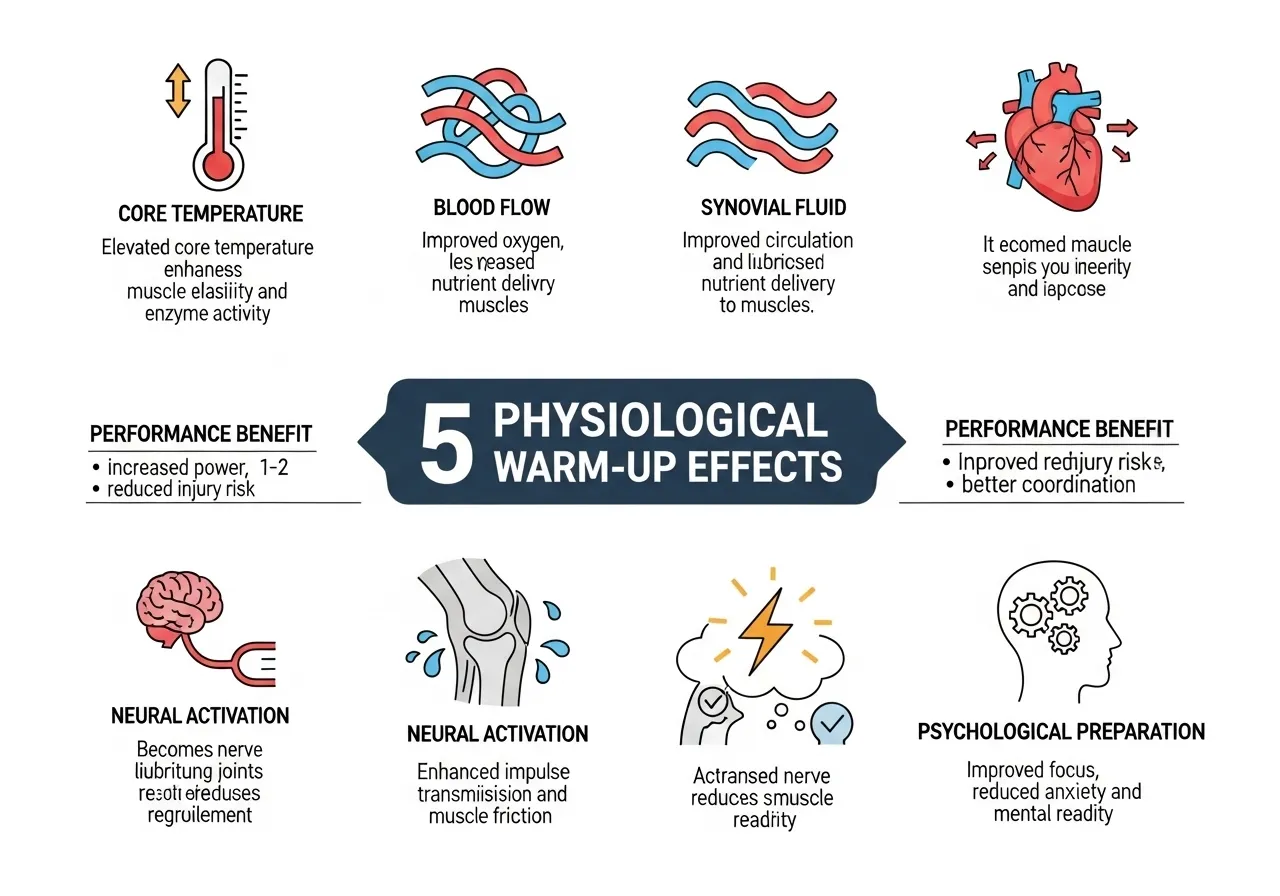
A warm-up is not just about “warming up” in temperature — though that is part of it. Multiple simultaneous physiological changes prepare the body for training:
| Change | Effect on Training |
|---|---|
| Increased core body temperature | Improves muscle contraction speed and enzyme activity |
| Increased blood flow to working muscles | More oxygen and fuel available; faster metabolite clearance |
| Increased synovial fluid production | Reduces joint friction — particularly important for the knees and hips |
| Neural activation | Improves motor unit recruitment — more muscle fibers available from the first working set |
| Psychological preparation | Focuses attention and reduces the subjective effort of early working sets |
What the Research Suggests
A 2010 meta-analysis in the Journal of Strength and Conditioning Research found that a dynamic warm-up (one involving active movement through range, not static stretching) consistently improved performance measures including jump height, sprint speed, and strength — compared to no warm-up or static-only warm-up protocols.
Static stretching (holding a stretch in a fixed position for 30+ seconds) performed immediately before strength or power training has been shown in multiple studies to reduce subsequent strength and power output by 5–8%. For this reason, static stretching is generally better placed after training, not before.
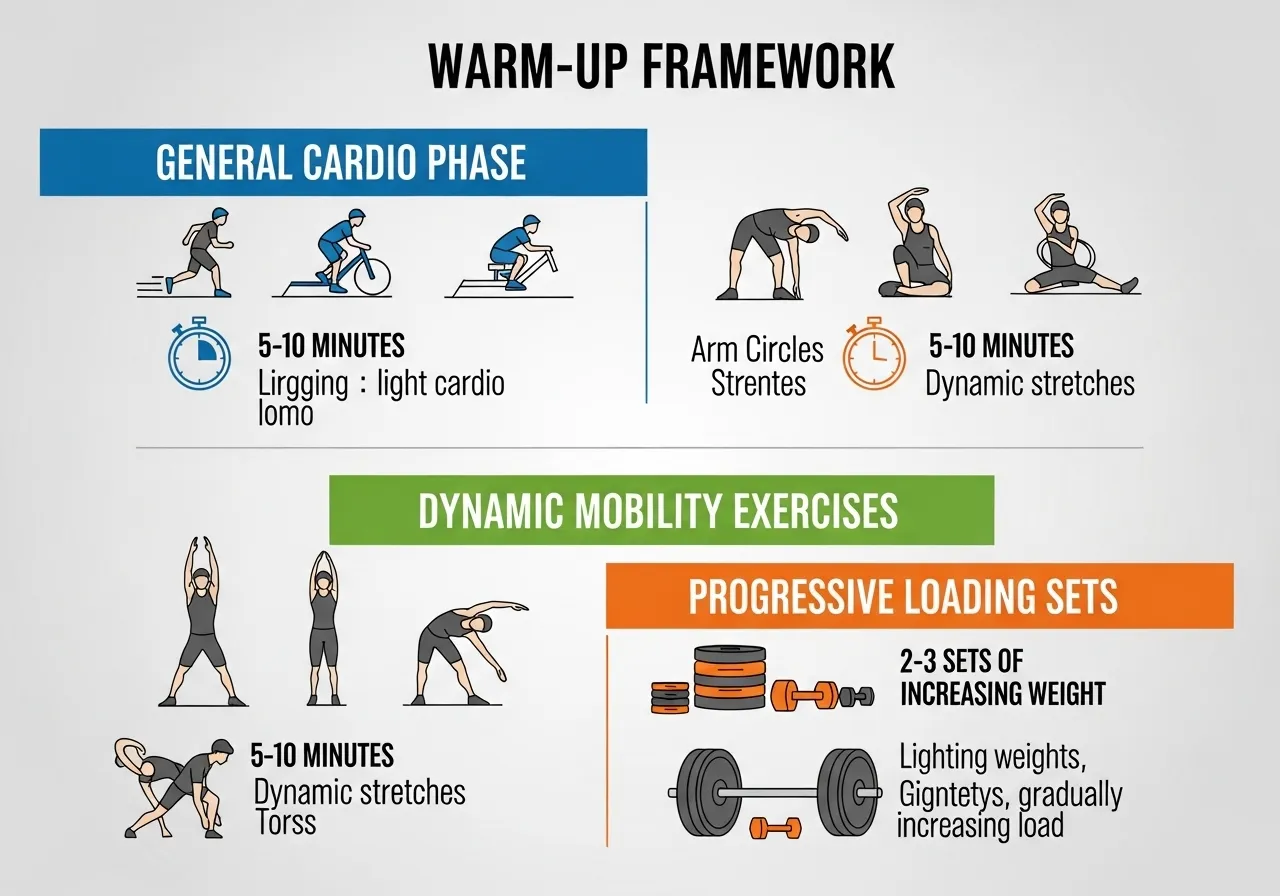
The 3-Part Warm-Up Framework
Part 1 — General Cardiovascular Activation (3–5 minutes)
The goal of this phase is to elevate heart rate, increase core temperature, and increase blood flow to the muscles before more specific movement preparation begins.
Options: Brisk walking, light jogging, rowing machine, cycling, jumping jacks, skipping. The specific choice matters less than achieving a mild elevation in heart rate — enough to produce light warmth or a very light sweat.
Part 2 — Dynamic Mobility and Movement Prep (3–5 minutes)
Dynamic movements through the joints and ranges relevant to the upcoming training session — not static holds.
• Leg swings (forward/back + lateral) — 10 each leg
• Hip circles — 10 each direction
• Bodyweight squat (slow, deep) — 10 reps
• Glute bridge — 10 reps
• Walking lunge — 8 steps
For upper body / push-pull day:
• Arm circles (small to large) — 10 each direction
• Band pull-aparts — 15 reps
• Wall slides — 10 reps
• Thoracic rotation — 8 each side
• Push-up (slow, 3-second lowering) — 5–8 reps
Part 3 — Progressive Exercise-Specific Loading (2–5 minutes)
Before beginning working sets on a compound exercise, performing 2–3 progressively heavier warm-up sets prepares the nervous system and joint structures specifically for the load about to be used.
Set 1: Empty bar × 10 (movement pattern focus)
Set 2: 40 kg × 5 (50% of working weight)
Set 3: 60 kg × 3 (75% of working weight)
Set 4: 72 kg × 1 (90% of working weight)
→ Begin working sets

Warm-Up Mistakes That Reduce Its Effectiveness
Mistake 1 — Performing Only Static Stretching
As noted above, prolonged static stretching before training has been shown to temporarily reduce strength and power output.
Static stretching is valuable — but after training, not before. Replace it with dynamic movements in the warm-up and save static holds for the cool-down or a separate mobility session.
Mistake 2 — The Warm-Up Is Too Long or Too Fatiguing
A warm-up should prepare — not deplete.
Some athletes spend 30–45 minutes warming up before a session, accumulating significant fatigue before the first working set begins. For most recreational trainees, 8–12 minutes total is sufficient — and more efficient than longer protocols.
Mistake 3 — Skipping Exercise-Specific Warm-Up Sets
Jumping from general cardiovascular activation directly to heavy working sets, skipping the progressive loading warm-up, is one of the most common causes of exercise-related joint discomfort.
Warm-up sets add minimal time (5–10 minutes) and meaningfully prepare the tendons, ligaments, and joint surfaces for the specific loading pattern about to be applied.
Mistake 4 — The Same Warm-Up Regardless of Training Type
A warm-up for a strength session (heavy barbell work) requires different emphasis than a warm-up before a run or a HIIT session.
Matching the dynamic movements in Part 2 to the actual movements and muscle groups of the upcoming session makes the warm-up meaningfully more effective than a generic routine applied uniformly.

Frequently Asked Questions About Warm-Ups
Q: Is a warm-up necessary if I don’t have much time?
A condensed warm-up is significantly better than none at all. Even 4–5 minutes of cardiovascular activation and 5–6 dynamic movements provides most of the neuromuscular and joint preparation benefits.
If time is very limited, prioritizing exercise-specific warm-up sets (Part 3) over the general cardiovascular phase tends to provide the most direct injury-prevention benefit for strength training specifically.
Q: Does warming up actually prevent injuries?
The relationship between warm-ups and injury prevention is supported by research — though establishing causation (rather than correlation) in observational studies is methodologically challenging.
What the evidence more clearly supports: warm-ups consistently improve acute performance (strength output, power, speed) — and the same physiological mechanisms (increased joint lubrication, improved neural activation, increased tissue extensibility) are theoretically protective against acute injury.
Q: Should the warm-up change with age?
Generally, yes. Older adults often benefit from longer warm-up phases — joints take more time to reach adequate synovial fluid production, and the nervous system may require more activation before achieving optimal motor unit recruitment.
A 10–15 minute warm-up may be more appropriate than a 5-minute warm-up for adults over 50, particularly before heavy compound loading — though individual variation is significant.
- Dynamic warm-ups (active movement) consistently improve performance; static stretching before training may reduce it
- The 3-part framework: cardiovascular activation → dynamic mobility → exercise-specific progressive loading
- Match the warm-up content to the specific training session that follows
- 8–12 minutes is sufficient for most recreational training sessions
- Older adults may benefit from a longer warm-up phase before heavy loading