How to Work Out When You Have Kids
⚠️ Disclaimer: The information in this article is for general educational purposes only and does not constitute medical, nutritional, or professional fitness advice. Individual results may vary. Always consult a qualified healthcare professional or certified fitness trainer before starting any new exercise program, changing your diet, or making decisions about injury treatment or recovery. If you experience pain, discomfort, or any unusual symptoms during exercise, stop immediately and seek professional guidance.

The Real Fitness Challenge of Parenthood (It’s Not What You Think)
Most fitness advice for parents frames the challenge as a time problem. And time is certainly limited — the early parenting years are among the most time-constrained periods most adults experience. But in my experience, the time constraint is actually secondary to the deeper challenge: the complete reorganization of identity, priority, and energy management that parenthood requires. The parent who can’t find 45 minutes to work out typically isn’t failing to find 45 unused minutes in their day — they’re failing to claim those minutes for themselves against a constant competing pull of family needs, household responsibilities, and the guilt that many parents feel about doing anything for themselves when there is always something child-related that could be done instead.
When my first child was born, my training frequency dropped from five days per week to essentially zero over the first three months. It wasn’t that I couldn’t find any time — it was that every available gap felt like it should be used for sleep, or for helping my partner, or for catching up on household tasks that had accumulated. Training felt selfish in a way it never had before. The reframe that changed everything was understanding that the energy, mood regulation, stress management, and physical capability that consistent training provides are not just personal benefits — they are inputs into my capacity to be a better parent, partner, and present adult. Training stopped feeling selfish when I understood it as infrastructure maintenance for my most important roles, not as time taken away from them.
Why Traditional Fitness Programs Fail Parents
Standard fitness programming assumes: consistent daily availability of 45–75 minutes, access to gym equipment, reliable sleep quality, stable energy levels throughout the day, and the ability to plan and execute training sessions at scheduled times. Parenthood systematically undermines all of these assumptions. Children are sick, schedules change without warning, naps don’t happen when planned, nights are disrupted unpredictably, and the mental load of managing childcare logistics alongside work and household responsibilities leaves less cognitive and emotional resource for the discipline that structured training requires.
Programs that acknowledge these realities and build flexibility, brevity, and schedule independence into their structure succeed where rigid traditional programs fail. The parent fitness approach that works is not a modified version of standard training — it’s a fundamentally different approach that prioritizes consistency over volume, adaptability over structure, and sustainable habit formation over short-term optimization.
What the Research Says About Exercise and Parenting Quality
Research on the relationship between parental exercise and parenting quality provides the motivational foundation for making fitness a non-negotiable priority. Studies published in Health Psychology and related journals have documented that parental physical activity is associated with better mood regulation, reduced parenting stress, higher patience levels, and — importantly for children — better active play engagement with children. Parents who exercise report feeling more energetic during child interactions, more emotionally regulated in challenging parenting moments, and more confident in their physical capability to engage in active play. The evidence supports what many active parents report from experience: training is not in competition with quality parenting time — it is preparation for it.
Additionally, modeling active behavior for children has documented developmental effects — children of physically active parents are significantly more likely to be physically active themselves in adolescence and adulthood. The fitness habits you maintain as a parent are not just personal investments — they are parenting investments that shape your children’s lifelong relationship with physical activity and health.
The Hidden Cost of Not Training as a Parent
The framing of parent fitness as a sacrifice — time taken from family — ignores the cost of not training that unfolds over months and years of physical inactivity. The detraining that occurs during periods of training absence is not merely a fitness setback; it accumulates into meaningful health risks including increased cardiovascular disease risk, reduced bone density, decreased insulin sensitivity, worsening body composition, and — most relevant to parents — reduced energy availability and mood regulation capacity. Research on sedentary behavior and health outcomes consistently shows that the health costs of physical inactivity accrue across the domains most relevant to parenting quality: cognitive function, emotional regulation, energy, and physical capability for active engagement with children.
Parents who remain sedentary during the high-demand years of early parenthood often find themselves at their children’s most physically active developmental phase — the 5–12 year period of sports participation, outdoor adventure, and high-energy play — in a physical state that limits their ability to fully participate. The parent who maintained fitness through the difficult early years is able to run with their child, hike, play sports, and model physical confidence in ways that the parent who deferred fitness until a “better time” cannot. The “better time” framing of parent fitness — “I’ll get back to it when the kids are older, when I have more time, when things settle down” — often defers fitness into a period when age-related detraining compounds with years of sedentary behavior into a much larger mountain to climb. Maintaining any level of consistent training through the high-demand years is categorically easier than rebuilding from years of complete inactivity.
The mental health dimension is equally important. Research on exercise and parental mental health shows that parents who exercise regularly report significantly lower rates of postpartum depression, parenting burnout, and general psychological distress compared to sedentary parents — controlling for other factors. For parents experiencing the particular mental health pressures of early parenthood, exercise is not a luxury that waits for circumstances to improve; it is a clinical-level mental health intervention that becomes more important, not less, when parenting demands are highest.
Reframing the Time Problem: What Actually Blocks Parent Training
When parents say they don’t have time to exercise, what they typically mean is more precisely: they don’t have uncontested, guaranteed, child-free time of sufficient duration that their mental model of “a workout” requires. This is a real constraint — but it’s a constraint on a specific type of training, not on physical activity itself. Most parents have more potential training opportunities than they recognize — they just require a different relationship with what “counts” as training. Standing desk stretching, active commuting, walking during phone calls, bodyweight exercises during TV time, playing actively with children instead of supervising passively — all of these accumulate into meaningful physical activity that the narrow “workout = dedicated gym session” definition excludes from consideration. Broadening the definition of training to include any deliberate physical activity produces a more accurate picture of training opportunities available within parent life than the narrow gym-session framework allows.
The Hidden Cost of Skipping Workouts as a Parent
There’s a pervasive cultural narrative that describes putting yourself last as virtuous parenting. This narrative is genuinely harmful. Parents who chronically deprioritize their own physical health — skipping exercise indefinitely because “the kids need me” — accumulate fatigue, irritability, and declining physical capacity that affects their parenting quality in ways that are invisible until they’re severe. The research on parental wellbeing and child outcomes is unambiguous: children of parents with higher physical and mental wellbeing have better outcomes across academic, social, and psychological dimensions. Maintaining fitness as a parent is not a selfish act at the expense of the children — it is an investment in the quality of presence and engagement the children receive.
Beyond child outcomes, parental fitness has direct practical implications as children grow. A parent who has maintained fitness through the early child years has the physical capacity to keep up with an active child, to participate in outdoor adventures, to model the physical engagement with life that influences what children believe is possible for adults. The parent who gave up fitness during young child years and is now deconditioned at 45 struggles to participate in the active family life that benefits everyone. The investment in maintaining fitness during the demanding early years pays dividends for a decade or more afterward.
Why Conventional Fitness Advice Fails Parents
Most mainstream fitness programming is designed for people with reliable, discretionary time — a category that parents of young children simply don’t occupy. The “train 5 days a week, 60 minutes per session” recommendation that dominates gym culture assumes a life structure that doesn’t exist for most parents during peak caregiving years. Following this advice as a parent produces consistent failure: missed sessions accumulate, guilt compounds, and eventually the whole fitness attempt is abandoned as incompatible with parenting reality. The solution isn’t more willpower — it’s better-designed programming that starts from parental life constraints rather than ideal conditions. A 3-day, 25-minute home-based program executed consistently for 12 months produces transformative results that a 5-day 60-minute program abandoned after 6 weeks never will.

Time-Efficient Workout Strategies That Actually Work for Parents
The research on minimum effective training dose provides the scientific foundation for parent-optimized workout design. The good news: the minimum dose of resistance training needed to maintain muscle mass and strength is substantially lower than the training volume needed to maximize them. For maintenance and modest progression, as little as 2 sessions per week of 20–30 minutes each, containing the key compound movements at appropriate intensity, is sufficient to maintain most training gains and continue producing modest improvements. This “minimum effective dose” framework transforms parent fitness from the seemingly impossible task of fitting a full training program into a constrained life into the achievable task of protecting a small, well-defined time investment for the most important training components.
The 20-Minute Compound Training Block
A 20-minute training session is achievable during a nap, before children wake, during a school or childcare drop-off window, or during any other predictable 25-minute gap in the day. The key is pre-planning the session so zero time is spent deciding what to do — every minute is execution. A 20-minute parent compound training block: 3-minute dynamic warm-up (jumping jacks, hip circles, arm swings), followed by a superset of one compound push (push-up or dumbbell press) and one compound pull (row or pull-up variation) for 3 rounds of 8–12 reps each with 30 seconds rest between exercises (approximately 8 minutes), followed by a superset of one lower body compound (squat or lunge variation) and one hip hinge (dumbbell RDL or hip thrust) for 3 rounds (approximately 7 minutes), finishing with 2 minutes of core work. This covers all major movement patterns and every major muscle group in 20 minutes with minimal rest time.
EMOM (Every Minute On the Minute) Training for Maximum Efficiency
EMOM training — performing a prescribed number of reps of an exercise at the start of each minute, resting for the remainder of the minute, and repeating — is one of the most time-efficient training formats available. A 15-minute EMOM of 5 pull-ups, 10 push-ups, and 15 air squats performed on alternating minutes provides meaningful upper and lower body training stimulus in a format that self-adjusts rest periods based on fitness level (faster completions equal more rest, slower completions equal less rest). EMOM training requires no equipment decisions during the session and is easily performed at home with minimal equipment, making it ideal for the constraints of parent training environments.
Habit Stacking: Attaching Training to Existing Routines
Habit stacking — attaching a new behavior to an existing, reliable trigger — is one of the most evidence-supported behavior change strategies for building new habits. For parent fitness, habit stacking means identifying the daily anchor points that reliably occur regardless of schedule variability (morning wake-up routine, school/daycare drop-off, post-children-bedtime) and attaching training to these anchors rather than scheduling training as an independent event that competes with the unpredictable demands of parenting. A parent who consistently trains for 15 minutes immediately after putting children to bed — before any other evening activity — builds a training habit that is more resilient to schedule disruption than a parent who plans to train “sometime during the day” around an unpredictable schedule. The habit formation research of Phillippa Lally at University College London suggests that consistent cue-based habits become automatic within 2–3 months of consistent execution — investing in building the stack during an initial establishment period pays dividends in reduced willpower requirement for years afterward.
Strategic Use of Gym Childcare
Many commercial gyms offer childcare facilities, typically for 1–2 hours per visit, either included in membership or at nominal additional cost. For parents of young children who lack reliable alternative childcare, gym childcare transforms training access dramatically. A 60–90 minute gym session with childcare while the parent trains is sustainable 2–3 times per week for many families, covering the training volume needed for meaningful fitness progress while providing child socialization benefits and parental mental health breaks simultaneously. Evaluating gym membership options with childcare quality and availability as a primary criterion — not just equipment availability and location — is a strategic parent fitness decision that makes a larger difference to training consistency than most equipment or programming choices.
Exercise “Snacks”: Micro-Sessions That Add Up
Exercise snacking — distributing physical activity throughout the day in short, frequent bouts of 5–15 minutes rather than in single consolidated sessions — has been studied increasingly as an alternative to traditional block exercise for populations with limited time for single extended sessions. Research published in the journal Applied Physiology, Nutrition, and Metabolism found that multiple short exercise bouts throughout the day produced cardiovascular and metabolic benefits comparable to a single continuous session of equivalent total duration for several health outcomes. For parents, this research validates the intuitively practical approach of accumulating fitness activity through the opportunities that parenting itself creates.
Practical exercise snacks for parents: a 10-minute resistance training circuit during a child’s independent play window, a 5-minute jump rope session during naptime, a 10-minute brisk walk during school pickup waiting time, and 2 sets of push-ups and squats during commercial breaks of a show watched after bedtime. These fragments, accumulated across the day, add up to meaningful total physical activity without requiring any single uninterrupted training block. The mental shift required is releasing the conviction that “real” training must occur in a single dedicated session — and accepting that the same physiological adaptations can be accumulated through distributed activity that integrates with the actual structure of parent life.
Progressive resistance exercise snacks require more thought because individual micro-sessions need to be tracked for progressive overload to occur across the distributed training. A simple approach: log each micro-session in a notes app, track cumulative weekly reps per exercise, and ensure cumulative weekly volume increases over time. This requires slightly more administrative effort than tracking a single weekly session, but the difference is manageable with a simple tracking habit and preserves the progressive overload principle that drives adaptation regardless of how that volume is distributed across the training week.
Equipment-Free Cardio for Time-Constrained Parents
Cardiovascular fitness doesn’t require dedicated cardio equipment or extended continuous sessions. The most practical parent cardio approaches: stair climbing (doing stairs in the home repeatedly for 5–10 minutes provides significant cardiovascular demand), jumping jacks and high knees during commercial breaks, a stationary bike or treadmill session while children watch a show nearby, brisk outdoor walks with the stroller at a pace that elevates heart rate meaningfully, and jump rope sessions that provide high-intensity cardiovascular training in 10–15 minutes with zero setup beyond the rope. Accumulating three 10-minute cardio bouts throughout the day produces comparable cardiovascular adaptation to a single 30-minute session — the exercise snacking research applies directly to cardiovascular training and legitimizes the fragmented parent training approach that necessity often creates.
Managing Sleep Deprivation and Training Intensity
New parents face sleep deprivation that is not merely uncomfortable — it is a genuine physiological impairment with measurable effects on strength, power output, reaction time, and injury risk. Training through severe sleep deprivation with normal intensity is not heroic; it’s a reliable path to injury, illness, or burnout that sets fitness back further than the missed sessions would have. The evidence-based approach to training under sleep deprivation is to train with reduced intensity — using 60–70% of normal working weights, reducing sets by 30–40%, and prioritizing movement quality over performance metrics. This maintains the habit, preserves the physiological stimulus for adaptation, and respects the reality that a depleted nervous system cannot safely or productively handle maximal loads.
Sleep debt is real and cumulative, but it is also recoverable. The period of severe parental sleep deprivation — typically the first 4–12 months of an infant’s life — is finite. Maintaining fitness at reduced intensity during this window, rather than abandoning it completely, means emerging from the sleep deprivation phase with a fitness foundation intact rather than starting from scratch. The athletes who maintain consistency through difficult periods at reduced intensity consistently outperform those who take extended breaks and restart — because consistency compounds and restarts have an early-adaptation cost that re-experienced athletes shouldn’t pay repeatedly.
Equipment Worth Having at Home for Parent-Friendly Training
A minimal home setup removes the biggest logistical barrier to parental fitness: the commute to a gym. The most cost-effective home equipment investment for parents is: a set of adjustable dumbbells (providing resistance from 5–50 lbs for under $200), a pull-up bar that fits in a doorframe ($30–50), and a resistance band set ($20–40). This $250–300 investment enables hundreds of exercise variations covering all major movement patterns, requires no dedicated space, and stores in a closet. For parents who can invest slightly more, a kettlebell set (16kg, 20kg, 24kg) and a barbell with plates adds the hip hinge and loaded squat progressions that produce the fastest strength and body composition changes. The point is that equipment doesn’t need to be extensive — it needs to be immediately accessible when the training window opens, without requiring a car trip.
Home Workout Routines Designed Around Kids’ Schedules
For parents who cannot reliably access a gym due to childcare constraints, travel distance, or scheduling, home training designed around the predictable windows in children’s schedules provides the consistency foundation that gym-dependent training cannot. The key insight is that home training doesn’t require extended uninterrupted time — it requires multiple short windows exploited consistently, or single reliable windows that are protected as non-negotiable training time regardless of other competing priorities.
The Nap Time Workout: 20–30 Minutes of Guaranteed Training Time
For parents of infants and toddlers who still nap, nap time is one of the most reliable training windows available — typically 45–90 minutes of predictable time with a known start. The critical mistake is using the first 15–20 minutes of nap time for household tasks and then attempting to train with insufficient time remaining, or falling into the “I’ll just rest for 10 minutes first” pattern that consumes the entire window. The discipline of training immediately when the child goes to sleep — before any other activity — is the behavioral habit that makes nap time training reliable. A 20-minute compound resistance training block or HIIT session immediately upon child-sleep, followed by a 20–30 minute shower and household task window, uses the nap time efficiently while ensuring training happens before competing priorities consume the available time.
The Pre-Wake Workout: Training Before the Day Begins
For parents who can modify sleep timing, training before children wake provides the most schedule-reliable training window available — no childcare logistics required, no schedule unpredictability, and training is complete before the day’s demands begin. This requires either going to sleep earlier to maintain adequate sleep duration, or accepting shorter total sleep in exchange for training time — a trade-off that requires honest evaluation of the physiological costs of reduced sleep against the psychological and physical benefits of consistent training. For most parents, 30 minutes earlier to bed combined with 30 minutes earlier wake creates a morning training window without sleep reduction. The behavioral difficulty is establishing the earlier sleep time in an evening culture that encourages late-night screen time; parents who successfully build morning training habits consistently identify earlier sleep as the critical enabling change rather than the earlier wake time itself.
The After-Bedtime Workout: The Post-Work Training Window
After children’s bedtime is the most popular training window for parents of older children and school-age kids, providing a 1–2 hour window of predictable adult time in the evening. The challenges: post-work, post-parenting fatigue reduces training motivation; the window often competes with household tasks, partner time, and personal recovery; and late-evening high-intensity exercise can affect sleep quality for sleep-sensitive individuals. Managing these challenges: keep training intensity moderate in evening sessions (resistance training and moderate-intensity cardio are better suited to evening timing than high-intensity intervals), commit to the session before engaging in any other evening activity, and maintain a consistent post-training wind-down routine that supports subsequent sleep quality.
Bodyweight Programs That Require Zero Equipment Setup Time
Setup time is a hidden training barrier that is particularly costly in the parent context where available windows are short and interruptions are common. A training approach that requires no equipment setup — bodyweight exercises performable in any room of the house with no preparation — eliminates the setup barrier and allows training to start within 30 seconds of window identification. A progressively challenging bodyweight program covering push-ups (and progressions toward archer push-ups and one-arm push-up progressions), pull-up progressions (using a doorframe bar), squat progressions (bodyweight squat to pistol squat), and hinge progressions (single-leg RDL to shrimp squat) provides years of progressive challenge without any equipment setup requirement. The most effective parent home training programs are those that can be started immediately — the absence of setup friction is a more important program design parameter than exercise variety or training sophistication for the typical parent training environment.
Training During School Hours: The Parent Who Works From Home or Part-Time
Parents with school-age children who work from home or part-time have access to a training window — during school hours — that many parents don’t fully exploit because work tasks and household responsibilities compete for attention even when childcare is handled. The strategic parent athlete treats the school day training window with the same intentional scheduling as work tasks: blocking 30–45 minutes on the calendar as non-negotiable training time, placing it early in the school-day window before work demands accumulate and motivation erodes, and communicating its importance to partners and colleagues who might otherwise book meetings or request availability during this time.
The psychological challenge of school-hours training for home-working parents is the guilt associated with exercising when work is undone and household tasks are visible. Managing this requires the same mindset reframe discussed earlier: training is not a leisure activity competing with productive work — it is part of the performance infrastructure that enables the quality of work and parenting that follows. A 30-minute training session at 9 AM during school hours is not time stolen from work; it is an investment that typically returns more than 30 minutes of improved cognitive performance, better mood, and higher energy across the subsequent 6–8 hours of work and parenting.
Nutrition during the school day training window is simplified relative to parent training at other times: the school-hours window allows adequate pre-training meal preparation and post-training recovery nutrition without the constraints of the nap-dependent or bedtime-adjacent windows. A proper pre-training meal 2 hours before the training block, 30-minute training session, and a post-training protein + carbohydrate recovery meal is achievable with school-day scheduling in a way that the 20-minute nap window or post-bedtime training window does not easily allow. Parents with school-age children who work from home have the most favorable parent training conditions available — the challenge is claiming and protecting this window against competing demands rather than finding the time itself.
Creating a Distraction-Resistant Training Environment at Home
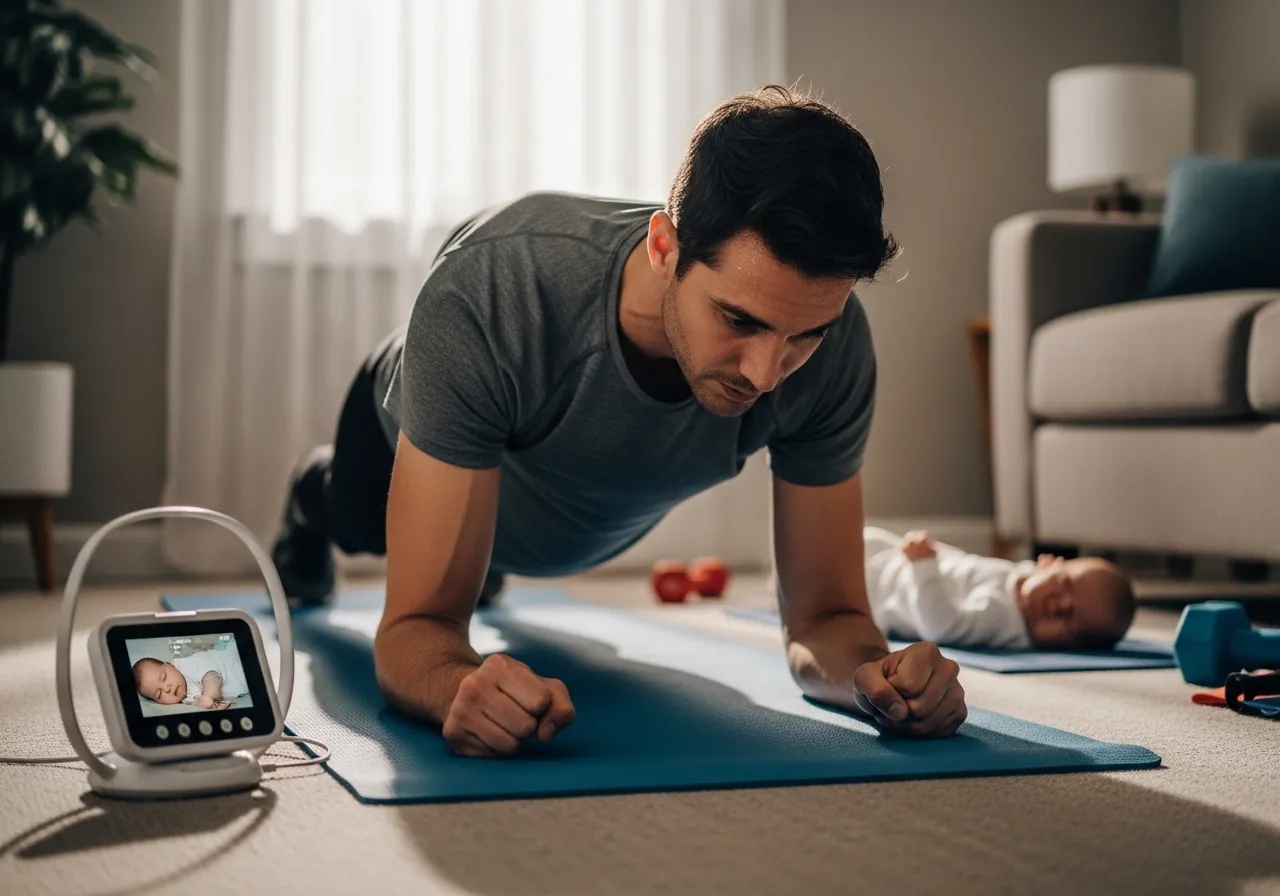
Home training with children nearby requires deliberate environment design to minimize the interruptions that erode session quality. Closing doors between the training space and child play areas, using child-gate barriers, setting up an engaging child activity station (art supplies, building blocks, a favorite show) before starting the session, and training during the portion of the child’s day when independent play is most reliable all reduce interruption frequency. Communicating with older children that training time is protected time — “Mommy/Daddy is exercising for 20 minutes, I’ll be done at 4pm, come find me if you need something but I’d like to finish my exercises” — establishes the social contract that many school-age children can understand and respect when consistently reinforced. Perfect distraction-free training is an unrealistic goal in most parent home training contexts; significantly reducing interruption frequency through environment design and communication is achievable and produces meaningfully better session quality than training in an unmanaged environment.
Nutrition Strategies for the Time-Pressed Parent
Training consistency without nutritional support produces a fraction of the results that training with adequate nutrition delivers. For parents with limited time, nutrition is often the first thing to suffer — meals become reactive, protein intake drops, and caloric management becomes an afterthought. Simple, repeatable nutritional habits that require minimal decision-making and preparation time maintain the dietary foundation that makes training productive even when life is demanding.
Batch protein preparation is the single highest-leverage nutritional habit for time-pressed parents. Cooking a large batch of chicken breast, hard-boiling a dozen eggs, or preparing a week’s worth of Greek yogurt and cottage cheese portions once per week takes 30–45 minutes and eliminates protein sourcing as a daily decision. Pre-portioned protein sources require only minutes to incorporate into any meal. Similarly, preparing a large pot of grains (rice, quinoa, oats) once per week provides the carbohydrate foundation for multiple meals without repeated cooking. These two batch preparations — protein and carbohydrates — take under an hour weekly and provide the nutritional scaffolding for consistent training fuel regardless of daily schedule chaos. The barrier to adequate nutrition as a parent is almost never knowledge of what to eat — it’s time and decision fatigue. Reducing daily nutrition decisions through weekly batch preparation addresses the actual barrier directly.
Creative Workout Windows Parents Actually Miss
Beyond nap time and early morning, parents have several training windows that are systematically overlooked because they don’t fit the traditional gym session model. The school drop-off walk — adding 20–30 minutes of brisk walking or jogging before or after drop-off — converts a mandatory daily errand into an aerobic conditioning session. Active playground participation rather than bench observation provides genuine cardiovascular and functional fitness stimulus. Lunch breaks of 20–30 minutes are an underutilized training window — a bodyweight HIIT circuit in cleared office space fits entirely within a standard break. The post-school pickup period, while children do homework, is another reliable window often spent passively rather than with intentional movement. These windows won’t replace dedicated sessions but combined add 150–300 minutes of additional weekly activity that accumulates meaningfully over months.

Involving Your Kids in Your Fitness Routine
The binary thinking that training requires separation from children — that productive exercise and childcare are mutually exclusive — prevents many parents from training that could be done with children present or actively involved. While high-intensity barbell training or focused technique work may legitimately require child-free time, a substantial portion of the training that supports fitness goals can be performed with children present, adapted for their participation, or actively integrated with their physical activity needs.
Family Active Play: Fitness That Doesn’t Feel Like Exercise
Active family play — wrestling, chase games, dancing, backyard sports, park visits with active participation rather than passive supervision — provides meaningful cardiovascular and muscular exercise stimulus while simultaneously developing children’s physical literacy and family bonds. Research on informal physical activity in adults consistently shows that accumulated moderate-intensity activity throughout the day — including active play with children — contributes meaningfully to weekly physical activity targets. A parent who engages in 30 minutes of active play with their children twice daily is accumulating 7 hours of moderate-intensity physical activity weekly — more than most adults achieve through formal exercise programs. This isn’t a complete substitute for resistance training, but it provides a cardiovascular and general fitness foundation that complements more formal training sessions efficiently.
Baby Carriers and Weighted Vest Training
For parents of infants and young toddlers, a baby carrier (structured carrier, ring sling, or wrap) transforms walks, hikes, and household activity into loaded exercise. Carrying 15–25 lbs of baby weight during a 30–45 minute walk produces significantly higher caloric expenditure and cardiovascular demand than an unloaded walk — research on loaded walking shows approximately 15–25% greater caloric expenditure per mile compared to unloaded walking at the same pace. This approach simultaneously addresses multiple parent needs (infant soothing, outdoor exposure, parent exercise) and requires no dedicated time beyond what would be spent with the child anyway. As children grow beyond carrying age, a weighted vest ($40–80) can replicate the loaded exercise benefit for walks, hiking, and bodyweight training.
Setting Up a Child-Friendly Home Training Space
A dedicated training area with child safety considerations allows training with young children present without constant supervision anxiety. Foam floor tiles ($30–60) provide safe flooring that softens falls and defines the training space. Storing equipment at height or in closed containers when not in use prevents access to items that could cause injury. Having a dedicated “helper” role for older children — timing rest periods, counting reps, performing modified versions of exercises alongside you — converts training from an exclusionary adult activity into family participation that older children often genuinely enjoy. The training quality with children present will be lower than training alone — there will be interruptions, questions, and the need for frequent attention redirection — but consistent lower-quality training far outperforms the perfectly optimal training that rarely happens because the conditions for it never reliably occur.
Sports and Activity Classes as Adult Fitness
Youth sports and activity programs that parents can participate in alongside children — family martial arts classes, parent-child yoga, community family swimming, parent-child dance classes — provide adult fitness benefits within the structure of child-centered activities. These programs exist in most communities, are often priced affordably through recreation centers and community organizations, and eliminate the binary choice between training time and family time by providing both simultaneously. For parents who struggle with the identity guilt of taking time away from family for personal fitness, parent-child activity classes resolve this tension entirely — the fitness and the family time are the same activity.
Screen Time as a Training Partner: Making Technology Work for Parent Fitness
The practical reality of parent training is that screens — tablets, phones, TVs — are frequently the childcare solution that creates the training window. A child engaged with appropriate screen content for 25 minutes creates exactly the training window a parent needs for a focused resistance training or cardiovascular session. While the debate about children’s screen time and its developmental effects is complex and nuanced, the practical use of moderate supervised screen time to enable parent exercise is a reasonable tradeoff — the parent who trains for 25 minutes during child screen time is likely a healthier, less stressed, more energized parent than the parent who never uses screens and never trains, at the same children’s screen time exposures from the child’s perspective.
Training-specific fitness content — workout videos, exercise apps, online training programs — can also improve parent training quality by eliminating the workout planning and decision-making that consumes time the parent doesn’t have. Following a structured video workout requires only execution, not programming decisions, making it an efficient choice for parents whose available mental bandwidth for training planning is low. Fitness apps that provide follow-along workout guidance, timer functions for EMOM and circuit formats, and progressive programming appropriate for home training contexts — Nike Training Club (free), Peloton app, and similar platforms — provide the programming intelligence that makes parent training more structured and progressive than the improvised approach that time pressure often creates.
Teaching Healthy Fitness Values to Children Through Your Example
Children observe parental behavior closely and form their own attitudes toward physical activity, body image, and health from what they see modeled at home. How parents talk about exercise — as punishment or obligation vs. as something valued — influences children’s developing attitudes toward their own fitness. Parents who frame their training positively (“I exercise because it makes me strong and energized”) and who include children in understanding the health benefits of activity without communicating negative body image messages are modeling a health relationship that supports children’s long-term wellbeing. Even very young children understand simple explanations: “I’m doing these to make my muscles strong so I can carry you and run around with you.” As children age, more sophisticated conversations about fitness and health build on the foundation of seeing a parent who values and regularly practices physical self-care.
Using Technology to Maintain Fitness Accountability as a Parent
Accountability is a significant driver of exercise adherence under normal conditions — and an even more critical one for parents, who face the additional burden of competing responsibilities that provide convenient justifications for skipping sessions. Technology-based accountability tools can partially substitute for the social accountability of a training partner or gym community when parenting schedule makes those options unavailable.
Fitness tracking apps that record completed workouts and display streak data create a low-friction accountability mechanism — the visible streak creates a mild psychological incentive to maintain consistency that operates even when motivation is absent. Apple Health, Google Fit, or dedicated training apps like Strong or JEFIT provide this function. Sharing workout completion with a training partner via text or a group chat — even asynchronously — replicates some of the social accountability of training together without requiring schedule coordination. Some parents find that committing to a brief daily movement minimum — 10 minutes, logged every day — maintains the habit identity during periods when full workouts aren’t consistently achievable, preventing the complete habit dissolution that makes return to exercise feel like starting from scratch.
Partner Training and Parental Fitness Support Systems
For parents with a co-parenting partner, creating a deliberate fitness support arrangement transforms training from guilt-laden solo pursuit into a mutually supported household priority. The most practical structure: each partner has 3 designated training windows per week treated as non-negotiable commitments the other partner covers childcare for. This requires an explicit conversation — the default mode for most households is that fitness gets whatever time remains after all other priorities, which in practice means it rarely gets scheduled time at all. Households that establish a mutual training support arrangement have dramatically higher training adherence rates than those negotiating training time on an ad hoc basis against competing household demands.
The Mental Health Dividend of Parental Fitness
The mental health benefits of regular exercise for parents deserve specific emphasis because parental mental health directly affects child wellbeing in ways that are well-documented in developmental psychology research. Exercise reduces cortisol, increases serotonin and dopamine, improves sleep quality, and provides the psychological experience of autonomous competence — doing something challenging and succeeding at it — that is often absent from the service-oriented demands of caregiving. Parents who exercise regularly report consistently lower rates of postpartum depression, better stress tolerance during high-demand parenting periods, and greater patience and emotional availability with their children. These benefits don’t require long or intense sessions: even 20-minute brisk walks three times per week produce measurable mood improvements in research on parental wellbeing. For parents who have historically viewed exercise as a body composition tool, reframing it as a mental health maintenance practice changes its priority status and its sustainability during periods when aesthetic motivation is low.

Mindset Shifts That Make Parent Fitness Sustainable Long-Term
The practical strategies above require a foundational mindset framework to be implemented consistently over months and years rather than abandoned when motivation fades or parenting demands intensify. Several specific mindset shifts reliably distinguish parents who maintain fitness long-term from those who cycle between intense training periods and long training absences driven by life demands.
Redefining Success: Volume-Independent Progress Metrics
Parents who define fitness success by training volume — number of days per week, total hours, session duration — will inevitably experience perceived failure during periods of parenting intensity (illness seasons, sleep regression periods, travel, family crises) when training volume drops involuntarily. Redefining success as training identity — “I am someone who moves their body in some way most days” — rather than training volume creates a relationship with fitness that can survive the inevitable disruptions of parent life. A parent who defines themselves as an exerciser who sometimes has minimal time will train through disrupted periods at whatever reduced level is achievable. A parent who defines themselves as someone who works out 5 days per week will stop identifying as an exerciser when 5-day consistency becomes temporarily impossible — and the resulting identity dissonance often leads to training cessation that extends far beyond the disrupting period.
The “Something Always Beats Nothing” Principle
Traditional fitness culture tends toward all-or-nothing thinking: a full planned session or nothing at all. This binary is destructive in the parent training context where the planned session is frequently what’s impossible but a shorter, modified version is entirely achievable. A parent who can’t execute their planned 45-minute workout but can do 15 minutes of push-ups, squats, and a run in place should do the 15 minutes without guilt or mental accounting of what they “should” have done. Research on training consistency shows that maintaining the training habit during constrained periods — even at dramatically reduced volume — is more important for long-term outcomes than the specific training quality of individual sessions. The habit continuity maintained through 15-minute “something” sessions during difficult periods prevents the complete detraining and habit extinction that multi-week training gaps produce.
Strategic Expectation Management: Seasonal Fitness Cycles
Parent fitness planning that acknowledges seasonal variation in training capacity produces better long-term outcomes than planning that assumes constant availability and consistently fails when reality diverges from plan. Parents of young children have predictable high-capacity and low-capacity training periods: summer and school breaks are typically lower capacity (more childcare responsibility, less schedule structure); back-to-school periods and school-year routines provide more predictable training windows. Planning for higher training volume during high-capacity seasons and protecting minimum effective dose training during low-capacity seasons — rather than attempting identical training year-round and experiencing repeated planned-vs-actual training disappointment — creates a more sustainable rhythm that acknowledges life reality without abandoning fitness goals.
Partner Integration: Building Mutual Support for Training
For parents with partners, the logistics of training access are significantly affected by whether both partners’ fitness needs are explicitly planned and mutually supported. “Trading childcare” — explicit scheduling where each partner has protected training time while the other manages child coverage — is more effective than implicitly expecting that training time will be found independently. Many parent couples fall into the pattern where neither partner explicitly takes training time because each feels guilty claiming it when the other is managing children — the result is both partners sacrificing fitness without the explicit conversation that would reveal their shared willingness to support each other’s training needs. Direct conversation about training scheduling as a family logistics issue — with both partners’ needs explicitly on the table — typically reveals more mutual willingness to support each other’s training than the implicit avoidance pattern allows.
Recovery for Parent Athletes: When Sleep Isn’t Optimal
The single largest recovery challenge for parent athletes — particularly parents of infants and young toddlers — is sleep disruption. The relationship between sleep quality and athletic recovery is direct and significant: growth hormone secretion, muscle protein synthesis, CNS recovery, and cortisol management all depend on adequate deep sleep that fragmented infant-care nights cannot provide. For parents in the sleep-disrupted phase, training adaptation is limited not by programming inadequacy but by physiological recovery constraint — the body cannot rebuild and adapt at the same rate as when sleep is uninterrupted.
Adapting training to sleep-disrupted periods: reduce training intensity and volume to approximately 60–70% of normal levels, avoid high-intensity training during periods of significant cumulative sleep deficit, prioritize maintenance over progression, and accept that training performance will be inconsistent and below normal capacity without interpreting this as training failure. The goal during sleep-disrupted periods is maintaining the training habit and keeping the physical system minimally deconditioned — not progressing at the rate that well-rested training enables. The periods of better sleep that follow (as children sleep longer and more consistently) will allow rapid fitness rebuilding from a base maintained through sleep-disrupted consistency, rather than rebuilding from complete detraining.
Napping when the baby naps — rather than training during every nap — is sometimes the highest-value recovery intervention a sleep-deprived parent can make. The decision between training and sleeping during any given opportunity should be made based on cumulative sleep deficit: if sleep deprivation is severe and accumulating, one or two recovery naps per week during what would otherwise be training windows may produce better long-term training outcomes than training through severe sleep deprivation that increases injury risk and prevents adaptation from the training that is being done. Listening to the body’s genuine recovery needs during the most demanding parenting phases — and temporarily prioritizing sleep recovery over training volume — is not giving up on fitness; it is sophisticated self-management that protects the long-term training habit.
The Identity Investment: Becoming a Parent Who Exercises
Beyond the practical strategies discussed throughout this article, the deepest and most important parent fitness intervention is identity-level: becoming someone who identifies as physically active regardless of current fitness level, training volume, or circumstance. Identity-based habits are dramatically more resilient to the disruptions of parent life than motivation-based habits. Building this identity requires extending it to include “someone who keeps trying to exercise even when conditions are hard” — not “someone who exercises X days per week with perfect consistency.” The parent who misses two weeks of training due to a child illness and returns to training the following week is maintaining the identity of a physically active person. The parent who concludes “I’ve failed, I’ll restart when things settle down” allows circumstantial disruption to rewrite their identity permanently. Identity maintenance through imperfect consistency is the single most valuable parent fitness investment available.
Involving Kids in Your Fitness Routine
One underutilized strategy for parental fitness is converting the parenting obligation itself into the training environment. Children — particularly those under 8 years old — are generally enthusiastic about participating in physical activity with their parents, and this enthusiasm can be channeled into workouts that are simultaneously training sessions and quality time investments.
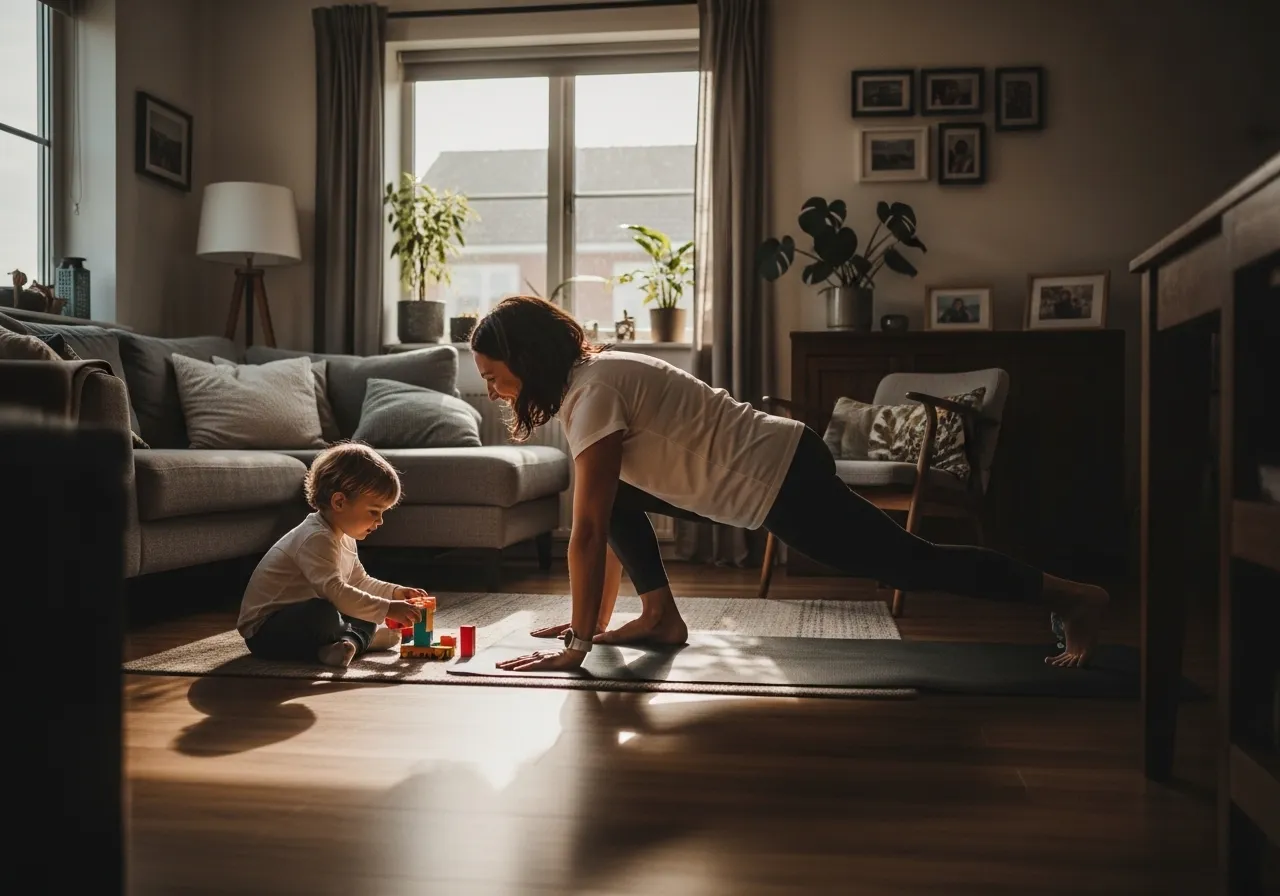
Toddlers and preschoolers make surprisingly effective training partners for bodyweight work. A toddler sitting on your back during push-ups adds 25–35 lbs of resistance. A child doing “count with me” during squats stays engaged while the parent completes working sets. Outdoor play — chasing, wrestling, playing at the playground — is genuine physical activity for parents when engaged fully rather than observed from a bench. Older children can be introduced to actual training concepts: a 7-year-old can learn bodyweight squats, push-up progressions, and simple agility work in a context framed as play and shared activity. These joint sessions develop the child’s relationship with physical activity while providing the parent with training stimulus — dual-purpose time use that the chronically time-pressed parent genuinely needs.
The research on children who exercise with parents versus those who observe parents exercising shows that participatory experience produces stronger physical activity habits than observational modeling alone. Both are valuable; combining them — exercising in front of your children and occasionally with them — maximizes the family fitness culture benefit across both pathways simultaneously.
Tracking Progress as a Parent: Realistic Metrics
Standard fitness progress metrics — weekly weigh-ins, monthly measurements, strength benchmarks — remain valid for parents but need to be evaluated against a realistic baseline of what parental life constraints allow. A parent who maintained strength and body composition through the first year of an infant’s life while sleeping 5–6 hours per night and training 2–3 times per week has achieved something genuinely impressive — more impressive, physiologically, than a childless person who trained optimally under normal conditions. Normalizing progress metrics to the actual constraints of the life phase prevents the demoralization that comes from comparing parental-constraint results to optimal-condition benchmarks. Monthly progress photos, strength benchmarks on key exercises, and energy and mood self-assessment provide useful parental fitness progress data that accounts for life context rather than ignoring it.
The Community Dimension of Parental Fitness
One often-overlooked dimension of parental fitness is the social and community aspect that gym environments and group fitness classes provide — and that parents frequently lose access to during the years of most intensive caregiving. The accountability, social connection, and shared struggle of a regular fitness community are genuinely valuable for adherence and motivation in ways that solo training at home cannot fully replicate. Parents who find parenting-compatible fitness communities — early morning bootcamps where childcare isn’t needed, stroller fitness classes, parent-and-child yoga sessions, online fitness communities with async accountability — maintain fitness at higher rates than those training in pure isolation. Seeking out or building these communities, even informally through text accountability with another parent friend, addresses the social dimension of fitness that makes the solo home workout approach feel sustainable long-term rather than isolating.
Building a Realistic Weekly Training Plan as a Parent
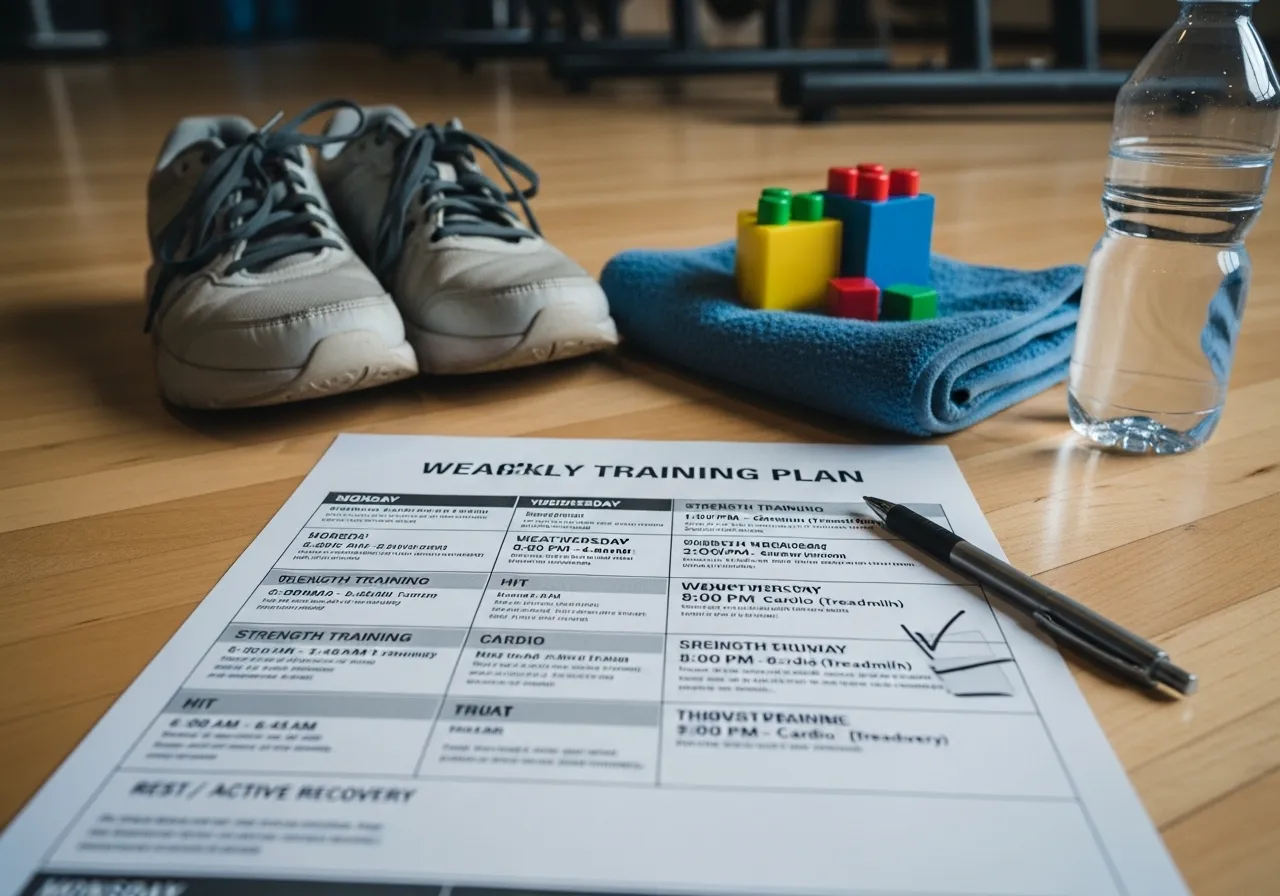
The following weekly training structure is designed for the specific realities of parent life: limited and irregular time windows, home training as the primary training environment for many sessions, high value on compound movements that provide maximum stimulus per time invested, and the need for genuine flexibility that allows the plan to adapt to parenting demands without being abandoned when circumstances change.
The 3-Day Minimum Effective Parent Training Plan
Three training sessions per week is the evidence-based minimum for maintaining and modestly improving fitness while meeting the time constraints of active parenting. Each session targets 20–35 minutes and focuses on compound movements that cover all major muscle groups. Session A (Upper Body Focus): push-up or dumbbell press variation (3×10), row or pull-up variation (3×10), overhead press variation (2×12), and 2 minutes of core work. Session B (Lower Body Focus): squat variation (3×10), hip hinge variation (3×10), lunge variation (2×10 per side), and 2 minutes of core work. Session C (Full Body Conditioning): EMOM or circuit format combining both upper and lower body movements for cardiovascular conditioning and full body muscular stimulus. Alternating A-B-C across three non-consecutive days per week provides comprehensive training stimulus in the minimum time investment that produces meaningful fitness outcomes.
Adding Flexibility: The Modular Weekly Plan
Rather than scheduling training on specific fixed days (which in parent life will frequently be disrupted), modular planning assigns training “slots” to windows in the week without specifying exact days. The goal is 3 slots completed by Sunday: one before or after a school/daycare drop-off, one during a reliable nap or quiet time, and one after children’s bedtime. If a planned slot is disrupted by a child illness, schedule change, or family demand, the slot is moved to the next available window rather than skipped — the weekly target is maintained by flexibility rather than rigidity. This slot-based approach maintains weekly training volume targets while accommodating the schedule unpredictability that fixed-day planning cannot survive in the parent context.
Progressive Overload in Parent Training: How to Keep Improving
Progressive overload — the consistent increase of training stimulus over time — remains the fundamental driver of continued fitness improvement, even within the time and equipment constraints of parent training. For home training with limited equipment, progression looks different from gym-based loading progression: advancing from easier to harder exercise variations (from push-ups to archer push-ups to one-arm push-up progressions, from bodyweight squats to pistol squats), adding reps before adding difficulty, reducing rest periods to increase training density, and adding load through resistance bands or dumbbells where available. These progression methods produce continued adaptation without requiring the weight room access that traditional progressive overload assumes. Tracking sessions — even a brief notes app entry of exercises completed and rep counts — makes progression visible and maintains the progressive overload mindset in the absence of the direct weight loading progression that gym-based training makes obvious.
Nutrition for Parent Athletes: Practical Strategies for Limited Time
Nutrition quality for parent athletes faces similar time constraints to training — elaborate meal preparation and precise macro tracking are often incompatible with the demands of feeding children, managing household food logistics, and finding time for personal nutrition within the family food system. The most practical nutrition approach for parents combines: high-protein defaults that don’t require tracking (eggs, Greek yogurt, cottage cheese, canned fish, lean meat at most meals), batch cooking of protein and grain components once weekly, and acceptance of nutritional imperfection without the perfectionism that leads to abandonment of good habits when the ideal isn’t achievable. The parent who consistently eats protein at most meals and prioritizes whole foods when available, while accepting flexibility when family logistics require it, will achieve better long-term nutrition outcomes than the parent who attempts strict tracking and clean eating, fails to maintain it during demanding parenting periods, and abandons good habits entirely rather than accepting imperfect consistency.
Frequently Asked Questions About Fitness as a Parent
How do I get started if I’ve been completely inactive since having kids? Start with the minimum: two 20-minute sessions per week of whatever movement you can reliably access. Don’t attempt to return to pre-parenting training volume immediately — consistency at reduced volume reestablishes the habit and allows gradual rebuilding without the injury risk of rapid return to previous training loads. Two sessions per week for one month, then three sessions, then gradually increasing session duration as schedule and recovery capacity permit.
Is it okay to exercise while pregnant or postpartum? Exercise during pregnancy and postpartum should be guided by your healthcare provider, as individual circumstances vary significantly. Generally, moderate exercise is safe and beneficial during uncomplicated pregnancies, and postpartum return to exercise should be gradual with specific attention to pelvic floor recovery and diastasis recti evaluation before returning to high-impact activities. A pelvic floor physical therapist consultation is valuable for many postpartum parents regardless of birth type.
What if my child never allows me any time to train? This is most common with infants under 4 months who have highly irregular schedules and high-contact needs. During this period, maintaining the identity of someone who values movement — through walks with the baby in a carrier, stretching during feeds, and brief bodyweight exercises when opportunities arise — is more important than specific training volume. This phase is temporary; building the training habit identity during a period when full training is impossible makes returning to regular training easier when the window opens.
Long-Term Parent Fitness Vision: What You’re Building Toward
The parent fitness journey is a long game — not just in the sense that fitness results take time, but in the sense that the habits, identity, and physical capability built during the demanding early years of parenting pay dividends across decades of family life. The parent who maintains consistent fitness through the challenging infant and toddler years enters the school-age and adolescent years of parenting with established training habits, preserved physical capability, and a body composition that hasn’t accumulated the “parenting weight” that gradual inactivity and stress eating produce in many parents during this period.
The school-age years, when children are in school for 6–7 hours daily and increasingly capable of independent activity, provide an expanding training window that well-established parent fitness habits can exploit. Parents who built and maintained training habits during the constrained early years find that expanding training availability with school-age children feels like an opening of possibility rather than a restart from zero. They don’t face the challenge of rebuilding habits from complete inactivity — they face the more manageable challenge of extending and optimizing habits that have been maintained, however imperfectly, through the most demanding years.
The adolescent years bring their own demands and opportunities: active sports participation with teenage children, family fitness activities (hiking, cycling, recreational sports), and the increasingly peer-influenced fitness behavior of teenagers who see active, healthy parents modeling the behaviors they’re being encouraged to adopt. Research on family fitness behavior consistently shows intergenerational transmission — the physical activity level and fitness identity of parents is one of the strongest predictors of children’s adult physical activity behavior. The fitness investment you make as a parent is not just a personal health investment; it is part of the environment that shapes your children’s lifelong relationship with health and physical capability.
Twenty years from now, the parent who maintained fitness through the demanding early years will be in their 40s, 50s, or 60s with preserved muscle mass, cardiovascular fitness, and bone density that active aging requires — and with grandchildren who will encounter a grandparent capable of playing actively with them. The parent who deferred fitness until a better time will be managing the health consequences of extended physical inactivity at the stage of life when rebuilding fitness is most challenging and most consequential. The 20 or 30 minutes of parent fitness that feels impossible today is building toward this long-term outcome — one session at a time, however imperfect and however brief, across the months and years of one of life’s most demanding but most meaningful roles.
Community and Accountability in Parent Fitness
Social support significantly improves exercise adherence in all populations, and parents specifically benefit from community with other parents who understand the specific challenges of training around childcare demands. Running groups, parent fitness classes, online communities of parent athletes, and training partnerships with other parents create accountability and motivation structures that purely individual training cannot provide. Finding even one training partner who shares the parent fitness challenge — and committing to check-in accountability — dramatically improves training consistency during difficult periods when individual motivation is insufficient to overcome the competing pull of parenting demands.
Online parent fitness communities on platforms like Reddit (r/fitness, r/running, r/bodyweightfitness with threads for parent athletes), Instagram (where parent athlete accounts provide both inspiration and practical strategies), and dedicated parent fitness platforms provide the community support and practical strategy sharing that parents in previous generations had to figure out independently. The collective problem-solving available in these communities — “how do you handle training when your toddler stops napping?”, “what’s the best home workout I can do with a baby strapped to me?”, “how do I get back into training 8 weeks postpartum?” — represents a resource that makes the specific parent fitness challenges that feel uniquely personal into shared problems with community-tested solutions.
Long-Term Vision: Fitness Through Every Parenting Phase
Parenting phases change, and the fitness strategies that work in each phase look different. The infant phase — characterized by severe sleep deprivation, breastfeeding demands, and near-total schedule unpredictability — requires the minimal viable workout approach: short, flexible, home-based, with intensity reduced to match energy availability. The toddler phase introduces more predictable nap schedules but adds the challenge of a mobile, curious child who cannot safely be left unattended. The school-age phase opens substantial training windows — school hours, after-school activities, sports practices — that restore more conventional training options. The teenage phase may bring children who want to train alongside you, creating an entirely new category of joint training opportunity.
Understanding these phase-specific constraints prevents the common mistake of applying the same fitness strategy across all parenting phases. Parents who successfully maintained fitness through the infant phase with minimal-viable home workouts sometimes struggle to transition to more structured training when the toddler phase provides longer windows — because they haven’t updated their strategy to match the new opportunity. Building a phase-aware fitness plan that explicitly addresses what the current parenting phase allows and what the next phase will enable creates a long-term fitness trajectory that evolves with the family rather than fighting against its changing demands.
The long view is essential: the parent who maintains some level of fitness consistently across every parenting phase — even imperfectly, even minimally during the hardest periods — arrives at the empty nest phase in incomparably better physical condition than the parent who surrendered fitness during demanding years and attempted to rebuild at 50. Consistency across decades, not perfection in any individual phase, is the fitness metric that matters most for lifelong health.
Frequently Asked Questions About Working Out as a Parent
How long do I need to work out to see results as a busy parent? Research on minimal effective dose for exercise adaptation consistently shows that 3 sessions per week of 20–30 minutes each produces meaningful cardiovascular and strength adaptations. This is approximately 75–90 minutes of training per week — far less than the perception that effective training requires hour-long daily sessions. Setting this realistic expectation removes one of the primary barriers to starting or restarting fitness as a parent.
What if I miss a week of workouts? Missing a week of training due to a sick child, a family emergency, or a period of extreme exhaustion produces negligible fitness loss. Physiological detraining begins in earnest after approximately 2–3 weeks of complete inactivity. A missed week is not a setback — it’s a recovery period that often results in better performance when training resumes. The habit maintenance concern is more relevant than any physical fitness concern from a single missed week.
Is it safe to exercise while sleep deprived? Low-to-moderate intensity exercise (walking, yoga, light resistance training) is safe during sleep deprivation and often improves energy and mood through endorphin release and increased circulation. High-intensity training, maximal strength work, and complex exercises requiring good coordination and balance are less safe when severely sleep deprived due to impaired reaction time and motor control. Adjust intensity to match energy and alertness state rather than following a fixed program regardless of sleep status.
Adapting When Life Gets Unpredictable
Even the best-designed parental fitness system will be disrupted regularly by sick children, schedule changes, family emergencies, and the general unpredictability of life with kids. Having a pre-decided adaptation protocol prevents these disruptions from becoming extended fitness breaks. The protocol: when a planned session can’t happen, immediately identify the smallest possible replacement — a 10-minute bodyweight circuit, a 15-minute walk, 5 minutes of stretching. This replacement isn’t adequate training; it’s habit maintenance under adverse conditions. The psychological difference between “I did something” and “I missed today completely” is significant for habit continuity, even when the something was minimal. Parents who have an explicit adaptation protocol for disrupted days maintain training habits through periods of family chaos that derail parents without such protocols, emerging from the disruption with a habit intact rather than needing to restart from zero.
Setting a Sustainable Long-Term Fitness Baseline
The most important fitness decision a parent can make is not which program to follow or which exercises to prioritize — it is establishing a sustainable minimum baseline that will be maintained regardless of what else is happening in life. For most parents, this minimum baseline is 2–3 sessions per week of 20–30 minutes each, at whatever intensity the current life phase supports. This baseline is not the ceiling of what’s possible during easy periods — it’s the floor that doesn’t get violated during hard ones. Parents who define and commit to this baseline produce more consistent long-term results than those who alternate between ambitious programs during good periods and complete inactivity during hard ones. The baseline maintained consistently for years is worth more than any optimal program executed intermittently.
Parents who reach their 50s having maintained fitness through the demanding child-rearing decades consistently report that the habit continuity — not any particular program or peak performance period — was the determining factor in their long-term health outcomes. Start with what the current phase allows. Protect that minimum. Build when conditions permit. This is the parental fitness strategy that actually works across a decade of changing family demands.