5 High-Protein Breakfast Ideas for Busy Mornings
⚠️ Disclaimer: The information in this article is for general educational purposes only and does not constitute medical, nutritional, or professional fitness advice. Individual results may vary. Always consult a qualified healthcare professional or certified fitness trainer before starting any new exercise program, changing your diet, or making decisions about injury treatment or recovery. If you experience pain, discomfort, or any unusual symptoms during exercise, stop immediately and seek professional guidance.
Why High-Protein Breakfasts Are the Foundation of a Muscle-Building Diet
For the first several years of serious training, I treated breakfast as optional — a meal I ate when hungry and skipped when rushed, fueling morning sessions with black coffee and the vague intention of eating “later.” My protein intake was adequate by day’s end but the distribution was terrible: two enormous protein-heavy meals in the afternoon and evening, a protein-light lunch, and no morning protein at all. When I finally started tracking not just total daily protein but the timing of each feeding, the pattern was obvious — I was spending 8–10 hours fasted overnight and then extending that fasted state through the morning, missing hours of potential anabolic activity before finally breaking the fast at noon with whatever was convenient. Shifting to a deliberate high-protein breakfast within 90 minutes of waking produced noticeably better recovery and energy within two weeks — not a placebo effect, but a measurable change in how morning training sessions felt and how soreness resolved between sessions.
The science behind that personal experience is straightforward and well-documented. Overnight fasting creates a net muscle protein breakdown state by morning — your body has been repairing and synthesizing proteins throughout the night but running on stored amino acids rather than dietary protein, and by morning the amino acid availability that supports this synthesis is depleted. A high-protein breakfast reverses this catabolic state by rapidly elevating plasma amino acids, triggering the mTOR signaling cascade that initiates muscle protein synthesis, and establishing the positive nitrogen balance that net muscle gain requires. The longer you extend the overnight fast without protein, the longer this breakdown-favoring state persists. For athletes training in the morning, a high-protein pre-workout breakfast also directly improves session performance by providing amino acids that blunt exercise-induced protein breakdown during the session itself.
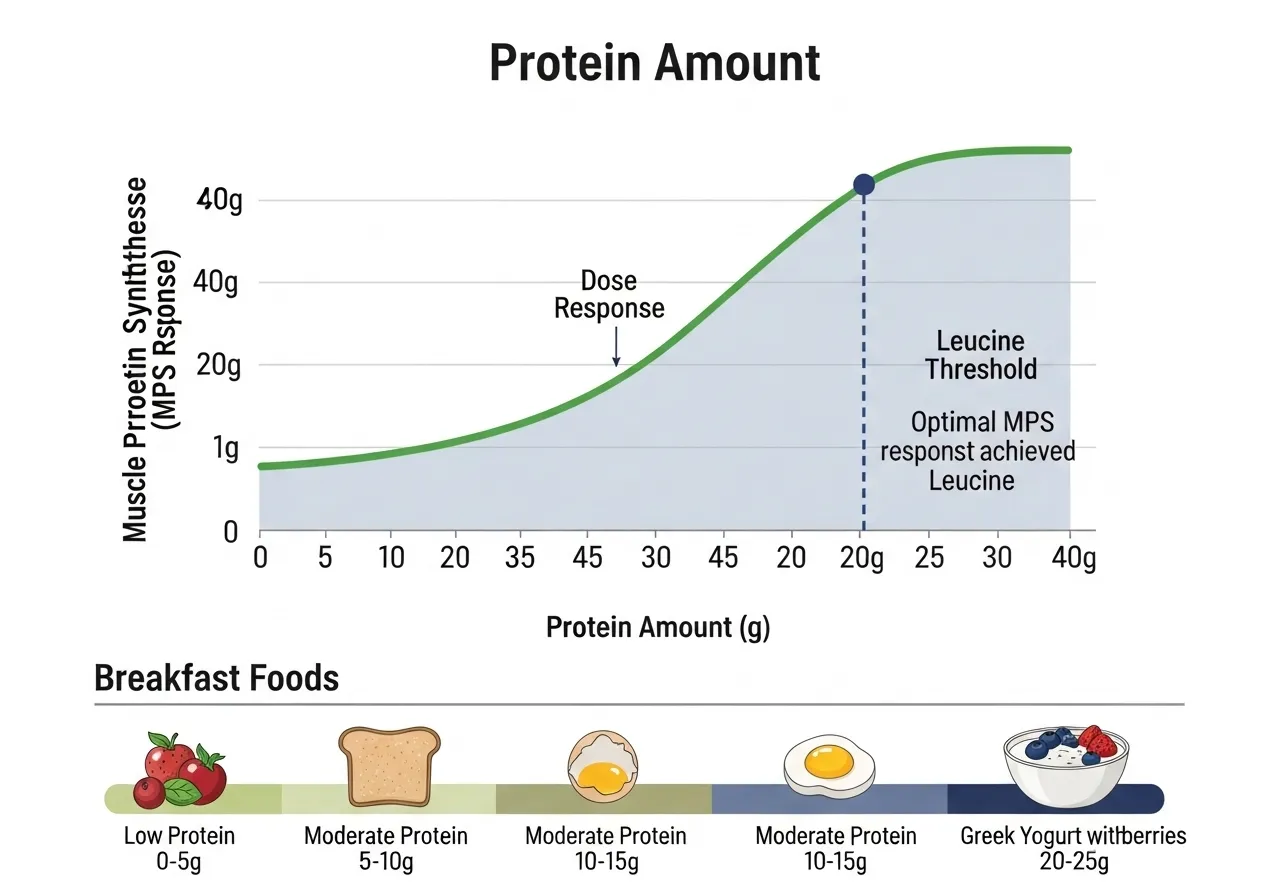
The Leucine Threshold: Why 30g Matters More Than 10g
Not all protein breakfasts are equally effective at triggering muscle protein synthesis. The key variable is leucine content — the branched-chain amino acid that directly activates mTOR-dependent protein synthesis signaling. Research from NIH studies on leucine and mTOR signaling has established that each protein feeding requires approximately 2–3g of leucine to maximally stimulate synthesis, which corresponds to roughly 25–35g of complete protein from most animal sources. A breakfast containing 10g of protein — a single egg, a small yogurt, a light protein smoothie — provides approximately 0.8–1g of leucine, which is below the threshold for maximal synthesis stimulation. A breakfast containing 35g of protein — three eggs with Greek yogurt, a protein shake with milk, cottage cheese with nuts — provides 2.5–3.5g of leucine, which crosses the threshold and produces the full anabolic response. The difference between a 10g breakfast and a 35g breakfast is not proportional additional benefit — it is the difference between a subthreshold response and a maximal one.
This leucine threshold finding has a practical implication that runs counter to common breakfast habits: a large glass of milk and a piece of toast provides approximately 12g of protein and does minimal anabolic work despite being a protein-containing meal. Breakfast cereals marketed as “high protein” at 8–10g per serving similarly fall short. The threshold requires real commitment to protein at breakfast — three eggs, a significant serving of Greek yogurt or cottage cheese, a protein shake, or a combination. Meeting this threshold at breakfast is the single most impactful nutritional upgrade most people who train can make, because it converts the first meal of the day from a subthreshold non-stimulus into a full anabolic trigger.
Satiety, Caloric Control, and Body Composition Benefits
High-protein breakfasts provide body composition benefits beyond their direct anabolic effects through their superior satiety properties compared to carbohydrate or fat-dominant breakfasts. Research published in the Journal of Nutrition on breakfast macronutrient composition and hunger regulation consistently finds that high-protein breakfasts reduce mid-morning and pre-lunch hunger, reduce the frequency and caloric size of snacking, and produce lower total daily caloric intake without conscious restriction compared to isocaloric carbohydrate-rich breakfasts. The mechanism is multi-factorial: protein stimulates greater secretion of GLP-1 and peptide YY (satiety hormones) and greater suppression of ghrelin (the hunger hormone) than equivalent calories from carbohydrates or fat; protein requires more energy to digest (its thermic effect is 20–35% of protein calories vs 5–10% for carbohydrates); and the sustained amino acid release from complete protein sources maintains satiety longer than rapidly digested carbohydrates. For athletes managing body composition alongside training, these satiety effects make high-protein breakfasts a passive caloric control tool — not a strategy that requires willpower, but a meal structure that naturally reduces caloric intake throughout the day.
Performance and Cognitive Benefits of Morning Protein
Beyond muscle protein synthesis and satiety, high-protein breakfasts produce cognitive and physical performance benefits that matter for morning training and for work or academic performance afterward. Tyrosine — an amino acid abundant in protein-rich foods — is a precursor to dopamine, norepinephrine, and epinephrine (the catecholamines that drive alertness, focus, and motivation). Research on tyrosine supplementation and cognitive performance under stress and fatigue finds improvements in working memory, attention, and mood — effects that dietary protein intake can partially replicate by providing the raw material for catecholamine synthesis. The practical experience of this is the sustained mental clarity that a protein-and-fat breakfast produces compared to the energy spike and crash of a high-carbohydrate cereal breakfast, which reflects the combined effects of stable blood glucose and adequate catecholamine precursor availability.
For morning training specifically, consuming protein before a session (even if the pre-workout meal is a complete breakfast rather than a pre-workout snack) provides circulating amino acids that reduce the muscle protein breakdown that exercise induces. An athlete who trains at 7am after a high-protein breakfast at 6am is providing their muscles with amino acid availability throughout the session; an athlete who trains fasted is relying entirely on stored amino acids and will have higher net muscle protein breakdown during the session. Over weeks and months of consistent training, this difference in peri-workout amino acid environment contributes meaningfully to cumulative muscle protein synthesis and adaptation outcomes.
The Time Problem and Why It’s Solvable
The most common reason people cite for skipping high-protein breakfasts is time — mornings are rushed, preparation takes too long, and the convenience of grabbing a granola bar on the way out the door wins by default. This is a real barrier, but it is a preparation and planning problem rather than an inherent limitation of high-protein breakfast foods. The five recipes in the next section are specifically designed to address the time barrier — each takes under 15 minutes to prepare, and with basic meal prep strategies, several can be prepared in advance and assembled in under 5 minutes on busy mornings. The planning investment of 30–60 minutes of Sunday meal prep produces 5 weekdays of convenient, high-protein breakfasts that require no meaningful morning time. The time problem is solvable; the solution is preparation, not settling for low-protein convenience foods that undermine the morning’s anabolic potential.
Blood Sugar Regulation and the High-Protein Breakfast Advantage
One of the most practically noticeable benefits of switching from a carbohydrate-dominant to a protein-dominant breakfast is the improvement in blood sugar stability throughout the morning. High-carbohydrate breakfasts — cereals, toast, pastries, fruit juice — produce rapid blood glucose elevation followed by an insulin-driven decline that often overshoots baseline, creating the mid-morning energy slump and hunger spike that sends people reaching for snacks or coffee within 2 hours of eating. High-protein breakfasts produce a more gradual and stable blood glucose response because protein digests more slowly than simple carbohydrates, stimulates insulin secretion more modestly, and provides a lower glycemic load per calorie. The practical result is sustained morning energy without the spike-and-crash cycle — a benefit that extends beyond athletic performance into work productivity, concentration, and mood stability through the morning hours.
For athletes managing body composition, this blood glucose stability provides passive caloric control: stable blood glucose reduces the frequency and intensity of between-meal hunger, reducing the caloric intake of mid-morning snacks and pre-lunch grazing that can significantly increase total daily intake without feeling like overeating. Research comparing caloric intake throughout the day in high-protein versus high-carbohydrate breakfast groups consistently finds lower total daily caloric intake in the high-protein group — not because they are restricting themselves, but because their blood glucose and satiety hormone profiles naturally suppress appetite more effectively through the morning and into the lunch period.
High-Protein Breakfast and Long-Term Habit Formation
Building the high-protein breakfast habit requires addressing the friction points that cause people to revert to low-protein convenience foods when time pressure or low motivation strikes. The most effective long-term habit strategy is reducing the decision-making required for breakfast by establishing a small rotation of 2–3 high-protein breakfasts that you actually enjoy and cycling through them on a predictable schedule. Decision fatigue is a real barrier — when the question of “what to eat for breakfast?” requires fresh deliberation every morning, the answer trends toward whatever is easiest rather than what is best. Removing the decision by pre-deciding Monday and Tuesday are overnight oats days, Wednesday and Thursday are egg scramble days, and Friday is burrito day transforms breakfast from a daily decision into an automatic execution of a pre-made plan. This predictability is not monotony — it is the behavioral structure that makes consistent high-protein breakfast execution possible across months and years of varying motivation levels.
The Science of Morning Anabolic Resistance and How to Overcome It
Morning represents a unique anabolic challenge: the overnight fasted state creates anabolic resistance — a reduced sensitivity of muscle protein synthesis machinery to the amino acid stimulus — that means the first protein feeding of the day needs to be both higher in leucine and consumed promptly after waking to overcome this resistance effectively. Research has demonstrated that elderly individuals have greater morning anabolic resistance than younger adults, requiring higher per-meal leucine doses to achieve the same synthesis response — but even in younger athletes, the fasted state reduces the anabolic efficiency of protein feedings compared to the fed state. Practically, this means that the first 30–45g of protein consumed in the morning reverses the anabolic resistance more effectively than equivalent protein consumed when already in a fed state — making breakfast the highest-return protein meal of the day in terms of the synthesis stimulus produced per gram of protein consumed. Delaying the first protein feeding extends the anabolic resistance period and reduces the cumulative synthesis benefit of that protein compared to consuming it earlier. Wake, hydrate, eat protein — in that sequence, within 60–90 minutes of rising.
My Personal High-Protein Breakfast Rotation
After years of experimenting with breakfast protein strategies, my current rotation reflects the simplest approach that consistently hits protein targets without requiring more than 5 minutes of morning preparation. Monday and Tuesday: overnight oats prepared Sunday evening (50g protein, zero morning effort). Wednesday and Friday: three-egg scramble with cottage cheese and vegetables, served with fruit (40g protein, 8 minutes). Thursday: Greek yogurt bowl with whey protein stirred in, granola, and berries (42g protein, 4 minutes). Weekend: breakfast burrito using batch-cooked ground turkey from the week’s Sunday prep (45g protein, 10 minutes). This five-option rotation covers the full week, keeps preparation time minimal, provides variety that prevents monotony, and hits 40–50g of protein at every breakfast without exception. The recipes are not novel — they are reliable, enjoyable, and executable consistently. Consistency, not novelty, is the property that makes a breakfast strategy effective over years rather than weeks.
Five High-Protein Breakfast Recipes You Can Make in Under 15 Minutes
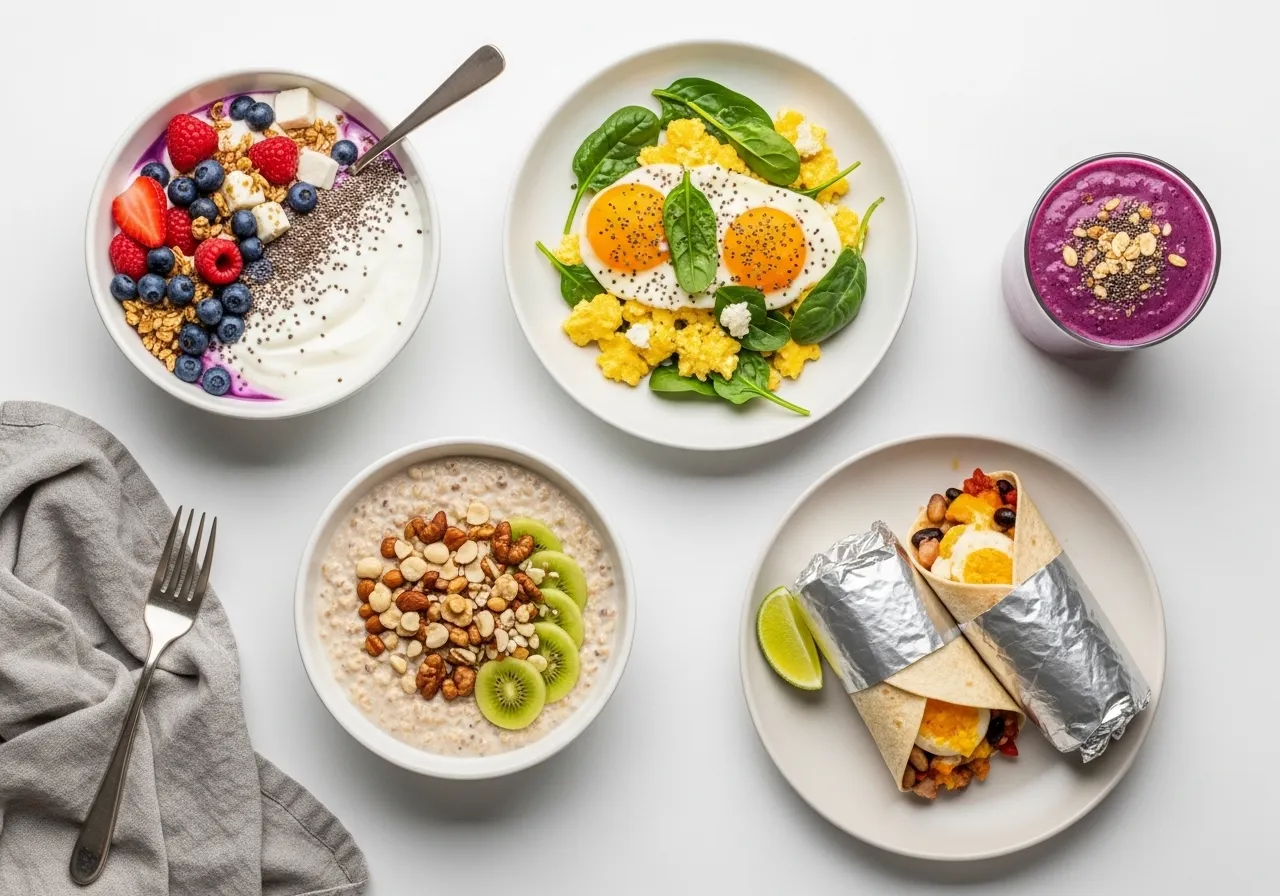
These five recipes are designed around three criteria: minimum 35g of protein per serving, preparation time under 15 minutes (under 5 minutes with basic prep), and practical ingredient lists that work with normal grocery shopping habits. Each recipe includes the protein breakdown so you can verify the numbers, variations for different dietary preferences, and notes on which components can be prepped in advance to reduce morning preparation time. I rotate through all five regularly and have tested preparation times with the ingredients in a typical home kitchen — the times listed are realistic, not optimistic.
Recipe 1: Greek Yogurt Power Bowl (5 minutes, 42g protein)
The Greek yogurt power bowl is the highest-convenience, lowest-cook-time high-protein breakfast available. Base: 200g of full-fat or 2% Greek yogurt (18–22g protein depending on brand). Protein boost: one scoop of unflavored or vanilla whey protein powder mixed into the yogurt (20–25g additional protein). Toppings: a handful of granola (15–20g), mixed berries (fresh or frozen and thawed), a drizzle of honey, and a tablespoon of chia seeds. Total protein: 40–45g, 500–550 calories. Preparation: 3–4 minutes to assemble, zero cooking. The key is using strained Greek yogurt (not regular yogurt, which has significantly less protein per serving) and not skipping the protein powder addition — the yogurt alone at 18–22g is below the leucine threshold and the protein powder addition is what brings the meal into anabolic territory.
Variations: substitute cottage cheese for Greek yogurt (similar protein content, different texture — cottage cheese has a slightly higher leucine ratio). Use casein protein powder instead of whey for a slower-digesting protein source with extended satiety. Replace granola with low-sugar alternatives (hemp seeds, pumpkin seeds) for a lower-carbohydrate version. The base structure — high-protein dairy plus protein powder plus toppings — accommodates nearly infinite variation while maintaining the protein content that makes it effective.
Recipe 2: The 3-Egg Scramble with Cottage Cheese (10 minutes, 38g protein)
Three whole eggs scrambled with half a cup of cottage cheese produces a scrambled egg texture that is creamier than eggs alone while significantly boosting protein content. Method: whisk 3 whole eggs with salt, pepper, and preferred herbs, then fold in 120g of cottage cheese just before the eggs finish cooking — the cottage cheese melts into the egg mixture, adding protein and creating a creamier texture than eggs alone. Serve with 2 slices of whole grain toast for carbohydrates and one piece of fruit. Protein breakdown: 3 whole eggs (18g), 120g cottage cheese (14g), bread (6g) = 38g total protein. Preparation: 8–10 minutes including pan heating time. The addition of cottage cheese to scrambled eggs is the most underrated protein density upgrade in breakfast cooking — it adds approximately 14g of protein for 30 seconds of additional preparation time.
Upgrade options: add a handful of spinach and diced vegetables to the scramble for micronutrient density without meaningful caloric addition. Include smoked salmon (30g provides an additional 6–8g protein) folded in at the end for an omega-3-rich variation. Prepare the vegetable mix in advance (diced peppers, onions, spinach in a container in the fridge) to reduce morning preparation to under 5 minutes.
Recipe 3: Overnight Protein Oats (5 minutes active prep, ready in the morning)
Overnight oats are the meal prep champion of high-protein breakfasts — 5 minutes of assembly the night before produces a ready-to-eat breakfast requiring zero morning preparation beyond opening the refrigerator. Recipe for one serving: combine 80g rolled oats, one scoop of protein powder (vanilla works well), 250ml of milk (whole or 2%), 100g of Greek yogurt, one tablespoon of chia seeds, and preferred mix-ins (peanut butter, cacao nibs, berries) in a jar or container. Mix, seal, refrigerate overnight, and eat cold or briefly microwaved in the morning. Protein: oats (10g), protein powder (22g), milk (8g), Greek yogurt (10g) = approximately 50g of protein. Caloric content: 600–650 calories depending on additions — a complete breakfast meeting both protein and caloric needs for most active adults.
The overnight oats format is the single most effective solution to the “I don’t have time for breakfast” problem because all of the preparation occurs the night before. Sunday preparation of five jars takes under 30 minutes and produces five complete breakfasts. The jars stay fresh in the refrigerator for up to 5 days, making Monday-to-Friday breakfast completely automated. Variations: chocolate protein powder with peanut butter and banana mimics the flavor profile of a Snickers bar while providing 48g of protein. Vanilla protein powder with mixed berries and granola provides a brighter, fruitier profile. Unflavored protein powder is nearly undetectable in the oat mixture and allows the oats’ natural flavor to dominate.
Recipe 4: High-Protein Breakfast Burrito (12 minutes, 45g protein)
The breakfast burrito is the most satisfying of the five options and the most appropriate for athletes who train in the morning and need substantial fuel before the session or after it. Fill a large whole wheat tortilla with: 3 scrambled whole eggs (18g protein), 100g of lean ground turkey or chicken pre-cooked and seasoned (22g protein), black beans (2 tablespoons, 3g protein), salsa, and avocado slices. Total protein: 43–45g, 550–600 calories, with substantial carbohydrates and healthy fats that make this an appropriate pre- or post-workout breakfast. Preparation time: 12 minutes if starting from scratch, 5 minutes if the ground meat has been pre-cooked (which takes 15 minutes batch-cooked on Sunday and stores well for 5 days refrigerated).
The breakfast burrito is highly portable — it can be wrapped in foil and eaten during a commute or at a desk without the preparation and utensil requirements of a sit-down breakfast. For meal prep purposes, pre-assembling and individually wrapping burritos the night before (or Sunday for the week) and refrigerating reduces morning preparation to microwave reheat time only. Burrito variations: substitute black beans with pinto beans or skip entirely for a lower-carbohydrate version. Add cheese (additional 7–8g protein per 30g serving) for a higher-calorie bulking breakfast. Use egg whites instead of whole eggs to reduce fat content while maintaining protein.
Recipe 5: Protein Smoothie with Real Food Additions (5 minutes, 40g protein)
The protein smoothie is the most time-efficient and most portable high-protein breakfast option — fully assembled in under 5 minutes and consumable during a commute, at a desk, or immediately pre-workout. But the standard protein powder and water smoothie that most people default to provides only 20–25g of protein — below the leucine threshold for maximal synthesis stimulation. The high-protein smoothie that crosses the threshold requires real food additions: blend one scoop of whey protein powder (22–25g protein), 200ml of whole milk (7g protein), 100g of Greek yogurt (10g protein), one banana, a tablespoon of peanut butter, and a handful of spinach. Total protein: 39–42g, 500–550 calories. The spinach is nutritionally meaningful and completely undetectable in taste when blended with banana and peanut butter — a consequence of fruit-dominant flavor profiles that makes incorporating leafy greens into smoothies effortless.
For higher protein targets, adding a tablespoon of hemp seeds (5g additional protein) or a tablespoon of nut butter (3–4g) increases protein without meaningfully changing the preparation time or taste profile. The smoothie format is the most adaptable — nearly any protein-rich ingredient (Greek yogurt, cottage cheese, nut butter, seeds, extra protein powder) can be blended in without changing the experience of drinking it, making it the easiest format for hitting high protein targets with minimal palatability trade-offs. Pre-portioning the dry ingredients (protein powder, seeds, protein powder measured into small bags or containers) the evening before reduces smoothie preparation to blending only — under 2 minutes total.
Adding Vegetables and Micronutrients Without Losing Protein Focus
High-protein breakfasts and micronutrient-rich breakfasts are not mutually exclusive — in fact, the most nutritionally complete breakfasts combine both, using the protein-rich base as the foundation and adding vegetables and micronutrient-dense foods as additions rather than substitutes. The egg scramble naturally accommodates spinach, bell peppers, mushrooms, and onions without meaningfully changing preparation time. The Greek yogurt bowl accommodates mixed berries (vitamin C, anthocyanins, fiber) and chia seeds (omega-3s, fiber, calcium). The overnight oats accommodate banana (potassium, B6), pumpkin seeds (zinc, magnesium), and cinnamon (blood glucose stabilizing polyphenols). None of these vegetable and micronutrient additions require separate preparation — they are incorporated into the existing recipe preparation with under 2 minutes of additional work. The most nutritionally complete breakfast approach combines adequate protein (35–45g) with a variety of whole food additions that provide vitamins, minerals, fiber, and phytonutrients in the same meal, converting the protein-focused breakfast into a genuinely comprehensive morning nutrition investment.
Hydration at Breakfast: The Often-Missed Component
Hydration is the nutritional component most often omitted from breakfast despite its documented impact on morning cognitive performance and physical readiness. After 7–9 hours of breathing and sweating during sleep without fluid replacement, most people wake with a mild fluid deficit of 400–600ml that impairs cognitive function, reduces physical performance, and contributes to the subjective sluggishness of early morning. Consuming 400–500ml of water (with or without electrolytes) immediately upon waking — before coffee, before breakfast, as the first input of the day — partially corrects this overnight deficit and improves morning alertness more rapidly than caffeine alone. Black coffee, consumed in addition to rather than instead of water, contributes to hydration despite its mild diuretic effect (the diuretic effect of caffeine is smaller than its fluid contribution at the amounts in coffee). Beginning breakfast from an adequately hydrated state improves the digestion and absorption of the breakfast nutrients, enhances the satiety response, and sets a positive fluid intake pattern for the rest of the day.
Recipe Variations for Special Dietary Requirements
The five core recipes accommodate special dietary requirements with straightforward modifications that maintain protein targets. For dairy-free athletes: replace Greek yogurt with coconut yogurt plus protein powder (dairy-free pea or hemp protein), use oat milk instead of dairy milk in overnight oats and smoothies (though oat milk has significantly less protein than dairy milk — supplement with additional protein powder), and use avocado and olive oil to replace the fat contribution of dairy. For gluten-free athletes: all five recipes are naturally gluten-free except the breakfast burrito (use a certified gluten-free corn or rice tortilla) and any granola added to the yogurt bowl (verify gluten-free certification). For athletes with egg allergies: the egg-based recipes require substitution with tofu scramble (firm tofu crumbled and cooked with turmeric and nutritional yeast mimics scrambled eggs in texture and appearance, providing approximately 10g protein per 150g serving), and protein intake gaps should be filled with increased Greek yogurt, protein powder, and legume additions. These modifications require checking protein totals carefully since substitution ingredients often have lower protein density than the animal-based originals.
The Economics of High-Protein Breakfast Preparation
Building a weekly high-protein breakfast habit at the protein levels recommended in this article (35–45g per morning) has a measurable but manageable weekly food cost that compares favorably to the alternative of protein supplement stacks, protein bars, or prepared food purchases. Weekly ingredient cost for five high-protein breakfasts at home: a dozen eggs ($3–4), large container of Greek yogurt ($5–7), tub of cottage cheese ($3–4), rolled oats ($2–3), one bag of frozen mixed berries ($4–5), and a week’s worth of protein powder from a bulk tub ($2–3 per week amortized). Total: approximately $19–26 per week for five complete, high-protein breakfasts — $4–5 per meal, including food cost for the protein powder serving. This compares favorably to convenience food alternatives: protein bars ($2.50–4.00 for 20–25g protein with minimal satiety), breakfast sandwiches from food service ($8–12 with variable protein quality), and specialty high-protein meal delivery options ($10–15 per meal). The economics strongly favor home preparation for anyone prioritizing both protein quality and cost efficiency.
The Role of Fat at Breakfast: Balancing Satiety and Digestion Speed
Fat content at breakfast influences both satiety duration and the rate at which the protein and carbohydrate content of the meal enters circulation. Moderate fat inclusion (15–25g) significantly extends the satiety duration of breakfast by slowing gastric emptying — meaning the breakfast keeps you full longer than a fat-free equivalent meal of the same protein and carbohydrate content. However, very high fat at breakfast (40g+, as in a cream-heavy breakfast or very high-nut-butter addition) slows gastric emptying to the degree that protein absorption is meaningfully delayed — which is relevant for pre-workout breakfasts where the goal is having circulating amino acids available during training. The practical recommendation: include moderate fat at breakfast from whole food sources (whole eggs, full-fat Greek yogurt, avocado, nuts) for extended satiety, but avoid very high fat content in pre-workout breakfasts where rapid protein and carbohydrate absorption is the priority. Post-workout breakfasts can include more fat without the absorption-timing concern since the synthesis window is longer and the urgency of rapid protein delivery is lower than immediately pre-workout.

Meal Prep Strategies: Making High-Protein Breakfasts Effortless Every Morning
The single biggest barrier to consistently eating high-protein breakfasts is morning time pressure — the 15–30 minutes of deliberate food preparation that a made-from-scratch breakfast requires competes with sleep, commute preparation, and the general urgency of weekday mornings. Meal prep eliminates this barrier by front-loading the preparation time to a single weekly session and reducing daily morning preparation to assembly or reheating only. The athletes who consistently eat high-protein breakfasts seven days per week almost universally either prepare breakfast ingredients in advance or eat the same 2–3 breakfasts on rotation — minimizing decision fatigue and preparation time through predictability and batching.
The Sunday Prep Protocol: 45 Minutes for 5 Days of Breakfasts
A single 45-minute Sunday meal prep session produces a complete week of high-protein breakfast ingredients that require under 5 minutes of daily assembly. The Sunday prep sequence: hard-boil 10–12 eggs (12 minutes in boiling water, 5 minutes active preparation time) — these provide the protein base for egg-centered breakfasts and can be eaten whole as protein additions to any meal throughout the week. Cook 400–500g of lean ground turkey or chicken with seasoning for burrito and scramble fillings (15 minutes of active cooking time, 5 minutes of preparation). Assemble 5 overnight oat jars simultaneously (25 minutes including measuring, mixing, and refrigerating all 5 jars). This 45-minute investment — most of it passive while the eggs boil and the meat cooks — produces the prepared ingredients that make every weekday breakfast a 5-minute assembly task rather than a 15-minute cooking task. The time cost of the Sunday prep is less than the total time saved across five mornings.
Beyond the Sunday prep, maintaining a consistent pantry of high-protein breakfast staples eliminates the secondary barrier of shopping logistics: Greek yogurt (buy the large tub, not individual servings — significantly cheaper and reducing packaging waste), a quality protein powder (a 2kg bag lasts 4–6 weeks of daily use), rolled oats (cheap, shelf-stable, and the base of overnight oats), eggs (buy 18 or 24 at a time for weekly prep), cottage cheese, and a variety of frozen fruits for smoothies. With these staples consistently in stock, the question of “what’s for breakfast?” has a set of default high-protein answers that don’t require grocery shopping decisions on the morning in question.
Batch Cooking Egg Muffins and Frittatas
Egg muffins — baked egg cups made in a muffin tin with vegetables, cheese, and protein additions — are among the most meal-prep-friendly high-protein breakfast items. Method: whisk 8–10 eggs, mix in 100g of diced vegetables (peppers, spinach, onion), 100g of diced lean protein (ham, turkey, smoked salmon), and 50g of cheese. Season generously and pour into a greased muffin tin. Bake at 180°C for 18–22 minutes until set. This yields 10–12 egg muffins that store in the refrigerator for 5 days and can be reheated in the microwave in 60–90 seconds. Protein per muffin: approximately 8–10g, meaning 3–4 muffins per serving provides 24–40g of protein. Egg muffins are the most portable prepared breakfast option — they can be eaten cold, eaten during a commute without utensils, and packed in a container for post-workout nutrition at the gym.
Freezer-Friendly High-Protein Breakfast Options
Preparing breakfast items in larger batches and freezing a portion extends the efficiency of meal prep beyond the weekly horizon. High-protein breakfast items that freeze and reheat well: breakfast burritos (individually wrapped in foil, microwave from frozen in 3–4 minutes), protein pancakes (batch-cook and stack with parchment paper between, toast from frozen), and homemade protein bars (set in a pan, cut into portions, individually wrapped, freeze for up to 3 months). Having a freezer stock of high-protein breakfast items creates a backup supply for weeks when Sunday prep doesn’t happen — ensuring that the absence of weekly prep doesn’t default to low-protein convenience food breakfast choices. The initial investment of a 2-hour batch prep session that produces a freezer full of breakfast options pays dividends in months of convenient, pre-made high-protein breakfast availability.
On-the-Go Solutions for Travel and Unpredictable Schedules
Travel, early meetings, and genuinely unpredictable schedule days create situations where even 5-minute meal prep isn’t available and pre-prepared breakfast items aren’t accessible. Non-perishable, high-protein options that travel without refrigeration and require zero preparation: individual protein powder sachets or packets (mixed with water or milk from a coffee shop), Greek yogurt in sealed individual containers (room temperature stable for several hours), individual nut butter packs with a protein bar, and hard-boiled eggs if traveling by car with a cooler. Hotel gym breakfasts almost universally include eggs — requesting a three-egg omelet at the breakfast station provides adequate protein without requiring any preparation. The key principle for travel nutrition is identifying which high-protein options are available in the environment you’ll be in and planning to use them rather than defaulting to the carbohydrate-dominant options that are disproportionately represented in grab-and-go food environments.
Budget Considerations for High-Protein Breakfasts
High-protein breakfasts do not require expensive specialty products — the most cost-effective complete protein sources (eggs, cottage cheese, Greek yogurt, dried oats, milk) are among the cheapest foods per gram of protein available. Cost comparison per 35g of protein: eggs (approximately $0.80–1.20 for 4 eggs providing 28g protein + cottage cheese topping), cottage cheese (approximately $0.60–0.90 for a 200g serving providing 28g protein), Greek yogurt with whey protein ($1.20–1.80 including the protein powder), protein smoothie with Greek yogurt ($1.50–2.00). By comparison, protein bars marketed as high-protein breakfast replacements cost $2.50–4.00 for 20–25g of protein — less protein at significantly higher cost than whole food alternatives. Building high-protein breakfasts from whole food staples rather than packaged protein products costs approximately $1.00–2.00 per meal for 35–45g of protein — a marginal daily food cost for a meaningful nutritional investment.
Timing of the High-Protein Breakfast Relative to Morning Training
The interaction between breakfast timing and morning training schedule is one of the most practically important meal timing considerations for athletes who train in the morning. The optimal pre-workout breakfast timing — 1.5–2 hours before training — allows partial digestion of the protein and carbohydrates before exercise begins, providing circulating amino acids and blood glucose for fuel and protein balance without the digestive discomfort of training on a full stomach. Athletes who train at 6–7am often cannot fit a full breakfast at 4:30–5am without disrupting sleep, creating a practical compromise: a smaller, easily digested breakfast 45–60 minutes before training (Greek yogurt with banana, or a protein smoothie) that provides enough protein and carbohydrates to prevent fasted training without requiring very early waking. The post-workout meal then serves as the full high-protein breakfast — the larger, more complete meal that provides the bulk of morning protein and calories after the session is complete. This pre-workout snack plus post-workout full breakfast approach accommodates early training schedules without sacrificing either sleep or nutritional preparation quality.
Protein Timing Throughout the Rest of the Day After a High-Protein Breakfast
A high-protein breakfast is most effective as the first meal in a day-long distributed protein strategy rather than as an isolated intervention. After a 35–45g protein breakfast, the next protein feeding should occur 3–4 hours later (mid-morning snack or lunch) to maintain the elevated muscle protein synthesis stimulation that the breakfast initiated. Allowing 6–8 hours between breakfast and the next protein-containing meal — as occurs when breakfast is the only morning meal and lunch is not eaten until early afternoon — allows the synthesis response from breakfast to peak and decline before additional amino acid availability restores it. The distributed protein strategy (4–5 protein feedings of 35–45g each spread across the waking hours) produces higher total daily muscle protein synthesis than the same total protein in fewer, larger meals — and the high-protein breakfast is the first and most important link in that chain. Build the rest of the day’s eating around the breakfast protein foundation, ensuring each subsequent meal maintains similar protein content and similar feeding spacing.
Seasonal Adjustments to High-Protein Breakfast Choices
Appetite, food preferences, and ingredient availability shift seasonally in ways that affect which high-protein breakfast options feel appealing and accessible. In cold winter months, warm egg-based breakfasts (scrambled eggs, frittatas, breakfast burritos) are more appealing than cold preparations like overnight oats and smoothies — a preference that should be accommodated rather than ignored since palatability directly affects compliance. Transitioning the winter breakfast rotation toward warm egg preparations and warming spiced oatmeal cooked on the stovetop (with protein powder stirred in after cooking) maintains protein targets while honoring seasonal appetite patterns. In hot summer months, the cold overnight oats, protein smoothies, and Greek yogurt bowls require no cooking and feel appropriately light — making them naturally appealing without requiring deliberate effort to choose them. Building seasonal variety into the breakfast rotation prevents the monotony that causes even well-established habits to erode when the same meals year-round begin to feel uninspiring. The protein target remains constant across seasons; the specific recipes that hit that target appropriately vary.
High-Protein Breakfasts and Gut Health
High-protein dietary patterns occasionally raise concerns about gut health — specifically whether high animal protein intake negatively affects gut microbiome composition. The current evidence on this question is nuanced: extremely high protein intake (3g/kg/day and above) with low fiber intake appears to shift gut microbiome composition in ways associated with reduced short-chain fatty acid production, which is a marker of reduced beneficial fiber fermentation. However, the protein intake levels recommended in this article (35–45g at breakfast, 160–180g daily) at adequate fiber intake (30–35g daily from vegetables, fruits, and whole grains) do not produce the microbiome disruption associated with very high protein diets. Including high-fiber foods in the breakfast — oats, berries, chia seeds, vegetables in egg preparations — alongside the protein-rich ingredients ensures adequate prebiotic substrate for beneficial gut bacteria to ferment, supporting gut health without compromising the protein-centered breakfast strategy.
High-Protein Breakfast Integration With Total Daily Protein Strategy
The high-protein breakfast functions most powerfully as the anchor of a complete daily protein distribution strategy. After the 35–45g breakfast, the subsequent meals of the day should maintain similar protein content (35–45g each) spaced 3–4 hours apart — creating the 4–5 daily protein feedings that research identifies as optimal for maximizing cumulative muscle protein synthesis. A common pattern that undermines the effectiveness of a good breakfast is treating it as license to eat less protein at subsequent meals — unconsciously compensating for the high-protein breakfast with lower-protein lunches and dinners, leaving total daily protein unchanged despite the breakfast improvement. Monitor total daily protein alongside breakfast protein to ensure the breakfast improvement is additive to, not a replacement for, adequate protein at other meals. The athlete who eats 40g of protein at breakfast and 80g spread across the rest of the day (120g total) gains less than the one who eats 40g at breakfast and 140g across the rest of the day (180g total) — the breakfast quality matters, and so does the full-day protein strategy it is embedded in.

Protein Sources and Combinations That Maximize Morning Muscle Protein Synthesis
Not all protein sources are equally effective at triggering muscle protein synthesis, and the morning context — with its specific demands of reversing overnight catabolism and potentially providing pre- or post-workout nutrition — creates specific preferences for protein source selection that differ from other meals. Understanding which protein sources are most effective at breakfast, and how to combine them for synergistic effects, allows you to optimize not just protein quantity but protein quality at the most anabolically important meal of the day.
The Fast vs. Slow Protein Distinction at Breakfast
Protein sources differ in their digestion and absorption rates — a property that has different implications depending on the meal context. Whey protein is “fast” — it is rapidly digested and produces a sharp peak in plasma amino acids within 60–90 minutes of consumption, then returns toward baseline within 3–4 hours. Casein protein is “slow” — it forms a gel in the stomach and releases amino acids steadily over 6–8 hours, producing a lower but more sustained plasma amino acid elevation. Whole food proteins generally fall between these extremes, with digestion speed varying by food structure, fat content, and fiber content of the meal. At breakfast, the fast protein properties of whey are advantageous for two reasons: they rapidly reverse the overnight fasted state by quickly elevating amino acid availability, and they are appropriate for pre-workout use because fast absorption means amino acids reach circulation before the training session begins. Greek yogurt and cottage cheese contain a mixture of whey and casein, providing both an initial fast peak and sustained release — making them particularly well-suited to the breakfast context where both rapid reversal of the overnight fast and sustained morning amino acid availability are desirable.
Eggs: The Gold Standard Breakfast Protein
Whole eggs have a biological value of 100 — the benchmark against which all other dietary proteins are measured — reflecting their near-perfect amino acid profile that matches human protein composition. Eggs are also the most versatile and time-efficient complete protein source available, requiring no planning (they are almost universally available), no special preparation knowledge beyond basic cooking skills, and minimal equipment (a pan and 5 minutes produces scrambled eggs, an oven and a muffin tin produces egg muffins that last a week). The debate about egg yolks — whether to include them or use only whites — has been substantially resolved by research: the fat, vitamins (D, B12, choline), and additional protein in the yolk are nutritionally valuable, and the cholesterol in whole eggs does not meaningfully increase cardiovascular risk in most healthy people at 1–3 eggs per day. For those consuming 4–6 eggs per day, mixing whole eggs with additional whites is a reasonable approach to managing cholesterol intake while maintaining protein density. For most people eating 3 eggs per breakfast, whole eggs are preferred over whites for their superior nutritional completeness.
Greek Yogurt and Cottage Cheese: The Underrated Champions
Greek yogurt and cottage cheese are the two most underrated high-protein breakfast foods — both providing 15–22g of protein per standard serving with minimal preparation time, high leucine content relative to their caloric density, and the casein-dominant protein profile that provides sustained amino acid availability. Greek yogurt has benefited from marketing attention that cottage cheese has not, but cottage cheese is in many respects the superior breakfast protein choice: it typically contains more protein per calorie than Greek yogurt, has a higher casein-to-whey ratio that provides even more sustained amino acid release, and is substantially cheaper per gram of protein than premium Greek yogurt brands. The textural difference — Greek yogurt’s smooth consistency versus cottage cheese’s curd texture — is the primary practical distinction; both are nutritionally excellent breakfast protein foundations. For athletes who dislike the curd texture of cottage cheese, blending it produces a smooth texture nearly indistinguishable from Greek yogurt, preserving all the nutritional benefits without the textural objection.
Plant-Based Protein Sources at Breakfast
Plant-based athletes face a more complex breakfast protein challenge because most plant proteins are lower in leucine and have lower digestibility than animal proteins, requiring higher total protein intake to achieve the same muscle protein synthesis stimulus. The most leucine-rich and digestibility-complete plant protein options for breakfast: soy-based products (tofu scramble, edamame, soy milk) provide the most complete amino acid profile among plant sources and the highest leucine content relative to protein content; hemp seeds are among the most leucine-rich plant seeds (approximately 5.5% leucine content) and blend easily into smoothies or yogurt; and protein-fortified plant milks combined with plant protein powder (pea or soy) can approach the leucine content of dairy-based smoothies. Plant-based athletes should target 40–50g of protein at breakfast (versus 30–40g for omnivores) to compensate for the lower leucine density and digestibility of plant proteins, and should prioritize combining protein sources (rice + pea protein powder provides a complementary amino acid profile that approaches the completeness of animal protein) rather than relying on a single plant source.
Protein Powder as a Breakfast Ingredient, Not a Supplement
Protein powder is most productively thought of as a high-protein ingredient rather than a supplement — a versatile, convenient powder that can be incorporated into almost any breakfast preparation to significantly increase protein content without meaningful changes to preparation time or food volume. The most useful breakfast applications of protein powder: mixed directly into Greek yogurt (nearly undetectable after stirring, adds 22–25g protein to the base yogurt’s 18–20g for a 40–45g total), blended into overnight oats during the Sunday prep (the protein powder distributes evenly throughout the oats and its flavor profiles — vanilla, chocolate, unflavored — complement the oat’s naturally mild flavor), stirred into cottage cheese (again largely undetectable, particularly unflavored varieties), or added to a smoothie as the protein backbone alongside whole food additions. Using protein powder as an ingredient rather than drinking it as a standalone shake integrates it into real food preparations that provide better satiety, better eating experience, and better practical compliance than protein shakes consumed separately from meals.
High-Protein Breakfasts for Weight Management and Body Recomposition
Athletes pursuing simultaneous fat loss and muscle retention (body recomposition) benefit particularly strongly from high-protein breakfasts because the combined anabolic, satiety, and thermogenic properties of morning protein address the most difficult challenges of this goal. During a caloric deficit, the elevated cortisol of the morning (which peaks in the first hour after waking as part of the natural cortisol awakening response) creates a temporarily more catabolic hormonal environment. A high-protein breakfast directly counters this by elevating insulin through the protein-driven insulin response, providing anti-catabolic amino acids that compete with cortisol’s muscle-breakdown signaling, and triggering muscle protein synthesis through the leucine-mTOR pathway. The result is better muscle preservation during a caloric deficit compared to starting the day with a low-protein or no breakfast, which allows cortisol’s catabolic effects to operate unopposed through the morning. Research on protein intake distribution during caloric restriction confirms that distributing protein earlier in the day (starting with a high-protein breakfast) produces better muscle retention and fat loss outcomes than equivalent protein concentrated in the evening — making breakfast protein particularly valuable during cutting phases.
Special Considerations for Post-Workout Breakfasts
When morning training precedes breakfast rather than following a pre-workout meal, the breakfast becomes a post-workout recovery meal with specific nutritional priorities that differ from a non-training-day breakfast. The post-workout breakfast should prioritize: fast-digesting protein (whey-dominant sources like a protein smoothie or whey powder stirred into Greek yogurt) to rapidly elevate amino acid availability in the elevated post-exercise synthesis period; a substantial carbohydrate component (50–80g) to replenish the glycogen depleted during the training session; and moderate calories overall to begin the caloric replenishment that supports both recovery and daily energy needs. The post-workout breakfast is the single highest-priority meal following a morning training session — more important than any supplement, any specific food choice, or any other nutritional timing consideration. Eating a complete high-protein, carbohydrate-rich post-workout breakfast within 90 minutes of completing a morning session provides the nutritional environment that makes the session’s training stimulus productive rather than just stressful.
Measuring Progress: How to Know If Your Breakfast Strategy Is Working
A high-protein breakfast strategy produces measurable outcomes that allow objective evaluation of whether the practice is delivering the intended benefits. The most relevant metrics to track for the first 4–6 weeks of implementing a consistent high-protein breakfast routine: morning energy and alertness (subjective rating 1–10 within 60 minutes of eating), mid-morning hunger rating before lunch (tracking whether the high-protein breakfast is producing the expected satiety benefit), training session quality for morning exercisers (tracking whether performance in the first sets of the session improves with better pre-session nutrition), and weekly average body weight (tracking body composition direction when the breakfast change is part of a broader nutrition strategy). Most people who implement genuine high-protein breakfasts (35–45g) after previously eating low-protein breakfasts report noticeable improvements in morning satiety within 1–2 weeks and measurable training performance improvements in morning sessions within 3–4 weeks. These relatively rapid feedback signals provide the motivational reinforcement that makes the new habit self-sustaining — the habit feels rewarding because the benefits are real and perceptible, not just theoretical.
Long-Term Sustainability: Keeping High-Protein Breakfasts Enjoyable for Years
Long-term dietary habits succeed when they are both effective and genuinely enjoyable — the nutritional strategy that is technically optimal but miserable to execute will eventually be abandoned for something more pleasant regardless of its evidence base. Building sustainable high-protein breakfast habits requires genuine attention to palatability: trying new recipes within the high-protein framework, using quality ingredients that you actually enjoy, investing in making the breakfast experience pleasant (nice crockery, sitting down rather than eating standing over the counter, pairing breakfast with a morning ritual like reading or listening to a podcast). The five recipes in this article represent a starting point, not a ceiling — the high-protein breakfast framework accommodates an enormous variety of preparations across cuisines, seasons, and flavor preferences. Experiment within the protein constraint (35–45g minimum), find what you genuinely look forward to eating, and the habit becomes self-sustaining through enjoyment rather than requiring continuous willpower. That is the ultimately sustainable foundation for any nutritional habit that will serve your goals for years rather than weeks.
Restaurant and Food Service High-Protein Breakfast Ordering Strategies
When eating breakfast away from home, navigating restaurant and food service menus to meet high-protein targets requires knowing which options reliably provide adequate protein and how to modify standard orders to increase protein content. The most reliable high-protein restaurant breakfast orders: a three-egg omelet with protein-rich fillings (ham, turkey, cheese) provides approximately 30–35g protein and is available at virtually every breakfast establishment; Greek yogurt parfaits at coffee chains provide 15–20g protein (still below optimal but better than pastry alternatives); eggs Benedict or eggs any style with a side of smoked salmon brings total protein into the 35–40g range. Requests that increase protein without changing the meal structure: substitute egg whites for half the eggs (adding protein while reducing fat), add a side of turkey sausage or Canadian bacon (8–12g additional protein), or order a protein-rich side to supplement a lower-protein main. Hotel breakfast buffets almost universally include eggs, Greek yogurt, and cottage cheese — the three items needed to construct a 35–45g protein breakfast are typically available even at basic hotel spreads.

Common Breakfast Mistakes, Customization Tips, and Frequently Asked Questions
Even athletes who are committed to high-protein breakfasts make common mistakes that undermine the nutritional effectiveness of the meal. Identifying these mistakes and understanding why they matter allows straightforward corrections that meaningfully improve the anabolic and satiety properties of breakfast without requiring wholesale changes to existing breakfast habits. This section also covers the individual customization considerations that make a high-protein breakfast strategy sustainable across different schedules, preferences, and dietary patterns.
Common Mistake 1: The Low-Protein “Healthy” Breakfast
The most pervasive breakfast mistake among health-conscious people is choosing foods that feel nutritious but are actually low in protein — granola and oat milk, açaí bowls, avocado toast, smoothie bowls with fruit, whole grain cereal. These foods are not unhealthy, but they are predominantly carbohydrate and fat with minimal protein — typically providing 5–15g of protein per serving, well below the 30–45g threshold that maximally triggers muscle protein synthesis. The health food marketing of these options creates the impression that they are optimal breakfast choices, but their macronutrient profiles simply do not support the muscle-building and satiety goals that high-protein breakfasts achieve. The fix is additive rather than replacement: add a protein source to existing favorite breakfasts rather than abandoning them. Avocado toast becomes a high-protein breakfast with 3 eggs on top. Granola becomes high-protein with a cup of Greek yogurt as the base. Smoothie bowls reach adequate protein with Greek yogurt, protein powder, and hemp seeds blended in. The carbohydrate and fat foundation can remain; the protein addition is what converts a low-protein meal into an effective one.
Common Mistake 2: Prioritizing Carbohydrates Over Protein at Pre-Workout Breakfasts
Athletes training in the morning commonly prioritize carbohydrates in their pre-workout breakfast at the expense of protein — reasoning that carbohydrates provide the fuel for training performance while protein can be addressed post-workout. This reasoning is partially correct (carbohydrates are the primary fuel for high-intensity training) but misses the important pre-workout role of protein: providing circulating amino acids that blunt exercise-induced muscle protein breakdown during the session. The most effective pre-workout breakfast combines both — 30–40g of protein and 50–80g of carbohydrates — rather than emphasizing one at the expense of the other. This combination ensures both training fuel availability and amino acid availability throughout the session, producing better performance and better protein balance outcomes than carbohydrates alone.
Common Mistake 3: The Protein Shake as Breakfast Replacement
A protein shake — protein powder mixed with water — consumed as a complete breakfast replacement provides adequate protein but inadequate caloric and micronutrient content for a meal. A standard whey and water shake provides 22–25g protein and 100–130 calories, which is insufficient caloric content to support morning energy needs, provide satiety through the morning, or contribute meaningful micronutrients. The result is adequate protein at breakfast but excessive hunger before the next meal, inconsistent energy, and micronutrient gaps from the absence of whole food breakfast components. Use protein powder as an ingredient within a complete breakfast — added to yogurt, blended into overnight oats, incorporated into a smoothie with whole food additions — rather than as a standalone meal replacement. The shake-as-breakfast habit is a common nutritional shortcut that feels like an adequate protein solution while actually representing an incomplete meal.
Customization for Different Goals and Dietary Patterns
The five recipes and principles in this article apply across different dietary patterns with straightforward modifications. For ketogenic and low-carbohydrate approaches: the egg scramble, egg muffins, and Greek yogurt bowl (without granola, substituting nuts and seeds) are naturally low-carbohydrate and high-fat. The overnight oats and burrito are high-carbohydrate and not appropriate without modification; substitute chia seed pudding (made with coconut milk and protein powder) for overnight oats and use a low-carbohydrate wrap or a lettuce wrap for the burrito. For intermittent fasting practitioners: the same recipes apply within the eating window, with the post-training meal (which may be the first meal of the eating window) requiring particular emphasis on both protein and carbohydrates for combined synthesis and glycogen replenishment. For vegetarians: all five recipes adapt to vegetarian versions without meaningful protein reduction (eggs and dairy provide complete protein); for vegans, the adaptation requires more deliberate protein combination and higher total protein targets as described in the plant protein section above.
Frequently Asked Questions About High-Protein Breakfasts
Can I eat the same high-protein breakfast every day? Yes — and for many people, routine reduces decision fatigue and improves execution consistency. Dietary variety is important across the full day and week, but breakfast repetition is a widely used strategy among athletes precisely because it eliminates the daily decision about what to eat and automates a high-protein meal without requiring fresh planning. If you find a recipe you enjoy and that hits your protein targets, repeating it daily for weeks is nutritionally appropriate as long as the rest of your daily diet provides adequate variety of micronutrients and macronutrients.
What if I’m not hungry in the morning? Morning appetite suppression is common and is often a consequence of eating too late the previous evening, which suppresses morning hunger hormones. Gradually advancing your dinner time earlier and reducing the size of late-evening snacking typically restores morning appetite within 1–2 weeks. If morning appetite remains low, a liquid breakfast (protein smoothie) is better tolerated than solid food by most people with low morning appetite — providing adequate protein in an easily consumable format without the fullness that solid food produces when appetite is low.
How does high-protein breakfast affect children’s nutrition? Children and adolescents benefit from high-protein breakfasts through the same satiety and cognitive performance mechanisms documented in adults. Research on children eating high-protein versus high-carbohydrate breakfasts finds better morning concentration, fewer mid-morning behavioral disruptions, and reduced school lunch overconsumption in the high-protein group. Age-appropriate high-protein breakfast options: eggs in any preparation, Greek yogurt with fruit, cottage cheese with granola, and whole milk with protein-rich whole grain toast. Protein requirements are lower for children than for adult athletes, but the principle of including a meaningful protein source at breakfast applies across all ages.
Is it possible to eat too much protein at breakfast? At the protein amounts recommended in this article (35–50g per breakfast), exceeding the body’s capacity to use protein for muscle protein synthesis is not a concern — the leucine threshold for maximal synthesis stimulation is approximately 30–40g, and amounts above this are used for other protein-dependent functions, gluconeogenesis, or energy without negative effects in healthy people. Extremely high single-meal protein intakes (100g+) are unnecessary and represent inefficient use of protein calories that would produce better outcomes distributed across multiple meals, but this is not a realistic concern at the breakfast protein amounts discussed here.
Building Breakfast Habits That Work Across the Whole Family
Athletes with families face the additional challenge of breakfast preparation that serves multiple people with potentially different preferences and nutritional needs. High-protein breakfast preparation scales efficiently — cooking eggs for three people takes almost the same time as cooking for one, and overnight oats can be batch-prepared for the whole family as easily as for one person. Establishing high-protein breakfasts as the family default rather than having separate breakfast preparation for the athlete creates a household food environment that benefits all family members through the satiety, blood glucose stability, and cognitive performance benefits of morning protein. Children particularly benefit from high-protein breakfasts for school performance and sustained morning energy. The practical approach: identify 2–3 high-protein breakfasts that the whole family enjoys and rotate them as the default, with individual customization of toppings or additions rather than completely different preparations for each family member.
Tracking and Optimizing Your Breakfast Protein Over Time
Athletes beginning to prioritize breakfast protein benefit from tracking their morning protein intake for 2–4 weeks using a food logging app to establish accurate baselines and verify that target protein amounts are actually being achieved. The most common finding when people start tracking is that their breakfast protein intake is lower than estimated — a Greek yogurt that feels like a high-protein breakfast provides only 15–18g rather than the 30–40g needed for optimal morning synthesis stimulation, and without tracking this discrepancy remains invisible. Tracking for 2–4 weeks builds an accurate intuitive sense of which foods and portions actually meet the protein threshold, after which active tracking can be discontinued and the calibrated intuition applied to daily breakfast choices. Periodic re-tracking every few months catches gradual drift toward lower-protein choices — a common pattern as the initial motivation of starting a new nutrition strategy fades and food choices regress toward whatever is most convenient in the moment.
The Complete High-Protein Breakfast Playbook: Putting It All Together
Implementing a consistent high-protein breakfast strategy that produces the anabolic, satiety, and performance benefits described in this article comes down to five practical commitments: hitting 35–45g of protein at every breakfast (not 15–20g, which is subthreshold for maximal synthesis stimulation); preparing ingredients in advance so that daily execution takes under 5 minutes; rotating through 2–3 recipes you genuinely enjoy to prevent monotony from undermining compliance; pairing the protein-rich breakfast with adequate carbohydrates for training days and moderate carbohydrates on rest days; and consuming the breakfast within 90 minutes of waking to minimize the duration of the morning catabolic state. These five commitments are the operational version of everything discussed in this article — the daily execution habits that convert research findings into actual physiological results. Start with the recipe that seems most appealing and most practical given your schedule, execute it for two weeks until it is automatic, then add a second recipe to the rotation. Within a month, the high-protein breakfast habit is established and self-sustaining.
The investment in building this habit pays compounding returns across years of training. Every morning that begins with a complete protein-rich breakfast is a morning that the body’s overnight repair processes are supported by adequate amino acids, that the training session is preceded by amino acid availability rather than extended fasting, and that the day’s total protein distribution is anchored by a strong first meal. Multiply this across 300 training days per year and five years of consistent practice, and the cumulative difference in muscle protein synthesis stimulation, recovery quality, and body composition is substantial — not because any single breakfast changes everything, but because a thousand breakfasts consistently executed at high quality changes everything. Start tomorrow. The ingredients are available, the recipes are simple, and the benefits are real.
Starting Tomorrow: Your First Week of High-Protein Breakfasts
The implementation path for the first week of high-protein breakfasts is straightforward: Sunday evening, prepare five overnight oat jars and hard-boil ten eggs. Monday through Friday, eat one overnight oat jar each morning — zero cooking required, protein target met, five full days of breakfast automation from one Sunday evening preparation. In the second week, introduce one of the cooked recipes (the egg scramble or yogurt bowl) on two days while keeping overnight oats on the other three. By the third week, you have the core rotation established and the preparation habits embedded. The first week’s simplicity — overnight oats only — removes all friction from the habit initiation phase, allowing the habit to form before the variety that makes it sustainable long-term is introduced. Simple first, then varied. The goal of the first week is not optimal nutrition — it is establishing the behavioral pattern that optimal nutrition requires. Build the habit, then optimize within it.
Summary: The High-Protein Breakfast Commitment
A high-protein breakfast is not a dietary trend or a short-term optimization strategy — it is a permanent foundational nutritional habit that produces compounding benefits across years of consistent execution. The anabolic, satiety, body composition, and performance benefits documented in this article are available every morning to any athlete who commits to the practice. The five recipes provide immediate practical tools; the meal prep strategies remove the time barrier; and the understanding of why morning protein matters provides the motivation to maintain the habit when convenience pulls toward lower-protein alternatives. Thirty-five to forty-five grams of complete protein, consumed within ninety minutes of waking, every morning — this single nutritional commitment may be the highest-return change most athletes can make to their daily nutrition. The ingredients are accessible, the recipes are straightforward, and the results are real. Make tomorrow morning the first of thousands of high-protein mornings that support the training you are committed to.