
How to Stay Consistent With Exercise When Life Gets Busy
This article is for general educational purposes only and does not constitute medical or professional fitness advice.
Consult a licensed healthcare provider or certified personal trainer before starting or significantly modifying any exercise program.
Starting a workout routine is relatively easy. Maintaining it through work stress, travel, illness, and seasonal motivation dips is where most people struggle.
Research consistently shows that behavioral consistency — not program quality — is the primary predictor of long-term fitness outcomes. This guide covers evidence-informed strategies for building exercise habits that last.
Why Consistency Fails: Understanding the Common Barriers
The Motivation Myth
Most people treat motivation as a prerequisite for exercise: “I’ll go to the gym when I feel motivated.”
The problem with this approach: motivation is inherently variable — it peaks and dips based on stress, sleep quality, social factors, and dozens of other variables outside your control.
Behavioral psychology research suggests a more reliable model: action often precedes motivation rather than following it. Starting the movement — even reluctantly — tends to produce the mood and energy shift that makes continuing feel worthwhile.
Common Barriers and Their Frequency
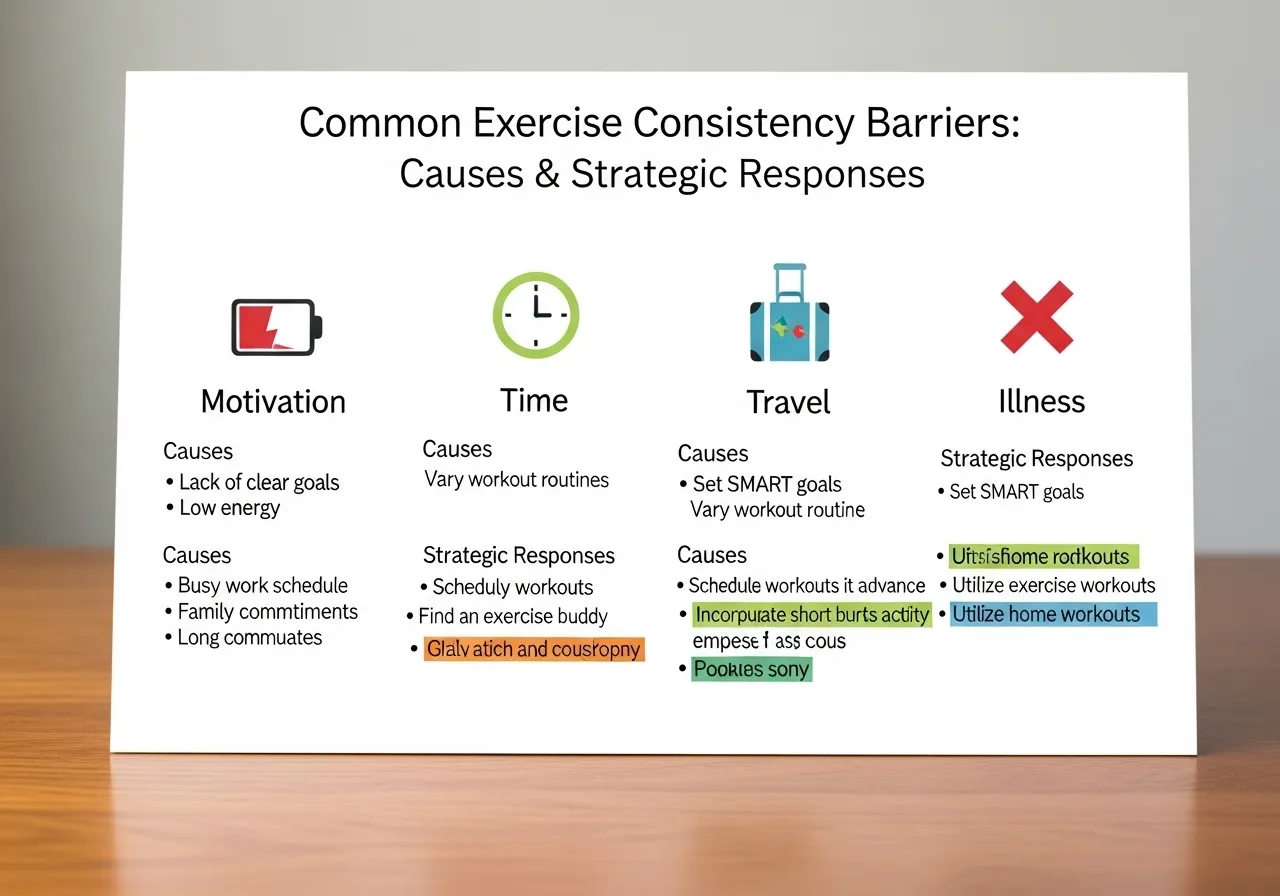
| Barrier | Why It Disrupts Consistency | Strategic Response |
|---|---|---|
| Time pressure | Workouts feel incompletable — so they’re skipped entirely | Have a 15-min backup session ready |
| Low motivation | Waiting to “feel like it” means never starting | Commit to 5 minutes — then reassess |
| Travel | Broken routine breaks the habit | Portable workout plan (bodyweight or bands) |
| Illness or injury | Full stop → momentum lost → restart feels hard | Maintain minimal activity if cleared to do so |
| All-or-nothing thinking | “I missed a session, so I’ll restart Monday” | Next best action — one missed session means nothing |

Strategy 1 — Design for Minimum Friction
The Habit-Friction Relationship
Behavioral science research consistently shows that the effort required to start a behavior is one of the strongest predictors of whether it happens.
Every additional step between you and your workout is a potential dropout point: finding gym clothes, driving somewhere unfamiliar, deciding what to do when you get there.
Practical Friction Reduction Tactics
✅ Choose a gym on your route to work, not out of your way
✅ Have a written workout plan — eliminates “deciding what to do” at the gym
✅ Keep a resistance band or mat at home for days when the gym isn’t viable
✅ Schedule workouts as calendar appointments with the same status as work meetings
The 5-Minute Rule
On low-motivation days, commit only to starting: put on your shoes, get to your workout space, and do 5 minutes.
This approach — sometimes called “implementation intention” in behavioral psychology literature — removes the activation energy barrier of starting while leaving the option open to stop after 5 minutes (most people don’t).
A 2010 study in the European Journal of Social Psychology found that implementation intentions (specific “when-then” plans for behavior) significantly increased follow-through compared to general goal-setting alone.
Strategy 2 — Build Identity-Based Habits
Goals vs Identity
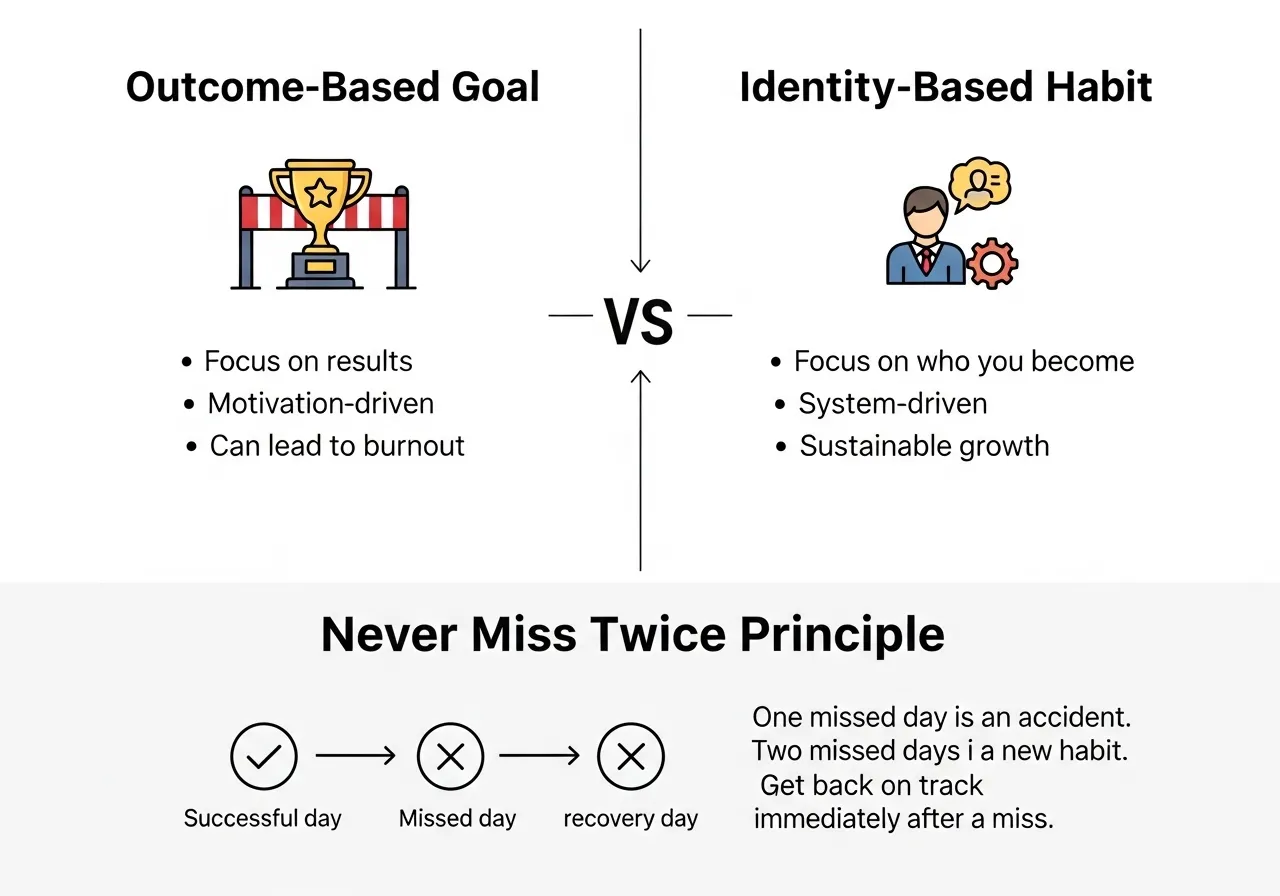
Most fitness goals are outcome-focused: “I want to lose 10 kg” or “I want to run a 5K.”
Outcome goals are useful for direction — but they provide motivation only until the outcome is achieved, and they leave no framework for what happens next.
Identity-based habits work differently: rather than focusing on what you want to achieve, they focus on who you want to become.
✅ Identity shift: “I am someone who runs regularly.”
Every completed run becomes evidence for the identity — which then makes skipping future runs feel inconsistent with your self-concept.
The “Never Miss Twice” Rule
Missing one workout does not meaningfully affect fitness outcomes.
Missing two in a row starts to break the behavioral pattern. Missing three or more suggests the habit is at risk.
The “never miss twice” principle — credited to behavioral habit researcher James Clear — provides a practical middle ground: give yourself permission to miss occasionally (life happens), but treat the second consecutive miss as the actual threat to address.
Strategy 3 — Track Progress and Make It Visible
Why Tracking Works
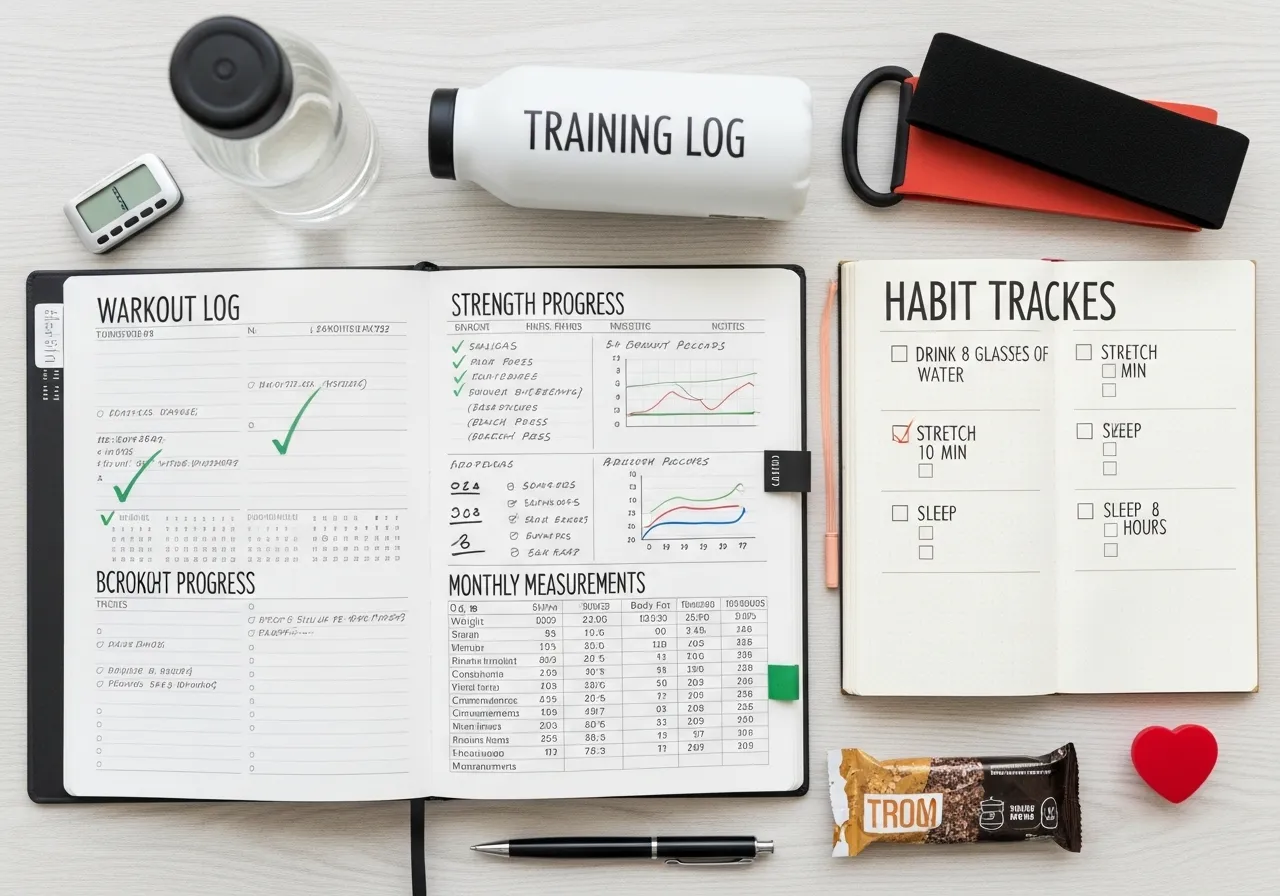
Progress tracking serves two functions:
- It provides objective evidence that the effort is producing results — sustaining motivation through periods when subjective progress is not obvious
- It creates a visual streak or record that has psychological value — missing a day breaks the chain, which many people find motivating to avoid
What to Track
| What to Track | Why It Helps | Simple Method |
|---|---|---|
| Session completion | Builds streak awareness | Calendar ✓ mark |
| Workout performance | Shows actual progress | Training log / app |
| Energy / mood after | Reinforces the feeling benefit | 1–10 rating in notes |
| Body measurements | More accurate than scale alone | Monthly tape measurement |
Progress Photos as a Motivational Tool
Progress photos taken every 4 weeks under consistent lighting and positioning can reveal body composition changes that the scale and subjective feeling consistently miss.
Many people report that reviewing their first-month comparison photo is more motivating than any single metric — because it captures changes across multiple dimensions simultaneously.

Frequently Asked Questions About Exercise Consistency
Q: How long does it take to build an exercise habit?
The commonly cited “21 days to form a habit” figure is not well-supported by the research.
A 2010 study in the European Journal of Social Psychology found that habit formation took between 18 and 254 days depending on the complexity of the behavior and individual differences — with a median of around 66 days for simple behaviors.
The practical implication: focus on showing up consistently for at least 2–3 months before expecting the behavior to feel automatic.
Q: What if I genuinely don’t have time for a full workout?
A partial workout is significantly more valuable than no workout — for both fitness and habit maintenance.
Consider keeping a 15–20 minute “minimum viable session” ready: a handful of compound exercises performed with whatever equipment is available. Completing this maintains the habit pattern even when the full session is not possible.
Over a year, 52 short sessions beats 10 perfect ones by a wide margin — both for fitness outcomes and for the durability of the behavioral pattern.
Q: Is it better to exercise in the morning or evening?
The best time to exercise is the time that is most reliably compatible with your schedule and that you are most likely to actually do.
Research shows modest physiological differences between morning and evening training — but these differences are generally small compared to the impact of consistency.
If morning workouts are consistently skipped due to a preference for sleep, switching to evenings may produce dramatically better adherence — and better outcomes — despite any theoretical morning advantage.
- Consistency matters more than program perfection — a sustainable routine beats an optimal one you can’t maintain
- Reducing friction (logistics, decision-making) may be more effective than trying to increase motivation
- The “never miss twice” principle protects the habit without demanding perfection
- Progress tracking provides both accountability and objective evidence of results
- The best workout time is the time you will actually use consistently — not the theoretically optimal one


