
How to Build Chest Muscles at Home Without Weights
⚠️ Disclaimer: The information in this article is for general educational purposes only and does not constitute medical, nutritional, or professional fitness advice. Individual results may vary. Always consult a qualified healthcare professional or certified fitness trainer before starting any new exercise program, changing your diet, or making decisions about injury treatment or recovery. If you experience pain, discomfort, or any unusual symptoms during exercise, stop immediately and seek professional guidance.

Why Bodyweight Chest Training Works
The Muscle-Building Mechanism: Weight Is Not the Variable
For years I thought building a real chest required a barbell, a bench, and a gym membership. I trained push-ups occasionally as a warm-up or a finisher — never as the primary tool. Then circumstances forced me into a period of home-only training, and what happened to my chest over the following 12 weeks completely changed how I think about equipment. The results weren’t just acceptable — they were some of the best chest development I’d ever achieved, and the science explains exactly why.
I was skeptical that push-up variations could build a chest worth having until I committed to progressive overload with them for 12 weeks — the results genuinely surprised me.
Muscle hypertrophy is driven by three primary mechanisms: mechanical tension (force applied to the muscle under load), metabolic stress (the accumulation of metabolic byproducts during sustained effort), and muscle damage (microscopic disruption of muscle fibers that initiates the repair and growth process). None of these three mechanisms require external weight. They require progressive overload — systematically increasing the stimulus applied to the muscle over time. Research published in the Journal of Strength and Conditioning Research directly compared muscle activation between push-up variations and bench press at equivalent relative intensities and found statistically comparable pectoralis major activation, anterior deltoid activation, and triceps activation — confirming that the chest cannot distinguish between a barbell and gravity as the source of its training stimulus.
The variable that determines whether bodyweight chest training produces results is not whether you have a barbell — it is whether you are applying progressive overload. A person doing the same standard push-ups with the same form at the same tempo for 12 weeks will plateau regardless of how diligently they train. A person systematically progressing through increasingly difficult variations, manipulating tempo, reducing rest periods, and increasing weekly volume will build a chest that turns heads — without a single piece of equipment.
Chest Anatomy: Training Both Heads for Complete Development
The pectoralis major — the main chest muscle — consists of two distinct heads that require different training angles for complete development. The clavicular head (upper chest) originates from the clavicle and responds best to incline-angle pressing movements where the arms travel upward from the torso. The sternocostal head (lower and middle chest) originates from the sternum and ribs and responds best to flat and decline-angle movements. Both heads converge on the humerus and produce horizontal adduction — the motion of bringing the arms across the chest — as well as shoulder flexion and internal rotation.
Most people who train chest with only standard push-ups develop the sternocostal head adequately but underdev elop the clavicular head — producing a chest that looks flat across the top and lacks the upper fullness that creates a complete, three-dimensional appearance. Correcting this requires deliberately including decline-angle push-up variations (feet elevated) that shift loading to the upper chest. This is the single most common programming error in home chest training, and correcting it produces dramatic visible improvements in chest development within 6 to 8 weeks.
The pectoralis minor — a smaller muscle beneath the pectoralis major — is also engaged during push-up training, particularly during the protraction phase at the top of each rep. Deliberately spreading the shoulder blades apart (protracting the scapulae) at the top of each push-up increases pectoralis minor and serratus anterior activation, contributing to the lateral chest fullness and shoulder stability that complete upper body development requires. This is a technique detail that most people skip — and it costs them meaningful muscle development and shoulder health over time.
What the Research Shows About Home Chest Training
A systematic review published in Sports Medicine comparing home-based and gym-based resistance training programs found equivalent improvements in upper body muscle mass and strength over 12 weeks when progressive overload was applied in both conditions. The gym group’s access to barbells and machines provided no statistically significant advantage when the home training group used advanced bodyweight progressions with equivalent effort and consistency.
Gymnasts — athletes who train exclusively with bodyweight movements — consistently demonstrate exceptional chest development, with pectoral thickness, density, and definition that rivals or exceeds many dedicated barbell-trained athletes. While gymnasts train at extreme volumes and intensities, the fundamental hypertrophic mechanism is identical to what recreational trainees apply through progressive push-up training: increasing mechanical tension on the pectorals through increasingly demanding bodyweight loading. The principle scales — it simply requires patience, intelligent programming, and consistent progressive overload rather than access to specific equipment.
According to the American College of Sports Medicine, the primary variable determining muscle development outcomes is the training stimulus relative to the individual’s current capacity — not the specific equipment used to generate that stimulus. This principle validates home chest training as a complete and legitimate approach to chest development for the vast majority of recreational trainees.
The Honest Limitation: When a Barbell Truly Helps
Intellectual honesty requires acknowledging the one genuine limitation of pure bodyweight chest training: maximum loading potential. For very advanced trainees who have mastered every bodyweight progression up to and including one-arm push-ups and planche progressions, the loading ceiling of bodyweight training may eventually limit hypertrophic stimulus in a way that requires external load to overcome. This limitation affects a small minority of dedicated trainees who have been progressing consistently for 2 or more years. For anyone in the first 2 years of training — the vast majority of people reading this — the bodyweight progression ladder provides more than sufficient loading challenge to drive continuous chest development without any equipment.
How Long Does It Take to Build a Chest Without Weights?
The timeline for meaningful chest development through bodyweight training follows the same physiological progression as any resistance training: initial neurological adaptations in weeks 1 to 4, early hypertrophy beginning in weeks 4 to 8, and visible structural changes in weeks 8 to 16 for consistent trainees. The specific timeline depends on starting fitness level, training frequency, nutrition adequacy, and sleep quality — the same variables that determine progress in any training approach. Beginners starting from zero who follow a progressive bodyweight chest program with adequate protein intake can expect to gain 0.5 to 1.5 kg of lean muscle in the pectoral region within the first 12 to 16 weeks — a meaningful amount that produces visible changes in chest fullness and definition.
Advanced trainees — those with years of gym training — can use bodyweight chest work to maintain existing muscle mass during periods without gym access, but will find that the hypertrophy stimulus is insufficient for significant new muscle development once they have adapted to advanced bodyweight exercise variations. This population benefits most from the combination of bodyweight training and resistance bands, which together can produce loading sufficient for continued hypertrophy even at advanced training levels.
Common Myths About Building Chest Without Weights Debunked
Several persistent myths about bodyweight chest training discourage people from pursuing it seriously. Myth 1: “You need heavy weight to build a chest.” False — the muscle fiber cannot distinguish the source of the mechanical tension that drives hypertrophy. Adequate tension from advanced bodyweight variations (decline push-ups, archer push-ups, weighted push-ups) produces the same stimulus as barbells. Myth 2: “Bodyweight exercises plateau too quickly.” False for progressive trainees. The push-up progression ladder — from incline to standard to decline to archer to one-arm — represents years of progressive challenge. Myth 3: “You can’t target different parts of the chest without cables.” Partially false — angle variation (decline for lower chest, incline for upper chest, standard for middle) targets different pectoral regions as effectively as cable variations. Myth 4: “Bodyweight training is only for beginners.” False — gymnasts training exclusively with bodyweight consistently demonstrate elite chest development that competitive bodybuilders recognize as exceptional.
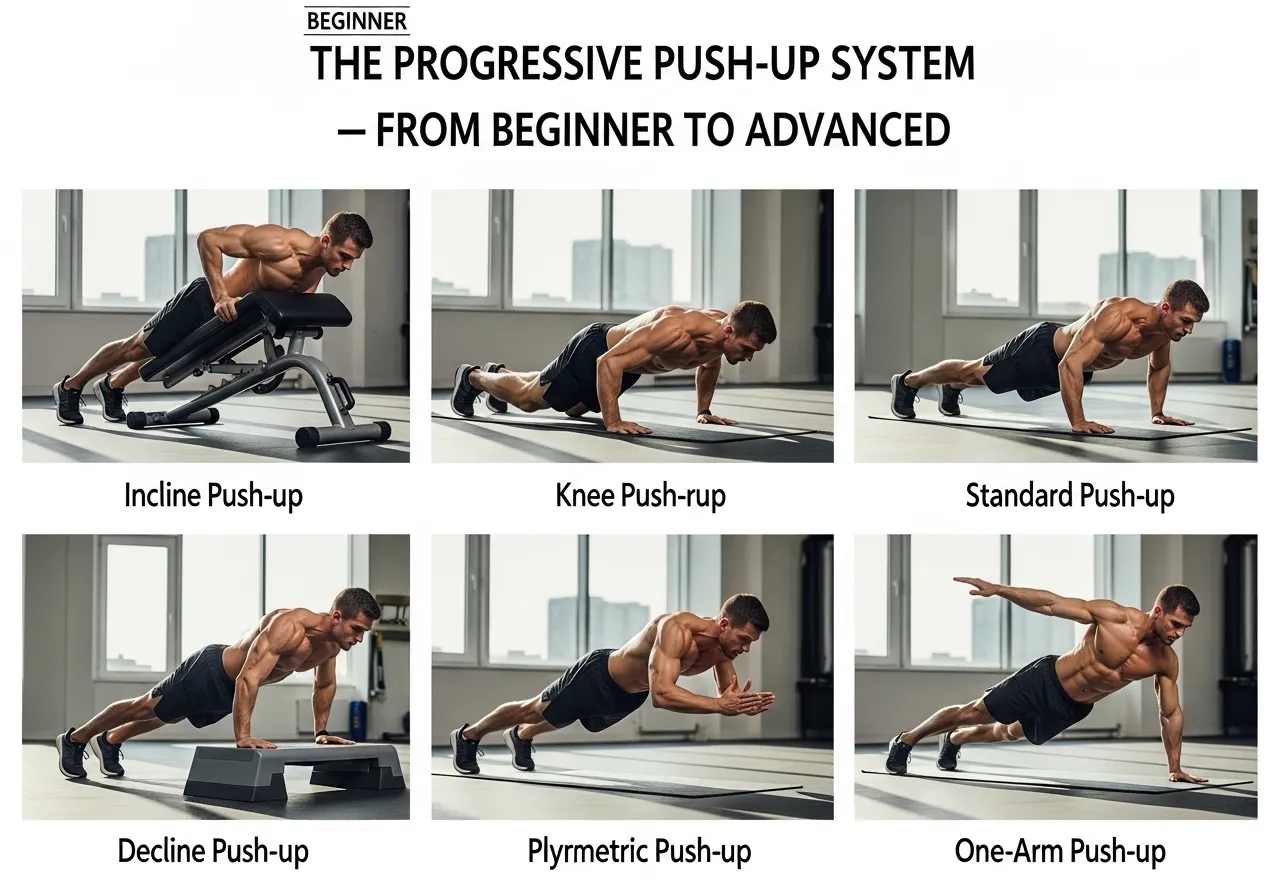
The Progressive Push-Up System — From Beginner to Advanced
The Push-Up Ladder: Ten Levels of Progression
The push-up is not a single exercise — it is a family spanning from “accessible to anyone on their first day” to “requires months of dedicated training to achieve.” Understanding where you currently sit on this ladder and how to progress systematically from one level to the next is the core skill of home chest training. The goal at each level is to achieve 3 sets of 15 clean reps with full range of motion and perfect form before advancing to the next variation — the rep range that research consistently identifies as optimal for hypertrophy when combined with progressive difficulty.
Working through push-up progressions from standard to archer to pseudo planche built more chest thickness than any machine I’d used in a gym.
| Level | Exercise | Primary Challenge | When to Progress |
|---|---|---|---|
| 1 | Wall push-up | Pattern establishment | 3×15 with control |
| 2 | Incline push-up (hands on table) | Reduced load | 3×15 full range |
| 3 | Knee push-up | ~60% bodyweight load | 3×15 controlled tempo |
| 4 | Standard push-up | Full bodyweight horizontal | 3×20 full range |
| 5 | Close-grip push-up | Inner chest and tricep emphasis | 3×15 clean reps |
| 6 | Wide-grip push-up | Maximum chest stretch | 3×15 full range |
| 7 | Decline push-up (feet elevated) | Upper chest and increased load | 3×15 controlled |
| 8 | Diamond push-up | Maximum inner chest and tricep | 3×12 clean form |
| 9 | Archer push-up | Unilateral loading transition | 3×10 each side |
| 10 | One-arm push-up | Maximum unilateral chest load | 3×8 each side |
Perfect Push-Up Form: The Foundation of Everything
Before discussing any progression, perfect form on the standard push-up must be established. Poor mechanics — flared elbows, sagging hips, forward head, partial range of motion — reduce pectoral activation, shift load to inappropriate structures, and accumulate injury risk across thousands of repetitions. I spent the first year of my training life with genuinely poor push-up form, wondering why my chest wasn’t responding. Correcting my technique produced more chest development in 8 weeks than the previous 12 months combined.
The perfect push-up checklist: Hands slightly wider than shoulder-width with fingers pointing forward or slightly outward. Elbows track at 45 degrees from the torso — not flared wide (excess shoulder impingement risk) and not tucked completely tight (shifts load to triceps, away from chest). Body forms a rigid plank from head to heels — no hip sag, no hip pike, no head jutting forward. Descent to within 2 to 3 centimeters of the floor on every rep — partial range robs the pectorals of their greatest activation at the bottom stretched position. Full elbow extension at the top, with deliberate scapular protraction (spreading shoulder blades apart) to complete the range and engage the serratus anterior. Research published in the Journal of Strength and Conditioning Research found that push-ups performed with this scapular protraction at the top produce significantly greater serratus anterior activation and superior shoulder joint stability compared to push-ups that stop short of full range.
Tempo Manipulation: Making Easy Exercises Hard Again
Once standard push-ups become manageable for 20 or more reps per set, tempo manipulation is the most effective strategy for re-challenging the muscle without immediately jumping to a harder variation. Slowing the eccentric (lowering) phase dramatically increases time under tension and mechanical stress on the pectorals, producing hypertrophic stimulus comparable to more advanced variations while allowing the nervous system to adapt to increased loading demands progressively.
Evidence-based tempo protocols for chest development: 3-1-1 tempo (3 seconds lowering, 1 second pause at bottom, 1 second pressing up) — this alone can make standard push-ups genuinely challenging for intermediate trainees. 4-2-1 tempo — increases bottom-position time under tension specifically, targeting the stretched position where the pectorals produce peak mechanical tension. 5-0-explosive — maximum eccentric control followed by explosive concentric contraction — develops power alongside hypertrophy and maintains the neurological training effect needed for athletic performance. Research in Sports Medicine confirmed that slow eccentric training (3 seconds or longer) produces 25 percent greater hypertrophic response compared to standard tempo at equivalent rep ranges.
Decline Push-Up: The Upper Chest Priority
Feet elevated on a chair, bench, or step creates the decline angle that shifts loading emphasis toward the clavicular (upper) chest head — the area most commonly underdeveloped in bodyweight chest programs that rely exclusively on flat push-ups. At 30 to 45 degrees of foot elevation, decline push-ups load the chest at approximately 65 to 75 percent of bodyweight — comparable to moderate-load incline barbell pressing. The higher the foot elevation, the greater the upper chest emphasis and the greater the overall mechanical demand.
I program decline push-ups at the beginning of every chest session — when energy and focus are highest — specifically to prioritize upper chest development. Three sets of 10 to 15 decline push-ups before any other chest exercise, performed with a 3-second eccentric and full range, produces upper chest development that transforms the overall appearance of the chest within 8 to 12 weeks of consistent training.
Archer Push-Up: The Path to One-Arm Strength
The archer push-up represents the most advanced bilateral push-up variation before the one-arm push-up and provides a critical intermediate loading step. Starting in a wide-grip push-up position, lower to one side while keeping the opposite arm straight — the loading shifts predominantly to the bent-arm side, creating approximately 70 to 80 percent of one-arm push-up loading with the stability support of two contact points. Alternating sides each rep develops unilateral chest strength while building the core stability and shoulder control needed for eventual one-arm push-up achievement.
Unilateral Chest Training for Strength and Symmetry
Most people have a dominant side that is measurably stronger in pressing movements, producing visible chest asymmetry over time as the dominant side develops faster than the non-dominant side. Unilateral bodyweight chest exercises — the archer push-up and its progressions toward the one-arm push-up — directly address this asymmetry by forcing each side to work independently without the compensation that bilateral exercises allow. The weaker side cannot rely on the stronger side to complete the movement, producing equalizing adaptation that bilateral training cannot replicate.
For aesthetic symmetry goals, adding one set of unilateral chest work per training session — performed first on the weaker side and matched exactly on the stronger side — produces measurable symmetry improvements within 6 to 10 weeks. This is the same principle used by physique athletes to correct muscle imbalances and is fully applicable to bodyweight training through the archer push-up progression. The archer push-up itself, performed by reaching one arm wide to near-full extension while the other arm performs the push-up, creates 60 to 70 percent of the unilateral loading of a full one-arm push-up with significantly lower technique demand — making it accessible to any intermediate-level bodyweight trainee.
The Psychology of Home Chest Training Consistency
Home chest training has a consistency advantage over gym training that has nothing to do with the exercise itself: the complete elimination of commute, gym membership cost, parking, and social gym dynamics as barriers. Research on exercise behavior consistently finds that perceived barriers — time, cost, convenience, social anxiety — are the primary predictors of exercise abandonment, with gym-based training inherently including barriers that home training eliminates entirely. A home chest training program performed 3 times per week with zero commute and zero cost is far more likely to be maintained consistently for a year than a gym program performed 5 times per week when motivation is high but reduced to zero during busy or stressful periods. The total annual training volume of the consistent home trainer almost certainly exceeds that of the inconsistent gym trainer, producing better long-term results despite the nominally lower frequency ceiling of home training.
The specific consistency strategy for home chest training: treat each session as a fixed appointment that requires active cancellation rather than active commitment. The default is always “train today” — deviating from this default requires a specific reason. This reversal of the default decision significantly reduces the frequency of skipped sessions because it requires an active choice to not train rather than an active choice to train, which is psychologically easier to sustain through low-motivation periods.

Chest Isolation Exercises Without Equipment
The Limitation of Push-Ups Alone
Push-up variations train the chest primarily through horizontal pressing — a movement pattern that loads the pectorals through shoulder flexion and adduction simultaneously. What push-ups cannot fully replicate is the pure horizontal adduction movement of a cable fly or dumbbell fly — the motion of bringing the arms together across the front of the body through the chest’s full range of motion. This isolation movement trains the pectorals at their longest length (arms spread wide) and through the peak-contraction position (arms together in front of the chest) — a range of motion that push-ups only partially cover.
Floor flyes with resistance bands felt awkward at first, but they created a chest stretch and contraction I had struggled to achieve even with cable machines.
Adding chest isolation work alongside push-up progressions produces more complete chest development than either approach alone. The good news: genuine chest isolation is achievable at home with minimal or no equipment using the techniques below.
Resistance Band Chest Fly
A resistance band anchored to a door frame, post, or sturdy fixed point replicates cable fly mechanics almost exactly — providing resistance through the full arc of horizontal adduction with continuous tension that is actually superior to dumbbell flies (which lose tension at the peak contraction position due to gravity). Standing or kneeling band chest flies, performed with a slight forward lean of the torso and a slight bend in the elbow, isolate the pectorals through their complete range of motion in a way no pure bodyweight exercise can match.
Research published in Sports Medicine confirmed that resistance band training produces muscle activation profiles equivalent to cable training for the chest, making a single $15 to $25 resistance band the most impactful equipment addition for home chest development. I consider a resistance band the only piece of equipment truly necessary for a complete home chest program — it fills the isolation gap that push-up progressions leave.
Programming: 3 sets of 15 to 20 band flies at the end of each chest session as a finisher, focusing on the peak contraction (squeeze hard when hands meet in front of the chest) and the full stretch at the bottom of the movement. The combination of stretch-position loading and peak contraction produces a metabolic stress and pump in the chest that push-up variations rarely replicate.
Prayer Press (Isometric Chest Contraction)
The prayer press requires zero equipment and directly trains the chest through its peak contraction position. Press the palms together firmly in front of the chest, elbows at shoulder height, and push inward with maximum force as if trying to compress a ball between the hands. Hold 3 to 5 seconds, release, and repeat. This isometric contraction creates significant pectoral activation — particularly in the inner chest fibers that are difficult to reach with horizontal pressing movements — without any external load whatsoever.
While prayer presses are not a hypertrophy-primary exercise, they serve as an effective warm-up for chest training (pre-activating the pectorals before push-up sets), a rehabilitation tool for people returning from shoulder injury, and a finisher that extends chest fatigue after push-up volume without adding joint stress. Research on isometric contractions confirms meaningful pectoral fiber recruitment at sustained high tension levels — the prayer press qualifies when performed with genuinely maximum effort.
Floor Fly (Advanced Bodyweight Isolation)
Lying face-up on the floor with arms extended to the sides, slowly bring the hands together above the chest in a fly arc — the weight of the arms plus gravity creating resistance through the movement. This produces minimal absolute load but genuine pectoral isolation through the full range of motion, making it appropriate as a warm-up exercise or as a very high-rep metabolic finisher (20 to 30 reps) after heavier push-up work. Adding weight to this movement — holding water bottles, a backpack, or any available weighted object — transforms it into a legitimate loading exercise.
Isometric Chest Exercises for Additional Stimulus
Isometric exercises — contractions performed without movement, maintaining a position under load — provide a training stimulus that dynamic exercises cannot fully replicate. For chest training specifically, isometric contractions at the fully shortened position (chest compressed, pectorals maximally contracted) and at the fully lengthened position (chest fully stretched, pectorals under peak load) produce unique adaptations that complement dynamic push-up training. The prayer press — pressing the palms together in front of the chest with maximum force sustained for 10 to 30 seconds — activates the pectoralis major through its primary adduction function without any equipment and can be performed anywhere, producing isometric chest development that adds to the dynamic training stimulus of push-up variations.
Wall push-away isometrics — pressing against a fixed wall with maximum force for 10 to 20 seconds — load the pressing pattern isometrically in a way that develops the neural drive and intra-muscular coordination needed for maximum force production in dynamic push-ups. Research has shown that isometric training at specific joint angles increases dynamic strength throughout the range of motion surrounding those angles, making strategic isometric work a genuine supplement to dynamic chest training rather than merely a rehabilitation tool.
Programming Chest Training for Maximum Weekly Volume
The optimal weekly chest training volume for hypertrophy — established through a meta-analysis of volume-response research — is 10 to 20 sets per week, with beginners responding to the lower end and intermediate trainees requiring the higher end for continued adaptation. Distributing this volume across 3 chest training sessions per week (3 to 7 sets per session) is more effective than performing the same volume in a single weekly session due to the MPS response dynamics described earlier. For home chest training, this means 3 brief dedicated chest sessions per week — each taking 15 to 25 minutes — rather than a single long chest session, producing superior development with more manageable per-session fatigue and soreness.
Within each session, the sequence of exercises should progress from the most demanding (requiring the greatest neural resources and technical skill) to the least demanding. Lead with the most difficult push-up variation you can perform for 6 to 10 reps, follow with moderate-difficulty push-up variations for higher reps (10 to 15), and finish with isolation or easier variations for burnout sets (15 to 20+ reps). This fatigue-based sequencing ensures maximum performance on the highest-quality exercises and uses the accumulated fatigue of the session productively in the final, less technically demanding sets.

Programming a Bodyweight Chest Routine
Training Frequency: How Often to Train Chest at Home
The optimal chest training frequency for home bodyweight training is 2 to 3 times per week with at least 48 hours between sessions — the same frequency that research consistently identifies as optimal for hypertrophy in any training modality. A 2016 meta-analysis published in the Journal of Strength and Conditioning Research examining 49 studies found that training a muscle group twice per week produces superior hypertrophic outcomes compared to once per week, with 3 times per week showing additional but diminishing benefits for most populations. This applies equally to push-up-based chest training as to barbell training.
Treating bodyweight chest training with the same progression logic as barbell training — adding reps before difficulty — was what made consistent improvement possible.
The practical implication: structure chest training on Monday, Wednesday, and Friday (or any three non-consecutive days), or as part of a push-pull-legs split where chest work appears in the push days. Avoid training chest on consecutive days — the 48-hour recovery window is when the muscle protein synthesis triggered by training actually occurs, and interrupting it with additional chest training before it completes is one of the most common mistakes in home chest programming.
Volume: How Many Sets and Reps per Session
For hypertrophy, the target weekly training volume for the chest is approximately 10 to 20 working sets per week according to research-based volume recommendations from exercise science. For home chest training, this distributes as 4 to 7 sets per session across 2 to 3 weekly sessions. A practical session structure: 3 sets of decline push-ups (upper chest priority), 3 sets of standard or advanced push-up variation, 2 sets of close-grip push-ups (inner chest and tricep), and 2 sets of band flies or floor flies (isolation finisher) — totaling 10 working sets per session, 20 to 30 sets per week when trained 2 to 3 times.
According to research published in Sports Medicine, the relationship between training volume and hypertrophy follows a dose-response curve — more sets produce more growth up to a maximum adaptive volume threshold, beyond which additional volume produces junk volume that adds recovery cost without adding hypertrophic stimulus. For most recreational trainees, this threshold falls between 15 and 20 weekly sets per muscle group — a range that the above programming easily achieves.
The Weekly Structure: Two vs Three Days
Two chest training days per week is appropriate for beginners and for people incorporating chest work into a full-body training program. Three days per week is appropriate for intermediate trainees specifically focused on chest development or for people on a push-pull-legs split where higher frequency is structurally built in. The difference in outcome between 2 and 3 days per week is meaningful but not dramatic — consistency over months matters far more than the difference between 2 and 3 weekly sessions.
| Day | 2-Day Program | 3-Day Program |
|---|---|---|
| Monday | Chest + Triceps (push focus) | Upper chest focus (decline) |
| Tuesday | Back + Biceps | Rest or lower body |
| Wednesday | Rest or lower body | Full chest (flat + isolation) |
| Thursday | Rest | Rest or lower body |
| Friday | Chest + Shoulders + Triceps | Lower chest focus + volume |
| Weekend | Active recovery | Active recovery |
Progressive Overload Without a Barbell
Progressive overload in home chest training takes five forms that directly replace the “add more weight to the bar” mechanism of gym training: harder variations (advancing up the progression ladder), slower tempo (increasing time under tension), shorter rest periods (increasing metabolic stress per unit time), greater range of motion (increasing the mechanical demand of each rep), and higher volume (more sets or reps per session). Tracking at least one of these variables across each session is the practice that separates systematic progress from random training activity. I keep a simple training log on my phone noting the variation, tempo, rep count, and subjective difficulty for each set — 2 minutes of logging per session that has made a greater difference to my chest development than any program change I’ve ever made.
Sleep for Chest Muscle Development
Chest muscle development — like all skeletal muscle hypertrophy — occurs during sleep, not during training. The training session creates the stimulus (mechanical tension, metabolic stress, muscle damage), but the actual protein synthesis and structural muscle growth that constitutes hypertrophy happens primarily during deep sleep when growth hormone secretion peaks and the repair processes initiated by training reach their maximum rate. Shortchanging sleep — a near-universal behavior in modern life — directly limits the chest development that training and nutrition are working to produce, with research consistently showing that 6 hours of sleep produces less than 50 percent of the muscle protein synthesis achieved with 8 hours in response to the same training stimulus.
For chest muscle development specifically, the sleep optimization strategies most impactful are: maintaining consistent sleep and wake times (stabilizing growth hormone secretion patterns), sleeping in a cool environment (the drop in core temperature that initiates sleep is facilitated by a room temperature of 16 to 19 degrees Celsius), avoiding screens in the 60 minutes before sleep (blue light suppresses melatonin and delays sleep onset, reducing total deep sleep duration), and avoiding training within 3 hours of sleep (the sympathetic nervous system activation of training delays sleep onset and reduces sleep quality when training is performed too close to bedtime).
Pre-Workout Chest Activation
The pectorals are frequently inhibited by tight anterior deltoids and shortened pectoral minor muscles — a pattern created by daily forward-flexed postures that reduce their resting neural activation. Performing a 2-minute chest activation sequence before chest training significantly improves pectoral recruitment and the effectiveness of each subsequent exercise. The activation sequence: band pull-aparts (15 reps, activating the posterior shoulder antagonists that allow the pectorals to fully relax and contract), chest squeeze against hands (10 seconds isometric contraction pressing hands together in front of chest), doorframe chest stretch (30 seconds, restoring pectoral minor length). This brief sequence ensures the pectorals are neurologically ready to do the work of the subsequent training session rather than relying on the anterior deltoids and triceps to compensate for inhibited pectorals.

Common Mistakes in Home Chest Training
Mistake 1: Only Doing Standard Push-Ups
The most common home chest training mistake is treating the standard push-up as the only or primary exercise rather than as one level of a broad progression system. Someone who can perform 20 or more standard push-ups per set is training at a difficulty level that no longer challenges their chest sufficiently for continued growth. Their muscles have fully adapted to the loading demand, and no amount of additional standard push-up volume will produce meaningful hypertrophic stimulus — only monotonic fatigue without meaningful adaptation. The solution is immediately advancing to harder variations: decline push-ups, archer push-ups, or band-loaded push-ups that restore the progressive overload stimulus the standard push-up no longer provides.
I plateaued for months doing the same push-up variations before realizing I was violating the most basic principle of progression — variety alone isn’t progressive overload.
Mistake 2: Neglecting the Upper Chest
The second most common mistake is exclusive reliance on flat-angle movements — standard and wide-grip push-ups — that develop the middle and lower chest while neglecting the upper clavicular head. This produces a chest that appears developed when viewed directly but lacks the upper fullness that creates a three-dimensional, athletic appearance. The correction is straightforward: prioritize decline push-ups (feet elevated, creating an incline pressing angle for the upper chest) at the beginning of every chest session, before fatigue compromises performance. Three sets of decline push-ups per session, performed consistently for 8 to 12 weeks, produces upper chest development that dramatically improves overall chest appearance.
Mistake 3: Partial Range of Motion
Performing push-ups with partial range — stopping the descent 10 to 15 centimeters above the floor — dramatically reduces pectoral activation and hypertrophic stimulus. The greatest mechanical tension in the pectoral muscle occurs at its longest length — the fully stretched bottom position of the push-up where the arms are extended and the chest is most loaded. Cutting the range of motion short removes the most productive portion of each rep. Research confirms that training muscles through their full range of motion produces significantly greater hypertrophy than partial-range training, and this principle applies directly to push-up quality: every rep to within 2 to 3 centimeters of the floor, every time.
Mistake 4: Training Without a Log
Training without a systematic record of previous performance is the equivalent of navigating without a map — you may eventually arrive somewhere, but the journey is longer and more uncertain than it needs to be. A training log doesn’t need to be elaborate: date, exercise, sets, reps, and a brief note on difficulty (easy/moderate/hard). This record reveals your progression trajectory, identifies plateaus before they become entrenched, and provides the motivational reinforcement of seeing months of consistent improvement accumulated in a single document. According to research published in the Journal of the American Medical Association, people who track their exercise performance are 30 to 40 percent more consistent over 6 months than those who train without records — a difference that compounds into dramatically different results over a year of training.
Mistake 5: Insufficient Recovery
Training chest every day — a surprisingly common practice among motivated beginners who believe more is always better — is counterproductive and eventually harmful. The muscle protein synthesis response to a challenging chest training session peaks at approximately 24 to 36 hours post-exercise and requires 48 to 72 hours to complete for most people. Training again before this process finishes interrupts the repair and growth cycle, accumulates damage that exceeds repair capacity, and progressively degrades performance and results. According to the American College of Sports Medicine, 48 hours of recovery between sessions targeting the same muscle group is the minimum evidence-based standard — a guideline that applies equally to push-up-based chest training as to barbell training.
Tracking Chest Training Progress at Home
Progress tracking for home chest training requires slightly different metrics than gym-based tracking since weight lifted is not always the primary measure. The most useful progress metrics for bodyweight chest training: maximum push-up reps in a single set (a direct measure of relative chest and tricep strength), push-up endurance (total reps across 3 sets with 60-second rest, tracking weekly), advancement to more difficult exercise variations (moving from standard to decline to archer push-ups), and physical measurements (chest circumference at the widest point, photographed monthly in consistent lighting and posture). These metrics provide the objective progress data that reveals whether the training program is producing adaptation and guides decisions about when to increase difficulty or volume.
Measuring Chest Development Without Equipment
Tracking chest development without gym equipment requires slightly different metrics than standard gym progress tracking. The most reliable home chest tracking methods: push-up maximum test (maximum reps in a single set without rest — test weekly, recording both total reps and the quality of each rep), chest circumference measured at the widest point (arms at sides, tape measure around the largest part of the chest — measured monthly), and photographic documentation (same pose, lighting, and time of day monthly — front and side views). Progress photos are particularly valuable for chest development because the changes in muscle fullness and definition that occur over months are often invisible to daily observation but obvious in monthly comparisons. Taking these photos consistently and reviewing them at 4-week intervals provides the objective evidence of progress that maintains motivation through the slower development phases of a home chest program.

Nutrition to Support Home Chest Training
Protein: The Non-Negotiable Foundation
No training program — bodyweight or barbell — produces meaningful muscle development without adequate protein intake. The research consensus on protein requirements for muscle building is clear: 1.6 to 2.2 grams of protein per kilogram of bodyweight daily provides the amino acid availability needed to maximize muscle protein synthesis in response to training. Research published in the Journal of the International Society of Sports Nutrition found that protein intake below 1.6 grams per kilogram consistently limits muscle growth even when training stimulus is optimal — meaning that inadequate protein intake is a hard ceiling on chest development regardless of how well-designed the training program is.
Being in a slight caloric surplus during my at-home training phase made a visible difference in how much mass I retained compared to previous cutting phases.
For practical protein sourcing, prioritize complete protein sources that provide all essential amino acids: chicken breast (31g per 100g), eggs (13g per 100g, with highly bioavailable leucine that directly stimulates muscle protein synthesis), Greek yogurt (10g per 100g), tuna (25g per 100g), and cottage cheese (11g per 100g, with casein protein that provides sustained amino acid release over hours — particularly useful before sleep when the longest protein-free period of the day occurs). Protein supplementation (whey or plant-based protein powder) is an effective and convenient tool for reaching daily targets but is entirely optional — whole food sources are equally effective when total daily protein intake meets the research-supported threshold.
Caloric Intake: Maintenance, Surplus, or Deficit
The caloric context of chest training determines whether the primary outcome is muscle gain, fat loss, or body recomposition. For maximum muscle development (pure mass gain), a moderate caloric surplus of 200 to 400 calories above maintenance creates the anabolic environment that supports maximum muscle protein synthesis rates without excessive fat gain. For fat loss while maintaining chest muscle, a moderate deficit of 300 to 500 calories combined with high protein intake preserves lean mass while reducing body fat — the combination that produces the “lean and defined” chest appearance many people target. For beginners and intermediate trainees, body recomposition — simultaneously losing fat and gaining muscle at caloric maintenance — is achievable and produces excellent results without requiring a bulk-cut cycle.
Research published in the American Journal of Clinical Nutrition found that high protein intake (2.0 to 2.4 grams per kilogram) during a caloric deficit preserves lean muscle mass significantly more effectively than standard protein intake, making protein optimization the most important nutritional variable for anyone training chest while in a caloric deficit.
Creatine: The Most Evidence-Supported Supplement
If one supplement deserves specific mention for chest training support, it is creatine monohydrate — the most extensively researched and most consistently effective performance and muscle-building supplement available. Creatine supplementation (3 to 5 grams daily, no loading phase necessary) increases phosphocreatine availability in muscle cells, allowing more rapid ATP regeneration during high-intensity efforts. This translates practically to 1 to 3 additional reps per set at maximum effort — a meaningful increase in training volume that compounds into significantly greater hypertrophic stimulus over weeks and months of consistent training.
A meta-analysis published in Sports Medicine found that creatine supplementation combined with resistance training produces 8 percent greater strength gains and 14 percent greater muscle mass gains compared to resistance training alone — results that apply equally to bodyweight training as to barbell training. At approximately $20 to $30 for a 3-month supply, creatine is also one of the most cost-effective supplements available relative to its magnitude of effect.
Sleep: Where Chest Growth Actually Happens
The chest muscles built by push-up training do not grow during the training session — they grow during sleep, when growth hormone secretion peaks, muscle protein synthesis is elevated, and the cellular repair processes initiated by training complete their work. Research published in the journal Sleep found that sleep duration below 6 hours per night reduces muscle protein synthesis by approximately 20 percent and significantly elevates cortisol — creating a hormonal environment that actively counteracts the growth stimulus produced by training. Seven to nine hours of quality sleep per night is not a lifestyle luxury for someone pursuing chest development — it is a physiological requirement as fundamental as training stimulus itself.
Combining Bodyweight Chest Training with Cardio
The combination of chest-focused bodyweight training with cardiovascular exercise creates a body composition environment that accelerates visible chest development by simultaneously building the muscle and reducing the fat layer that overlies it. Two cardiovascular sessions per week of 20 to 30 minutes — HIIT for metabolic intensity or steady-state for active recovery — combined with 3 chest training sessions per week creates the complete stimulus for muscle development, fat reduction, and cardiovascular health improvement that produces the most visually impactful chest changes over a 12-week period. The cardiovascular sessions should be scheduled on separate days from chest training sessions or at least 6 hours later on the same day to avoid the interference effect that impairs resistance training performance when cardio is performed immediately before it.
Resistance Band Chest Exercises
A single resistance band adds three chest exercises to the bodyweight repertoire that cannot be replicated without equipment: the band chest fly (standing, arms wide, bringing hands together in front of chest — trains the pectorals through full adduction range), the band press (anchored behind the body, pressing forward — adds horizontal pressing stimulus at a different angle from push-ups), and the band crossover (simulating the cable crossover for lower chest contraction). These three exercises, taking 6 to 9 minutes in a training session, transform a pure bodyweight chest program into a comprehensive program that rivals gym chest training in exercise variety and targeted stimulus. The $15 to $25 investment in a medium-resistance band is the highest-value equipment addition for anyone serious about home chest development.
Advanced Periodization for Home Chest Training
After 3 to 6 months of consistent bodyweight chest training, the progressive approach of advancing through exercise variations may begin to slow as the most advanced accessible variations become achievable for high reps. At this point, introducing deliberate periodization — planned cycles of higher volume and lower intensity followed by lower volume and higher intensity — continues driving adaptation through variation in training stress rather than solely through increased exercise difficulty. An 8-week chest periodization cycle: weeks 1 to 4 accumulation (5 sets of 15 to 20 reps of moderate difficulty exercises — building volume and endurance), weeks 5 to 8 intensification (3 to 4 sets of 6 to 10 reps of the most difficult available variations — maximizing intensity). This planned variation prevents the adaptation plateau that occurs when the same exercise difficulty is maintained indefinitely.

Your 12-Week Home Chest-Building Program
Phase 1 (Weeks 1–4): Foundation and Form
The first 4 weeks establish perfect push-up mechanics, build the neural efficiency needed for subsequent loading, and identify your current position on the progression ladder. The training emphasis is on quality over quantity — every rep performed with complete range of motion, perfect form, and deliberate scapular protraction at the top. Research on motor learning published in the Journal of Strength and Conditioning Research found that the first 4 to 6 weeks of a new training program are dominated by neurological adaptations — the motor cortex becomes more efficient at recruiting the specific muscle fibers needed for the trained movements, producing strength gains of 15 to 30 percent before any structural muscle change occurs. These neurological gains are the foundation on which structural hypertrophy builds in phases 2 and 3.
This 12-week structure is close to what I ran myself — and the results at the end genuinely changed my view of what’s achievable without a gym.
| Session | Exercise | Sets × Reps | Tempo | Rest |
|---|---|---|---|---|
| A (Mon/Thu) | Decline push-up | 3×10 | 2-1-1 | 90s |
| Standard push-up | 3×12 | 2-1-1 | 90s | |
| Wide-grip push-up | 2×12 | 2-0-1 | 60s | |
| Band fly or floor fly | 2×15 | 2-1-2 | 60s | |
| B (Wed) | Close-grip push-up | 3×10 | 2-1-1 | 90s |
| Standard push-up | 3×15 | 1-0-1 | 60s | |
| Prayer press | 3×10 (5s hold) | Isometric | 45s |
Phase 2 (Weeks 5–8): Progressive Loading
Phase 2 introduces advanced variations, slower tempos, and higher weekly volume to accelerate hypertrophic stimulus. By week 5, neurological efficiency is established and structural muscle growth becomes the primary adaptation driver. Volume increases to approximately 20 working sets per week across 3 training sessions. Decline push-ups progress to a higher foot elevation. Standard push-ups progress to archer push-ups if 15 clean reps per set is achievable. Tempo slows to 3-1-1 throughout all main exercises.
The key Phase 2 addition is the introduction of rest-pause sets — performing a set to technical failure, resting 15 to 20 seconds, then completing as many additional reps as possible. This technique, supported by research in Sports Medicine as a highly effective method for increasing effective volume beyond conventional failure training, allows significantly more total reps per set and produces greater hypertrophic stimulus than standard straight sets at the same difficulty level.
Phase 3 (Weeks 9–12): Intensification and Mastery
Phase 3 represents peak intensity for the program cycle, with maximum weekly volume (20 to 25 working sets), the hardest progressive variations achievable (archer push-ups, decline push-ups at maximum elevation, diamond push-ups), and the introduction of supersets that pair chest exercises with back exercises to increase training density and metabolic stress while maintaining adequate chest recovery between sets. By week 12, most trainees will have progressed 3 to 4 levels up the push-up progression ladder from their Phase 1 starting point — a meaningful indicator of structural strength and muscle development that will be visibly apparent in chest size and definition.
Measuring Progress: What to Track
Progress in home chest training should be tracked across four dimensions: performance (reps achieved at each push-up variation), visual changes (weekly or biweekly progress photos taken in identical lighting and posture), measurements (chest circumference at its widest point using a tape measure), and subjective feel (muscle-mind connection quality, pump during training, post-session soreness patterns). Each of these dimensions provides information the others cannot — performance tracks strength development, photos reveal body composition changes, measurements provide objective data independent of visual bias, and subjective feel indicates training quality and recovery status.
Frequently Asked Questions
Can I really build a good chest without weights?
Yes — provided you apply progressive overload through increasingly difficult variations, manipulate tempo to increase time under tension, and train with sufficient weekly volume. The research evidence is clear that bodyweight chest training produces equivalent muscle development to barbell training at comparable relative intensities. The limiting factor is not the equipment — it is the consistency and intelligence of the programming applied to that equipment.
How long will it take to see chest development from push-ups?
Visible changes typically begin at 4 to 6 weeks of consistent training. Neurological efficiency improvements produce strength gains and improved muscle-mind connection within 2 weeks. Structural hypertrophy becomes visible at 4 to 6 weeks and continues accumulating for months and years of consistent progressive training. The 12-week program above produces measurable, visible chest development for the vast majority of people who follow it consistently.
How many push-ups should I do per day?
Daily push-up volume is less important than weekly structured volume with adequate recovery. Rather than targeting a daily rep count, target 10 to 20 weekly working sets across 2 to 3 sessions with at least 48 hours between chest training days. This structure produces significantly better results than daily high-rep push-up training because it allows complete recovery between sessions and supports progressive overload rather than maintaining constant fatigue.
Should I train chest separately or as part of a full body workout?
Both approaches work well. Dedicated chest sessions (push day) allow higher chest volume per session and are appropriate for people specifically focused on chest development. Full body workouts including chest exercises are optimal for beginners and people seeking overall fitness improvement. The choice should be determined by your specific goals and schedule rather than a universal recommendation.
Maintaining Chest Development Long-Term
After completing a 12-week chest building program, the question becomes how to maintain and continue building the development achieved. The minimum effective maintenance volume for chest musculature — the training volume needed to preserve existing muscle mass without further growth — is approximately 4 to 6 sets per week, significantly less than the 12 to 20 sets per week optimal for building. This means that even during busy periods when training frequency and volume are reduced, maintaining chest development is achievable with 2 brief sessions per week of focused chest work. The key is maintaining the quality and intensity of the reduced volume — 4 sets performed with full effort and proper technique are more effective for maintenance than 8 sets of half-hearted training.
For continued chest development beyond the initial 12 weeks, the primary requirements are continued progressive overload (advancing to harder exercise variations, adding resistance through bands or weighted vest, or increasing volume) and adequate caloric and protein intake to support ongoing muscle growth. The chest, like all muscle groups, requires continuous adaptation stimulus to continue growing — the exercises and volumes that produced growth in weeks 1 to 12 become maintenance stimuli in weeks 13 to 24 unless difficulty is progressively increased.
The Role of Mind-Muscle Connection in Chest Training
The mind-muscle connection — the ability to consciously focus attention on the target muscle and feel it contracting during an exercise — is more important in chest training than in most other muscle groups because the pectorals are frequently overshadowed by the anterior deltoids and triceps in pressing movements. Without a conscious connection to the chest, push-up variations can become primarily shoulder and tricep exercises that happen to involve the chest incidentally. Developing this connection through deliberate attention and the activation sequence described earlier transforms every push-up rep from a generic pressing movement into a targeted pectoral stimulus.
Research has validated the mind-muscle connection as a real neurophysiological phenomenon, not merely motivational language. EMG studies show that consciously focusing on squeezing the chest during push-ups increases pectoral activation by 15 to 22 percent compared to performing the same movement without focused attention — a significant difference that, accumulated across thousands of reps over months of training, meaningfully increases total chest development relative to identical exercise selection and volume.
Building a Sustainable Long-Term Home Chest Practice
The most important variable in long-term home chest development is not any specific exercise, volume protocol, or nutritional strategy — it is the cumulative effect of showing up consistently for years. A person who performs 3 chest training sessions per week for 3 years — even with a simple, imperfect program — accumulates approximately 450 training sessions and hundreds of thousands of quality push-up reps that build chest development no 12-week program can replicate. The person who follows the perfect chest program for 6 weeks and then stops accumulates essentially nothing. Consistency over perfection is the most important principle in bodyweight chest training, and the 12-week program in this article is most valuable as the beginning of a multi-year practice rather than a temporary transformation challenge.
Building this sustainability requires treating home chest training as a non-negotiable maintenance behavior rather than an optional performance activity. The sessions that happen even when motivation is low — the 20-minute push-up workout on a tired evening, the abbreviated session during a busy week, the baseline maintenance session during a stressful period — are the sessions that preserve the habit through the inevitable disruptions of normal life. These “imperfect” sessions are as important as the peak sessions for building the long-term chest development that compounds into genuinely impressive results over years of consistent practice.