How to Do a Dumbbell Deadlift: Step-by-Step Guide for Beginners
This article is for general educational purposes only and does not constitute medical or professional fitness advice.
Consult a licensed healthcare provider or certified fitness professional before starting any new exercise program, especially if you have a pre-existing condition or injury.
The deadlift is widely regarded as one of the most effective exercises for building posterior chain strength (the muscles along the back of the body — hamstrings, glutes, lower back, and upper back).
The dumbbell variation offers a beginner-friendly entry point: it requires less technical skill than the barbell, allows independent arm movement, and is accessible in virtually any gym or home setup.
This guide walks through the setup, movement, common errors, and a starter programming approach.
Why the Dumbbell Deadlift Is an Excellent Starting Point
Advantages Over the Barbell for Beginners
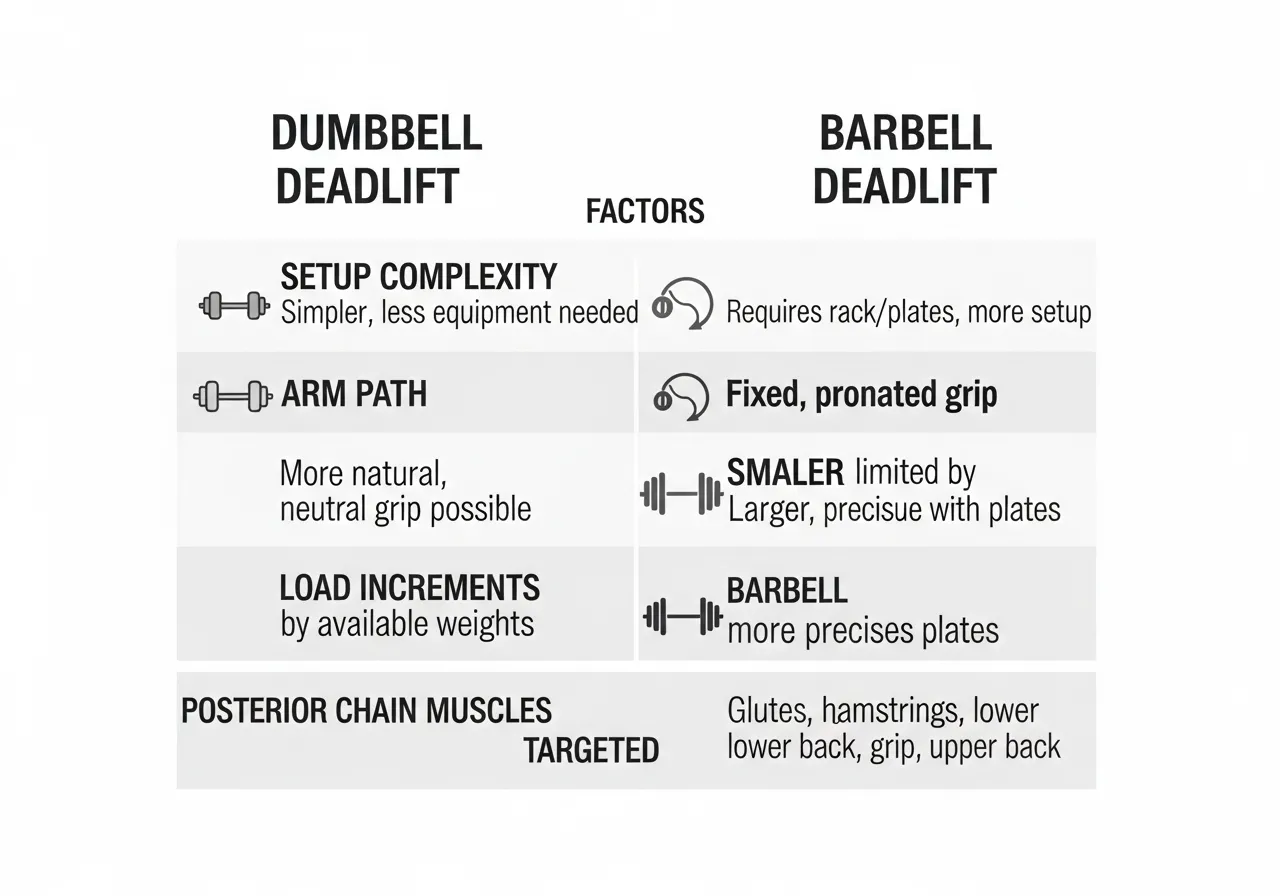
| Factor | Dumbbell Deadlift | Barbell Deadlift |
|---|---|---|
| Setup complexity | Low — grab and go | Higher — bar path, plates, stance |
| Arm path | Natural, follows hip structure | Fixed — shoulder-width grip required |
| Load increments | Smaller steps (2–5 kg) | Larger steps (5–10 kg typically) |
| Lower back stress | Lower at equivalent relative loads | Higher at heavier absolute loads |
Muscles Primarily Trained
- Hamstrings — primary hip extensor during the pull
- Gluteus Maximus — drives hip extension at lockout
- Erector Spinae (the muscles running along either side of the spine) — maintains spinal extension throughout
- Trapezius and Rhomboids — stabilize the shoulder blades and upper back
- Forearms and Grip — hold the load throughout the movement
Step-by-Step Setup and Execution
Starting Position
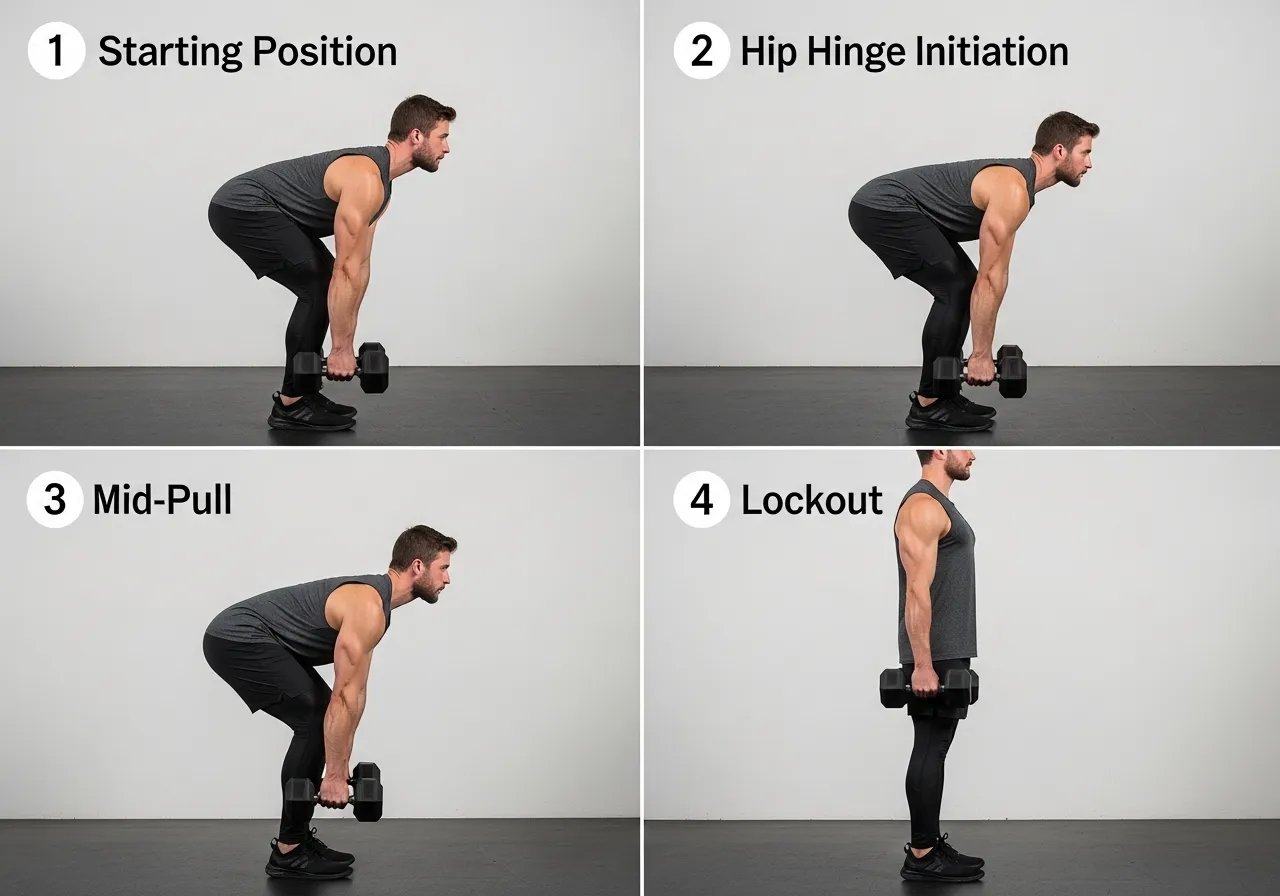
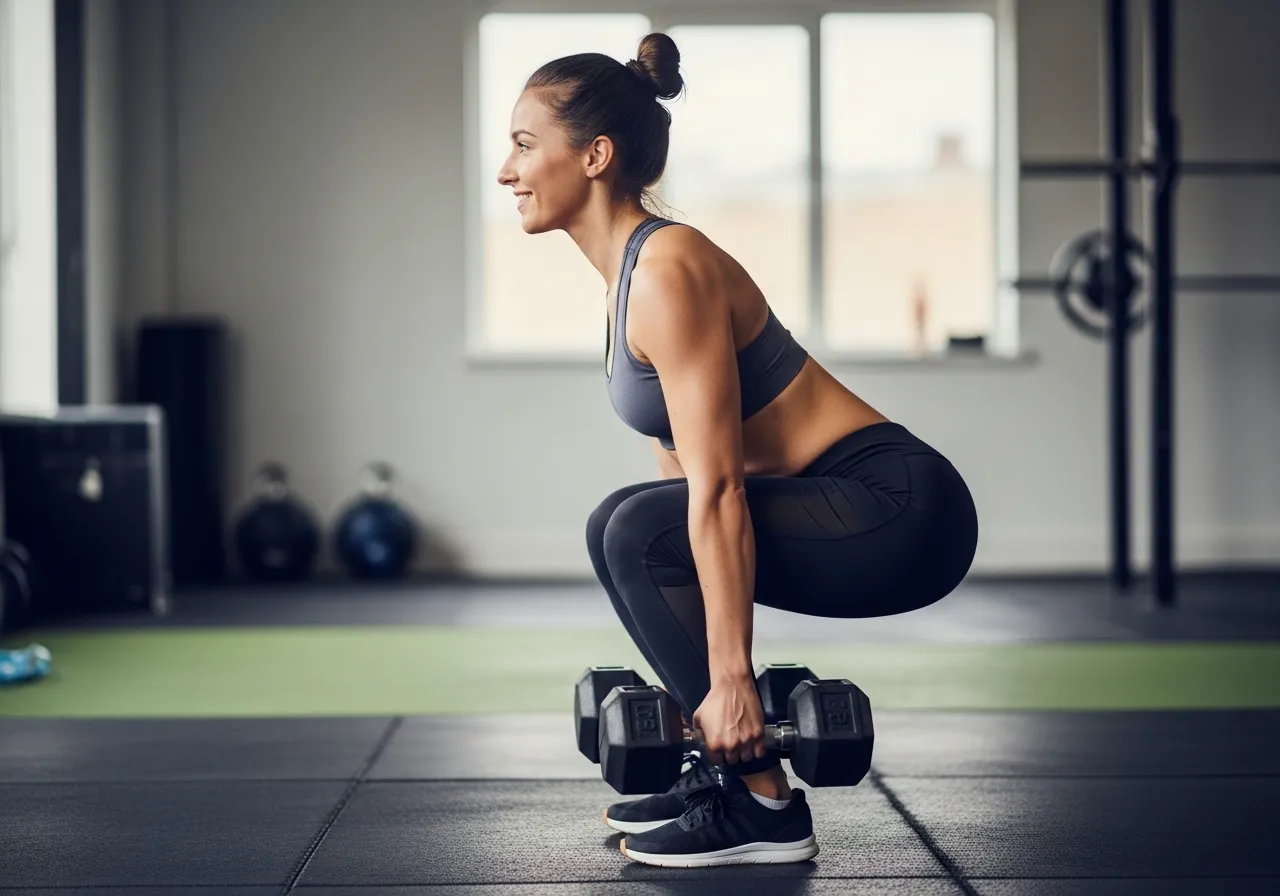
Stand with feet hip-width apart, dumbbells resting on the floor beside each foot (or held at arms length to start).
Toes can point slightly outward — whichever feels natural for your hip structure.
The Hip Hinge — The Most Important Concept
The deadlift is fundamentally a hip hinge (a movement where the hips travel backward while the spine stays neutral, as opposed to a squat where the hips travel downward).
A useful drill to feel the hinge: stand about 20 cm from a wall, push your hips back until they touch the wall while keeping your shins relatively vertical. This is the path the hips should travel during a deadlift.
The Pull
2. Keep the dumbbells close to your legs throughout — they should almost graze your shins
3. Drive the hips forward to reach standing — avoid hyperextending the lower back at the top
4. Squeeze the glutes at lockout — full hip extension, shoulders directly over hips
5. Lower under control — hinge the hips back first, then bend the knees once the dumbbells pass the knees
Breathing
🔼 Exhale at the top once the rep is completed
This creates intra-abdominal pressure — a key spinal stabilization mechanism during loaded hip hinges

Common Dumbbell Deadlift Mistakes and How to Correct Them
Mistake 1 — Rounding the Lower Back
The lumbar spine (lower back, L1–L5) loses its neutral curve and flexes under load — the most important form error to address.
Suggested correction: Reduce the load immediately. Practice the hip hinge drill described above. A useful cue is “proud chest” — thinking of lifting your sternum slightly helps most people maintain lumbar extension naturally.
Mistake 2 — Squatting Instead of Hinging
The hips drop down rather than pushing back, turning the movement into a squat pattern.
This reduces hamstring recruitment significantly and often results in the dumbbells drifting away from the body.
Suggested correction: Think “hips back first, then down.” The hip crease should move backward before any knee bend occurs.
Mistake 3 — Hyperextending at the Top
Leaning back beyond vertical at lockout, with the lower back excessively arched.
Suggested correction: The goal is a “tall standing” position — hips fully extended, glutes contracted, but the lower back not forced beyond neutral. Think of reaching full height rather than leaning backward.
Mistake 4 — Letting the Dumbbells Drift Forward
As the load increases, the dumbbells often drift away from the legs — increasing the moment arm (the horizontal distance between the load and the spine) and substantially increasing lumbar stress.
Suggested correction: Cue “drag the dumbbells up your shins.” Keeping the load close to the body is one of the most mechanically important principles in any deadlift variation.
Programming the Dumbbell Deadlift: Sets, Reps, and Progression
Suggested Starting Parameters
| Goal | Sets × Reps | Frequency | Rest |
|---|---|---|---|
| Learn the movement | 3 × 8 (light) | 2×/week | 90 sec |
| Build strength | 4 × 5–6 | 2×/week | 2–3 min |
| Hypertrophy | 3 × 10–12 | 2×/week | 90–120 sec |
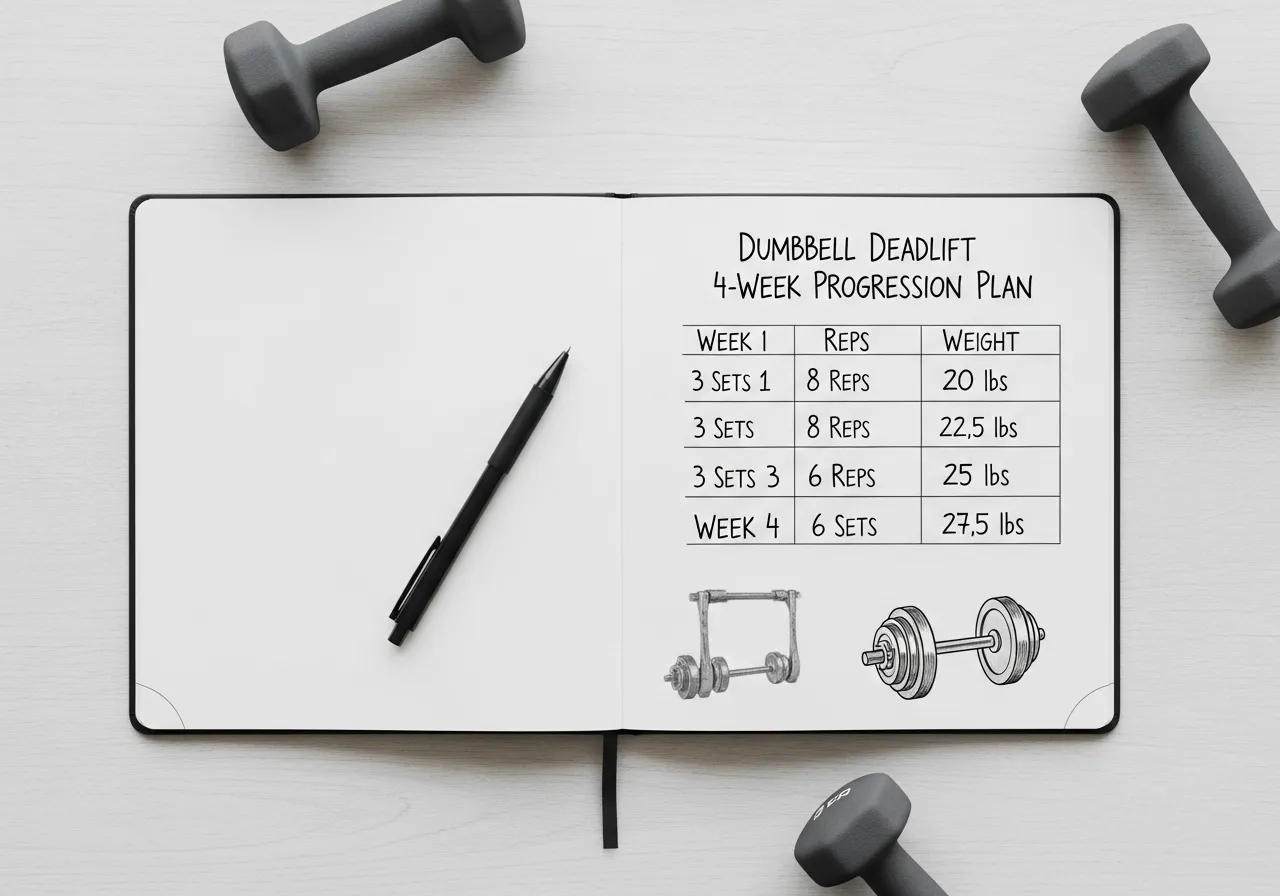
A Simple 4-Week Progression
Week 2: 3 × 10 @ same weight — add 2 reps if form is solid
Week 3: 3 × 8 @ +2–4 kg — return to lower reps with increased load
Week 4: 3 × 10 @ new weight — consolidate strength at the new load
When to Progress to the Barbell
Consider transitioning to a barbell deadlift when:
- Hip hinge mechanics feel natural and consistent under dumbbell load
- You can comfortably lift the heaviest dumbbells available in your gym
- You have access to coaching or can confidently self-assess barbell form
There is no set timeline — some people train with dumbbell deadlifts long-term by choice, and this is a perfectly valid approach for general fitness.
Frequently Asked Questions About the Dumbbell Deadlift
Q: Is the dumbbell deadlift as effective as the barbell version?
For general fitness, muscle development, and learning the hip hinge pattern — yes, the dumbbell deadlift can be highly effective.
For maximum strength development, the barbell allows heavier absolute loads and may produce superior outcomes at advanced stages. For most beginners, the difference is negligible — both develop the posterior chain effectively when performed with good form.
Q: I feel this mostly in my lower back, not my hamstrings — is that normal?
Mild erector fatigue is normal. Significant lower back dominance — or any pain — usually suggests one of two things:
- The load is too heavy for current technique to handle cleanly
- The hip hinge is not being used — the movement has become squat-like, shifting load posteriorly
A useful technique cue: think about feeling a “hamstring stretch” as you lower the dumbbells. If you feel the stretch in the back of the thighs, the hinge is likely happening correctly.
Q: Can I do dumbbell deadlifts if I have lower back pain?
This depends significantly on the cause and severity of the pain. Some individuals with lower back discomfort find that properly performed hip hinge exercises are therapeutic over time. Others may need to avoid them entirely during acute phases.
Please consult a licensed physical therapist or sports medicine physician before performing deadlift variations if you have existing lower back pain. A professional assessment can determine whether the exercise is appropriate and, if so, how to modify it for your situation.
- The dumbbell deadlift is an accessible and effective way to learn the hip hinge pattern
- Neutral spine throughout the movement — particularly the lower back — is the top priority
- Keep the dumbbells close to the legs to minimize spinal stress
- Progress load conservatively — adding 2–4 kg every 1–2 weeks is a reasonable starting rate
- If lower back pain is present, seek professional guidance before training this movement