The Best Posture Exercises for Desk Workers Who Also Tra
1. Why Desk Work Destroys Your Posture and How Training Makes It Worse (Or Better)
I train four days per week consistently, eat well, sleep seven hours, and consider myself a serious recreational athlete. For three years, I also worked eight to nine hours daily at a desk — and despite my training, I developed progressively worsening neck pain, recurring shoulder impingement, and a lower back tightness that never fully resolved between training sessions. My physiotherapist’s diagnosis was not a structural problem that required medical intervention; it was the postural syndrome that desk work produces even in people who train regularly — a predictable pattern of muscle shortening, weakness, and imbalance that training can amplify rather than correct if the program does not specifically address it. This article is the posture correction system that resolved my problems — not from stopping training, but from adding the targeted exercises and daily mobility work that undid what eight hours of sitting was doing to the same body I was investing four sessions per week in improving.
The Physiology of Desk Posture: What Eight Hours of Sitting Does
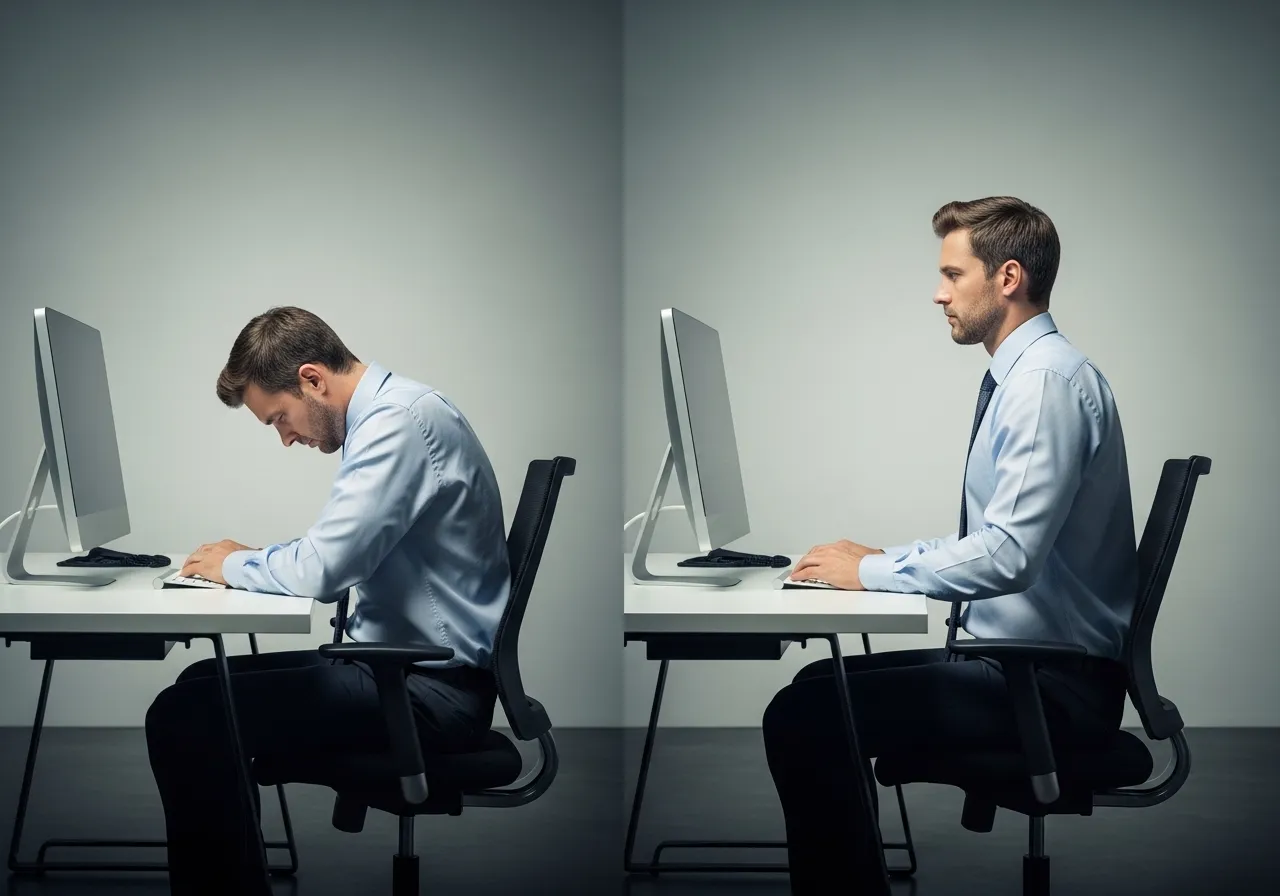
The seated desk posture that most office workers maintain for eight or more hours daily produces a predictable pattern of structural adaptation that physical therapists describe as upper crossed syndrome (affecting the neck, shoulders, and upper back) and lower crossed syndrome (affecting the hips, pelvis, and lower back). Understanding the specific physiological changes that prolonged sitting produces explains why the targeted exercises in this article work — and why generic training without posture-specific correction perpetuates rather than resolves the problems. Upper crossed syndrome: the forward head position that screen work encourages shortens the suboccipital muscles (at the base of the skull), upper trapezius (neck and shoulder elevators), levator scapulae (neck and scapula), and pectoralis minor (chest muscle that protracts the shoulder forward). Simultaneously, the thoracic flexion of desk posture inhibits and weakens the deep cervical flexors (neck stabilizers), middle and lower trapezius (scapular retractors), rhomboids (shoulder blade retractors), and serratus anterior (scapular upward rotators). The result: shortened and overactive muscles pulling the head forward and shoulders inward; lengthened and inhibited muscles failing to hold the head upright and shoulders retracted. Lower crossed syndrome: the flexed hip position of sitting shortens the hip flexors (psoas and iliacus) and lumbar erectors, while inhibiting and weakening the glutes and abdominals. The shortened hip flexors tilt the pelvis anteriorly, increasing lumbar lordosis; the weak glutes fail to provide the posterior chain stability that upright posture requires. From Journal of Orthopaedic and Sports Physical Therapy posture research, the muscular imbalance patterns of upper and lower crossed syndrome are present in over 60% of sedentary office workers and significantly impair the movement quality and injury resilience of those who train without specifically addressing these imbalances.
How Conventional Training Can Worsen Desk Posture
The counterintuitive reality for desk-working athletes: the training programs that most gym-goers follow — emphasizing chest pressing, anterior deltoid development, and quadriceps-dominant lower body exercises — reinforce and amplify the exact muscle imbalances that desk work creates. The specific training culprits: heavy bench pressing performed with already-shortened pectorals and forward-shoulders further shortens the anterior chest muscles and anterior shoulder capsule, deepening the forward shoulder position that desk work initiated; forward-head position during heavy compound lifting creates the neck and upper trapezius overloading that translates into the chronic neck tightness and headaches that many desk-working athletes experience; anterior-dominant lower body training (leg presses, leg extensions) that neglects the glutes and hamstrings maintains the quad-hip flexor dominance that desk sitting established; and inadequate rowing volume relative to pressing volume creates the pulling-to-pushing imbalance that forward shoulder posture requires — industry recommendations suggest 2:1 pulling to pushing ratios for desk workers, versus the 1:1 or even 1:2 ratio that many gym programs inadvertently create. The desk-working athlete who trains regularly but without posture awareness may be simultaneously building impressive strength and progressively worsening the postural dysfunction that their desk hours generate — the two influences running in opposite directions and leaving the body worse off than either alone would produce.
The Postural Assessment: Identifying Your Specific Imbalance Pattern
Before beginning the correction exercise program, a brief self-assessment identifies the specific imbalances most present in your posture — allowing you to prioritize the exercises that address your highest-priority corrections rather than applying the full program with equal emphasis to every component. The standing postural self-assessment (best performed with a full-length mirror or a partner observing from the side): forward head position (your ear should be directly above your shoulder — each inch of forward head position adds approximately 10 pounds of effective load on the cervical spine structures); rounded shoulders (your shoulders should not round forward visibly — the palms should face inward in a relaxed standing position, not backward, which indicates internally rotated shoulders); thoracic kyphosis (excessive rounding of the mid-upper back, visible as a hump or exaggerated curve when viewed from the side); anterior pelvic tilt (the front of the pelvis tilting downward, creating an exaggerated lumbar curve — visible as an excessive arch in the lower back and a protruding abdomen in an otherwise lean individual); and knee hyperextension or collapse (knees that lock back beyond neutral or rotate inward during standing indicate the hip and knee alignment issues that lower crossed syndrome produces). Rate each finding as absent, mild, moderate, or severe — the areas rated moderate or severe receive priority attention in your correction program, while mild findings require only maintenance work. From PubMed desk work posture research, postural imbalances in desk workers are progressive without intervention — mild findings become moderate, and moderate findings become severe with continued uncorrected sitting time — confirming that early intervention produces better outcomes than waiting for symptoms to develop before addressing visible postural changes.
The Pain Patterns That Desk Posture Produces: Recognizing the Signs
The postural imbalances that desk work creates manifest in predictable pain and dysfunction patterns — recognizing these patterns in your own experience confirms the diagnosis and motivates the correction work that resolves them. Neck pain and headaches: the forward head position that desk work produces strains the suboccipital muscles and upper trapezius continuously — the tension headaches that start at the base of the skull and radiate over the top of the head, and the neck stiffness and pain that build across a workday, are characteristic presentations of upper cervical postural strain. Shoulder impingement: the internally rotated, forward shoulder position that desk work and anterior-dominant training combine to produce reduces the subacromial space through which the rotator cuff tendons pass — creating the pinching sensation at the top of the shoulder with overhead movements that shoulder impingement characteristically produces. Lower back pain: the anterior pelvic tilt and hip flexor shortening of lower crossed syndrome places continuous tension on the lumbar erectors and creates the compressive loading on the posterior lumbar disc structures that lower back pain following prolonged sitting characteristically reflects. Wrist and forearm pain: the forearm pronation and wrist extension that keyboard and mouse use requires, combined with the sustained isometric loading of screen-focused desk work, produces the tendinopathy patterns (including carpal tunnel and forearm extensor tendinopathy) that office workers disproportionately experience. The connection between all these pain patterns and postural imbalance is not coincidental — they are mechanical consequences of the structural changes that desk posture produces, and they resolve predictably when the structural imbalances are corrected through the targeted exercises in this program.
The Neurological Dimension of Postural Dysfunction: Motor Control and Re-Education
Postural dysfunction is not merely a structural problem of shortened and lengthened muscles — it is also a neurological problem of altered motor control patterns that persist even after tissue length has been restored. The nervous system learns posture through experience: the forward head position that desk work establishes over years becomes the nervous system’s default reference for “neutral,” and the muscles that maintain this position receive chronic excitatory input while their antagonists receive chronic inhibitory input. Structural restoration alone — stretching the shortened pectorals, strengthening the weakened mid-trapezius — is necessary but not sufficient if the underlying motor control pattern has not been re-educated to activate the newly strengthened muscles in functional posture maintenance. The motor re-education principle: every posture correction exercise should be performed with deliberate conscious attention to the corrected position, the specific muscles being activated, and the postural alignment being trained. The wall angel that is performed mechanically without conscious attention to the scapular retraction and thoracic extension it requires is less effective than the same exercise performed with full attentional focus on the target muscles and movement quality. Over weeks and months of deliberately practiced, consciously executed posture correction exercises, the nervous system gradually updates its postural reference and makes the corrected position the new default — reducing the conscious effort that maintaining good posture requires until correct posture becomes automatic. This neurological re-education process explains why posture correction takes months rather than days: the structural tissue changes require weeks, but the motor control reprogramming that makes the changes functionally permanent requires consistent, deliberate practice across months of repetition.
The Breathing-Posture Connection: How Desk Work Disrupts Respiratory Mechanics
The thoracic kyphosis and forward head position that desk work produces directly impairs respiratory mechanics — the rib cage compression and diaphragm restriction that thoracic flexion creates reduces the lung volume that deep breathing requires, shifting the breathing pattern toward the accessory respiratory muscles (scalenes and upper trapezius) that amplify the upper trapezius and neck tension that desk workers already experience. The dysfunctional breathing pattern: the shallow, upper chest breathing that restricted thoracic expansion promotes chronically activates the neck and shoulder muscles used as accessory breathing muscles, adding to the tension and fatigue these already-overloaded muscles accumulate from postural holding duties. The restoration of diaphragmatic breathing — deep belly breathing that uses the diaphragm as the primary respiratory muscle and allows the lower ribcage to expand with each breath — requires the thoracic extension that the foam roller and wall angel exercises restore. The breathing exercise for posture correction: lie on your back with knees bent; place one hand on your chest and one on your belly; breathe in slowly, directing the breath downward toward your belly — the belly hand should rise while the chest hand remains relatively still; exhale fully, allowing the belly to fall. Practice this diaphragmatic breathing for 5 minutes in the morning and 5 minutes as part of the evening routine — the re-establishment of diaphragmatic breathing pattern reduces the accessory muscle loading that shallow breathing maintains, directly reducing the neck and shoulder tension that desk workers carry.
Upper Crossed Syndrome in Female Desk Workers: Specific Considerations
While upper crossed syndrome affects desk workers of all sexes, the biomechanical and social context of upper crossed syndrome in women includes specific considerations that a generalized program should acknowledge. The biomechanical considerations: women on average have greater inherent shoulder joint mobility and looser connective tissue than men, which means the anterior shoulder instability component of upper crossed syndrome may produce different symptom patterns — shoulder clicking, apprehension with certain movements, and the anterior instability symptoms that hypermobile shoulder structures produce rather than the tight, restricted presentations more common in men. The posterior shoulder strengthening emphasis in this program addresses both populations, but women with hypermobile shoulders may require additional rotator cuff strengthening and stabilization work beyond the general program. The bra strap and clothing considerations: poorly fitting bras that create chronic pressure across the upper trapezius and rhomboids can contribute to the chronic tightness in these areas that desk work exacerbates — proper fitting support that distributes load across the torso rather than creating focal pressure points at the shoulder straps reduces one contributing factor to upper shoulder tension. The social context: women are more frequently diagnosed with fibromyalgia and chronic pain conditions that overlap with the pain presentation of postural dysfunction — ensuring that postural dysfunction receives appropriate evaluation and treatment rather than being attributed to chronic pain conditions without postural assessment prevents misdiagnosis and ensures that the mechanical contributors to pain are addressed.
Tracking Your Posture with Photography and Measurement Tools
The progressive nature of posture correction — gradual improvements occurring over weeks and months — makes it easy to underestimate progress and lose motivation when daily self-assessment reveals no dramatic change. Systematic photography and functional measurement overcome this problem by creating objective records that reveal the improvement trajectory that daily perception cannot reliably detect. The posture photography protocol: once weekly, photograph from the side and from the front in a relaxed, natural standing position (not a deliberately corrected posture) — wear the same minimal clothing each week and stand in the same location at the same distance from the camera. Compare each week’s photographs side by side with the week-one baseline: forward head position measurable as the horizontal distance from earlobe to shoulder tip; shoulder height and forward position; and thoracic curvature angle. These measurements change slowly but measurably with consistent correction work — the week-12 photograph showing the earlobe over the shoulder tip rather than 3cm in front of it provides the visual confirmation that daily subjective assessment cannot. Functional measurements that complement the photographic record: the wall angel range (how far the arms travel up the wall before losing contact); the overhead reach test (how high the hands can reach with arms alongside the ears without lumbar extension compensation); and the Thomas test hip flexor length (whether the hanging leg remains on the table during the assessment). Retesting these functional measures monthly provides the objective performance metrics that confirm the structural improvements that the photographs suggest — and identifies which areas require additional work versus which have achieved adequate correction.
Posture Correction Case Study: The 12-Week Transformation
To make the progression concrete, the typical 12-week experience of a committed desk-working athlete applying this program: week 1 — the morning routine reveals significant thoracic restriction (foam roller extension is limited and mildly uncomfortable), the wall angels show arms lifting off the wall above the horizontal, and the hip flexor stretch produces tightness at 15-degree hip extension. Neck aches are daily by mid-afternoon; shoulder impingement symptoms appear during overhead pressing. Weeks 2–4 — morning thoracic foam roller extension becomes deeper and more comfortable; wall angel range improves modestly with arms staying on the wall higher; hip flexor tightness begins to decrease. Afternoon neck aching reduces in frequency and intensity; overhead pressing becomes slightly more comfortable. Weeks 4–8 — photographed thoracic curvature shows visible reduction; wall angels can be performed without arm-wall loss through two-thirds of the range; the hip flexor stretch reaches 30 degrees without the previous tightness. Training quality improvements become noticeable: squat depth has increased, deadlift hip hinge range improved, and overhead press feels mechanically cleaner. Neck pain is occasional rather than daily; shoulder impingement symptoms have largely resolved. Weeks 8–12 — thoracic photographs show near-normal alignment from the side; wall angels complete the full range with arms on the wall; hip flexors have sufficient length for neutral pelvic position without deliberate correction. Training session quality is consistently better than pre-program, with PRs in the squat and overhead press reflecting the improved mechanics. Neck pain is rare; shoulder function is normal. This progression is typical for the motivated, consistent practitioner — faster in those with milder imbalances, slower in those with more severe or long-standing dysfunction, but reliably progressive when the daily practice is maintained.
2. The 10 Best Posture Exercises: Part 1 — Thoracic and Shoulder Corrections
The first five posture correction exercises address the upper body components of desk posture dysfunction — thoracic spine mobility, shoulder retraction strength, and the anterior chest and shoulder flexibility that desk work restricts.
Exercise 1: Thoracic Foam Roller Extension — The Foundation of Upper Body Posture Correction
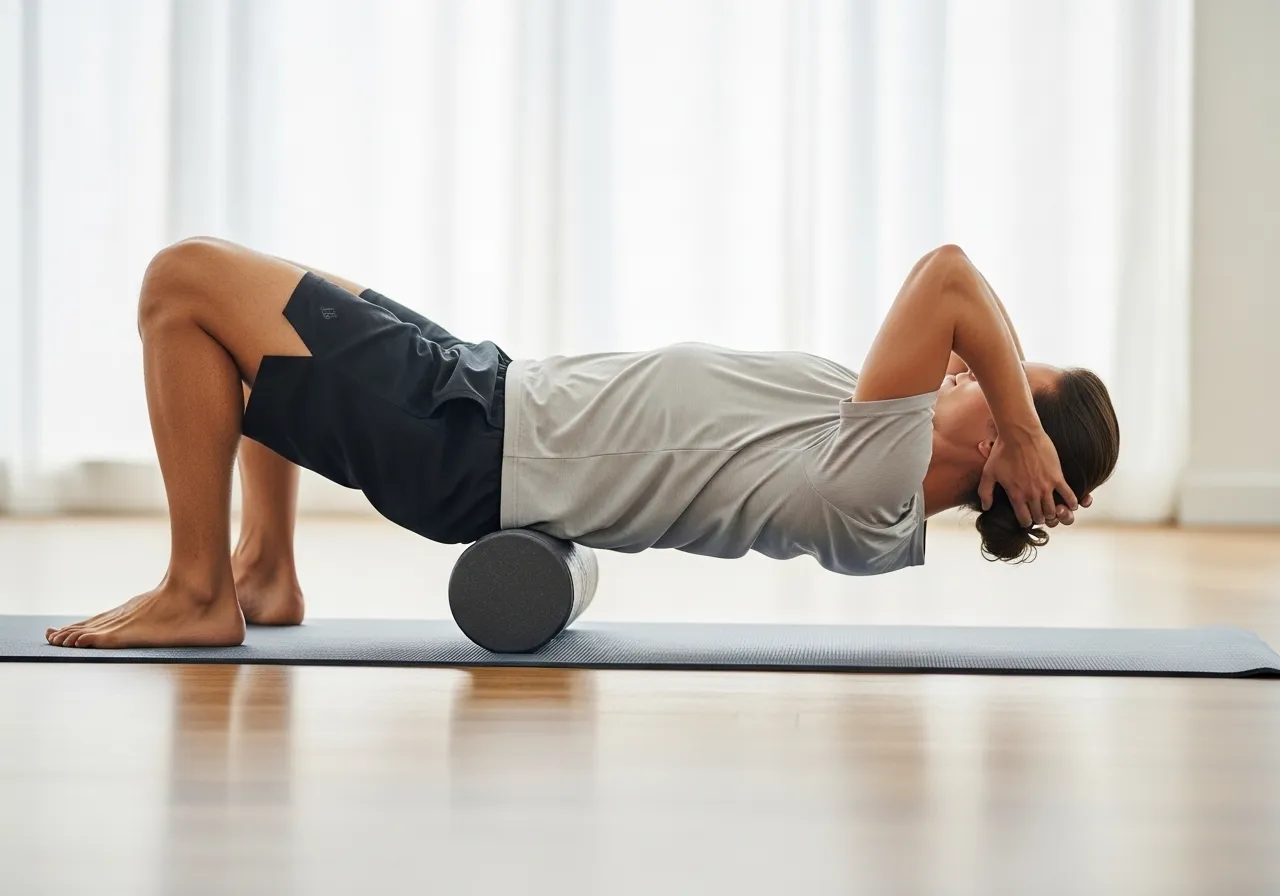
The thoracic spine extension that desk posture consistently restricts is the foundation of all upper body postural correction — without restored thoracic extension, every other upper body posture exercise operates against the structural limitation that thoracic kyphosis imposes. The thoracic foam roller extension: place a foam roller perpendicular to your spine at the level of your mid-back (approximately T6–T8); place your hands behind your head to support your neck; allow your thoracic spine to extend over the roller, using your body weight to create the extension pressure; take 3–4 deep breaths in this position, allowing the exhale to deepen the extension; then roll the foam roller one segment toward your head and repeat. Work from T12 (the lowest thoracic vertebra, just below the ribcage) to T3 (at the base of the neck), spending 30–60 seconds at each level. The mechanism: the foam roller extension provides a mechanical lever that reverses the thoracic flexion that desk posture imposes — using gravity and body weight to restore the extension mobility that sustained flexion progressively restricts. The neural release that follows thoracic extension often produces immediate improvements in overhead reach, deep breathing capacity, and neck pain — reflecting the decompression of the thoracic structures that extension restores. Perform daily before training sessions and as a standalone posture correction practice; the 5–8 minutes that thoracic foam rolling requires produces immediate mobility improvements that compound into lasting structural change with consistent practice. From British Journal of Sports Medicine thoracic mobility research, thoracic foam rolling produces acute improvements in thoracic extension range of motion that persist for 30–45 minutes post-treatment — sufficient to improve the training positions that thoracic restriction otherwise compromises, making it valuable both as a pre-training posture preparation and a standalone mobility practice.
Exercise 2: Wall Angels — Scapular Retraction and Thoracic Extension Integration
Wall angels — the exercise of performing arm raises while maintaining full contact between the back, arms, and a wall — are the single most diagnostic and corrective exercise for the shoulder mobility and thoracic extension combination that desk workers most need. The wall angel technique: stand with your back flat against a wall, feet approximately 15cm from the base; press your lower back, upper back, and the back of your head against the wall (this alone may be difficult for significant thoracic kyphosis or forward head presentation — prioritize maintaining these contacts throughout); place your arms against the wall in a goalpost position (elbows at shoulder height, elbows bent at 90 degrees); slowly slide your arms up the wall toward a fully extended overhead position while maintaining all contact points; return to the starting position. The diagnostic value: the typical desk worker cannot maintain contact between their arms and the wall through the full range of movement — the arms lift off the wall as the restricted thoracic extension and tight anterior shoulder structures pull them forward. This exercise makes the restriction visible and provides the repeated mobility work that gradually restores the full range. Perform 2–3 sets of 10 repetitions, moving slowly and controlling the arm-wall contact throughout. The corrective benefit compounds with each session — the athlete who performs wall angels daily for eight weeks typically achieves the full range that their initial attempt revealed as absent.
Exercise 3: Band Pull-Aparts — Mid-Trapezius and Rear Deltoid Activation
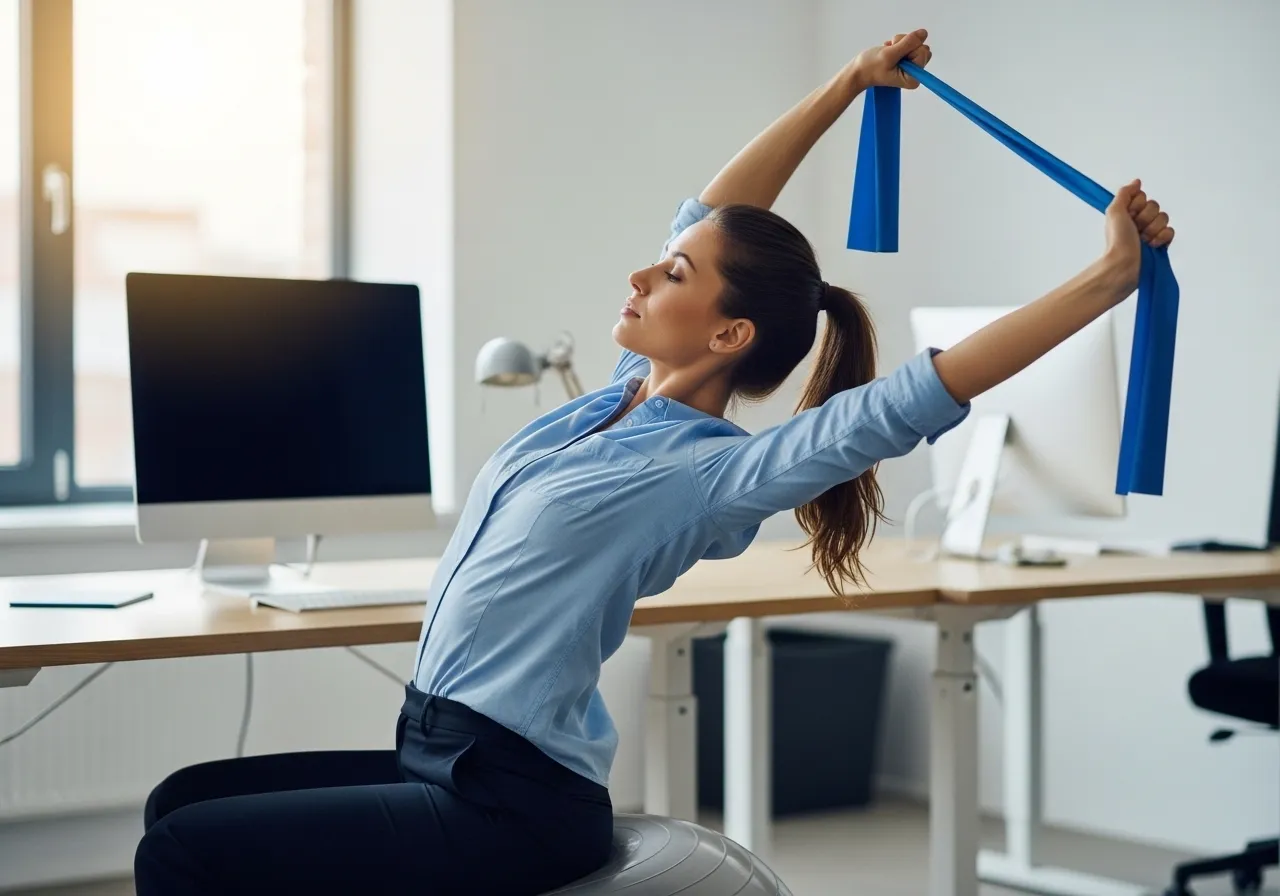
The band pull-apart is the most efficient exercise for strengthening the mid-trapezius and rear deltoid — the muscles most inhibited and weakened by the forward shoulder position that desk work and anterior-dominant training together produce. The exercise: hold a resistance band at shoulder height with arms extended in front of you, hands shoulder-width apart; keeping arms straight, pull the band apart by squeezing the shoulder blades together and moving the arms out to the sides until the band reaches your chest; slowly return to the starting position with controlled eccentrics. The scapular retraction focus is critical: the exercise is performed in the scapular retractors (mid-trapezius and rhomboids), not the posterior deltoids alone — initiating the movement with a strong squeeze between the shoulder blades ensures the correct muscle activation pattern. Perform 3–4 sets of 15–20 repetitions with a light band — the repetition range for activation and endurance is higher than for strength development, reflecting the postural role of these muscles in maintaining shoulder position across hours rather than generating force in brief efforts. Band pull-aparts can be performed anywhere — at the desk between work sessions, in the car, or while watching television — the low intensity and equipment portability make them ideal for the frequent, distributed practice that postural muscle endurance requires. For desk-working athletes whose training programs include significant pressing volume, performing 2–3 sets of band pull-aparts before every pressing session activates the scapular retractors before the pressing movement can suppress them.
Exercise 4: Doorway Pectoral Stretch — Releasing the Anterior Chain
The pectoralis major and minor shortening that desk posture and anterior-dominant training produce requires dedicated static stretching to restore the resting length that posture correction depends on. The doorway pectoral stretch: stand in a doorframe with your elbow bent at 90 degrees and your forearm resting against the doorframe at shoulder height; gently lean forward through the doorframe until a stretch is felt across the chest and anterior shoulder; maintain for 30–45 seconds; repeat with the arm positioned above horizontal (elbow at eye level or higher) to target the different fiber orientations of the pectoralis major. The technique points that maximize effectiveness and minimize injury risk: the stretch should be felt in the chest, not the shoulder joint — if shoulder pain rather than chest stretch is produced, reduce the lean intensity; maintain a braced core and avoid excessive lumbar hyperextension as a compensation for the chest restriction; and breathe continuously throughout the stretch, using the exhale to gently deepen the position. Perform 2–3 times daily — morning, post-training, and pre-sleep — accumulating the daily stretching volume that significant pectoral shortening requires for genuine lengthening over weeks and months. The combination of regular doorway pectoral stretching with band pull-aparts produces the anterior lengthening and posterior strengthening that together restore the shoulder position that desk work and pressing training have displaced.
Exercise 5: Face Pull — Rear Deltoid, External Rotator, and Upper Back Integration
The face pull — a cable or band exercise pulling the handles toward the face with externally rotated shoulders — is the most comprehensive single exercise for the posterior shoulder and upper back complex that desk workers need most. It simultaneously develops the rear deltoids, external rotators (infraspinatus and teres minor), and mid/lower trapezius in the pattern of shoulder retraction and external rotation that healthy shoulder posture requires. The face pull technique: set the cable at face height or use a band at face height; grasp the handles with palms facing down, thumbs pointing toward you; pull the handles toward your face while simultaneously rotating your hands so that palms end facing forward and thumbs point backward (external rotation); your elbows should finish above the level of the cable, with the rope ends passing beside your ears; return slowly to the starting position. The external rotation component is the critical differentiator between the face pull and simpler row variations — the combined retraction and external rotation specifically addresses the internal rotation pattern that desk work imposes, restoring the shoulder alignment that pain-free pressing and overhead movements require. 3–4 sets of 15 repetitions with a load that allows full range and controlled external rotation throughout. For desk-working athletes, the face pull should appear in every training week with volume proportional to pressing volume — the 2:1 pulling-to-pressing ratio that upper body postural balance requires means face pull and row volume should genuinely exceed pressing volume, not merely accompany it.
The Posture-Sleep Connection: How You Sleep Affects Daytime Posture
The sleeping position that individuals maintain across 7–9 hours of sleep each night creates structural loading patterns that either support or counteract the postural correction work performed during waking hours. The sleep positions and their postural implications: side sleeping with a pillow of appropriate height (filling the space between ear and shoulder to maintain cervical spine neutral) is generally the most posture-neutral sleeping position for most people, provided the pillow height prevents both lateral neck flexion (pillow too low) and neck side-bending away (pillow too high). A pillow between the knees during side sleeping reduces the hip internal rotation and lumbar rotation that unsupported side sleeping creates in the lower spine and hip joints. Back sleeping with appropriate cervical support maintains the cervical spine in its natural curve and distributes body weight across the broadest available surface — but the single flat pillow that many back sleepers use is often insufficient for adequate cervical support. The pillow that fits under the cervical curve rather than elevating the head maintains the natural cervical lordosis that desk work disrupts. Stomach sleeping is generally the most problematic position for desk workers with forward head and thoracic kyphosis — the cervical rotation required to breathe face-down creates the same rotational cervical loading that awkward desk positions produce, and the lumbar hyperextension that stomach sleeping creates reinforces the anterior pelvic tilt that lower crossed syndrome involves. Transitioning from stomach sleeping requires deliberate sleep position modification over weeks — placing a pillow against the back to prevent stomach rolling, and potentially using a body pillow that provides the tactile feedback of lateral support that stomach sleepers often seek.
Technology and Screen Habits: The New Posture Challenges of the Digital Era
The posture challenges of desk work have been compounded by the smartphone era — the “text neck” phenomenon of prolonged head-down phone use creates the same cervical loading as desk work, extending the total daily duration of forward head posture beyond the office into commutes, evenings, and weekends. The smartphone posture impact: holding a phone at waist height produces the same forward head position as screen work at desk height, with the effective head weight on the cervical spine increasing from approximately 5kg at neutral to 27kg at 45-degree forward head position. The accumulated cervical loading of 2–4 hours of smartphone use added to 7–9 hours of desk work produces a total daily cervical loading burden that significantly exceeds what the postural correction exercises can fully compensate for. The practical smartphone posture habit: raise the phone to eye level rather than lowering the head to phone level — the arm fatigue that elevated phone holding produces is far less harmful than the cervical loading that the alternative creates. Use voice commands, text-to-speech, and phone stands or mounts that allow screen viewing at eye level to reduce the hand-holding duration that smartphone use requires. The television and reading posture: the head-forward, chin-down position that low-screen television and book reading creates reproduces the desk posture problem in leisure hours — positioning screens at eye level and supporting reading material at an angle that allows neutral head position extends posture-neutral hours beyond the ergonomically optimized workstation into the home environment that accounts for a significant portion of daily posture loading.
Nutrition and Hydration for Connective Tissue Health and Posture Recovery
The nutritional factors that support connective tissue health — the tendons, ligaments, and fascial networks that postural muscles work through — provide an often-overlooked complement to the exercise interventions that posture correction requires. Collagen synthesis for connective tissue repair: vitamin C (75–90mg daily from citrus, bell peppers, and leafy greens) is the essential cofactor for collagen synthesis — the structural protein that tendons, ligaments, and the extracellular matrix of postural muscles require for repair and maintenance. Consuming 10–15g of collagen or gelatin with vitamin C approximately 30–60 minutes before the posture correction exercise session specifically enhances the collagen synthesis response to the exercise loading — the combination of nutritional substrate and mechanical stimulus producing synergistic connective tissue adaptations. Hydration and intervertebral disc health: the intervertebral discs that cushion and support the cervical and lumbar spine are approximately 80% water in their healthy state, with the fluid content providing the shock-absorbing and load-distributing function that disc health depends on. Adequate daily hydration — 2–2.5 liters for desk workers in temperate climates — maintains disc hydration and reduces the compressive loading vulnerability that dehydrated disc tissue experiences. Magnesium for muscle tension: adequate dietary magnesium (found in leafy greens, nuts, seeds, and legumes) or supplemental magnesium glycinate supports the muscle relaxation that postural muscle tension requires — the chronic low-grade magnesium deficiency common in populations with high stress and low vegetable intake contributes to the sustained muscle tension that postural correction exercises are working against. Addressing nutritional factors alongside exercise produces the comprehensive recovery environment that postural tissue healing requires.

3. The 10 Best Posture Exercises: Part 2 — Hip, Core, and Neck Corrections
The second five posture correction exercises address the lower body components — hip flexor release, glute activation, core stability, and the neck mobility and deep cervical flexor strengthening that forward head position requires.
Exercise 6: Kneeling Hip Flexor Lunge with Posterior Pelvic Tilt
The hip flexor shortening that prolonged sitting produces is the primary structural driver of anterior pelvic tilt, lumbar hyperlordosis, and the lower back pain that desk workers and desk-working athletes both experience. The kneeling hip flexor lunge specifically targets the psoas and iliacus — the deep hip flexors that attach to the lumbar spine and femur — in the stretched position that directly reverses sitting’s adaptations. The technique that ensures genuine hip flexor stretch rather than lumbar extension compensation: start in a half-kneeling position (one knee on the ground, the opposite foot forward); before moving forward, actively tuck the pelvis posteriorly (flatten the lower back) and maintain this pelvic tuck throughout the exercise — this posterior tilt prevents the lumbar hyperextension that compensates for restricted hip flexors and ensures the stretch is felt in the hip flexor rather than the lower back; gently lean the entire torso forward (not just the hips) until a stretch is felt in the front of the hip of the back leg; hold for 30–45 seconds per side. The psoas stretch can be deepened by raising the same-side arm overhead while maintaining the posterior pelvic tilt — the combined hip extension and arm elevation creates the full psoas length that static stretching alone cannot achieve. Perform 2–3 times daily — the hip flexors that shorten across an eight-hour workday require the same frequency of release to prevent progressive shortening across weeks and months of desk work. From Spine Journal lower crossed syndrome research, hip flexor tightness is among the strongest predictors of lower back pain in desk workers, and targeted hip flexor stretching reduces pain scores and functional limitations significantly within 6–8 weeks of consistent practice.
Exercise 7: Glute Bridge and Hip Thrust — Reactivating Inhibited Glutes
Gluteal inhibition — the reduced neural activation of the glute muscles that prolonged sitting produces — is the muscular companion to hip flexor shortening in the lower crossed syndrome pattern. The glutes that are compressed and neurally inhibited during eight hours of sitting fail to generate the hip extension power and pelvic stability that both posture and athletic performance require. Reactivating the glutes requires dedicated isolation work before compound movements can effectively recruit them. The glute bridge (floor): lying on your back with knees bent and feet flat on the floor, squeeze the glutes deliberately before initiating the movement; drive through the heels to raise the hips until the body forms a straight line from shoulders to knees; hold the top position for 1–2 seconds with maximum glute contraction; lower with control. The deliberate glute squeeze at the initiation of the movement ensures gluteal rather than lumbar erector dominance of the exercise — many people with gluteal inhibition drive primarily with their lower back in bridge exercises, which reinforces the lumbar hyperextension pattern rather than correcting it. Progress from the bodyweight bridge to the single-leg bridge (removing one foot from the floor to increase unilateral demand), then to the barbell hip thrust (loading the pelvis with a barbell for maximal glute development). 3–4 sets of 15–20 repetitions for the bodyweight bridge; 3–4 sets of 8–12 for loaded variants. Including the glute bridge in the pre-session activation routine for every lower body training session ensures that the glutes are neurally ready to contribute to the squats, deadlifts, and lunges that follow — improving both technique and training outcomes while reinforcing the glute activation that posture improvement requires.
Exercise 8: Dead Bug — Anti-Extension Core Stability for Lower Back Health
The dead bug exercise — the foundational anti-extension core stability movement — develops the deep core musculature (transversus abdominis, multifidus, and diaphragm) that maintains lumbar neutral position against the extension forces that lower crossed syndrome and anterior pelvic tilt create. The technique: lie on your back with arms extended toward the ceiling and knees bent at 90 degrees (tabletop position); press your lower back firmly into the floor and maintain this neutral spine position throughout; slowly lower one arm overhead while simultaneously extending the opposite leg, maintaining the lower back contact with the floor; return to the starting position and repeat on the other side. The lower back pressure against the floor is the performance standard — if the lower back loses contact with the floor, the core stability has been exceeded and the movement range should be reduced. The dead bug develops the reflexive core bracing that protects the lumbar spine during the training loads and daily movements that the desk-weakened core fails to stabilize adequately. Progress from the partial range (arm only or leg only) to the full contralateral movement; then to the fully extended position with arm and leg parallel to the floor; finally to loaded variations with cable resistance or weight. 3 sets of 8–10 repetitions per side, performed with the quality control focus that anti-extension core training requires.
Exercise 9: Chin Tuck — Deep Cervical Flexor Strengthening for Forward Head Correction
The chin tuck — the most targeted exercise for the deep cervical flexors that forward head position inhibits — is the least impressive-looking exercise in this list and among the most impactful for desk workers experiencing neck pain, headaches, and the radiating symptoms that cervical spine compression produces. The chin tuck reverses the forward head position by activating the deep cervical flexors (longus colli and longus capitis) that maintain the cervical spine’s natural curve against the forward pull that prolonged screen time imposes. The technique: sit or stand in a neutral posture; without tilting your head up or down, gently retract your chin directly backward — creating a “double chin” appearance — until a gentle stretch is felt at the base of the skull; hold for 5–10 seconds; release; repeat 10–15 times. The chin tuck should feel like a horizontal translation (backward movement) of the head rather than a chin-down tilt — if the chin is being tucked toward the chest, the exercise is producing cervical flexion rather than the retraction that deep cervical flexor activation requires. Perform 2–3 sets of 10–15 holds multiple times daily — at the desk between work sessions, during phone calls, while watching television. The frequency that deep cervical flexor endurance development requires exceeds what a single daily session provides; distributing the practice across the day in the environments where the postural fault manifests accelerates both the neuromotor re-education and the muscular endurance development that lasting forward head correction requires.
Exercise 10: 90/90 Hip Stretch — Combined Hip Mobility for Sitting-Induced Restriction
The 90/90 hip stretch addresses both hip external and internal rotation simultaneously — the combined restriction pattern that sustained sitting in a single plane produces. Sitting maintains both hips in approximately 90-degree flexion with limited rotation variation; the result is progressive restriction in hip rotation that limits the movement quality of squats, deadlifts, lunges, and the athletic movements that full hip rotation range supports. The 90/90 technique: sit on the floor with one leg in front of you bent at 90 degrees (shin parallel to your body, knee and ankle at hip height or lower), and the other leg to the side bent at 90 degrees (shin perpendicular to your body); maintain an upright spine with both sit bones on the floor (both down is the goal — most people will find one elevated, indicating restriction on that side); gently lean forward over the front leg to increase the external rotation stretch; then transition to lean over the back leg to access the internal rotation stretch. Hold each position for 30–45 seconds, breathing deeply and allowing the exhale to deepen the position. The 90/90 stretch is particularly valuable for athletes because it simultaneously addresses the hip external rotation that deep squatting requires, the hip internal rotation that hip hinge mechanics depend on, and the combined rotation mobility that single-leg athletic movements demand. Perform daily as part of the morning routine or pre-training mobility work — the hip restriction that desk work accumulates requires daily intervention to prevent the progressive limitation that weekly mobility work alone cannot counter.
The Posture-Athletic Performance Connection: How Better Posture Makes You Stronger
The relationship between improved posture and athletic performance is more direct and more significant than most athletes recognize — the structural corrections that posture work produces translate into genuine strength, power, and movement quality improvements that the training program alone cannot achieve in a posturally dysfunctional body. The performance improvements from posture correction: thoracic extension restoration improves overhead pressing range and removes the lumbar compensations that overhead movements require when thoracic mobility is restricted — the athlete who cannot genuinely extend their thoracic spine is pressing overhead with a lumber hyperextension compensation that both limits load tolerance and increases injury risk. Hip flexor lengthening improves squat depth and hip hinge range — the anterior pelvic tilt that tight hip flexors create reduces the available posterior chain range in both movements and forces compensatory patterns that impair both performance and safety. Glute activation improvement directly increases hip extension power in deadlifts, squats, and sprinting — the inhibited glutes of lower crossed syndrome represent untapped power that postural correction reveals. Shoulder external rotation and posterior capsule flexibility improvement allows the shoulder to track correctly in pressing movements — reducing the impingement risk that internal rotation restriction creates at the front of the shoulder in any overhead or pressing movement. The athlete who invests 20–30 minutes daily in the posture correction program for 8–12 weeks discovers that the training sessions that follow are qualitatively different: heavier, deeper, more coordinated, and more comfortable than the same exercises performed in the posturally compromised state that preceded the correction work. The investment pays returns in every training session for the rest of the athletic career.
Common Posture Correction Mistakes: What Not to Do
Understanding the common mistakes in posture correction attempts prevents the ineffective or counterproductive approaches that delay improvement. Mistake 1 — Overcorrecting: actively pulling the shoulders excessively back and down, maintaining an artificially upright posture that requires constant muscular effort, creates fatigue and tension in the very posterior muscles that correction is trying to develop. Posture correction should work toward the effortlessly upright position that appropriate muscle balance produces — not toward a militarily rigid position that requires deliberate holding. Mistake 2 — Stretching without activating: stretching the short muscles (hip flexors, pectorals) without simultaneously strengthening the long and weak muscles (glutes, mid-trapezius) produces only half the correction that full postural balance requires. Every stretching intervention should be paired with its antagonist-strengthening counterpart. Mistake 3 — Treating posture correction as a temporary program: adopting the posture exercises for six weeks, achieving some improvement, and then discontinuing them while continuing the eight-hour desk workday that created the problem will produce gradual relapse. Posture correction is a maintenance practice, not a rehabilitation course — the exercises that correct the imbalance continue to be necessary as long as the desk work that creates the imbalance continues. Mistake 4 — Ignoring the training program contribution: performing daily posture correction exercises while continuing a pressing-dominant training program that reinforces the anterior imbalances creates a treatment-and-reinjury cycle that prevents lasting correction. The training program adjustments are as essential as the correction exercises. Mistake 5 — Expecting rapid dramatic change: postural adaptation takes months of consistent practice, and the improvements visible in two to four weeks are modest compared to the structural normalization that six to twelve months of consistent work produces. Impatience that leads to abandonment of the program before genuine structural change occurs is the most common reason that desk workers fail to achieve the posture improvements that consistent practice reliably produces.
Posture Correction for Remote Workers: The Work-From-Home Challenge
The transition to remote and hybrid work that the global pandemic accelerated created a new postural challenge for millions of desk workers: the home office is rarely ergonomically optimized, with kitchen tables, sofa laptop work, and improvised setups creating postural loading that often exceeds what well-designed office environments produce. The remote worker posture assessment: identify the specific postural demands of your home work setup — the kitchen table that is typically too high for keyboard work; the sofa position that creates extreme hip flexion and thoracic kyphosis; the laptop-only setup that places the screen too low for neutral head position; and the absence of the automatic movement breaks (meetings, colleagues, coffee trips) that office work structure naturally provides. The remote work posture optimization: invest in a monitor, external keyboard, and appropriate chair for the primary work location rather than adapting the body to the workstation’s limitations; establish the work schedule structure that includes explicit movement breaks that the home environment’s flexibility makes easy to skip; and recognize that the remote worker’s unlimited access to the home gym or workout space that the office commute previously required travel to represents a posture correction opportunity — the morning workout, mid-day movement break, and evening stretching routine are all more accessible when the gym is in the same building as the desk. Remote workers who leverage their schedule flexibility for more frequent movement breaks and exercise access often achieve better postural outcomes than their office-commuting counterparts, despite the ergonomic challenges of home setups — because the behavioral flexibility that remote work provides can accommodate more movement across the day when the intention and structure to use it are present.
The posture correction journey rewards patience and consistency above all else — the athlete who shows up daily with modest effort achieves more than the athlete who trains intensely for brief periods and then abandons the practice when visible results are slow to materialize. Daily practice, sustained over months, produces the structural transformation that makes every effort worthwhile. Trust the process, maintain the habit, and allow the evidence-based program to deliver the results that consistent application reliably produces across the weeks and months of committed practice ahead.
4. Building the Daily Posture Correction Routine: When, How Often, and How Long
The posture correction exercises are most effective when organized into a structured daily routine that addresses the specific times and contexts where desk posture restriction accumulates — combining the morning restoration session, the at-desk micro-breaks, the pre-training activation, and the post-work release that together produce systematic postural correction.
The Morning Posture Reset: Starting the Day Correctly
The overnight position that most sleepers maintain — some variation of spinal flexion, shoulder internal rotation, and hip flexion — means that the body requires deliberate movement preparation before the demands of work and training. The morning posture reset (10 minutes): thoracic foam roller extension (2 minutes, working from T12 to T3); chin tucks (2 sets of 15 holds while standing); hip flexor lunge stretch (30 seconds per side); 90/90 hip stretch (45 seconds per side); and wall angels (2 sets of 10). This 10-minute morning sequence restores the thoracic extension, cervical retraction, and hip mobility that overnight rest reduces, setting up the postural foundation that the day’s sitting will progressively challenge. The morning routine creates the structural baseline from which the day begins — the person who starts the workday with this 10-minute reset has better postural positioning from the first working hour than the person who sits down with the restricted overnight posture still fully intact. Over weeks and months, the morning routine’s cumulative effect compounds into genuine structural change: the morning sessions that repeatedly load the thoracic spine into extension, restore hip flexor length, and activate the deep cervical flexors produce the tissue adaptations that lasting postural improvement requires.
At-Desk Posture Micro-Breaks: The Every-30-Minute Habit
The most important single intervention for desk worker posture is the regular movement break that interrupts the sustained static loading that continuous sitting produces. Research on sitting physiology finds that muscle activation, intervertebral disc nutrition, and postural muscle fatigue all deteriorate within 20–30 minutes of sustained static sitting — making the every-30-minute movement break the minimum effective intervention for preventing the progressive deterioration that prolonged continuous sitting produces. The at-desk micro-break protocol (90 seconds every 30 minutes): stand up from the desk (the postural reset of standing alone is beneficial — the change from hip flexion to hip extension and the shift from supported to self-supported upright posture activates the postural muscles that sitting inhibits); perform 5 chin tucks standing; perform 10 band pull-aparts (keep a resistance band at the desk for this purpose); perform a brief doorway or hands-clasped-behind-back pectoral stretch. Set a timer or use a standing reminder app to prompt the every-30-minute break consistently — the habit will not form reliably on intention alone, and the sitting that feels comfortable in the moment does not generate the discomfort that motivates breaks without external prompting. From ACSM sedentary behavior and health guidelines, regular interruptions to sitting — even brief standing or movement breaks — significantly reduce the metabolic, cardiovascular, and musculoskeletal negative effects of prolonged sitting compared to equal duration sitting without interruption, confirming that the micro-break habit produces health benefits beyond its postural correction value.
Pre-Training Activation: Preparing the Posture-Corrected Body for Training
The desk worker who trains immediately after work arrives at the gym with the accumulated postural deficit of a full workday — the hip flexors shortened by six to eight hours of sitting, the thoracic spine stiffened into flexion, and the scapular retractors inhibited by prolonged forward shoulder position. Training without addressing this accumulated restriction means performing exercises with the compromised mechanics that the workday produced — loading the hip flexor-dominant lunge that inhibited glutes allow, pressing with the internally rotated shoulder that restricted thoracic extension creates, and squatting with the reduced depth that tight hip flexors impose. The pre-training activation for desk workers (8–10 minutes): 2 minutes thoracic foam roller extension; hip flexor lunge stretch (30 seconds per side); glute bridges (2 sets of 15 with deliberate glute activation focus); band pull-aparts (2 sets of 20); wall angels (2 sets of 10); and 90/90 hip stretch (30 seconds per side). This activation sequence takes 8–10 minutes and transforms the quality of the training session that follows — the squat depth increases, the pressing mechanics improve, and the posterior chain recruitment that compound exercises require becomes available after the desk-accumulated restrictions are addressed. Athletes who implement this pre-training activation consistently report immediate improvements in training quality and comfort, and sustained improvements in both posture and performance over the weeks and months that the routine is maintained.
Post-Work and Pre-Sleep Posture Release: The Evening Routine
The end of the workday and the hour before sleep provide the opportunity for the deeper, longer static stretching that the morning and pre-training sessions cannot accommodate — using the maximum warmth and relaxation of the evening to produce the tissue lengthening that genuine flexibility development requires. The evening posture release routine (15–20 minutes): thoracic foam roller extension (3 minutes, deeper and slower than the morning session); doorway pectoral stretch (2 × 45 seconds, two arm heights); kneeling hip flexor lunge with posterior pelvic tilt (45 seconds per side); 90/90 hip stretch (60 seconds per side); supine dead bug (2 sets of 8 per side with full range); and chin tuck sequence lying on the floor (2 sets of 15 with 10-second holds). The evening routine’s psychological benefit — the relaxation response that slow, deliberate stretching with deep breathing produces — improves sleep quality alongside the structural postural correction benefit. Performed 30–60 minutes before sleep, the evening routine activates the parasympathetic nervous system and reduces the cortisol elevation that work stress maintains — creating the physiological transition from workday sympathetic activation to the rest-and-recovery state that quality sleep requires. The desk-working athlete who performs this evening routine consistently reports both improved morning postural quality (the overnight stiffness that skipped evening stretching produces is measurably reduced) and better sleep quality through the relaxation and decompression that the routine provides.
The Weekly Posture Progress Check: Measuring What You’re Improving
Tracking posture correction progress provides the reinforcement that sustained habit maintenance requires — the subtle, gradual improvements that posture correction produces are easy to miss without deliberate measurement. The weekly posture check: stand against a wall in relaxed posture (without deliberately correcting) and photograph from the side; compare each week’s photograph to the previous week for changes in head position, shoulder alignment, thoracic curvature, and pelvic tilt. Additionally, assess the functional benchmarks that posture improvement produces: can you perform wall angels with arms touching the wall through a greater range than last week? Has your squat depth increased? Can you reach overhead with less compensatory lumbar extension? Is your neck pain or shoulder discomfort less frequent or intense than it was a month ago? These functional benchmarks connect the daily posture work to the training and pain outcomes that motivate the effort — making the progress visible and the routine’s value tangible. The typical progression: weeks 1–4, reduced pain and tightness, modest range of motion improvements; weeks 4–8, visible postural changes in photographs, meaningful functional movement improvements; months 2–4, structural normalization of the most restricted areas, training technique improvements reflecting the improved postural foundation; months 4–12, consolidation and maintenance of achieved corrections with reduced correction effort as improved posture becomes the new structural default.
Posture Correction for Athletes With Existing Pain: The Rehabilitation-Correction Interface
Many desk-working athletes present not merely with postural imbalance but with active pain — the shoulder impingement, neck pain, or lower back ache that postural dysfunction has progressed to produce. Exercising with pain requires distinguishing between the corrective loading that moves the body toward structural improvement (therapeutic discomfort) and the loading that creates or worsens tissue injury (harmful pain). The general principle for exercising with postural pain: movement that feels like muscle tension, mild tightness, or dull aching is generally safe and often beneficial; sharp, electrical, or radiating pain during or immediately after exercise, pain that persists for more than a few hours post-exercise, or pain that is worsening session to session requires professional evaluation before continuing. For athletes with active shoulder impingement: the face pull, band pull-apart, and external rotation exercises in this program are typically well-tolerated and specifically therapeutic for the rotator cuff irritation that internal rotation restriction and posterior capsule tightness produce. Pressing movements that provoke impingement pain should be modified (reducing range, adjusting angle, reducing load) or temporarily replaced with pain-free alternatives until the underlying mobility and strength deficits have been addressed sufficiently to allow pain-free pressing mechanics. For athletes with lower back pain: the glute bridge, dead bug, and hip flexor stretching exercises are generally well-tolerated and therapeutic; loaded spinal flexion and heavy spinal extension under load should be approached cautiously until the anterior pelvic tilt and hip flexor tightness that commonly drive lower back pain have shown measurable improvement. The posture correction program and the management of postural pain are complementary processes — the exercises that correct the structural imbalance simultaneously address the mechanical loading patterns that generate the pain, producing both structural improvement and pain reduction through the same consistent practice.
Children, Teenagers, and Posture: Early Intervention for Lifelong Benefit
The postural imbalances that desk work produces in adults are increasingly developing in children and teenagers — the smartphone use, school desk sitting, and gaming-related posture habits of digital-native generations are creating upper crossed syndrome presentations in adolescents that previously appeared in middle-aged office workers. The intervention opportunity in young people is more significant and more responsive than in adults: the connective tissue compliance and neuroplasticity of youth allow faster postural correction with less sustained effort; the years of established dysfunction that must be overcome in adult correction are absent; and the habit formation that occurs in adolescence has longer-lasting effects than habits established in adulthood. Parents and educators who identify forward head position, rounded shoulders, and thoracic kyphosis in children and teenagers should encourage the movement habits and ergonomic practices that prevent progression — limiting continuous device use to 30-minute periods with standing breaks; encouraging the physically active play that naturally develops the posterior chain and thoracic extension that desk posture restricts; and teaching the basic body awareness (what good posture feels like, how to sit with proper lumbar support, how to hold a device at eye level) that reduces the postural loading of inevitable screen use. The teenager who develops good postural habits before desk work becomes a full-time adult reality requires dramatically less corrective intervention than the adult who must overcome years of established dysfunction — making early posture education among the highest-leverage health interventions available in adolescence.
Wrist, Forearm, and Hand Posture: The Forgotten Extremities
While the major postural imbalances of desk work concentrate in the neck, shoulders, thoracic spine, and hips, the wrists, forearms, and hands experience their own desk-related loading patterns that contribute to the repetitive strain injuries and discomfort that desk workers disproportionately experience. The keyboard and mouse use that desk work requires maintains the wrists in extension (the slightly extended position that keyboard typing requires), the forearms in pronation (palms facing down), and the finger flexors in sustained low-level contraction — a combination that loads the forearm extensor tendons and the carpal tunnel structures that median nerve compression produces. The wrist and forearm correction exercises: the forearm flexor stretch (extending the arm in front with palm facing up and gently pressing the fingers back with the opposite hand) releases the finger flexor tightness that keyboard typing produces; the forearm extensor stretch (extending the arm with the palm facing down and gently pressing the fingers toward the floor with the opposite hand) addresses the extensor tendon loading that mouse work creates; and the wrist rotation series (circling the wrists in both directions through full range) maintains the joint mobility that sustained static positioning reduces. Perform these stretches 2–3 times daily, holding each for 30 seconds — the same frequency recommendation that applies to the hip and thoracic mobility work, reflecting the same principle that the positions accumulated over eight hours of desk work require daily correction to prevent progressive restriction. The desk worker who adds wrist and forearm mobility to their daily posture routine addresses the full spectrum of desk-related postural loading — from the base of the skull to the fingertips — creating the comprehensive postural health that the complete desk-working athlete requires.

5. Workstation Setup, Training Program Adjustments, and Long-Term Posture FAQs
Addressing desk posture requires both the exercise interventions that restore lost mobility and strength, and the ergonomic and training program adjustments that prevent the exercises from fighting losing battles against the ongoing structural stressors they are attempting to correct.
Ergonomic Workstation Setup: Reducing the Postural Load at the Source
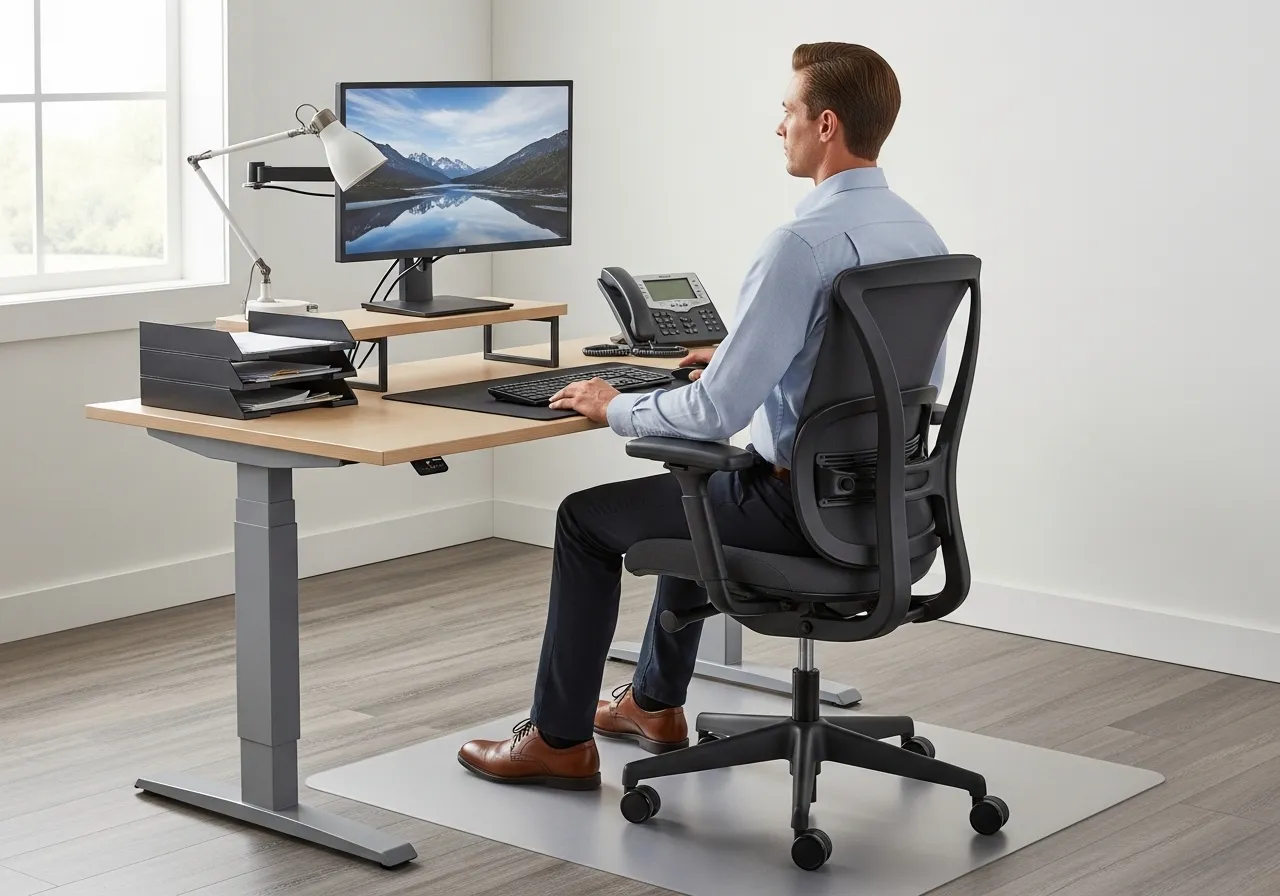
The most effective posture intervention is reducing the postural stress of sitting rather than merely treating its consequences — the ergonomically optimized workstation reduces the strain that the correction exercises must then address. The evidence-based ergonomic workstation setup: monitor height at eye level or slightly below (the top of the monitor at eye height prevents the persistent downward gaze that forward head posture requires); monitor distance of approximately 50–70cm (arm’s length) from the face — too close creates convergence eye strain and neck forward lean; chair height adjusted so that feet rest flat on the floor and knees are at approximately 90 degrees; lumbar support that maintains natural lumbar lordosis — a small lumbar roll or the chair’s built-in support positioned at the curve of the lower back; keyboard and mouse positioned at elbow height with the forearms parallel to the floor and the wrists in neutral position; and if possible, a monitor arm that allows easy height and angle adjustment rather than a fixed-position monitor that requires the user’s position to adapt to the screen’s fixed location. The standing desk consideration: standing desks that alternate between sitting and standing throughout the workday reduce the total sitting duration that drives the postural problems this article addresses — with the important caveat that sustained standing without movement has its own musculoskeletal consequences, and the alternation between sitting and standing is more beneficial than either alone. The ideal standing desk use pattern: 20–30 minutes standing followed by 30–40 minutes sitting, repeated throughout the day — preventing both the sitting-accumulated hip flexor shortening and the standing-accumulated calf and hip extensor fatigue.
Training Program Adjustments for Desk Workers
The training program modifications that specifically address desk posture imbalances — rather than inadvertently reinforcing them — require intentional changes to exercise selection, volume ratios, and the emphasis that the program places on the posterior chain and mobility work. The priority training adjustments: pulling-to-pressing ratio of 2:1 (for every set of pressing — bench press, overhead press, push-up — perform two sets of pulling — rows, face pulls, pull-ups); this ratio corrects the anterior-to-posterior imbalance that both desk work and conventional training create, building the upper back strength that both posture and shoulder health require. Prioritize hip hinge movements (Romanian deadlifts, conventional deadlifts, cable pull-throughs) over quadriceps-dominant movements (leg press, leg extension) — the posterior chain development that hip hinge training provides directly counteracts the anterior chain dominance that desk sitting creates. Include thoracic mobility work within every training session warm-up — the 2–3 minutes of foam rolling and wall angel practice before training converts the training session from a posture-neutral or posture-worsening activity to a posture-positive investment. Eliminate or significantly reduce exercises that reinforce dysfunction: chest fly and decline bench press further shorten already-shortened pectoral muscles; leg extension develops the already-dominant quadriceps without addressing the inhibited hamstrings and glutes; upright row with internally rotated position reinforces the internally rotated shoulder pattern. These eliminations are not permanent — they are corrections for the specific imbalance period, with reassessment every 8–12 weeks to evaluate whether the imbalance has sufficiently corrected to allow reintroduction.
The Posture-Pain Connection: When to See a Professional
The posture correction program in this article addresses the functional postural imbalances that desk work produces in otherwise healthy adults — the muscle tightness, weakness, and imbalance patterns that exercise and mobility work can resolve without medical intervention. The situations that require professional assessment before or alongside self-directed posture correction: neurological symptoms including numbness, tingling, or weakness in the arms or legs (these may indicate cervical or lumbar nerve compression that requires imaging and professional diagnosis before exercise intervention); pain that is severe, constant, or worsening despite rest and gentle movement (unlike the tightness and mild discomfort of postural dysfunction, structural pathology produces pain that does not improve with appropriate exercise); any history of cervical spine surgery, disc herniation, or spinal stenosis (these conditions require physician clearance for the specific exercises in this program before initiation); and persistent headaches with visual changes, balance problems, or other neurological features (headaches from postural neck strain are common and respond to the exercises in this article; headaches with neurological features require medical evaluation). For these presentations, a qualified physiotherapist, sports medicine physician, or musculoskeletal specialist should provide assessment and guidance before initiating a self-directed posture correction program. For the majority of desk workers with the typical tightness, aching, and stiffness that postural dysfunction produces without neurological features, the exercises in this program are appropriate, safe, and progressively effective with consistent practice.
The Standing Desk, Treadmill Desk, and Active Sitting Options
The workstation modification market has expanded significantly beyond the standard seated desk — offering standing desks, treadmill desks, cycling desks, and active seating options (balance discs, kneeling chairs, saddle seats) that address sedentary desk work from the ergonomic rather than purely exercise-based direction. The standing desk evidence: well-designed standing desks used in the alternating sit-stand pattern reduce musculoskeletal discomfort, lower-extremity fatigue, and the markers of cardiometabolic risk that prolonged sitting elevates. The caveats: static standing is not neutral — sustained standing without movement produces its own musculoskeletal demands (particularly in the calves, lower back, and hip extensors) and is not simply better than sitting but differently stressful. The anti-fatigue mat, supportive footwear, and deliberate weight shifting that standing desk use requires are practical requirements that the stand-all-day approach ignores. The treadmill desk: walking at 1–2 km/h while working reduces the health risks of sedentary work while maintaining cognitive performance for non-precision tasks — research suggests that complex cognitive tasks (writing, detailed analysis) show modest performance decrements at treadmill walking speeds above 2 km/h, while simpler tasks maintain performance at 2–3 km/h. The treadmill desk is not appropriate as the sole work activity but as one component of the workday movement repertoire that the alternating workstation approach provides. Active seating options — balance discs, kneeling chairs, and dynamic saddle seats — increase the minor muscular activity of seated work and may reduce some postural loading but do not replace the movement breaks and exercise interventions that genuine postural health requires.
Frequently Asked Questions About Posture Exercises for Desk Workers
How long does posture correction take? Meaningful reductions in pain and tightness occur within 2–4 weeks of consistent practice; visible postural changes appear within 6–12 weeks; and significant structural normalization requires 3–6 months of daily corrective work. The timeline extends proportionally with the severity of the imbalance — moderate postural dysfunction corrects faster than severe, long-standing imbalances. Can I correct posture at any age? Yes — postural imbalances respond to corrective exercise at any adult age, though the rate of change slows with age and the duration of established imbalance. Older adults demonstrating significant thoracic kyphosis can still improve thoracic mobility and reduce the progression of existing kyphosis through consistent exercise, even if complete normalization is not achievable after decades of established structural adaptation. Should I see a chiropractor for posture correction? Chiropractic manipulation can provide temporary relief from the joint restrictions that postural imbalance produces, but without the exercise interventions that address the underlying muscle imbalances, manipulation effects are temporary. The combination of appropriate manual therapy with the exercise program in this article produces better outcomes than either alone. Is forward head posture reversible? Mild to moderate forward head posture is substantially reversible with consistent chin tuck practice, thoracic mobility work, and deep cervical flexor strengthening — reducing both the visual and the symptomatic expression of the forward head position. Severe, long-standing forward head position in older adults may be partially irreversible due to structural adaptation in the cervical vertebrae and soft tissue, but exercise consistently reduces symptoms even when full structural correction is limited. How do I prevent posture problems from returning after correction? The maintenance program — the daily 10-minute morning routine, the at-desk micro-breaks, and the training program adjustments — prevents relapse in most cases. Periods of increased desk time (major projects, travel) predictably increase postural restriction and require temporary increases in correction work until the workload normalizes. Building the daily posture habits into automatic routine rather than treating them as temporary corrective measures provides the continuous maintenance that desk-working athletes require for the rest of their professional careers.
The Long-Term Vision: Training and Desk Work in Balance
The desk-working athlete faces a unique challenge that neither the sedentary office worker nor the full-time athlete encounters: the accumulation of postural dysfunction from the desk paired with the loading demands of serious training creates a higher-risk mechanical environment than either alone. The response to this challenge — deliberate, consistent posture correction practice integrated into both the workday and the training routine — produces outcomes that exceed what either lifestyle dimension could achieve in isolation: the training improves the muscular strength and movement quality that desk work degrades; the posture correction ensures that the training loads a balanced, structurally sound body rather than amplifying the imbalances that desk work creates; and the combination produces the physically capable, pain-free, posturally competent athlete that both the training investment and the professional career deserve. The exercises in this article are not a temporary fix — they are a permanent component of the desk-working athlete’s lifestyle, maintained as long as the desk work continues. The 20–30 minutes daily that the complete posture correction routine requires is the overhead cost of combining serious training with a desk-based career — a cost that the pain-free, high-performance training that it enables repays many times over across the athletic career that it protects.
Building a Supportive Work Environment: Communicating Posture Needs to Employers
The ergonomic workstation modifications that posture correction requires — a standing desk, monitor arm, lumbar support, and appropriate chair — represent an investment that employers are increasingly recognizing as both ethically appropriate and economically rational. The business case for employer-provided ergonomic support: musculoskeletal disorders are among the most common causes of workplace absenteeism and reduced productivity, with the costs of lost workdays and reduced performance significantly exceeding the cost of the ergonomic modifications that prevention requires. Many employers have formal ergonomic assessment processes through their occupational health programs — requesting an ergonomic assessment positions the request as a health and safety matter rather than a personal preference, and typically results in more comprehensive intervention than self-directed equipment requests. The documentation approach for ergonomic requests: obtaining a physiotherapist’s or occupational health professional’s recommendation for specific modifications strengthens the employer request and may be necessary for claiming the equipment as a workplace health accommodation in organizations with formal processes. Home office ergonomic support: many employers now provide home office setup stipends or equipment allowances for remote workers — requesting ergonomic equipment for home use through these programs is appropriate and widely accepted in organizations with established remote work policies. The desk-working athlete who advocates for their ergonomic needs at work is not being demanding — they are protecting the employer’s investment in their productivity and the personal health investment that their training represents.
The Integrated Athlete: Training, Desk Work, and Whole-Life Physical Health
The desk-working athlete who successfully integrates posture correction into their training and daily routine achieves something more significant than either desk worker wellness or athletic performance alone: a comprehensive physical lifestyle that serves both the professional demands of the career and the athletic ambitions of the training program, while building the physical foundation that decades of healthy, capable living require. The integration is not complicated — it is primarily a matter of intention and habit: the 10-minute morning posture routine, the at-desk micro-breaks, the pre-training activation, the evening release, and the training program adjustments that together produce the structural balance that desk work and training could otherwise systematically undermine. None of these components require extraordinary time or fitness — they require only the awareness that desk work and training interact, and the commitment to address that interaction deliberately rather than hoping the two influences will somehow cancel each other’s negative effects. The athlete who makes this commitment discovers, typically within weeks, that their neck pain decreases, their shoulder impingement resolves, their training quality improves, and their overall daily comfort and energy increase in ways that the training alone or the ergonomic adjustment alone could not produce. The whole is more than the sum of these parts — the structural balance that integrated posture correction creates provides the foundation from which both professional performance and athletic achievement can rise together, sustaining the active, capable, pain-free physical life that every desk-working athlete deserves.
Workplace Wellness Programs and Posture: Using Available Resources
Many organizations have corporate wellness programs that cover physiotherapy assessments, ergonomic consultations, and even subsidized fitness memberships — resources that desk-working athletes are frequently unaware of or underutilize. The occupational physiotherapy assessment available through many employer wellness programs provides a professional evaluation of individual postural imbalances, specific exercise recommendations tailored to the individual’s presentation, and written guidance that can support ergonomic modification requests. These assessments typically take 45–60 minutes and produce a personalized correction program that complements or refines the general program in this article with individual-specific priorities. Corporate wellness portals frequently provide online posture and exercise resources — video-guided desk stretching routines, ergonomic setup tutorials, and movement break apps — at no additional cost to employees. The employee assistance programs that many organizations provide may also cover a number of physiotherapy sessions with a qualified practitioner when musculoskeletal pain is affecting work performance, providing professional oversight for the posture correction process at no personal cost. Desk-working athletes who are investing personal resources in gym memberships, equipment, and nutrition for their training performance should apply the same resourcefulness to claiming the employer-provided wellness resources that their organization offers — the professional guidance these resources provide accelerates the posture correction process and ensures the program is appropriately individualized for the specific presentation each person brings to the work.
The Final Word: Commitment to the Process
Posture correction for the desk-working athlete is not a quick fix — it is a sustained commitment to addressing the structural consequences of the professional environment that your career requires. The exercises work. The daily routine produces genuine structural change. The training program adjustments prevent the reinforcement of the imbalances that the correction work is addressing. What determines the outcome is not the quality of the program but the consistency of its application — the daily practice that accumulates across weeks and months into the lasting structural normalization that isolated effort cannot produce. Begin the morning routine tomorrow. Set the 30-minute desk reminder today. Adjust the training program this week. The structural improvement that these small daily commitments produce will be visible within weeks and significant within months — and the pain-free, mechanically sound, posturally competent athletic body that emerges from the process will serve both the desk and the training floor with a physical capability that the uncorrected desk-working athlete cannot access. Your desk is not your enemy — it is simply an environment that requires deliberate physical management. This program provides that management. The rest is daily commitment to the process.
The integration of wrist and forearm care into the comprehensive posture program reflects the whole-body approach that genuine desk worker health requires — no joint or muscle group that desk work loads continuously should be left without the mobility maintenance and corrective exercise that accumulated loading demands. The desk-working athlete who addresses posture from the cervical spine to the wrist flexors has built the complete physical maintenance system that their professional life and athletic performance both deserve. The daily investment is modest; the cumulative return across a career of desk work and athletic training is extraordinary. Begin today, practice consistently, and allow the compounding effect of daily physical maintenance to build the structurally sound, pain-free, high-performance body that is the rightful outcome of the training investment you are already making. Every correct posture rep, every morning routine, and every training session in a balanced body brings you closer to the physical life that your commitment deserves.