8 Best Exercises You Should Do Every Single Day

1. The Science of Daily Exercise: Why These 8 Movements Transform Your Body
The idea of exercising every single day contradicts much of the conventional fitness wisdom that emphasizes rest days, recovery periods, and the dangers of overtraining. But the research on daily movement — and the distinction between the high-intensity training that requires recovery and the daily movement patterns that human physiology was designed for — reveals that the right exercises performed every day produce health, mobility, and functional fitness outcomes that 3-day-per-week training cannot fully replicate. I changed my daily movement practice three years ago after understanding the physiological difference between training the body and moving it — and the cumulative effects on joint health, energy levels, and physical capability have been more significant than any structured training program I have followed.
Daily Movement vs. Daily Training: A Critical Distinction
The exercises that belong in a daily practice are not the maximal-effort, heavy-load movements that require 48–72 hours of recovery between sessions — they are the movement patterns that maintain the physiological systems that daily living and athletic performance depend on: mobility, stability, fundamental strength patterns, and cardiovascular function. The research on sedentary behavior and health outcomes establishes that the human body deteriorates measurably from the absence of daily movement — joint mobility declines, postural muscles weaken, cardiovascular fitness decreases, and metabolic health worsens at rates that 3-day training cannot fully counteract if the other 4 days are sedentary. Research from the British Journal of Sports Medicine on physical activity guidelines confirms that the health benefits of exercise are not stored — each day of physical inactivity carries its own metabolic and physiological cost that previous exercise days do not fully offset. The 8 exercises in this article are selected for daily practice because they maintain movement quality, joint health, and physiological function without requiring the recovery that intense training demands — they are maintenance movements that preserve the physical capacity that targeted training develops.
The Compounding Effect of Daily Movement
The most significant argument for daily exercise is the compounding effect that consistent daily movement produces over weeks, months, and years — effects that intermittent training separated by sedentary days cannot replicate. Consider hip flexor mobility: a person who performs a 60-second hip flexor stretch daily accumulates 365 minutes (over 6 hours) of hip flexor work annually — compared to the same stretch performed 3 times per week accumulating 156 minutes. At the tissue level, this difference in total stretching volume produces a meaningfully greater collagen remodeling, viscoelastic change, and range of motion improvement that explains why daily practitioners consistently demonstrate better mobility outcomes than those who stretch only on training days. The same compounding logic applies to the daily practice of fundamental strength patterns (glute activation, push, pull), posture-supporting stability work, and the cardiovascular stimulus of daily movement — each day’s practice builds on the previous day’s without the mobility and strength regression that the sedentary recovery days of intermittent training produce between sessions.
How These 8 Exercises Were Selected
The selection criteria for the 8 daily exercises prioritized: universal applicability (exercises performable by any healthy adult without equipment or special environment); comprehensive coverage of the fundamental movement patterns that daily function and athletic performance require (hip hinge, squat, push, pull, carry, rotation, locomotion, and breathing); scalability from completely deconditioned beginners to advanced athletes; joint-friendly loading that is appropriate for daily practice without accumulating the mechanical fatigue that heavy resistance exercise produces; and evidence of health benefits from research literature that supports the specific physiological systems each exercise targets. The 8 exercises together address the complete spectrum of physical capability that optimal health and functional independence require — strength, mobility, stability, cardiovascular fitness, and neuromuscular coordination — in a daily practice that requires 15–30 minutes and no equipment. Research from PubMed literature on daily exercise health outcomes consistently identifies this combination of strength, mobility, and cardiovascular daily movement as the most effective preventive health intervention available — superior to any medication or supplement in its breadth and magnitude of health effects.
The Minimal Effective Dose for Daily Exercise
The dose-response relationship between daily exercise and health outcomes is non-linear — a relatively small daily movement investment produces a disproportionately large health benefit, with diminishing returns as duration extends beyond the minimum effective dose. For daily movement maintenance practice, research identifies 15–30 minutes as the minimum effective daily duration for producing the mobility maintenance, cardiovascular health, and musculoskeletal resilience outcomes that distinguish daily movers from sedentary individuals. This 15–30 minute investment — less than 2% of the day — produces health and functional benefits across the remaining 98% of waking time: improved energy from better cardiovascular function, reduced pain from maintained mobility and joint health, better mood from daily endorphin release and sympathetic-parasympathetic balance, and the functional capability that makes physical challenges of daily life manageable rather than threatening. The 8 exercises in this article can be performed in 20 minutes at moderate intensity — making the daily practice feasible for any schedule while providing the comprehensive movement stimulus that daily physiological maintenance requires.
The Research Evidence for Daily Movement
The research evidence for daily moderate exercise extends across multiple health domains with consistency that higher-intensity intermittent training cannot match across all outcomes. Cardiovascular health: daily moderate exercise (walking, light calisthenics, yoga) produces cardiovascular adaptations — reduced resting heart rate, improved heart rate variability, lower blood pressure — that are maintained more consistently by daily practice than by 3-day training with sedentary intervals. Joint health: articular cartilage receives nutrients through the synovial fluid that joint movement circulates — the daily movement that maintains cartilage nutrition prevents the degenerative changes that sedentary joint loading produces over decades. Research from the American College of Sports Medicine on exercise and arthritis prevention confirms that daily moderate joint-loading movement reduces osteoarthritis progression rates compared to sedentary behavior. Mental health: the mood-stabilizing effects of exercise — through endorphin release, cortisol regulation, and the neurogenesis that physical activity stimulates in the hippocampus — are most pronounced and most consistent when exercise is performed daily rather than intermittently, as the neurochemical benefits of a single exercise session last 4–24 hours and require daily renewal to maintain the mood stability that consistent practitioners experience.
Who Benefits Most from Daily Exercise Practice
While the 8 daily exercises benefit virtually every healthy adult, certain populations derive particularly significant benefits from establishing a consistent daily movement practice. Desk workers and sedentary professionals: the 8–10 hours of seated posture that knowledge-work occupations demand produce predictable patterns of hip flexor shortening, thoracic kyphosis, anterior shoulder rounding, and posterior chain weakness that daily corrective movement directly addresses — the daily practice counteracts the postural and mobility degeneration that occupational sedentarism produces at rates that compensate for the seated hours that employment requires. Athletes in structured training programs: the daily movement practice provides the active recovery, mobility maintenance, and nervous system stimulation that rest days from structured training should include rather than the complete inactivity that “rest day” is often interpreted to mean — maintaining daily movement quality on non-training days prevents the mobility regression that complete rest allows. Adults over 40: the age-related declines in muscle mass (sarcopenia), joint mobility, cardiovascular efficiency, and balance that accelerate after 40 are significantly attenuated by consistent daily movement — the daily practice provides the minimum movement stimulus that counteracts age-related physiological regression in the domains that functional independence and quality of life depend on. Individuals recovering from injury: the modified daily movement practice (adjusting exercises to avoid provocative positions and loads) maintains the movement quality and physical condition of unaffected body systems during injury recovery — preventing the deconditioning that complete injury-related rest produces in the systems that are not injured.
Setting Up Your Daily Practice for Success
The consistency that daily exercise requires is more dependent on the behavioral and environmental design of the practice than on the physiological content of the exercises themselves — the most scientifically optimal exercise selection is irrelevant if the practice is not consistently performed. The evidence-based habit formation principles that maximize daily exercise adherence: habit stacking (attaching the daily exercise practice to an existing daily anchor behavior — immediately after waking, before the morning shower, or before a daily meal — converts the exercise from a separate decision requiring willpower into an automatic behavior triggered by the anchor event); environmental design (keeping the exercise mat, foam roller, or resistance band visible and accessible at the location and time of daily practice removes the setup friction that makes skipping easier than starting); minimum viable practice (committing to 5 minutes of the daily practice on low-motivation days rather than all-or-nothing — the physical initiation of movement frequently produces the motivation to continue beyond 5 minutes, and the 5-minute practice maintains the habit streak that complete skip breaks). Research from the Harvard Health research on exercise habit formation confirms that consistency is the dominant predictor of exercise’s health benefits — a modest daily practice maintained for years produces superior health outcomes to an intensive program performed intermittently, making the behavioral design of a sustainable daily practice the most important investment in long-term fitness.
Adapting the Daily Practice to Different Fitness Levels
Each of the 8 exercises has a beginner modification that makes it accessible to completely deconditioned individuals and an advanced progression that provides adequate stimulus for competitive athletes — the same exercise selection serves all fitness levels through appropriate scaling rather than requiring different exercises for different populations. Beginner modifications prioritize: reduced range of motion (squatting to a chair rather than full depth), assisted versions (wall push-ups rather than floor push-ups), and reduced duration (10 seconds of each exercise rather than 30–60 seconds) that build the movement quality and physical capacity for progression to standard versions within 4–8 weeks of consistent daily practice. Advanced progressions add: resistance (weighted variations, resistance bands, or bodyweight leverage changes that increase load without additional equipment), complexity (single-limb versions that add balance and stability demands to the basic movement pattern), and duration or volume (extending the daily practice from 15 to 30 minutes as fitness improves and the practice becomes the comfortable baseline that increased challenge can build upon). The exercises themselves — not the scale of execution — remain constant across fitness levels, providing the movement pattern consistency that skill development requires while the physical parameters adapt to each individual’s current capacity.
The 8 exercises that follow represent the result of applying these selection criteria to the full spectrum of movement patterns that daily physical function requires — each chosen for its specific physiological benefit, its accessibility across fitness levels, and its contribution to the comprehensive daily movement practice that the research on physical activity and health consistently identifies as one of the most powerful interventions available for long-term wellbeing. Practice them daily, scale them appropriately for your current fitness level, and allow the compounding effects of consistent daily movement to produce the health, mobility, and functional capacity improvements that the research on daily exercise reliably demonstrates. The research on daily moderate exercise across all major health outcomes — cardiovascular, metabolic, musculoskeletal, cognitive, and psychological — consistently identifies it as the single most impactful preventive health behavior available to any individual regardless of age, fitness history, or genetic background. The 8 exercises in this article operationalize this research evidence into a practical, time-efficient daily practice that is more accessible, more sustainable, and more comprehensive in its health benefits than any gym-based program that requires equipment, commute, and high-intensity effort. The daily commitment is the investment; the compounding physiology of consistent movement is the return; and the long-term health and functional capability that daily practice produces across years is the reward that daily movement consistently and reliably delivers to every person who establishes and maintains it. The daily exercise practice described in this article is not a program with a start and end date — it is a lifestyle adoption that, once established through the 30-day action plan and reinforced through the identity shift from ‘someone trying to exercise’ to ‘someone who moves every day,’ becomes as automatic and non-negotiable as eating and sleeping. Treat it as such from Day 1, design the environment and schedule to support it consistently, and allow the physiological intelligence of the human body — evolved over hundreds of thousands of years to function optimally with daily movement — to produce the health outcomes that consistent daily practice reliably delivers.

2. Exercises 1–4: Foundation Movements for Strength and Mobility
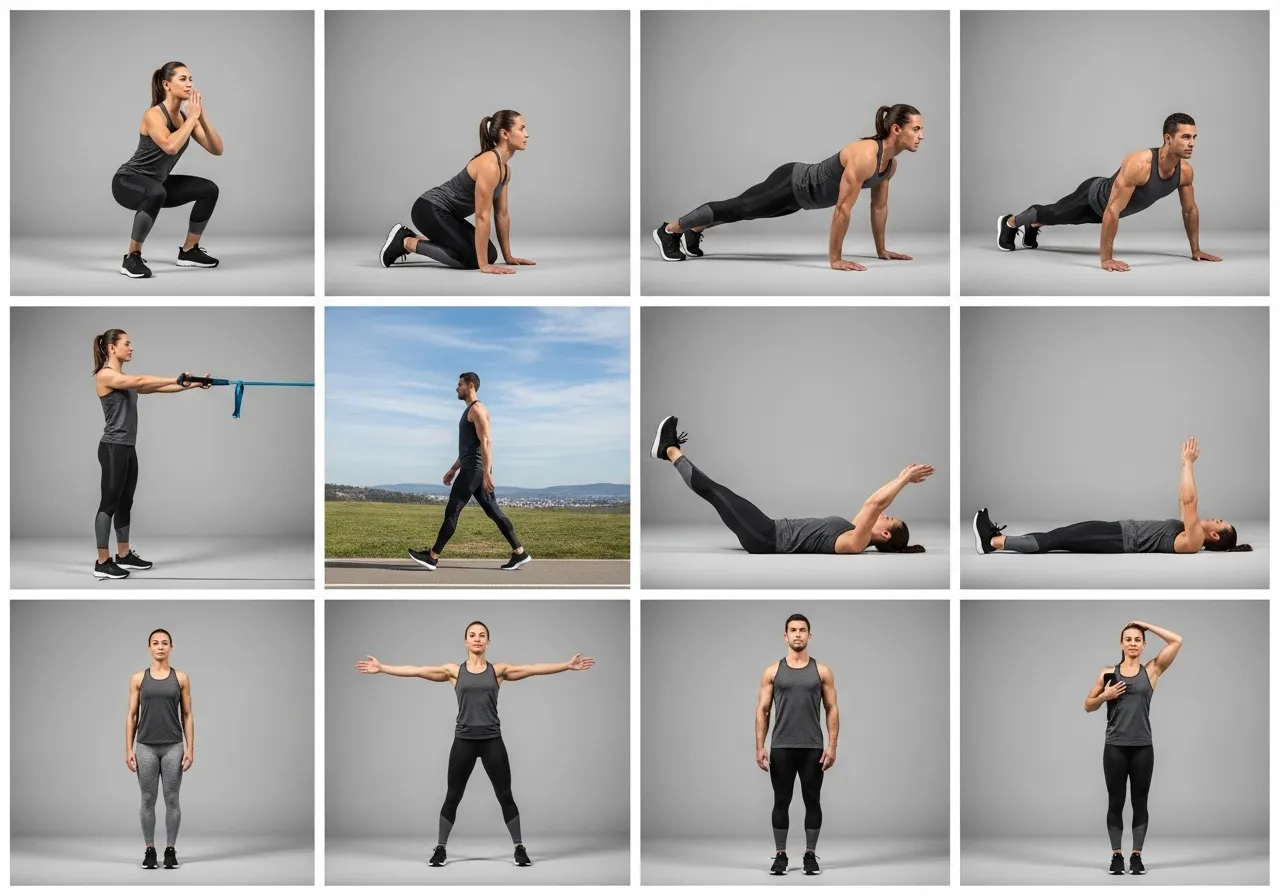
The first four daily exercises address the foundational movement patterns and mobility needs that form the physical basis for all other exercise and daily function: the hip hinge, the squat, the push, and the pull. These patterns, practiced daily at appropriate intensity, maintain the fundamental physical competencies that sedentary modern life systematically erodes.
Exercise 1: The Hip Hinge (Bodyweight Romanian Deadlift)
The hip hinge — the fundamental movement pattern of bending forward at the hips while maintaining a neutral spine — is the single most important daily exercise for the posterior chain (hamstrings, glutes, and lower back) that desk work and prolonged sitting systematically weakens and shortens. The bodyweight Romanian deadlift (RDL) performs the hip hinge pattern with sufficient posterior chain loading to maintain strength and mobility without the recovery demands of barbell loading. Execution: stand with feet hip-width apart, soft knee bend (15–20 degrees), hands on thighs. Hinge at the hips by pushing them backward as if closing a door with your hips, maintaining a flat back and neutral spine throughout the movement. Lower until a hamstring stretch is felt (typically hands reach mid-shin to ankle level, depending on hamstring flexibility), then drive the hips forward to return to standing by squeezing the glutes at the top. Daily dose: 2–3 sets of 10–15 repetitions, or 1 set of 20–30 repetitions as a continuous movement. The daily hip hinge practice produces: maintained hamstring flexibility (preventing the posterior pelvic tilt and lower back pain that tight hamstrings produce in sedentary individuals); glute activation that counteracts the gluteal amnesia (reduced neural drive to the glutes from prolonged sitting) that contributes to lower back pain and poor movement quality; and the movement pattern competency for safe everyday activities like picking up objects from the floor. Beginner modification: perform against a wall, placing the hands on the thighs and bending to touch the knees. Advanced progression: single-leg RDL, adding a resistance band around the hips, or adding dumbbells for resistance.
Exercise 2: The Bodyweight Squat
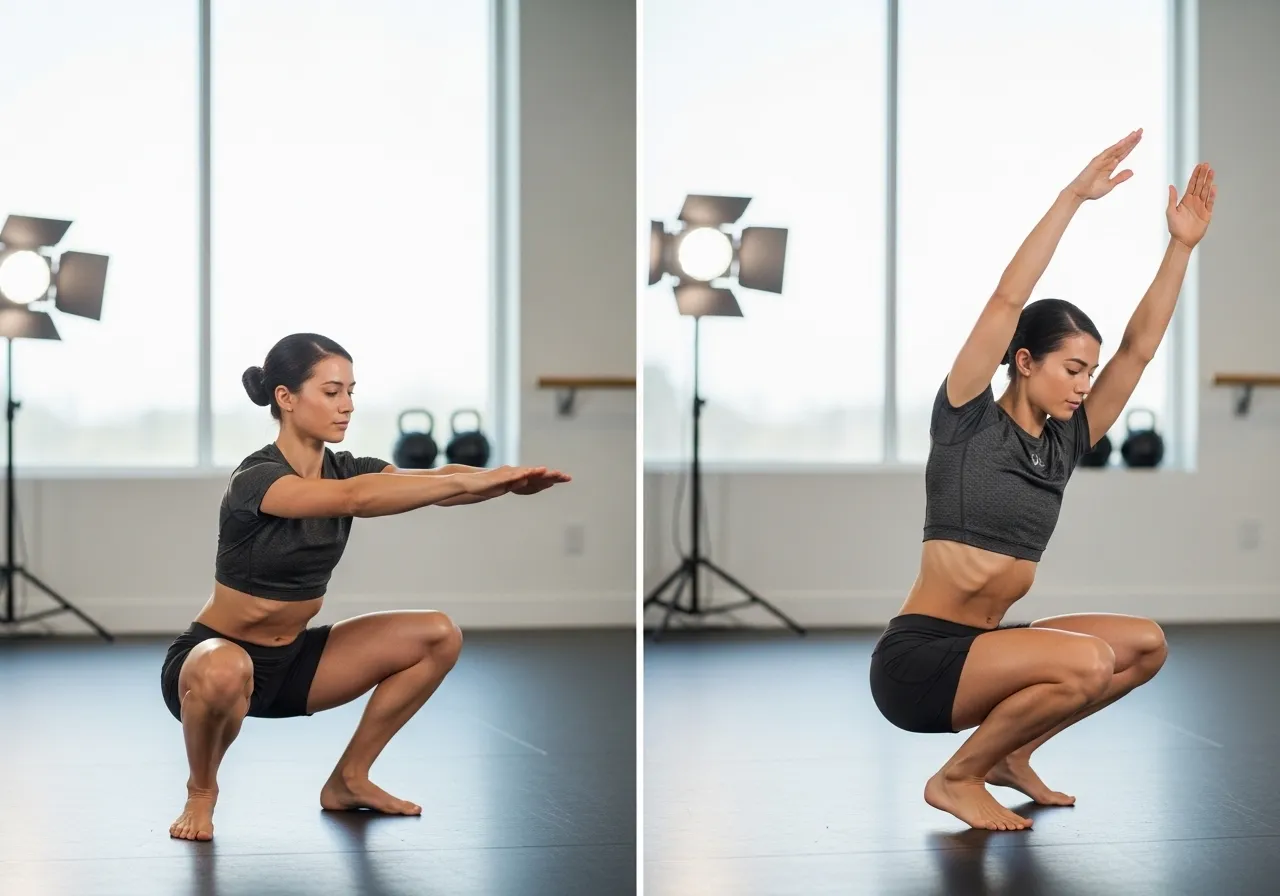
The squat — the fundamental lower body movement pattern of lowering and rising from a seated position — is the most comprehensive single exercise for lower body strength, hip and ankle mobility, and functional independence. The ability to perform a full-depth bodyweight squat with good mechanics is a reliable indicator of lower body mobility and strength adequacy, and the daily practice of this movement maintains the hip, knee, and ankle mobility that aging and sedentarism progressively reduce. Execution: stand with feet shoulder-width apart, toes turned out 15–30 degrees. Initiate the squat by pushing the knees out in the direction of the toes while sitting the hips back and down — maintaining the chest upright and the spine neutral throughout the movement. Descend until the hips are at or below knee level (full depth) if mobility allows, then drive through the heels to return to standing. Daily dose: 2–3 sets of 15–20 repetitions, or practice holding the bottom position for 30–60 seconds (the deep squat hold that addresses ankle dorsiflexion and hip mobility simultaneously). Research from the Journal of Strength and Conditioning Research on daily squatting practice finds that the ability to perform and maintain a full-depth squat correlates strongly with ankle dorsiflexion mobility, hip internal rotation range, and thoracic spine extension — the mobility limitations that aging and sedentarism produce fastest. Daily bodyweight squatting maintains these mobility components through the regular full-range loading that preserves the tissues’ capacity for the movement. Beginner modification: squat to a chair or box that limits depth to a pain-free range; hold a doorframe for balance during descent. Advanced progression: pause squat (3-second hold at the bottom), single-leg squat (pistol squat progression), or goblet squat with a weight for additional resistance.
Exercise 3: The Push-Up
The push-up — the fundamental pushing pattern that loads the chest, shoulders, and triceps through a full range of motion — is the most accessible and joint-friendly daily upper body pressing exercise available, producing the upper body pressing strength and shoulder stability that overhead activities, sports, and injury prevention require. Unlike the barbell bench press or overhead press, the push-up’s closed-chain nature (hands fixed, body moves) allows the scapulae to move freely in a physiologically natural pattern that develops the serratus anterior and lower trapezius muscles that shoulder health depends on — muscles that fixed-position pressing exercises (bench press with hands fixed on bar) do not fully develop. Execution: begin in a high plank position with hands slightly wider than shoulder-width, body forming a straight line from head to heels. Lower the chest to the floor by bending the elbows (flaring 45 degrees from the torso, not 90 degrees) while maintaining a rigid plank position throughout — no hip sagging or piking. Press back to the starting position by extending the arms fully. Daily dose: 3 sets to near-failure (within 2–3 repetitions of the point where another repetition cannot be completed with good form), resting 60–90 seconds between sets. For daily practice, stopping 2–3 reps short of failure prevents the accumulated fatigue that training to absolute failure daily would produce while still providing a sufficient maintenance stimulus. Beginner modification: incline push-ups (hands on a bench or wall), knee push-ups, or a combination that allows quality movement at appropriate difficulty. Advanced progression: decline push-ups (feet elevated), archer push-ups (wider stance with one arm nearly straight), or ring push-ups for added instability.
Exercise 4: The Band Pull-Apart or Doorframe Row
The pulling pattern — the horizontal or vertical pulling movement that engages the upper back, rear deltoids, and biceps — is the most commonly neglected daily exercise for the population that spends most waking hours in the forward-rounded position that computer work and driving produce. The anterior-dominant posture of modern sedentary life (rounded shoulders, forward head position, shortened pectorals) creates the muscle imbalances that contribute to shoulder pain, neck pain, and upper back tightness — the daily pulling practice directly addresses these imbalances by maintaining the posterior shoulder and upper back strength that counteracts the anterior dominance of sedentary posture. The band pull-apart (using a resistance band or towel held with both hands, pulling apart as if trying to break the band across the chest) provides the daily posterior shoulder stimulus without requiring gym access: hold the band at shoulder height with both hands shoulder-width apart, arms extended forward. Pull the band apart to shoulder level, squeezing the shoulder blades together, until the band reaches the chest. Control the return movement. Daily dose: 3 sets of 15–20 repetitions, or 2 sets of 30 repetitions as a continuous movement. The alternative doorframe row (gripping a doorframe at waist height and leaning back, then pulling the chest to the frame) provides a bodyweight rowing stimulus without any equipment. Research on posterior shoulder weakness and shoulder pain consistently identifies the strength deficit between the anterior and posterior shoulder musculature as a primary contributing factor to the impingement, rotator cuff pathology, and upper back pain that high-volume computer workers experience — making the daily pulling exercise one of the highest-value preventive interventions for this population.
Why These Four Movements Form the Foundation
The four foundation movements — hip hinge, squat, push, pull — together address the primary strength and mobility needs of the human movement system in the most time-efficient combination possible. Their daily practice maintains: the posterior chain strength and hip mobility that protects the lower back and enables pain-free daily lifting and bending (hip hinge); the lower body strength, ankle mobility, and hip mobility that functional independence and athletic performance require (squat); the upper body pressing strength and scapular stability that overhead function and shoulder health demand (push-up); and the posterior shoulder and upper back strength that counteracts the postural deformation of sedentary modern life (pull). Together they require 15–20 minutes at appropriate daily volume — a complete strength and mobility maintenance session that preserves the physical capabilities that structured training develops and sedentary recovery days would otherwise allow to regress. The compounding benefit of performing these four movements daily rather than 3 times per week is most pronounced in the mobility domain: hip flexors, hamstrings, ankle dorsiflexors, and thoracic spine all benefit disproportionately from daily movement stimulus compared to the 3-day-per-week schedule that allows regression between sessions.
Programming the Foundation Four for Daily Practice
The sequence in which the four foundation exercises are performed influences both the physiological effectiveness and the injury safety of the daily practice — and the optimal sequence follows the general principle of addressing mobility before loading and bilateral before unilateral movement patterns. Recommended daily sequence: begin with the bodyweight squat (addressing hip and ankle mobility while the body is cold and the joint range needed is greatest for first-thing-in-the-morning practice); transition to the hip hinge (posterior chain activation and hamstring mobility maintenance); perform the push-up (upper body pressing that is appropriate after the lower body movements have elevated body temperature slightly); complete with the pull-apart or row (posterior shoulder stimulus that closes the session with the most important postural countermeasure). This sequence requires no rest between exercises for the daily maintenance volume recommended — moving directly from squats to hip hinges to push-ups to pull-aparts within 10–15 minutes maintains elevated body temperature and movement quality throughout while producing the comprehensive daily stimulus the practice is designed to deliver. For athletes who add the foundation four to an existing training program: perform the foundation four as a warm-up before the main training session (using the mobility and activation benefits to enhance training quality) or as the active recovery practice on non-training days (providing the daily movement stimulus that rest-day inactivity would otherwise leave absent). The flexibility of the foundation four — requiring no equipment, no specific location, and minimal time — makes them the most universally sustainable daily exercise practice available for any schedule or environment.
Monitoring Progress in the Foundation Movements
Tracking progress in the daily foundation movements provides both the motivation that visible improvement generates and the diagnostic data that identifies when specific movements need additional attention or progression. Squat depth and quality: can you reach full depth (hip crease below knee) with a neutral spine and heels on the floor? Monthly assessment of squat depth against this standard tracks ankle and hip mobility improvement over the first 90 days of daily practice — most previously sedentary individuals achieve full-depth squatting within 60–90 days of daily practice. Hip hinge range: can you reach your ankles with flat-back form? Progressive improvement in hamstring flexibility is measurable through increased range of the bodyweight RDL — tracking how far down the leg the hands can reach while maintaining neutral spine documents the flexibility progress that daily practice produces. Push-up repetitions: how many push-ups can you perform with good form before form breaks down? Monthly testing of maximal push-up repetitions documents the upper body pressing strength progression that daily practice drives. The pull-apart band resistance: progressing from a lighter to a heavier resistance band over weeks documents the posterior shoulder strengthening that the daily pulling practice produces. These simple monthly assessments provide the progress confirmation that sustains daily practice motivation through the early weeks when the benefits are physiologically significant but not yet subjectively obvious.
The foundation four, practiced daily with progressive improvement tracking and appropriate scaling, build the physical foundation that all other exercise and daily function depend upon. The research on daily moderate exercise across all major health outcomes — cardiovascular, metabolic, musculoskeletal, cognitive, and psychological — consistently identifies it as the single most impactful preventive health behavior available to any individual regardless of age, fitness history, or genetic background. The 8 exercises in this article operationalize this research evidence into a practical, time-efficient daily practice that is more accessible, more sustainable, and more comprehensive in its health benefits than any gym-based program that requires equipment, commute, and high-intensity effort. The daily commitment is the investment; the compounding physiology of consistent movement is the return; and the long-term health and functional capability that daily practice produces across years is the reward that daily movement consistently and reliably delivers to every person who establishes and maintains it. The daily exercise practice described in this article is not a program with a start and end date — it is a lifestyle adoption that, once established through the 30-day action plan and reinforced through the identity shift from ‘someone trying to exercise’ to ‘someone who moves every day,’ becomes as automatic and non-negotiable as eating and sleeping. Treat it as such from Day 1, design the environment and schedule to support it consistently, and allow the physiological intelligence of the human body — evolved over hundreds of thousands of years to function optimally with daily movement — to produce the health outcomes that consistent daily practice reliably delivers.

3. Exercises 5–8: Cardiovascular, Core, and Functional Daily Movements
The final four daily exercises complete the comprehensive movement practice by adding the cardiovascular stimulus, core stability, hip mobility, and nervous system activation that the foundation strength movements do not fully address. Together with the foundation four, these exercises produce the complete physical maintenance practice that daily health and functional performance require.
Exercise 5: Walking (10,000 Steps or 30 Minutes)
Walking — the most natural human movement pattern and the cardiovascular exercise with the most consistent research support for long-term health outcomes — is the fifth daily exercise, and arguably the most important for the metabolic health, cardiovascular fitness, and longevity outcomes that all other exercises support. The specific health benefits of daily walking are well-established across decades of epidemiological and interventional research: daily walkers have 30–35% lower all-cause mortality rates than non-walkers; cardiovascular disease risk is reduced by 19% with 30 minutes of daily walking; type 2 diabetes risk is reduced by 30%; depression and anxiety symptoms are significantly improved; and cognitive decline is meaningfully attenuated compared to sedentary controls. The dose: 7,000–10,000 steps per day (approximately 5–7 km) or 30 minutes of continuous walking produces the majority of walking’s health benefits, with additional incremental benefits from higher step counts. For most adults, achieving 7,000–10,000 daily steps requires intentional walking beyond incidental daily movement — adding a 20–30 minute dedicated walk either as part of the daily exercise practice or as a separate daily habit captures both the cardiovascular benefit and the NEAT (non-exercise activity thermogenesis) contribution that walking provides. The walking prescription: aim for brisk walking pace (3–4 mph) that produces mild breathlessness but allows continuous conversation — the moderate intensity that research identifies as optimal for cardiovascular health and metabolic benefit. Research from Harvard Health research on walking and longevity identifies daily walking as the single most evidence-supported daily exercise recommendation for adults across all fitness levels — accessible, joint-friendly, metabolically beneficial, and cognitively stimulating in ways that indoor exercise cannot fully replicate.
Exercise 6: Dead Bug or Hollow Body Hold (Core Stability)
Core stability — the ability to maintain spinal neutrality while the limbs move — is the foundational physical quality that all other movement depends on and that lower back health requires. The dead bug exercise is the most evidence-based, spine-safe daily core stability exercise available: it trains the deep core stabilizers (transverse abdominis, multifidus, diaphragm, pelvic floor) that maintain spinal position under load, without the spinal flexion loading of crunches and sit-ups that can stress lumbar discs and exacerbate existing lower back issues. Execution: lie on your back with arms pointing toward the ceiling and legs raised with knees bent to 90 degrees (tabletop position). Maintaining a flat lower back pressed gently against the floor (the neutral spine position), simultaneously lower the right arm overhead and extend the left leg toward the floor — stopping before the lower back arches. Return to the starting position, then alternate sides. Daily dose: 3 sets of 8–10 repetitions per side, focusing on the quality of spinal control rather than the speed or range of the movement. The dead bug challenges the core’s fundamental function — resisting the rotational and extension forces that limb movement creates — in the exact demand pattern that lower back protection during daily activities and sport requires. Progression from the dead bug: the hollow body hold (a gymnastics-based exercise where the body assumes a banana-curved position with arms overhead and legs elevated, creating an isometric demand for the anterior core strength that bridges the gap between floor-based dead bugs and standing loaded movements).
Exercise 7: Hip Flexor and Thoracic Spine Mobility (90/90 Stretch + Thoracic Extension)
The combination of hip flexor tightness and thoracic spine stiffness is the most prevalent mobility restriction in modern sedentary adults — and the daily targeted mobilization of these two areas produces proportionally large improvements in posture, lower back pain, shoulder function, and athletic performance relative to the time invested. The 90/90 hip stretch: sit on the floor with one leg in front bent to 90 degrees (shin parallel to the front of the body) and one leg behind bent to 90 degrees (shin parallel to the side of the body) — the hip external rotation of the front leg and hip internal rotation of the back leg together address the complete hip rotation mobility that most sedentary adults have lost. Hold each position for 60–90 seconds with upright posture, then switch sides. The thoracic extension over a foam roller or rolled towel: place the roller perpendicular to the spine at the mid-back level, support the head with interlaced hands, and allow the thoracic spine to extend over the roller for 30–60 seconds before moving the roller to adjacent spinal levels. This thoracic extension mobilization directly counteracts the thoracic kyphosis that prolonged forward-flexed sitting produces — the thoracic mobility improvement that results improves shoulder elevation, reduces cervical strain, and enhances the respiratory capacity that thoracic stiffness limits. Daily dose: 90/90 stretch 60–90 seconds per side, thoracic extension 2–3 positions each held 30–60 seconds. The combined time investment of 5–7 minutes produces the hip and thoracic mobility maintenance that prevents the progressive restriction that untreated sedentary postural loading accumulates over months and years.
Exercise 8: Jumping Jacks or Jump Rope (Neural Activation and Coordination)
The eighth daily exercise addresses the neuromuscular coordination, reaction time, bone density stimulus, and cardiovascular activation that rhythmic, coordinated movement provides — a physiological stimulus category that the strength and mobility exercises of the other seven movements do not fully supply. Jumping jacks (or jump rope if available) performed for 2–5 minutes daily provide: bone density stimulus through the impact loading that repeated jumping produces (among the most effective bone density maintenance strategies for osteoporosis prevention); neuromuscular coordination through the rhythmic bilateral coordination pattern; cardiovascular activation that elevates heart rate above the walking pace of Exercise 5; and the neurological alertness that high-frequency limb coordination demands. The daily jumping stimulus also maintains the ankle stiffness (the elastic energy storage capacity of the Achilles tendon and plantar fascia) and calf strength that running, jumping sports, and stair-climbing depend on — physical qualities that walking alone does not adequately challenge. Daily dose: 2–5 minutes of continuous jumping jacks or jump rope at a moderate pace — enough to elevate heart rate to 60–70% of maximum, producing mild breathlessness. Beginner modification: marching in place with arm swings (eliminating the ground impact for individuals with joint contraindications); advanced progression: double-unders with jump rope, alternating jump jacks with squat jumps, or continuous box jumps. The daily jumping practice, while brief, provides the high-impact stimulus that distinguishes the complete daily exercise practice from the low-impact walking and mobility work that, without the jumping component, provides insufficient bone and connective tissue loading for long-term skeletal health maintenance.
Completing the Daily Practice: Putting All 8 Exercises Together
The complete 8-exercise daily practice, performed in the recommended sequence, requires 20–30 minutes and addresses every major physical quality that daily health and functional performance require. The recommended sequence: begin with 5 minutes of walking (warm-up and cardiovascular initiation); perform the foundation four (squat × 15, hip hinge × 15, push-up × 10–20, pull-apart × 20) as a continuous circuit without rest; transition to the dead bug (3 × 8 per side); perform the 90/90 hip stretch and thoracic extension mobilization (5–7 minutes total); and complete with 3 minutes of jumping jacks. This sequence produces a natural progression from cardiovascular activation through strength and mobility work to neural coordination — each component building on the physiological state that the previous component established. The 20–30 minute practice can be performed as a single morning session, split between morning and evening (foundation four in the morning, mobility and jumping jacks in the evening), or integrated with the daily walk as the bookends of a 30–45 minute outdoor practice. The flexibility of the 8-exercise daily practice — in timing, sequence, and location — makes it the most adaptable comprehensive daily exercise program available, capable of consistent performance across the variations in schedule, location, and motivation that daily life inevitably produces.
Breathing as the Ninth Daily Exercise
Deliberate breathing practice — the intentional cultivation of diaphragmatic breathing patterns, breath control, and the parasympathetic activation that slow exhalation produces — is the unsung daily exercise that most fitness programs omit despite its profound effects on stress management, core function, and cardiovascular health. The diaphragm is the body’s primary breathing muscle and a key contributor to intra-abdominal pressure regulation that core stability depends on — the shallow chest breathing that chronic stress and poor posture produce reduces both respiratory efficiency and core stability through the diaphragm’s degraded contribution to the intra-abdominal pressure system. Daily diaphragmatic breathing practice (5 minutes of deliberate nose breathing with visible belly expansion on each inhalation and complete exhalation through the mouth) directly trains the breathing mechanics that both athletic performance and daily parasympathetic regulation require. The specific daily breathing protocol: lie or sit comfortably, place one hand on the chest and one on the belly. Inhale through the nose for 4 counts, allowing the belly to rise while the chest remains relatively still (diaphragmatic engagement). Exhale through the mouth for 6–8 counts, allowing the belly to fall. The longer exhalation activates the cardiac vagal tone that produces parasympathetic dominance — the physiological state that stress management, sleep quality, and recovery all require. Five minutes of deliberate diaphragmatic breathing can be performed during the 90/90 stretch portion of the daily practice, converting the passive stretch into an active breathing and relaxation practice simultaneously.
Cold Exposure and Contrast Therapy as Daily Recovery Additions
Cold exposure — finishing showers with 30–60 seconds of cold water — is an increasingly evidence-supported daily addition to the movement practice that produces specific physiological adaptations: enhanced norepinephrine release (improving mood, focus, and energy), reduced systemic inflammation, and improved cold adaptation that increases metabolic rate through brown adipose tissue activation. Research on regular cold exposure finds mood improvements equivalent to moderate-dose antidepressant medication in some studies — with the practical advantage of being available without prescription, cost, or side effects for the majority of healthy adults. The cold shower protocol: complete the normal warm shower, then reduce the temperature to cold for the final 30–90 seconds, breathing continuously and allowing the initial cold shock response to subside. The daily cold exposure combines physiologically with the other 8 exercises to create a complete health-optimization practice that addresses strength, mobility, cardiovascular fitness, and stress resilience — the physical and physiological factors that determine the quality of daily experience and long-term health trajectory. For athletes, cold exposure after the daily movement practice (rather than immediately after intense training sessions where it may impair muscle protein synthesis) provides the recovery and mood benefits without the training adaptation compromise that post-training ice bath research identifies.
The 8 daily exercises, supplemented by deliberate breathing practice and optional cold exposure, create a comprehensive daily movement and recovery practice that addresses every physiological system that long-term health, athletic performance, and quality of life depend on — all within the 25–35 minute daily investment that these evidence-based practices require. The research on daily moderate exercise across all major health outcomes — cardiovascular, metabolic, musculoskeletal, cognitive, and psychological — consistently identifies it as the single most impactful preventive health behavior available to any individual regardless of age, fitness history, or genetic background. The 8 exercises in this article operationalize this research evidence into a practical, time-efficient daily practice that is more accessible, more sustainable, and more comprehensive in its health benefits than any gym-based program that requires equipment, commute, and high-intensity effort. The daily commitment is the investment; the compounding physiology of consistent movement is the return; and the long-term health and functional capability that daily practice produces across years is the reward that daily movement consistently and reliably delivers to every person who establishes and maintains it. The daily exercise practice described in this article is not a program with a start and end date — it is a lifestyle adoption that, once established through the 30-day action plan and reinforced through the identity shift from ‘someone trying to exercise’ to ‘someone who moves every day,’ becomes as automatic and non-negotiable as eating and sleeping. Treat it as such from Day 1, design the environment and schedule to support it consistently, and allow the physiological intelligence of the human body — evolved over hundreds of thousands of years to function optimally with daily movement — to produce the health outcomes that consistent daily practice reliably delivers.

4. How to Build a Daily Exercise Habit: Programming, Progression, and Recovery
The most carefully selected exercise program produces no benefit if it is not consistently performed — and daily exercise requires a behavioral and programming approach that differs from the 3-day-per-week training model that most fitness programs are built around. This section addresses the specific strategies for establishing and maintaining daily exercise as a permanent lifestyle practice rather than a temporary motivation-driven program.
The Identity-Based Approach to Daily Exercise
Motivation-based daily exercise — performing the practice when feeling motivated and skipping it when motivation is absent — produces the inconsistency that undermines the compounding effects that daily practice is designed to create. The most durable basis for daily exercise consistency is identity: the self-concept of being “someone who moves every day” rather than the goal-based framing of “someone who is trying to exercise more.” Research on habit formation and behavior change consistently identifies identity-based goals as more durable than outcome-based goals — because identity provides a motivational foundation that persists through the low-motivation periods that outcome-based motivation cannot bridge. The practical shift: instead of “I want to exercise daily to lose weight” (outcome-based, subject to motivational fluctuation as results vary), adopt “I am someone who moves their body every day as an expression of self-care and health commitment” (identity-based, resistant to the motivational fluctuations that outcome-based goals are vulnerable to). Each day’s exercise practice reinforces the identity — and the identity sustains the practice on the days when outcomes are not visible and motivation is low. This approach, documented extensively in the behavior change research that James Clear’s work on habits synthesizes, produces the daily consistency that the compounding effects of regular movement require to deliver their full health and performance benefits.
Progressive Overload in Daily Exercise: How to Keep Improving
Daily exercise at a fixed intensity and volume maintains the physical capabilities that the practice develops but does not drive ongoing improvement beyond the initial adaptation period. Progressive overload — the systematic increase in exercise stimulus over time — applies to daily practice just as it applies to structured training programs, though the increment and rate of progression are smaller for daily maintenance practice than for training-focused programming. The progression strategies for each of the 8 daily exercises: squats progress from bodyweight to goblet squat to barbell; hip hinges progress from bodyweight to band-resisted to weighted; push-ups progress from incline to standard to decline to archer; pull-aparts progress from light to heavy resistance band; walking progresses from 20 to 30 to 45 minutes, and from flat to hilly terrain; dead bugs progress from arm-only to leg-only to full alternating limb; 90/90 stretches progress from passive to active-assisted to loaded mobility; jumping jacks progress to jump rope to double-unders. The key distinction from gym-based progressive overload: daily practice progression should be gradual enough that the daily practice remains achievable on the lowest-motivation days — the threshold for the minimum acceptable daily practice should remain low while the ceiling for the best daily practice rises with ongoing progression.
When Rest Days Are Appropriate: Adjusting for Life and Recovery
The daily movement practice is not immune to the recovery demands of life — illness, injury, extreme fatigue from unusual life stress, or the recovery needs following very high-intensity training sessions all represent legitimate reasons to modify the daily practice rather than forcing through it at full capacity. The distinction between modification and skipping: on days when complete rest is appropriate, replacing the full 20–30 minute practice with a 5-minute minimum viable practice (a short walk, 5 minutes of stretching, or 5 minutes of breathing) maintains the habit streak and the physiological continuity of daily movement while respecting the body’s current recovery needs. The minimum viable practice concept prevents the all-or-nothing thinking that converts a modified rest day into a complete skip — and the behavioral research on habit maintenance confirms that even a minimum version of a habit on low-capacity days preserves the behavioral momentum that prevents extended absence. Genuine rest days (complete absence of intentional movement) are appropriate during illness with fever or systemic symptoms, during acute injury management, or on the recommendation of a healthcare provider — and represent appropriate exceptions to the daily practice rather than failures that require guilt or compensatory overexertion on subsequent days.
Tracking the Daily Practice: Simple Logging Methods
Tracking the daily exercise practice provides the motivational benefits of visible streak maintenance and the diagnostic data that identifies when specific exercises are consistently skipped (revealing practical barriers to address) or when progression has stalled (indicating the need for program modification). The simplest effective tracking method: a paper calendar or habit tracking app with a single checkmark or X for each day’s completed practice — the visual streak of consecutive days provides the streak-preservation motivation that behavioral research identifies as a powerful consistency driver (“don’t break the chain”). More detailed tracking: a brief daily log noting which exercises were performed, how many repetitions or how long, and a subjective rating of the session quality (1–5 scale) provides the data for the monthly review that identifies whether the practice is progressing and which components need modification. The tracking investment should be minimal — 2–3 minutes of logging daily — to ensure that tracking itself does not become a barrier to practice. Apps like Streaks, Habitica, or a simple notes application provide the digital tracking that is available for logging in the immediate post-practice minutes before the daily routine continues.
Integrating the Daily Practice with Structured Training
For athletes who combine the daily movement practice with structured training programs (resistance training, running, sport practice), the daily exercises serve a different function on training days versus non-training days. On training days: perform the daily practice as a warm-up before the main training session — the mobility work (squat, hip hinge, 90/90 stretch) prepares the joints and muscles for the training session’s demands; the cardiovascular activation of jumping jacks elevates heart rate and body temperature; and the pulling exercise activates the posterior shoulder before pressing-dominant upper body sessions. On non-training days: perform the complete daily practice as a standalone active recovery session — the light cardiovascular stimulus, mobility maintenance, and neural activation of the practice prevents the stiffness and mobility regression that complete rest allows, while the moderate intensity respects the recovery demands of the preceding training session. The daily practice on non-training days should be performed at conversational intensity — if any component feels harder than easy, reduce intensity or volume to ensure the active recovery purpose is served rather than adding training load that impairs recovery from the previous session.
The Social Dimension of Daily Exercise
The social accountability and community aspects of daily exercise practice significantly improve the consistency that solo practice struggles to maintain across months and years. The research on social influence on exercise adherence is unambiguous: people who exercise with a partner or group exercise more consistently and for longer than solo exercisers — the social commitment and shared identity of group practice provides motivational support that individual willpower cannot reliably sustain across the full range of life circumstances. The social strategies for daily practice: a daily walking partner who expects your company on the morning walk; an online community or accountability group sharing daily practice logs; a committed friend or family member who matches your daily practice commitment; or a fitness tracking app with social features that makes completion visible to a connected network. The social element also converts the daily exercise from a solitary obligation into a social activity that provides relational value — making the time investment serve multiple life priorities simultaneously rather than competing with social connection for limited daily time. For those who prefer solo practice, the public accountability of posting workout completion to social media, maintaining a visible habit tracker in a household location, or sharing progress with a trusted individual provides the social accountability benefit without requiring a consistent co-participant.
Nutrition to Support Daily Movement
The nutritional requirements of a daily movement practice differ from the demanding nutritional management that structured training programs require — the moderate intensity of daily maintenance exercises does not deplete glycogen, elevate protein turnover, or create the energy deficit that high-intensity training produces. The daily practice nutritional priorities: adequate total protein (1.2–1.6g/kg bodyweight daily for the generally active individual performing daily movement rather than structured training); hydration (2–3 liters of water daily, with additional intake on days of higher sweat loss from walking or jumping jacks in warm environments); and the general dietary pattern that supports the cardiovascular and metabolic health that daily movement is designed to maintain — emphasizing whole foods, adequate fiber, and the micronutrient diversity that varied plant food intake provides. For athletes combining daily practice with structured training, the nutritional requirements follow the more demanding structured training guidelines rather than the maintenance-focused daily practice guidelines — the daily practice’s nutritional needs are a modest addition to the training program’s existing nutritional demands rather than a separate nutritional management challenge. The integration of post-practice nutrition with the daily movement timing is straightforward for most daily practitioners: the morning daily practice is most naturally followed by breakfast, the evening practice by dinner — making the post-exercise nutritional window naturally coincide with the existing meal schedule without requiring additional food preparation or eating occasions.
Long-Term Vision: What 5 Years of Daily Practice Produces
The compounding effects of daily exercise — accumulated across 5 years of consistent practice — produce health, mobility, and functional outcomes that are qualitatively different from the outcomes of intermittent exercise programs. A person who performs the 8-exercise daily practice for 5 years accumulates: over 1,800 hours of deliberate movement that maintains the mobility, strength, and cardiovascular fitness that aging would otherwise progressively reduce; 1,800+ hip hinge sessions maintaining the posterior chain strength and hamstring flexibility that protects the lower back across the decade of greatest lower back pain risk; 1,800+ squatting sessions maintaining the ankle, knee, and hip mobility that functional independence requires into older age; and 1,800+ days of cardiovascular stimulation from walking and jumping that maintains the metabolic health, bone density, and cardiovascular fitness that sedentary aging rapidly erodes. The health trajectory of a 5-year daily practice is fundamentally different from the health trajectory of intermittent exercise — not because any individual session is dramatically different, but because the compound of 1,800 consistent daily practices prevents the progressive decline that inconsistent movement allows across the same period. Start the daily practice today, maintain it through the habit formation period of the first 90 days (the research-established threshold at which new behaviors become automatic), and allow the biology of consistent daily movement to compound into the health, vitality, and functional capability that 5 years of investment delivers.
The daily practice is the most democratically available health intervention — requiring no gym membership, no expensive equipment, no specific location, and no professional guidance beyond the exercise instructions in this article. Every person who commits to it has access to the same compounding health investment that the research on daily movement confirms produces meaningful, measurable outcomes across the lifespan. The research on daily moderate exercise across all major health outcomes — cardiovascular, metabolic, musculoskeletal, cognitive, and psychological — consistently identifies it as the single most impactful preventive health behavior available to any individual regardless of age, fitness history, or genetic background. The 8 exercises in this article operationalize this research evidence into a practical, time-efficient daily practice that is more accessible, more sustainable, and more comprehensive in its health benefits than any gym-based program that requires equipment, commute, and high-intensity effort. The daily commitment is the investment; the compounding physiology of consistent movement is the return; and the long-term health and functional capability that daily practice produces across years is the reward that daily movement consistently and reliably delivers to every person who establishes and maintains it. The daily exercise practice described in this article is not a program with a start and end date — it is a lifestyle adoption that, once established through the 30-day action plan and reinforced through the identity shift from ‘someone trying to exercise’ to ‘someone who moves every day,’ becomes as automatic and non-negotiable as eating and sleeping. Treat it as such from Day 1, design the environment and schedule to support it consistently, and allow the physiological intelligence of the human body — evolved over hundreds of thousands of years to function optimally with daily movement — to produce the health outcomes that consistent daily practice reliably delivers.
5. Daily Exercise FAQs, Common Mistakes, and Your 30-Day Action Plan
The final section addresses the practical questions and common errors that most often derail the daily exercise practice in its critical early weeks — and provides the specific 30-day action plan that converts the intention of daily exercise into the established habit that delivers its full long-term benefits.
Common Mistakes in Daily Exercise Practice
The most frequent errors in daily exercise practice undermine consistency and results — identifying and avoiding them from the start prevents the frustration that drives early abandonment of an evidence-based practice. Mistake 1 — Starting too intensely: beginning daily practice at a volume or intensity that is difficult to sustain on low-energy days produces the inevitable failure experiences that undermine streak maintenance and habit confidence. Start at 60–70% of comfortable effort and build gradually — the daily practice is a long-term commitment and optimal starting intensity is the one that is genuinely sustainable on the worst days, not the best. Mistake 2 — All-or-nothing thinking: treating any modification to the ideal practice as a failure, rather than performing the minimum viable practice that the day allows. A 5-minute walk on a challenging day maintains the habit far better than a missed day that breaks the streak and restores the friction of restart. Mistake 3 — Neglecting the mobility components: athletes who perform the strength exercises (push-ups, squats, hip hinges) while skipping the hip mobility and thoracic extension work because they “don’t feel like stretching” miss the most meaningful long-term benefit of the daily practice — the mobility maintenance that prevents the gradual restriction that aging and sedentarism produce. Mistake 4 — Performing the same daily practice indefinitely without progression: the body adapts to a given movement stimulus within 4–8 weeks — introducing progressions (heavier resistance, more repetitions, more complex variations) every 4–6 weeks ensures ongoing adaptation rather than plateau maintenance at the initial fitness level. Mistake 5 — Comparing to others: the daily practice is a personal investment in individual health and physical capability — the progress of others is irrelevant to the value of one’s own consistent daily practice.
Frequently Asked Questions About Daily Exercise
Can I really exercise every single day? Yes — at the moderate intensity appropriate for a daily maintenance practice, the 8 exercises do not create the accumulated fatigue that high-intensity training produces and require days off to address. The research supports daily moderate exercise as the healthiest activity pattern available. Will daily exercise prevent muscle growth from structured training? No — the daily practice exercises are performed at maintenance intensity that does not interfere with the recovery from structured training sessions, and the mobility and stability benefits of the daily practice enhance structural training quality and reduce injury risk. How long until I see results? Physical improvements (improved mobility, reduced stiffness, better energy) are often noticeable within 2–3 weeks of consistent daily practice. Body composition changes require 8–12 weeks of consistent practice combined with appropriate nutrition. Is the daily practice a replacement for structured training? No — the daily practice maintains baseline physical capability and health but does not provide the progressive overload necessary for significant strength, hypertrophy, or sport-specific fitness development. Structure training programs provide the growth stimulus; the daily practice maintains the foundation. What if I miss a day? Return to practice the next day without guilt or compensatory overexertion — a single missed day does not erase the benefits of consistent practice, and the appropriate response is simple resumption rather than the doubled next-day effort that increases injury risk and rarely improves adherence. Can older adults perform all 8 exercises? Yes, with appropriate modifications — every exercise has beginner variations accessible to deconditioned or older adults, and the daily practice is particularly beneficial for the mobility, strength, and cardiovascular health maintenance that aging makes increasingly important.
Your 30-Day Daily Exercise Action Plan
The 30-day action plan converts the 8 exercises from information into the embedded daily habit that produces long-term benefits. Week 1 (Days 1–7): perform a 15-minute session consisting of 10 squats, 10 hip hinges, 5 push-ups, 10 pull-aparts, 5 dead bugs per side, 60 seconds of 90/90 stretch per side, thoracic extension on a rolled towel, and 1 minute of jumping jacks. Perform immediately after waking, before the morning shower. Track each day on a paper calendar. Week 2 (Days 8–14): increase repetitions (15 squats, 15 hip hinges, 10 push-ups, 15 pull-aparts, 8 dead bugs per side) and extend the jumping jacks to 2 minutes. Add a 10-minute walk at any point in the day. Week 3 (Days 15–21): add a second set of the foundation four exercises, extend the 90/90 stretch to 90 seconds per side, and increase the walk to 20 minutes. Week 4 (Days 22–30): perform the complete recommended daily practice — 3 sets of foundation four, dead bugs, full mobility sequence, 3 minutes of jumping jacks, and 30-minute walk. Assess your squat depth, push-up count, and overall energy and mobility compared to Day 1. At Day 30, you have established the behavioral pattern and initial physiological adaptations that make the daily practice the automatic, identity-reinforcing health investment it becomes with sustained commitment.
The Cumulative Case for Daily Movement
The 8 exercises in this article are not special or complicated — they are the fundamental human movement patterns that the body was designed to perform daily, now requiring intentional scheduling because modern environments have removed them from the natural flow of daily life that evolution built them into. The case for daily practice is ultimately simple: the body that is moved every day is a different body than one moved intermittently — with better joint health, more resilient connective tissue, higher baseline metabolic rate, more consistent mood and energy, and the functional capability that makes physical challenges of daily life manageable and athletic pursuits available across decades rather than limited to the years before age-related deconditioning removes them. Start with Day 1 of the 30-day plan today. Perform the minimum viable practice on the hard days. Progress gradually on the good ones. Track the streak. And allow the 365-day compounding of daily movement to deliver the health outcomes that the research on physical activity consistently identifies as among the most powerful determinants of human health and longevity available to any individual regardless of genetics, history, or starting fitness level.
Building Beyond the 8: Expanding the Daily Practice
Once the 8-exercise daily practice is established as an automatic habit (typically 60–90 days of consistent performance), expanding the practice with additional evidence-supported daily habits amplifies the comprehensive health investment that the foundation practice initiates. Additions that integrate naturally with the established 8-exercise practice: a 5-minute morning sunlight exposure (supporting circadian rhythm regulation and vitamin D synthesis that the indoor modern lifestyle reduces); a 2-minute cold shower finish (enhancing norepinephrine and mood as described in Section 3); a gratitude practice during the 90/90 stretch (combining the psychological benefits of gratitude journaling with the physical benefits of the hip mobility work); and a post-walk mindfulness practice (10 minutes of quiet reflection after the daily walk that provides both psychological and neurological recovery benefits). These additions transform the 8-exercise daily practice from a purely physical intervention into a comprehensive daily wellbeing practice that addresses the physical, psychological, and neurological dimensions of optimal daily function — making the 30–40 minute morning or evening practice the most time-efficient comprehensive health investment available to any motivated individual.
The research on daily moderate exercise across all major health outcomes — cardiovascular, metabolic, musculoskeletal, cognitive, and psychological — consistently identifies it as the single most impactful preventive health behavior available to any individual regardless of age, fitness history, or genetic background. The 8 exercises in this article operationalize this research evidence into a practical, time-efficient daily practice that is more accessible, more sustainable, and more comprehensive in its health benefits than any gym-based program that requires equipment, commute, and high-intensity effort. The daily commitment is the investment; the compounding physiology of consistent movement is the return; and the long-term health and functional capability that daily practice produces across years is the reward that daily movement consistently and reliably delivers to every person who establishes and maintains it. The daily exercise practice described in this article is not a program with a start and end date — it is a lifestyle adoption that, once established through the 30-day action plan and reinforced through the identity shift from ‘someone trying to exercise’ to ‘someone who moves every day,’ becomes as automatic and non-negotiable as eating and sleeping. Treat it as such from Day 1, design the environment and schedule to support it consistently, and allow the physiological intelligence of the human body — evolved over hundreds of thousands of years to function optimally with daily movement — to produce the health outcomes that consistent daily practice reliably delivers.