
How to Create Your Own Workout Plan from Scratch
⚠️ Disclaimer: The information in this article is for general educational purposes only and does not constitute medical, nutritional, or professional fitness advice. Individual results may vary. Always consult a qualified healthcare professional or certified fitness trainer before starting any new exercise program, changing your diet, or making decisions about injury treatment or recovery. If you experience pain, discomfort, or any unusual symptoms during exercise, stop immediately and seek professional guidance.

Why Most People Fail at Creating Their Own Workout Plan
Every January, millions of people sit down with good intentions and try to design their own workout program. Most abandon these programs within six weeks — not because they lack discipline, but because the plans themselves were built on faulty assumptions, disconnected from real life, or structured in ways that made failure inevitable from day one.
I’ve made every mistake in this category. In my early twenties I cobbled together programs from fitness magazines, YouTube videos, and fragments of overheard gym advice. The results were inconsistent at best and injurious at worst. It took years of trial, error, and eventually studying exercise science seriously to understand that effective program design isn’t mysterious — it follows predictable principles that anyone can learn.
The Three Biggest Workout Planning Mistakes
The most common failure mode is goal vagueness. “Get fit” or “lose weight” are directions, not goals. Without specific, measurable targets you cannot design a program to reach them, cannot measure progress, and cannot know when you’ve succeeded. The first requirement of a good workout plan is a specific goal.
The second failure mode is complexity overreach. Beginners routinely design programs that would challenge advanced athletes — six days per week, two-hour sessions, seven different exercises per muscle group. Complexity is inversely correlated with adherence at every level below advanced. Simple programs done consistently beat complex programs done sporadically every single time.
The third failure mode is ignoring individual constraints. A perfect program for someone with unlimited time and a fully equipped gym is useless for someone with 45 minutes three times per week, basic home equipment, and a cranky lower back. Effective programs are designed around real life, not ideal conditions that don’t exist.
What the Research Says About Exercise Adherence
Research published in the Journal of Strength and Conditioning Research on training adherence consistently identifies three factors as most predictive of long-term program compliance: goal clarity, perceived manageability, and flexibility to accommodate life disruptions. A well-designed personal program addresses all three from the outset.
The framework in this article walks through every step — from goal definition to exercise selection to progressive overload — with the specificity needed to build something that works for you, not just in theory but under the real conditions of your actual life.

Step 1: Define Your Goal with Precision
Goal clarity is the foundation everything else is built on. The specific goal you’re training for determines your training split, exercise selection, volume, intensity, rep ranges, rest periods, and cardio approach. Different goals require fundamentally different programs.
The Four Primary Fitness Goals and What They Require
Fat loss requires a caloric deficit, moderate-to-high training volume, and a combination of resistance training and cardiovascular conditioning. The primary driver is total weekly energy expenditure and muscle retention under a caloric deficit.
Muscle gain (hypertrophy) requires caloric surplus or maintenance, higher training volumes in the 8–15 rep range, and consistent progressive overload. Volume — total sets per muscle group per week — is the primary driver.
Strength development requires lower rep ranges of 1–5 reps, higher intensities (85–95% of one-rep max), longer rest periods of 3–5 minutes, and compound movement focus. Intensity is the primary driver, not volume.
General fitness and health requires a balanced approach covering cardiovascular endurance, functional strength, mobility, and body composition. No single variable dominates — balance and consistency are the primary drivers.
Applying the SMART Framework to Fitness Goals
SMART goals are: Specific (“lose 15 pounds of fat while maintaining muscle”), Measurable (tracked via scale, photos, strength benchmarks), Achievable (realistic given your current level and available time), Relevant (aligned with values you actually care about), and Time-bound (with a 12-week or 6-month deadline).
Be honest about your primary goal for the next 12–16 weeks. Many people want fat loss, muscle gain, and improved cardiovascular fitness simultaneously. While some overlap is possible, trying to fully optimize all goals at once produces mediocre results across all of them. Choose a primary focus and let secondary goals be partially accommodated without derailing the main objective.
Breaking Long-Term Goals Into Milestones
Research from the Psychology of Sport and Exercise on goal-setting and exercise adherence shows that specific, proximal (near-term) goals produce better behavioral outcomes than vague, distal ones. Break a 6-month goal into monthly milestones. This creates regular checkpoints that maintain motivation and allow early identification of programming problems before they become serious.

Step 2: Assess Your Current Fitness Level Honestly
Accurate self-assessment prevents the two most common programming errors: designing something too easy (insufficient stimulus for adaptation) or too hard (injury, burnout, and abandonment). Both errors are equally common and equally preventable with a few simple tests.
Cardiovascular Fitness Benchmarks
The simplest field test is the 1-mile walk or run. Complete it as fast as you comfortably can and note your time. Under 8 minutes indicates a solid cardiovascular base; 8–10 minutes is average; over 10 minutes indicates limited cardiovascular capacity that should influence initial training intensity. The step test — stepping on and off a standard step for 3 minutes, then measuring heart rate at one minute of recovery — is a useful alternative that doesn’t require outdoor space.
Strength Benchmarks You Can Test Right Now
Push-ups: fewer than 10 consecutive = beginner; 10–20 = intermediate; 20+ = advanced foundation. Bodyweight squats with controlled 3-second descent: fewer than 15 = limited lower body strength; 15–25 = adequate; 25+ = solid base. Plank hold: under 30 seconds = limited core endurance; 30–60 seconds = average; over 60 seconds = strong foundation. These numbers directly inform starting loads and set/rep volumes in your program.
Mobility and Movement Quality Checks
Can you touch your toes from standing with legs straight? Can you perform a bodyweight squat below parallel while keeping your heels on the ground and chest up? Can you raise both arms fully overhead without your lower back arching dramatically? Failing these screens identifies mobility restrictions that should influence exercise selection — substituting goblet squats for back squats when ankle mobility limits depth, for example.
Injury and Training History Context
Document recurring pain patterns, previous injuries, and physical limitations before building your program. A history of shoulder impingement alters upper body pressing selection. A previous knee injury changes lower body exercise choices. Training history also matters: beginners (under 1 year consistent training) respond to almost any reasonable program; intermediates (1–3 years) need structured progressive overload; advanced trainees (3+ years) require periodization. Accurately placing yourself on this spectrum prevents both under- and over-programming.
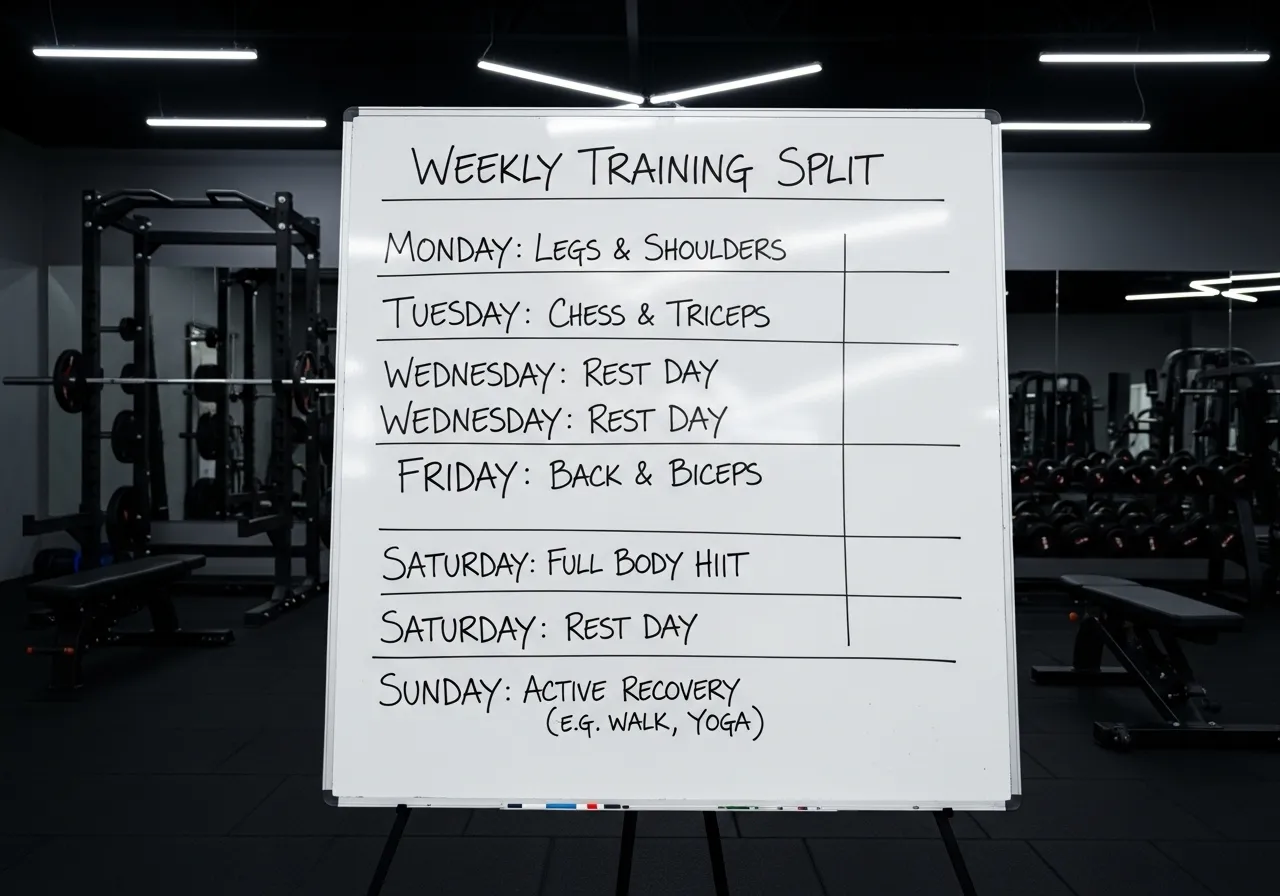
Step 3: Choose the Right Training Split and Frequency
Training split — how you divide muscle groups across sessions — is one of the most consequential structural decisions in program design. The right split depends on your goal, experience level, available training days, and recovery capacity.
Full Body Training (2–4 Days Per Week)
Full body training is optimal for beginners and anyone training 3 or fewer days per week. Every session stimulates all major muscle groups, which maximizes the frequency of neural and mechanical stimulus — the primary driver of adaptation for beginners. It also provides the most scheduling flexibility: missing one session doesn’t create the imbalances that result from missing a dedicated “leg day” in a split program. A classic 3-day full body structure (Monday, Wednesday, Friday) with different exercise variations each session is one of the most evidence-supported approaches in strength training research.
Upper/Lower Split (4 Days Per Week)
Alternating upper and lower body sessions on 4 days per week provides excellent frequency — each muscle group is trained twice weekly — while allowing sufficient volume per session to produce meaningful stimulus. This is the natural progression from full body training for intermediates adding a training day. A typical structure: Monday upper, Tuesday lower, Thursday upper, Friday lower, with the weekend as rest or active recovery.
Push/Pull/Legs Split (3 or 6 Days Per Week)
Push (chest, shoulders, triceps), pull (back, biceps), legs (quads, hamstrings, glutes, calves) run either 3 days per week for one full-body cycle or 6 days for a twice-weekly frequency. The 6-day PPL is demanding and appropriate only for those who have demonstrated consistent recovery at lower frequencies. The 3-day version provides good variety and adequate frequency for most intermediates.
Body Part Splits (4–6 Days Per Week)
Dedicated days for individual muscle groups produce the highest per-session volume but the lowest weekly frequency. These work well for advanced bodybuilders who have the training history to respond to high-volume, low-frequency stimulation. For beginners and intermediates, the research consistently supports higher-frequency approaches — the meta-analysis by Schoenfeld et al. showed that training a muscle group twice per week produced significantly greater hypertrophy than once per week at equivalent total volume.
How Many Days Per Week Is Actually Optimal?
For most people with normal life demands, 3–4 days per week of structured training is the sweet spot. It provides sufficient stimulus for meaningful progress, allows adequate recovery, and is sustainable across months and years. Five or six days per week is appropriate for advanced athletes with well-developed recovery management. Two days per week can maintain fitness but is generally insufficient for significant improvement in most goals.

Step 4: Select Exercises and Build Your Weekly Template
Exercise selection should be guided by three principles: movement pattern coverage, individual suitability, and goal alignment. A well-designed program covers the fundamental human movement patterns — push, pull, hinge, squat, carry, and rotation — through exercises appropriate for the individual’s mobility, equipment access, and training level.
The Six Fundamental Movement Patterns
Horizontal push: bench press, push-up, dumbbell press. Develops chest, anterior deltoid, triceps.
Vertical push: overhead press, pike push-up, landmine press. Develops deltoids, upper trapezius, triceps.
Horizontal pull: barbell row, dumbbell row, seated cable row, inverted row. Develops back, rear deltoid, biceps.
Vertical pull: pull-up, lat pulldown, band-assisted pull-up. Develops latissimus dorsi, biceps, rear deltoid.
Hip hinge: deadlift, Romanian deadlift, kettlebell swing, hip thrust. Develops posterior chain — glutes, hamstrings, lower back.
Squat: back squat, front squat, goblet squat, Bulgarian split squat. Develops quads, glutes, adductors.
Compound vs. Isolation Exercises
Compound exercises (involving multiple joints and muscle groups) should form the foundation of any program — they produce the greatest hormonal response, the highest caloric expenditure, and the most functional strength development. Isolation exercises (targeting a single muscle group) are valuable accessories that address specific weaknesses or aesthetic goals but should not be prioritized over compounds.
A practical exercise selection hierarchy: 1–2 compound exercises per movement pattern per session form the core; 1–3 isolation accessories per session address specific targets. For a beginner full-body program, 4–6 compound exercises per session with minimal isolation is sufficient. For advanced hypertrophy-focused programs, 5–7 compounds plus 4–6 targeted isolation exercises per session may be appropriate.
Building Your Weekly Template
Map your chosen split to a weekly calendar with specific days. Ensure adjacent training days don’t overload the same muscle groups — training chest on Monday and shoulders on Tuesday creates accumulating fatigue in the pressing musculature. Sequence days to allow 48 hours of recovery for directly trained muscles. Include 1–2 rest or active recovery days as non-negotiables, not optional additions. Write the template before filling in specific exercises so the structural logic is clear before the details are added.
Volume Guidelines by Training Level
Research on minimum effective volume for hypertrophy (summarized in Menno Henselmans’ volume guidelines) suggests: beginners respond to as few as 5–10 working sets per muscle group per week; intermediates need 10–20 sets; advanced trainees may need 15–25+ sets for continued progress. Starting at the lower end of appropriate volume and increasing gradually is safer and more sustainable than starting at maximum volume.

Step 5: Apply Progressive Overload and Track Everything
Progressive overload — the systematic increase of training stimulus over time — is the single most important principle in exercise science. Without it, adaptation stops. With it, almost any reasonable program produces continued progress. The goal of tracking is to ensure progressive overload is actually occurring, not just assumed.
Five Ways to Apply Progressive Overload
Load progression: Add weight to the bar or increase dumbbell weight. The most obvious and most effective form of progressive overload. Even adding 2.5 pounds per week to a barbell squat compounds to 130 pounds of additional load over a year. Small, consistent increases beat sporadic large jumps.
Volume progression: Add sets or reps at the same weight. Performing 3×10 this week and 3×12 next week at the same weight is meaningful progression even if the load hasn’t changed.
Density progression: Complete the same work in less time, or more work in the same time. Reducing rest periods from 90 seconds to 75 seconds while maintaining performance is progression.
Range of motion progression: Performing a movement through a greater range with control — going from parallel squats to below-parallel, for example — increases the mechanical stimulus even without adding load.
Technique progression: Performing the same exercise with better form, more control, and improved mind-muscle connection produces greater stimulus even without changes in load or volume.
How to Track Your Training Effectively
Every training session should be recorded. The minimum useful record is: exercise name, weight used, sets completed, reps completed. This information allows direct comparison with previous sessions and makes progression decisions objective rather than approximate. Apps like Strong, JEFIT, or a simple notebook all work equally well — the best tracking system is the one you’ll actually use consistently.
Review your training log weekly. Ask: did I progress on any lift? Did I complete all planned sets and reps? Were there any pain or discomfort patterns worth monitoring? This weekly review catches problems early and celebrates progress that would otherwise go unnoticed in the day-to-day grind of training.
Deload Weeks: Planned Recovery Is Not Optional
Every 4–8 weeks of progressive training, include a deload week where volume is reduced by 40–50% and intensity drops to approximately 60–70% of normal. Deloads allow accumulated fatigue to dissipate, connective tissue to recover, and the nervous system to reset. Skipping deloads leads to accumulated fatigue that masks fitness gains and eventually produces overuse injuries or burnout. Schedule them proactively, not reactively in response to breakdown.

Step 6: Review, Adjust, and Evolve Your Plan Over Time
No program should be followed rigidly indefinitely. The body adapts to training stress, and a program that produced excellent results for the first 12 weeks will produce diminishing returns if unchanged through weeks 24 and beyond. Systematic program review and evolution is what separates people who continue progressing for years from those who plateau and lose motivation.
The 12-Week Review Framework
Every 12 weeks, conduct a structured program review. Compare your current performance metrics (strength benchmarks, body composition measurements, cardiovascular benchmarks) to where you started. Assess whether your primary goal has been meaningfully progressed. Evaluate your adherence — what percentage of planned sessions were completed? Identify which exercises produced the best results and which felt unproductive or problematic. This data drives the next cycle’s programming decisions.
When to Change Your Program
Change is warranted when: progress on key lifts has stalled for 3+ weeks despite adequate nutrition and recovery; motivation has declined to the point where adherence is consistently poor; your goal has shifted; you’ve successfully completed the current program’s intended duration; or you’ve identified specific weaknesses that require targeted attention. Change is not warranted simply because a program feels boring — motivation fluctuates naturally and discomfort is not the same as ineffectiveness.
How to Evolve Without Starting Over
Most program evolution should be incremental rather than complete overhaul. Changing 20–30% of exercises while maintaining core structure, adjusting rep ranges or rest periods, altering the split slightly, or adding a training day preserves continuity while providing novelty. Complete program overhauls every few weeks — a common mistake of people who consume a lot of fitness content — prevent the accumulation of adaptation that requires consistent stimulus over months.
Long-Term Periodization
Advanced trainees benefit from planned mesocycles — blocks of 4–8 weeks with specific focuses (hypertrophy block, strength block, maintenance phase) that cycle systematically. This periodized approach, supported by extensive research reviewed in the Journal of Human Kinetics, prevents accommodation and maintains progress over years. Even beginners benefit from understanding that their first year’s program should look different from their second year’s program — the evolution is planned, not reactive.
The most important thing I’ve learned about workout planning over years of doing it well and badly: the best program is the one you build around your real life, execute consistently, and adjust honestly based on what’s actually working. Perfect program design on paper is worthless without execution. Imperfect execution of a good program beats perfect execution of nothing every single time. Start with the framework in this article, get it in place, and refine it as you go. That’s exactly how every successful long-term athlete approaches it.