10-Minute Core Workout for a Stronger Midsection
⚠️ Disclaimer: The information in this article is for general educational purposes only and does not constitute medical, nutritional, or professional fitness advice. Individual results may vary. Always consult a qualified healthcare professional or certified fitness trainer before starting any new exercise program, changing your diet, or making decisions about injury treatment or recovery. If you experience pain, discomfort, or any unusual symptoms during exercise, stop immediately and seek professional guidance.
Why Core Training Is More Than Just Sit-Ups
Ask most people what core training means and they’ll describe sit-ups, crunches, and maybe leg raises. This narrow definition is responsible for more wasted gym time and more lower back injuries than almost any other misconception in fitness. The core is not a single muscle or even a single movement pattern — it’s a complex, three-dimensional system of muscles that functions primarily as a stabilizer and force transmitter, not as a spinal flexor.
I spent two years doing endless crunches and wondering why my lower back kept hurting during squats and deadlifts. The problem wasn’t my back — it was that my core training had developed one small portion of the system (the rectus abdominis, the “six-pack” muscle) while neglecting the deep stabilizers, the obliques, and the posterior core that actually protect the spine under load. When I shifted to a training approach that targeted the full core system, both the back pain and my lifting performance transformed within weeks.
What the Core Actually Does
The primary function of the core musculature is not to move the spine — it’s to resist movement of the spine under load. When you squat with a heavy barbell, your core muscles fire not to flex your trunk but to prevent unwanted flexion, rotation, and lateral bending from collapsing your spine. This anti-movement function is what makes a strong core protective and performance-enhancing. Training exclusively in the spinal flexion pattern (crunches, sit-ups) builds only one aspect of this system while leaving the most important aspects underdeveloped.
Research on Core Function and Injury Prevention
Research published in the Spine journal by Dr. Stuart McGill — widely considered the world’s foremost authority on spine biomechanics — demonstrated that spinal instability from inadequate core stiffness is a primary mechanism of lower back injury under load. His research directly informed the shift away from flexion-based core training toward stability-based training that has become standard in evidence-based physical therapy and strength coaching.
The 10-minute core workout in this article is built around these principles. It trains anti-extension, anti-rotation, anti-lateral-flexion, and hip stability — the functional demands that make a core strong in the ways that matter for both athletic performance and injury prevention.
The Anatomy of Your Core: What You’re Actually Training
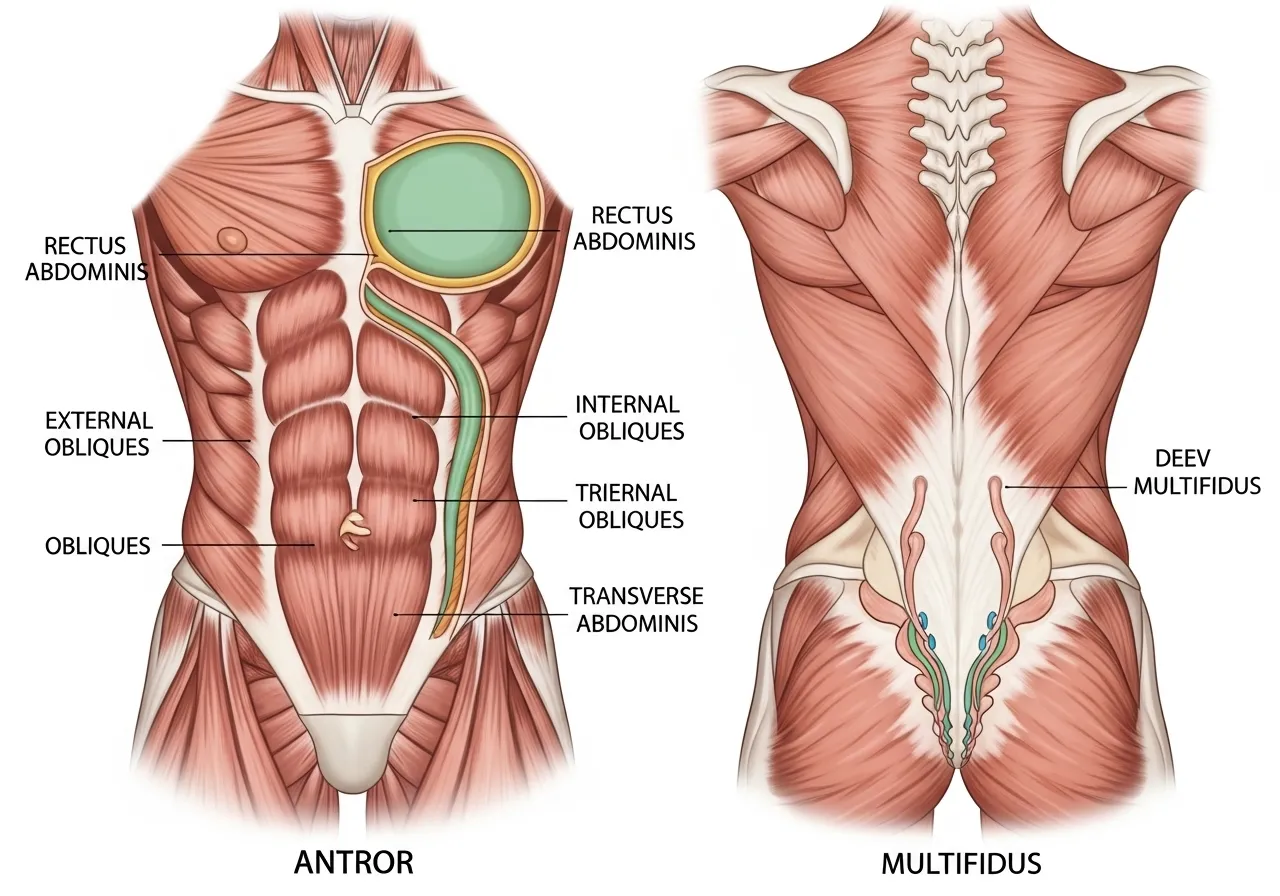
Understanding the specific muscles of the core system helps you understand why each exercise in the 10-minute routine is included and what it’s developing. The core is not just the abdominals — it’s a cylindrical system of muscles that surrounds the lumbar spine from all directions.
The Deep Stabilizers: Your Inner Foundation
The transverse abdominis (TVA) is the deepest abdominal muscle, wrapping around the trunk like a corset. It is the primary spinal stabilizer activated before any limb movement — research shows it fires 30–110 milliseconds before arm or leg movements to pre-stiffen the spine. Weakness in the TVA is strongly associated with lower back pain. The TVA is trained through exercises that require maintaining intra-abdominal pressure under load — planks, dead bugs, and bracing under resistance.
The multifidus is a deep spinal muscle that runs along the vertebral column and provides segmental stability — preventing individual vertebrae from shifting under load. It is almost always found to be atrophied in people with chronic lower back pain. It responds best to isometric and low-load endurance training rather than heavy loaded movements.
The Superficial Force Producers
The rectus abdominis (the six-pack muscle) runs vertically along the front of the abdomen and produces spinal flexion. It’s important but vastly overemphasized relative to its functional significance. Strong rectus abdominis with weak deep stabilizers is a common pattern that produces aesthetic definition with poor spinal protection under load.
The internal and external obliques run diagonally across the abdomen and are responsible for trunk rotation and anti-rotation — resisting unwanted twisting forces. They are also heavily involved in lateral stability. The obliques are undertrained in programs that emphasize only forward-facing movements like crunches and planks.
The Posterior Core
The erector spinae and quadratus lumborum form the posterior core — the muscles of the lower back that resist forward bending and lateral bending respectively. In most gym-goers these are either significantly undertrained or trained exclusively through heavy loaded movements without the endurance work that builds protective stability. McGill’s research found that core endurance — the ability to maintain stiffness under load over time — is more predictive of lower back health than core strength alone.
The Hip Stabilizers as Core Muscles
The gluteus medius and minimus, along with the hip external rotators, are functionally part of the core system — they stabilize the pelvis during single-leg movement and transfer force between the lower body and spine. Weak hip stabilizers result in lateral pelvic tilt and compensatory lumbar spine loading during walking, running, and single-leg exercises. Including hip stability work in core training addresses one of the most commonly overlooked components of the system.
The 10-Minute Core Workout: Exercise-by-Exercise Breakdown
This 10-minute routine is structured to train all functional components of the core system in a time-efficient sequence. It requires no equipment and can be performed anywhere. Perform it 2–3 times per week, either as a standalone session or appended to the end of a strength training session.
Exercise 1: Dead Bug — 3 Sets × 8 Reps Per Side (90 Seconds)
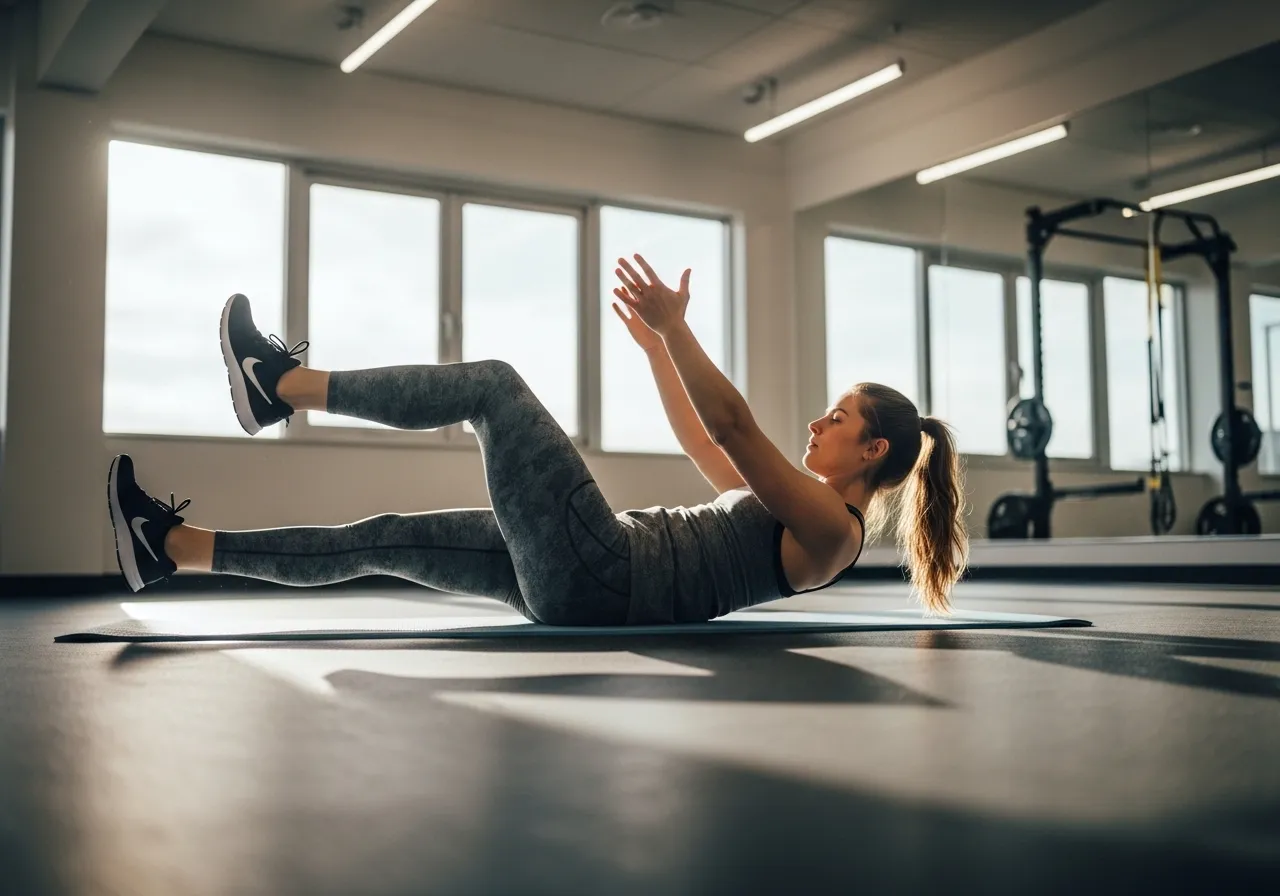
The dead bug is the safest and most effective anti-extension exercise available, particularly for people with lower back sensitivity. Lie on your back with arms extended toward the ceiling and knees bent at 90 degrees directly above your hips. Press your lower back firmly into the floor (eliminating the lumbar arch), then slowly lower your right arm overhead and your left leg toward the floor simultaneously, keeping the back flat throughout. Return and alternate sides. The key is maintaining the lower back-floor contact throughout — any arch means the core has lost the battle against the extension moment.
Exercise 2: Plank — 3 Sets × 30–60 Seconds (90 Seconds)
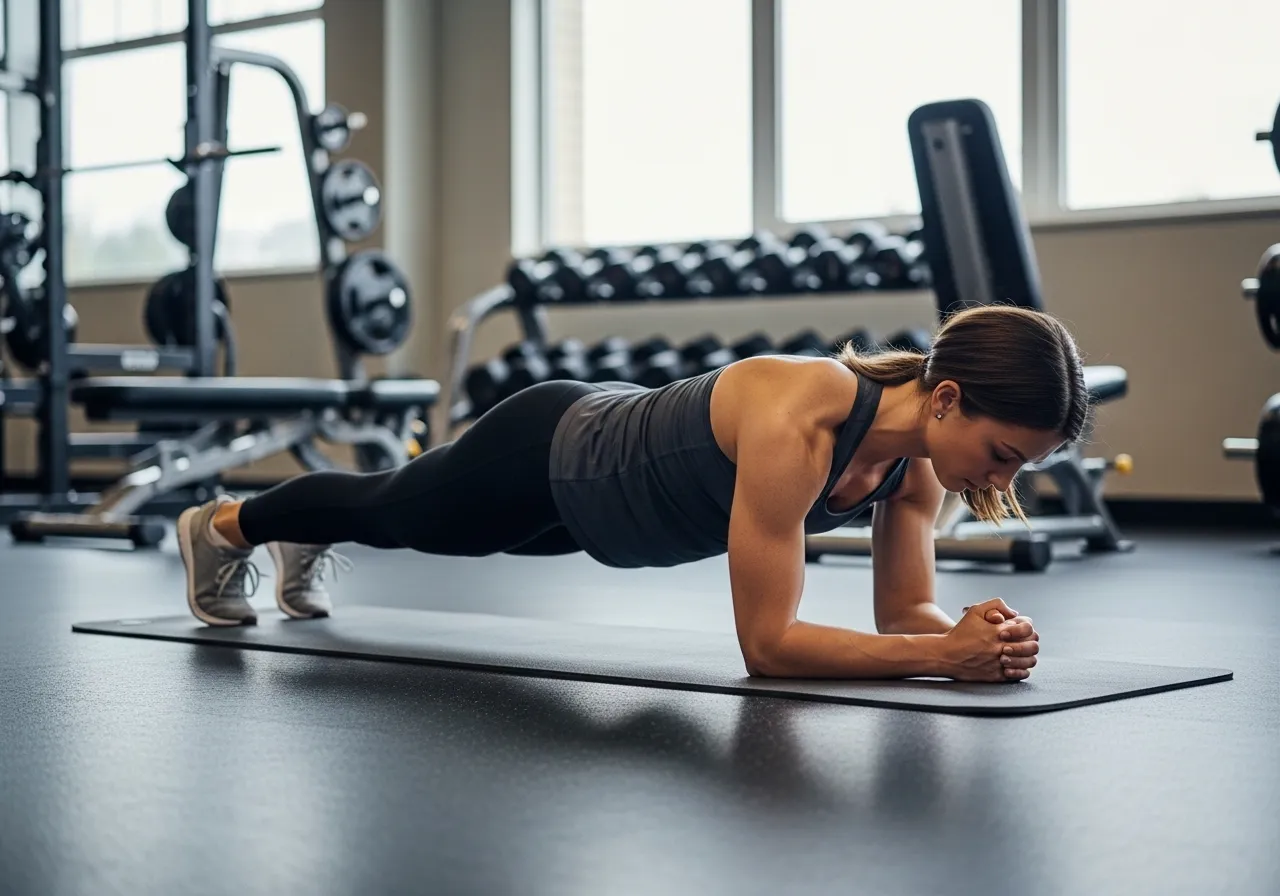
The plank trains anti-extension endurance — the ability to maintain a rigid, stable trunk position against the gravitational load on the spine. Elbows under shoulders, body in a straight line from head to heels, glutes squeezed, core braced as if about to take a punch. The most common errors are hips too high (removing the challenge), hips sagging (indicating fatigue), and holding breath. Breathe steadily throughout. Duration is less important than quality — a 30-second plank with perfect form is superior to a 90-second plank with a sagging midsection.
Exercise 3: Pallof Press Hold — 3 Sets × 20 Seconds Per Side (90 Seconds)
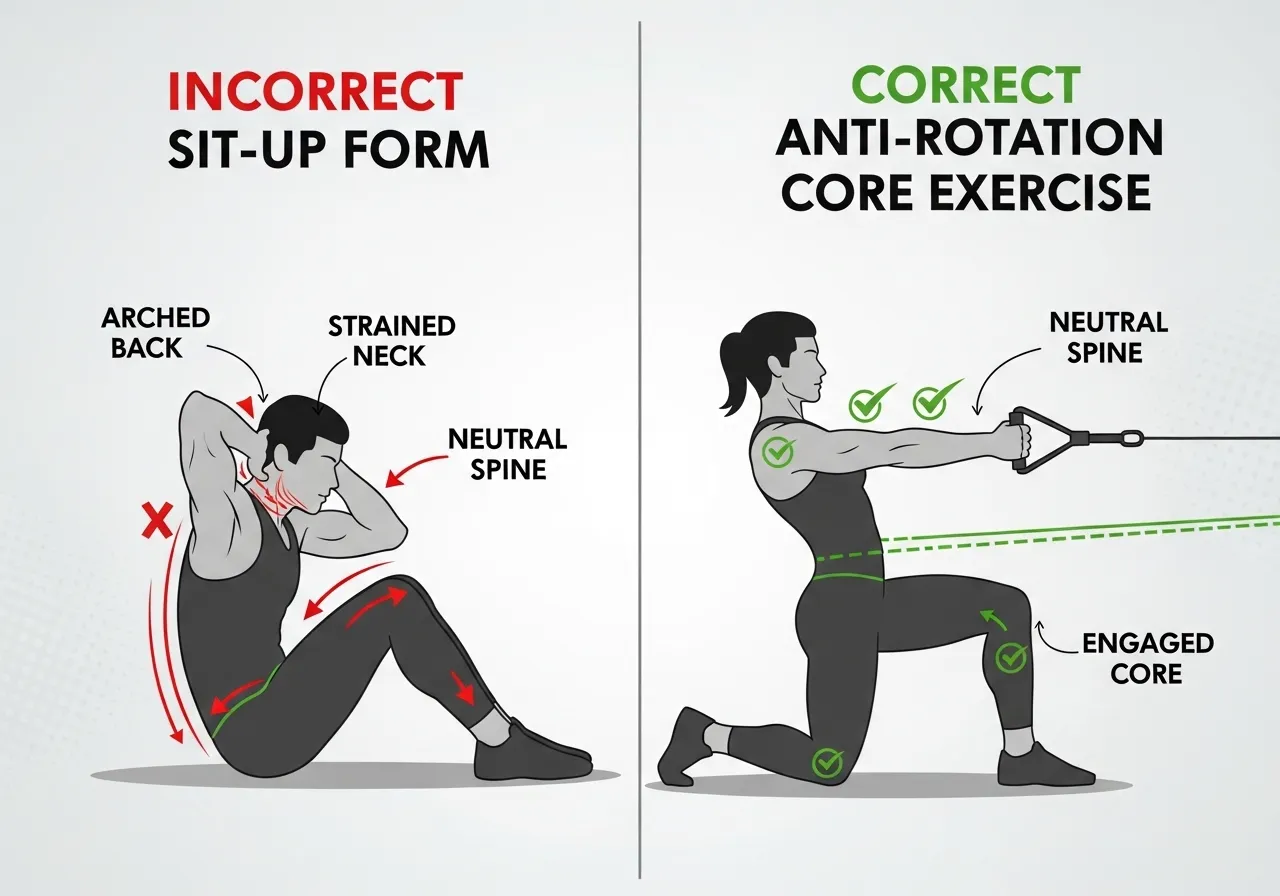
The Pallof press is the gold standard anti-rotation exercise. Using a resistance band anchored at chest height, stand sideways to the anchor, hold the band at your chest with both hands, and press it straight out from your chest and hold. The band is pulling you toward the anchor; your core is resisting this rotational force isometrically. This directly trains the obliques in their primary anti-rotation function. Without a band, the bodyweight alternative is a side plank with controlled breathing.
Exercise 4: Side Plank — 3 Sets × 20–30 Seconds Per Side (90 Seconds)
The side plank trains anti-lateral flexion — resisting the gravitational force trying to collapse the spine sideways. It also directly trains the quadratus lumborum and hip abductors. Stack feet or stagger them (easier), elbow under shoulder, hips elevated and in line with torso. The hips should be neither sagging nor piked — a straight lateral line. Progress to feet stacked, then to adding a hip dip variation for additional challenge.
Exercise 5: Bird Dog — 3 Sets × 8 Reps Per Side (90 Seconds)
The bird dog simultaneously trains anti-rotation, anti-extension, and hip extension in a position that closely mimics the demands of walking and running. From hands and knees (quadruped position), simultaneously extend the opposite arm and leg while maintaining a perfectly level pelvis and neutral spine. The tendency to rotate the torso or hike the hip on the extending leg side is what the core is resisting. Move slowly and with control — this is a stability exercise, not a range-of-motion exercise.
Total time: 10 minutes with 30-second transitions between exercises. This covers anti-extension (dead bug, plank), anti-rotation (Pallof press), anti-lateral-flexion (side plank), and integrated stability (bird dog) in a complete, evidence-based routine that addresses every functional component of the core system.
How to Progress Your Core Training Over Time
The same progression principle that governs all strength training — progressive overload — applies to core training. The specific overload mechanisms differ from load-bearing exercises, but the principle is identical: the core must be challenged progressively or adaptation ceases.
Progression Methods for Each Exercise Type
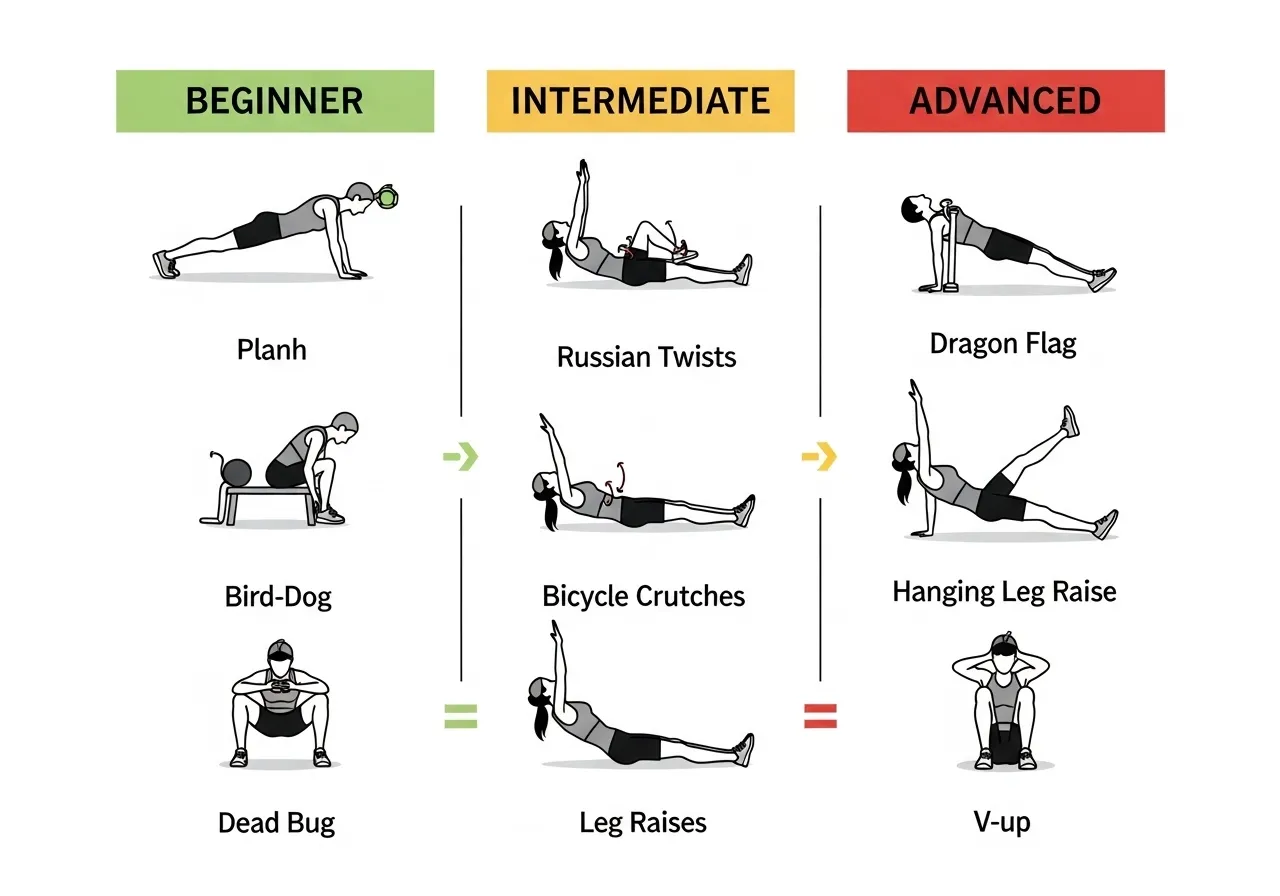
Plank progressions: Standard plank → feet elevated plank → plank with shoulder taps → plank with leg lifts → RKC plank (maximum full-body tension) → plank with band anti-rotation pull. Each step adds either instability or additional force to resist without compromising the fundamental anti-extension demand.
Dead bug progressions: Standard dead bug → dead bug with added band resistance → dead bug holding a light weight overhead → dead bug on a decline → hollow body hold. The hollow body hold — lying on your back with lower back pressed flat, arms overhead and legs raised — is the maximum isometric anti-extension challenge with bodyweight.
Anti-rotation progressions: Pallof press hold → Pallof press (dynamic press-out) → Pallof press with split stance → landmine rotation → loaded carries (farmer’s walk, suitcase carry). Loaded carries deserve special mention — carrying a heavy weight in one hand while walking is one of the most functionally demanding core exercises available and builds anti-lateral-flexion strength under fatigue in a way static exercises cannot replicate.
Adding Load to Core Training
When bodyweight core exercises become manageable — when you can perform all prescribed sets and reps with perfect form and controlled breathing — it’s time to add resistance. This can mean using a resistance band for additional anti-rotation demand, holding a weight plate during planks, wearing a weighted vest during bird dogs, or transitioning to cable-based variations of anti-rotation exercises. Research published in the Journal of Orthopaedic and Sports Physical Therapy supports progressive loading of core exercises as superior to bodyweight-only protocols for developing functional core stability in trained individuals.
Core Training Periodization
Like other training, core work benefits from periodization. During strength-focused training blocks, core work should emphasize stiffness and maximal force resistance — shorter duration isometric holds with higher resistance. During hypertrophy or endurance blocks, longer duration holds and higher reps develop the endurance component of core function that protects the spine during prolonged activity. Varying the emphasis prevents accommodation and builds a more complete core system.
Common Core Training Mistakes That Kill Your Results
Several persistent mistakes cause gym-goers to spend significant time on core training with minimal results and occasionally worsen the lower back problems they were trying to address. Identifying and correcting these mistakes is as important as understanding the correct approach.
Mistake 1: Training Only Spinal Flexion
The most prevalent core training mistake is a program consisting entirely of spinal flexion exercises — crunches, sit-ups, leg raises, Russian twists. This approach develops the rectus abdominis while neglecting the deep stabilizers, obliques in their anti-rotation function, posterior core, and hip stabilizers. A flexion-dominant core training program is analogous to training only the bench press for upper body — it develops one component while leaving critical others completely underdeveloped.
Mistake 2: Using Momentum Instead of Muscle
In both crunch variations and dynamic exercises like Russian twists, momentum substitution is pervasive. When exercise speed increases beyond the point where the core muscles control the movement, momentum carries the load and the target muscles receive minimal stimulus. All core exercises should be performed with deliberate control — particularly on the lowering or anti-gravity phase of dynamic movements. If an exercise can be done quickly without feeling challenging, it’s either too easy or being performed with momentum substitution.
Mistake 3: Neglecting Breathing and Bracing
The relationship between intra-abdominal pressure, bracing, and spinal stability is well established in sports medicine research. Proper bracing — creating circumferential pressure around the trunk — provides significantly greater spinal protection than abdominal drawing-in (sucking in the stomach) under load. Learning to breathe while maintaining appropriate brace is a skill that takes practice but dramatically improves both the safety and effectiveness of all loaded movements, not just dedicated core exercises.
Mistake 4: Treating Core Work as Optional
Core training is frequently the first thing dropped when gym time is limited — relegated to “if I have time at the end” status that ensures it rarely happens. This is a mistake with consequences that extend beyond aesthetics. The core stability that allows safe progression in squats, deadlifts, overhead presses, and virtually every other loaded movement is built through consistent, dedicated core training. Treating it as optional is equivalent to treating warm-up as optional — it works until it doesn’t.

How Core Strength Transfers to Every Other Lift
The functional significance of core strength extends far beyond aesthetics or direct core exercise performance. A strong, stable core is the mechanical prerequisite for safe and efficient performance in virtually every major compound exercise. Understanding these transfer effects provides the motivation to prioritize core training even when time is limited.
Core Strength and the Squat
During the back squat, the core musculature must resist the forward bending moment created by the barbell and gravitational forces. A weak or fatiguing core results in the classic “good morning” failure pattern — the torso pitches forward, loading the posterior chain inappropriately and creating significant spinal flexion under load. Strengthening the anti-extension function of the core through exercises like dead bugs and planks directly improves squat technique and allows safe progression to heavier loads.
Core Strength and the Deadlift
The deadlift imposes the highest absolute spinal load of any common gym exercise. The core’s role is to maintain a neutral spine throughout the lift — preventing both lumbar flexion (rounding) and hyperextension. Research published in the Journal of Strength and Conditioning Research on deadlift mechanics confirms that lumbar flexion under load, often a result of core fatigue rather than technique errors, is the primary mechanism of deadlift-related lower back injury. Core endurance training — the ability to maintain stiffness across multiple sets of heavy lifting — is directly protective.
Core Strength and Upper Body Performance
The overhead press requires the core to resist the extension moment of a load held overhead — without adequate anti-extension strength, the lower back hyperextends to compensate, creating both performance limitations and injury risk. The bench press requires core stability to maintain the arch and foot drive that optimize pressing mechanics. Even pulling exercises like rows and pull-ups rely on core stability to prevent compensatory lumbar motion during the pulling phase. A weak core limits upper body training in ways that are not always obvious until the core is strengthened and performance improvements follow unexpectedly.
Core Strength and Athletic Performance
In sport contexts, the core’s role as a force transmitter between the lower body (the primary force producer) and the upper body is critical. All throwing, striking, and pushing sport movements depend on the core’s ability to efficiently transfer ground reaction force through the trunk to the extremities. Rotational sports — tennis, golf, baseball, martial arts — depend particularly on oblique strength and anti-rotation control. Athletes who strengthen their cores through the stability-based approach described in this article consistently report improvements in sport performance that they attribute to more efficient force transfer.

Building Core Training Into Your Weekly Routine
The final challenge is integration — fitting core training into a weekly schedule that already includes strength training, cardiovascular conditioning, and real life. The good news: 10–15 minutes of targeted core training 2–3 times per week is sufficient to produce meaningful development when the training is well-structured. This is not a large time investment relative to the functional returns.
When to Do Core Training: Before, During, or After?
Core training placement in the session matters. Performing exhausting core work before compound lifts is contraindicated — a fatigued core cannot provide the spinal stability required for safe heavy squatting or deadlifting. Options: perform brief, low-fatigue core activation (2–3 minutes of dead bugs and bird dogs) as part of the warm-up to prime the stabilizers, then complete the bulk of core work at the end of the session when it won’t compromise compound lift performance.
Integrating Core Demands Into Compound Movements
Dedicated core exercises are not the only way to develop core strength. Choosing compound exercises that impose high core demands — standing overhead press rather than seated, barbell rows rather than chest-supported rows, single-leg exercises, loaded carries — builds core strength incidentally through the regular training program. Many people find that shifting to more demanding compound movement variations reduces or eliminates the need for dedicated core work to maintain functional stability.
A Sample Weekly Core Integration Schedule
For a 4-day upper/lower split: add 8–10 minutes of core work at the end of both lower body sessions. Lower body training creates the highest core demand context, making post-session core work both practical and complementary. For a 3-day full body program: include 8–10 minutes of core work at the end of all three sessions, rotating emphasis between anti-extension (Monday), anti-rotation (Wednesday), and anti-lateral-flexion (Friday) to ensure complete coverage across the week.
The World Health Organization’s physical activity guidelines recommend muscle-strengthening activities for all major muscle groups twice weekly — the core is no exception. Making core training a non-negotiable, scheduled component of your program rather than an optional add-on is the single most important implementation decision. Ten consistent minutes twice per week produces more results over a year than an hour-long core workout done sporadically when you remember to include it.
Start with the 10-minute routine in this article. Track your progress — note when planks get easier, when dead bugs feel controlled throughout, when side planks can be held longer. These are objective signs that your core is developing. Within 6–8 weeks of consistent practice, you’ll feel the difference in every compound movement you perform — and that functional carryover is the most compelling motivation to keep going.