How to Stay Fit While Traveling
⚠️ Disclaimer: The information in this article is for general educational purposes only and does not constitute medical, nutritional, or professional fitness advice. Individual results may vary. Always consult a qualified healthcare professional or certified fitness trainer before starting any new exercise program, changing your diet, or making decisions about injury treatment or recovery. If you experience pain, discomfort, or any unusual symptoms during exercise, stop immediately and seek professional guidance.
Why Travel Wrecks Your Fitness (And How to Prevent It)
Travel is one of the most reliable disruptors of established fitness routines. Research on exercise behavior during travel periods consistently shows that regular exercisers reduce their training frequency by 50 to 80 percent during travel, often abandoning training entirely for days or weeks at a time. The cumulative effect of frequent travel on annual training volume — and therefore on fitness and body composition maintenance — is substantial for people who travel regularly for work or leisure.
The mechanisms by which travel undermines fitness are well-documented and predictable, which is precisely why they can be proactively addressed. Disrupted sleep from time zone changes, unfamiliar sleeping environments, and schedule alterations impairs recovery capacity and motivation for training. Irregular meals and limited food choices compromise the nutritional support for training. Packed schedules — meetings, sightseeing, transportation — eliminate the time blocks that accommodate training. Absent familiar gym environments remove the environmental cues that prompt training behavior. And the psychological “vacation mode” that accompanies travel creates permission-giving that relaxes normal health commitments.
The True Cost of Fitness Breaks During Travel
Understanding exactly what is lost during travel-induced training breaks motivates the effort of maintaining training while traveling. Cardiovascular fitness begins to measurably decline within 2 weeks of training cessation, with VO2 max reductions of 5 to 10 percent after 2 to 4 weeks and more substantial losses after longer breaks. Strength, surprisingly, is more resistant — measurable strength loss requires 3 or more weeks of complete inactivity for most people, and even then, the loss is primarily neural rather than structural in the first 4 to 6 weeks. Body composition effects occur more gradually, but consistent travel-induced training breaks with unrestricted eating can produce meaningful fat gain over months of regular travel.
For people who travel 3 to 5 days per month, the cumulative training loss from travel is equivalent to missing 36 to 60 training sessions per year — the difference between 200 sessions and 140 sessions, which represents a meaningful reduction in annual training volume that affects fitness trajectory. This makes travel fitness management not a marginal concern but a central element of maintaining long-term training progress for regular travelers.
The Minimum Maintenance Standard
The minimum effective training standard for maintaining fitness during travel is lower than most people assume: 2 to 3 resistance training sessions per week of 20 to 30 minutes each, plus daily walking, is sufficient to maintain strength and body composition for most recreational trainees during travel periods of 1 to 4 weeks. This minimum is achievable in virtually any travel context — hotel rooms, outdoor spaces, and airport terminals can all accommodate the bodyweight training that forms the foundation of a travel workout program. The challenge is not capability but habit and motivation when the familiar training environment is absent.
Reframing Travel Fitness: Maintenance Over Optimization
The most productive mental frame for travel fitness is shifting from optimization (maximizing training quality and progression) to maintenance (preserving the fitness developed during normal training periods). During travel, the goal is not to make progress — it is to preserve the fitness that normal training has built so that upon returning home, progress can resume immediately rather than requiring weeks of rebuilding lost conditioning. This maintenance mindset reduces the pressure that leads many travelers to attempt overly ambitious travel workout programs that fail in the first day, producing all-or-nothing abandonment rather than sustainable minimum-dose maintenance.
The Ultimate Hotel Room Workout Routine
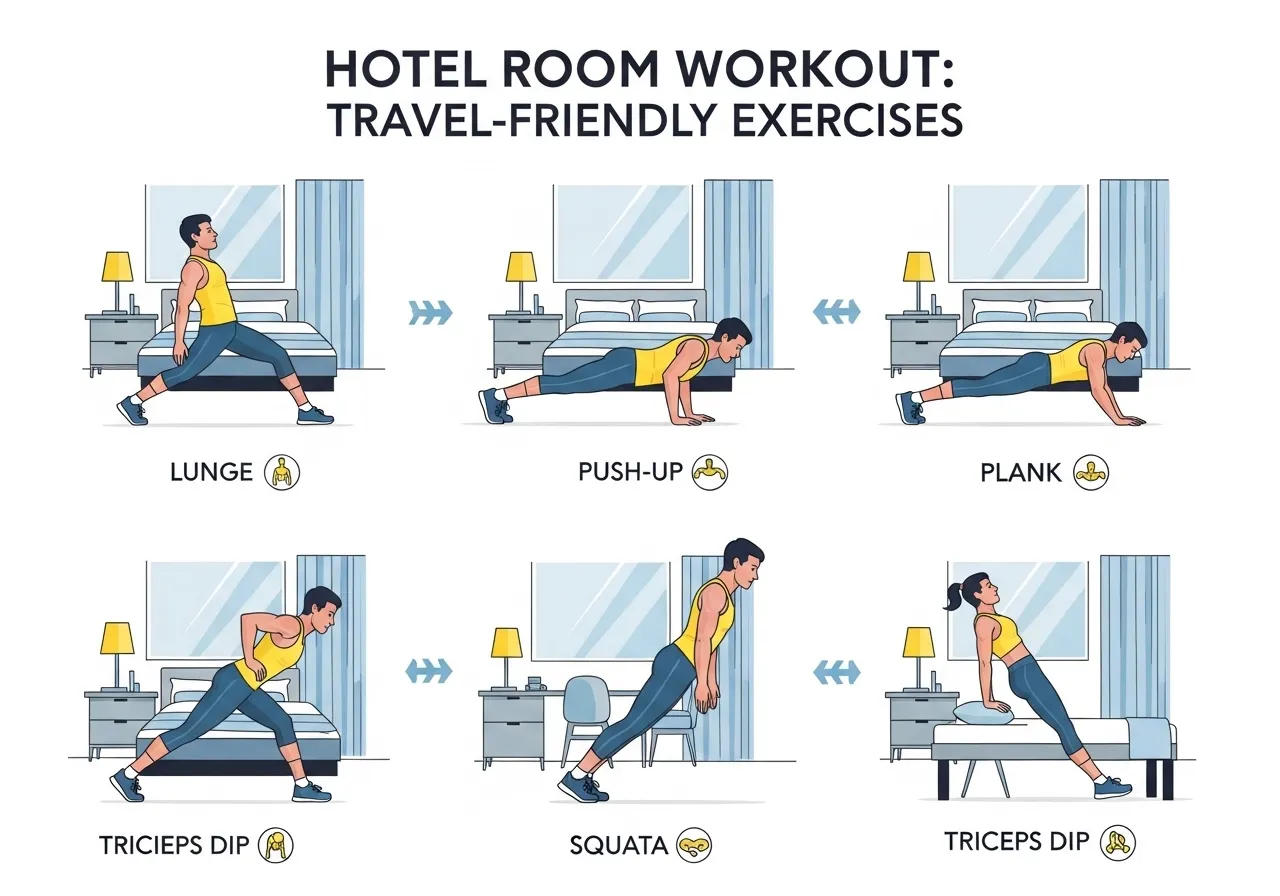
The hotel room workout is the foundational tool of travel fitness — a complete resistance training session requiring nothing beyond floor space, bodyweight, and a bed or chair for exercise variation. The room workout described in this section has been designed to provide full-body stimulus in 25 to 35 minutes, challenging the major muscle groups with progressive variations appropriate for different fitness levels, and requiring only 2 × 2 meters of floor space.
The 30-Minute Full-Body Hotel Room Workout
Warm-Up (5 minutes): Arm circles 20 reps each direction. Hip circles 10 each direction. Bodyweight squats × 10 slow. Inchworm × 5. Jumping jacks × 20.
Circuit (3 rounds, 40 seconds work / 20 seconds rest per exercise): Push-up variation (standard, decline with feet on bed, or archer). Squat variation (bodyweight, jump squat, or single-leg). Hip thrust with feet on bed (bridges for easier, single-leg bridges for harder). Mountain climber. Inverted row under desk or door frame pull. Reverse lunge. Plank with shoulder tap.
Core Finisher (5 minutes): Dead bug 3 × 10. Side plank 2 × 30 seconds each side. Hollow body hold 3 × 20 seconds.
Three rounds of this 7-exercise circuit with the timing described takes approximately 21 minutes — completing the full session including warm-up and core finisher in approximately 30 minutes. The intensity is adjustable through exercise variation selection (easier or harder versions of each movement) to match any fitness level from beginner through intermediate.
Exercise Modifications for Small Spaces
Even standard hotel rooms — which typically provide only 15 to 20 square meters of total space with most of it occupied by furniture — have sufficient clear floor space (approximately 2 × 1.5 meters) for every exercise in the program above. The bed functions as an inclined surface for decline push-ups and Bulgarian split squats, an elevated platform for hip thrusts, and a support for single-leg movements. A stable chair (most hotel rooms have at least one) provides support for pistol squat progressions and tricep dips. The bathroom offers a door frame for stretching and, in some configurations, resistance band anchoring.
When to Train During Travel
The most reliable time to complete a hotel room workout during travel is early morning — before the day’s schedule intervenes and before decision fatigue from a full day of meetings, sightseeing, or conferences reduces motivation. Laying out workout clothes the night before, setting a specific alarm time for training, and treating the morning workout as a non-negotiable appointment rather than an optional activity when time permits produces significantly higher travel workout completion rates than leaving training to whenever the schedule allows.

Staying Active When You Have No Gym Access
Travel fitness is not limited to structured workout sessions — the cumulative activity of a travel day, when managed intentionally, provides substantial additional caloric expenditure and movement that complements formal training sessions. Active travel habits are easy to implement, require no dedicated time block, and can maintain daily step counts that support health and body composition during even the busiest travel schedules.
Walking as a Fitness Tool
Walking is the most underutilized fitness tool in any traveler’s arsenal and one that travel uniquely facilitates. Cities and destinations are inherently walkable in ways that suburban daily life often isn’t, and the sightseeing motivation of travel provides inherent motivation to walk that typical daily routines lack. A traveler who walks to meetings instead of taking taxis, explores the destination on foot rather than by transport, and chooses stairs over elevators throughout the day may accumulate 10 to 15 thousand steps — the equivalent of 7 to 10 kilometers of walking — that burns 400 to 600 additional calories compared to a sedentary travel day.
Finding Fitness Options at the Destination
Most cities with hotels have public parks with outdoor fitness equipment, running trails, or pools within walking distance of typical hotel locations. A brief search before travel for “running routes near [hotel address]”, “outdoor workout parks near me”, or “24-hour gyms near [location]” provides options that the traveler who doesn’t look never discovers. Many hotels have gyms that range from basic to excellent — reviewing the hotel gym before booking allows selection of accommodations that support training goals. Hotel gym equipment is variable and often limited, but even a minimal hotel gym with a cable machine, a few dumbbells, and a treadmill provides sufficient tools for an effective 30-minute maintenance training session.
Running as the Ultimate Travel Workout
Running is the most consistent, most scalable, and most adaptable exercise available to travelers because it requires nothing more than running shoes — equipment that packs flat and adds no meaningful weight to luggage. A 20 to 30-minute run through any urban environment simultaneously provides cardiovascular training, active tourism (seeing the destination at street level), and the mood-regulating neurochemical benefits of exercise that combat the stress and disruption of travel. Downloading a local running route map (Strava’s route finder or Map My Run) before arrival ensures immediate run-readiness without the orientation time that could deter spontaneous running in an unfamiliar environment.
Resistance Band Training While Traveling
A set of 3 resistance bands (light, medium, heavy — total weight approximately 200 grams, total volume approximately 500ml) fits in any luggage and converts a hotel room into a functional training environment with pushing, pulling, and lower body resistance exercises not available through bodyweight alone. Band pull-aparts and face pulls provide the posterior shoulder and upper back training that bodyweight-only programs lack. Band squats and deadlifts add resistance to lower body training. Banded push-ups increase horizontal pressing resistance. The modest investment of $15 to $25 in a quality resistance band set dramatically expands travel training capacity.

Eating Well on the Road Without Obsessing Over It
Travel nutrition presents two failure modes: overly permissive eating (treating every travel day as a free day from normal dietary standards) and overly restrictive eating (attempting to maintain perfectly clean eating in environments that make it impractical, creating anxiety and social isolation). The optimal travel nutrition approach occupies the middle ground: maintaining the most important nutritional habits while allowing flexibility in the areas that matter least.
The Three Non-Negotiables of Travel Nutrition
Three nutritional practices maintained consistently during travel produce the most significant positive impact on energy, body composition, and training quality relative to their practical cost. First: adequate protein intake at each meal. Protein is available in virtually every restaurant, airport, and hotel dining context — grilled chicken, fish, eggs, legumes, dairy — and maintaining protein intake at 0.4 to 0.6 grams per kilogram per meal supports muscle preservation regardless of other dietary variations. Second: adequate hydration. Travel dehydration — from recycled aircraft cabin air, alcohol consumption, increased caffeine, and reduced water intake due to logistical inconvenience — is extremely common and produces the fatigue, brain fog, and reduced physical performance that many travelers attribute to jet lag. Carrying a refillable water bottle and drinking consistently throughout travel days prevents this entirely avoidable performance impairment. Third: vegetable and fiber inclusion at most meals. Including at least one vegetable side or salad at sit-down meals maintains gut microbiome diversity, satiety regulation, and digestive comfort during the dietary disruptions of travel.
Smart Airport and Restaurant Navigation
Airports and travel hubs now offer sufficient whole food options that eating relatively well during travel is genuinely achievable rather than the compromise it was 10 to 15 years ago. Most airport terminals have options including grilled protein salads, sushi, Greek yogurt, fresh fruit, hard-boiled eggs, and wraps with whole ingredients — all preferable to the fried, processed options that also fill airport food courts. The key decision principle: choose the option with the highest protein and vegetable content from the available selection, rather than holding out for the ideal option that may not exist in the current environment.
Packing Travel Snacks
Packing a small selection of high-protein, non-perishable snacks in carry-on luggage eliminates the worst travel nutrition situations — the 3-hour airport delay when only potato chips and chocolate bars are available, the 5-hour flight with only pretzels, or the late arrival when hotel room service is the only option. Practical travel snacks: individual protein bar packets (20+ grams protein, 200 to 250 calories), individual almond butter packets, mixed nuts in pre-portioned bags, jerky or dried meat, and fresh fruit from the departure airport. These snacks take under 5 minutes to pack and ensure that energy and protein needs can be met regardless of what the travel environment offers.
Managing Sleep and Recovery While Traveling
Sleep quality during travel is typically the most compromised component of the health and fitness routine — and also the component with the greatest single-night impact on next-day performance, mood, and training quality. Jet lag, unfamiliar sleeping environments, schedule disruptions, and the higher-than-usual consumption of alcohol and caffeine that often accompanies travel all impair sleep in ways that compound over multi-day trips.
Managing Jet Lag
Jet lag — the desynchronization between internal circadian rhythm and the local time zone — produces performance impairment, mood disruption, digestive discomfort, and reduced sleep quality that can persist for 1 to 3 days per hour of time zone difference. Evidence-based jet lag management strategies: immediately adjust eating and sleeping to local time on arrival rather than maintaining home timezone patterns, use morning light exposure to accelerate circadian re-entrainment (a 30-minute outdoor morning walk in the local timezone is the most powerful jet lag intervention available), avoid alcohol during the flight (which disrupts sleep architecture even when it initially promotes sleep onset), and use low-dose melatonin (0.5 to 3mg) at local bedtime in the first 2 to 3 days at the destination to support sleep timing adjustment.
Optimizing Hotel Room Sleep
Hotel rooms are chronically sub-optimal sleep environments due to light pollution from curtains that rarely fully block street lights and corridor lights, noise from other guests, HVAC systems, and street traffic, and unfamiliar mattresses and pillows that disrupt the body-to-surface relationship optimized in home sleeping. Travel adaptations that significantly improve hotel sleep: bringing a sleep mask (completely blocking light is the single most impactful hotel room sleep improvement), packing foam earplugs or using a white noise app on a phone (masking variable noise with consistent sound), requesting a room away from elevator banks and street-facing windows, and maintaining the same pre-sleep routine (shower, low-light activity, screen-free period) that supports quality sleep at home.
Recovery When Normal Protocols Are Unavailable
The recovery protocols available at home — foam rolling, stretching, sauna access, quality sleep — are often partially or fully unavailable during travel. Prioritizing the available options: daily walking (the most accessible active recovery modality), brief stretching routines that require no equipment (10 minutes of hip flexor, thoracic, and hamstring work), and maximizing sleep quality through the strategies above. The British Journal of Sports Medicine confirms that sleep is the most impactful single recovery intervention — prioritizing sleep quality during travel produces better training recovery than any other available travel recovery tool.
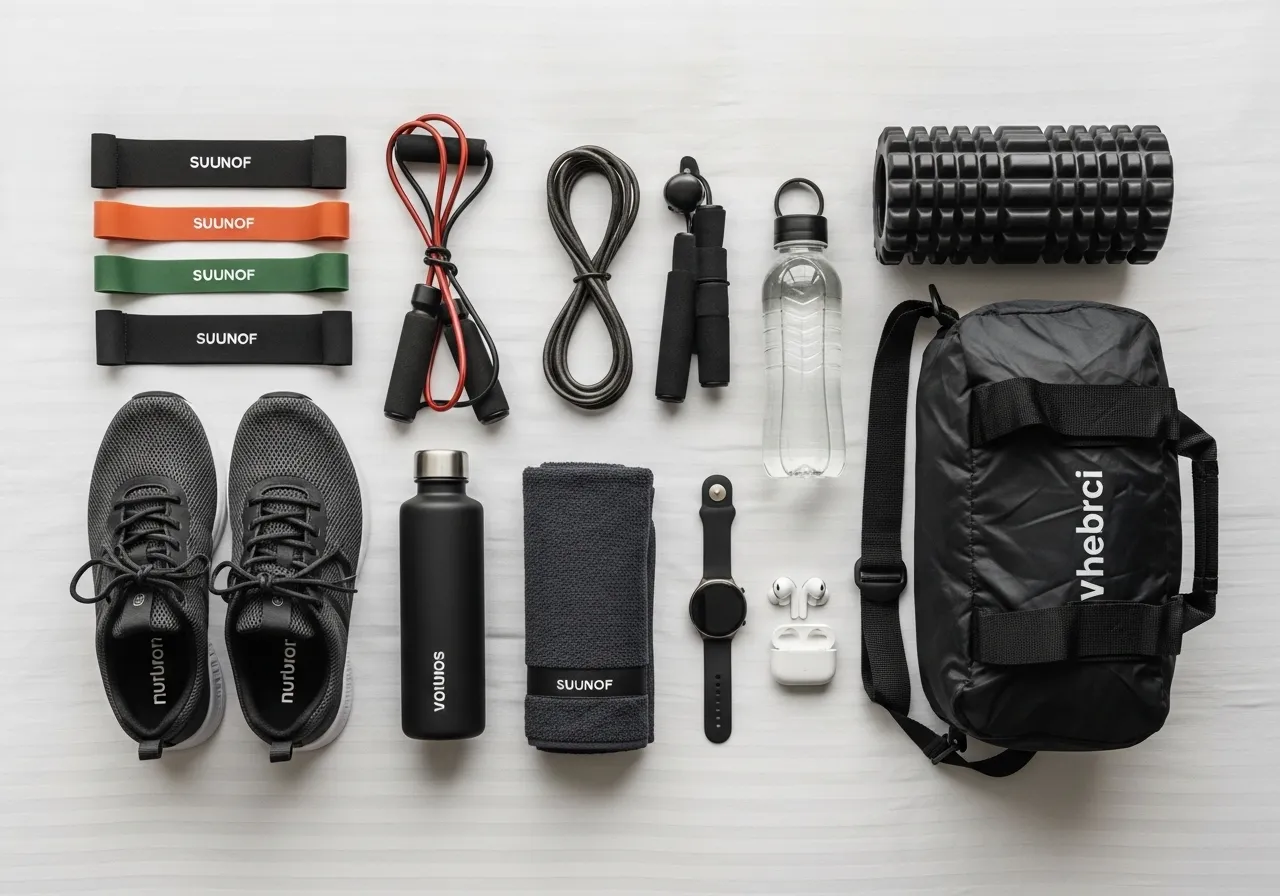
Travel Fitness Gear Worth Packing
Travel fitness equipment should meet three criteria: lightweight enough to not meaningfully impact luggage weight, compact enough to fit within carry-on luggage restrictions, and functionally versatile enough to justify the packing space it occupies. The following items meet all three criteria and collectively weigh under 600 grams while providing equipment for resistance training, cardiovascular conditioning, and recovery.
Essential Travel Fitness Items
Resistance bands (3-band set): 150-200g, fits in a small pouch. The most versatile travel fitness investment, providing resistance for upper body pushing, pulling, lower body, and core exercises that bodyweight cannot adequately load. A complete upper and lower body workout is achievable with bands alone. Jump rope: 150-200g, fits coiled in a side pocket. The highest cardio output per gram of any travel fitness equipment — 20 minutes of jump rope provides cardiovascular training equivalent to a 30-minute moderate run. Lacrosse ball or travel massage ball: 50-80g. Provides the targeted soft tissue release of a foam roller for the hip flexors, glutes, and thoracic spine in a fraction of the space and weight. Athletic shoes appropriate for both running and gym training. The footwear flexibility that enables both cardio and resistance training without multiple shoe pairs eliminates a significant travel fitness barrier.
Optional Upgrades for Longer Trips
For trips exceeding 2 weeks or for people who train at higher frequency, additional items worth considering: a suspension trainer (TRX or equivalent, 450g) that attaches to any door and provides pulling exercises not otherwise available in a bodyweight program, a travel foam roller (small diameter, 400g) for more thorough soft tissue work, and a compact pull-up bar that fits over door frames without tools (varies by accommodation compatibility).
Technology for Travel Training
The right apps remove the planning friction that is a common barrier to travel training. Nike Training Club and YouTube fitness channels provide guided follow-along workouts that require no planning and adapt to available equipment. Google Maps and Strava provide running routes in unfamiliar environments. A fitness tracking app that maintains a visible streak of training sessions provides the gamification accountability that research shows significantly improves training consistency during disruption periods. The combination of guided workouts (removing the need to plan) and streak tracking (providing accountability) addresses the two most common travel training barriers simultaneously.

Building a Travel Fitness Routine That Actually Sticks
The most important element of sustainable travel fitness is not the specific workout program or the equipment packed — it is the systematic approach that converts travel fitness from an effortful exception to an automatic behavior that persists across years of regular travel. This requires the same habit formation principles that make home training consistent: environmental design, pre-commitment, minimum viable standards, and identity alignment.
The Pre-Travel Fitness Checklist
Implementing a pre-travel fitness checklist — completed in the 24 to 48 hours before each trip — removes the in-trip decision-making that allows travel training to be postponed indefinitely. The checklist: Pack resistance bands and jump rope (5 minutes). Download 3 guided workout videos for offline use (10 minutes). Research one running route near the hotel (5 minutes). Set a morning workout alarm for travel days (1 minute). Pack healthy snacks for the journey (10 minutes). Pre-committing to these preparations makes in-trip training the path of least resistance rather than the effortful choice.
The Travel Training Minimum Viable Standard
Defining a minimum viable training standard for travel — the smallest training action that counts as training and preserves the habit — prevents the all-or-nothing collapse that causes many travelers to abandon training entirely when the ideal workout is impossible. The minimum standard: 15 minutes of any physical activity counts as training. A 15-minute hotel room session, a 15-minute walk at elevated pace, or 15 minutes of resistance band work all count. This minimum is achievable on the busiest travel days and preserves the training habit and identity through disruptions that would otherwise produce complete training abandonment.
Making Peace with Imperfect Travel Training
The traveler who trains imperfectly — shorter sessions, fewer days per week, simpler exercises than at home — accumulates substantially more annual training volume than the traveler who holds out for optimal conditions and trains rarely during travel. Releasing the expectation that travel training should replicate home training quality — and instead accepting that its purpose is maintenance rather than optimization — removes the perfectionism that is the enemy of consistent travel fitness. The goal is arriving home with fitness preserved, not with fitness improved. With that realistic goal established, virtually any travel fitness effort qualifies as success.
Frequently Asked Questions
What’s the best time to work out when traveling across time zones?
Morning workouts accelerate jet lag recovery by synchronizing circadian rhythms with local time through light exposure and activity. Training in the morning local time — even when your body thinks it’s the middle of the night — produces faster circadian adaptation than training at your home timezone’s workout time.
How do I stay motivated to train when traveling?
Remove motivation as the variable by making pre-commitment the mechanism. Packing workout gear, booking hotels with gyms, scheduling training as calendar appointments, and having ready-to-go workout plans eliminates the motivation-dependent decisions that allow training to be postponed when motivation is low.