The Best Stretches to Do Every Morning
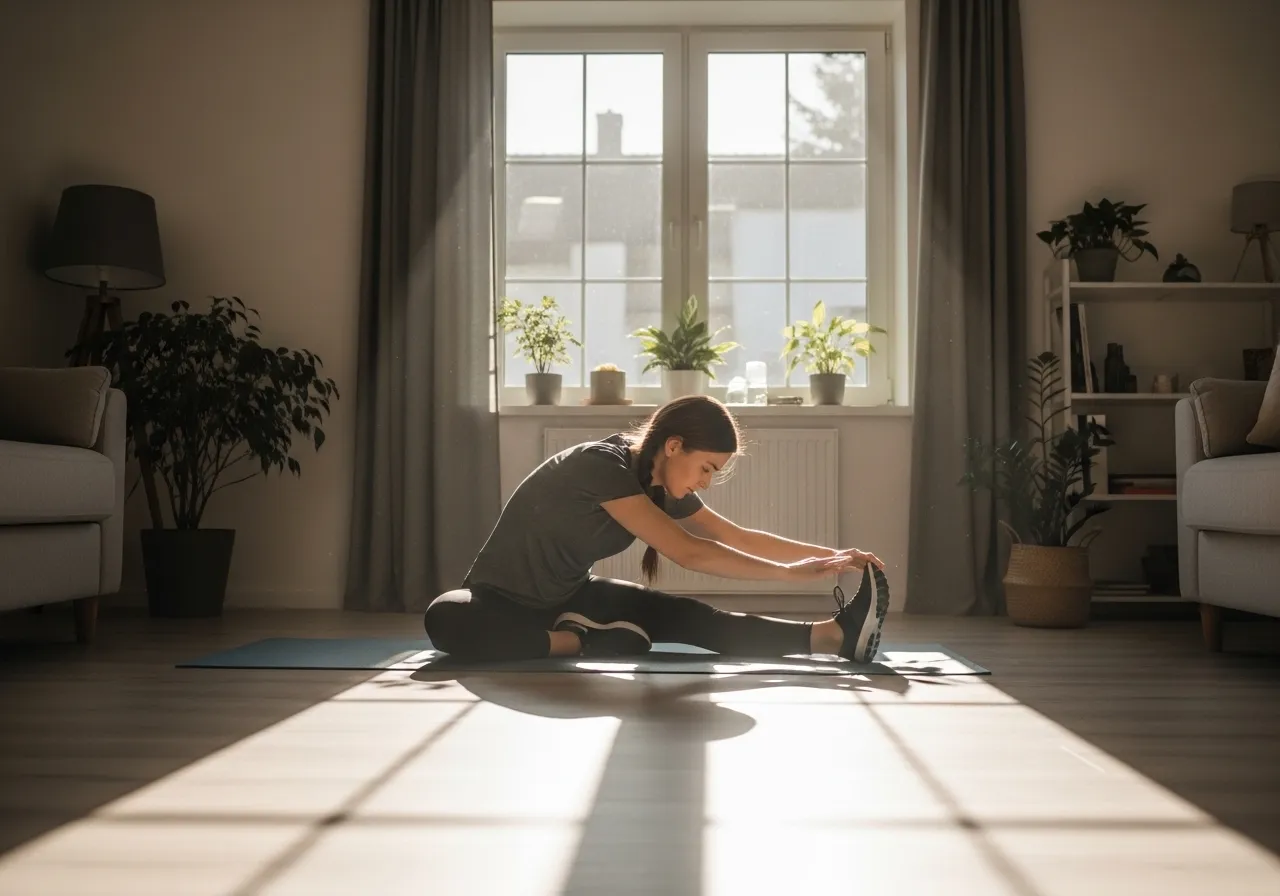
Why Your Morning Stretch Routine Changes Everything
I resisted morning stretching for years. The alarm goes off and the immediate instinct is coffee, not floor work — and the idea of spending fifteen minutes on a yoga mat before the day properly begins felt like a luxury that a full schedule could not accommodate. What changed my mind was not motivation; it was pain. The lower back stiffness that had been escalating for months reached the point where getting out of bed was genuinely uncomfortable, and a physiotherapist suggested that the overnight postural loading my body was accumulating was not being adequately addressed by my activity throughout the day. Eight weeks of consistent morning stretching later, the stiffness was gone, my posture had visibly improved, and I had discovered the additional benefits — reduced anxiety, improved focus, and better workout performance — that had not been part of the original plan. This article covers the science behind morning stretching and the specific routine that the research supports.
The Overnight Body: Why Mornings Are the Optimal Stretching Window
The human body undergoes specific physiological changes during sleep that make the morning the most important stretching opportunity of the day — not merely a convenient time but the period when stretching addresses the specific needs that overnight rest creates. During sleep, the intervertebral discs rehydrate: the compressive loading of daytime activity forces fluid out of the nucleus pulposus, and the unloaded overnight position allows osmotic reabsorption that can increase disc height by up to twelve percent by morning. This disc expansion, while beneficial for long-term spinal health, creates the temporary stiffness and reduced spinal mobility that most people experience on first waking — the classic difficulty bending forward that resolves within the first thirty to sixty minutes of activity. Morning stretching accelerates this resolution and ensures that the increased fluid absorption is matched by the flexibility work that prevents the tightness from becoming a persistent pattern. Fascia — the connective tissue network that surrounds muscles and organs — also undergoes dehydration-like changes overnight, with the collagen matrix becoming less pliable at the lower body temperatures and minimal mechanical loading of sleep. The warmth and mechanical stimulus of morning stretching restores fascial pliability and reduces the resistance to movement that cooled, underloaded fascia presents. From PubMed connective tissue and morning mobility research, morning flexibility interventions produce greater range of motion improvements than equivalent flexibility work performed at other times of day — confirming that the morning physiological state creates an optimal window for stretching benefit.
Flexibility vs. Mobility: Understanding What Morning Stretching Actually Develops
The distinction between flexibility and mobility — frequently conflated in popular fitness discussion — matters for understanding what a morning stretching routine actually develops and why both components should be included. Flexibility is the passive range of motion of a joint or muscle — the extent to which a muscle can lengthen without active control, measured by how far a limb can be moved by an external force. Mobility is the active range of motion under muscular control — the range through which you can move a joint using your own muscle strength, without passive assistance. A hypermobile but unstable shoulder has high flexibility but low mobility; a stiff but well-controlled hip has low flexibility but reasonable mobility for the ranges it does have. Morning stretching ideally develops both: static stretching develops flexibility by applying sustained tension to muscle and connective tissue that gradually increases their length; dynamic stretching develops mobility by taking joints through their full range under muscular control, building the neuromuscular coordination that active range of motion requires. The most effective morning routine incorporates both modalities — beginning with gentle dynamic movements that restore circulation and neuromuscular activation, then progressing to the static stretching that extends flexibility gains. This sequence ensures that the static stretching occurs in tissues that are appropriately prepared (warmed, activated) rather than cold and stiff — reducing the injury risk that aggressive static stretching of unprepared tissues can create.
The Research on Morning Stretching and Daily Function
The research specifically examining morning stretching routines and their effects on daily function is more compelling than popular wellness discussion typically acknowledges. Studies of office workers who implemented ten to fifteen minute morning stretching routines demonstrated significant reductions in musculoskeletal discomfort at four weeks — specifically targeting the lower back, neck, and shoulder regions where sedentary work postures create the greatest accumulation of tension. The mechanism is the interruption of the progressive tightening cycle that sedentary lifestyles produce: overnight immobility creates stiffness, daytime sedentary work adds postural tension, and the incomplete recovery of non-stretching evenings prevents the restoration that the accumulated tightness requires. Morning stretching breaks this cycle at its beginning, starting the day with reduced baseline tension and greater movement freedom than the non-stretching alternative. From British Journal of Sports Medicine stretching and work-related musculoskeletal disorder research, consistent morning stretching routines reduce work-related musculoskeletal disorder incidence by twenty to thirty percent compared to control groups — a meaningful functional benefit that extends well beyond the immediate physical effects of the stretch session itself.
Cortisol, Morning Light, and the Circadian Stretch Window
The physiological timing of morning stretching aligns with a specific cortisol phenomenon — the cortisol awakening response (CAR) — that makes the first thirty to sixty minutes after waking a uniquely potent window for both physical and cognitive preparation. The CAR is the fifty to one hundred percent spike in cortisol that occurs within thirty minutes of waking, peaking approximately thirty to forty-five minutes after waking before declining throughout the day. This cortisol surge serves an adaptive purpose — mobilizing energy, sharpening attention, and preparing the cardiovascular system for the demands of the day. Morning stretching performed during the CAR window amplifies its benefits: the cortisol-mediated increase in tissue perfusion accelerates the warming of connective tissue that overnight temperatures reduce; the heightened alertness of the CAR peak makes the mindful attention to body sensation that effective stretching requires easier to achieve; and the combination of physical movement and morning light exposure (which the standing dynamic phase can be performed near a window to access) reinforces the circadian rhythm entrainment that consistent waking time supports. The morning stretch routine is therefore not competing with the morning cortisol response — it is working synergistically with the physiology that the body has already prepared for the waking transition, using the CAR’s energy mobilization to support the movement restoration that begins the day optimally. Research on the cortisol awakening response and physical activity timing from PubMed CAR and exercise timing research confirms that physical activity during the CAR window produces greater hormonal and cognitive benefits than equivalent activity performed outside this window — supporting morning stretching as the neurobiologically optimal moment for the routine, not merely the most convenient one.
Breathing Techniques That Amplify Morning Stretching Benefits
The integration of specific breathing techniques into morning stretching produces benefits that extend well beyond the flexibility improvements that movement alone achieves — addressing the parasympathetic activation, diaphragm function, and tissue oxygenation that optimal recovery and daily readiness require. Diaphragmatic breathing during static stretches: placing one hand on the abdomen and one on the chest during held stretches, practicing the breathing pattern that moves the abdominal hand without moving the chest hand activates the diaphragm’s full excursion and increases intra-abdominal pressure in a way that stabilizes the spine during the stretching movements. More importantly, diaphragmatic breathing activates the parasympathetic nervous system through the vagal stimulation that deep, slow breaths produce — reducing the sympathetic tone that contributes to muscle tension and making the passive tissue relaxation that stretching requires easier to achieve. The practical breathing prescription for morning stretching: four-count inhale through the nose (expanding the abdomen), two-count pause, six-count exhale through the mouth. This ratio (longer exhale than inhale) maximizes the parasympathetic activation that improves stretch tolerance. Box breathing for more advanced practitioners (four-count inhale, four-count hold, four-count exhale, four-count hold) produces even greater parasympathetic activation and the focused attention that transforms a perfunctory morning routine into a genuine mindfulness practice. The breath-movement integration that yoga has formalized for thousands of years has robust physiological mechanisms behind it — and incorporating even basic breath awareness into the morning stretch routine significantly improves both its immediate experience and its long-term benefits.
Consistency Over Perfection: The Philosophy That Sustains the Morning Habit
The morning stretching practice that transforms physical health over months and years is not built on perfect execution of a comprehensive routine — it is built on the unwavering commitment to doing something every morning, regardless of how little time or energy is available. The practitioner who completes five minutes of imperfect morning stretching every day for a year has accumulated three hundred and sixty-five training stimuli that progressively improve flexibility and mobility; the practitioner who attempts the full routine but skips every morning that does not allow fifteen perfect minutes has accumulated far fewer stimuli despite a nominally higher standard of practice. Consistency is the primary variable in long-term flexibility development — the research is unambiguous that daily stretching produces flexibility improvements that two or three times per week stretching cannot match, regardless of session duration, because the time between sessions is sufficient for partial regression toward pre-stretching stiffness. The philosophical reframe that supports daily consistency: the morning stretch is not something you do when you have time — it is the first thing you do each morning, allocated ahead of the demands that otherwise consume the morning. The five-minute minimum is the irrevocable daily commitment; the additional ten minutes of the full routine is the bonus that available time provides. With this framing, the morning stretch is never skipped due to time constraints — it is either the full version or the minimum version, never nothing. This philosophy, applied consistently, produces the physical transformation that ambitious but inconsistently executed programs cannot achieve. Start with the minimum. Build toward the full. Never skip entirely. The results, across months and years of this simple discipline, will exceed what you currently believe fifteen minutes a day can produce.
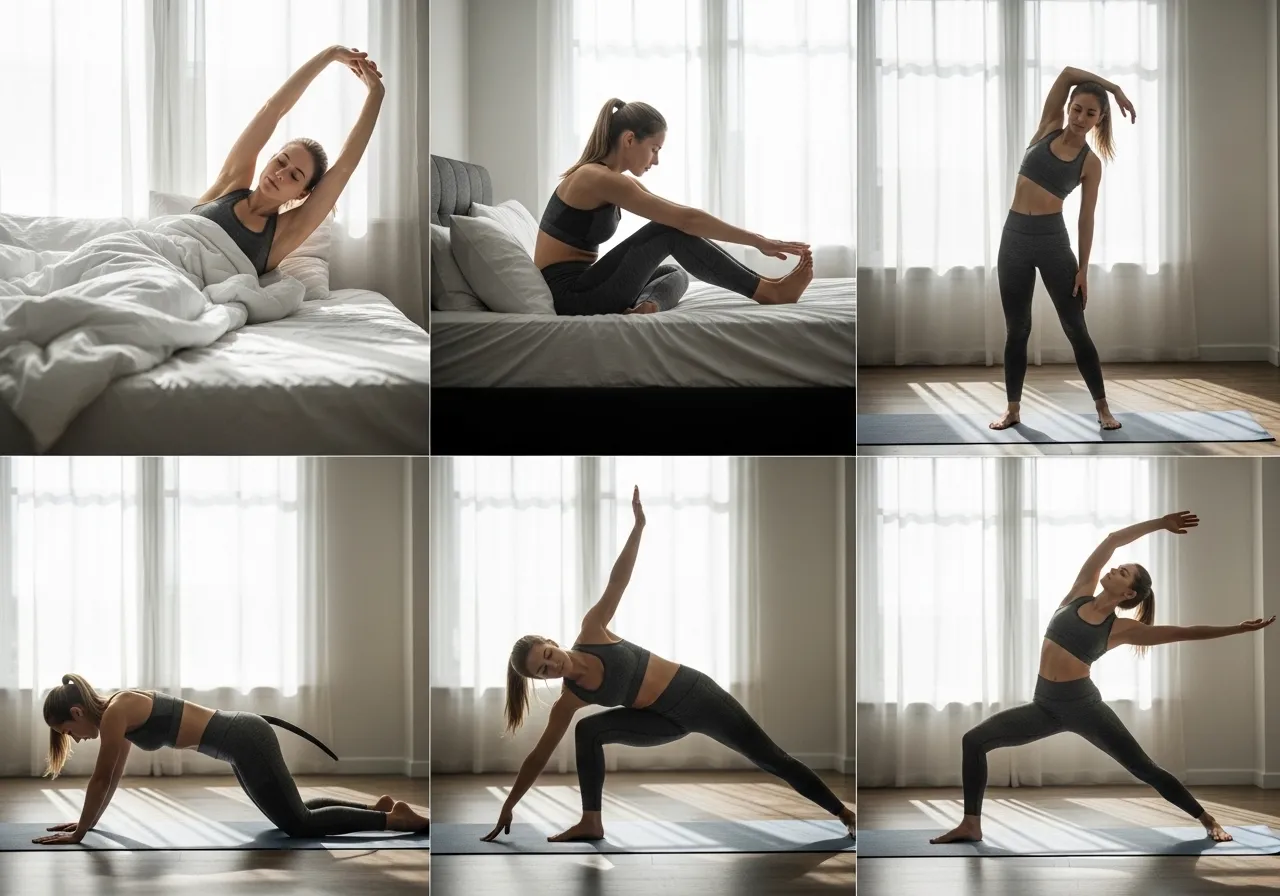
The Complete Morning Stretch Sequence: From Bed to Full Mobility
The morning stretch sequence that follows progresses systematically from the gentle in-bed movements appropriate for the first moments of waking to the full standing dynamic stretches that prepare the body for the day’s demands. This progression respects the physiological state of the waking body — beginning conservatively and increasing intensity as circulation improves and tissue temperature rises.
Phase One: In-Bed Stretches (Minutes 1–3)
The first stretches begin before leaving the bed — capitalizing on the supportive surface to perform gentle spine decompression and hip mobility work that prepares the body for the more demanding movements that follow. Supine knee-to-chest: lying flat, draw both knees to the chest simultaneously and hold for thirty seconds, gently rocking side to side to mobilize the sacroiliac joints and decompress the lumbar vertebrae. This simple movement addresses the lumbar compression that overnight disc expansion combined with sleep position creates, restoring the neutral spinal curves that the day’s activity requires. Supine spinal twist: from the knee-to-chest position, lower both knees to one side while keeping shoulders flat on the mattress, looking toward the opposite shoulder. Hold thirty to forty-five seconds on each side. This rotation gently mobilizes the thoracic spine and stretches the quadratus lumborum — the deep lateral hip muscle that is among the most common contributors to low back tightness. Happy baby pose: lying on the back, bring the knees to the chest and grip the outer edges of the feet, drawing the knees wide toward the armpits while pressing the lower back toward the mattress. This position simultaneously stretches the hip flexors, inner thighs, and lower back in a supported position that requires no balance or core engagement — making it ideal for the first moments of waking. These three in-bed movements require no floor space, no equipment, and approximately three minutes — making them the most adherence-friendly component of the morning routine, requiring nothing more than the willingness to begin before standing up.
Phase Two: Floor Stretches for Major Muscle Groups (Minutes 4–10)
Moving to the floor (or a yoga mat) for phase two, the sequence addresses the major muscle groups most affected by overnight immobility and sedentary lifestyle patterns. Child’s pose with lateral reach: beginning in child’s pose (kneeling, forehead toward the floor, arms extended overhead), walk the hands to the right until a stretch is felt along the left lateral torso — the quadratus lumborum, latissimus dorsi, and intercostal muscles that overnight compression and shallow breathing have tightened. Hold forty-five seconds on each side before returning to center. Cat-cow: on all fours, alternate between maximum spinal flexion (cat — rounding the spine toward the ceiling and tucking the chin) and maximum extension (cow — allowing the belly to drop and the head to lift). Perform ten cycles, moving slowly and deliberately through the full range. This movement lubricates the facet joints of the entire spine with synovial fluid, activates the deep spinal stabilizers (multifidus and transversospinalis), and assesses the morning mobility that guides the intensity of subsequent stretches. Hip flexor stretch (low lunge): step one foot forward into a lunge position with the back knee on the floor, and gently press the hips forward until a stretch is felt in the front of the back thigh (psoas and iliacus). The hip flexors are among the most commonly tight muscles in modern sedentary populations — shortened by prolonged sitting and further tightened by the hip flexion position that most sleep positions involve. Holding forty-five to sixty seconds on each side begins the restoration of hip extension range that lower back health and running mechanics both require. Seated hamstring stretch: with legs extended, fold forward from the hips (not the lower back) reaching toward the feet, maintaining a long spine throughout. The hamstrings’ connection to the posterior pelvis means that hamstring tightness directly contributes to the posterior pelvic tilt and lumbar flexion that lower back pain involves — morning hamstring stretching addresses this contribution before the day’s compressive loading reinforces it.
Phase Three: Standing Dynamic Stretches (Minutes 11–15)
The standing dynamic phase completes the morning routine by converting the passive flexibility gains of phases one and two into active mobility — taking joints through their full range under muscular control and stimulating the neuromuscular activation that prepares the body for the day’s demands. Leg swings: standing facing a wall with hands lightly touching for balance, swing one leg forward and backward through its full range, beginning conservatively and gradually increasing amplitude over ten to fifteen repetitions. Then swing the same leg laterally (side to side) for ten to fifteen repetitions. The pendular movement of leg swings lubricates the hip joint with synovial fluid, activates the hip flexors and extensors through dynamic range, and develops the hip mobility that daily movement and athletic performance require. Hip circles: standing with feet hip-width apart, place hands on hips and make large circular movements with the hips in both directions, as if rolling a hula hoop. Ten circles in each direction mobilize the hip joint through its full three-dimensional range and warm the deep hip rotators (piriformis, obturators, and gemellae) that are often undertrained and overtightened by sedentary patterns. Thoracic rotation: standing with arms crossed over the chest, rotate the upper body as far as possible in each direction while keeping the hips relatively stationary — ten rotations in each direction. This movement specifically addresses the thoracic spine stiffness that sedentary work creates and that compromises both shoulder function and the rotational mechanics that running and athletic movement require. Ankle circles and toe raises: ten ankle circles in each direction, followed by twenty calf raises — the distal movement sequence that restores circulation to the lower extremities and prepares the joints that bear the body’s full weight throughout the day. From ACSM flexibility and warm-up guidelines, the dynamic stretching phase is consistently more effective than static stretching alone at improving subsequent athletic performance and reducing the injury risk associated with the transition from rest to activity.
Morning Stretching for Specific Populations: Pregnancy, Postpartum, and Older Adults
The morning stretch routine requires meaningful modification for specific populations whose physiological conditions create both different needs and different limitations than the general adult population. During pregnancy, the relaxin-mediated ligament laxity that begins in the first trimester and peaks in the third significantly increases joint hypermobility — a state that makes aggressive static stretching potentially destabilizing rather than beneficial. The pregnant morning routine should emphasize gentle dynamic movements and supported stretching positions (using walls, chairs, and props for stability) while avoiding the deep end-range stretches of the hip flexors and sacroiliac region that relaxin-loosened joints cannot stabilize safely. Cat-cow remains among the most beneficial pregnancy stretches, as the dynamic spinal flexion and extension gently mobilizes the spine while the all-fours position relieves the anterior loading that the growing uterus creates. The postpartum period presents different challenges: the abdominal muscle separation (diastasis recti) that many pregnancies produce means that core-loading stretching positions (standard plank, intense spinal flexion) should be avoided until diastasis recti resolution has been assessed and appropriate rehabilitative progression prescribed. For older adults (sixty-five and beyond), the morning stretch routine is arguably more important than for any other age group — the age-related declines in flexibility, balance, and proprioception that increase fall risk and limit functional independence are substantially addressable through the consistent mobility practice that a daily morning routine represents. The older adult routine should emphasize the balance components of the standing dynamic phase, the hip and ankle mobility that fall prevention most requires, and the thoracic extension work that the progressive kyphosis of aging needs to counteract. From PubMed stretching and fall prevention in older adults, consistent flexibility and balance training reduces fall risk by twenty to thirty percent in community-dwelling older adults — confirming that the morning stretch routine is among the most clinically significant interventions available for maintaining independence with aging.
Addressing Common Morning Stretching Mistakes
The stretching errors that undermine the benefits of morning routines are consistent enough to warrant explicit identification — because the well-intentioned practitioner who is consistently making these errors is leaving significant benefit unrealized. Ballistic stretching on cold tissue: bouncing movements at end range of motion (ballistic stretching) activate the stretch reflex — the myotatic reflex that contracts a muscle when it is stretched rapidly — producing muscle guarding that prevents the relaxation that effective stretching requires and increasing the risk of micro-tears in cold, unprepared tissue. Morning stretching should always use slow, controlled movements without bouncing. Inconsistent breathing: holding the breath during stretches activates the Valsalva maneuver and increases sympathetic tone, making the tissue relaxation that stretching targets physiologically harder to achieve. Conscious exhalation during the deepening phase of each stretch is essential for the parasympathetic relaxation response that maximizes stretch effectiveness. Targeting only tight areas: the tendency to stretch only the areas that feel tight ignores the compensatory patterns that tightness creates in adjacent areas — the tight hip flexor that anteriorly tilts the pelvis also tightens the lower back extensors that compensate, and addressing only the hip flexor without the lower back extensors incompletely resolves the postural distortion. Stretching through pain: the distinction between the discomfort of effective stretching (a pulling sensation at end range that diminishes within fifteen seconds) and pain (sharp, joint-located, or worsening sensations) is fundamental — the former indicates effective tissue loading; the latter indicates potential injury and requires an immediate reduction in intensity or cessation of that movement. Neglecting the upper body: the lower body focus of most stretching routines underaddresses the neck, shoulders, and thoracic spine where sedentary populations accumulate the greatest functional restrictions — a comprehensive morning routine must dedicate equal attention to the upper quadrant that posture and upper extremity function depend on.
Stretching and Posture Correction: The Morning Routine as Postural Reset
Posture is not a fixed structural characteristic but a dynamic habit — the cumulative result of the positions the body most frequently adopts and the muscle length and strength relationships those positions create. The forward head posture, rounded shoulders, and anterior pelvic tilt that represent the modern sedentary postural syndrome are not permanent structural adaptations after they have developed, but they do require consistent daily intervention to reverse — because the forces that created them (prolonged sitting, device use, and insufficient movement variety) continue to be applied daily. The morning stretch routine is the most powerful single daily intervention for postural correction available outside of clinical treatment, because it systematically addresses the muscle shortening and neural inhibition patterns that postural distortion involves. The specific postural corrections that morning stretching targets: pectoral stretching addresses the anterior shoulder tightness that rounds the shoulders; thoracic extension and rotation work addresses the kyphotic curvature that forward-head posture reinforces; hip flexor stretching addresses the anterior pelvic tilt that lumbar hyperlordosis involves; and hamstring stretching addresses the posterior pelvic tilt that compensates for excessive anterior tilt. Together, these four stretch targets address the primary muscular components of the most common postural distortion pattern — the upper and lower crossed syndromes that Vladimir Janda identified as the characteristic postural presentations of sedentary lifestyles. Consistent daily application gradually restores the resting muscle length and neural activation patterns that support the upright, balanced posture that distributes gravitational forces evenly across the spine — reducing the chronic compression and joint stress that poor posture creates and that chronic neck, shoulder, and lower back pain reflects. From PubMed stretching and postural correction research, eight to twelve weeks of targeted flexibility training addressing the primary postural muscles produces measurable improvements in sagittal and coronal plane posture — confirming that the morning stretch routine is a legitimate postural correction intervention, not merely a wellness ritual.
The morning stretching habit, built gradually and maintained consistently, is among the most transformative physical practices available — producing the daily physical freedom, reduced pain, and movement quality that make every subsequent activity easier, more comfortable, and more effective. Commit to the routine. Respect the minimum. Aspire to the full. Let the accumulating investment of consistent daily practice reveal what fifteen minutes each morning can do for a body that is given the mobility work it deserves.
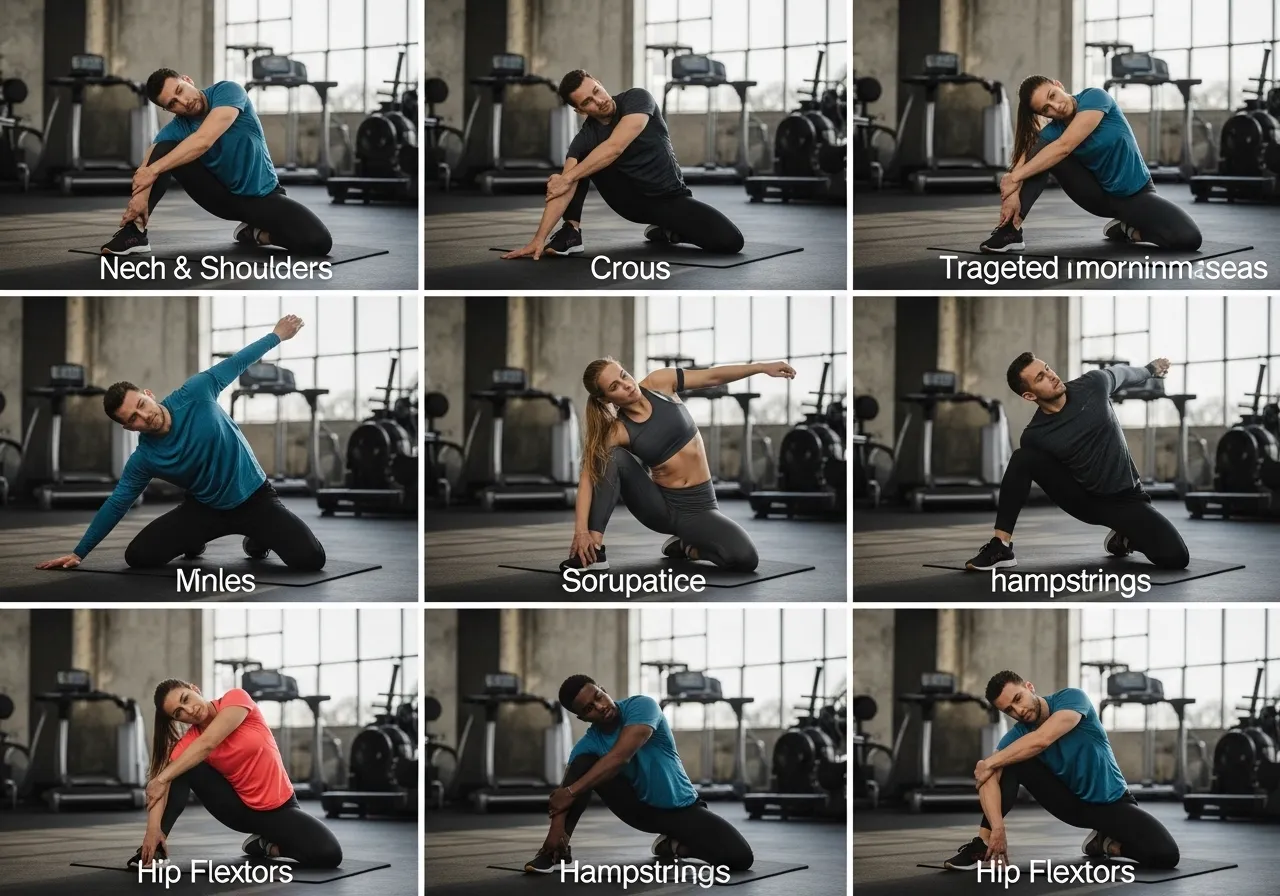
Targeted Stretches for the Most Common Morning Problem Areas
Beyond the comprehensive sequence, specific problem areas accumulate tension preferentially and benefit from targeted attention within the morning routine.
Neck and Shoulder Stretches for the Desk Worker
The neck and shoulders are among the most commonly tight areas in populations who spend significant time at computer workstations — the forward head position and elevated shoulder tension that desk work produces become fixed overnight and are best addressed immediately in the morning before the day’s postural loading adds to them. Neck lateral flexion stretch: sitting tall with the spine upright, gently drop the right ear toward the right shoulder until a stretch is felt along the left side of the neck. Hold twenty to thirty seconds on each side — do not force the movement or use the hand to add pressure, as the neck muscles respond better to gentle sustained tension than to aggressive loading. Scalene stretch: with the neck in lateral flexion, turn the nose slightly upward toward the ceiling to specifically target the anterior and middle scalene muscles that forward head posture overtightens — muscles that also affect diaphragm function and breathing mechanics when chronically shortened. Doorway chest stretch: standing in a doorway with arms at ninety degrees and forearms on the door frame, step through until a stretch is felt across the pectorals and anterior shoulders. The pectoral tightness that accompanies rounded shoulder posture maintains the postural distortion that neck and upper back tension perpetuates — stretching the pectorals simultaneously addresses the anterior tension that is the proximate cause of the posterior pain that desk workers typically feel. Eagle arms pose: crossing one arm over the other and intertwining the forearms, lift the elbows to shoulder height and press them forward until a stretch is felt between the shoulder blades. Ten seconds, three to four times on each arm combination. This stretch addresses the rhomboids and middle trapezius — the postural muscles that are chronically lengthened and weakened by the rounded shoulder posture, and that benefit from both the stretching and the gentle isometric activation that the eagle arms position produces in these muscles.
Hip Flexor and Lower Back Stretches for Pain Prevention
The hip flexors and lower back represent the most functionally significant morning stretch targets — the areas where overnight immobility most directly contributes to the compensatory movement patterns and chronic pain that inadequate daily mobility produces. The psoas major — the deep hip flexor that connects the lumbar vertebrae to the lesser trochanter of the femur — is among the most clinically significant muscles for lower back health. When the psoas is chronically shortened (from prolonged sitting and insufficient hip extension activity), it pulls the lumbar vertebrae anteriorly, increasing lumbar lordosis and the facet joint compression that contributes to lower back pain. The morning low lunge sequence described in phase two addresses psoas tightness effectively — but for individuals with significant lower back pain or hip flexor tightness, an additional three minutes of pigeon pose significantly deepens the hip flexor and external rotator release. Pigeon pose: from a plank position, slide the right knee forward toward the right hand and extend the left leg behind, settling the hips as evenly as possible toward the floor. The depth of hip flexion in pigeon simultaneously stretches the piriformis, psoas, and hip capsule — producing a comprehensive hip complex release that the lower-back-pain population consistently identifies as the single most effective morning stretch for their primary symptom. Hold sixty to ninety seconds on each side and apply deep diaphragmatic breathing to assist tissue relaxation. The 90-90 hip stretch: seated with both legs at ninety-degree angles (one leg in front, one behind, both externally and internally rotated respectively), fold forward over the front leg and then lean back over the rear leg. This position simultaneously stretches hip internal and external rotators in a position that more closely mirrors the loaded movement demands of daily life than most classical stretching positions — producing the functional hip mobility that prevents the compensation patterns that lower back pain initiates.
Calf, Ankle, and Foot Stretches for Whole-Body Alignment
The feet and ankles are the foundation of every upright movement pattern — yet they receive the least attention in most stretching routines despite their outsized role in whole-body alignment and movement quality. Plantar fascia stretch: before the first steps of the morning (which deliver the maximum mechanical stress to the cold, contracted plantar fascia of those susceptible to plantar fasciitis), stand with the toes propped against a wall and press the heel toward the floor, stretching the arch. The overnight contraction of the plantar fascia is the mechanism behind the classic morning “first step” pain of plantar fasciitis — and morning plantar fascia stretching before weight-bearing is the intervention most consistently recommended by podiatrists for both prevention and rehabilitation. Gastrocnemius stretch: facing a wall, step one foot back and press the heel into the floor with the knee straight — the gastrocnemius stretch that also decompresses the Achilles tendon attachment that overuse injuries involve. Thirty to forty-five seconds on each side. Ankle alphabet: seated with the leg extended, draw each letter of the alphabet in the air with the big toe, moving only at the ankle. This comprehensive joint mobilization activates all the ankle dorsiflexors, plantarflexors, invertors, and evertors that ankle stability and movement quality require — a five-minute investment that meaningfully reduces the ankle injury risk that inadequate ankle mobility creates in both athletic and daily life contexts. From BJSM ankle mobility and injury prevention research, adequate ankle dorsiflexion range (minimum fifteen to twenty degrees) is associated with significantly reduced risk of ankle sprains, knee injuries, and lower back pain — confirming that ankle mobility is a whole-body functional prerequisite, not merely a local performance variable.
Stretch and Breathe: Morning Yoga vs. Targeted Stretching — What’s the Difference?
The relationship between morning yoga and targeted stretching is frequently confused — with practitioners either assuming that yoga is inherently superior (due to its holistic reputation) or that targeted stretching is more efficient (due to its specific focus). The accurate assessment is that both offer genuine and partially overlapping benefits, with the right choice depending on the individual’s specific goals, available time, and personal engagement. Morning yoga provides flexibility development alongside the balance, strength, mindfulness, and breathing practice that the yoga framework integrates — making it a more comprehensive wellness practice for those who engage meaningfully with all its dimensions. The evidence for yoga and flexibility improvement is strong; the additional benefits for mental health, stress reduction, and mind-body connection are also well-supported. Targeted stretching provides the most time-efficient path to specific flexibility improvements — the person who needs hip flexor length and thoracic rotation more than anything else achieves these goals more directly in less time with targeted stretching than with a yoga practice that addresses the same areas within a broader sequence. The practical recommendation: the targeted morning stretching routine described in this article is superior for individuals with specific movement restrictions, time limitations, or performance goals that require targeted intervention; a morning yoga practice is superior for individuals who benefit from the community, mindfulness, and holistic physical practice that yoga provides, and for whom the broader engagement is more likely to sustain the daily habit that consistent practice requires. Many practitioners benefit from a hybrid approach — targeted stretching on the majority of mornings with a yoga class or guided practice once or twice per week for the motivational renewal and technique refinement that expert guidance provides.
The Mind-Body Benefits of Morning Stretching
The psychological benefits of morning stretching — though less often discussed than the physical outcomes — are both practically significant and well-supported by research. The deliberate physical self-care that a morning stretching routine represents activates the psychological mechanisms of self-efficacy and intentionality that behavioral research identifies as among the strongest predictors of sustained health behavior maintenance. The person who begins each morning with the evidence-based, body-caring practice of a stretching routine is engaging in what psychologists call “identity-based behavior” — each session is a small confirmation of the identity of someone who takes care of their physical health, and the accumulation of these identity-confirming behaviors produces the internalized health identity that sustains health behaviors without requiring constant effortful motivation. The anxiety reduction that morning stretching produces is both immediate (through parasympathetic activation and the mental focus on body sensation that interrupts anxious rumination) and cumulative (through the reduction in baseline physiological tension that consistent practice produces over weeks). Morning cortisol levels are lower on days following consistent physical activity, and the calm, prepared state that a completed morning routine produces reduces the reactivity to daily stressors that underlies the chronic stress-inflammation-visceral fat cycle discussed throughout fitness research. The morning that begins with fifteen minutes of intentional physical self-care is neurobiologically different from the morning that begins with immediate digital engagement — the former activates the embodied awareness and physical readiness that positions the rest of the day favorably; the latter activates the vigilance and reactivity that information exposure at waking produces.
Full-Body Flexibility Sequence for Office Workers
Office workers represent the population with the most consistent and severe morning stretching needs — the cumulative postural and musculoskeletal impact of prolonged daily sitting creates the specific pattern of restrictions that an office-worker-optimized morning routine should prioritize. The office worker sequence: begin with the in-bed spinal decompression movements, then move to a five-minute sequence specifically targeting the most office-affected areas before the general routine. Chest opener in doorway (sixty seconds): standing in a doorway with arms at ninety degrees and elbows at shoulder height, step through until a stretch is felt across the pectorals — directly addressing the anterior chest tightness that prolonged keyboard use produces. Chin tucks (fifteen repetitions): sitting or standing, gently draw the chin straight back (not downward) to restore the cervical curve that forward-head posture flattens — a motor pattern exercise that simultaneously stretches the suboccipital muscles and activates the deep cervical flexors that forward head posture inhibits. Hip-to-wall stretch (sixty seconds each side): standing facing a wall, place the foot against the wall with the knee at ninety degrees and lean forward, pressing the hip into dorsiflexion to stretch the often-ignored but critically important hip external rotators in a position that mimics the loaded demands of stair climbing and squatting. Wrist and forearm extensors (thirty seconds each side): extending one arm with palm facing down, use the other hand to gently press the fingers downward into wrist flexion — addressing the extensor tightness that typing and mouse use creates and that contributes to the lateral epicondylitis (tennis elbow) that keyboard workers develop at higher rates than their non-desk-working peers. Thoracic extension over chair (sixty seconds): sitting in a chair, place the hands behind the head and gently extend over the chair back, allowing the thoracic spine to curve into extension around the chair’s top edge. This specific movement targets the exact thoracic stiffness that sitting creates — the loss of thoracic extension range that drives neck pain, shoulder impingement, and the forward head posture that rounds the upper back into kyphosis.
Your flexibility is not fixed — it is a daily choice, made each morning before the day begins. Make it consistently, and watch what your body becomes over the months and years that consistent practice produces.

Morning Stretching for Athletic Performance
For athletes and regular exercisers, the morning stretch routine serves a dual purpose: addressing the restoration needs that daily training creates alongside the general mobility maintenance that health requires. The specific performance benefits of consistent morning stretching extend well beyond immediate movement quality.
How Morning Flexibility Work Improves Training Performance
The performance-stretching connection operates through mechanisms that are more specific than the general “warm up before exercise” principle that most athletes are familiar with. Consistent daily stretching — performed every morning regardless of whether a training session follows — increases the resting length of chronically shortened muscles, improving the biomechanical efficiency of movement patterns throughout the day and during training. The athlete who performs hip flexor stretches every morning gradually restores the hip extension range that anterior pelvic tilt restricts — producing the improved glute activation during squatting and running that the hip extension range of motion enables. The thoracic rotation work in the standing dynamic phase restores the thoracic mobility that shoulder pressing mechanics and rotational sports require — the overhead athlete who begins each day with thoracic rotation work maintains the shoulder function that thoracic restriction otherwise progressively impairs. The performance evidence: athletes who implement consistent daily stretching routines demonstrate improvements in vertical jump height, sprint speed, and change-of-direction performance over eight to twelve week periods — effects that reflect the improved neuromuscular efficiency and mechanical advantage that increased range of motion provides. From JSCR flexibility training and athletic performance research, chronic stretching programs producing meaningful improvements in flexibility also produce concurrent improvements in strength and power performance — contradicting the older assumption that flexibility and strength development were competing training goals.
Recovery Stretching: Morning Routines After Hard Training Days
The morning after an intense training session requires a modified stretching approach that accommodates the muscle damage and systemic fatigue that hard training produces while still addressing the increased tightness that training creates. Avoid static stretching of acutely sore (DOMS-affected) muscles with significant force — the micro-damage in recently trained muscles reduces their tolerance for the tensile loading that aggressive static stretching applies. Instead, perform the full dynamic phase with particular attention to the affected areas (gentle, within-range movements that increase circulation without adding tensile stress to damaged tissue), and reduce the static stretching duration from thirty to forty-five seconds to fifteen to twenty seconds with significantly less end-range pressure. The goal of morning-after training stretching is circulation, not flexibility development — the increased blood flow that gentle movement produces accelerates metabolite clearance and delivers the nutrients that muscle repair requires. The specific morning-after additions: self-myofascial release (foam rolling or massage ball work) before the stretch routine reduces the adhesions and trigger points that intense training creates, improving both the comfort and effectiveness of subsequent stretching. Five to ten minutes of foam rolling the trained areas before the morning stretch converts the morning routine from merely a flexibility session to a comprehensive recovery intervention that meaningfully affects the quality of subsequent training sessions.
Sample Morning Stretching Schedules for Different Lifestyles
The morning stretch routine adapts to radically different schedules and constraints — with specific configurations suited to the early commuter, the home worker, the parent of young children, and the athlete with early training sessions. The five-minute routine for time-constrained mornings: cat-cow ten cycles (ninety seconds), hip flexor stretch forty-five seconds each side (ninety seconds), thoracic rotation standing ten repetitions each direction (sixty seconds), forward fold with bent knees thirty seconds (thirty seconds). Total: five minutes addressing the highest-priority mobility areas for sedentary adults. The ten-minute routine for moderate schedules: add child’s pose with lateral reach sixty seconds each side, pigeon pose sixty seconds each side, and neck lateral flexion thirty seconds each side to the five-minute foundation. The fifteen-minute comprehensive routine: the full sequence described in phases one through three, addressing all major muscle groups with both static and dynamic components. The post-workout evening stretching routine (for athletes who cannot prioritize morning): full static stretching sequence following training, when elevated tissue temperature maximizes flexibility development — with a compressed five-minute dynamic morning routine to address overnight immobility without the extensive static work that post-training sessions provide. For parents of young children whose mornings are controlled by others: two minutes of in-bed stretching before rising (the phase one sequence) provides the most accessible minimum that a parent-controlled morning schedule can guarantee, with the floor and standing phases completed during any subsequent window (nap time, before the household wakes) that the day provides. The consistent practice in whatever form the schedule accommodates outperforms the perfect practice performed inconsistently — build the routine around your life, not your life around the routine.
Sport-Specific Morning Stretching: Runners, Swimmers, and Cyclists
The morning stretching priorities differ meaningfully between sports based on the specific muscle groups and movement patterns that each discipline stresses. Runners require particular attention to hip flexor length (the restricted hip extension that tight psoas creates reduces stride length and increases lumbar loading), IT band and lateral hip mobility (the iliotibial band tightness that high mileage accumulates contributes to the most common running overuse injuries), and ankle dorsiflexion range (restricted dorsiflexion increases Achilles tendon loading and alters running mechanics toward the heel striking pattern that plantar fasciitis and shin splints involve). The runner’s morning routine should add three additional minutes targeting these structures: a ninety-second pigeon pose on each side for the hip complex, a standing IT band stretch (crossing one leg behind the other and reaching the same-side arm overhead), and a wall calf stretch emphasizing both gastrocnemius and soleus at forty-five seconds each. Swimmers require thoracic rotation and shoulder mobility above all else — the overhead stroke mechanics demand the thoracic extension and rotation that sedentary lifestyle progressively restricts. Five minutes of additional thoracic foam rolling (or thoracic extension over a rolled towel) and shoulder cross-body and behind-the-head stretches should be added to the swimmer’s morning routine. Cyclists face the most severe postural challenges of any endurance sport — the fixed flexed hip position of cycling produces the most significant hip flexor and thoracic extension restrictions, requiring the most aggressive hip flexor and spinal extension work in the morning routine. The cyclist’s morning priority: three minutes of low lunge with active hip extension press on each side, and two minutes of cobra pose to thoracic backbend for the spinal extension that cycling position systematically restricts.
Integrating Mobility Work With Strength Training for Complete Physical Development
The morning stretch routine and the strength training program are not competing priorities for the limited time and energy of a fitness schedule — they are complementary investments whose synergy produces physical capabilities that neither alone can develop. The flexibility and mobility that morning stretching develops creates the joint range that strength training loads most productively: the athlete who squats through full hip and ankle range trains the full muscle length that maximum hypertrophy requires; the athlete who presses through full shoulder and thoracic mobility trains the complete range that shoulder health demands; and the athlete whose hip mobility allows the hip hinge mechanics of the deadlift without compensatory lumbar flexion trains the posterior chain safely and effectively. Conversely, the strength training that builds muscle around flexible joints provides the active control through range of motion that flexibility without strength cannot support — the hypermobile but weak joint is more injury-prone than the less flexible but strong and stable joint. The integration principle: use the morning stretch routine to develop the passive flexibility that defines the range of motion available, and use the strength training program to develop the active mobility through that range — the combination produces the functional movement quality that defines athletic physical development at every age and training level. The fifteen-minute morning investment in flexibility creates the physical environment that every subsequent training session builds within — making it not an optional wellness addition but a foundational practice that the entire physical development program depends on for its maximal effectiveness. Maintain both. They serve each other. The physically capable, pain-free, high-performing body that training ultimately produces is the one that has invested consistently in both.

Building the Morning Stretch Habit: Consistency Strategies That Work
The most effective morning stretch routine is the one that is actually performed consistently — making the habit architecture that supports daily compliance as important as the specific exercises the routine contains.
The Minimum Effective Dose: When You Only Have Five Minutes
The perfect morning stretch routine is fifteen minutes of comprehensive mobility work. The practically sustainable morning stretch routine for a busy schedule is five minutes of the highest-priority movements. The five-minute minimum effective dose: one minute of cat-cow (ten cycles); ninety seconds of hip flexor stretch on each side (three minutes total); and one minute of thoracic rotation in each direction. This abbreviated routine addresses the three most functionally critical areas (spinal mobility, hip flexor length, and thoracic rotation) in the time that virtually any morning schedule can accommodate. The five-minute version performed every day produces better outcomes than the fifteen-minute version performed twice per week — the frequency of stretching is more important than the duration of any individual session for the chronic flexibility improvements that daily practice produces. When more time is available, extend the five-minute minimum with the additional movements that the full routine provides — but commit to the five-minute minimum as the non-negotiable daily floor rather than treating the full fifteen-minute routine as the minimum that justifies doing anything at all. The person who refuses to stretch if they cannot do the full routine misses the five minutes that would have produced real benefit; the person who always does at least five minutes builds the consistent daily practice that cumulative improvement requires.
Environment Design for Morning Stretching Success
The environmental design principle — making the desired behavior easy and the alternative harder — is particularly powerful for morning stretching because the competition with other morning activities and the inertia of early rising creates systematic barriers to starting. The most effective environmental design strategies: keep a yoga mat visible and unrolled in the bedroom or the first room entered in the morning (the friction of retrieving, unrolling, and positioning equipment is sufficient to prevent the habit on low-motivation days); set a phone alarm labeled “5-minute stretch” rather than merely “wake up,” making the specific behavior the cue rather than merely the time; and pair the stretching with an existing morning habit (stretching while coffee brews, or immediately after brushing teeth) using the habit stacking technique that behavior research identifies as among the most effective strategies for new habit establishment. The visual cue of a positioned mat has been specifically identified in habit research as a powerful behavioral trigger — the mat on the floor is an environmental commitment device that makes starting the stretch easier than the decision not to start it.
Tracking Progress and Staying Motivated
The flexibility improvements that consistent morning stretching produces are gradual enough that daily practitioners frequently fail to recognize their progress without tracking. Photograph the forward fold, hip flexor lunge depth, and overhead reach at the beginning of the routine and at thirty-day intervals — the comparison reveals changes that daily awareness obscures. Track the streak: a simple daily habit tracker (paper calendar, app, or journal) recording each completed morning stretch session makes visible the consistency that produces the results, and the psychological resistance to breaking a streak (the “don’t break the chain” principle) provides motivation on the mornings when the session feels optional rather than essential. The performance markers most sensitive to morning flexibility improvements: the ease of the first morning movements (the “bed stiffness” that reduces progressively with consistent stretching); the depth of the forward fold and hip flexor stretch (directly measurable with landmarks like finger-to-floor distance); and subjective energy and mood in the hours following the morning routine — which research consistently finds improves significantly within two to three weeks of beginning a consistent morning stretching practice, through the combination of physical mobility improvement and the psychological benefits of an intentional morning ritual.
Progressive Flexibility Goals: What to Work Toward at 30, 60, and 90 Days
Setting specific, measurable flexibility milestones at thirty-day intervals provides the objective targets that convert the daily morning routine from an indefinite habit into a structured program with progressive goals and the motivation that measurable achievement provides. At thirty days of consistent morning stretching: the forward fold finger-to-floor distance should have decreased by three to five centimeters for individuals starting with restricted hamstrings; the morning hip stiffness that took thirty to sixty minutes to resolve should largely resolve within the first five minutes of the routine; and the neck rotation range should have improved enough to make shoulder checks while driving noticeably more comfortable. At sixty days: the hip flexor stretch depth should allow the pelvis to drop to within three to five centimeters of the floor in the low lunge position; the thoracic rotation should allow ninety degrees of rotation from a seated position; and the shoulder mobility should allow the hands to clasp behind the back in a reach-up, reach-down position that most people cannot achieve at the start. At ninety days: the forward fold should approach palms or fingertips flat on the floor for most people starting at normal hamstring restriction; the pigeon pose should allow relatively even hip alignment with minimal compensatory lumbar rotation; and the full morning routine should feel noticeably easier and more natural than at day one — the reduction in perceived effort that increased flexibility produces is one of the most motivating markers of the progress that daily practice accumulates. Photograph and measure these benchmarks at each thirty-day interval — the visual and numerical documentation of improvement provides the objective evidence of progress that the subjective daily experience of gradual change consistently underestimates.
When to Seek Professional Guidance: Physiotherapy and Stretch Coaching
The self-directed morning stretching routine that this article describes is appropriate for most healthy adults — but specific situations warrant professional guidance before or alongside the home practice. Sharp pain during any stretch (as opposed to the pulling sensation of effective stretching) indicates either aggressive application that requires technique correction or a structural issue that requires assessment before stretching continues. Persistent pain in one or both sides of the lower back, hips, or legs that does not respond to two to four weeks of gentle morning stretching may indicate a herniated disc, nerve impingement, or hip pathology that stretching alone cannot address and that aggressive stretching may worsen. Significant asymmetry — one hip or shoulder that is dramatically more restricted than the other — often indicates a structural or postural imbalance that self-directed symmetric stretching inadequately addresses, and that physiotherapy assessment can identify and provide targeted intervention for. A qualified physiotherapist, sports medicine practitioner, or certified stretch therapist can assess the specific movement restrictions present, identify their causes, prescribe the targeted interventions most appropriate for the individual’s specific pattern, and provide the manual therapy (joint mobilization, soft tissue work) that accelerates the resolution of restrictions that stretching alone cannot achieve. The investment in a single or small number of professional assessment sessions produces the individualized guidance that makes the subsequent self-directed practice more effective and reduces the risk of perpetuating compensatory patterns that an experienced eye would identify and correct.
Begin on the mat. Stay on the mat. The results will follow.

Stretching Science: Static vs. Dynamic vs. PNF — What the Research Says
The research on stretching modalities is nuanced enough that the simplistic “static stretching is bad before exercise” messaging that spread through fitness culture in the 2000s requires a more evidence-based update — one that clarifies when each modality is most appropriate.
Static Stretching: When It Helps and When to Be Cautious
Static stretching — holding a stretched position for thirty to sixty seconds or longer — is the most commonly practiced flexibility modality and the one with the most extensive research base. The evidence is clear that static stretching performed immediately before power and speed activities (sprinting, jumping, heavy resistance training) reduces performance acutely — the neural inhibition and reduced muscle stiffness that static stretching produces impair the force production and reactive stretch-shortening cycle that explosive activities require. However, this acute performance reduction is specific to immediate post-stretch timing and does not apply to static stretching performed more than fifteen to thirty minutes before activity, or to the chronic flexibility improvements that consistent static stretching produces over weeks and months. For the morning stretching routine whose purpose is restoring overnight mobility and improving chronic flexibility (not preparing for immediate athletic performance), static stretching is entirely appropriate and produces the greatest flexibility gains of any stretching modality. The practical resolution: a morning routine that concludes with static stretching is appropriate for the typical non-athlete morning; the athlete who trains immediately after waking should emphasize the dynamic stretching phase and minimize extended static holds, reserving static stretching for the post-training period when its flexibility-developing effects are uncontested and its acute performance effects are irrelevant.
Dynamic Stretching: The Morning Mobility Multiplier
Dynamic stretching — controlled movements through the full range of motion, without holding at end range — produces improvements in both flexibility and mobility through mechanisms that static stretching alone cannot achieve. The muscle activation during dynamic stretching develops the neuromuscular coordination that active range of motion requires; the repeated movement through end range produces the proprioceptive adaptations that stability at new ranges of motion demands; and the increased circulation and tissue temperature that dynamic movement produces prepare the musculoskeletal system for the demands of the day more effectively than passive static stretching. The morning dynamic stretching phase is particularly important for the aging athlete: the age-related decline in proprioceptive sensitivity that makes balance and coordination more challenging after forty is partially addressable through the dynamic movement practice that consistently challenges proprioceptive systems through range. A daily dynamic morning routine that includes single-leg balance work, rotational movements, and multi-directional stepping patterns provides the proprioceptive stimulus that maintains neuromuscular control as the musculoskeletal system ages. From Sports Medicine dynamic stretching and performance research, dynamic warm-up protocols produce superior improvements in functional movement quality, balance, and coordination compared to static stretching protocols — confirming that the dynamic phase of the morning routine is not merely preparatory but directly develops the functional capacities that daily and athletic performance require.
PNF Stretching for Advanced Flexibility Development
Proprioceptive neuromuscular facilitation (PNF) stretching — techniques that use muscle contraction against resistance before or during a stretch to achieve greater relaxation and range than passive stretching alone — produces the greatest acute and chronic flexibility improvements of any stretching modality. The most accessible PNF technique for morning routines is contract-relax: in a stretch position (e.g., hamstring stretch), contract the stretched muscle against resistance (pressing the leg into the floor or a partner’s hand) at sixty to eighty percent of maximum for five to six seconds, then relax completely and move deeper into the stretch as the muscle releases. The contraction triggers the Golgi tendon organ (GTO) inhibition response — a spinal reflex that produces deep muscle relaxation following contraction, allowing greater passive range than the pre-contraction stretch achieved. This technique can be applied to any stretch in the morning routine — hip flexors, hamstrings, pectorals, and hip rotators all respond well to contract-relax PNF. The morning application: incorporating PNF into two or three of the stretches that represent the greatest flexibility limitations (rather than applying it to every stretch, which extends the routine significantly) produces accelerated flexibility development in the specific areas most limiting movement quality, within a time investment of an additional three to five minutes beyond the standard routine.
Morning Stretching and Sleep Quality: The Evening-Morning Connection
The quality of the morning stretch experience is meaningfully determined by the sleep that precedes it — and conversely, the consistent morning stretching practice improves the sleep quality that subsequent mornings build on. The sleep quality variables most relevant to morning stretching: total sleep duration (seven to nine hours produces the full cycle of restorative overnight disc rehydration and fascial restoration that makes morning mobility work most productive); sleep position (side sleeping with a pillow between the knees maintains more neutral spinal alignment than positions that create the rotational stress that lateral sleeping without hip support produces); and pre-sleep mobility work (ten minutes of gentle static stretching immediately before bed reduces the sympathetic nervous system activation and muscle tension that impairs sleep onset and quality). The connection works in both directions: adequate sleep produces the rested, physiologically prepared state from which morning stretching is most effective; consistent morning stretching reduces the anxiety, muscular tension, and physical discomfort that are among the most common contributors to sleep disturbance. The person who builds both a morning stretching routine and a pre-sleep stretching practice creates the circadian health architecture that maximizes both sleep quality and morning readiness simultaneously — the two practices reinforcing each other in the virtuous cycle that consistent physical self-care produces.
Ten minutes each day changes everything over a year.
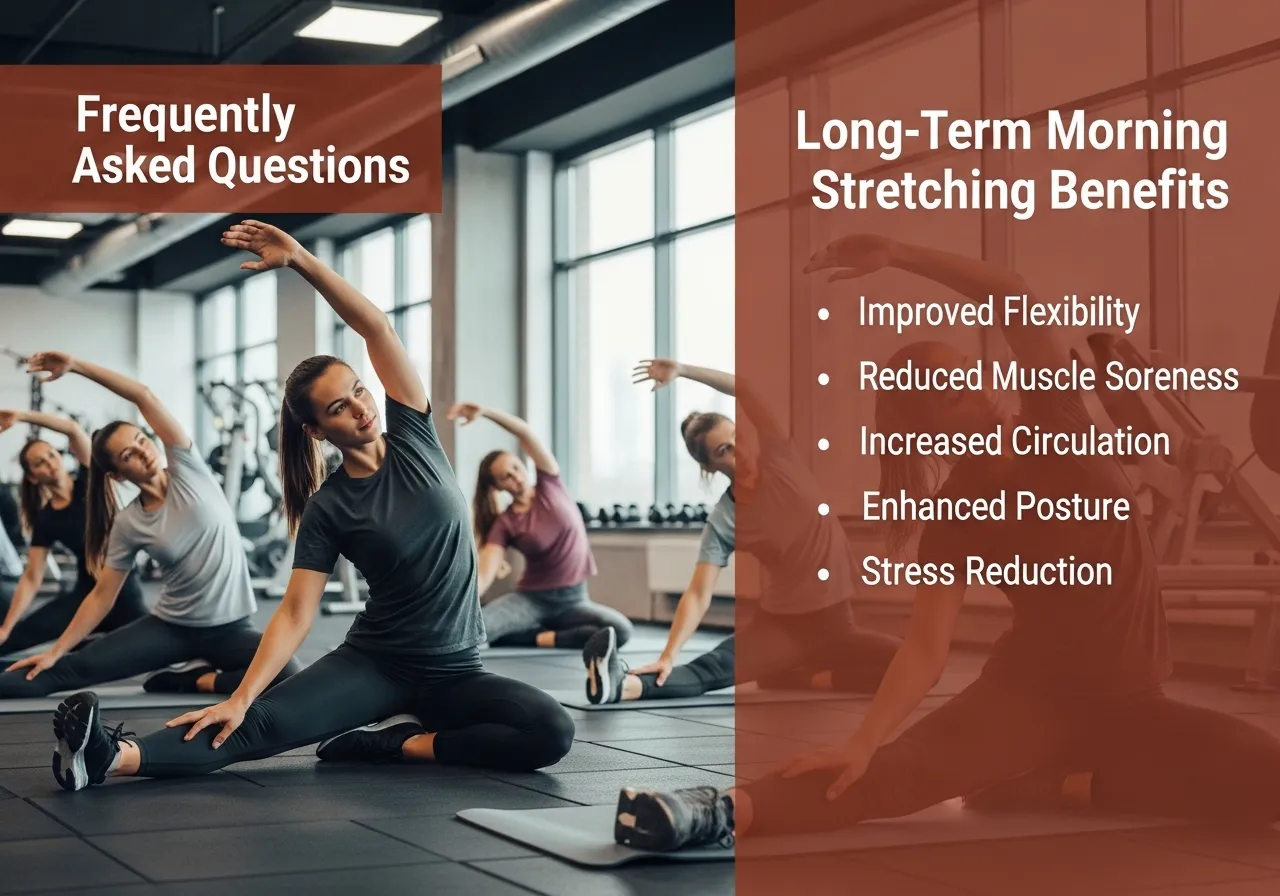
Frequently Asked Questions and Long-Term Morning Stretching Benefits
The questions most commonly asked about morning stretching — and the long-term benefits that consistent practice produces — address both the practical implementation concerns and the bigger picture of what daily mobility work contributes to over years and decades.
Frequently Asked Questions About Morning Stretching
Should I stretch before or after my morning workout? If your workout begins immediately after waking, perform the dynamic phase of the morning routine before training and save the static stretching for post-workout, when flexibility development is unimpaired and recovery support from improved circulation is most useful. If morning stretching is separate from a later workout, the full routine including static stretching is appropriate in the morning. How long does it take to see flexibility improvements from morning stretching? Measurable improvements in hamstring length and hip flexor range of motion are typically apparent within two to four weeks of daily stretching — though the gradual nature of improvement means that a thirty-day photograph comparison reveals changes that daily awareness underestimates. Can morning stretching replace evening stretching? Morning and evening stretching address different physiological states and serve complementary purposes. Morning stretching addresses overnight immobility and prepares movement for the day; evening stretching addresses the accumulated tension of the day’s activity and supports the relaxation that sleep quality requires. Both have value; if only one is possible, morning stretching has the greater functional impact on daily movement quality. Is it normal for morning stretches to hurt? Mild discomfort at end range is normal and appropriate — the tension that indicates effective stretching. Sharp pain, joint pain, or pain that worsens rather than decreasing within the first fifteen seconds of a stretch indicates either technique error (overly aggressive application) or a condition requiring medical assessment rather than stretching. Do I need to warm up before morning stretching? The in-bed phase of the routine described in this article serves as the warm-up — gentle movements in a supported position that restore circulation before more demanding floor work begins. Never begin with aggressive static stretching of cold, unprepared tissue; always start with the gentle progressive sequence that the routine prescribes. How many days per week should I stretch in the morning? Daily. The flexibility improvements from stretching have a short half-life — they begin to reverse within twenty-four to forty-eight hours without continued stimulus. Daily practice maintains the improvements that every session produces, while less frequent practice produces improvements that partially reverse between sessions, resulting in a slower net progression.
The Long-Term Picture: Morning Stretching Across Decades
The cumulative benefits of a consistent morning stretching practice that spans years and decades are qualitatively different from the benefits of an occasional stretching habit — producing the fundamental changes in movement quality, postural health, and physical longevity that separate the functionally capable sixty-year-old from their movement-restricted peer. Posture: the progressive postural changes that sedentary modern life produces — forward head, rounded shoulders, anterior pelvic tilt, and reduced lumbar mobility — are not inevitable consequences of aging but of inadequate movement maintenance. The ten to fifteen minutes of morning stretching that consistently addresses these postural tendencies prevents the structural adaptation that makes them permanent, maintaining the upright, balanced posture that supports lifelong functional independence. Injury prevention: the chronic flexibility and mobility that daily morning stretching maintains provides the joint range and tissue resilience that prevents both the acute injuries (muscle tears, ligament sprains, disc herniations) that occur when movement demands exceed movement capacity, and the overuse injuries that compensatory movement patterns around restricted areas produce. The research on injury rates and flexibility consistently finds that individuals with adequate functional mobility in key joints — particularly hip mobility, ankle dorsiflexion, and thoracic rotation — demonstrate significantly lower injury rates across all physical activities than those with restricted mobility in these areas. Pain management: the lower back pain, neck pain, and hip discomfort that represent the most common musculoskeletal complaints of adult populations are substantially addressable through the consistent morning stretching practice that maintains the tissue length and joint mobility that pain-free movement requires. From ACSM chronic pain and flexibility research, consistent stretching programs demonstrate clinically meaningful reductions in chronic lower back pain intensity and frequency — confirming that the morning routine is not merely wellness supplementation but a legitimate intervention for the most prevalent chronic pain condition affecting working-age adults.
Creating Your Personalized Morning Stretch Routine
The morning stretch routine that produces the greatest long-term benefit is one that is specifically designed for the individual’s particular movement restrictions, postural tendencies, and lifestyle demands — rather than a generic sequence applied uniformly regardless of individual needs. Begin by identifying your specific limitations: where is the morning stiffness most pronounced? Which movements feel most restricted in the first minutes of the day? What physical activities or occupational demands does your day require that specific flexibility would most support? Use these answers to weight the routine toward the areas of greatest need while maintaining the comprehensive sequence that addresses the whole body. For the desk worker with chronic neck and upper back tightness, the pectoral stretch and thoracic rotation work should constitute the largest portion of the routine. For the runner with recurring hamstring issues, the hamstring and hip flexor sequence deserves the most time and the PNF technique most needs applying. For the parent who lifts small children throughout the day, the spinal mobility work and hip flexor routine most directly address the movement demands that injury prevention requires. The customized routine is not merely more effective — it is more engaging, because the movements that most directly address felt limitations produce the most immediately noticeable benefits, reinforcing the daily practice with the tangible improvement that motivation requires to sustain. Build your routine, practice it daily, and allow the years of consistent investment to produce the physical freedom that adequate movement maintenance enables — because the body that is consistently stretched and mobilized retains the capability for a full, active life that the body left to accumulate restriction gradually loses.
The Neuroscience of Morning Movement: How Stretching Primes Your Brain
The cognitive benefits of morning stretching extend beyond the generalized “exercise is good for the brain” finding to specific mechanisms that morning movement preferentially activates. Proprioceptive input from the joint position sensors activated during stretching feeds directly into the cerebellum and sensorimotor cortex — the brain regions responsible for movement coordination and body awareness. This morning sensorimotor activation literally warms up the neural circuits that all subsequent movement requires, producing the coordination and body awareness improvements that athletes notice as improved technical performance in morning training sessions following a stretching routine. The BDNF (brain-derived neurotrophic factor) elevation that exercise produces is measurable after as little as ten minutes of moderate physical activity — and the morning window is particularly valuable for this neurochemical effect because the cognitive function benefits of BDNF elevation arrive at the beginning of the mental work day rather than following it. The attentional focus that stretching requires — the deliberate awareness of body sensation and breathing that effective stretching demands — is itself a form of mindfulness practice that trains the present-moment attention that anxiety reduction and cognitive clarity require. Research on the cognitive effects of morning physical activity consistently finds significant improvements in executive function, working memory, and sustained attention in the hours following morning exercise — effects that are attributable both to the neurochemical changes exercise produces and to the attentional and psychological preparation that intentional physical activity at the start of the day provides. The person who stretches mindfully for fifteen minutes each morning is not merely improving their physical mobility — they are priming their brain for the cognitive demands of the day in ways that no other morning ritual equivalently achieves.
Tools and Props That Enhance Morning Stretching
The basic morning stretch routine requires nothing beyond a floor surface and enough space to lie down — but specific tools can meaningfully enhance the effectiveness and comfort of the practice for practitioners who want to deepen particular aspects of the routine. A yoga mat provides the cushioning for floor work and the grip for standing balance movements that makes the routine more comfortable on hard floors and reduces the friction concerns that stretching in socks on hardwood produces. A foam roller addresses the myofascial restrictions that stretching alone cannot resolve — spending five minutes on the foam roller before the stretch routine reduces the muscle guarding and adhesion that limits stretch effectiveness, particularly in the thoracic spine, IT band, and hip flexors. A resistance band serves as an external assist for hamstring stretches that individuals with significant hamstring restriction cannot reach effectively without assistance — looping the band around the foot and using the arms to apply gentle additional tension produces the same effect as a partner assist without requiring one. A yoga block or firm bolster supports the hip in pigeon pose modifications for individuals whose hip restrictions make the full ground position impossible or painful, allowing the stretch to be performed at an appropriate intensity rather than compensated around the limitation it should address. A tennis or lacrosse ball provides targeted trigger point release for the foot (plantar fascia and intrinsic foot muscles), hip rotators (piriformis and gluteus medius), and thoracic paraspinals — areas where the broad pressure of a foam roller is less effective than the concentrated pressure that a small ball provides. None of these tools is essential; all provide meaningful value for practitioners who engage with the aspects of the routine they each support. Start with the mat and floor, add tools as the practice develops and specific needs become apparent.
The Complete Morning Stretch: Putting It All Together
The comprehensive morning stretch program integrates every element described in this article into a single coherent daily practice that addresses the whole body systematically, respects the physiological state of the waking body, and produces the cumulative flexibility and mobility improvements that consistent daily practice enables. The complete sequence: Phase one in bed (three minutes) — supine knee-to-chest, spinal twist both sides, happy baby pose. Phase two on the floor (seven minutes) — child’s pose with lateral reach both sides, cat-cow ten cycles, low lunge hip flexor stretch both sides, seated hamstring stretch, pigeon pose both sides, chest opener in doorway, seated spinal twist. Phase three standing dynamic (five minutes) — leg swings forward-back and lateral both legs, hip circles both directions, thoracic rotation both directions, ankle circles and calf raises. Total: fifteen minutes. For the five-minute minimum: cat-cow, low lunge both sides, thoracic rotation standing. The non-negotiable commitment: perform the minimum version every single day, and the full version whenever time allows. The flexibility, mobility, and pain-free movement that consistent daily practice produces compound over weeks and months in ways that occasional stretching cannot match — each morning session builds on the previous one, gradually expanding the range of motion and reducing the tension that the body’s default response to sedentary living otherwise accumulates. Begin tomorrow morning. The mat is already laid out. The fifteen minutes are already allocated. The only remaining element is the decision to start — and once started consistently, the daily practice that morning stretching becomes is one of the most reliably rewarding investments in physical and psychological health available to anyone willing to spend fifteen minutes on the floor before the day begins.
Start.