The Pros and Cons of Working Out Alone vs. with a Traine

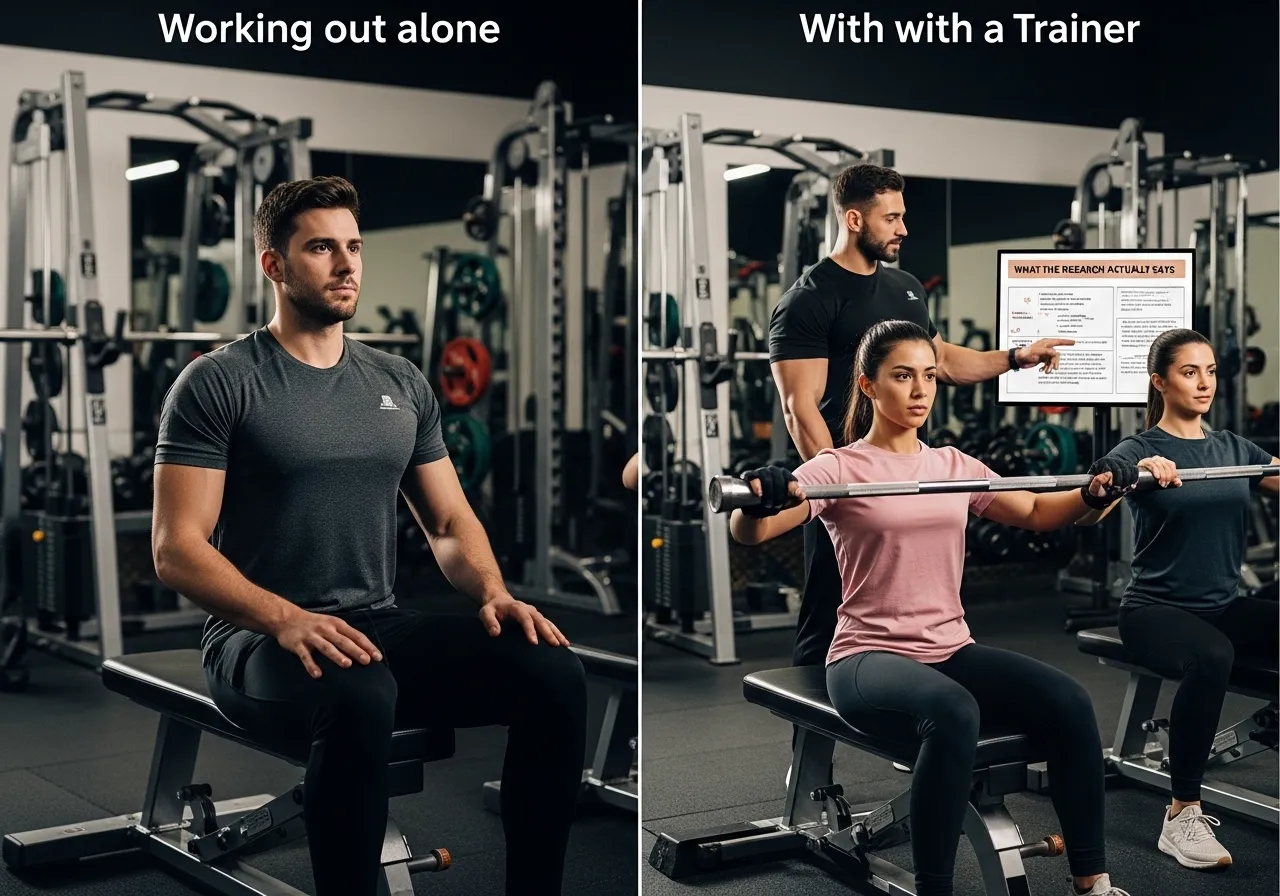
Working Out Alone vs. With a Trainer: What the Research Actually Says
I have trained both ways — years of solo lifting with nothing but a notebook and headphones, followed by a period of working with a coach during a competitive preparation phase — and the honest assessment is that both have genuine advantages and genuine limitations that the training world’s tribal allegiances tend to obscure. The “just hire a trainer” camp and the “I don’t need anyone telling me what to do” camp are both missing the more nuanced reality: the optimal training approach for any individual depends on their specific goals, training history, learning style, schedule, budget, and the particular stage of their athletic development. This article examines both sides with the evidence and personal honesty that the decision actually deserves.
How the Research Frames the Trainer Effectiveness Question
The academic research on personal training effectiveness is less straightforward than the fitness industry’s marketing suggests. The most-cited finding — that exercisers working with personal trainers demonstrate significantly greater strength gains and program adherence than self-directed exercisers — comes from studies comparing trained versus untrained populations over relatively short time frames (8-16 weeks), which captures the period where trainer guidance has its greatest relative impact: the beginner phase where technique, programming, and consistency all need development simultaneously. Research on trained athletes and advanced exercisers shows a considerably smaller trainer effectiveness advantage — experienced athletes who already have technical proficiency and programming knowledge benefit primarily from the accountability and external perspective components of coaching rather than the instruction and structure components that beginners need most. The adherence finding is robust across studies: accountability to a specific person at a specific time improves exercise consistency more reliably than any intrinsic motivation strategy studied — which is why the primary argument for training with a trainer for long-term athletes is often the accountability mechanism rather than the technical knowledge component. From American College of Sports Medicine exercise adherence research, social accountability — whether to a trainer, a training partner, or an online community — is consistently identified as one of the strongest predictors of long-term exercise program adherence in both beginner and experienced exerciser populations, outperforming intrinsic motivation alone in sustaining consistency across months and years of training.
The Evolution of Training Needs Over an Athletic Career
The relative value of solo versus trainer-guided training changes dramatically across the developmental arc of an athletic career, which explains why dogmatic positions on either side are almost always based on a snapshot of experience at one particular career stage rather than a considered view of the full development timeline. In the beginner phase (first 6-12 months of structured training), the value of qualified instruction is at its maximum: technique learning on compound movements requires external feedback that mirrors and verbal cues cannot fully provide; programming structure prevents the common beginner errors of random exercise selection and haphazard intensity management; and the confidence that competent coaching builds in movement quality accelerates the foundational development that training history is built on. In the intermediate phase (1-3 years of consistent training), the value proposition shifts: technical proficiency is largely established, basic programming principles are understood, and the primary limiting factor becomes the training quality consistency that accountability and advanced programming periodization support. In the advanced phase (3+ years of dedicated training), the trainer’s value is most specifically about the external perspective on technique inefficiencies and fatigue management that self-coaching struggles to objectively assess — the periodization expertise that optimizes the training blocks surrounding competition or peak performance goals, and the accountability and psychological support that high-level athletic pursuit demands at points of motivational plateau. Understanding where you are in this developmental arc provides the framework for assessing whether the investment in a trainer addresses the specific limiting factor in your current training — rather than representing either a universal necessity or a universal waste of money.
The Social Dynamics of Training With Someone vs. Alone
The social dimension of personal training extends beyond accountability into the relational dynamics that the coaching relationship itself creates — and these dynamics have both positive and potentially limiting effects on training quality and athlete development. The positive social dynamics of a good trainer relationship: the emotional safety to attempt difficult or unfamiliar challenges that a supportive coach’s presence provides; the encouragement during genuinely hard efforts that requires another person’s acknowledgment to feel socially complete; and the continuity of a relationship that understands the athlete’s history, preferences, and patterns in ways that impersonal program following cannot replicate. The potentially limiting social dynamics: the social inhibition of training in front of someone whose perception matters — some athletes perform certain movements less freely or less authentically when being observed, particularly during the learning phases of technically demanding skills; the conversational distraction that some trainer-client relationships develop, where social interaction during rest periods reduces focus and training quality rather than enhancing it; and the dependency that full-time coaching can create in athletes who never develop the self-direction capacity that independent training requires when coaching is unavailable. The ideal trainer relationship is one that builds the athlete’s self-management capacity rather than creating dependence on the trainer’s presence — the trainer whose athletes can train effectively alone between sessions, who know their own responses, and who have internalized the principles behind the program rather than just following instructions, produces better long-term outcomes than the trainer who creates maximum session-to-session dependency. The athlete who evaluates their trainer relationship by this standard — am I becoming more capable and self-directed over time, or more reliant on this person’s presence? — maintains the developmental trajectory that athletic growth requires rather than the service relationship that personal training can become when athlete development is subordinated to client satisfaction.
Online Coaching: The Middle Ground Between Solo and In-Person Training
The rapid growth of online coaching — remote training program design and oversight through apps, video reviews, and regular check-in communication — has created a middle ground between full personal training and entirely self-directed training that serves intermediate and advanced athletes particularly well. Online coaching provides the programming expertise and accountability of professional coaching at 20-40% of in-person training costs, using the asynchronous communication and video review capabilities of modern apps to deliver most of the coaching value without the physical co-location requirement that in-person training demands. The specific advantages of online coaching over in-person training for suitable athletes: geographic flexibility (access to coaches with specific expertise regardless of local availability); schedule flexibility (asynchronous communication rather than synchronized appointment scheduling); cost efficiency (reduced hourly coaching rates because the coach’s time is used more efficiently across multiple clients); and the self-logging discipline that online coaching requires developing — because the coach’s program oversight depends on the athlete’s accurate training records, online coaching athletes consistently develop better training log habits than in-person training clients whose session records are maintained by the trainer. The limitations of online coaching: no real-time technique correction during the session moment when motor learning consolidation occurs; reduced accountability intensity compared to in-person financial and relationship commitments; and the technical setup requirement (video recording equipment, app proficiency) that creates friction for athletes not already comfortable with digital training tools. For the intermediate-to-advanced athlete seeking expert programming and periodic technique oversight without the in-person training investment, online coaching represents the most cost-effective professional development resource currently available in the fitness market.
The Hidden Costs of Personal Training Dependency
Beyond the direct financial cost, personal training dependency carries indirect costs that are rarely discussed: the scheduling constraint of training only when the trainer is available limits the flexibility that life’s unpredictability requires; the skill and confidence atrophy that results from always having decisions made by someone else impairs the athlete’s ability to self-manage training during the inevitable periods when trainer access is interrupted; and the psychological dynamic of some trainer relationships — where the trainer’s authority creates the passive recipient role that reduces the client’s agency in their own fitness development — can undermine the autonomy and intrinsic motivation that sustainable long-term exercise requires. The trainer-dependent athlete who loses access to their trainer through moving, budget change, or trainer retirement frequently experiences the regression that the absence of external structure reveals — having never developed the self-management infrastructure that solo training requires. Building at least the foundational self-management capabilities — a basic understanding of progressive overload, the ability to assess technique from video, a training log practice — even while working with a personal trainer prevents this dependency trap and ensures that the trainer relationship enhances rather than replaces the athlete’s own exercise management capabilities.
Using Video Analysis for Solo Technique Development
The technique improvement that personal training provides through real-time feedback is increasingly accessible to solo athletes through deliberate video self-review — a practice that requires only a smartphone propped at the right angle and the discipline to actually watch the footage critically rather than assuming the movement is correct because it felt right. The effective video self-review protocol: set up the camera at a 45-degree angle to the movement plane for compound exercises (this angle captures both the sagittal and frontal plane information that technique assessment requires); film every working set on technique-development days rather than just occasional sets; compare your footage against the specific technique standards for the exercise (available through authoritative sources like Starting Strength, Barbell Medicine, or sport-specific coaching resources); and identify one specific technique cue to focus on per session rather than trying to correct multiple elements simultaneously. The video self-review practice, applied consistently over months, produces technique improvement that approaches the quality of personal training feedback — more slowly, because the feedback loop is less immediate, but at a fraction of the cost and with the additional benefit of developing the visual movement literacy that self-assessment requires and that enhances every subsequent training decision. The form check communities available on Reddit (r/formcheck) and dedicated lifting forums provide the additional feedback of experienced external eyes reviewing submitted videos — a free crowdsourced technique assessment resource that complements self-review and partially addresses the real-time feedback gap of solo training.

The Genuine Advantages of Working With a Personal Trainer
The personal trainer’s value proposition is strongest and most empirically defensible in specific training contexts — and honest about where it provides genuine advantages versus where the returns diminish against the cost.
Technical Instruction and Movement Quality
The compound barbell movements that produce the greatest training returns — the squat, deadlift, bench press, overhead press, and their variations — are technically demanding enough that learning them without qualified external feedback produces movement patterns that are less efficient, more injury-prone, and less productive than properly coached technique allows. The kinesthetic sense of how a movement feels from inside the body is an unreliable guide for the beginner who has no previously established correct movement pattern to reference — a squat that feels deep and upright to an untrained body may be a shallow, forward-leaning pattern that a coach’s eyes immediately identify as requiring corrective feedback. Video self-review helps but doesn’t replace real-time coaching cues that redirect movement in the moment of execution, when motor learning consolidation is occurring. The investment in technical instruction for compound movements has compounding returns: correct technique learned early prevents the injury-prone compensation patterns that self-taught lifters frequently develop and then spend years trying to unlearn; and movement efficiency improvements from proper technique translate into greater long-term load capacity that the progressive overload framework requires for continued adaptation. Even experienced lifters periodically benefit from technique reviews by skilled coaches who identify the subtle inefficiencies that years of self-coaching can entrench — the bar path deviation on the bench press that the athlete has compensated for rather than corrected, the slight forward lean on the squat that limits depth at heavy loads.
Accountability and Consistency: The Most Undervalued Trainer Benefit
The accountability mechanism of scheduled training appointments with a financial commitment and a human relationship attached is, paradoxically, one of the most powerful behavior modification tools available for maintaining exercise consistency — and it works through psychological mechanisms that intrinsic motivation cannot reliably replicate over months and years of training. The anticipated disappointment of cancelling on a trainer, the social cost of showing up unprepared or uncommitted to a session someone is being paid specifically to deliver, and the positive reinforcement of the trainer relationship that consistent attendance builds all create the external behavioral support structure that self-directed training has to replace with purely internal mechanisms. Research on exercise dropout rates consistently finds that financial accountability (having paid for training), social accountability (having scheduled with a person rather than a facility), and temporal specificity (a scheduled time rather than a general intention) are the strongest predictors of session completion — all three of which working with a personal trainer provides simultaneously. For athletes who have a pattern of training inconsistency despite genuine motivation and knowledge, the accountability of personal training may produce more training quality improvement per dollar spent than any program optimization or equipment upgrade — because the sessions that don’t happen produce zero adaptation regardless of how excellent the program is.
Customized Programming and Periodization
A skilled personal trainer provides individualized programming that a generic online program, a cookie-cutter gym app, or a self-written program based on general principles cannot match for the athlete with specific goals, injury history, schedule constraints, and physiological response patterns that require personalized adjustment. The customization advantage is greatest at the extremes of the training experience spectrum: beginners who need programming that matches their current capacity and accommodates the rapid technique development of the learning phase; and advanced athletes whose training history, competition schedule, and performance plateaus require the sophisticated periodization that general programs don’t provide. The programming quality difference between a coach who knows their client’s response to specific loading parameters — which volumes produce good recovery, which intensities trigger peak performance, which rest periods suit their recovery speed — and a generic template applied without this individualization is genuinely meaningful for the athlete who has the training history to be limited by programming precision rather than execution quality or consistency. The question for each athlete: am I currently limited by having the wrong program, or by executing any reasonable program inconsistently? The answer determines whether programming customization or accountability support is the primary value that a trainer provides — and whether the investment is justified by the specific limitation it addresses.
Solo Training Safety: Managing Risk Without a Spotter
The safety concern that most frequently surfaces in the solo versus personal training debate is the physical safety of training heavy without a spotter — the risk of a failed bench press or squat ending badly when no one is present to assist. This concern is legitimate for specific exercise and equipment configurations and deserves a practical management framework rather than dismissal. The exercises where solo training without a spotter creates genuine injury risk: barbell bench press (a failed rep with the bar across the chest and no safety cage can cause serious injury); barbell back squat without safeties (a forward collapse with the bar on the shoulders can cause spinal injury); and any heavy loaded movement where the failure position traps the athlete under the load. The equipment and technique solutions that make these exercises safe for solo training: power rack or squat cage with properly set safety bars eliminates the falling bar risk for squat and bench press completely — the safety bars catch the bar if the rep fails and the athlete ducks under or tilts the bar off; learning the bail technique for the back squat (pushing the bar back off the shoulders while stepping forward) makes the movement safe without safeties in emergencies; and substituting dumbbell bench press (which can be safely bailed by lowering the weights to the floor when a rep fails) for barbell bench press in the specific sessions where maximum load testing occurs without a spotter available. The solo training athlete who trains in a properly equipped power rack with correctly set safety bars can safely perform heavy squats and bench presses alone — and the athlete who trains at a commercial gym with access to rack equipment but without a consistent training partner can manage this safety consideration with technique rather than requiring constant supervision.
Group Training and Class-Based Alternatives to Solo and Personal Training
Between the poles of individual personal training and entirely solo training lies the group training landscape — CrossFit boxes, group fitness classes, running clubs, martial arts schools, yoga studios, and the various community-based training environments that provide structured programming, technical instruction, and social accountability at per-session costs typically 75-85% lower than personal training. Group training’s distinct advantage is the combination of community and competitive social dynamics that neither solo training nor individual personal training provides — the competitive alignment with training partners at similar performance levels that pushes effort beyond what either solitary commitment or trainer encouragement alone typically produces. The collective suffering dynamic of a demanding group class — where everyone is working at high intensity simultaneously and social norms of effort apply to all participants — often produces higher training intensities than solo training at comparable absolute capacity, because the social presence of struggling training partners makes abandoning hard effort socially costly in ways that private solo training does not. The group training limitation is the inverse of its strength: the group program cannot be individually optimized for any single participant’s goals, injury history, or performance level — every class member receives the same stimulus, which may be excellent for some, insufficient for others, and excessive for others still. The athlete who supplements group training with the individual programming adjustments and complementary solo sessions that their specific development requires extracts the community energy and accountability of group training while addressing the individualization gap that group formats structurally cannot provide.
What Excellent Trainers Do That Average Trainers Don’t
The quality variation within the personal trainer profession is enormous — ranging from coaches who produce genuinely exceptional athlete development to those whose technical knowledge and instructional skill are insufficient to justify the investment their rates reflect. Understanding what distinguishes excellent from average trainers guides the evaluation process that prevents both the underinvestment of choosing a credential-only trainer without delivery capability and the avoidance of professional coaching based on one poor trainer experience. Excellent trainers demonstrate: acute observational skill during movement — the ability to identify the specific kinetic chain impairment that produces a technique error, rather than offering generic cue adjustments that don’t address the root cause; systematic assessment before program design — conducting posture assessment, movement screening, and goal interviews before prescribing a single exercise, because the program that serves one client’s needs may actively worsen another’s movement dysfunction or injury pattern; the ability to articulate why — explaining the physiological rationale behind program design decisions rather than just prescribing exercises, building the client’s understanding that enables self-direction between sessions; honest expectation management — communicating realistic timelines and outcomes that align with the science rather than the marketing, because the client who understands realistic progress builds sustainable motivation that oversold expectations undermine; and the ongoing education investment that professional credibility requires in an evidence-base that continues to evolve — reading current research, attending continuing education, and updating practice based on what the science reveals rather than what their original certification taught them a decade ago.

The Genuine Advantages of Training Alone
Solo training has advantages that trainer-assisted training cannot provide — and these advantages become increasingly important as training experience, self-knowledge, and intrinsic motivation develop into genuine athletic assets.
Freedom, Flexibility, and Self-Knowledge Development
Training alone provides a degree of schedule flexibility that trainer appointments fundamentally cannot — the ability to train at 6am, 11pm, for 25 minutes or 2 hours, to modify the session in real-time based on how the body is responding, and to eliminate the scheduling and communication overhead that coordinating with another person’s availability requires. For athletes with unpredictable schedules, frequent travel, or the strong intrinsic motivation that makes external accountability unnecessary, this flexibility advantage over trainer-dependent training is substantial and practically significant. The self-knowledge that solo training develops is a less-discussed but genuinely valuable asset: the experienced self-directed athlete who has spent years learning their own response to different training stimuli — which exercise variations their body responds to best, what their personal fatigue indicators are, how their sleep quality affects performance in specific movement patterns — develops a sophisticated understanding of their own physiology that no trainer’s external observation can fully replicate. This self-knowledge is the foundation of the autoregulation training approach that advanced athletes use to optimize training intensity in real-time — adjusting loads, volumes, and exercise selections based on daily readiness signals that the athlete themselves is best positioned to interpret. From NSCA autoregulation and self-directed training principles, athletes with 3+ years of consistent training experience demonstrate significantly better autoregulation accuracy — the ability to select training loads that produce the intended training stimulus — compared to beginners and early-intermediate athletes, suggesting that the self-directed training approach becomes more appropriate as training age and self-knowledge develop.
Focus, Flow, and Psychological Benefits of Solo Training
Solo training creates the uninterrupted psychological space that the flow state — the immersive concentration in a challenging activity that research associates with peak performance and deep satisfaction — requires to develop. The social dynamic of trainer-guided training, while valuable for motivation and accountability, introduces the conversational and relational elements that prevent the complete absorption in the training task that highly motivated self-directed athletes actively pursue. Many serious athletes report that their best training sessions — the ones where technical execution, focus, and physical output align in the way that training is always trying to produce — happen during solo sessions where the absence of external interaction allows complete concentration on the internal experience of the movement, the breath, and the progressive challenge that well-designed training provides. The meditative or cathartic quality that some athletes derive from solo training — using the session as a period of focused, physical self-expression that provides psychological recovery from the cognitive and social demands of work and daily life — is a genuine wellbeing benefit that the social presence of training with another person necessarily modifies. Solo training also allows the training soundtrack, pace, energy level, and conversational absence that the athlete’s personal preferences require rather than the compromises that shared training space and social dynamics impose.
Cost and Long-Term Financial Sustainability
Personal training in urban markets typically costs $60-150 per 60-minute session, meaning that a twice-weekly personal training schedule costs $6,240-15,600 annually — a significant financial commitment that requires honest assessment of the return on investment. The solo training alternative — gym membership plus the initial investment in quality programming (either a purchased online program at $50-200, a periodization book, or a few sessions with a coach specifically for programming design rather than ongoing delivery) — reduces the ongoing annual cost to $600-1,500 while maintaining most of the programming quality of a continuously coached approach for the athlete with sufficient training experience. The appropriate financial framework: personal training costs are most justified when the knowledge, accountability, and technique instruction components all provide value that cannot be replicated by lower-cost alternatives — which is clearly the case for beginners and clearly less the case for experienced athletes with solid technique and strong intrinsic motivation. The middle ground — periodic coaching check-ins every 6-12 weeks for program review and technique assessment, combined with self-directed daily training — provides most of the trainer’s value for 20-30% of the ongoing cost, representing the most efficient use of coaching resources for the intermediate-to-advanced athlete who has outgrown the full-time coaching need of the beginner phase.
Motivation Science: Why Some People Thrive Solo and Others Need External Support
The psychological research on exercise motivation identifies two fundamentally different motivational orientations that predict training modality preference more reliably than any practical consideration: autonomous motivation (deriving training drive from intrinsic interest, personal values, and self-determined goals) versus controlled motivation (deriving training drive from external rewards, social approval, obligation, and accountability). Athletes with strongly autonomous motivational profiles — who train because they genuinely want to, find intrinsic satisfaction in the process, and maintain that motivation even without external reinforcement — consistently demonstrate better self-directed training adherence and derive less additional benefit from the external accountability component of personal training. Athletes with primarily controlled motivational profiles — who perform best when external structure, scheduled appointments, and interpersonal obligation create the consistency that intrinsic drive alone does not sustain — derive the most benefit from the trainer’s accountability function and are most at risk of inconsistency in self-directed training contexts. Self-determination theory, the most comprehensive psychological framework for understanding human motivation, predicts that training approaches supporting the three basic psychological needs of autonomy (choosing how to train), competence (feeling capable and improving), and relatedness (connecting with others through training) produce the strongest long-term motivation regardless of whether those needs are satisfied through solo or trainer-guided training. The practical implication: the training format that best satisfies your specific motivational architecture — rather than the format with the theoretically superior programming or technique instruction — will produce better long-term outcomes because it sustains the consistency that any format requires to produce results. Honest self-assessment of which motivational profile describes your historical training behavior is more predictive of the optimal training approach for you specifically than any abstract comparison of solo versus trainer-guided training quality.
Training Partners: The Often-Overlooked Third Option
The binary framing of solo versus personal training training obscures the third option that many athletes find provides the optimal combination of accountability, motivation, cost efficiency, and training quality: the training partner relationship. Training with a committed, knowledgeable, similarly motivated partner provides the interpersonal accountability that schedule commitment and the social cost of cancelling creates; the motivational energy of collaborative effort and friendly competition; real-time feedback on technique from someone who knows your movement patterns and common errors; and the spotter support that heavy barbell training safely requires — all at zero direct financial cost beyond the shared gym access that both athletes would be paying independently. The training partner quality limitation: both the motivational and technical benefits are constrained by the least knowledgeable and least motivated partner — a training partner whose technique knowledge is as limited as yours provides neither correction nor confirmation of your movement quality; and a partner whose motivational energy is low on a given day may reduce rather than amplify your own training quality. Finding the right training partner — at similar training level, with complementary scheduling, compatible training pace, and the commitment reliability that accountability requires — is therefore the most impactful and most challenging aspect of the training partner approach. The effort invested in finding and cultivating the right training partnership is, for many athletes, the highest-return investment in their training environment: it provides most of what a trainer provides for social accountability without the financial cost, and most of what solo training provides for flexibility without the motivational isolation.
The bottom line: the best training setup is the one that keeps you showing up, progressing, and enjoying the process across years — and that answer is uniquely yours to discover through honest self-assessment and deliberate experimentation rather than anyone else’s blanket recommendation.
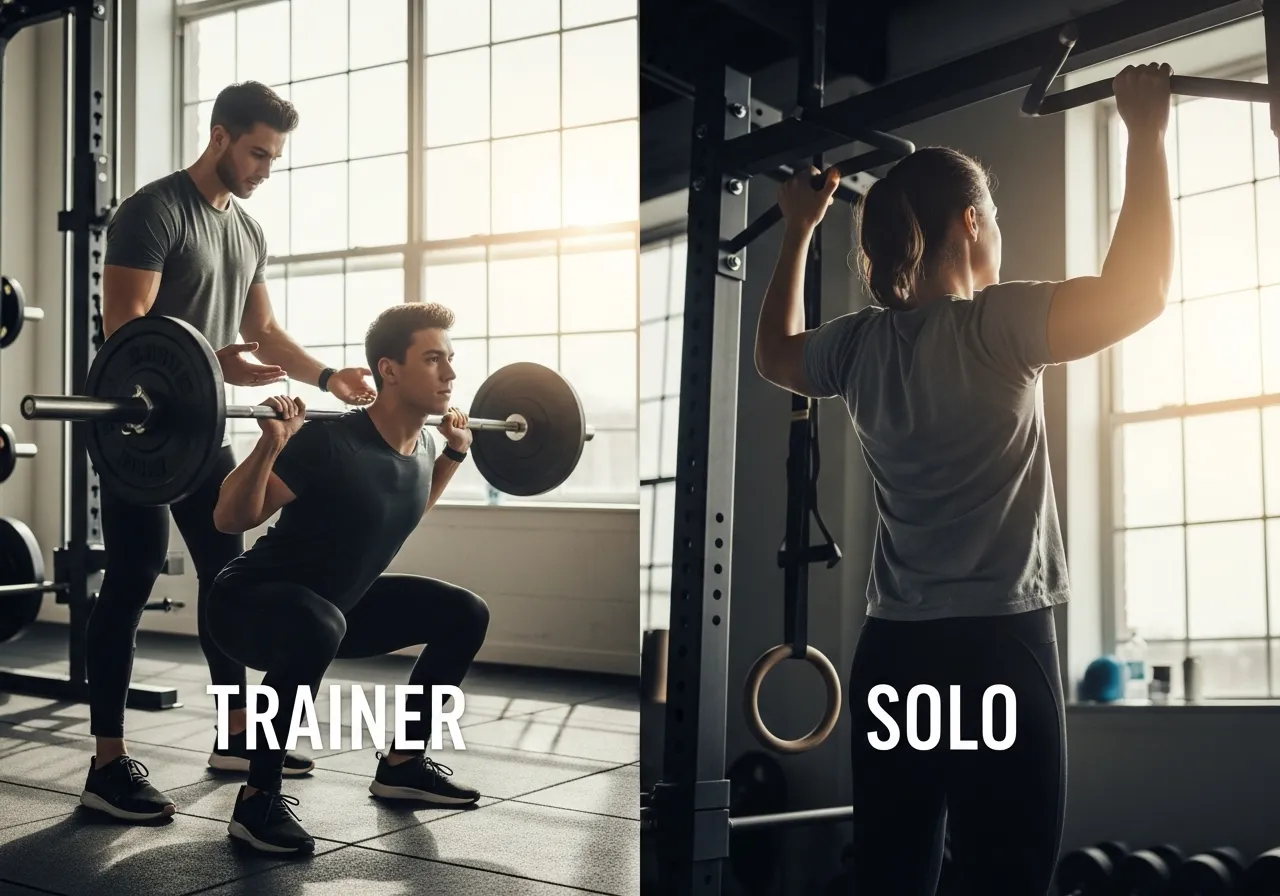
When to Choose a Trainer and When to Train Solo
The decision between personal training and solo training is not a permanent binary choice — it is a dynamic assessment that different life stages, goal phases, and training contexts call for different answers to at different times.
Situations Where a Trainer Is the Right Investment
The clearest cases for investing in personal training: learning a new movement discipline or training modality where technique foundation is being established from scratch — Olympic weightlifting, powerlifting, gymnastics, and similar technically demanding disciplines where incorrect self-taught patterns are genuinely harder to unlearn than to learn correctly from the beginning. Return to training after extended injury, illness, or significant deconditioning period, where the medical-adjacent component of movement pattern reestablishment and load reintroduction benefits from qualified supervision. Training for a first competition (powerlifting meet, physique competition, triathlon, martial arts competition) where the performance stakes justify the cost of optimized preparation guidance. Athletes who have an objective pattern of training inconsistency — who have genuine motivation but repeatedly find reasons to skip solo sessions — benefit most from the accountability structure that training appointment commitment provides. And athletes with specific movement dysfunction, chronic injury patterns, or biomechanical asymmetries that require the detailed corrective work that skilled coaches assess and address through specifically tailored intervention. In all these contexts, the trainer’s value is clear, the investment is justified, and the cost-per-improvement is favorable compared to the alternative of self-directed progress in contexts where guidance produces dramatically faster and more reliable outcomes.
Situations Where Solo Training Is the Right Choice
The clearest cases for self-directed training: experienced athletes (3+ years of consistent structured training) with established technical proficiency across their movement disciplines and the programming knowledge to structure effective training without external design. Athletes with strong intrinsic motivation who train consistently regardless of accountability structure — who have never found self-directed training to result in significant adherence challenges. Schedule-constrained individuals whose availability and location variation make the regular trainer appointment logistically impractical or financially burdensome relative to the value provided. Athletes whose goals are maintenance-oriented rather than performance-improvement-oriented, where the programming precision and accountability of coaching are less critical than the consistent habit that self-directed training already supports. And athletes who have clearly identified their training limiting factors as neither technique nor programming but training consistency, training environment, or recovery management — areas that a trainer’s presence during sessions cannot address as effectively as the behavioral systems, sleep management, and nutrition strategies that self-directed athletes need to build independently regardless of coaching status.
Whichever path you choose — solo, supervised, or somewhere in between — the fundamentals of progressive overload, consistent execution, and adequate recovery determine the outcome. Apply them honestly and the results will follow, regardless of whether a trainer is watching.
The Hybrid Approach, Common Questions, and Building the Best of Both Worlds
The most effective training approach for many athletes is neither pure solo nor pure personal training but rather a hybrid that extracts the highest-value components of each — periodic expert coaching for the oversight and course correction that objective external perspective provides, combined with self-directed daily training for the flexibility, self-knowledge development, and cost efficiency that the between-sessions majority of training delivers.
Designing an Effective Hybrid Training Approach
The hybrid training model works best when structured around specific coaching functions rather than simply reducing session frequency. Monthly program review sessions with a coach or trainer — 60-minute consultations focused on reviewing the previous month’s training logs, assessing performance trends, adjusting program variables, and addressing technique issues that the athlete has identified or that the data reveals — provide the programming optimization and external perspective that prevents the self-coached plateau without the daily training session cost of full personal training. Technique check-in sessions every 6-8 weeks — recorded video reviews of key movements analyzed by a qualified coach who provides specific cue adjustments — maintain the movement quality that self-coaching cannot reliably self-assess over time. Periodic programming blocks (4-8 week intensive coaching phases surrounding important training milestones like competition preparation, post-injury return, or program restructuring) provide the high-value coaching periods when the investment is most clearly justified, with self-directed intervals between them when the daily value of coaching sessions is lower. Online coaching platforms that provide this programmatic review and oversight at $100-300 per month (versus the $1,000-2,000+ per month of twice-weekly in-person personal training) make the hybrid model financially accessible to athletes who could not sustain full personal training costs but who benefit meaningfully from expert oversight of their self-directed training. From ACE Fitness coaching and training models comparison, hybrid coaching models combining periodic in-person or online coaching with self-directed daily training are increasingly recognized as the most cost-effective approach for intermediate and advanced athletes who have sufficient self-management capability to execute between-session training independently.
Maximizing Solo Training Quality: What the Research Recommends
Solo training quality can approach and in some metrics exceed trainer-guided training quality when the self-directed athlete implements the specific practices that research identifies as the primary determinants of training effectiveness without external guidance. Written program adherence — following a pre-written, periodized program rather than making in-the-moment exercise selections — eliminates the decision fatigue and volume inconsistency that characterizes most underperforming self-directed training. Video self-review of key technique movements every 2-4 weeks provides the external visual feedback that replaces some of the real-time coaching that solo training lacks — using a phone stand to record sets from the appropriate angles and reviewing between sets or after the session. Training log discipline — recording every set, every rep, every load, and subjective performance quality ratings (energy, recovery, execution quality) — creates the data that makes autoregulation and progressive overload management possible without the external observer that trainer-guided training provides. Pre-session preparation (reviewing the day’s program, selecting the appropriate loads based on training log history, warming up systematically rather than arbitrarily) replaces the trainer’s session structure function with the athlete’s own systematic preparation. And the training environment optimization — removing the phone-based distractions that social media, messaging, and the default attention capture of digital devices introduce into solo sessions — recovers the focus quality that trainer-guided training structures naturally produce through the presence of another person’s attention.
Frequently Asked Questions About Training Alone vs. With a Trainer
Q: Is a personal trainer necessary for beginners? A: Not strictly necessary, but highly valuable for the first 3-6 months when technique foundations are established. At minimum, 3-5 sessions with a qualified trainer for each major compound movement pattern provides the technical instruction that prevents years of suboptimal self-taught patterns. Full-time ongoing training is valuable but not essential if solid technique is established and programming is provided by a credible source. Q: Can I get results training alone without any professional input? A: Absolutely — the majority of recreational and competitive athletes train primarily or entirely self-directed and achieve excellent results. The critical requirements: a well-designed program from a credible source, accurate technique either taught initially by a qualified instructor or verified through video review, and the consistency that results from whatever accountability structure the individual finds reliably sustaining. Q: How do I find a quality personal trainer? A: Look for nationally recognized certifications (NSCA-CSCS, ACSM-CPT, NASM-CPT, ACE-CPT) as baseline credentials. Ask specific questions about their experience with athletes at your training level and goals — a trainer who primarily works with sedentary beginners may not provide the advanced programming that an experienced athlete needs. Request references from current or former clients at similar training levels. And trust the initial experience — a skilled trainer quickly demonstrates the technical knowledge, communication quality, and program design capability that separates genuine expertise from credential-only qualification. Q: What if I can’t afford a personal trainer? A: The most cost-effective alternatives in order of value: online coaching programs from qualified coaches ($50-200 for periodized programs with video instruction); occasional single-session technique consultations rather than ongoing training; YouTube instruction from credentialed coaches for technique refinement; and training communities (running clubs, CrossFit, martial arts, group fitness) that provide the social accountability and technical feedback components of personal training at dramatically lower per-session cost. Q: Should I train solo or with a trainer for weight loss specifically? A: For weight loss as the primary goal, both approaches work when combined with appropriate nutrition — but the accountability component of trainer-guided training is particularly valuable because weight loss requires behavioral consistency across both training and nutrition that external accountability supports more reliably than intrinsic motivation alone, particularly in the early phases when new behavioral patterns are still being established and motivation fluctuates most significantly.
Choose intentionally. Train consistently. Adjust intelligently.
Making the Decision: A Practical Self-Assessment Framework
The decision between solo training, personal training, and the various hybrid and group options benefits from a structured self-assessment that applies the considerations of this article to the specifics of your situation. Ask yourself these five questions honestly: First — what is my current training experience level and technical proficiency? Beginners and returning athletes without solid technique foundations have the strongest case for professional instruction. Second — what has been my historical pattern of training consistency? Chronic inconsistency despite genuine motivation is the clearest indicator that external accountability structure would improve outcomes. Third — what are my specific training goals and timeline? Performance-critical goals with specific timelines justify the enhanced programming precision and accountability of professional coaching more clearly than general fitness maintenance. Fourth — what is my budget and how do I prioritize fitness investment relative to other financial commitments? The answer determines which tier of the solo-hybrid-full coaching spectrum is financially sustainable rather than aspirationally preferred. Fifth — what specific training limitation am I trying to solve? If the answer is technique, progressive programming, or consistency, these are clearly trainer-influenced limitations. If the answer is motivation, environmental access, nutrition, or recovery management, a trainer may not address the primary limitation at all. The athlete who answers these five questions honestly arrives at a training approach decision that is genuinely matched to their specific situation rather than generically applied from advice designed for a different athlete in a different context. That specificity is the quality that converts training approach decisions from potentially wasted investments into genuine athletic development catalysts — whether those decisions point toward hiring a trainer, committing more deeply to self-directed training, or building the hybrid structure that extracts the highest value from both approaches simultaneously. The best training approach is always the one you will actually commit to, execute consistently, and progress within over the months and years that meaningful athletic development requires. Solo or coached, the consistency and progressive intent you bring to it matters more than which approach you choose.

Group Training, Classes, and Team Environments as Additional Options
The solo versus personal training framing overlooks the group training environment that provides a cost-effective middle ground combining the social motivation and structured programming of guided training with the per-person cost efficiency that individual personal training cannot match.
Group Fitness Classes: The Overlooked Option
Group fitness classes — from CrossFit boxes to yoga studios to spinning classes to small group personal training — provide the program structure, technique instruction, accountability, and social energy of guided training at $15-40 per session rather than the $60-150 of individual personal training. The class environment provides the social facilitation effects that training research consistently identifies as performance-enhancing: the mere presence of others exercising at similar or higher intensity increases individual effort through social comparison and competitive motivation that solitary training cannot replicate. The limitations of group classes: the standardized program that serves the average group member may not optimally serve your specific goal (a general fitness class is not a powerlifting program or a marathon training plan); the technique instruction quality is diluted by the multiple-participant attention demand that limits individual feedback; and the scheduling rigidity of class times constrains training to the class schedule rather than the athlete’s optimal timing. The practical value proposition of group classes: for athletes who benefit from the social accountability and motivational energy that others provide, and whose goals are broadly met by the class program quality, the cost efficiency of group training relative to individual training is a compelling reason to use group classes as the primary training vehicle rather than a secondary supplement to solo work. From PubMed social facilitation and exercise performance meta-analysis, training in the presence of others consistently increases exercise performance and perceived enjoyment compared to identical training performed alone — confirming the group training motivational benefit as a genuine physiological and psychological phenomenon rather than a marketing claim.
Building Your Optimal Training Environment
The most honest conclusion about the solo versus trainer debate is that the optimal training environment is one that maximizes the specific factors that determine your personal training quality and consistency — and this optimal environment is individual, not universal. Some athletes perform best in the structured, accountable environment of regular personal training sessions. Others train with more focus, autonomy, and enjoyment when completely alone in a session they have designed themselves. Many find the combination of solo self-directed training with periodic coaching check-ins provides the ideal balance of independence and quality assurance. The evidence does not support a universal recommendation because the behavioral and psychological factors that determine training consistency and quality — motivation style, accountability needs, learning preferences, budget constraints, and goal specificity — vary too widely between individuals for any single approach to serve all of them optimally. What the evidence does support is this: regardless of the training arrangement, the non-negotiables of training quality are progressive overload, adequate recovery, sufficient protein, and consistent execution over months and years. These outcomes are achievable with or without a personal trainer, and the arrangement that most reliably produces them for your specific psychology and circumstances is the optimal arrangement — regardless of what the fitness industry, your training peers, or any generic recommendation suggests.
My Personal Experience: What I Learned from Both Approaches
The 18 months I spent training with a personal trainer after years of solo work revealed the specific gaps in my self-directed training that I could not see clearly from inside it. My squat depth was consistently 2-3 centimeters short of parallel — something I had convinced myself was full depth based on my internal perception of the movement. My deadlift had a subtle but consistent early morning of the back in the first 5 centimeters of the pull that video review with my trainer identified immediately. My training program had too much pressing volume relative to pulling volume — a balance problem that was building the anterior shoulder tightness that I had been attributing to desk work. Addressing these three specific issues — achieved through the external feedback that 18 months of training alone had been unable to provide — improved my training quality and reduced the shoulder discomfort that had been quietly present for two years. When I returned to solo training after 18 months, I was a better and more self-aware trainee than I would have been without that supervised period — precisely because the trainer relationship had developed the movement literacy and program design principles that I now apply independently. The lesson I take from this experience: personal training at its best is not a permanent service but a time-limited educational investment that makes the athlete more competent and self-sufficient rather than more dependent. The trainer who serves this function — explicitly transferring knowledge and capability to the client over time — provides a qualitatively different and more genuinely valuable service than the trainer whose business model requires indefinite client dependency to remain financially viable.
The rest is execution.
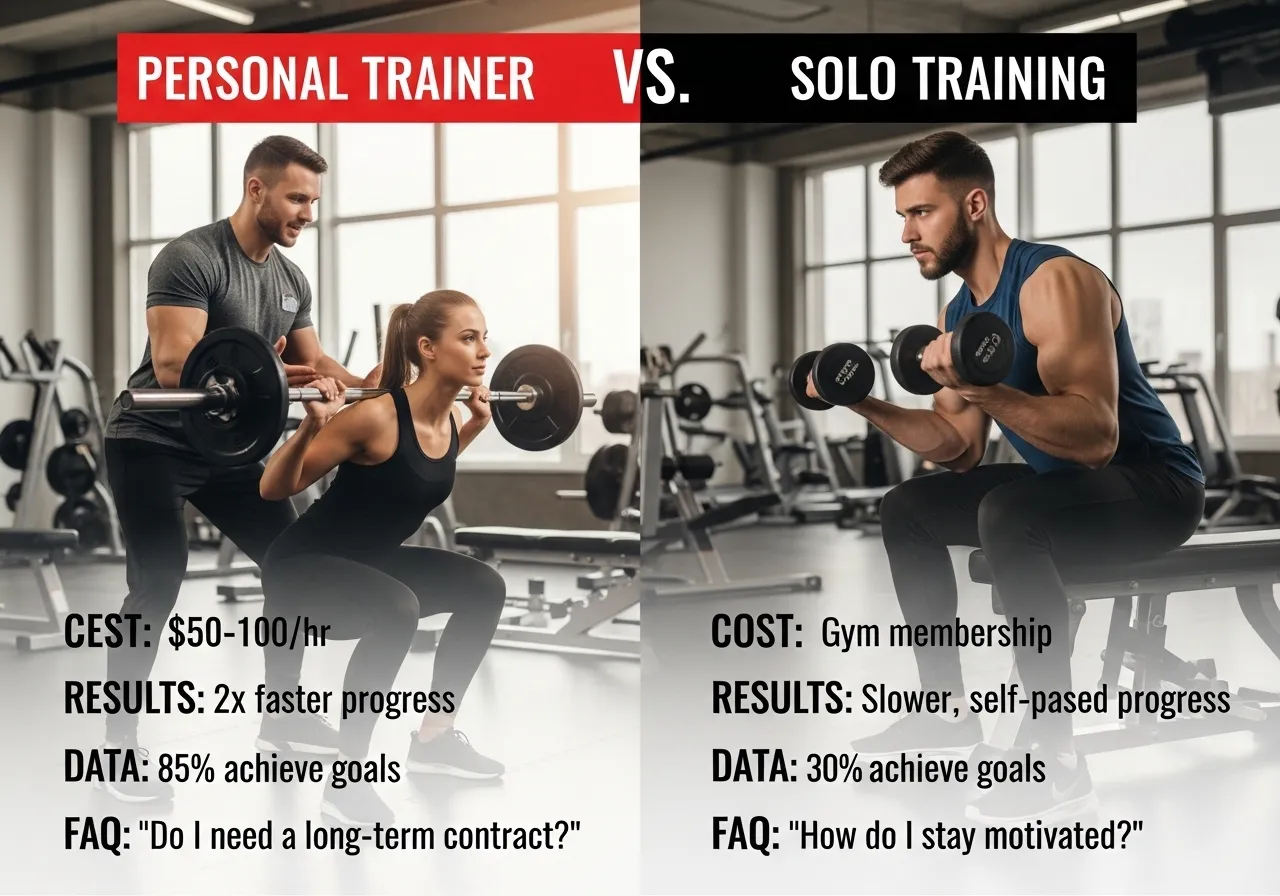
Real Costs, Results Data, and FAQ About Training Alone vs. With a Trainer
Making an informed decision about personal training requires honest information about what the research says about outcomes, what the realistic costs are across different training arrangements, and what the most common questions reveal about how athletes actually navigate this choice.
What the Research Actually Says About Training Outcomes
The research comparing personal training to self-directed training shows a consistent but contextually important pattern: beginners and individuals with accountability challenges show significantly better short-term outcomes (3-6 month improvements in strength, body composition, and adherence) with personal training; experienced, motivated, and exercise-literate individuals show equivalent long-term outcomes between personal training and structured self-directed programs. A 2014 meta-analysis in the Journal of Sports Sciences found that supervised resistance training produced greater strength gains than unsupervised training across studies — but the effect size was largest for novice populations and smallest for experienced trainees, supporting the beginner-focused value of personal training investment. The adherence data is similarly context-dependent: the accountability advantage of personal training produces better adherence for individuals with documented consistency challenges, but the intrinsic motivation, self-determination, and autonomy satisfaction of self-directed training produces equivalent or better adherence for individuals who are already consistently self-motivated. The honest interpretation: personal training provides its greatest measurable value for beginners and for individuals whose primary training challenge is consistency — and provides diminishing additional value relative to cost as training experience and self-management capability increase.
Frequently Asked Questions
Q: How long should I work with a personal trainer before going solo? A: For technique and program foundation, 3-6 months of regular personal training is sufficient for most individuals to develop the baseline competencies that self-directed training then builds on. The specific milestone to target before transitioning: the ability to execute the primary compound movements (squat, deadlift, press, row) with consistently good technique under moderate load, and the ability to describe why each element of the program is designed as it is — indicating sufficient program literacy for self-management. Q: Can I get good results training alone without any guidance? A: Yes, with a well-structured evidence-based program (not freestyle training without progression), deliberate technique self-assessment through video review, and consistent execution. The majority of advanced athletes were self-directed for the majority of their development. Q: Is online coaching worth it compared to in-person? A: For experienced trainees with established technique, online coaching provides equivalent program design value at significantly lower cost. For beginners who need real-time technique correction, the immediate feedback of in-person training justifies the higher cost during the technique development phase. Q: What is the most cost-effective path to serious fitness? A: 3-6 months of in-person personal training for foundation building, transitioning to an evidence-based training app or online coach at a fraction of the cost, with periodic one-time technique assessment sessions as needed. This hybrid approach extracts the highest-value elements of personal training at a cost that remains sustainable indefinitely. Q: How do I know if my personal trainer is worth the money? A: You are making measurable progress toward your specific goals (increasing training weights, changing body composition in the intended direction, improving movement quality); the trainer designs a structured program with clear progressive overload rather than random workout variety; and they can explain the purpose and progression logic of every element of your program when asked. If any of these criteria are not met after 8-12 weeks, the trainer is not delivering the professional service that the fee justifies. From NASM certified personal trainer program standards, qualified personal trainers should provide individualized assessment, goal-specific program design, and ongoing progress monitoring — the professional standard that distinguishes certified qualified trainers from the industry’s less qualified practitioners and justifies the premium investment that professional training commands.
Building a Sustainable Long-Term Training Practice
The ultimate measure of any training arrangement is whether it produces the long-term, consistent, progressive practice that the health and fitness benefits of exercise require to accumulate across decades. The research on exercise habits across the lifespan consistently identifies enjoyment, autonomy, and social connection as the three factors most strongly associated with sustained exercise participation into middle and older age — suggesting that the training arrangement that best preserves these three qualities for the individual athlete is the one most likely to produce the lifetime fitness that health outcomes depend on. Personal training serves the social connection and possibly the enjoyment factors; solo training serves the autonomy factor; and training partnerships can address all three simultaneously. The meta-conclusion of this entire analysis: there is no universally superior training arrangement, only the arrangement that best serves the specific individual’s motivational psychology, learning style, financial reality, and training phase. The intellectually honest recommendation is therefore not a blanket endorsement of either approach but an encouragement to honestly assess your own specific needs, try the arrangements that seem most appropriate, monitor the results honestly, and adjust based on what the evidence of your own experience reveals — rather than committing permanently to an approach based on cost alone, social pressure, or the marketing interests of the industry that profits from your choice.
Making the Decision: A Step-by-Step Framework
Synthesizing the analysis in this article into a practical decision framework: Step 1 — Assess your training experience. If you are a complete beginner with no established compound movement technique, prioritize at least 3-4 months of personal training or supervised instruction before going solo. Step 2 — Assess your consistency history. If previous unstructured training attempts have consistently failed to produce 3+ months of adherent practice, the accountability structure of personal training, group classes, or a training partner is addressing a genuine behavioral need — prioritize this before optimizing other variables. Step 3 — Assess your budget honestly. If regular personal training requires financial strain that is unsustainable beyond 3-6 months, the transition to lower-cost approaches is not a fitness compromise but a budget management imperative — plan it deliberately from the start rather than discovering it at the point of financial stress. Step 4 — Identify your specific gaps. If the gap is technique, personal training or online coaching addresses it directly. If the gap is program structure, a quality training app or evidence-based program resource addresses it at far lower cost. If the gap is motivation and consistency, training partners, group classes, or scheduled accountability systems address it without requiring the program design expertise that personal training uniquely provides. Step 5 — Commit to the chosen approach for a minimum of 12 weeks before evaluating. Neither approach delivers results in 4-6 weeks — the consistency across months that results require means the evaluation of whether an approach is working happens at 12-week intervals, not 4-week intervals. The athlete who follows this five-step process makes a genuinely informed, individually appropriate decision rather than the default choice that marketing, peer pressure, or financial convenience would otherwise produce.
