How Many Days a Week Should You Work Out?
⚠️ Disclaimer: The information in this article is for general educational purposes only and does not constitute medical, nutritional, or professional fitness advice. Individual results may vary. Always consult a qualified healthcare professional or certified fitness trainer before starting any new exercise program, changing your diet, or making decisions about injury treatment or recovery. If you experience pain, discomfort, or any unusual symptoms during exercise, stop immediately and seek professional guidance.

What the Research Actually Says About Training Frequency
The Core Science of Frequency and Adaptation
Training frequency — the number of workout sessions per week — is one of the most debated variables in exercise science, yet the research delivers a surprisingly clear picture once you understand the underlying mechanisms. The key driver of adaptation is muscle protein synthesis (MPS): after a resistance training session, MPS elevates for 24 to 48 hours before returning to baseline. If you train the same muscle group again within that elevated window, you stack another MPS spike on top of the first, compounding the anabolic stimulus. Training that same muscle group only once per week misses this opportunity entirely, leaving 5 to 6 days of recovery time where no new protein is being added to muscle fibers.
I trained six days a week for a year thinking more was always better — the research on frequency versus volume changed how I structured my programming completely.
A landmark meta-analysis published in the Journal of Strength and Conditioning Research examined 25 studies on training frequency and hypertrophy and found that training each muscle group twice per week produced 3.1 percent greater muscle growth than once per week at equal weekly volume. A smaller but consistent additional benefit was observed for three times per week versus twice per week. The conclusion: for most people with muscle building or body composition goals, training each muscle group at least twice weekly is the minimum productive approach.
Frequency vs. Volume: The Critical Distinction
Frequency and volume are frequently confused, but they are distinct variables with different effects on training outcomes. Volume refers to the total amount of work performed — sets multiplied by reps multiplied by load. Frequency refers to how often that work is performed. The research consistently shows that total weekly volume is the primary driver of adaptation, while frequency determines how that volume is distributed and therefore how effectively it can be recovered from and responded to.
This distinction matters enormously for program design. Someone doing 20 sets for the chest in a single weekly session can theoretically achieve the same hypertrophic stimulus as someone doing 10 sets twice per week — but the single-session approach produces far greater per-session fatigue, more severe delayed-onset muscle soreness, and a recovery demand that impairs the quality of other training sessions during the week. Distributing that same 20 sets across two sessions of 10 sets each maintains training quality in each session, reduces soreness, and allows other muscle groups to be trained effectively. This is why higher frequency — when total weekly volume is held constant — consistently produces better practical outcomes despite equivalent theoretical stimulus.
What “Training Frequency” Means in Practice
When exercise scientists discuss training frequency, they typically mean the number of times per week a specific muscle group is trained, not the total number of gym sessions. This distinction is critical for understanding frequency recommendations. A person who trains 6 days per week using a body part split — chest Monday, back Tuesday, shoulders Wednesday, and so on — is training each muscle group only once per week despite an apparently high training frequency. Conversely, a person training 3 full-body sessions per week is training each muscle group 3 times per week at a nominally lower session frequency. Research consistently favors the latter approach for muscle development outcomes at equivalent weekly volumes, because the distribution of stimulus across the week better matches the MPS response timeline.
The practical takeaway: when evaluating or designing a training program, count how often each major muscle group is trained per week, not just how many times you enter the gym. A 6-day body-part split that trains each muscle once weekly is a lower frequency program, by the research definition, than a 3-day full-body program.
The Minimum Effective Frequency for Different Goals
The minimum effective training frequency varies meaningfully by goal. For hypertrophy: 2 sessions per muscle group per week is the evidence-supported minimum for ongoing muscle development beyond the beginner stage. For strength: 2 to 3 sessions per week for the primary lifts (squat, deadlift, press) allows sufficient practice of the motor pattern and progressive loading to drive strength adaptation. For cardiovascular fitness: 3 sessions per week of moderate intensity is the minimum for meaningful VO2 max improvement according to the American College of Sports Medicine. For general health: 150 minutes per week of moderate-intensity activity — achievable in 3 sessions of 50 minutes or 5 sessions of 30 minutes — is the evidence-based minimum for cardiovascular and metabolic health benefits.
Understanding these minimums enables intelligent program design around life constraints. During busy periods, reducing frequency to the minimum effective dose for your primary goal preserves adaptation while accommodating real-world demands. During optimal periods, training above the minimum and approaching the optimal frequency produces faster progress. Oscillating between these two poles — rather than maintaining rigid frequency regardless of life circumstances — is both more sustainable and more effective over a training career than inflexible commitment to any single frequency.
How Training Frequency Affects Hormone Levels
Training frequency directly influences the hormonal environment that determines the rate of muscle building, fat loss, and recovery. Testosterone and growth hormone — the primary anabolic hormones — both respond to resistance training with acute elevations that promote muscle protein synthesis and fat mobilization. More frequent training sessions mean more frequent hormonal spikes, creating a more consistently anabolic hormonal environment throughout the week. However, this relationship has an important ceiling: when training frequency exceeds recovery capacity, cortisol — the primary catabolic hormone — becomes chronically elevated, creating the hormonal signature of overtraining that inhibits muscle development, promotes fat storage particularly in the abdominal region, and impairs immune function.
Research published in the Journal of Strength and Conditioning Research found that the optimal training frequency for maintaining the anabolic-to-catabolic hormone ratio is 4 to 5 resistance training sessions per week for most intermediate trainees — a frequency that produces multiple weekly testosterone and growth hormone surges while keeping cortisol from becoming chronically elevated. Above this frequency, without adequate nutrition and sleep to support recovery, the cortisol-to-testosterone ratio shifts unfavorably, explaining why some trainees who increase frequency see worse results than those who train at moderate frequency.
For fat loss specifically, the frequency effects on insulin sensitivity are significant. Each resistance training session improves insulin sensitivity for 24 to 48 hours following the session — the window during which glucose and amino acids are preferentially directed toward muscle glycogen replenishment and muscle protein synthesis rather than fat storage. More frequent training sessions maintain this insulin-sensitizing effect more continuously throughout the week, creating a metabolic environment that persistently favors lean tissue preservation and fat mobilization during a caloric deficit.
Frequency Myths That Waste Your Time
Several persistent myths about training frequency lead people to either train too much and burn out or too little and plateau unnecessarily. Myth 1: “More is always better.” False — the dose-response relationship between training frequency and adaptation follows an inverted U-curve: too little produces insufficient stimulus, the optimal range produces maximum adaptation, and too much exceeds recovery capacity and produces diminishing or negative returns. Myth 2: “You need to train every day to make real progress.” False for recreational trainees. Elite athletes train daily under professional supervision with optimized nutrition and recovery resources; recreational trainees without these supports see better results at 4 to 5 days per week. Myth 3: “You’ll lose all your gains if you miss a session.” False — missing a single session has no measurable effect on fitness adaptations. Missing weeks of training begins to produce measurable detraining; missing a single session produces nothing measurable except perhaps psychological guilt.
Finding What Works: The Experimental Mindset
The most important meta-skill in training frequency management is treating your training program as an ongoing experiment rather than a fixed prescription. Your body is unique, your life circumstances are unique, and the optimal training frequency for you will be discovered through systematic experimentation and honest assessment rather than by following any generic recommendation — including the evidence-based guidelines in this article. Use the research as a starting point and the principles as guardrails, but let your own data — performance trends, recovery quality, body composition changes, and how training makes you feel — be the ultimate arbiter of what works for you. The person who trains at 4 sessions per week consistently for 5 years while continually optimizing based on personal data will almost always develop better than the person who jumps between different prescriptions chasing the theoretically optimal frequency without building the sustained relationship with training that real progress requires.
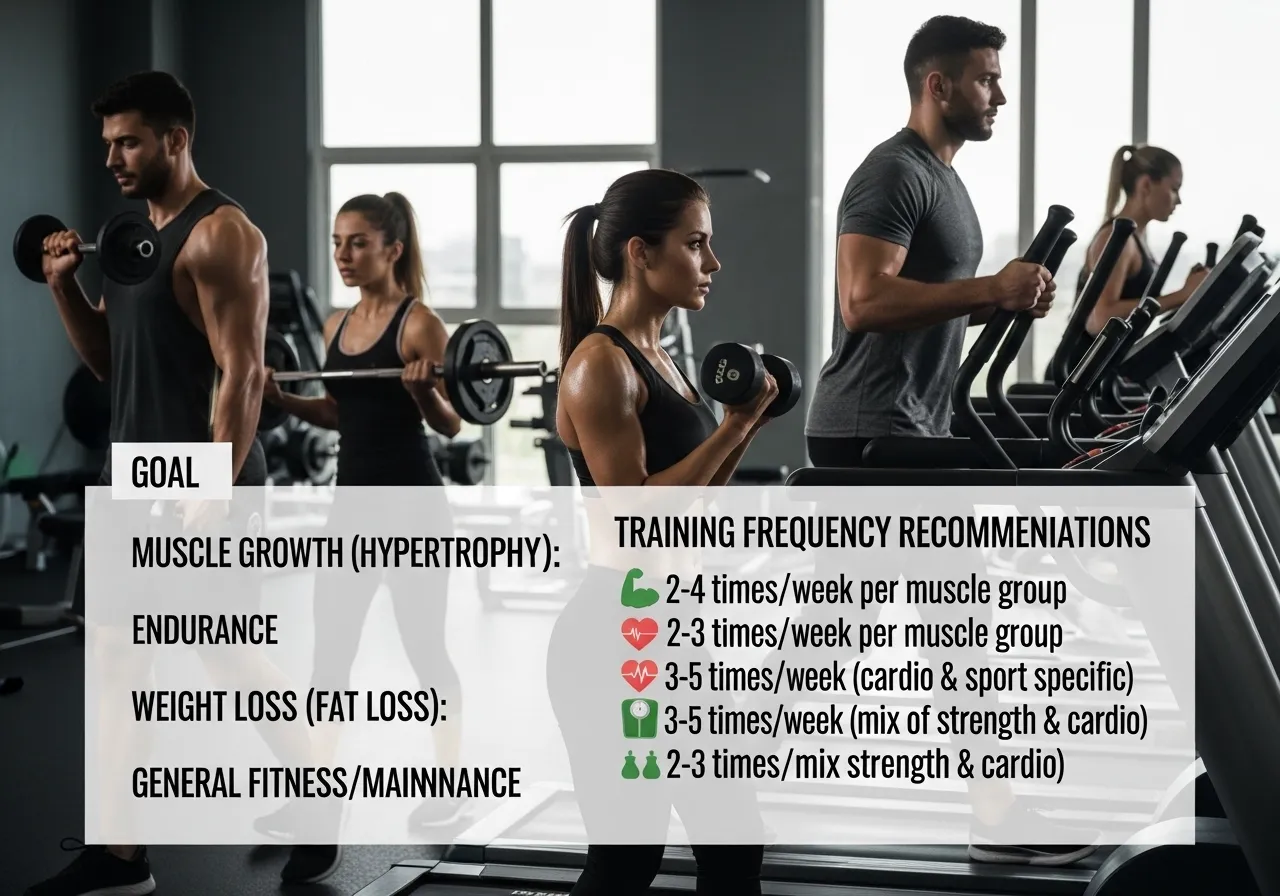
Training Frequency Recommendations by Goal
Frequency for Fat Loss and Body Composition
Fat loss goals are best supported by higher training frequency — 4 to 5 sessions per week — because daily or near-daily physical activity maintains elevated insulin sensitivity continuously, keeps the sympathetic nervous system activation associated with fat mobilization elevated throughout the week, and sustains the elevated resting metabolic rate that resistance training creates. Research from the Harvard T.H. Chan School of Public Health tracking over 10,000 adults found that physical activity frequency — independent of total weekly volume — was a significant predictor of long-term weight management, with daily activity associated with substantially lower weight regain over 2 years compared to equivalent volume concentrated in fewer sessions.
Matching my frequency to my actual goal rather than what I thought looked impressive on paper cut my training time by 30% and improved my results.
The optimal fat loss training structure combines resistance training (3 to 4 days per week, to preserve muscle mass and maintain resting metabolic rate) with cardiovascular training (2 to 3 days per week, to maximize total caloric expenditure and cardiovascular fitness). This combination, rather than exclusive cardio, produces superior fat loss outcomes because resistance training preserves the muscle mass that would otherwise be lost during caloric restriction — and every kilogram of muscle maintained during fat loss represents a permanently higher resting metabolic rate that makes long-term weight management dramatically easier.
Frequency for Muscle Building
For muscle hypertrophy, the evidence-based optimal frequency is 2 to 3 sessions per muscle group per week, achieved through 4 to 5 total training sessions using an upper-lower or push-pull-legs split. The upper-lower split — Monday and Thursday upper body, Tuesday and Friday lower body — is the most time-efficient structure for intermediate trainees, providing each major muscle group with exactly 2 weekly stimuli at 48 to 72 hours separation. For advanced trainees with the recovery capacity to handle higher volume, a push-pull-legs split performed twice weekly (6 sessions total) provides each muscle group with 2 sessions per week at higher total volume, representing the practical upper limit of productive natural training frequency for most people.
A critical nuance for muscle building frequency: the quality of each training session matters enormously. Six half-hearted sessions per week will not outperform 4 sessions performed at appropriate intensity with progressive overload. Before increasing frequency, ensure that current sessions are performed with sufficient challenge — reaching technical failure within the target rep range, applying progressive overload from session to session, and executing exercises with full range of motion. These quality factors produce more hypertrophic stimulus per session than any frequency adjustment.
Frequency for Strength Development
Strength development — increasing the maximum force output in specific movements — benefits from practice frequency in addition to the loading stimulus. Skill acquisition research demonstrates that motor pattern learning (the neurological component of strength improvement, particularly important for complex movements like the squat and deadlift) is enhanced by more frequent, shorter practice sessions compared to less frequent, longer sessions at equivalent total volume. This is why powerlifters who compete at elite levels often squat 4 to 6 days per week despite the heavy loads involved — the frequent practice consolidates the motor pattern in ways that less frequent training cannot replicate.
For recreational trainees focused on strength: 3 sessions per week of the primary lifts (squat, deadlift, and press) at varying intensities provides sufficient practice frequency for motor pattern development while allowing adequate recovery from the heavy loads involved. Daily undulating periodization — varying rep ranges and intensities across sessions within the week (e.g., heavy/5 reps Monday, moderate/8 reps Wednesday, volume/12 reps Friday) — is the evidence-based approach for maximizing strength gains at this frequency.
Frequency for Beginners vs. Experienced Trainees
Training experience is the single most important modifier of frequency recommendations. Beginners — typically defined as individuals with fewer than 6 months of consistent training — produce significant adaptation from as few as 2 sessions per week because any structured training stimulus is novel enough to drive adaptation. Starting at 3 sessions per week and spending 4 to 6 weeks at each frequency level before adding another session prevents the overwhelming soreness and injury risk that occurs when beginners attempt the frequencies appropriate for advanced trainees.
Experienced trainees have adapted to established frequency and require progressive increases in volume, intensity, or frequency to continue adapting. A person who has trained 3 days per week consistently for 2 years and plateaued may find that increasing to 4 or 5 days per week with appropriate volume distribution across the added sessions reignites adaptation that had stalled at the lower frequency. This progression — from beginner-appropriate 3 sessions to intermediate-appropriate 4 to 5 sessions to advanced-appropriate 5 to 6 sessions over years of training — mirrors the increasing training demands that ongoing adaptation requires.
Frequency for Specific Sports and Activities
Athletes whose primary performance goal involves a specific sport face frequency considerations that differ from general fitness trainees. The resistance training frequency that supports athletic performance must be balanced against the training demands of the sport itself — too much resistance training at the wrong time in the training cycle impairs sport performance by creating fatigue that reduces the speed, agility, and coordination the sport demands. During in-season competitive periods, 2 resistance training sessions per week — focused on maintaining strength developed during the off-season rather than building new strength — is the evidence-based standard for most team sports. During off-season periods, 4 to 5 sessions per week focused on building the physical qualities needed for the upcoming season produces the greatest performance development.
Special Case: Concurrent Training Frequency
Concurrent training — simultaneously pursuing strength and cardiovascular fitness goals — requires careful management of training frequency for both modalities to avoid the interference effect that impairs adaptation when both types of training are combined at high volumes. The interference effect is most pronounced when cardiovascular training is performed at high intensity immediately before or after resistance training, reducing the anabolic signaling pathways that drive muscle adaptation. Moderate-intensity cardiovascular training performed on separate days from resistance training, or at low enough intensity to avoid significant muscle damage, produces minimal interference with resistance training adaptation.
For concurrent trainees, the practical frequency guidance is: schedule resistance training and high-intensity cardiovascular training on separate days when possible. When both must occur on the same day, always perform resistance training first and cardiovascular training after, never before. Moderate-intensity cardio (walking, light cycling) can be performed on any day, including immediately after resistance training, without meaningful interference. The maximum productive concurrent training frequency that avoids significant interference is 3 to 4 resistance sessions plus 3 to 4 cardiovascular sessions per week — a 6 to 8 session weekly total that requires careful distribution to provide adequate recovery for each modality.
The Effect of Exercise Type on Optimal Frequency
Different exercise types have different recovery demands, and therefore different optimal frequencies. Bodyweight exercises — push-ups, pull-ups, squats — produce moderate muscle damage and can typically be trained daily at moderate intensities without overtraining. Heavy compound lifts — deadlifts, squats, bench press at high percentages of maximum — produce significant systemic fatigue and require 48 to 72 hours of recovery before the same pattern can be trained again productively. High-impact cardiovascular training — sprinting, jump training, intense interval work — produces significant mechanical stress on tendons and joints that requires 48 to 72 hours recovery between sessions. Low-impact cardiovascular training — swimming, cycling, walking — can be performed daily without meaningful recovery cost. Understanding these recovery profiles allows training frequency to be calibrated by exercise type rather than treating all training as equivalent.

Signs You Are Training Too Much or Too Little
The Overtraining Warning Signs
Overtraining — the chronic accumulation of training stress that exceeds recovery capacity — produces a characteristic and recognizable symptom cluster. Performance decline across multiple consecutive sessions is the most reliable indicator: if strength or endurance consistently decreases over 3 or more sessions despite adequate sleep and nutrition, training frequency or volume has exceeded what the body can recover from. Persistent fatigue that does not resolve after a full night’s sleep, elevated resting heart rate of 5 or more beats per minute above established personal baseline, increased susceptibility to upper respiratory illness (reflecting immune suppression from chronically elevated cortisol), and mood disturbances including unusual irritability, anxiety, or depression are additional hallmarks of genuine overtraining.
Recognizing the signs of overtraining in myself — elevated resting heart rate, persistent mood changes, stalled lifts — came too late the first time, but I caught it early every time after.
The most important behavioral response to these signs is immediate and meaningful reduction in training frequency and intensity — not a single rest day but a full week of reduced-volume, low-intensity training followed by gradual return. Attempting to push through overtraining with willpower accelerates the deterioration, extends the recovery timeline, and increases injury risk. Research published in Sports Medicine found that full recovery from overreaching syndrome requires 2 to 6 weeks of dramatically reduced training, making the prevention of overtraining far more cost-effective than its treatment.
Signs of Insufficient Training Frequency
Insufficient training frequency produces its own characteristic signs that are subtler than overtraining but equally important to recognize. A persistent performance plateau — no measurable improvement in strength, endurance, or body composition over 4 to 6 weeks despite consistent training — often reflects insufficient training volume or frequency rather than a true physiological ceiling. If training intensity and nutrition are adequate, this plateau signals that the training stimulus is being fully recovered from between sessions without producing ongoing adaptation — the body’s way of communicating that more stimulus is needed.
Other signs of insufficient frequency include arriving at each session feeling completely fresh with no residual training fatigue (suggesting the previous session’s stimulus was too low to require meaningful adaptation), rapid detraining between sessions (noticeably worse performance at the beginning of each session compared to the end of the previous one), and the absence of the progressive DOMS reduction that should occur as the body adapts to a consistent training stimulus.
The Goldilocks Zone: Finding Your Personal Optimal
The optimal training frequency is the highest frequency you can sustain while maintaining performance quality, adequate recovery between sessions, and consistent progressive overload over weeks and months. Finding this zone requires systematic experimentation: start at a conservative frequency, track performance and recovery metrics for 4 weeks, increase frequency by one session for the next 4 weeks, and compare results. Continue this process until performance begins declining despite adequate sleep and nutrition — the frequency just below this threshold is your current optimal.
This optimal frequency changes over time. As fitness improves, recovery capacity typically increases, allowing higher frequencies. During periods of high non-training stress — demanding work, family pressures, illness — recovery capacity decreases, and optimal frequency temporarily drops. Treating training frequency as a dynamic variable that responds to changing life circumstances, rather than a fixed commitment that must be maintained regardless of conditions, produces better long-term outcomes and prevents the burnout that rigid frequency adherence can create.
When to Take a Complete Rest Week
A complete rest week — 7 days with no structured training, only light daily walking — is sometimes the most productive training decision available. Situations that warrant a complete rest week: after completing a peaking phase before a competition or fitness test, after 3 or more consecutive weeks of poor sleep combined with high training volume, when multiple overtraining symptoms are present simultaneously, or at the end of a 3 to 4 month training block as a planned recovery period. The physiological response to a complete rest week is not detraining but supercompensation — the body, freed from the accumulated fatigue that has been masking its adaptation, temporarily exceeds its pre-rest performance baseline in the first sessions following the break.
The most common reason trainees avoid complete rest weeks is the fear of losing fitness. This fear is understandable but largely unfounded: meaningful detraining — measurable loss of the cardiovascular and strength adaptations developed through training — requires 2 to 3 weeks of complete inactivity. A single week of rest produces no measurable fitness loss and often produces performance improvements in the week following the rest due to the supercompensation effect. Understanding this physiology removes the psychological barrier to taking rest weeks when the body genuinely needs them.

How to Structure Your Training Week
The 3-Day Full Body Structure
The 3-day full body training structure — training all major muscle groups in each of three weekly sessions — is the most efficient approach for beginners, time-constrained trainees, and those returning to training after a break. Monday, Wednesday, Friday or Tuesday, Thursday, Saturday are the most common 3-day structures, providing 48 hours of recovery between sessions. Each session follows a consistent template: one compound lower body movement (squat or hip hinge), one compound upper body push movement, one compound upper body pull movement, and a core exercise. Performed for 3 to 4 sets of 8 to 12 repetitions, this structure delivers a complete stimulus for all major muscle groups in 45 to 60 minutes per session.
Building my week around the gym sessions first, then fitting everything else around them, made consistency almost automatic compared to fitting workouts into leftover time.
The 3-day full body structure trains each muscle group 3 times per week — above the minimum effective frequency of 2 — making it significantly more effective for hypertrophy than the body-part splits that are often recommended for beginners. Its simplicity and flexibility (the same template works at all intensity levels and can be performed with any equipment) make it the most durable long-term structure available, capable of producing meaningful results from beginner to advanced levels with appropriate load and exercise progression.
The 4-Day Upper-Lower Split
The 4-day upper-lower split is the sweet spot for most recreational trainees with intermediate experience — it provides each muscle group with 2 weekly training sessions, distributes volume across 4 manageable sessions, fits easily into typical work schedules, and allows a full weekend recovery day when structured Monday through Friday. The canonical structure: Monday upper body, Tuesday lower body, Thursday upper body, Friday lower body. Each session focuses exclusively on the relevant muscle groups with sufficient volume (3 to 5 sets per exercise, 3 to 4 exercises per muscle group) to drive meaningful adaptation without the total-session fatigue of trying to train everything in one session.
Upper body sessions typically include horizontal push (bench press or dumbbell press), horizontal pull (row), vertical push (overhead press), and vertical pull (pull-up or lat pulldown) as the primary compound exercises, with isolation work for arms and rear deltoids added afterward. Lower body sessions include the squat pattern (back squat, goblet squat, or leg press), hip hinge pattern (Romanian deadlift or conventional deadlift), a unilateral exercise (split squat or lunge), and calf and core work. This balanced structure develops all major muscle groups proportionally and prevents the imbalances that specialization-heavy programs create over time.
The 5 and 6-Day Push-Pull-Legs Split
The push-pull-legs (PPL) split organizes training by movement pattern: push days (chest, shoulders, triceps), pull days (back, biceps), and leg days (quads, hamstrings, glutes, calves). When performed twice per week — push, pull, legs, push, pull, legs over 6 days — each muscle group is trained twice weekly with approximately 48 to 72 hours between same-muscle sessions. This structure provides the highest weekly training volume of any standard split while maintaining the 2-times-per-week muscle group frequency that the research supports as optimal for most trainees.
The PPL split is appropriate for advanced trainees with established recovery capacity, sufficient sleep and nutrition to support 5 to 6 sessions per week, and the scheduling flexibility to train 5 to 6 days consistently. Sessions must be shorter (45 to 60 minutes) than full-body sessions because the daily training frequency requires each session’s recovery cost to be modest enough to allow the next day’s session at full quality. This means per-session volume is lower than in less frequent programs — the frequency provides the additional stimulus, not excessive single-session volume.
Distributing Cardio Within the Training Week
Cardiovascular training placement within the training week significantly affects the quality of resistance training sessions. Performing intense cardiovascular exercise immediately before resistance training reduces subsequent strength output by 5 to 15 percent — the interference effect caused by residual fatigue and glycogen depletion. For people who train both modalities, the optimal structure places resistance training before cardiovascular training in the same session, or schedules them on separate days with at least 6 hours between sessions. Moderate-intensity cardiovascular exercise (walking, light cycling) on resistance training rest days serves as active recovery without creating meaningful interference.
For people whose primary goal is fat loss — where cardiovascular training is important for caloric expenditure — the practical compromise is scheduling 2 to 3 moderate cardiovascular sessions on non-resistance training days, using resistance training days exclusively for resistance work. This separation of modalities prevents the interference effect while maintaining the cardiovascular stimulus needed for fat loss and cardiovascular health goals.
Deload Weeks and Planned Recovery
Every training frequency structure requires periodic planned reduction to prevent the accumulated fatigue that leads to overtraining, injury, and psychological burnout. A deload week — reducing training volume by 40 to 50 percent and intensity by 20 to 30 percent — every 6 to 8 weeks allows the structural adaptations initiated during the training block to consolidate, connective tissue to recover from accumulated stress, and the nervous system to reset from the chronic fatigue that high-frequency training produces. Most experienced trainees find that performance in the week immediately following a deload exceeds pre-deload levels — the supercompensation effect where the recovered body temporarily surpasses its previous baseline.
The Role of Non-Exercise Activity in Total Weekly Movement
Non-exercise activity thermogenesis (NEAT) — the calories burned through all physical activity outside of structured exercise, including walking, fidgeting, standing, and daily movement — can vary by 1,000 to 2,000 calories per day between individuals and is one of the most underappreciated variables in both fitness and weight management. People who are highly active outside of structured exercise sessions — who walk to work, take stairs, stand while working, and move frequently throughout the day — have fundamentally different total weekly movement profiles than sedentary individuals even if both attend the gym the same number of times per week.
For training frequency planning, the implication is that highly sedentary people may benefit more from increasing NEAT through daily habit changes (walking more, standing more, taking stairs) than from adding a fourth structured training session. Conversely, very active people who work physical jobs or have high daily movement already have significant weekly training volume from NEAT that should factor into structured training frequency decisions — adding 5 structured sessions per week on top of an already physically demanding daily life may exceed recovery capacity even if 5 structured sessions would be appropriate for a sedentary desk worker.
Using Periodization to Manage Frequency Over the Year
Annual periodization — planned variation in training frequency, volume, and intensity across the year — prevents the accommodation and burnout that fixed training frequency produces over 12 months of continuous training. A simple annual periodization approach for recreational trainees: two higher-frequency blocks (5 sessions per week, 8 to 10 weeks each) during periods of lower life demand when recovery resources are most available, separated by lower-frequency maintenance phases (3 sessions per week, 4 to 6 weeks) during higher-demand periods. This deliberate variation maintains the training habit through demanding life phases while capitalizing on lower-demand phases to accelerate fitness development. The total annual training volume across this periodized structure is often higher than a fixed moderate frequency, because the maintenance phases prevent the burnout that causes many fixed-frequency trainees to take involuntary extended breaks.

Adjusting Frequency for Life Phases and Circumstances
Training Through High-Stress Periods
Psychological stress consumes recovery resources through the same physiological pathways as physical training stress — elevated cortisol, sympathetic nervous system activation, disrupted sleep, and reduced nutrient partitioning efficiency. During genuinely high-stress life periods — demanding work projects, family illness, relationship upheaval, financial pressure — the body’s total recovery capacity is partly redirected to managing the psychological stress load, leaving less available for training adaptation. Maintaining normal training frequency during these periods produces the same outcome as overtraining: accumulated fatigue, declining performance, and eventually forced rest or illness.
Dropping to two sessions a week during a particularly demanding work period felt like failure, but maintaining the habit at lower frequency meant I never had to restart.
The evidence-based approach to training during high-stress periods is to reduce frequency to the minimum effective dose (2 to 3 sessions per week) while maintaining intensity and focusing on the exercises most important for preserving existing fitness. This approach preserves the genuine psychological benefits of exercise — which are particularly valuable during stressful periods — without creating the additional physical stress that a full training program would impose. Research published in Sports Medicine consistently supports moderate exercise as a stress management intervention, with the strongest evidence for 20 to 30 minutes of moderate-intensity cardiovascular exercise 3 times per week as the optimal dose for psychological stress reduction.
Training Frequency and Aging
Recovery capacity generally declines with age due to reduced anabolic hormone concentrations (testosterone and growth hormone decline progressively from the mid-20s), slower protein synthesis rates per session, and accumulated connective tissue changes that require more conservative loading progressions. These changes do not mean older adults should train less — the health benefits of resistance training become more important, not less, as age-related muscle loss (sarcopenia) and bone density reduction accelerate after 50. They mean that training frequency must be paired with more deliberate recovery management: longer rest intervals between working sets, 48 to 72 hours between sessions targeting the same muscle groups (compared to 24 to 48 for younger trainees), more frequent deload weeks, and greater attention to sleep, nutrition, and mobility work that supports recovery.
Training Frequency During Fat Loss Phases
Caloric restriction — the dietary component of fat loss — reduces the energy and recovery resources available for training adaptation. Muscle protein synthesis rates decrease in a caloric deficit, recovery from training takes longer, and the anabolic hormonal response to resistance training is blunted relative to caloric maintenance. For these reasons, attempting to maintain the highest training frequency during a meaningful caloric deficit frequently results in accumulated fatigue, performance decline, and compromised fat loss. The optimal frequency during fat loss phases is typically 3 to 4 resistance training sessions per week — sufficient to provide the muscle-preserving stimulus of resistance training — supplemented by 2 to 3 moderate cardiovascular sessions for additional caloric expenditure.
Pregnancy and Postpartum Training Frequency
Exercise during pregnancy and the postpartum period requires individualized guidance, but general frequency principles remain applicable with appropriate modifications. During uncomplicated pregnancies, maintaining pre-pregnancy training frequency at progressively reduced intensity is generally safe and beneficial, with the first trimester typically allowing continuation of existing programs and the second and third trimesters requiring exercise selection modifications as the center of gravity shifts and joint laxity increases. Postpartum return to training should begin gradually — typically 6 to 8 weeks after delivery for low-impact activity, longer for more intense exercise — starting at 2 sessions per week and increasing frequency only as recovery allows, guided by the absence of pain, bleeding, or pressure symptoms that indicate the pelvic floor and abdominal wall are not ready for higher loading.
Nutrition Periodization to Match Training Frequency
Total weekly caloric and macronutrient intake should be periodized to match training frequency and intensity variation across the week — a practice called nutritional periodization that improves body composition outcomes compared to uniform daily nutrition regardless of training demands. On high-intensity training days, carbohydrate intake should be higher (4 to 5 grams per kilogram of bodyweight) to fuel performance and maximize glycogen replenishment. On low-intensity active recovery days, carbohydrate intake can be lower (2 to 3 grams per kilogram) while fat intake is relatively higher, supporting fat oxidation during lower-intensity activity without the glycogen demands of hard training. Protein intake should remain consistently high (1.8 to 2.2 grams per kilogram) regardless of training day intensity, as muscle protein synthesis requires consistent amino acid availability throughout the week.
This nutritional periodization approach requires more planning than uniform daily eating but is practical when the weekly training schedule is consistent enough to plan meals around. For people with highly variable training schedules, a simpler approach is to eat more on the days following hard training sessions (when recovery and glycogen replenishment needs are highest) and less on rest days — a practical approximation of nutritional periodization that captures most of its benefits without requiring rigid daily meal planning.
Recovery Foods That Support Higher Training Frequency
The ability to maintain higher training frequency depends significantly on the quality and timing of post-workout nutrition. Tart cherry juice — containing high concentrations of anthocyanins with anti-inflammatory properties — has been shown in multiple studies to reduce DOMS severity by 20 to 30 percent when consumed twice daily during intense training periods, effectively reducing the recovery time between sessions and supporting higher training frequency. Fatty fish (salmon, sardines, mackerel) consumed 3 to 4 times per week provides the omega-3 fatty acids EPA and DHA that reduce exercise-induced inflammation and accelerate muscle repair — with research showing that regular omega-3 consumption reduces muscle soreness and recovery time sufficiently to support one additional training session per week compared to low omega-3 intake. Whole food sources of magnesium — dark leafy greens, nuts, seeds, dark chocolate — support muscle relaxation and sleep quality that is essential for recovery between frequent training sessions.
Adequate total caloric intake is the most fundamental nutritional requirement for high training frequency. Training in a large caloric deficit (greater than 700 calories below maintenance) significantly impairs recovery capacity, making frequencies that would be productive at maintenance unsustainable during aggressive fat loss phases. If maintaining higher training frequency is a priority — for athletic performance or training habit reasons — moderating the caloric deficit to 300 to 500 calories below maintenance rather than pursuing more aggressive deficits preserves the recovery capacity needed for frequency without sacrificing meaningful fat loss progress.

Rest Days and Active Recovery
The Physiology of Rest Days
Rest days are not idle time — they are the days when training-induced adaptations actually occur. Muscle protein synthesis, which is elevated for 24 to 48 hours following resistance training, operates most efficiently during rest days when the metabolic resources that would be redirected to fueling exercise are instead fully available for tissue repair and remodeling. Growth hormone secretion peaks during deep sleep on rest days, driving the protein synthesis and fat mobilization that collectively produce the body composition changes training is designed to create. Glycogen stores are replenished, connective tissue undergoes repair and strengthening, and the nervous system recovers the capacity for maximal force production that heavy training temporarily reduces.
I used to treat rest days as wasted days until I understood that adaptation happens during recovery — now I protect them as deliberately as I protect training sessions.
Understanding rest days as productive physiological periods — not as wasted training time — is one of the most important mindset shifts for people serious about training outcomes. The trainee who views rest days as opportunities for recovery and adaptation will protect them as carefully as training days; the trainee who views them as lazy intervals to be minimized will chronically undertrain by overtraining, accumulating fatigue that prevents the adaptations they are training for.
Active Recovery vs. Complete Rest
Active recovery — performing low-intensity physical activity on designated rest days — consistently produces better training outcomes than complete passive rest by maintaining blood flow to recovering muscles, accelerating metabolite clearance, preserving joint mobility, and providing the neurochemical benefits of physical activity without meaningful training stress. A 30 to 45-minute walk, gentle swimming, easy cycling, or yoga performed at 40 to 60 percent of maximum heart rate serves this purpose effectively. The key is genuine low intensity: activities that feel effortless and produce only mild increases in breathing rate, not activities that simply avoid weights but still create significant cardiovascular or muscular stress.
Complete rest — no physical activity whatsoever — is appropriate following illness, after periods of genuine overtraining, and during full deload weeks when the goal is maximum nervous system recovery. For normal rest days between productive training sessions, active recovery is superior to complete rest for most people with intact health and adequate sleep, because the mild increase in blood flow and movement quality it provides meaningfully accelerates the recovery process without adding training stress.
Sleep as the Foundation of Recovery
Sleep quality and duration is the single most impactful recovery variable for training adaptation, and the one most frequently compromised by the same busy schedules that challenge training consistency. Research consistently shows that 7 to 9 hours of sleep produces dramatically superior muscle protein synthesis, anabolic hormone concentrations, and next-session performance compared to 5 to 6 hours — with the difference being large enough that a person sleeping 8 hours and training 4 days per week will outperform a person sleeping 6 hours and training 6 days per week over most measurable training outcomes. If training frequency must be reduced to protect sleep duration, that trade-off unambiguously favors sleep.
Nutrition on Rest Days
Nutritional requirements on rest days differ from training days in ways that affect body composition outcomes when managed deliberately. Protein intake should remain consistent on rest days — 1.6 to 2.2 grams per kilogram of bodyweight — because muscle protein synthesis continues on rest days and adequate amino acid availability is required for the repair processes initiated during training. Carbohydrate intake can be modestly reduced on complete rest days (as glycogen replenishment demand is lower without training), with the reduction compensated by slightly higher fat intake to maintain total caloric intake at the appropriate level for the current goal. This approach — sometimes called carbohydrate cycling — maintains the protein and caloric requirements for recovery while modestly improving insulin sensitivity on non-training days.
Building Gym Community Around Your Training Frequency
Training at consistent times creates the conditions for building a gym community — relationships with other regular trainees who share similar schedules and training times. These community relationships are among the most powerful adherence mechanisms available, providing social accountability, workout partners, shared knowledge, and the sense of belonging that makes training genuinely enjoyable rather than merely productive. Research on exercise adherence consistently finds that having social connections within a training environment significantly increases long-term participation rates — the gym friends who expect to see you at 7am on Monday, Wednesday, and Friday are a more reliable motivation source than any internal resolve on low-motivation mornings.
For home trainers or those without regular gym social connections, online fitness communities provide much of the same social accountability benefit. Fitness tracking apps with social features, online accountability groups, and virtual training partners who share progress and hold each other to training frequency commitments produce measurable improvements in adherence that replicate many of the in-person community benefits. The specific platform matters less than the genuine social commitment it creates — knowing that someone will notice if you miss your scheduled sessions is a psychological accountability tool that works regardless of whether that accountability is provided in person or digitally.
Technology Tools for Frequency Management
Several technology tools provide objective data that improves training frequency management beyond what subjective self-assessment can achieve. Wearable fitness trackers that monitor heart rate variability, resting heart rate, sleep stages, and respiratory rate provide the objective recovery data that enables day-to-day frequency decisions based on physiological readiness rather than scheduled obligation or fluctuating motivation. Apps like Whoop, Garmin Body Battery, and Apple Watch Recovery Score aggregate multiple biometric signals into practical recovery recommendations that have been validated against performance outcomes in research settings.
Training logging apps — from simple spreadsheets to dedicated platforms like Strong, Hevy, or MyFitnessPal — provide the historical data needed to identify patterns in training quality across different frequencies and recovery conditions. Reviewing 4 to 6 weeks of training logs reveals whether Monday sessions (after weekend recovery) consistently outperform Thursday sessions (after accumulated mid-week fatigue), whether certain training frequencies are associated with more sick days or joint complaints, and whether performance trends are positive or negative over time. This data-informed approach to frequency management produces consistently better outcomes than intuition-based training decisions.

Building Your Personalized Training Frequency Plan
The Self-Assessment Framework
Choosing the right training frequency begins with an honest assessment of four variables: your primary fitness goal (fat loss, muscle building, strength, endurance, or general health), your current training experience level (beginner, intermediate, or advanced), your available time and scheduling constraints, and your current recovery capacity (assessed through sleep quality, non-training stress level, and nutritional adequacy). These variables together determine the appropriate starting frequency, which should be implemented consistently for 4 to 6 weeks before any evaluation or adjustment.
The frequency plan that works is the one you can actually sustain — I’ve tried every configuration and the one that fits your life is always better than the theoretically optimal one.
The most common mistake in frequency selection is choosing aspirationally rather than realistically — selecting the frequency that fits the ideal schedule rather than the actual schedule, or choosing based on what seems like enough effort rather than what the evidence supports for the stated goal. Aspirational frequency selection produces the cycle of ambitious planning, inconsistent execution, and guilt-driven restart that characterizes the training approach of most people who fail to make long-term progress. Realistic frequency selection produces consistent execution, measurable progress, and the confidence that comes from reliably following through on training commitments.
The 4-Week Trial Protocol
Whatever frequency is selected based on the self-assessment, commit fully to it for exactly 4 weeks — the minimum duration needed to produce meaningful adaptation data and establish whether the frequency is sustainable within current life circumstances. During this trial period, track training performance (weights, reps, and sets for each session), recovery quality (subjective energy score from 1 to 10 on waking each day), and consistency (sessions completed versus planned). These three data streams together reveal whether the chosen frequency is appropriate: improving performance with high recovery scores and full consistency suggests the frequency is appropriate or could be increased; declining performance or poor recovery scores suggest the frequency is too high; consistently skipped sessions suggest the frequency is incompatible with current life circumstances and needs reduction.
Progressive Frequency Development Over Time
Training frequency is not a fixed prescription but a variable that should develop progressively over the course of a training career as fitness, recovery capacity, and time management efficiency improve. A realistic long-term frequency progression: months 1 to 3 at 3 sessions per week; months 4 to 6 at 3 to 4 sessions; months 7 to 12 at 4 sessions; years 2 to 3 at 4 to 5 sessions; year 3 and beyond at 5 to 6 sessions with planned deload weeks every 6 to 8 weeks. Each step in this progression should be driven by genuine adaptation (progress plateauing at the current frequency) rather than impatience or comparison to others.
Sample Weekly Structures for Each Frequency
3 Days Per Week: Monday full body resistance (45 min), Wednesday cardio or active recovery (30 min), Friday full body resistance (45 min). Each resistance session: 1 squat pattern, 1 hip hinge, 1 horizontal push, 1 horizontal pull, 1 core exercise. 3 to 4 sets × 8 to 12 reps each.
4 Days Per Week: Monday upper body (push + pull, 45 min), Tuesday lower body (squat + hinge + single leg, 50 min), Thursday upper body (45 min), Friday lower body (50 min). Each session focuses on its muscle groups with 3 to 4 exercises at 3 to 5 sets each.
5 Days Per Week: Monday push (chest, shoulders, triceps), Tuesday pull (back, biceps), Wednesday lower body, Thursday push (alternate exercises), Friday pull or full body. Saturday active recovery or sport. The fifth session can also be used for an additional cardiovascular session if fat loss is the primary goal.
FAQ: Common Training Frequency Questions
Is it OK to work out every day?
Yes, if intensity is appropriately varied. Daily training is sustainable when high-intensity sessions alternate with active recovery days and mobility work. The problem is daily high-intensity training without variation, not daily activity itself. Olympic athletes train daily throughout their competitive careers — but with sophisticated intensity periodization that prevents chronic fatigue accumulation.
Can I build muscle with 3 days per week?
Absolutely. Three full-body sessions per week training each major muscle group at adequate intensity and volume produces meaningful hypertrophy for beginners and intermediate trainees. Most people reach their first 1 to 2 years of fitness goals on a 3-day program. Increasing to 4 to 5 sessions becomes beneficial when adaptation from the current frequency has plateaued and additional volume is needed to continue progress.
How do I know if I need to add a training day?
Add a training day when progress has stalled for 4 to 6 weeks at the current frequency, total daily protein and caloric targets are being consistently met, sleep is averaging 7 or more hours nightly, and you have identified a specific time slot that can accommodate the additional session reliably. If any of these conditions are not met, the stall is more likely due to nutrition, sleep, or programming issues than insufficient frequency.
Tracking Progress Across Different Training Frequencies
When experimenting with different training frequencies to find your optimal, tracking must be sufficiently comprehensive to capture changes in all relevant outcome measures. Tracking only body weight or only strength metrics will miss important signals that other metrics would reveal. A complete tracking protocol for frequency optimization: strength benchmarks (squat, deadlift, press — tested every 4 to 6 weeks), body measurements (waist, chest, arms, thighs — monthly), cardiovascular fitness (1.5km run time or step test — monthly), recovery metrics (resting heart rate, subjective energy, sleep quality — weekly), and performance in training sessions (completion rate, set quality, session energy — every session). This multi-metric tracking approach reveals whether a given training frequency is producing the combined outcomes of strength development, body composition improvement, and maintained recovery quality that define an optimal frequency for a specific individual.
The tracking data becomes most valuable when reviewed at 4 to 6 week intervals with a specific question in mind: are all metrics trending in the desired direction, or are any declining in ways that signal inadequate recovery or insufficient training stimulus? Declining strength with maintained body composition suggests volume may be too low. Improving strength with declining recovery metrics suggests frequency may be too high relative to current recovery capacity. All metrics trending positively together confirms the current frequency is optimal — a confirmation worth celebrating and maintaining until circumstances change.
Long-Term Frequency Management: A 2-Year Roadmap
Building from beginner to advanced training frequency over 2 years requires deliberate progression and honest self-assessment at each stage. Year 1, Phase 1 (months 1 to 3): 3 full-body sessions per week, focus on movement quality and habit formation, no flexibility required in schedule. Year 1, Phase 2 (months 4 to 6): 4 sessions per week (upper-lower split), introduce planned deload weeks every 8 weeks, begin tracking recovery metrics. Year 1, Phase 3 (months 7 to 12): 4 to 5 sessions per week, experiment with split training, develop the nutritional habits that support higher frequency. Year 2, Phase 1 (months 13 to 18): 5 sessions per week with deliberate intensity periodization, annual frequency variation plan, comprehensive tracking system. Year 2, Phase 2 (months 19 to 24): 5 to 6 sessions per week during peak phases, 3 to 4 during maintenance phases, full integration of frequency, volume, intensity, and nutrition periodization.
This 2-year roadmap produces an advanced recreational trainee with the training frequency, programming sophistication, and recovery management skills to continue developing for years beyond year 2 — not through more dramatic frequency increases, but through the progressive refinement of quality, intensity, and periodization within the 5 to 6 session framework that represents the practical upper limit for most non-professional athletes. The patience required to follow this progression timeline — resisting the urge to jump to advanced frequencies prematurely — is itself a trainable quality that develops alongside the physical adaptations of the training.