The Best Ab Workout for a Flat Stomach
⚠️ Disclaimer: The information in this article is for general educational purposes only and does not constitute medical, nutritional, or professional fitness advice. Individual results may vary. Always consult a qualified healthcare professional or certified fitness trainer before starting any new exercise program, changing your diet, or making decisions about injury treatment or recovery. If you experience pain, discomfort, or any unusual symptoms during exercise, stop immediately and seek professional guidance.

The Truth About Abs and Stomach Fat
Why Spot Reduction Is a Myth
The single most important thing I can tell you about getting a flat stomach is also the thing most people resist hearing: you cannot selectively reduce fat from your abdominal region by performing ab exercises. This concept — spot reduction — is one of the most persistent myths in fitness, and the industry has exploited it relentlessly to sell ab machines, waist trainers, and targeted abdominal programs that promise results the physiology cannot deliver. Understanding why spot reduction is physiologically impossible reorients your entire approach to flat stomach training and makes your efforts dramatically more effective.
I did 500 crunches a day for three months and my stomach looked exactly the same — understanding that abs are made in the kitchen, not on the floor, was my real starting point.
Fat mobilization — the process of releasing stored triglycerides from fat cells for use as energy — is regulated systemically by hormones, particularly catecholamines (adrenaline and noradrenaline) that circulate throughout the bloodstream. When you perform an ab exercise, catecholamines are released and bind to fat cell receptors throughout the entire body — not preferentially in the abdominal region. The fat that gets mobilized comes from wherever the body’s genetic programming dictates, not from the muscles being exercised. A study published in the Journal of Strength and Conditioning Research confirmed that 6 weeks of targeted abdominal exercise produced no greater reduction in abdominal fat than a control group performing no exercise — directly disproving the spot reduction premise of most ab training programs.
What ab training does accomplish — and what makes it genuinely valuable — is strengthening and developing the muscles beneath the fat. Well-developed abdominal muscles create a visually flatter, more defined midsection at any body fat percentage by providing the muscle tone and structure beneath the skin. But making those muscles visible requires reducing the fat layer covering them — and that requires a caloric deficit and full-body training, not more crunches.
The Body Fat Threshold for Visible Abs
Visible abdominal definition — the appearance of visible rectus abdominis sections — typically becomes apparent at body fat percentages below approximately 15 percent for men and below approximately 22 percent for women. These thresholds vary significantly based on individual fat distribution patterns, abdominal muscle development, and skin thickness, but they provide useful reference points for understanding why ab training alone cannot produce visible abs when body fat is substantially above these levels. A person at 25 percent body fat can perform 1,000 crunches per day for a year and still not see visible ab definition — not because their abs aren’t developing, but because the fat covering them is insufficient reduced by exercise alone to reveal them.
The practical implication is that ab training should be viewed as a long-term investment in abdominal muscle development that will become visible as body fat is reduced through the combination of full-body training and dietary modification. The abs you build through consistent training today become visible as your overall body fat decreases over months and years — making current ab work a genuine investment in future aesthetic results even when the results are not immediately visible.
The Role of Bloating and Digestive Health
A significant portion of abdominal distension — what many people describe as belly fat — is not fat at all but retained water, gas, and food volume related to digestive health. Chronic bloating can add several centimeters to apparent waist circumference and create an abdomen that appears larger than its actual fat content would suggest. Addressing digestive health — through adequate hydration, fiber intake, probiotic-rich foods, and identifying and eliminating food sensitivities — can produce remarkable improvements in the apparent flatness of the stomach without any change in actual body fat percentage. Research published in Nutrients found that probiotic supplementation and dietary fiber optimization reduced self-reported bloating and waist circumference by an average of 2.3cm over 8 weeks in individuals with chronic digestive discomfort, independent of any change in body composition.
Visceral vs. Subcutaneous Fat: Understanding the Difference
Not all abdominal fat is the same, and understanding the distinction between visceral and subcutaneous fat significantly affects both the training approach and the health context of abdominal fat reduction. Subcutaneous fat — the fat directly under the skin that you can pinch — is primarily an aesthetic concern and responds to caloric deficit and exercise over weeks to months. Visceral fat — the metabolically active fat stored around the internal organs in the abdominal cavity — is associated with insulin resistance, inflammation, and cardiovascular disease risk, and is more responsive to lifestyle changes than subcutaneous fat.
The encouraging news about visceral fat is that it responds more rapidly to exercise and dietary intervention than subcutaneous fat. A meta-analysis published in the Obesity Reviews journal found that regular exercise reduces visceral fat independently of changes in body weight — meaning that exercise reduces the dangerous deep abdominal fat even before significant changes in scale weight or visible body composition occur. This visceral fat reduction represents genuine, measurable health improvement that occurs before the aesthetic changes become visible.
The Ab Training Frequency Question
How often should you train abs? This question has a more nuanced answer than most training frequency questions because the abdominal muscles have significantly higher recovery capacity than the large prime-mover muscle groups. The abdominals are predominantly slow-twitch in fiber composition, are involved in stabilization during virtually all waking activity, and recover from moderate training stimulus within 24 to 48 hours. Research supports training the abdominals 3 to 5 times per week for muscle development and endurance — significantly more frequently than the once-per-week body part split approach that many gym-goers apply to core training.
The caveat is that training frequency must be matched to training volume per session. A 20-minute dedicated ab session can be repeated 3 times per week without recovery issues. A 45-minute high-volume ab session may require 48 to 72 hours of recovery before equivalent volume can be productively applied again. The most practical approach for most trainees: 10 to 15-minute targeted ab sessions appended to the end of 3 resistance training sessions per week, providing 3 weekly ab training stimuli at volumes that allow full recovery before the next session.
The research finding that often surprises people: you do not need a dedicated ab day to develop the core. Three 10 to 15-minute ab finishers per week produce greater total ab training volume than a single 30-minute dedicated session per week — the distributed approach beats the concentrated approach for the specific physiology of abdominal muscle development.
Core Stability vs. Core Strength: The Distinction That Matters
The fitness industry conflates core stability and core strength in ways that lead to poorly designed ab training programs. Core stability — the ability to maintain spinal position and resist unwanted movement under load — is a neuromuscular quality that develops through anti-movement exercises: planks, dead bugs, bird dogs, and pallof presses. Core strength — the ability to produce spinal movement against resistance — develops through dynamic exercises: crunches, leg raises, and rotational movements. Both qualities are important for health and performance, but for most people with desk jobs and sedentary daily lives, core stability is the more underdeveloped quality and the higher priority for initial training emphasis.
Research from the American College of Sports Medicine on core training for low back pain prevention found that stability-focused programs outperform strength-focused programs for reducing lower back pain incidence and improving functional movement quality — the most clinically relevant outcomes of core training for the majority of the adult population. Aesthetic outcomes (visible ab definition) require both stability development and the fat loss that makes developed muscles visible, making the stability-first approach doubly justified: it develops the functional quality with greatest health relevance while building the muscular foundation that becomes aesthetically impressive as body fat decreases.
The Psychology of Visible Ab Progress
The psychological challenge of ab development is unique among fitness goals because the feedback cycle is unusually long and the intermediate progress is often invisible. Unlike strength training where weekly weight increases provide clear, objective progress signals, ab development requires 12 to 20 weeks of consistent training and dietary management before the visual changes become clearly apparent. This long feedback delay creates a motivation challenge that causes many people to abandon ab-focused programs before reaching the threshold of visible results — not because the program isn’t working, but because visible confirmation of progress is delayed beyond the window of most people’s patience without other progress indicators to sustain motivation.
Managing this challenge requires establishing non-visual progress indicators that provide feedback during the pre-visible phase: strength in specific exercises (maximum plank time, maximum bicycle crunches in 30 seconds, rollout distance), waist measurements taken monthly, and the functional improvements in athletic activities that core development produces. These indicators reveal the genuine progress occurring beneath the surface before it becomes visually apparent, providing the motivational evidence that prevents premature program abandonment during the most critical early development phase.
The Difference Between Core and Abs
The terms “core” and “abs” are often used interchangeably in fitness contexts, but they refer to meaningfully different anatomical territories that require different training approaches for complete development. The abdominals — rectus abdominis, internal obliques, external obliques, and transversus abdominis — are the anterior and lateral muscles of the trunk that most people visualize when they think of “abs training.” The core is a broader three-dimensional concept that encompasses all the muscles surrounding the spine and pelvis: the abdominals, the spinal erectors and multifidus (posterior), the glutes and hip abductors (lateral and posterior), the hip flexors (anterior), and the diaphragm and pelvic floor (superior and inferior). A training program that targets only the abdominals while neglecting the posterior and lateral core produces a front-weighted core that is stronger in flexion than in the extension and rotation that most daily movement and athletic activity demands.
The most functional ab training programs incorporate exercises from both the abdominal and broader core categories, creating the balanced three-dimensional core stability that protects the spine, improves posture, and transfers to athletic performance. The specific ab exercises in this article — planks, bicycle crunches, hanging leg raises, ab wheel rollouts — all engage broader core musculature beyond the isolated abdominals, making them superior choices to pure isolation exercises that train the rectus abdominis in isolation from the stabilizing context in which it functions in real movement.
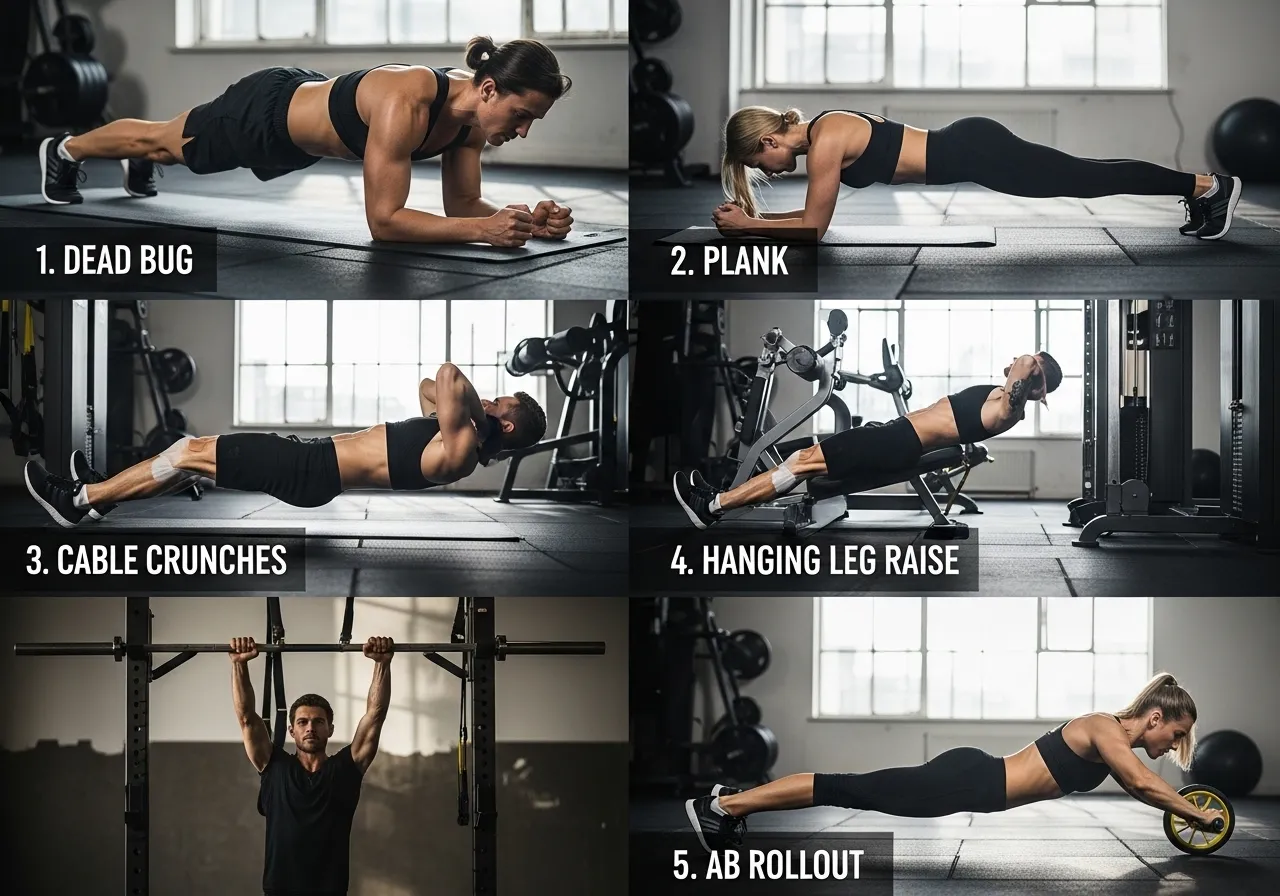
The Most Effective Ab Exercises Ranked by Evidence
Understanding Core Anatomy for Smarter Training
The “abs” are not a single muscle but a complex of muscles that together create the functional core: rectus abdominis (the six-pack muscle, running vertically from sternum to pubis), internal and external obliques (diagonal fibers producing rotation and lateral flexion), transversus abdominis (the deep stabilizing corset muscle that compresses the abdomen and stabilizes the spine), and erector spinae (back extensors that balance the anterior core). Training only the rectus abdominis through crunches and sit-ups neglects the obliques and transversus abdominis that are equally important for core function, aesthetics, and injury prevention.
Swapping crunches for dead bugs and planks felt like a downgrade until I noticed more core stability and significantly less lower back fatigue after every training session.
Research using electromyography (EMG) — which measures electrical activity in muscles during exercise — has produced a hierarchy of ab exercise effectiveness that differs substantially from the exercises most commonly performed. The American Council on Exercise commissioned an EMG study comparing 13 common ab exercises that found the bicycle crunch, captain’s chair leg raise, and exercise ball crunch produced significantly greater rectus abdominis and oblique activation than the standard floor crunch — the exercise that the majority of people use for ab training despite its relative inefficiency.
Top Tier Ab Exercises: Maximum Effectiveness
Bicycle Crunch: The highest-ranking ab exercise in multiple EMG studies, the bicycle crunch simultaneously targets the rectus abdominis and obliques through the combination of spinal flexion and rotation. Lying on your back, hands lightly supporting the head without pulling, alternate touching elbow to opposite knee with a deliberate rotation through the thoracic spine rather than the neck. The key technical error to avoid is rushing — the rotational component loses its effectiveness when performed too quickly, converting a powerful oblique exercise into a neck-straining momentum drill. Aim for 2 seconds per rep, feeling the oblique fully engage at the point of maximum rotation.
Plank and Plank Variations: The plank is deceptively simple and genuinely essential. Holding a rigid plank position requires continuous activation of the transversus abdominis — the deep stabilizer that is chronically underactivated in most people and is most responsible for the flat, drawn-in appearance of a well-developed core. Research published in the British Journal of Sports Medicine found that the plank produces high transversus abdominis activation levels comparable to specialized clinical rehabilitation exercises, confirming it as an essential exercise for functional core development. Progress from standard plank to plank with arm reaches, plank with hip dips, RKC plank (maximum tension throughout body), and eventually to single-arm or single-leg plank variations.
Hanging Leg Raise: The most demanding ab exercise in terms of both strength and technique, the hanging leg raise produces exceptional lower rectus abdominis activation — the area below the navel that is notoriously difficult to develop and that contributes most to the lower stomach flatness that most people seek. Hanging from a bar, curl the pelvis under as you raise the legs — this posterior pelvic tilt is the key to shifting the work from the hip flexors to the lower abs. Begin with bent-knee raises and progress to straight-leg raises as hip flexor and abdominal strength develops.
Ab Wheel Rollout: The ab wheel rollout is one of the most challenging and effective ab exercises available, training the rectus abdominis through its full range of motion under significant load — a combination that few other ab exercises can replicate. Starting on knees, roll forward to the point where you can maintain a neutral spine without arching, then pull back to start. The rollout trains the abs in an anti-extension role — resisting extension of the spine as the wheel moves away from the body — which is the functional role the abs play most commonly in real movement and athletic activity.
The Most Overrated Ab Exercise: The Standard Crunch
The standard floor crunch — the exercise that virtually everyone performs first when they think of ab training — produces lower abdominal activation than most alternatives, creates repetitive spinal flexion stress that can contribute to disc irritation in people with lower back issues, and trains the rectus abdominis through a limited range of motion that understimulates the muscle compared to full-range alternatives. This does not mean crunches have no value — they are a reasonable beginner ab exercise and produce some training effect — but they should not be the primary or exclusive ab exercise for anyone serious about developing their core.
Building the Push-Up to Ab Wheel Progression
The ab wheel rollout is one of the most effective anti-extension exercises available, but it requires a substantial level of core anti-extension strength that most beginners lack when they first attempt it. The safe and effective progression to full ab wheel rollouts: Master the plank (hold 60 seconds with full body tension) → Dead bug (controlled contralateral arm and leg extension from hollow body position) → Ab wheel from knees with half-range (rolling only to the point where a neutral spine can be maintained) → Ab wheel from knees with full range → Ab wheel rollout from standing. Each stage requires 2 to 4 weeks of consistent practice before progressing, and attempting full rollouts from standing before the prerequisite strength is developed produces lumbar hyperextension that stresses the spine rather than training the abs.
The key technical cue for ab wheel rollouts at any stage: maintain a posterior pelvic tilt (flatten your lower back) throughout the movement. The natural tendency as the wheel extends away from the body is for the lower back to arch, which shifts the stress from the abdominals to the lumbar spine. Consciously pulling the navel toward the spine and keeping the lower back flat throughout the rollout ensures the abs — not the lower back — are absorbing the anti-extension demand of the exercise.
Core Training for Athletic Performance
For people who participate in sports — running, tennis, golf, basketball, swimming, or any activity with rotational, directional, or impact demands — core training has direct performance transfer that extends its value far beyond aesthetics. Rotational core strength determines power generation in golf, tennis, baseball, and any sport involving throwing or striking. Core stability determines injury prevention in running, where poor core stability is associated with hip drop and knee valgus collapse patterns that cause knee and hip overuse injuries. Core endurance — the ability to maintain core activation quality throughout a long athletic event — determines form preservation in distance running, cycling, and rowing.
The specific core training needs of athletes differ from aesthetic-focused core training: athletes need rotational strength (Russian twists with resistance, landmine rotations, cable woodchops), anti-rotation stability (pallof press, single-arm carries, half-kneeling exercises), and core endurance under fatigue (long-duration planks, hollow body holds). The aesthetic ab exercises — crunches, leg raises — are secondary for athletes compared to the functional core qualities that directly translate to sport performance.
Programming Ab Exercise Order for Maximum Effectiveness
The sequence in which ab exercises are performed within a session significantly affects the quality of training stimulus each exercise produces. The principle is the same as for any resistance training: perform the most technically demanding and highest-intensity exercises first, when the nervous system is fresh and neural drive is highest, and save the simpler, endurance-based exercises for the end of the session when fatigue has accumulated. For an ab training session, this means: stability exercises requiring precise neural control (dead bugs, RKC planks) first, dynamic loaded exercises (ab wheel rollouts, hanging leg raises) second, and endurance exercises requiring less technique (mountain climbers, bicycle crunches) third. Reversing this order by beginning with high-rep endurance work creates accumulated fatigue that impairs performance on the high-quality stability and strength exercises — reducing their training effect precisely when maximum quality matters most.

How to Program Ab Training for Maximum Results
Frequency and Volume for Ab Development
The abdominal muscles are primarily slow-twitch in fiber composition and are involved in stabilization throughout virtually all daily movement — meaning they have greater recovery capacity and can be trained more frequently than larger prime-mover muscle groups. Research supports training the abdominals 3 to 5 times per week for hypertrophy and endurance development, with each session totaling 3 to 5 exercises for 3 to 4 sets each. This frequency is substantially higher than what most people apply to ab training, who typically perform one or two ab exercises at the end of a workout session once or twice per week — insufficient for meaningful core development.
Treating ab training like any other muscle group — progressive overload, not just reps — was the shift that finally produced visible development.
The progressive overload principle applies to ab training exactly as it does to any other muscle group. Adding weight (holding a plate during crunches, adding ankle weights to leg raises), increasing range of motion (full extension on rollouts, deeper leg raises), reducing rest periods, and advancing to more difficult exercise variations are all valid progressive overload strategies for ab development. Performing the same unweighted crunch sets indefinitely produces no additional adaptation once the initial stimulus has been absorbed — the same principle that limits any resistance training program that fails to progressively overload.
The Ab Training Session Structure
An effective ab training session takes 10 to 15 minutes and targets all components of the core through a combination of flexion, rotation, anti-extension, and anti-rotation exercises. A sample complete ab session: Plank — 3 sets × 45 to 60 seconds (anti-extension, transversus abdominis emphasis). Bicycle crunch — 3 sets × 20 reps (rectus abdominis and oblique emphasis). Hanging leg raise — 3 sets × 10 to 15 reps (lower rectus abdominis emphasis). Side plank — 3 sets × 30 to 45 seconds each side (lateral core and oblique emphasis). Ab wheel rollout — 3 sets × 8 to 12 reps (full core anti-extension emphasis). This combination of exercises provides comprehensive core training stimulus in a time-efficient format that can be added to any training session or performed as a standalone core workout.
Integrating Core Training Into Full Workouts
Core training does not need to be a separate isolated session to be effective. Compound exercises — squats, deadlifts, overhead press, rows — all require significant core stabilization and produce meaningful core training stimulus as a byproduct of their primary movement. Research published in the American College of Sports Medicine Health & Fitness Journal found that compound resistance training sessions produce core activation levels comparable to dedicated isolation core training, suggesting that people who perform regular compound resistance training are providing substantial core stimulus even without dedicated ab exercises. Adding a 10 to 15-minute dedicated core session 3 times per week on top of a comprehensive resistance training program represents the optimal approach — maximizing core development without requiring a separate daily training session.
The Mind-Muscle Connection in Ab Training
The mind-muscle connection — the ability to consciously direct neural activation to the target muscle during an exercise — is particularly important for abdominal training because the abs are frequently inhibited by dominant hip flexors and spinal extensors that prefer to take over abdominal exercises when the movement pattern allows them to. Learning to feel the abdominal muscles contracting and consciously directing effort to them rather than allowing substitute movement patterns significantly increases the training stimulus per rep.
A practical technique for developing the mind-muscle connection with the abs: lie on your back with knees bent, place one hand on your abdomen, exhale completely and draw the navel toward the spine without moving the pelvis. This activates the transversus abdominis in isolation, developing the proprioceptive awareness of deep core activation that makes all subsequent ab exercises more effective. Practice this activation drill for 2 to 3 minutes before ab training sessions until the sensation becomes automatic.
Progressive Overload for Ab Training: The Often-Missing Ingredient
The reason most people’s abs never develop beyond a certain point despite years of training is the absence of progressive overload. They perform the same crunch sets, the same plank holds, the same leg raise volume indefinitely — expecting continued development from a stimulus the body adapted to months or years ago. Progressive overload for ab training means systematically increasing the demand over time through one of several mechanisms: increasing resistance (holding a weight plate during crunches, adding ankle weights to leg raises), increasing range of motion (deeper rollouts, higher leg raise positions), reducing rest periods (shorter rest between ab exercises maintains higher metabolic stress), or advancing to more challenging exercise variations (standard plank to RKC plank, standard leg raise to toes-to-bar).
The double progression method works for ab training exactly as it does for any other resistance training: select a target rep range for each exercise (e.g., 10 to 15 reps), perform the exercise at current difficulty for 3 sets, and when all 3 sets consistently achieve the upper rep range with excellent form, either add resistance or advance to a harder variation. This structured progression ensures that the ab training stimulus continues challenging the muscles beyond initial adaptation and drives the sustained development that stagnant training cannot produce.
The Ab Training Session: Full Example
A complete, evidence-based 15-minute ab training session structured for comprehensive core development: Exercise 1 — Dead bug (3 sets × 10 reps each side, 30 seconds rest) — Deep core stability, anti-extension. Exercise 2 — Plank with reach (3 sets × 45 seconds, 30 seconds rest) — Anti-extension, transversus abdominis. Exercise 3 — Bicycle crunch (3 sets × 20 reps, 30 seconds rest) — Rectus abdominis and obliques. Exercise 4 — Side plank (3 sets × 30 seconds each side, 30 seconds rest) — Lateral core, obliques. Exercise 5 — Hanging knee raise or lying leg raise (3 sets × 12 reps, 45 seconds rest) — Lower rectus abdominis. Total session time: approximately 14 to 16 minutes. This session provides anti-extension, lateral stability, rotation, and dynamic flexion in a balanced combination that develops all components of the core comprehensively.
The 3-Day-per-Week Ab Program Condensed
Monday (Stability Focus): Dead bug 3×10 each side, RKC plank 3×30 seconds, Bird dog 3×10 each side, Hollow body hold 3×20 seconds. Rest 30-45 seconds between sets. Total: 12 minutes.
Wednesday (Dynamic Strength Focus): Bicycle crunch 3×20, Hanging knee raise 3×12, Ab wheel rollout 3×8, Side plank 3×30 seconds each side. Rest 45 seconds between sets. Total: 14 minutes.
Friday (Endurance and Integration Focus): Plank 3×60 seconds, Leg raise 3×15, Russian twist 3×20, Mountain climber 3×30 seconds. Rest 30 seconds between sets. Total: 13 minutes.
This 3-day structure provides stability, dynamic strength, and endurance stimuli across the week, training all components of the core through different mechanisms and preventing the accommodation that occurs when the same exercises are repeated every session. Progress by extending sets, reducing rest, or advancing exercise variations every 2 to 3 weeks.

Nutrition Strategies for a Flat Stomach
The Caloric Deficit: The Non-Negotiable Requirement
No training program, ab exercise selection, or supplementation strategy can produce a flat stomach without a caloric deficit that reduces the fat overlying the abdominal muscles. This is not a negotiable variable — it is the physiological foundation of fat loss, and its primacy does not diminish regardless of what fitness marketing suggests. A caloric deficit of 400 to 600 calories per day below total daily energy expenditure produces fat loss of approximately 0.4 to 0.6 kilograms per week — a rate that produces visible abdominal changes over 8 to 12 weeks for most people starting from typical body fat levels.
Getting my body fat to the point where abs became visible was almost entirely a nutrition problem — the training had been sufficient for a long time.
Achieving this deficit through nutrition alone is possible but inefficient; achieving it through exercise alone is difficult and metabolically incomplete; achieving it through the combination of dietary modification and regular training is the most effective and sustainable approach. The training component — both resistance training and cardiovascular work — contributes to the deficit through caloric expenditure while simultaneously building and preserving the abdominal muscles that will become visible as fat decreases. The nutritional component creates the majority of the deficit while supporting training performance and recovery.
Foods That Reduce Belly Bloating
Beyond the caloric deficit needed for fat loss, specific dietary choices significantly affect the day-to-day flatness of the stomach through their effects on water retention, gut gas production, and inflammatory status. Foods that consistently reduce bloating and promote abdominal flatness: fermented foods (yogurt, kefir, kimchi, sauerkraut) that support gut microbiome balance; adequate dietary fiber from vegetables and whole grains that promotes healthy digestive motility; anti-inflammatory foods (berries, fatty fish, olive oil, turmeric) that reduce the systemic inflammation associated with visceral fat accumulation; and adequate hydration that reduces the sodium-driven water retention that contributes to abdominal distension.
Foods That Cause Bloating to Avoid
Conversely, several common foods disproportionately contribute to abdominal bloating in many people: carbonated beverages (the bubbles are literally gas entering the digestive system), cruciferous vegetables in large quantities (broccoli, cauliflower, Brussels sprouts — highly nutritious but fermented by gut bacteria into significant gas), high-FODMAP foods (certain fruits, legumes, and wheat products that are poorly absorbed and fermented in the colon), artificial sweeteners (particularly sugar alcohols like sorbitol and xylitol that produce significant fermentation and gas), and excessive sodium (promotes water retention that can add visible volume to the abdominal area within hours of consumption). Identifying your personal bloating triggers through an elimination and reintroduction approach can produce immediate and significant improvements in abdominal flatness independent of any change in actual body fat.
Foods That Directly Support Abdominal Muscle Development
Beyond the caloric deficit needed for fat loss and the protein needed for muscle development, specific foods have evidence-based benefits for the gut health and inflammation reduction that directly affects abdominal appearance. Fermented foods — yogurt, kefir, kimchi, sauerkraut, kombucha — contain probiotic bacteria that improve gut microbiome balance, reducing the chronic bloating that makes the abdomen appear larger than its fat content alone would produce. Research published in Nutrients found that probiotic supplementation reduced waist circumference by an average of 1.5cm over 8 weeks in participants with digestive discomfort — not through fat loss but through reduction in gut inflammation and gas production.
Anti-inflammatory foods reduce the visceral fat accumulation associated with chronic low-grade inflammation — a dietary effect that is separate from and additive to the fat loss produced by caloric deficit. Berries (anthocyanin-rich antioxidants), fatty fish (EPA and DHA omega-3s), olive oil (oleocanthal, a natural anti-inflammatory), and turmeric (curcumin) all have research support for reducing inflammatory markers that are associated with abdominal fat accumulation. These foods do not produce dramatic fat loss on their own but create the hormonal and inflammatory environment that supports the fat loss efforts of training and caloric management.
The Water Retention Problem: Managing Sodium and Carbohydrates
A significant portion of day-to-day variation in abdominal flatness is determined by water retention rather than fat, making dietary management of water retention as important as fat loss for the consistent flat stomach appearance most people seek. Sodium is the primary driver of short-term water retention: consuming 2 to 3 grams of sodium above habitual intake causes temporary water retention of 1 to 2 liters — visible as bloating and a rounder abdomen that resolves within 24 to 48 hours as the excess sodium is excreted. High-sodium meals, restaurant food, and processed snacks are the primary culprits, and reducing sodium intake to 2,300mg daily (the recommended maximum) consistently reduces water retention-related abdominal distension for most people.
The Role of Sleep in Abdominal Fat Loss
Sleep duration and quality have a direct, research-established relationship with abdominal fat accumulation that is independent of total caloric intake and exercise habits. Short sleep duration (less than 6 hours per night) is associated with higher ghrelin (the hunger hormone) and lower leptin (the satiety hormone), producing increased appetite particularly for high-calorie, high-carbohydrate foods — a hormonal pattern that makes the caloric deficit needed for abdominal fat loss genuinely more difficult to maintain. Beyond appetite regulation, sleep deprivation elevates cortisol, which promotes visceral fat accumulation specifically in the abdominal region — the most metabolically active and health-relevant fat depot.
A landmark study from the University of Chicago found that participants sleeping 5.5 hours per night lost 55 percent less fat and 60 percent more lean mass compared to participants sleeping 8.5 hours on identical caloric deficits over two weeks — demonstrating that sleep optimization is as important as training and nutrition for abdominal fat loss. Prioritizing 7 to 9 hours of quality sleep per night produces measurable differences in abdominal fat loss that cannot be compensated for by any training or dietary intervention.
The Biggest Mistakes That Prevent Ab Development
Doing Only Crunches
The most common ab training mistake is performing only crunches and crunch variations — training the rectus abdominis in spinal flexion while neglecting the obliques, transversus abdominis, and the anti-movement roles that constitute the majority of real-world core function. This creates a core that is strong in the sagittal plane (flexion and extension) but weak in rotation, lateral stability, and the deep stabilization that prevents lower back pain and supports all athletic movement. Rotating through a variety of exercises — planks for anti-extension, side planks for lateral stability, rotational exercises for the obliques, and compound movements for integrated core stability — produces far more functional and aesthetically complete core development than any single-exercise approach.
Training abs every day was my most persistent mistake — they recover slower than I thought, and the overtraining was actually limiting development.
Training Abs Daily at High Volume
While the abdominals recover faster than larger muscle groups and can be trained more frequently, training them at high volume every single day with insufficient recovery produces diminishing returns and potential overuse issues. The abs require recovery to develop just as any other muscle does — the stimulus and adaptation process requires adequate rest between high-volume sessions. Three to four dedicated ab sessions per week, allowing at least one recovery day between sessions, produces better long-term core development than daily high-volume training that prevents the adaptation response from completing.
Neglecting the Posterior Core
Core training is frequently conceptualized as training only the front and sides of the core — the abdominals and obliques — while the posterior core (lower back extensors, glutes, and thoracic extensors) is overlooked or trained only incidentally. The core functions as a three-dimensional structure that requires balanced development in all directions for optimal function and injury prevention. Weak posterior core musculature creates anterior pelvic tilt, lower back pain risk, and a protruding lower abdomen that persists regardless of how developed the anterior core muscles become. Incorporating exercises like bird-dogs, supermans, glute bridges, and deadlifts that develop the posterior chain is as important for abdominal aesthetics and function as any direct ab exercise.
The Problem with Training Through Lower Back Pain
Lower back pain during or after ab training is a warning signal that the training approach — usually excessive spinal flexion volume from too many crunches and sit-ups — is creating more stress than the structures can manage. The appropriate response is not to push through the pain and build tolerance, but to modify the exercise selection toward spine-neutral core training: planks, dead bugs, bird dogs, and anti-rotation exercises that develop core strength without repetitive spinal flexion. Research published in the Physical Therapy journal consistently shows that spine-neutral core training produces equivalent or superior core stability development compared to flexion-based training, with significantly lower rates of lower back pain exacerbation — making it the evidence-based choice for anyone with lower back sensitivity.
The McGill Big Three — the curl-up (a minimal-range crunch that avoids full flexion), the side plank, and the bird dog — were specifically developed by Dr. Stuart McGill as a low-spinal-stress alternative to conventional ab training that develops all components of core stability without the repetitive flexion that aggravates disc pathology. For anyone with existing lower back issues, building the core training program around these three exercises provides comprehensive core development while minimizing the risk of pain exacerbation.
The Anterior Pelvic Tilt Problem
Anterior pelvic tilt — where the pelvis rotates forward, the lower back arches excessively, and the lower abdomen protrudes — creates an abdominal appearance that looks like lower belly fat even in lean individuals with well-developed abdominals. This postural pattern is extremely common in people who sit for many hours daily, due to chronic hip flexor shortening and glute inhibition that allows the anterior tilt to become the default pelvis position. Correcting anterior pelvic tilt through targeted stretching and strengthening produces a visually flatter lower abdomen without any fat loss at all — purely through postural improvement that brings the lower belly in rather than allowing it to protrude forward.
The correction protocol for anterior pelvic tilt: Daily hip flexor stretching (couch stretch, kneeling lunge stretch — 60 seconds each side, 2 to 3 times daily). Glute activation (glute bridges, clamshells — 3 sets of 15 daily before sitting). Abdominal bracing practice (conscious drawing-in of the lower abdomen throughout the day). This protocol, maintained consistently for 4 to 6 weeks, produces noticeable improvements in resting pelvic position and the corresponding lower abdominal flatness that anterior pelvic tilt masks.
The Genetics of Ab Development
The appearance of the abdominal muscles — the number of visible sections, their symmetry, their shape — is significantly determined by genetics in ways that no amount of training can change. The number of tendinous intersections in the rectus abdominis (which determines whether someone has a 6-pack, 8-pack, or asymmetrical arrangement) is genetically fixed. The distribution pattern of body fat — whether it accumulates predominantly in the abdomen or elsewhere — is largely genetic. The skin thickness over the abdominal region affects how visible the muscles are at any given body fat percentage and varies between individuals. Understanding these genetic realities prevents the discouragement of comparing your ab development to social media physiques that reflect favorable genetics for abdominal appearance in addition to dedicated training — two variables that are not equally distributed.
Age-Related Changes in Core Training
Core training becomes increasingly important with age — and requires specific adjustments that optimize both safety and effectiveness. After age 40, connective tissue recovery slows, spinal disc hydration decreases, and the incidence of lower back issues increases — making the spine-neutral anti-movement emphasis of core training more important and the high-rep spinal flexion volume of conventional crunch-heavy programs less appropriate. Adults over 40 benefit most from a core training approach that emphasizes plank variations, dead bugs, bird dogs, and pallof press over high-volume dynamic flexion exercises, maintaining the core stability that protects the spine under the increasing mechanical demands of daily activity.
Conversely, the strength and aesthetic benefits of core training are equally valuable at 40, 50, and 60 as they are at 20 and 30 — and the postural correction benefits become progressively more important as the decades of accumulated postural load begin to manifest as visible changes in spinal curvature and resting posture. Beginning a deliberate, age-appropriate core training program at any age produces meaningful improvements in both function and appearance, with research showing no age ceiling on the adaptability of core musculature to training stimulus.
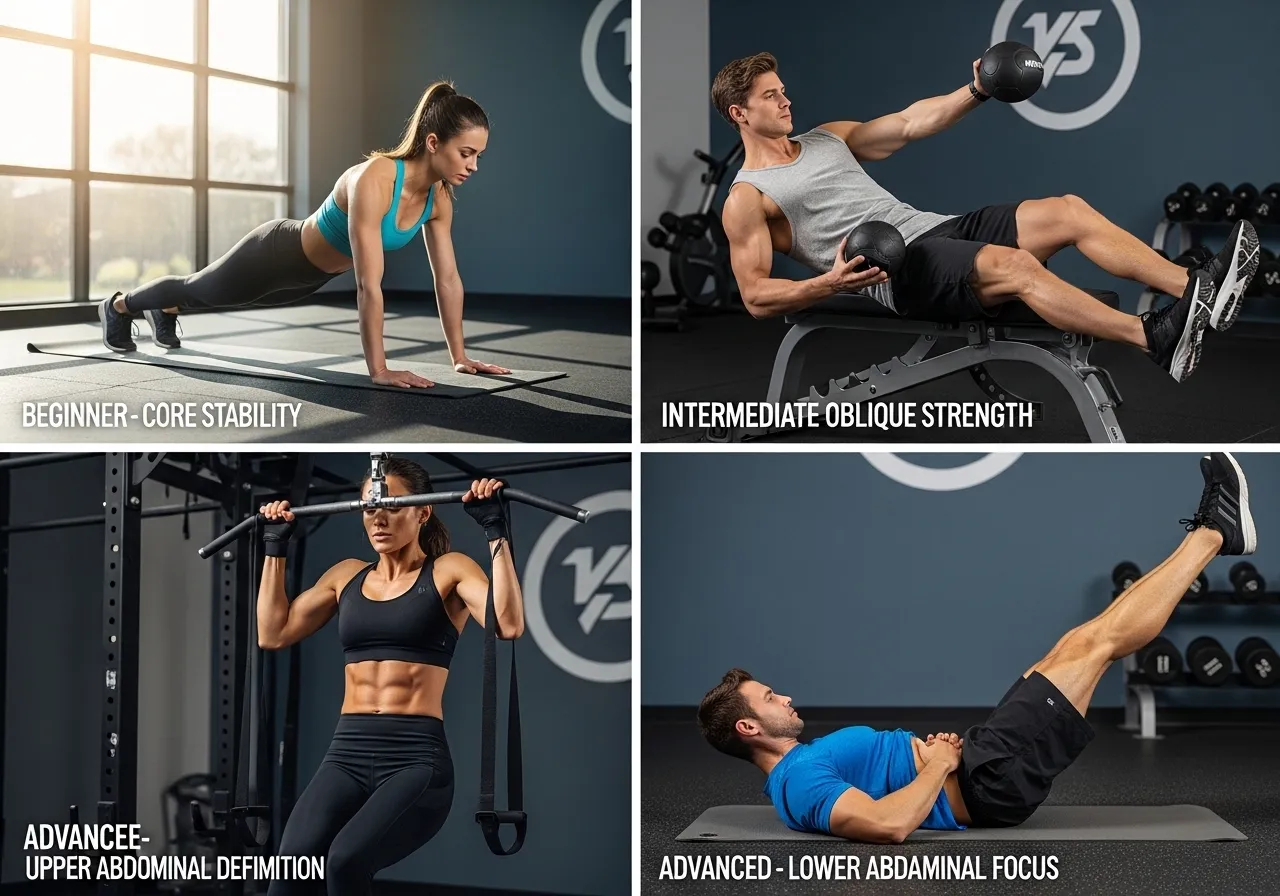
Ab Training Variations for Different Goals and Fitness Levels
Beginner Ab Routine
Beginners should build the foundational movement patterns of core training before attempting advanced exercises that require significant strength or stability. The beginner routine focuses on mastering the plank position, developing basic spinal flexion strength, and establishing the mind-muscle connection with the abdominals that makes more advanced training progressively more effective. A progressive beginner ab routine: Dead bug (3 sets × 10 reps each side) — develops deep core stability with minimal spinal stress. Modified plank on knees (3 sets × 20 to 30 seconds) — builds the anti-extension strength needed for full plank. Heel tap (3 sets × 15 reps each side) — introduces oblique activation in a controlled range of motion. Bird dog (3 sets × 10 reps each side) — develops rotational stability and posterior core activation. Crunch with proper form (3 sets × 15 reps) — foundational spinal flexion with controlled tempo.
Once I understood that core strength and visible abs require slightly different training emphases, I could structure sessions that served both goals simultaneously.
Intermediate Ab Routine
The intermediate routine introduces greater range of motion, reduced stability, and increased load to continue driving adaptation beyond the beginner stage. Standard plank to full plank with reaches and hip dips. Bicycle crunch — the primary oblique exercise at this level. Leg raises from floor progressing to hanging variations. Ab wheel rollout from knees. Russian twist with light weight. This combination provides comprehensive core stimulus at a level appropriate for someone with 3 to 6 months of consistent core training, producing both aesthetic and functional improvements.
Advanced Ab Routine
Advanced ab training requires significant core strength, shoulder stability, and body control that develops only after months of progressive training. Dragon flag (Bruce Lee’s signature exercise) — one of the most demanding anti-extension exercises available. Full hanging leg raise with posterior pelvic tilt. Ab wheel rollout from standing. Weighted decline crunch. L-sit hold. These exercises represent the upper tier of core training difficulty and produce the deepest, most complete abdominal development achievable through bodyweight and minimal equipment training.
Core Training for Injury Rehabilitation
Core training has well-established applications in rehabilitation from lower back injuries, hip injuries, and many other musculoskeletal conditions where impaired core stability contributed to injury onset or recovery. The specific core exercises appropriate during rehabilitation differ from those appropriate for healthy individuals pursuing aesthetic or performance goals: dynamic, high-load exercises that are appropriate for healthy trainees can aggravate healing tissues and are generally contraindicated during active rehabilitation phases. The McGill Big Three — the modified curl-up, side plank, and bird dog — were specifically developed as rehabilitation-appropriate core exercises that develop stability without the spinal stress of conventional ab exercises.
For anyone returning to ab training after a lower back injury, the standard recommendation from sports medicine physicians and physical therapists is to begin with the McGill Big Three and progress gradually to more dynamic exercises only after establishing pain-free movement through the rehabilitation exercises. Rushing this progression — jumping to crunches and leg raises before adequate stability has been re-established — risks re-injury and extends the total rehabilitation timeline. The conservative approach of 4 to 8 weeks of rehabilitation-appropriate core training before advancing to conventional ab exercises produces better long-term outcomes than attempting to maintain pre-injury training volumes during recovery.
Ab Training Equipment Worth Using
A small number of pieces of equipment meaningfully enhance bodyweight ab training: a pull-up bar for hanging exercises (leg raises, toes-to-bar — the most effective lower ab exercises available), an ab wheel for rollouts (one of the highest-value single-exercise purchases available for core training), a captain’s chair or dip station for supported leg raises, and resistance bands for pallof press and rotational exercises. These four items collectively cost under $100, occupy minimal storage space, and provide the equipment needed for a complete, progressive core training program from beginner through advanced level. Beyond these four items, additional core training equipment provides marginal benefit relative to cost and complexity.
Integrating Ab Training Into Full Body Workouts
The most time-efficient approach to ab training is integrating it within full-body resistance training sessions rather than treating it as a separate training block. Compound exercises — deadlifts, squats, overhead press, single-arm rows — all require significant core stabilization and produce meaningful core training stimulus as a byproduct of their primary movement pattern. Building ab-specific exercises into the warm-up (dead bugs and bird dogs), superset structure (plank holds supersetted with upper body exercises), and cooldown (static ab stretches and light core activation) of regular training sessions provides continuous core stimulus throughout the session without requiring dedicated core training time.
This integration approach is supported by research showing that the core activation produced by heavy compound exercises is comparable to dedicated core training exercises in some movement patterns — meaning that a comprehensive resistance training program with deliberate core activation cues produces significant core development even without dedicated ab exercises. Adding 10 to 15 minutes of targeted ab work 3 times per week on top of this integrated foundation provides the supplemental targeted stimulus needed for aesthetic core development beyond what compound training alone produces.
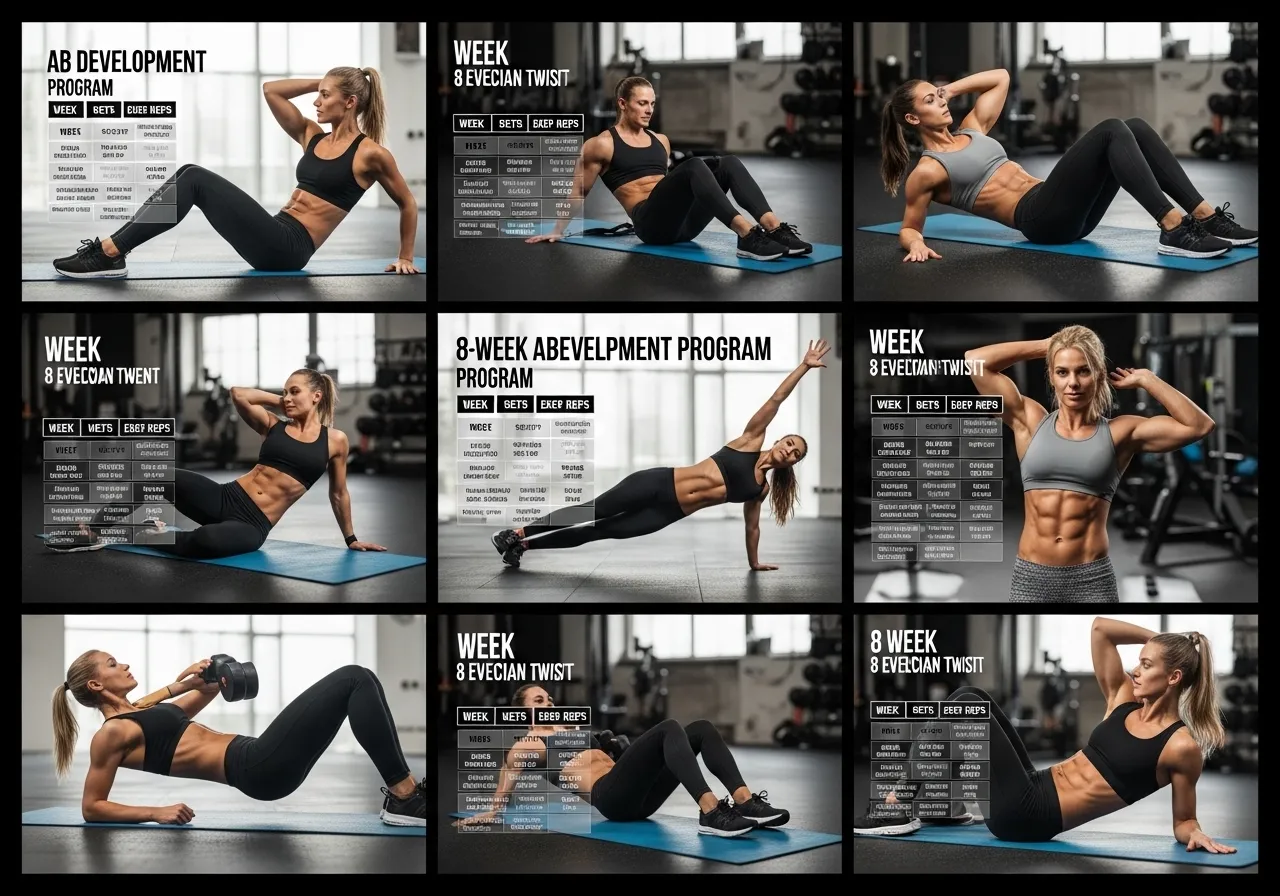
Complete 8-Week Ab Development Program
Program Overview and Design Principles
This 8-week program is designed to progressively develop all components of the core while simultaneously supporting the fat loss that makes abdominal development visible. The program follows a 3-day-per-week ab training schedule, with each session building in difficulty from week to week through exercise progression, added sets, and reduced rest periods. The consistent structure across 8 weeks allows the progressive overload principle to drive continuous adaptation rather than the random exercise selection that characterizes most informal ab training approaches.
Running a structured 8-week block rather than random ab sessions was what finally produced consistent visible improvement — structure matters even for abs.
Weeks 1 to 2: Foundation
Session A (Mondays): Dead bug × 3 sets × 10 each side. Modified plank × 3 sets × 25 seconds. Heel taps × 3 sets × 15 each side. Rest 60 seconds between sets. Session B (Wednesdays): Bird dog × 3 sets × 10 each side. Crunch × 3 sets × 15 reps. Side plank (modified) × 3 sets × 20 seconds each side. Session C (Fridays): Repeat Session A with 5 additional seconds on plank hold.
Weeks 3 to 4: Progression
Session A: Full plank × 3 sets × 35 seconds. Bicycle crunch × 3 sets × 16 reps. Leg raise (bent knee) × 3 sets × 12 reps. Session B: Ab wheel from knees × 3 sets × 8 reps. Side plank (full) × 3 sets × 25 seconds each side. Russian twist × 3 sets × 20 reps. Session C: Repeat Session A adding 5 seconds to plank and 2 reps to each exercise.
Weeks 5 to 6: Intensification
Session A: Plank with reaches × 3 sets × 10 each side. Bicycle crunch × 4 sets × 20 reps. Hanging knee raise × 3 sets × 12 reps. Session B: Ab wheel from knees progressing toward standing × 3 sets × 10 reps. Copenhagen plank × 3 sets × 20 seconds each side. Dragon flag negative × 3 sets × 5 reps. Session C: Full circuit × 4 rounds with 30 seconds rest between exercises.
Weeks 7 to 8: Peak Phase
Session A: Hanging leg raise (straight) × 4 sets × 10 reps. Plank with hip dips × 4 sets × 20 reps. Ab wheel from standing if possible × 3 sets × 5 reps. Session B: Dragon flag (partial or full) × 3 sets × 6 reps. Weighted crunch × 4 sets × 12 reps. L-sit hold × 3 sets × 10 seconds. Session C: Full 20-minute core circuit combining all learned exercises.
Frequently Asked Questions
How long does it take to get a flat stomach?
Visible abdominal flattening — reduction in bloating and abdominal protrusion — can occur within 2 to 4 weeks of dietary and training changes. Visible ab definition (seeing muscle separation) requires reaching the body fat threshold of approximately 15 percent for men and 22 percent for women, which typically takes 3 to 6 months of consistent training and dietary deficit from typical starting points.
Should I do cardio or ab exercises for a flat stomach?
Both, combined with dietary modification. Cardio creates caloric deficit that reduces the fat layer over your abs. Ab exercises develop the muscles that become visible as fat is lost. Diet creates and maintains the caloric deficit required for fat loss. No single element produces a flat stomach — all three must work together. The priority order is diet first, then cardio, then dedicated ab training.
How many ab exercises should I do per session?
3 to 5 exercises per session is the evidence-based recommendation for comprehensive core development. More than 5 exercises per session produces diminishing returns through accumulated fatigue and time investment disproportionate to additional benefit. Choose exercises that target different aspects of core function — one anti-extension, one rotation, one flexion-based, and one lateral stability exercise covers all components efficiently.
Making Ab Training Enjoyable: The Sustainable Approach
Ab training has a reputation for being unpleasant — the burn, the grinding repetition, the frustration of slow visible progress. Transforming this reputation requires deliberately designing ab training sessions that are challenging but also in some way enjoyable or satisfying. The most effective strategies: pair ab training with music that motivates you specifically (the right music transforms the subjective experience of difficult exercise more reliably than almost any other environmental modification), use the ab training session as a mentally restorative period by disconnecting from screens and focusing entirely on the physical sensations of the movement, train with a partner or in a group when possible (social exercise is consistently rated as more enjoyable and produces higher adherence than solo training), and celebrate specific achievements — the first unbroken minute plank, the first full-range rollout, the first toes-to-bar rep — as milestones that reinforce the effort invested.
The people who maintain consistent ab training for years and develop the deep, functional core development that shows in every athletic activity have typically found genuine enjoyment in the process rather than merely tolerating it for aesthetic results. Finding the exercises you genuinely prefer, the music that elevates the experience, and the format (standalone session versus training appendage) that fits best into your routine are not trivial details — they are the design elements that determine whether ab training becomes a sustainable practice or an obligation that eventually gets dropped. Invest the time to find what makes the process genuinely sustainable for you, and the results will follow naturally from the consistency that enjoyment enables.
Setting Realistic Aesthetic Goals for Ab Development
Setting realistic aesthetic goals for abdominal development is one of the most important things I can do for anyone beginning an ab training program — both to prevent the discouragement that leads to abandonment and to ensure the methods chosen are proportionate to the goals being pursued. Visible ab separation (seeing the lines between individual rectus abdominis sections) requires reaching body fat percentages in the range of 14 to 17 percent for men and 19 to 24 percent for women — thresholds that require dedicated fat loss for most people starting from typical body fat levels and that cannot be achieved through ab training alone regardless of how developed the underlying muscles become.
The realistic aesthetic outcomes of 12 weeks of consistent ab training combined with appropriate caloric management: noticeably reduced abdominal protrusion from improved core activation and posture correction, visible definition in the upper abdominal region for people starting below 20 percent body fat (men) or 28 percent (women), improved core tightness and reduced waistline from postural improvement, and the functional improvements in daily posture that produce a visually slimmer silhouette independent of fat loss. For most people, these outcomes are meaningful, motivating, and achievable — far more realistic than the dramatic transformations promised by 30-day ab challenges, and far more sustainable than the extreme dietary restriction those challenges typically imply.