
Cardio vs. Strength Training: Which Is Better for Weight
⚠️ Disclaimer: The information in this article is for general educational purposes only and does not constitute medical, nutritional, or professional fitness advice. Individual results may vary. Always consult a qualified healthcare professional or certified fitness trainer before starting any new exercise program, changing your diet, or making decisions about injury treatment or recovery. If you experience pain, discomfort, or any unusual symptoms during exercise, stop immediately and seek professional guidance.

What the Research Actually Says: Cardio vs. Strength Training
Why This Question Has No Simple Answer
The cardio versus strength training debate for weight loss is one of the most frequently asked questions in fitness, and the internet has responded by producing an extraordinary amount of confidently stated, contradictory advice. Cardio advocates cite the higher calories burned per session. Strength training advocates cite the metabolic rate elevation and muscle-building benefits. Both camps are correct about the specific mechanisms they emphasize — and both are oversimplifying a question that the research has answered with significantly more nuance than either side typically acknowledges.
The research consensus is unambiguous on one point: for fat loss specifically — as opposed to scale weight reduction — the combination of resistance training and cardiovascular exercise produces outcomes that neither approach achieves alone. A meta-analysis published in the Obesity Reviews journal analyzing 66 randomized controlled trials found that combined exercise programs produced 20 to 35 percent greater fat loss than cardio-only programs and 40 to 60 percent greater fat loss than resistance-only programs over equivalent intervention periods. The combination is not merely additive — it is synergistic, with each modality enhancing the fat-loss mechanisms of the other in ways that produce outcomes greater than their independent contributions would predict.
Caloric Expenditure: Where Cardio Wins During the Session
Within a single training session, cardiovascular exercise burns more calories than resistance training of equivalent duration. A 45-minute moderate-intensity run burns approximately 400 to 500 calories for a 75kg person; 45 minutes of resistance training burns approximately 200 to 350 calories. This caloric expenditure advantage during the session is real and significant — and is the primary basis for the cardio-for-weight-loss recommendation that dominated fitness advice for decades.
The limitation of session-only caloric accounting is that it ignores what happens in the 23 hours after the session ends. Cardiovascular exercise has a modest EPOC (excess post-exercise oxygen consumption) effect — elevated metabolic rate continuing after the session — that adds approximately 50 to 100 additional calories over the following hours. Resistance training, particularly high-intensity resistance training, produces a substantially larger EPOC effect — adding 100 to 300 additional post-session calories over the following 24 to 48 hours. When total 24 to 48 hour caloric expenditure is measured rather than session-only expenditure, the difference between cardio and resistance training becomes much smaller than the session numbers suggest.
The Muscle Preservation Factor: Where Strength Training Wins Long-Term
The most important long-term advantage of resistance training for weight loss is muscle preservation during a caloric deficit. Without resistance training stimulus, the body draws on muscle tissue as well as fat during a caloric deficit — a process that reduces lean body mass, lowers resting metabolic rate, and creates the physiological conditions for weight regain once normal eating resumes. Research published in the Journal of Strength and Conditioning Research found that individuals who combined resistance training with a caloric deficit lost an average of 1.5 times more fat and retained significantly more muscle mass over 12 weeks compared to those who used cardio-only approaches with identical caloric deficits — a finding that fundamentally changes the arithmetic of fat loss planning.
The metabolic rate implications of this muscle preservation are substantial. Each kilogram of muscle tissue burns approximately 13 calories per day at rest. Losing 3 kilograms of muscle during a fat loss phase — a realistic outcome for cardio-only dieters — reduces resting metabolic rate by approximately 40 calories per day, creating a progressively widening deficit between the calories needed and the calories burned that requires continuous dietary restriction just to maintain results. Resistance training, by preserving and potentially increasing muscle mass during fat loss, protects and elevates the resting metabolic rate that determines long-term weight management success.
Additional Evidence and Practical Application
The research on this topic continues to evolve, but the current consensus is clear: for virtually all recreational fitness goals — fat loss, muscle maintenance, cardiovascular health, longevity, body composition improvement — the combination of resistance training and cardiovascular exercise produces outcomes that neither modality achieves alone. The specific combination, balance, and sequencing should be tailored to individual goals, schedules, and physical capacities, but the principle of combining both is as close to universal as any recommendation in exercise science.
For practical program design, the 3:2 ratio (3 resistance sessions to 2 cardiovascular sessions per week) provides a starting point that emphasizes the muscle-preserving, metabolically active tissue-building effect of resistance training while maintaining the cardiovascular health and fat-burning benefits of aerobic work. This ratio can be adjusted toward more resistance (4:2 or 5:2) for people prioritizing muscle building and strength, or toward more cardiovascular work (3:3 or 3:4) for people prioritizing athletic endurance or cardiovascular health, while maintaining both modalities in the program regardless of which receives greater emphasis.
The most important variable in making the cardio versus strength decision for any individual is sustainability: the modality combination you can maintain consistently for months and years will always outperform the theoretically optimal combination that you abandon after 6 weeks. If you genuinely enjoy running and dread the weight room, a running-heavy program with 2 strength sessions per week will produce better long-term outcomes than a strength-heavy program you resist. Conversely, if lifting energizes you and steady-state cardio bores you to distraction, a strength-heavy program with HIIT substituting for steady-state cardio will produce better adherence and better results than fighting your preferences indefinitely.

The Mechanisms: How Each Approach Burns Fat
How Cardiovascular Exercise Burns Fat
Cardiovascular exercise promotes fat loss through several distinct mechanisms. The direct caloric expenditure during the session creates an immediate contribution to the daily energy deficit needed for fat loss. The cardiovascular adaptations produced by regular aerobic training — increased mitochondrial density, enhanced fat oxidation enzyme activity, improved oxygen delivery to tissues — increase the body’s capacity to burn fat as fuel both during exercise and at rest. Regular cardiovascular training also improves insulin sensitivity, reduces inflammatory markers associated with visceral fat accumulation, and produces neurochemical changes that reduce appetite in the hours following moderate-intensity sessions.
The fat oxidation rate during cardiovascular exercise varies significantly with intensity. At low to moderate intensities (50 to 65 percent of maximum heart rate), fat contributes approximately 40 to 60 percent of total fuel use. At higher intensities (75 to 85 percent of maximum heart rate), carbohydrate becomes the dominant fuel source and fat oxidation rate decreases. This does not mean high-intensity cardio is less effective for fat loss — the total caloric expenditure at higher intensities more than compensates for the reduced fat oxidation percentage. But it does mean that both moderate-intensity steady-state cardio (maximizing fat oxidation rate per minute) and high-intensity interval training (maximizing total caloric expenditure and EPOC) have distinct and complementary roles in a comprehensive fat loss program.
How Strength Training Burns Fat
Resistance training promotes fat loss through mechanisms that are fundamentally different from and complementary to cardiovascular exercise. The acute metabolic effects — EPOC, hormonal response, glycogen depletion and replenishment — produce elevated caloric expenditure for 24 to 48 hours after each session. The chronic adaptations — increased muscle mass, improved insulin sensitivity, enhanced metabolic rate — create favorable long-term body composition conditions that make fat loss progressively easier rather than progressively harder as it continues.
The hormonal response to resistance training is particularly significant for fat loss. Heavy compound resistance training acutely elevates testosterone, growth hormone, and IGF-1 — anabolic hormones that promote muscle protein synthesis and fat mobilization simultaneously. Research published in Sports Medicine found that the hormonal response to resistance training significantly enhances fat oxidation in the 24 to 48 hours following the session, suggesting that the fat-burning effects of resistance training extend well beyond the immediate post-exercise period through hormonal signaling mechanisms.
The EPOC Comparison: Which Burns More After the Session
Post-exercise oxygen consumption — the elevated metabolic rate following exercise — is the mechanism that most clearly differentiates the long-term fat loss impact of different exercise types. Moderate-intensity steady-state cardio produces an EPOC of approximately 50 to 150 calories over 2 to 4 hours. High-intensity cardio (HIIT) produces an EPOC of 100 to 250 calories over 4 to 8 hours. Heavy resistance training produces an EPOC of 150 to 400 calories over 12 to 48 hours. The substantially longer EPOC duration from resistance training reflects the ongoing energy demands of muscle protein synthesis and tissue repair — processes that continue for days after training and that represent a genuine caloric expenditure advantage for strength training in the days following each session.
| Exercise Type | Calories During Session | EPOC Calories | EPOC Duration | Total 48hr Effect |
|—|—|—|—|—|
| Moderate cardio (45 min) | 350–450 | 50–150 | 2–4 hours | 400–600 |
| HIIT (25 min) | 200–350 | 100–250 | 4–8 hours | 300–600 |
| Heavy resistance (45 min) | 200–350 | 150–400 | 12–48 hours | 350–750 |
| Combined session (60 min) | 400–600 | 200–450 | 12–48 hours | 600–1050 |
Additional Evidence and Practical Application
The research on this topic continues to evolve, but the current consensus is clear: for virtually all recreational fitness goals — fat loss, muscle maintenance, cardiovascular health, longevity, body composition improvement — the combination of resistance training and cardiovascular exercise produces outcomes that neither modality achieves alone. The specific combination, balance, and sequencing should be tailored to individual goals, schedules, and physical capacities, but the principle of combining both is as close to universal as any recommendation in exercise science.
For practical program design, the 3:2 ratio (3 resistance sessions to 2 cardiovascular sessions per week) provides a starting point that emphasizes the muscle-preserving, metabolically active tissue-building effect of resistance training while maintaining the cardiovascular health and fat-burning benefits of aerobic work. This ratio can be adjusted toward more resistance (4:2 or 5:2) for people prioritizing muscle building and strength, or toward more cardiovascular work (3:3 or 3:4) for people prioritizing athletic endurance or cardiovascular health, while maintaining both modalities in the program regardless of which receives greater emphasis.
The most important variable in making the cardio versus strength decision for any individual is sustainability: the modality combination you can maintain consistently for months and years will always outperform the theoretically optimal combination that you abandon after 6 weeks. If you genuinely enjoy running and dread the weight room, a running-heavy program with 2 strength sessions per week will produce better long-term outcomes than a strength-heavy program you resist. Conversely, if lifting energizes you and steady-state cardio bores you to distraction, a strength-heavy program with HIIT substituting for steady-state cardio will produce better adherence and better results than fighting your preferences indefinitely.

Why the Combined Approach Wins for Fat Loss
The Synergistic Effect
The combined approach to fat loss training does not merely add the benefits of cardio and strength training — it produces a synergistic effect where each modality enhances the outcomes of the other. Cardiovascular training improves the metabolic machinery that makes resistance training more efficient: better oxygen delivery, improved glucose regulation, and enhanced recovery capacity allow higher-quality resistance training sessions. Resistance training improves the fat oxidation capacity and hormonal environment that enhances cardiovascular training outcomes: greater muscle mass increases the absolute caloric demand of cardio sessions, and the hormonal adaptations from resistance training amplify fat mobilization during aerobic work.
According to the American College of Sports Medicine position stand on exercise for weight management, the combined approach produces superior outcomes to either modality alone across all body composition measures — total fat mass, visceral fat, lean mass preservation, and resting metabolic rate — and is the evidence-based recommendation for anyone with fat loss as a primary goal. The question “cardio or weights?” should not be framed as a binary choice but as a programming question: how to optimally combine both modalities within the available training time.
How to Structure Combined Training for Fat Loss
The most effective structure for combined training depends on total available training time and individual preferences. For most people training 4 to 5 days per week, the optimal distribution is 3 resistance training sessions and 2 to 3 cardiovascular sessions, with resistance training taking priority in session scheduling and exercise order. Resistance training on Monday, Wednesday, and Friday; cardiovascular training on Tuesday, Thursday, and optional Saturday represents the classic structure that provides both modalities with adequate frequency while allowing appropriate recovery between same-modality sessions.
When both modalities must be performed in the same session, resistance training should precede cardiovascular training for two reasons: glycogen availability is greatest at the start of the session (supporting the high-intensity glycolytic demands of resistance training), and the hormonal response to resistance training is maximized when performed fresh rather than post-cardio. Post-resistance cardio, performed at 65 to 75 percent of maximum heart rate when glycogen stores are partially depleted, accesses fat oxidation more readily than pre-resistance cardio — making this sequence advantageous for both performance quality and fat oxidation.
Optimal Cardio Type for Combined Programs
Within a combined program, the type of cardiovascular training chosen affects both the fat loss outcomes and the recovery demands that interact with resistance training. HIIT cardio sessions (20 to 25 minutes) produce superior fat loss per unit of time invested and greater EPOC compared to steady-state cardio, but create significant systemic fatigue that can impair the quality of subsequent resistance training sessions if not spaced adequately. Steady-state moderate cardio (30 to 45 minutes at 60 to 70 percent max heart rate) produces lower per-session fat loss but can be performed on rest days from resistance training or immediately after resistance sessions without compromising resistance training quality. An optimal combined program uses HIIT for 1 to 2 sessions per week (on non-resistance training days) and steady-state cardio for 1 to 2 sessions per week (on resistance training days as a finisher or on active recovery days).
Additional Evidence and Practical Application
The research on this topic continues to evolve, but the current consensus is clear: for virtually all recreational fitness goals — fat loss, muscle maintenance, cardiovascular health, longevity, body composition improvement — the combination of resistance training and cardiovascular exercise produces outcomes that neither modality achieves alone. The specific combination, balance, and sequencing should be tailored to individual goals, schedules, and physical capacities, but the principle of combining both is as close to universal as any recommendation in exercise science.
For practical program design, the 3:2 ratio (3 resistance sessions to 2 cardiovascular sessions per week) provides a starting point that emphasizes the muscle-preserving, metabolically active tissue-building effect of resistance training while maintaining the cardiovascular health and fat-burning benefits of aerobic work. This ratio can be adjusted toward more resistance (4:2 or 5:2) for people prioritizing muscle building and strength, or toward more cardiovascular work (3:3 or 3:4) for people prioritizing athletic endurance or cardiovascular health, while maintaining both modalities in the program regardless of which receives greater emphasis.
The most important variable in making the cardio versus strength decision for any individual is sustainability: the modality combination you can maintain consistently for months and years will always outperform the theoretically optimal combination that you abandon after 6 weeks. If you genuinely enjoy running and dread the weight room, a running-heavy program with 2 strength sessions per week will produce better long-term outcomes than a strength-heavy program you resist. Conversely, if lifting energizes you and steady-state cardio bores you to distraction, a strength-heavy program with HIIT substituting for steady-state cardio will produce better adherence and better results than fighting your preferences indefinitely.

Which to Prioritize Based on Your Specific Goal
If Your Primary Goal Is Fat Loss
For people whose primary goal is fat loss with body composition improvement (maintaining or building muscle while losing fat), resistance training should be prioritized over cardiovascular training. This recommendation reflects the muscle preservation, metabolic rate elevation, and body composition outcomes that make resistance training the superior long-term fat loss tool — even if it produces less immediate scale weight reduction than a cardio-heavy approach. A program structure of 3 resistance training sessions supplemented by 2 cardiovascular sessions produces superior 6-month body composition outcomes compared to 5 cardio sessions weekly, despite potentially similar total caloric expenditure.
If Your Primary Goal Is Cardiovascular Health
For people whose primary goal is cardiovascular health — reducing cardiovascular disease risk, improving VO2 max, managing blood pressure — cardiovascular training should be prioritized, with resistance training maintained for its complementary cardiovascular benefits. Regular aerobic exercise produces the primary cardiovascular adaptations: increased stroke volume, reduced resting heart rate, improved endothelial function, and lower blood pressure. Resistance training adds complementary benefits including improved insulin sensitivity and reduced cardiovascular mortality risk, but aerobic training remains the dominant modality for direct cardiovascular adaptation.
If Your Goal Is Maximum Caloric Burn in Minimum Time
For people with limited training time who want maximum caloric expenditure efficiency, HIIT protocols that combine resistance and cardiovascular elements — circuit training, metabolic resistance training, complexes — produce the highest caloric expenditure per minute of any training approach. A 20-minute metabolic resistance training circuit using compound movements (squat to press, deadlift, push-up, row, lunge) performed at high intensity burns comparable or greater total calories than a 45-minute steady-state cardio session while simultaneously providing resistance training stimulus for muscle preservation.
If You Are a Complete Beginner
For beginners with no established training base, any consistent exercise is dramatically more valuable than the optimal exercise not performed. Starting with the modality that feels most accessible and enjoyable — whether cardio or strength training — and building consistency before optimizing the approach is the most evidence-supported recommendation for this population. Research on beginner exercise adherence consistently shows that preference, enjoyment, and perceived competence are the strongest predictors of long-term exercise maintenance, outweighing the modest differences in fat loss outcomes between different exercise modalities for people in the first 6 months of training.
For General Health and Longevity
For general health and longevity goals — reducing chronic disease risk, improving metabolic health, maintaining functional fitness — the evidence most strongly supports a balanced combination of both modalities rather than specialization in either. The landmark Copenhagen City Heart Study tracking over 20,000 participants for 25 years found that regular aerobic exercise reduced all-cause mortality by 36 percent, while regular resistance training reduced it by 23 percent — with combined exercisers showing the greatest longevity benefits of any group. These synergistic effects are believed to operate through complementary mechanisms: cardiovascular exercise improves cardiac function and metabolic flexibility, while resistance training preserves muscle mass and resting metabolic rate that naturally declines with age.
The practical implication for health-focused exercisers: a weekly routine of 150 minutes of moderate cardiovascular activity plus 2 resistance training sessions covering all major muscle groups meets the minimum recommendations of the World Health Organization for meaningful health benefit — a target achievable in 4 to 5 hours of total weekly activity.
Adjusting the Balance as Goals Evolve
Most people’s fitness goals are not static. Someone who begins training primarily for fat loss may, after achieving their initial goal, shift their primary motivation toward athletic performance, muscle building, or stress management. As goals evolve, the appropriate cardio-to-strength ratio should evolve with them — and the flexibility to make these adjustments is one of the most important skills in long-term fitness management. Establishing proficiency in both cardiovascular training and resistance training from the beginning — rather than specializing exclusively in one from the start — creates the physical and technical foundation to shift emphasis as priorities change without starting from scratch in the deprioritized modality.
Additional Evidence and Practical Application
The research on this topic continues to evolve, but the current consensus is clear: for virtually all recreational fitness goals — fat loss, muscle maintenance, cardiovascular health, longevity, body composition improvement — the combination of resistance training and cardiovascular exercise produces outcomes that neither modality achieves alone. The specific combination, balance, and sequencing should be tailored to individual goals, schedules, and physical capacities, but the principle of combining both is as close to universal as any recommendation in exercise science.
For practical program design, the 3:2 ratio (3 resistance sessions to 2 cardiovascular sessions per week) provides a starting point that emphasizes the muscle-preserving, metabolically active tissue-building effect of resistance training while maintaining the cardiovascular health and fat-burning benefits of aerobic work. This ratio can be adjusted toward more resistance (4:2 or 5:2) for people prioritizing muscle building and strength, or toward more cardiovascular work (3:3 or 3:4) for people prioritizing athletic endurance or cardiovascular health, while maintaining both modalities in the program regardless of which receives greater emphasis.
The most important variable in making the cardio versus strength decision for any individual is sustainability: the modality combination you can maintain consistently for months and years will always outperform the theoretically optimal combination that you abandon after 6 weeks. If you genuinely enjoy running and dread the weight room, a running-heavy program with 2 strength sessions per week will produce better long-term outcomes than a strength-heavy program you resist. Conversely, if lifting energizes you and steady-state cardio bores you to distraction, a strength-heavy program with HIIT substituting for steady-state cardio will produce better adherence and better results than fighting your preferences indefinitely.
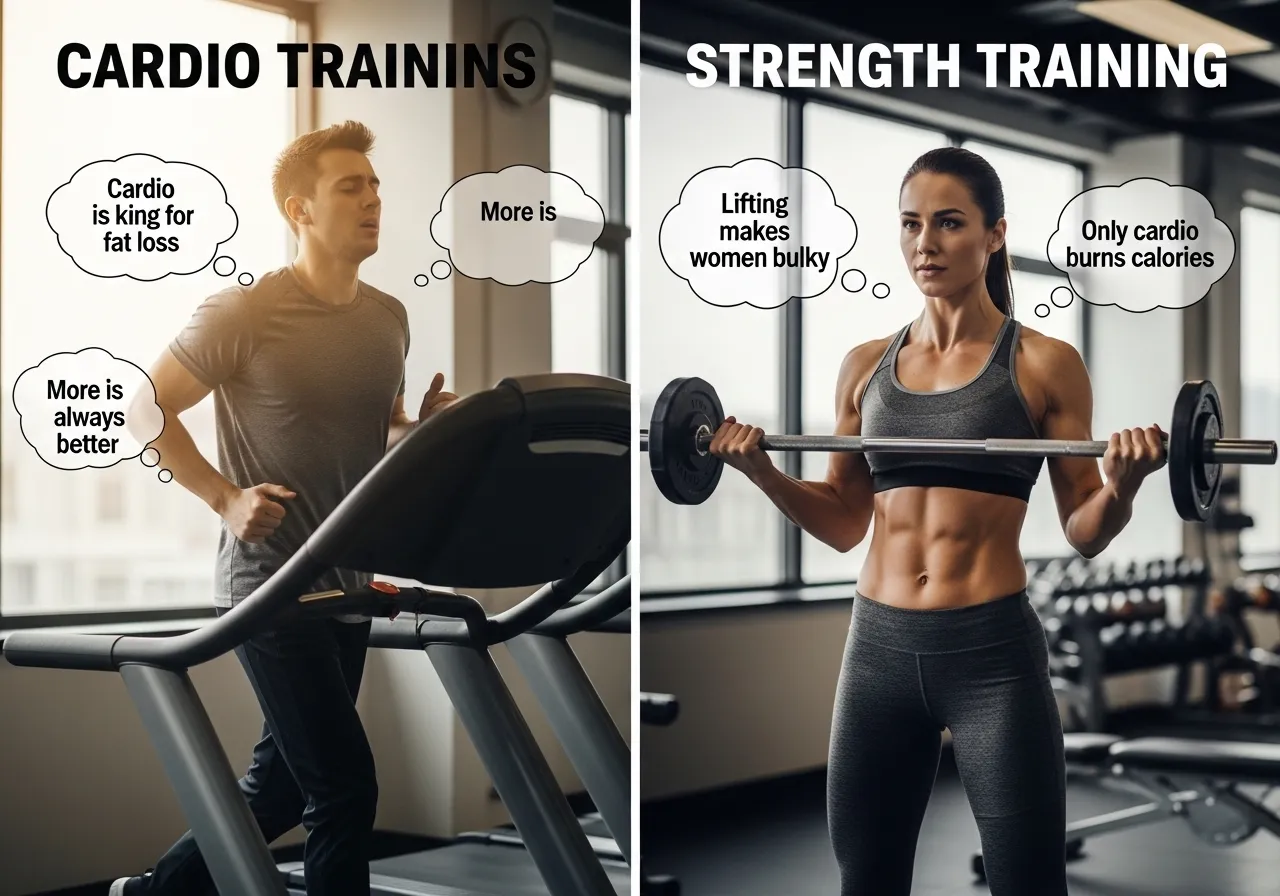
Common Misconceptions About Cardio and Strength Training for Weight Loss
“Cardio Is the Only Way to Lose Weight”
This misconception persists despite decades of research demonstrating the superior body composition outcomes of combined training over cardio-only approaches. It likely originates from the visible caloric burn of cardiovascular exercise — the sweat, elevated heart rate, and calorie counter numbers on cardio machines provide immediate, tangible feedback that resistance training sessions do not. But body composition change — which is what most people actually mean when they say they want to “lose weight” — is driven by fat loss rather than scale weight reduction, and resistance training produces superior fat loss outcomes when total body weight is examined alongside muscle mass and fat mass separately.
“Lifting Weights Makes Women Bulky”
The concern that resistance training will cause women to develop disproportionate muscle mass is physiologically unfounded. Women produce testosterone at approximately 10 to 20 times lower concentrations than men — the primary hormonal driver of the substantial muscle hypertrophy that characterizes male bodybuilder physiques. The professional female bodybuilders who achieve dramatic muscularity do so through years of extremely high-volume training, precise nutritional manipulation, and in most cases, pharmacological assistance that creates hormonal environments far beyond what natural female physiology supports. Recreational resistance training in women produces lean, defined muscularity that reduces body fat, improves body composition, and enhances the aesthetic qualities most women report wanting — without the bulk that the misconception predicts.
“More Cardio Always Means More Fat Loss”
The dose-response relationship between cardiovascular training volume and fat loss is not linear — it plateaus and eventually reverses as the body adapts to high cardio volumes through metabolic compensation. Research has documented that high-volume endurance training can trigger adaptive thermogenesis — downregulation of non-exercise energy expenditure — that offsets a significant portion of the caloric expenditure from added cardio. People who dramatically increase cardio volume without corresponding dietary adjustment often find their rate of fat loss plateauing or reversing as the body compensates. Adding resistance training to a stalled cardio-heavy program more reliably reinitiates fat loss progress than simply adding more cardio.
“Cardio Kills Gains” — Examining the Evidence
The popular claim that cardiovascular exercise inhibits muscle building — commonly expressed as “cardio kills gains” — is based on the interference effect, a real but frequently overstated phenomenon. The interference effect refers to the blunted hypertrophic response observed when aerobic and resistance training are performed in very close proximity (particularly aerobic training immediately before resistance training) or at very high combined volumes. Research in Sports Medicine found that the interference effect is significant when cardiovascular training volume is high (60+ minutes daily), intensity is high (above lactate threshold), and both modalities are performed in the same session. For recreational trainees performing moderate-volume cardio (150 to 200 minutes per week) on separate days from resistance training, the interference effect is minimal and the muscle-building benefits of resistance training are fully preserved.
The practical implication: 3 to 4 moderate cardiovascular sessions per week does not meaningfully compromise muscle building for recreational trainees. The “cardio kills gains” concern is primarily relevant to competitive bodybuilders performing extreme training volumes, not to anyone following a balanced health and fitness program.
“You Have to Do Fasted Cardio to Burn Fat”
Fasted cardiovascular training — performing cardio before eating, typically first thing in the morning — produces a modestly greater proportion of fat oxidation during the session, leading to the popular belief that it produces superior fat loss outcomes. The research, however, does not support the claim that fasted cardio produces greater total fat loss than fed cardio. A meta-analysis published in the Journal of the International Society of Sports Nutrition found no significant difference in body fat reduction between fasted and fed cardio groups over 4 to 12 weeks when total caloric expenditure and intake were equated. Total daily caloric deficit is the determining variable for fat loss — not the fed/fasted state during exercise. Fasted cardio is a personal preference, not a fat loss requirement.
Additional Evidence and Practical Application
The research on this topic continues to evolve, but the current consensus is clear: for virtually all recreational fitness goals — fat loss, muscle maintenance, cardiovascular health, longevity, body composition improvement — the combination of resistance training and cardiovascular exercise produces outcomes that neither modality achieves alone. The specific combination, balance, and sequencing should be tailored to individual goals, schedules, and physical capacities, but the principle of combining both is as close to universal as any recommendation in exercise science.
For practical program design, the 3:2 ratio (3 resistance sessions to 2 cardiovascular sessions per week) provides a starting point that emphasizes the muscle-preserving, metabolically active tissue-building effect of resistance training while maintaining the cardiovascular health and fat-burning benefits of aerobic work. This ratio can be adjusted toward more resistance (4:2 or 5:2) for people prioritizing muscle building and strength, or toward more cardiovascular work (3:3 or 3:4) for people prioritizing athletic endurance or cardiovascular health, while maintaining both modalities in the program regardless of which receives greater emphasis.
The most important variable in making the cardio versus strength decision for any individual is sustainability: the modality combination you can maintain consistently for months and years will always outperform the theoretically optimal combination that you abandon after 6 weeks. If you genuinely enjoy running and dread the weight room, a running-heavy program with 2 strength sessions per week will produce better long-term outcomes than a strength-heavy program you resist. Conversely, if lifting energizes you and steady-state cardio bores you to distraction, a strength-heavy program with HIIT substituting for steady-state cardio will produce better adherence and better results than fighting your preferences indefinitely.

Practical Combined Programs for Different Time Availabilities
The 3-Day Combined Program (Minimum Time Commitment)
For people who can commit only 3 days per week to structured training, a full body resistance circuit format that incorporates cardiovascular elements provides both modalities in each session. Each session: 5-minute warm-up, 30 minutes of full body resistance training circuit (compound movements, 45 seconds work/15 seconds rest), 15 minutes of moderate-intensity cardio (treadmill, bike, or rowing), 5-minute cool-down. Three sessions per week of this format provides 90 minutes of combined resistance and cardiovascular training — sufficient for meaningful fat loss and muscle preservation when accompanied by appropriate dietary deficit.
The 5-Day Optimal Program
For people with 5 training days available, the optimal fat loss structure separates the modalities to allow maximum quality in each: Monday — Full body resistance training. Tuesday — HIIT cardio (20 to 25 minutes). Wednesday — Upper body resistance training. Thursday — Steady-state cardio (35 to 40 minutes). Friday — Lower body resistance training. This structure provides each muscle group with adequate training stimulus twice per week (through full body + upper/lower split), two cardiovascular sessions per week, and uses the varied cardio intensity (one HIIT, one steady-state) to capture the distinct benefits of both approaches.
Cardio Timing: Before or After Weights?
When both resistance and cardiovascular training are performed in the same session, ordering resistance training first maximally protects strength training quality. Cardiovascular exercise depletes glycogen, raises core temperature, and creates peripheral fatigue that reduces the force production capacity needed for effective resistance training. Resistance training first, followed by 15 to 25 minutes of moderate cardio, maintains resistance training quality while still capturing the fat-oxidation benefits of post-weight cardio — where partially depleted glycogen stores encourage higher proportional fat oxidation during the cardio component. Research from British Journal of Sports Medicine confirmed that strength performance is significantly better when weights precede cardio compared to the reverse sequence, supporting this ordering as the standard recommendation for combined sessions.
The Time-Efficient Combined Program (4 Days per Week)
For people with limited training time who want to implement a combined approach, the most efficient structure is 4 days per week: 2 resistance training sessions and 2 cardiovascular sessions. Monday — full body resistance training (45 minutes). Wednesday — HIIT cardio (25 minutes). Friday — full body resistance training (45 minutes). Saturday — steady state cardio (35 minutes). This 4-day structure provides 2 resistance stimuli per week for each major muscle group, 2 cardiovascular sessions per week meeting minimum aerobic recommendations, and 3 recovery days distributed throughout the week for adequate adaptation.
The key principle for the combined approach is session ordering: on days when both resistance and cardiovascular training are performed (which this program avoids by separating them), always perform resistance training first. Research consistently shows that performing cardio before resistance training reduces subsequent strength output by 5 to 15 percent due to accumulated fatigue and glycogen depletion, while resistance training before cardio produces no significant impairment of cardiovascular performance.
Tracking Progress Across Both Modalities
One practical challenge of combined training programs is tracking progress across two different training modalities with different metrics. For resistance training: track weights, reps, and sets for each exercise each session. For cardiovascular training: track distance, time, heart rate, or perceived exertion depending on the training goal (speed development versus fat loss versus cardiovascular fitness). Reviewing both sets of metrics weekly allows early identification of stagnation or excessive fatigue in either modality and enables appropriate program adjustments before performance declines become significant.
Additional Evidence and Practical Application
The research on this topic continues to evolve, but the current consensus is clear: for virtually all recreational fitness goals — fat loss, muscle maintenance, cardiovascular health, longevity, body composition improvement — the combination of resistance training and cardiovascular exercise produces outcomes that neither modality achieves alone. The specific combination, balance, and sequencing should be tailored to individual goals, schedules, and physical capacities, but the principle of combining both is as close to universal as any recommendation in exercise science.
For practical program design, the 3:2 ratio (3 resistance sessions to 2 cardiovascular sessions per week) provides a starting point that emphasizes the muscle-preserving, metabolically active tissue-building effect of resistance training while maintaining the cardiovascular health and fat-burning benefits of aerobic work. This ratio can be adjusted toward more resistance (4:2 or 5:2) for people prioritizing muscle building and strength, or toward more cardiovascular work (3:3 or 3:4) for people prioritizing athletic endurance or cardiovascular health, while maintaining both modalities in the program regardless of which receives greater emphasis.
The most important variable in making the cardio versus strength decision for any individual is sustainability: the modality combination you can maintain consistently for months and years will always outperform the theoretically optimal combination that you abandon after 6 weeks. If you genuinely enjoy running and dread the weight room, a running-heavy program with 2 strength sessions per week will produce better long-term outcomes than a strength-heavy program you resist. Conversely, if lifting energizes you and steady-state cardio bores you to distraction, a strength-heavy program with HIIT substituting for steady-state cardio will produce better adherence and better results than fighting your preferences indefinitely.

Building Your Personal Fat Loss Training Strategy
Assessing Your Starting Point
The optimal balance of cardio and strength training for fat loss depends on individual factors that make universal prescriptions less useful than personalized assessment. Current fitness level determines which modality provides the greatest growth stimulus — a person with no resistance training history responds dramatically to even minimal resistance training, while someone with 5 years of consistent lifting needs more sophisticated programming to continue progressing. Body composition goals — how much fat to lose, how much muscle to maintain or build — affect the relative emphasis. Time availability determines the practical combination structure. And personal preference — critically undervalued in most fitness programming — determines what will actually be sustained long enough to produce results.
The 12-Week Fat Loss Plan Framework
A practical 12-week combined fat loss plan framework that can be adapted to individual circumstances: Weeks 1 to 4 — Establish baseline with 3 resistance training sessions and 2 cardiovascular sessions per week, moderate intensity throughout, focus on form and habit establishment. Weeks 5 to 8 — Add one cardiovascular session per week (total 3 cardio), increase resistance training intensity, introduce HIIT for one cardio session. Weeks 9 to 12 — Maximum intensity phase: 3 to 4 resistance sessions with progressive overload, 3 cardio sessions with 2 HIIT and 1 steady-state, caloric deficit maintained throughout. This progressive structure prevents the metabolic adaptation that stalls fat loss when the same training stimulus is maintained throughout a program and ensures continued progress through the full 12 weeks.
Tracking Progress and Adjusting the Balance
The balance between cardio and resistance training should be adjusted dynamically based on progress feedback every 2 to 4 weeks. If fat loss has stalled despite consistent training: consider adding one cardiovascular session or increasing cardio duration before reducing calories further, as the additional caloric expenditure from exercise is generally preferable to excessive dietary restriction for maintaining training quality and muscle preservation. If strength performance is declining: reduce cardiovascular volume or intensity, as this typically indicates insufficient recovery from the combined training load. If body weight is decreasing faster than 0.75 percent of bodyweight per week: reduce the caloric deficit slightly to prevent the muscle loss that accompanies overly aggressive fat loss rates.
Frequently Asked Questions
How much cardio should I do while lifting weights for fat loss?
2 to 3 cardiovascular sessions per week of 20 to 40 minutes each is the evidence-based range for people combining cardio with 3 resistance training sessions weekly. This volume provides sufficient cardiovascular training stimulus and caloric expenditure without creating the recovery interference that impairs resistance training quality and muscle preservation at higher volumes.
Will cardio destroy my muscle gains?
Moderate cardiovascular training (2 to 3 sessions per week at moderate to high intensity) does not significantly interfere with muscle gain when performed on separate days from resistance training and when protein intake is adequate. The interference effect — where high-volume endurance training suppresses muscle hypertrophy — becomes meaningful only at cardiovascular training volumes of 5 or more sessions per week or when cardio is consistently performed immediately before resistance training.
What is the fastest way to lose fat?
The fastest sustainable rate of fat loss — the rate that maximizes fat loss while minimizing muscle loss — is approximately 0.5 to 0.75 percent of bodyweight per week, achieved through a combined approach of resistance training, moderate cardiovascular training, and a caloric deficit of 400 to 600 calories below total daily expenditure. Faster rates are achievable but produce progressively greater muscle loss, hormonal disruption, and rebound weight gain that undermine long-term outcomes.
Additional Evidence and Practical Application
The research on this topic continues to evolve, but the current consensus is clear: for virtually all recreational fitness goals — fat loss, muscle maintenance, cardiovascular health, longevity, body composition improvement — the combination of resistance training and cardiovascular exercise produces outcomes that neither modality achieves alone. The specific combination, balance, and sequencing should be tailored to individual goals, schedules, and physical capacities, but the principle of combining both is as close to universal as any recommendation in exercise science.
For practical program design, the 3:2 ratio (3 resistance sessions to 2 cardiovascular sessions per week) provides a starting point that emphasizes the muscle-preserving, metabolically active tissue-building effect of resistance training while maintaining the cardiovascular health and fat-burning benefits of aerobic work. This ratio can be adjusted toward more resistance (4:2 or 5:2) for people prioritizing muscle building and strength, or toward more cardiovascular work (3:3 or 3:4) for people prioritizing athletic endurance or cardiovascular health, while maintaining both modalities in the program regardless of which receives greater emphasis.
The most important variable in making the cardio versus strength decision for any individual is sustainability: the modality combination you can maintain consistently for months and years will always outperform the theoretically optimal combination that you abandon after 6 weeks. If you genuinely enjoy running and dread the weight room, a running-heavy program with 2 strength sessions per week will produce better long-term outcomes than a strength-heavy program you resist. Conversely, if lifting energizes you and steady-state cardio bores you to distraction, a strength-heavy program with HIIT substituting for steady-state cardio will produce better adherence and better results than fighting your preferences indefinitely.